

When Can Acne Scar Treatment Begin? Why Active Acne Must Be Controlled First

Key Takeaways
- Acne scars form when inflammation ruptures a follicle wall and the skin repairs the damage with too little or too much collagen, which is why stopping inflammation is the first step of scar treatment.
- NHS guidance notes acne treatments typically take 2 to 3 months to show an effect, so stability is judged over months, not weeks.
- Gently stretching the skin separates true scars, which change with stretching, from flat red or dark marks that usually fade over months without procedures.
- NHS medicines guidance advises against waxing, dermabrasion and laser treatment while taking oral isotretinoin and for at least 6 months afterward; the prescriber decides how that applies to other procedures.
- Narrow ice pick scars are usually treated with small surgical techniques, while broader boxcar and rolling scars respond to resurfacing, microneedling and subcision, often in combination.
- Collagen remodeling continues for months after each session, and complete scar removal is not achievable; realistic plans aim to soften and blend.
Acne scar treatment usually begins only after active acne has been controlled for several months, because every new breakout can create a new scar and inflamed skin heals poorly after procedures. Dermatologists first confirm the acne is quiet, separate true scars from fading red or dark marks, and check for recent isotretinoin use before planning resurfacing, microneedling, fillers or minor surgical techniques.
The bathroom light is unkind at seven in the morning. A woman in her late twenties leans toward the mirror, fingertips stretching the skin along her cheek, counting small pits that have outlasted the breakouts that made them. Then she notices the new spot on her jaw, red and tender, and her shoulders drop. She has saved a note on her phone that simply reads “acne scar treatment when to start?” and she has been carrying that question around for the better part of a year.
Her frustration is familiar to anyone who has sat in a dermatology clinic and heard the phrase “we need to get the acne quiet first.” It sounds like a delay. In practice it is the single most protective decision in the whole process.
What follows explains why the sequence matters, how clinicians judge that the moment has arrived, and what the weeks after treatment tend to look like, with the evidence stated plainly where it is strong and flagged where it is thin.
Acne scar treatment when to start: the short version
The order of operations is simple to state and hard to be patient with: control the acne, confirm it has stayed controlled, work out exactly what kind of marks remain, and only then treat the scars. Skipping a step tends to cost more time than it saves.
Control comes first because acne is a disease of inflammation inside the skin, and inflammation is what makes scars. Acne medicines also need time. NHS guidance notes that most acne treatments take around 2 to 3 months before they show a meaningful effect, so a plan written in the first fortnight of a new prescription is a plan written too early.
Confirmation is the quieter middle step. A clinician wants to see that the skin has gone through at least a couple of its usual flare cycles, such as a menstrual cycle or a stressful stretch at work, without a crop of new inflamed spots. Stable is a pattern, not a single good week.
Classification is where many people are surprised. A large share of what looks like scarring in the mirror is actually discoloration left behind after a spot heals, and discoloration is handled very differently from a true dent in the skin. Sorting this out changes which treatment is even on the table.
Treatment itself is then matched to scar type, skin tone, lifestyle and any medicines on board, particularly oral isotretinoin, which carries its own waiting period. The one consistent message across NHS, Mayo Clinic and Cleveland Clinic patient guidance is that scar procedures are planned around quiet skin, and that the treating dermatologist makes the call about when quiet is quiet enough.
Why active acne must be controlled first
Think of an inflamed acne lesion as a small fire burning in the dermis, the deeper, collagen-rich layer that gives skin its structure. The spot you see on the surface is the smoke. Underneath, immune cells are breaking down the wall of a clogged follicle and, with it, surrounding collagen. When the follicle wall ruptures, the body repairs the damage in a hurry. Sometimes it lays down too little collagen and leaves a pit; sometimes it lays down too much and leaves a raised lump.

Treating scars while that process is still running means the target keeps moving. A resurfacing session might improve six old scars this month while two new breakouts add two fresh ones. The result is not zero, but it is far less than it should be, and the sessions are not easy on the skin.
Procedures also depend on an orderly wound-healing response. Lasers, microneedling and chemical peels all work by creating a controlled injury and relying on the skin to rebuild in a tidier pattern. Skin that is already inflamed does not rebuild tidily. It is more prone to prolonged redness, to post-inflammatory hyperpigmentation (dark marks that appear after any skin injury), and to secondary bacterial infection when the surface barrier is opened near active pustules.
There is a practical reason too. Acne medicines such as topical retinoids, benzoyl peroxide and oral antibiotics each change how the skin behaves, and a clinician cannot judge the final scar landscape until the medicine has done its job and the skin has settled. Cleveland Clinic patient guidance puts it plainly: scar treatment is considered once breakouts are under control, because new acne means new scars. Controlling the acne is not the warm-up act. It is the first and most effective part of scar treatment.
What does "controlled acne" actually mean to a dermatologist?
Patients often picture a face with no spots at all. Clinicians use a looser but more useful definition: the inflammatory part of the disease has stopped, and it has stayed stopped long enough to trust.
In a consultation, the dermatologist is usually weighing a few things at once. Are there any painful, deep lumps (nodules or cysts), which are the lesions most likely to scar? Is the number of red, inflamed spots falling month on month, or merely bouncing around? Are the remaining bumps mostly blackheads and whiteheads, which rarely scar on their own, rather than inflamed papules? Has the person been on a stable maintenance routine for several months without needing rescue courses of oral treatment?
Timeframes here are judgment calls rather than fixed rules, and published patient guidance does not set a universal number. The NHS figure of 2 to 3 months for treatments to take effect is a floor, not a finish line. Many teams prefer to see the skin stable across a longer stretch before scheduling anything that breaks the surface, and they will commonly keep the maintenance medicine going throughout scar treatment rather than stopping it.
That last point deserves emphasis. Controlled does not mean off medication. For a lot of people it means a topical retinoid at night, sun protection by day and a plan for what to do if a flare appears, all continuing in the background while the scar work happens in the foreground. Any adjustment to that routine, including pausing a cream before a peel, is the prescribing clinician’s decision, not a change to make on the morning of an appointment.
A fair summary: controlled acne is quiet, predictable, and boring. Boring is exactly what you want before someone points a laser at your face.
Red marks vs acne scars: are you looking at a scar at all?
Here is a small test clinicians use that you can understand in a sentence. Stretch the skin gently between two fingers. If the mark flattens or loses its edge, it is probably a change in texture, meaning a scar. If the color stays exactly the same but the surface is flat, it is probably a mark, not a scar.
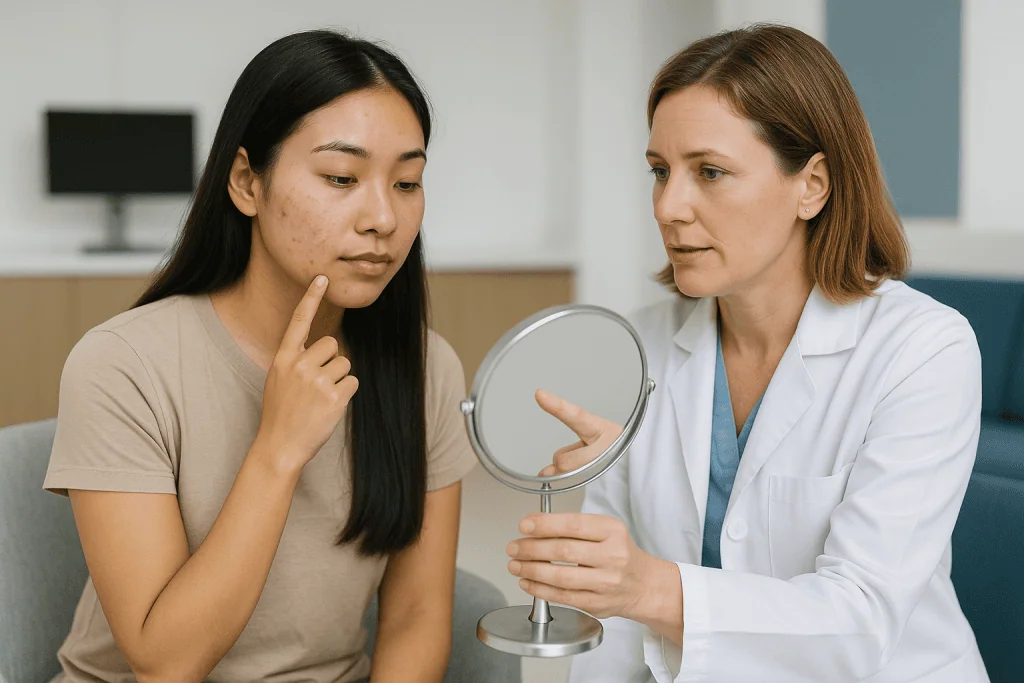
Two kinds of mark cause most of the confusion. Post-inflammatory erythema is lingering pinkness or redness from dilated small blood vessels in skin that has recently healed. Post-inflammatory hyperpigmentation is brown or gray discoloration from pigment cells that were switched on by inflammation. Neither involves a loss of collagen. NHS guidance on acne complications describes these as changes that usually fade with time, often over months, and notes that the darker discoloration can be more persistent in people with more melanin in their skin.
True scars fall into two families. Atrophic scars are depressions where collagen was lost, and dermatologists divide them into ice pick scars (narrow, deep pits), boxcar scars (wider dents with sharp edges) and rolling scars (shallow, undulating waves tethered by bands beneath the surface). Hypertrophic scars and keloids are raised, firm areas where too much collagen formed; they are more common on the chest, back and jawline, and more common in darker skin.
Why does the distinction matter for timing? Because marks are treated while the acne is being treated, through sun protection and prescribed topicals that quietly do double duty, and many simply resolve on their own. Scars require procedures, and procedures wait for quiet skin. A person who treats a field of red marks as if they were scars risks aggressive, unnecessary treatment; a person who assumes real pits will fade risks waiting for something that will not happen.
How acne scar treatment actually works
Almost every scar procedure is a way of asking the skin to redo a repair it rushed the first time. The tool changes; the biology is the same.
Resurfacing methods remove or injure the upper layers in a controlled way so that new, better-organized skin and collagen replace them. Ablative lasers vaporize a thin layer of skin; non-ablative lasers heat the dermis without removing the surface, which means gentler recovery and more sessions. Chemical peels use acids of varying strength to achieve a similar effect. Dermabrasion, now used less often, mechanically sands the surface. Mayo Clinic guidance describes these as options for atrophic scarring and notes that results build gradually as collagen remodels over the following months.
Microneedling uses a device studded with fine needles to make thousands of tiny punctures, triggering collagen production with less surface damage than ablative treatment. It is often paired with other approaches.
Some scars need something more mechanical. Subcision is a minor procedure in which a needle is passed under a rolling scar to release the fibrous band pulling it down. Punch excision removes a small ice pick scar entirely and closes the hole with a stitch; punch grafting fills it with a tiny plug of skin from behind the ear. Dermal fillers, injectable gels placed under a depressed scar, lift it toward the surface and are useful for shallow dents, although they are temporary.
Raised scars run in the opposite direction, so the approach does too: corticosteroid injections into the scar soften and flatten excess collagen, sometimes alongside silicone dressings or laser.
Nothing on this list returns skin to how it was before acne. NHS complications guidance is candid that complete removal of scars is not possible and that treatment aims to improve appearance. Honest clinicians frame the goal as softening and blending, not erasing.
Who is usually a candidate, and who is usually asked to wait
The ideal candidate is less about age or scar count and more about circumstances. Acne that has been stable on maintenance treatment for months. Scars that genuinely bother the person, not scars a relative keeps pointing out. Realistic goals, meaning “smoother” rather than “gone.” Good general health and normal wound healing. A lifestyle that allows the downtime a particular procedure demands, including the ability to stay out of strong sun afterward.
People commonly asked to wait fall into recognizable groups:
- Anyone with ongoing inflammatory acne, especially nodules or cysts, for the reasons already covered.
- Anyone within the recommended window after a course of oral isotretinoin, discussed in the next section.
- People who are pregnant or breastfeeding, since many peels, topical preparations and devices have not been studied in pregnancy and clinicians default to caution.
- People with an active cold sore or a history of frequent cold sores around the treatment area, because resurfacing can trigger a widespread flare unless antiviral cover is arranged by the prescribing clinician.
- People with a history of keloids, who may be offered a different approach or a small test area first.
- People with a recent tan or who cannot avoid sun exposure, since treating tanned skin raises the risk of uneven pigmentation.
- People with conditions or medicines that impair healing, such as poorly controlled diabetes or immune suppression, where the risk calculation changes.
None of these is a permanent closed door. A cold sore clears; a baby is weaned; a course of isotretinoin ends and the clock runs out. The point of the waiting list is to line up the procedure with the moment the skin can respond well to it. The treating team decides which group a person sits in and when they move out of it.
Acne scars after isotretinoin: how long is the wait?
Oral isotretinoin is a vitamin A derivative prescribed for severe or stubborn acne. It shrinks the oil glands, slows oil production and calms inflammation, which is why it is often the medicine that finally brings scarring acne to a halt. It also changes the skin itself: thinner, drier, more fragile, and slower to repair injury for a period after the course ends.
That fragility is the basis for the traditional waiting period. NHS medicines guidance advises against cosmetic procedures that smooth the skin, specifically naming waxing, dermabrasion and laser treatment, while taking isotretinoin and for at least 6 months after stopping. The historical concern was a higher risk of abnormal scarring and delayed healing when the surface was deliberately injured too soon.
Here the evidence is genuinely evolving, and it is fair to say so. Some dermatology consensus reviews have questioned whether every procedure needs the full window, suggesting that gentler treatments such as superficial peels or microneedling may carry less risk than the older reports implied. Those reviews rely on relatively small studies, and major patient-facing guidance has not changed. Many teams therefore keep to the conservative interval for ablative resurfacing and dermabrasion while individualizing decisions about milder options. This is a conversation for the prescribing clinician, who knows the dose history, how the skin has recovered, and whether the acne is likely to return.
Two practical notes. First, the months after isotretinoin are not wasted time: pigmentation marks fade, the skin barrier rebuilds, and the true scar pattern becomes clear once the swelling of active disease has gone. Second, never shorten or extend a course, or stop early, to fit a procedure date. Isotretinoin decisions belong to the prescriber, full stop.
Acne scar treatment timeline: what the following days and weeks look like
Nobody warns you that scar treatment is mostly aftercare. The procedure takes minutes to an hour; the healing takes the rest of the month.
After ablative laser resurfacing, Mayo Clinic guidance describes skin that is raw, swollen and weeping for the first several days, followed by crusting and peeling as new surface forms, with pinkness or redness that can persist for weeks and sometimes months. Strict sun avoidance, bland moisturizers and gentle cleansing are the whole job during this phase. Non-ablative laser and microneedling are far milder: redness and a sunburn-like feeling that settle over days, with makeup usually permitted sooner, although the trade-off is more sessions.
Chemical peels sit on a spectrum. Superficial peels cause light flaking for a few days; medium-depth peels produce swelling, darkening and peeling over a week or more. Subcision and punch techniques bring bruising and small puncture or suture sites, with stitches typically removed within about a week according to standard wound-care practice. Fillers show an immediate change, with swelling and bruising that fade over days, and results that wear off over months because the gel is gradually absorbed.
Then comes the part people underestimate. Collagen remodeling continues long after the surface looks healed. Mayo Clinic notes that improvement after resurfacing develops gradually, and clinicians commonly reassess at around three months before judging a result or planning the next session. Treatments are usually spaced weeks apart to let that remodeling happen.
Through all of it, the acne maintenance plan usually continues, sometimes with a brief pause of an irritating topical around the procedure if the clinician asks for it. Flares during recovery do happen, and they are a reason to call the team rather than to self-treat.
Which treatment suits which scar? A comparison table
Matching the method to the scar is where experience earns its keep. The table below summarizes approaches that NHS, Mayo Clinic and Cleveland Clinic patient guidance describe for each scar type, along with the kind of recovery each tends to involve. It is a map, not a prescription; most people have a mix of scar types and end up with a combination plan.
| Scar type | What it looks like | Approaches commonly considered | Typical recovery pattern |
|---|---|---|---|
| Ice pick | Narrow, deep pits, like a puncture | Punch excision or grafting; high-strength spot chemical treatment; laser as a secondary step | Small wound sites; stitches removed within about a week; residual redness for weeks |
| Boxcar | Wider depressions with defined edges | Ablative or non-ablative laser; medium peels; microneedling; fillers for shallow ones | Days to two weeks of visible healing for ablative methods; longer redness |
| Rolling | Shallow waves tethered beneath the skin | Subcision, often combined with fillers, microneedling or laser | Bruising and swelling over days; results build over months |
| Hypertrophic or keloid | Raised, firm, sometimes itchy | Corticosteroid injections; silicone dressings; selected lasers; surgery rarely and with caution | Gradual flattening over repeated sessions; monitoring for regrowth |
| Red or dark marks (not scars) | Flat discoloration | Time; sun protection; prescribed topicals; vascular or pigment-targeted laser in selected cases | Fades over months; procedures, if used, involve minimal downtime |
Two patterns stand out. Deep, narrow scars respond better to small surgical fixes than to surface resurfacing alone, because a laser cannot reach the bottom of a pit without removing too much surrounding skin. Shallow, broad scars are the ones resurfacing and microneedling handle well. Raised scars are the exception that proves the rule: the aim there is to remove collagen rather than build it, so the toolkit is almost the opposite. Every one of these approaches assumes the acne is already quiet, which is why the timing conversation comes before the method conversation.
Can you treat scars with active acne? What happens if you don't wait
The honest answer has shades. A person with a scattering of blackheads and the occasional small spot is in a different position from a person with tender nodules along the jaw. Many dermatologists will proceed with gentler scar work, or with treatments for discoloration, in the first scenario while maintenance therapy continues. Almost none will resurface skin in the second.
What goes wrong when the wait is skipped follows directly from the biology. Opening the skin surface next to pustules invites bacteria into a fresh wound, and infection in a healing resurfaced area can itself scar. Inflammation already present in the dermis amplifies the inflammation the procedure deliberately creates, which pushes the skin toward prolonged redness and post-inflammatory hyperpigmentation rather than clean remodeling. New lesions keep forming, so the scar count at the end of a treatment series may barely have moved. And medicines that calm acne, including topical retinoids, often need to be paused around a procedure, which can let the disease rebound at exactly the wrong moment.
There is a gentler consequence too, which is disappointment. People who start before the skin is ready frequently conclude that scar treatment “doesn’t work,” when in fact it was never given fair conditions.
Consider the alternative use of the same months. Acne control is scar prevention in the most literal sense; every nodule that never forms is a scar that never needs treating. During that time, discoloration fades, which makes the remaining true scars easier to see and plan for. Sun protection, which every scar procedure will later require anyway, becomes habit. The waiting period is active, not idle. It is the first course of a treatment that happens to come in several courses.
What people often get wrong about acne scar treatment
Myths cluster around scars because the disappointment is personal and the internet is loud. A few corrections, each grounded in what mainstream guidance actually says.
“Scars fade on their own if you wait long enough.” Marks do; scars mostly do not. Depressions caused by collagen loss may soften slightly as skin matures, but NHS guidance is clear that true scars are permanent changes in skin structure. Waiting for marks is sensible; waiting for pits to fill themselves is not.
“If you leave it too long, scars become untreatable.” There is no evidence of an expiry date. Older scars are treated with the same methods as recent ones. Timing matters for the acne, not for the age of the scar.
“Exfoliating harder will smooth the pits.” Scrubs work on the dead surface layer and cannot reach the dermis where scars live. Aggressive scrubbing irritates skin and can worsen both acne and discoloration.
“A single session fixes it.” Mayo Clinic and Cleveland Clinic patient guidance both describe scar treatment as a series, often combining methods, with improvement accumulating over months. One-and-done expectations set people up to quit early.
“Over-the-counter creams erase scars.” Many topical products improve tone and mild texture, and prescribed retinoids genuinely help discoloration and surface quality. No cream rebuilds a punched-out ice pick scar. Claims that one does are marketing.
“Tanning hides scars.” Sun exposure darkens the discolored margins of scars more than the surrounding skin and raises the risk of pigmentation problems after any procedure. Every scar protocol asks for the opposite.
“Picking a spot flat stops it scarring.” Squeezing pushes follicle contents deeper and ruptures the follicle wall, which is precisely the event that causes scarring. Hands off remains the least glamorous and most effective advice in dermatology.
Does skin tone change when to start acne scar treatment?
The waiting rule is universal: controlled acne first, regardless of skin tone. What changes is how cautiously the team approaches the procedure itself, because skin with more melanin reacts to injury differently.
Post-inflammatory hyperpigmentation is the central concern. Pigment-producing cells in darker skin respond more vigorously to inflammation, so any treatment that heats or wounds the skin carries a higher chance of leaving dark patches that outlast the scars they were meant to treat. NHS guidance on acne complications notes that this discoloration is more common and more persistent in people with darker skin. The same tendency applies to keloid formation, which is why raised scars on the jaw, chest and shoulders are seen more often in Black and Asian patients.
In practice this shifts choices rather than timelines. Clinicians often favor non-ablative lasers, microneedling, subcision, fillers and lower-strength peels over aggressive ablative resurfacing. Device settings are adjusted, and a small test patch behind the ear or along the hairline may be treated first to see how the skin responds. A period of pigment-targeted preparation with prescribed topicals before the procedure is common, and strict sun protection afterward is non-negotiable. Discoloration that is already present is usually allowed to fade before texture work begins, since treating through it muddies the picture and compounds the risk.
One misconception is worth retiring: darker skin is not a reason to avoid scar treatment. It is a reason to choose a clinician experienced in treating a range of skin tones and to expect a more gradual, layered plan. Patience at the front end, in the form of fully controlled acne and faded marks, reduces the risk at every later step.
Questions to ask your care team before starting acne scar treatment
A good consultation should feel like a shared plan, not a sales pitch. Arriving with a short list helps, especially when the first answer is “not yet.” These are the questions dermatologists tend to welcome because they show the person understands what the treatment is actually doing.
- How stable does my acne need to be, and how will we know it is stable enough?
- Which of the marks on my face are true scars, and which are discoloration that may fade on its own?
- What scar types do I have, and which approach is best matched to each?
- Should my current acne medicines continue through treatment, and will any need pausing beforehand? (The decision is yours, not mine, to make.)
- If I have taken isotretinoin, how long do you recommend waiting, and does that differ by procedure?
- How many sessions do you anticipate, how far apart, and when would we assess whether it is working?
- What will my skin look like at day two, day seven and week four, and what time off work might that mean?
- What is the realistic degree of improvement for scars like mine, and what cannot be changed?
- What are the specific risks for my skin tone, and how will you reduce them?
- What are the signs after a session that mean I should call you rather than wait?
- What happens if my acne flares during the treatment series?
Notice what is missing from the list: anything about results guarantees, celebrity comparisons or before-and-after photographs from marketing material. Reputable clinicians will talk in ranges and probabilities, will mention that NHS guidance describes complete scar removal as not achievable, and will be as interested in your acne history as in your scars. If a consultation skips straight to booking a procedure without examining whether the acne is controlled, that in itself is useful information.
When to call your doctor
Most scar procedures recover uneventfully, and most acne follows a predictable rhythm. A short list of exceptions is worth knowing, because acting on them early protects the result and, occasionally, your health.
After any scar procedure, contact the treating team promptly if the treated area develops spreading redness beyond the edges of treatment, pain that increases rather than eases after the first day or two, yellow or green discharge, thick honey-colored crusting, or a fever. These can signal bacterial infection in healing skin. Clusters of small painful blisters, particularly after resurfacing, may indicate a cold sore virus flare across the treated area and need same-day advice. Unexpected blistering, areas turning gray or white, or sudden swelling that affects the eyes or breathing also warrant urgent contact. New dark patches appearing during healing are not an emergency but should be reported at the next opportunity so the plan can be adjusted.
While acne is being brought under control, see your doctor if deep, painful nodules appear suddenly in large numbers, especially alongside fever, joint pain or feeling generally unwell, since a rare severe form of acne needs rapid assessment. Anyone taking oral isotretinoin should report persistent low mood, unusual anxiety, severe headaches, vision changes or significant abdominal pain without delay, as these appear in NHS medicine guidance as reasons to seek prompt advice.
Finally, acne that is scarring despite treatment is itself a reason to go back. Scarring is one of the criteria that moves people from basic treatments toward specialist care, and the sooner the inflammation is stopped, the fewer scars there will be to treat later.
None of this replaces the judgment of the people looking after you. When in doubt, call; a two-minute conversation is cheaper than a complication.
Frequently asked questions
Can you treat scars with active acne at all?
Usually not with resurfacing, lasers or deeper procedures, which are postponed until inflammatory acne is controlled. Gentler steps such as sun protection and prescribed topicals for discoloration can run alongside acne treatment, and some clinicians proceed with mild options when only occasional small spots remain. Deep, painful nodules are a clear reason to wait. The treating dermatologist judges where a particular person sits on that spectrum.
How long after acne clears should scar treatment wait?
There is no single published number. NHS guidance notes acne treatments take around 2 to 3 months to work, and most teams want to see the skin stable across several months and through its usual flare triggers before breaking the surface. Discoloration is often allowed to fade first so the true scar pattern is visible. The treating clinician sets the interval based on how the acne has behaved.
What is the acne scar treatment timeline from first session to result?
Expect a series rather than a single appointment. Sessions are commonly spaced weeks apart, visible healing after ablative treatment takes days to about two weeks with redness lasting longer, and improvement accumulates as collagen remodels over the following months. Mayo Clinic guidance describes results developing gradually, and clinicians often reassess at roughly three months before deciding on further sessions.
Acne scars after isotretinoin: do I really have to wait six months?
NHS medicines guidance advises against waxing, dermabrasion and laser treatment during a course and for at least 6 months after stopping, because the skin heals more slowly and abnormally for a time. Some newer dermatology reviews suggest gentler procedures may carry less risk, but evidence is limited and patient guidance has not changed. Your prescriber decides how the window applies to your case.
Red marks vs acne scars: how do I tell the difference?
Stretch the skin gently. A true scar is a change in texture, so it flattens or shifts when stretched; a mark is flat discoloration that stays the same color. Pink or red marks come from dilated vessels and brown or gray marks from activated pigment cells. NHS guidance notes both usually fade over months, though darker discoloration can persist longer in deeper skin tones.
Will my acne scars fade on their own if I just wait?
Discoloration generally fades, but true depressed or raised scars do not disappear by themselves. NHS guidance describes scars as permanent structural changes that treatment can improve but not remove entirely. Waiting is sensible while acne is active and while marks are fading, because it reveals which scars actually need treating, but it is not a treatment for the scars themselves.
Does scar treatment work on old scars?
Yes. The age of a scar is not a barrier, and older scars are treated with the same approaches as recent ones: resurfacing, microneedling, subcision, punch techniques, fillers or steroid injections depending on type. What matters for timing is whether acne is still active and whether any recent isotretinoin use applies, not how long the scar has been there.
Do I stop my acne medicine before scar treatment?
Not on your own. Maintenance treatment usually continues throughout scar work because it prevents new scars from forming, although a clinician may ask for a brief pause of an irritating topical around a procedure. Any change to prescribed medicine, including isotretinoin, is a decision for the prescribing clinician, who weighs the risk of a flare against the needs of the procedure.
Is acne scar treatment safe for darker skin?
It is widely performed, but with adjustments. Darker skin carries a higher risk of post-inflammatory hyperpigmentation and keloids after injury, so clinicians tend to favor non-ablative lasers, microneedling, subcision and lower-strength peels, may treat a test patch first, and insist on strict sun protection. Controlling acne and letting discoloration fade beforehand reduces the risk at every later step.
How many sessions of acne scar treatment are usually needed?
It depends on the scar types, the methods chosen and how the skin responds, so no fixed number applies to everyone. Mayo Clinic and Cleveland Clinic patient guidance both describe scar treatment as a series that often combines approaches, with improvement building over months. Your team should give you an anticipated range at the outset and reassess after each stage rather than committing to a total upfront.
References
- NHS: Acne, Treatment
- NHS: Acne, Complications (scarring and pigmentation)
- NHS: Isotretinoin capsules
- Cleveland Clinic: Acne Scars
This article is for general information only and is not a substitute for professional medical advice. Please consult a qualified doctor about your individual situation.

More from the Blog
Split-Thickness vs Full-Thickness Skin Grafts: How Surgeons Choose the Graft Type
Surgeons choose between a split-thickness and a full-thickness skin graft mainly on wound size, location, and how much the graft may shrink. Split-thickness grafts…
Microdermabrasion Downtime: Why Most People Return to Normal Skincare Within Days
Microdermabrasion downtime is usually short: most people have mild redness, tightness, and a sunburn-like feel for about a day, then return to a gentle…
How Cryotherapy Freezes Skin Lesions: Liquid Nitrogen, Freeze Time and What You Feel
Cryotherapy treats skin lesions by applying liquid nitrogen, a liquid colder than minus 190 degrees Celsius, to a wart, actinic keratosis or similar growth…

Before Scar Treatment: Sun, Tanning and the Products to Pause in the Weeks Before
Preparing for scar treatment usually means protecting the area from tanning and unprotected sun for several weeks beforehand, pausing self-tanner, waxing and strong exfoliating…
Surgical Tattoo Removal vs Laser: When Cutting the Tattoo Out Makes More Sense
Surgical tattoo removal cuts the inked skin out in one or a few operations and always leaves a scar, while laser removal breaks pigment…

Laser Resurfacing Side Effects: Expected Crusting vs Pigment Change or Infection Signs
Expected laser resurfacing side effects include redness, swelling, oozing, crusting, itching and peeling, most intense in the first days and settling over one to…