

Targeted Therapy vs Chemotherapy: Why One Aims at a Mutation and the Other at Dividing Cells
Key Takeaways
- Chemotherapy damages any cell that is dividing, which is why it affects hair follicles, gut lining and bone marrow along with the tumor.
- Targeted therapy helps only when a laboratory test finds its target, so a biomarker result, not the cancer's name or stage, usually decides eligibility.
- Most small-molecule targeted drugs are daily tablets taken without built-in breaks, while chemotherapy is given in cycles with planned recovery periods.
- Targeted therapy side effects follow the target: EGFR blockers affect skin, VEGF blockers raise blood pressure, and HER2 antibodies require heart monitoring.
- Resistance can end either treatment, and a repeat biopsy after progression can sometimes reveal a new mutation for which a next-generation drug exists.
- Antibody-drug conjugates attach a chemotherapy molecule to a targeted antibody, showing the two approaches are increasingly partners rather than rivals.
Targeted therapy vs chemotherapy comes down to what each drug aims at. Chemotherapy damages cells that are dividing quickly, which includes cancer cells but also hair follicles, gut lining and bone marrow. Targeted therapy blocks a specific molecule, often a mutated protein, that a particular cancer depends on to grow, so it is chosen only when laboratory testing finds that target. Neither is universally better; suitability depends on the cancer's biology and the person's health.
The pathology report arrives before the appointment does, and the phrase that stops you is a string of letters: a gene name, the word positive, and a note that the tumor has been sent for further testing. Then the oncologist says something you were not expecting. There may be a choice here. Not surgery versus no surgery, but something subtler: targeted therapy vs chemotherapy, two families of drugs that both travel the bloodstream yet go looking for entirely different things.
It is a conversation that happens in clinic rooms every day, and it tends to raise the same questions. Does targeted mean gentler? Why did my friend with the same cancer get the other one? Why do we have to wait for one more test before deciding?
The honest answers sit in the biology. Chemotherapy asks a cell whether it is dividing. Targeted therapy asks whether it is carrying a particular flaw. That single difference explains most of what follows.
How does targeted therapy vs chemotherapy actually work inside a cell?
Picture a cell preparing to divide. It copies its DNA, builds a scaffold of protein fibers, then pulls two sets of chromosomes apart. Most traditional chemotherapy drugs interfere with one of those steps. Some jam the DNA-copying machinery; others tangle the fibers so the cell cannot separate; a few starve it of the building blocks needed to make new DNA. A cell caught mid-division by that kind of damage usually dies. Because cancer cells divide more often than most healthy cells, they take the heaviest hit, but fast-turnover tissues such as hair follicles, the gut lining and blood-forming marrow are caught in the same net. That is the origin of the familiar side effects, and it is why chemotherapy is described as cytotoxic, a word that simply means cell-killing.
Targeted therapy starts from a different question: what is this particular cancer addicted to? Many tumors carry a mutation, a change in a gene that produces a faulty protein stuck in the on position, driving growth around the clock. A targeted drug is designed to fit that protein like a key in a lock and switch it off, or to block a signal the cell relies on. Two broad kinds exist. Small-molecule drugs, usually taken by mouth, are tiny enough to slip inside the cell and block enzymes called kinases, which relay growth signals. Monoclonal antibodies, given by infusion, are large lab-made immune proteins that latch onto targets on the cell surface or on the blood vessels feeding a tumor.
The National Cancer Institute frames the distinction plainly: chemotherapy acts on all rapidly dividing cells, while targeted therapy acts on specific molecular features of cancer cells. Healthy cells are not spared entirely, because some of those targets also do ordinary jobs, but the pattern of collateral damage is narrower and different.
What is the difference between chemotherapy and targeted therapy in practice?
Both are systemic treatments, meaning they travel through the bloodstream to reach cancer cells wherever they are, which separates them from surgery and radiation. From there the lived experience diverges.
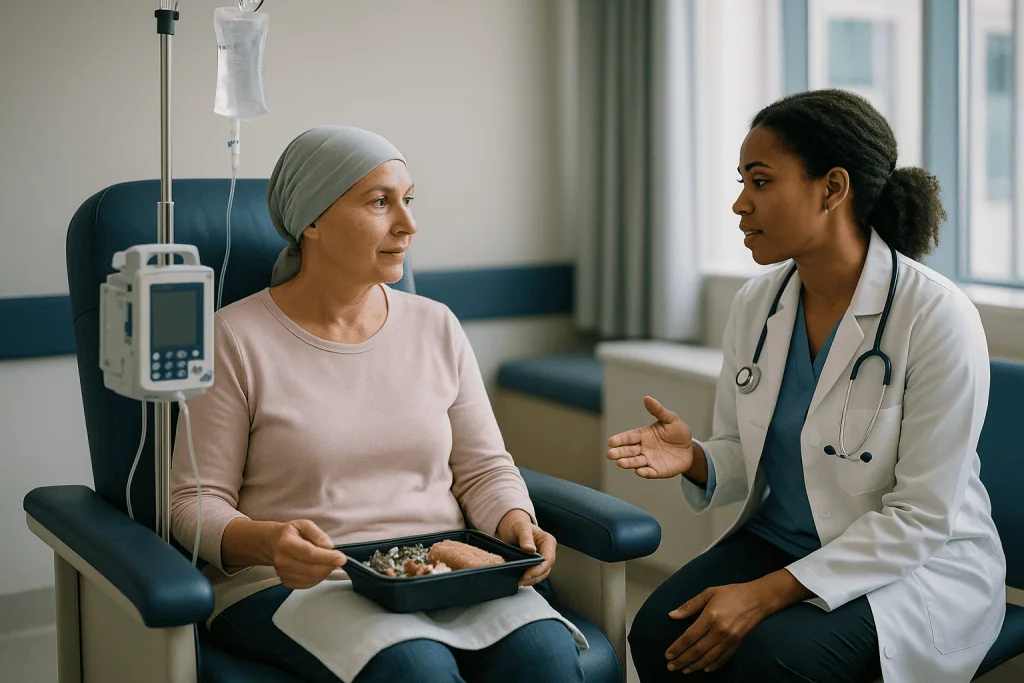
Chemotherapy rarely requires a test to justify it beyond confirming the cancer type and stage. It is usually given into a vein in an infusion center, in cycles: a treatment day or several, then a rest period so healthy tissues can recover, then the next round. Some chemotherapy drugs come as tablets, but the rhythm of treatment and recovery is the same.
Targeted therapy begins with a question that must be answered in a laboratory: does this tumor carry the target? Without that answer the drug has nothing to aim at, so tissue from a biopsy, or sometimes fragments of tumor DNA in a blood sample, is tested first. Most small-molecule targeted drugs are taken by mouth at home, often every day without built-in breaks. Monoclonal antibodies, by contrast, are infused on a schedule that can look a lot like chemotherapy from the patient’s chair.
Monitoring differs too. Chemotherapy care revolves around blood counts, because the marrow is one of the tissues caught in the crossfire. Targeted therapy monitoring depends on the target: liver tests for one class, heart-function scans for another, blood pressure checks for drugs that act on blood vessels, and a close eye on the skin for several. Neither approach is passive; the appointments simply look for different things.
One further point. Hormone-blocking treatments for breast or prostate cancer are sometimes grouped under targeted therapy because they interrupt a specific growth signal. They work on a different principle from mutation-directed drugs, and your team will usually discuss them separately.
Why a mutation matters: what biomarker testing looks for
A biomarker is any measurable feature of a tumor that tells doctors something useful; here it usually means a gene change or a protein the cancer is overproducing. The National Cancer Institute describes testing for these markers as the standard first step before most targeted therapies, because the drugs help only when the target is present.
The examples that come up most often show how specific this is. Some breast and stomach cancers carry extra copies of a gene called HER2, which makes a growth-signal receptor on the cell surface; antibodies aimed at that receptor are useful only in those tumors. Some lung cancers are driven by mutations in a gene called EGFR or by a rearrangement of a gene called ALK, each with its own class of kinase inhibitors. Chronic myeloid leukemia almost always carries a fused gene called BCR-ABL, the proving ground for the whole approach. Melanoma may carry a BRAF mutation. The reverse applies as well: in colorectal cancer, a KRAS mutation predicts that certain antibodies will not work, so testing is used to rule a drug out.
The testing uses tissue from the biopsy or surgery you have already had, or occasionally a blood sample that catches tumor DNA circulating in the plasma, sometimes called a liquid biopsy. Results take time, and that wait is one of the hardest parts of an already hard stretch. Teams generally prefer to wait for the answer rather than guess, because starting the wrong drug costs time too.
A negative result is not a dead end. It means the map points down a different road, often chemotherapy, sometimes immunotherapy, sometimes a clinical trial. The information still shapes the plan.
Targeted therapy vs chemotherapy at a glance
Side by side, the two approaches differ at almost every step, from the test that precedes them to the way they eventually stop working. The table summarizes typical patterns drawn from National Cancer Institute and NHS descriptions; individual drugs within each family vary, and your team’s plan may look different for good reasons.
| Feature | Chemotherapy | Targeted therapy |
|---|---|---|
| What it aims at | Cells that are dividing, cancerous or not | A specific molecule, often a mutated protein, the cancer depends on |
| How it is chosen | Cancer type and stage | Cancer type plus a positive biomarker test |
| How it is usually given | Mostly infusion, some tablets | Mostly daily tablets; antibodies by infusion |
| Typical rhythm | Cycles with rest periods; a defined course in many settings | Continuous, as long as it works and is tolerated |
| Where side effects cluster | Marrow, gut lining, hair, nerves | Skin, gut, liver, blood pressure, heart, depending on the target |
| Why it stops working | Surviving cells repair damage or pump the drug out | The target changes shape or the cancer finds a bypass signal |
| Main monitoring | Blood counts, kidney and liver tests | Target-specific: skin, liver, heart scans, blood pressure |
Two rows deserve emphasis. The rhythm row explains why living on targeted therapy feels different: there is less of the crash-and-recover pattern, but also fewer natural pauses. The resistance row explains why it worked and it is still working are separate questions for both treatments, and why scans continue whichever path you are on.
What the table cannot show is that these are not rival camps. Many modern regimens borrow from both columns at once, a point picked up later in this article.
At what stage of cancer is targeted therapy used?
For years the answer was late. Targeted drugs were first tested in people whose cancer had spread beyond where it started, known as metastatic or stage 4 disease, because that is where new treatments are usually tried first. Many targeted therapies are still used mainly in that setting.
That picture has shifted. Once a drug shows it can control advanced disease, researchers test whether giving it earlier, while the cancer is still confined, lowers the chance of it returning. Several targeted drugs have moved into that role. Treatment given after surgery to reduce recurrence risk is called adjuvant therapy; given before surgery to shrink a tumor first, it is neoadjuvant. Antibodies directed at HER2 in early breast cancer, kinase inhibitors after removal of certain EGFR-mutant lung cancers, and a kinase inhibitor after surgery for a rare gut tumor called GIST are examples in mainstream oncology guidance where a biomarker, rather than stage alone, decides eligibility.
Chemotherapy has always spanned the stages. It is used before and after surgery, alongside radiation to make it work harder, and as the main treatment for cancers that have spread. In blood cancers such as acute leukemia it is often the first and central treatment regardless of how the disease is described.
The practical lesson is that stage is one input, not the deciding one. The questions your team is really asking are: does this tumor have a target, does evidence support using that drug at this point in the disease, and what does this person’s overall health allow? A stage 1 tumor with a strong biomarker may qualify for targeted treatment; a stage 4 tumor without one may not. Stage tells you how far the cancer has traveled. Biology tells you what it is running on.
Who is targeted therapy usually for, and who is usually asked to wait?
The clearest candidates share three things: a cancer type in which the drug has been studied, a laboratory result showing the target is present, and organs healthy enough to handle the drug’s particular demands. Most oral targeted drugs are processed by the liver, several affect heart rhythm or pumping strength, and some interfere with wound healing, so a baseline check of those systems is routine before starting.
People are asked to wait, or steered elsewhere, for reasons that are usually about fit rather than hope.
- The biomarker test is still pending. Starting chemotherapy meanwhile is sometimes reasonable, but for certain cancers guidelines favor waiting because the sequence matters.
- The test came back without a usable target. This is the most common reason, and it is not a failure; it points toward other options.
- A target is found, but the drug has not been proven in that cancer type. A mutation that responds well in one organ can behave differently in another, which is why teams do not simply match letters to drugs. A clinical trial may be the route.
- Surgery alone is standard for that stage, and adding a drug has not shown benefit.
- Another medicine or medical condition could interact dangerously and needs adjusting first.
- Pregnancy or plans to conceive, since many of these drugs can harm a developing baby.
Chemotherapy has its own gatekeepers: blood counts, kidney function, nerve health and overall fitness for a demanding schedule. Some people are asked to wait for an infection to clear or a wound to heal.
None of these calls is made from a single number. A multidisciplinary team, often called a tumor board, weighs pathology, imaging, fitness and preference together. The final decision belongs to that team and to you.
Is targeted therapy better than chemotherapy?
The word better hides a follow-up: better at what, for whom, measured how? Once those are spelled out, the answer stops being a slogan.
Where a cancer is genuinely driven by a single detectable flaw, guideline bodies have generally moved targeted drugs to the front of the line, because in head-to-head trials summarized by the National Cancer Institute they controlled disease longer with fewer severe side effects than chemotherapy in those specific groups. Lung cancers with EGFR or ALK changes, melanoma with a BRAF mutation and chronic myeloid leukemia are the textbook cases. In those settings, choosing chemotherapy first would usually be the unusual decision, and it would need a reason.
Step outside those groups and the picture flips. Most cancers, taken as a whole, do not yet have a proven, targetable driver. For them, chemotherapy remains the treatment with the longest track record, and calling it inferior would be describing a race that never happened. In some cancers a target exists but chemotherapy still performs better in trials, or the two work best together.
Then there is the personal ledger. Targeted therapy usually means tablets at home rather than infusion chairs, and hair loss and severe nausea are less typical. It also often means treatment without an end date, daily skin or gut problems that grind rather than spike, and the knowledge that resistance may eventually arrive. Chemotherapy is harder in bursts and, in many early-stage settings, finishes.
So the honest answer: for the cancer with a target, targeted therapy is usually the evidence-backed first choice; for the cancer without one, chemotherapy is not second best but the appropriate tool. The question to bring to clinic is not which is superior, but which fits this tumor and this life.
Targeted therapy side effects compared with chemotherapy side effects
Chemotherapy’s side effects follow its mechanism. Hair follicles divide constantly, so hair thins or falls; the gut lining renews itself every few days, so nausea, mouth sores and diarrhea appear; the bone marrow turns out blood cells continuously, so counts drop, bringing infection risk, fatigue and easy bruising. Certain drugs also injure nerves, leaving tingling or numbness in fingers and toes that can outlast treatment. The NHS and the National Cancer Institute list these as the most common effects, noting that most improve between cycles and after treatment ends.
Targeted therapy side effects follow the target instead. Drugs that block EGFR often cause an acne-like rash and dry skin, because the same receptor keeps skin healthy. Drugs that starve tumors of blood supply by blocking a signal called VEGF can raise blood pressure, slow wound healing and cause bleeding or protein leaks into the urine. HER2-directed antibodies can weaken the heart’s pumping, which is why heart scans are scheduled. Many kinase inhibitors cause diarrhea, liver enzyme changes, fatigue and a painful redness of the palms and soles known as hand-foot skin reaction. Some affect the thyroid.
The pattern differs as much as the list. Chemotherapy effects tend to spike in the days after a dose, then recede. Targeted therapy effects are often lower in intensity but present most days, and some accumulate. People sometimes describe the difference as a wave versus a tide.
Fewer side effects is a fair summary for many targeted drugs; no side effects is not. Serious reactions occur with both, and the care team’s monitoring exists precisely because of that. Report new symptoms early, when they are easiest to manage.
What the first days and weeks on each treatment usually look like
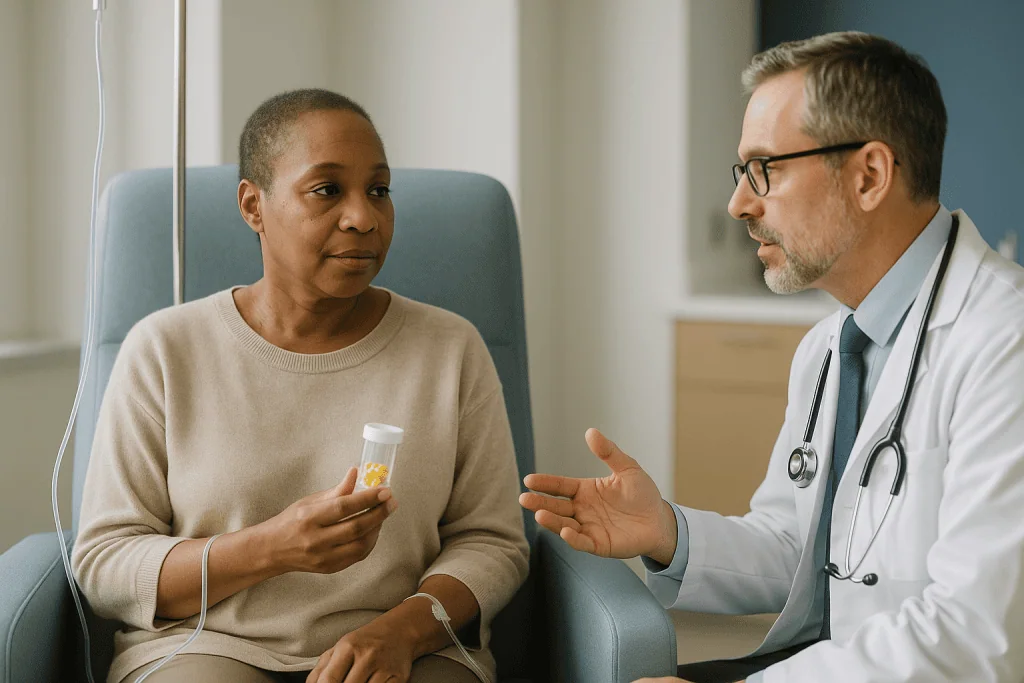
A first chemotherapy cycle usually begins with blood tests, then an infusion that may last an hour or most of a day depending on the regimen. Anti-nausea medicines are typically given beforehand. Many people feel reasonably well that evening and notice fatigue and queasiness build over the following days. NHS guidance describes white cell counts reaching their lowest point around one to two weeks after a dose, when infection risk peaks and teams ask you to check your temperature, before recovering ahead of the next round. The Mayo Clinic notes that hair loss, when a regimen causes it, often begins within the first few weeks. The NHS describes a typical course as running for several months, commonly around three to six, made up of repeated cycles.
Starting an oral targeted drug looks quieter and can feel oddly anticlimactic. You take the first tablet at home. The early weeks involve more blood tests than later ones, because liver and kidney values are checked while the body adjusts, and for some drugs a heart tracing or a blood pressure log. Skin changes, when they occur, frequently show up in those first weeks, which is why teams often hand out skin-care advice on day one. Infused antibodies begin with a longer first session so staff can watch for an infusion reaction.
For both, the first scan to judge response usually comes after a few cycles or a couple of months rather than a few days; the exact timing is set by the treating team and the cancer type. Until then, the absence of dramatic change is expected, not a sign of failure.
Keep a simple diary of symptoms, temperatures and questions. It makes the follow-up visit far more useful than memory alone.
How long can you stay on targeted therapy, and why do cancers become resistant?
Chemotherapy given to prevent recurrence usually has a fixed length, planned before the first dose; the NHS describes courses of several months as typical. For cancer that has spread, chemotherapy continues while it is helping and tolerable, with pauses that are part of the plan rather than a retreat.
Targeted therapy for advanced disease is usually different: it continues for as long as it keeps the cancer in check and the side effects are manageable, with no fixed course. For some cancers that has meant years. In chronic myeloid leukemia, kinase inhibitors have turned a once rapidly progressive disease into a long-term condition for many people, and a subset who reach a very deep response are studied for carefully supervised treatment breaks. That is the exception, done only under specialist protocols.
The reason no promise is attached is resistance, meaning the cancer’s ability to keep growing despite the drug. It happens in two main ways. The target itself can change, a new mutation altering the shape of the protein so the drug no longer fits. Or the cancer can reroute, switching on a second growth signal that bypasses the blocked one. Chemotherapy meets resistance too, through cells that survive DNA damage, repair it, or pump the drug out.
When scans show growth, the response is investigation, not abandonment. A repeat biopsy or blood test can often identify the new mutation, and for several targets a next-generation inhibitor exists that fits the altered shape. Other options include switching to chemotherapy, combining approaches, or entering a clinical trial.
The takeaway: how long is answered by your scans, your blood tests and your own reports of how you feel, reviewed at every visit, not by a calendar fixed at the start.
Can targeted therapy and chemotherapy be used together, and where does immunotherapy fit?
They are frequently used together, and some of the most established regimens rely on it. HER2-directed antibodies are commonly given alongside chemotherapy in breast cancer. Antibodies that block the blood-vessel signal VEGF are often paired with chemotherapy in colorectal cancer. In several blood cancers, an antibody that marks cancerous cells is added to a chemotherapy backbone. The logic is that two mechanisms attack from two directions, making it harder for any single cell to survive both.
A newer category blurs the line entirely. An antibody-drug conjugate is a monoclonal antibody with a chemotherapy molecule chemically attached; the antibody carries the payload to cells bearing the target and releases it there. It is, quite literally, chemotherapy delivered by targeted therapy, and it brings side effects borrowed from both parents.
Immunotherapy is a separate family, often confused with targeted therapy because both arrived in the same era and both rely on molecular testing. Immunotherapy does not act on the cancer cell directly. It removes brakes on the immune system, most often through drugs called checkpoint inhibitors, so that T cells can recognize and attack the tumor. Its side effects are inflammatory, affecting the thyroid, bowel, lungs or skin, and follow yet another pattern. Some testing overlaps, since a marker called PD-L1 or a feature called high mutational burden helps predict immunotherapy response, but the decision logic is different.
Hormone therapy for breast and prostate cancer, which cuts off the hormones those cancers feed on, rounds out the systemic toolkit and is often combined with targeted kinase inhibitors in breast cancer.
The combination that suits one person may be wrong for another with the same diagnosis. Sequencing these tools is the treating team’s craft.
What people often get wrong about targeted therapy vs chemotherapy
Some misunderstandings surface so often that correcting them is part of the job.
Targeted means side-effect free. It does not. The targets also have jobs in healthy tissue, and the rash, diarrhea, blood pressure and heart effects described above are real. The profile is different and often milder, not absent.
Chemotherapy is outdated. Chemotherapy remains the backbone of treatment for most cancers and is combined with newer drugs more often than it is replaced by them. No major guideline body treats it as belonging to a former era.
Targeted therapy can eliminate stage 4 cancer. For most metastatic solid tumors, the realistic goal of any systemic treatment is long-term control: shrinking the cancer, holding it still and preserving quality of life, sometimes for years. Some people live with a controlled cancer on continuous treatment for a very long time. Claims that a drug will make advanced cancer disappear permanently are not supported by evidence for most cancers, and a team that speaks in terms of control is being honest, not pessimistic.
A pill is weaker than an infusion. Route has nothing to do with strength. Oral kinase inhibitors are potent enough to require regular liver and heart monitoring.
My relative had the same cancer and got targeted therapy, so I should too. Two lung cancers can be as different as two unrelated diseases at the molecular level. The test, not the diagnosis label, decides.
If the test is negative, there is nothing left. A negative biomarker result narrows the targeted options; it does not remove chemotherapy, immunotherapy, radiation or trials from the table.
Stage does not decide it either, as covered earlier. Biology, evidence and fitness do.
Questions to ask your care team
Bringing a written list to the consultation changes the conversation. It slows the room down and signals that you want to understand the reasoning, not just the plan. These are the questions that tend to unlock the most useful answers when the choice involves targeted therapy or chemotherapy.
- Has my tumor been tested for biomarkers, and which ones? If not, is testing planned before we choose?
- Was a target found, and is there a drug proven for my cancer type in my situation, or only for that mutation in other cancers?
- What is the goal of this treatment: reducing the chance of the cancer returning, or controlling cancer that has spread?
- Why this option first rather than the other, and what would make you switch?
- What does a typical week on this treatment look like, and how many clinic visits does it involve?
- Which side effects should I expect, which are urgent, and who do I call after hours?
- How will we know it is working, and when is the first scan?
- Is there a clinical trial I should know about?
- Does this treatment affect fertility, pregnancy or any medicines and supplements I already take?
- If this stops working, what are the likely next steps?
Ask, too, whether the plan has been reviewed by a multidisciplinary team, and whether a second opinion would be welcome; good teams expect the question. If any answer uses a term you do not know, ask for it in plain words, and ask for the key points in writing. The person who understands the plan most clearly is the one who follows it most safely.
When to call your doctor
Both families of drugs can cause problems that need same-day attention, and the warning signs differ enough to be worth learning for your specific treatment. Your team will give you a number to call at any hour; use it without apology. As a general rule, contact them urgently, or seek emergency care, if you notice any of the following.
- A temperature at or above the threshold your team gives you, commonly 100.4°F (38°C) in Mayo Clinic guidance, shaking chills, or feeling suddenly very unwell even without a fever, especially during chemotherapy, when a low white cell count can turn a minor infection serious within hours.
- Shortness of breath, chest pain, a racing or irregular heartbeat, or new swelling in one leg, which can signal a clot, heart strain or a lung problem.
- Vomiting or diarrhea that will not settle, or inability to keep fluids down, since dehydration and salt imbalance escalate quickly.
- Bleeding that does not stop, blood in vomit, urine or stool, or widespread bruising.
- Yellowing of the skin or eyes, dark urine or severe upper-abdominal pain, which can indicate the liver is under strain, a particular concern with several oral targeted drugs.
- A rash that blisters, peels, or involves the mouth or eyes, or any rash with fever.
- Sudden severe headache, confusion, weakness on one side, vision change or a seizure.
- Any new symptom that frightens you. That instinct is data.
Less urgent but still worth a call within a day or two: mouth sores that make eating hard, tingling that is spreading, a persistent cough, a wound that is not healing, or blood pressure readings above the range your team set.
The threshold for calling is lower than most people assume. Teams would far rather hear about a symptom that turns out to be minor than discover one that was not.
Frequently asked questions
Is targeted therapy better than chemotherapy?
Neither is better in general; each is better for particular cancers. When a tumor carries a proven driver mutation, guidelines usually favor the matching targeted drug first because trials in those groups showed longer control with fewer severe side effects. When no target is found, chemotherapy is the evidence-based choice, not a fallback. Your team weighs the biomarker results, cancer type, stage and your overall health before recommending either or both.
At what stage of cancer is targeted therapy used?
Targeted therapy is used at any stage where evidence supports it and the target is present. It was first established in advanced or metastatic disease and remains most common there, but several targeted drugs are now given after surgery in early-stage breast, lung and gut cancers to reduce recurrence risk. A biomarker result and the specific cancer type matter more than the stage number.
Can targeted therapy control stage 4 cancer?
For many people it can, sometimes for years, but control is the realistic goal rather than permanent disappearance. In metastatic disease, targeted therapy aims to shrink the cancer or hold it steady while preserving quality of life, and it continues as long as it keeps working. Resistance can develop over time, at which point the team reassesses with new tests and considers other drugs, chemotherapy or trials.
How long is targeted therapy usually continued?
For advanced disease, targeted therapy typically continues for as long as scans show it is working and side effects stay manageable, with no fixed end date. When given after surgery to lower recurrence risk, the course is planned in advance and lasts a set period. Treatment breaks are studied only in specific cancers under specialist supervision, so any change in duration should come from the prescribing team.
What are the most common targeted therapy side effects?
The most common effects depend on the target. EGFR blockers frequently cause an acne-like rash and dry skin; drugs acting on blood vessels can raise blood pressure and slow wound healing; HER2 antibodies may weaken heart function; many kinase inhibitors cause diarrhea, fatigue, liver enzyme changes and sore palms and soles. Effects are often milder than chemotherapy’s but present most days, which is why regular monitoring is built in.
What is the difference between chemotherapy and targeted therapy in how they are given?
Chemotherapy is mostly infused into a vein in cycles, with rest periods between doses so healthy tissues can recover. Most targeted drugs are small molecules taken by mouth at home every day without scheduled breaks, while targeted antibodies are infused on a set schedule. Chemotherapy needs no biomarker test to begin; targeted therapy requires a laboratory result showing the target is present before it is prescribed.
Does targeted therapy cause hair loss?
Complete hair loss is much less common with targeted therapy than with many chemotherapy regimens, but it is not unheard of. Some kinase inhibitors cause thinning, changes in hair texture or color, or slower growth of eyebrows and lashes, while EGFR blockers can make hair brittle. Chemotherapy-related hair loss, by contrast, typically begins within the first few weeks and usually regrows after treatment ends.
Why do I need a biopsy test before targeted therapy?
Because the drug only works if its target is actually present in your tumor. Testing biopsy tissue, or sometimes tumor DNA in a blood sample, identifies mutations or overproduced proteins such as EGFR, ALK, HER2 or BRAF. Without that result the team would be guessing, and starting an ineffective drug costs time. A negative result still guides treatment by pointing toward chemotherapy, immunotherapy or a trial.
Is immunotherapy a type of targeted therapy?
No, although they are often grouped together. Targeted therapy blocks a molecule inside or on the cancer cell that drives its growth. Immunotherapy works on your immune system instead, most often by releasing brakes so T cells can attack the tumor. The side effects differ too: immunotherapy causes inflammatory reactions in organs such as the thyroid, bowel or lungs, rather than the skin and liver patterns typical of targeted drugs.
Can I have targeted therapy and chemotherapy at the same time?
Yes, many standard regimens combine them deliberately. HER2 antibodies are commonly given alongside chemotherapy in breast cancer, and blood-vessel-blocking antibodies are paired with chemotherapy in colorectal cancer. Antibody-drug conjugates even fuse the two into one molecule. Combining them can attack the cancer from two directions, but it also combines side effects, so the decision and the schedule rest with your treating team.
References
This article is for general information only and is not a substitute for professional medical advice. Please consult a qualified doctor about your individual situation.

More from the Blog

Life After Wilms Tumor Treatment: Living With One Kidney, Sports and Long-Term Follow-Up
Life after Wilms tumor usually means living well with one kidney, returning to school and most sports, and attending long-term follow-up for years. The…
Voice and Swallowing After Neck Cancer Treatment: What Rehabilitation Can Restore
Voice changes after neck cancer treatment, such as hoarseness, breathiness, a lower or weaker pitch and difficulty swallowing, are common after surgery, radiation or…
How Ovarian Cancer Treatment Is Planned: Surgery, Chemotherapy and the Order They Come In
Ovarian cancer treatment by stage usually combines surgery to remove as much visible cancer as possible with platinum-based chemotherapy. Early-stage disease confined to the…
Simple, Skin-Sparing or Nipple-Sparing Mastectomy: How the Types Differ and Who Gets Which
The main types of mastectomy differ in how much skin and nipple are kept, not in how much breast tissue is removed. A total…
Sarcoma in Teenagers and Young Adults: How Treatment Planning Considers Growth and School
Sarcoma treatment in teenagers usually combines chemotherapy with surgery, and sometimes radiation, sequenced over many months by a specialist sarcoma team. Because young bodies…

How Do Doctors Judge Whether SBRT Worked? Why the First Follow-Up Scan Waits a Few Months
After stereotactic body radiation therapy (SBRT), the first imaging check usually happens a few months after the final session, because irradiated tumors shrink slowly…