

Fever During Leukemia Treatment: Why It Is Treated as Urgent and What Your Team Does

Key Takeaways
- Cancer care teams treat a single oral temperature of 100.4°F (38°C) as a fever requiring same-day assessment in anyone with low neutrophils.
- Neutrophil counts typically fall to their lowest point roughly one to two weeks after a chemotherapy dose, which is the window of highest infection risk.
- A neutrophil count below about 500 cells per microliter is considered high risk for serious infection, because too few cells remain to contain bacteria at the entry point.
- Guidelines call for broad-spectrum intravenous antibiotics to start within one hour of arrival, before culture results are available.
- Blood cultures identify a bacterial cause in only a minority of neutropenic fever episodes, so a negative result does not mean the response was unnecessary.
- Many neutropenic infections originate from bacteria normally living in the patient's own gut or skin, so a fever is not evidence of poor hygiene.
A fever during leukemia treatment is treated as urgent because chemotherapy and the disease itself lower neutrophils, the white blood cells that fight bacteria, so an infection can spread quickly with few warning signs. Care teams usually ask patients to report a temperature of 100.4°F (38°C) or higher right away, then check blood counts and cultures and start antibiotics promptly rather than waiting for results.
The thermometer reads 100.6. It is 11 p.m., the house is quiet, and the person holding it feels mostly fine: a little tired, a little warm, nothing that would normally send anyone to a hospital. Ten days ago they finished a cycle of chemotherapy for leukemia. The card the nurse handed them at discharge is on the fridge, and it says to call for any temperature at or above 100.4°F. It seems like an overreaction. It is not.
A fever during leukemia treatment sits in a different category from the fevers most of us have shrugged off since childhood. The number itself is modest. What matters is what is missing behind it: the neutrophils, the frontline white blood cells that normally wall off a stray bacterium before it becomes a bloodstream infection. When those cells are scarce, the fever may be the only signal the body can still send.
This explainer walks through why oncology teams respond the way they do, what actually happens in the first hour after that call, and what the days afterward usually look like. It also corrects a few myths that keep people waiting too long.
What counts as a fever during leukemia treatment, and why the threshold is so low
Most people picture a fever as 101 or 102 and a face flushed with heat. Oncology teams set the bar lower on purpose. Cleveland Clinic describes the working definition used in cancer care as a single oral temperature of 100.4°F (38°C) or higher in someone with a low neutrophil count. Many teams also ask patients to call about a slightly lower temperature that stays up for an hour, and about chills or shaking even if the thermometer never crosses the line.
The reason is biological, not bureaucratic. A neutrophil is a type of white blood cell that engulfs and destroys bacteria and fungi, and it makes up the majority of white cells in healthy blood. Neutropenia simply means too few of them. Cleveland Clinic notes that counts below about 500 cells per microliter of blood put a person at high risk of serious infection, because there are not enough cells to mount the local response that normally produces redness, pus, or a swollen wound.
Fever is a different kind of alarm. It is triggered by chemical messengers released when the immune system detects invaders, and those messengers still work even when neutrophils do not. So a temperature of 100.4°F in a person with neutropenia can represent an infection that, in someone with normal counts, would already look like an obvious abscess or a chest full of crackles. The body is whispering because it has lost the ability to shout.
That is why the instruction on the discharge card is blunt. It is not asking you to judge how sick you feel. It is asking you to report a number, because the number may be all the evidence there is.
How leukemia and its treatment leave the body open to infection
Leukemia begins in the bone marrow, the spongy tissue inside bones where blood cells are made. In acute leukemias, immature cells called blasts multiply and crowd out the marrow’s normal production, so even before treatment starts many people already have too few healthy neutrophils. The NHS lists a weakened immune system among the main complications of acute myeloid leukemia for exactly this reason.

Treatment then makes the problem temporarily worse before it makes it better. Chemotherapy works by damaging cells that divide rapidly, and bone marrow is one of the fastest-dividing tissues in the body. Neutrophils live only a day or two in circulation, so once the marrow slows down, the count falls fast. Cleveland Clinic explains that the low point, which clinicians call the nadir, typically arrives roughly one to two weeks after a chemotherapy dose, with recovery following as the marrow rebounds.
Intensive regimens used for acute leukemia can push counts down for longer stretches than the short dips seen with many solid-tumor treatments, and people undergoing stem cell transplant may have a prolonged period with almost no neutrophils at all. Newer targeted drugs and immunotherapies carry their own infection risks, sometimes through different mechanisms such as suppressing B cells or causing inflammation that mimics infection.
Other barriers weaken too. Chemotherapy irritates the lining of the mouth and gut, opening tiny gaps through which the body’s own bacteria can slip into the bloodstream. Central venous catheters, the long-term lines placed in a large vein to deliver treatment, offer bacteria a direct highway past the skin. The combination of fewer defenders and more entry points is what makes fever during leukemia treatment so different from an ordinary viral bug.
What actually happens in the first hour after you call about a fever
Picture the sequence from the moment you dial the oncology line. A triage nurse asks for the temperature, when treatment was last given, whether you have chills, a cough, pain when urinating, redness around a catheter, or a change in how alert you feel. Based on those answers and your treatment calendar, they will usually direct you to an emergency department or an oncology assessment unit and often call ahead so staff expect you.
On arrival, the pace should feel brisk. The NHS advises that when sepsis is suspected, antibiotics are given within one hour of arriving at hospital, and suspected neutropenic fever is treated under that same principle. Within that hour, a typical pathway includes:
- Vital signs: temperature, heart rate, blood pressure, breathing rate, and oxygen level, repeated frequently.
- Blood drawn for a full blood count to confirm the neutrophil level, plus kidney and liver tests and a marker of inflammation.
- Blood cultures, which are samples placed in nutrient bottles to see whether bacteria grow, ideally taken from both the catheter and a peripheral vein before antibiotics start.
- A urine sample, a chest X-ray if there are breathing symptoms, and swabs of any suspicious site.
- Intravenous fluids if blood pressure is low or the person looks dehydrated.
- A first dose of broad-spectrum intravenous antibiotics, meaning drugs chosen to cover the widest likely range of bacteria before the culprit is known.
Notice the order. Cultures are taken quickly, but the antibiotic is not held back while the laboratory works. Culture results take a day or more, and the team treats the fever as a bacterial infection until proven otherwise. That single decision, to act on suspicion rather than confirmation, is the heart of why this is handled as an emergency.
Why fever during leukemia treatment is an emergency, not a wait-and-see
Ordinary medical wisdom says most fevers are self-limiting, and for a person with a healthy immune system that is true. MedlinePlus describes fever as a normal response that often needs no treatment at all. The calculation flips in neutropenia, and the reason is speed.
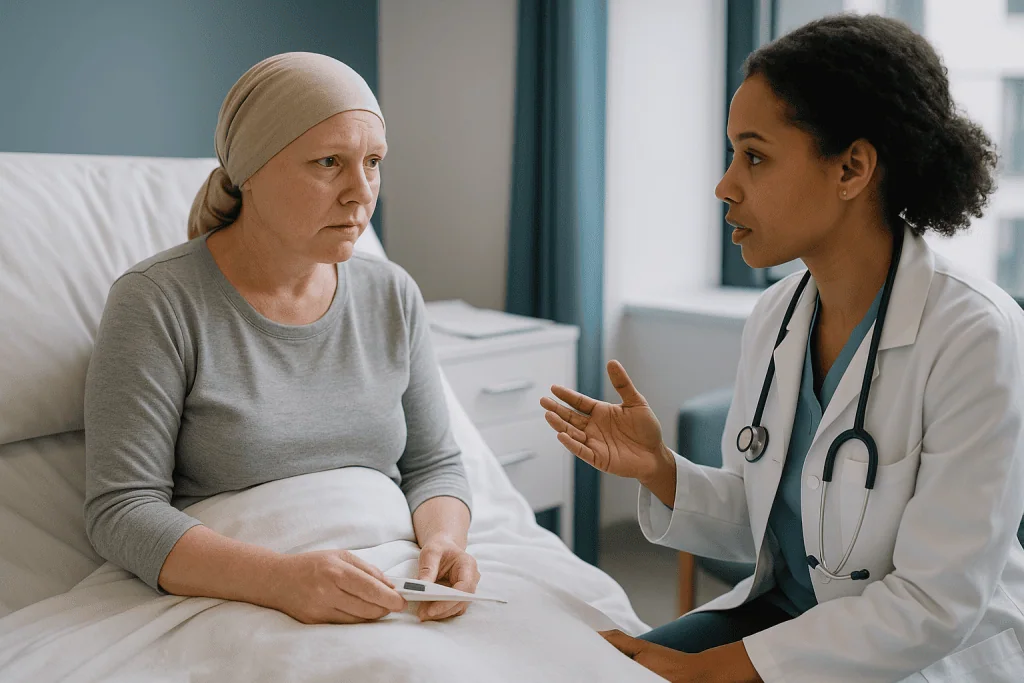
Without neutrophils, bacteria that enter the blood are not contained at the entry point. They can multiply in the bloodstream within hours, a condition called bacteremia, and trigger sepsis, the body’s overwhelming and disorganized response to infection that can drop blood pressure and starve organs of oxygen. The NHS explains that sepsis can develop quickly and that early antibiotics and fluids are the mainstays of treatment. In a person with neutropenia, the window between a low-grade fever and septic shock can be short, and there is no reliable way to tell from the bedside which fever will stay mild and which will not.
Historical experience shaped the modern approach. Before routine empirical antibiotics, meaning antibiotics given on suspicion, deaths from infection in people with acute leukemia were common. The shift to treating every neutropenic fever promptly, regardless of how well the patient looked, is one of the changes that made intensive leukemia treatment feasible at all. Care teams are not being cautious for its own sake; they are following a protocol that exists because the alternative was studied and found dangerous.
There is also a practical asymmetry. If the fever turns out to be a harmless reaction to a transfusion or a drug, a person has spent a night on antibiotics that can be stopped once cultures stay negative. If a true bloodstream infection is left for twelve hours because the person felt fine, the cost can be measured in organ function. Faced with that imbalance, teams choose to over-respond.
Who is treated as highest risk, and who may be managed less intensively
Not every fever in cancer care triggers the same response, and understanding how teams sort risk helps make sense of what happens to you. Guideline bodies use scoring tools that weigh how low the neutrophil count is and how long it is expected to stay low, the type of cancer and treatment, age, other health conditions, and how unwell the person appears.
People with acute leukemia almost always land in the higher-risk group. Induction chemotherapy for acute myeloid or acute lymphoblastic leukemia is designed to empty the marrow of blasts, which means neutrophils are often near zero for a week or more, and the mouth and gut lining are frequently damaged at the same time. Stem cell transplant recipients, people with a central line, anyone whose blood pressure is low or who is confused, and those already on immune-suppressing drugs are also placed firmly in this category. For them, admission and intravenous antibiotics are the standard starting point.
A smaller group is sometimes managed differently. Someone with a chronic leukemia on an oral targeted therapy whose neutrophils are only mildly reduced, who looks well, has stable vital signs, and lives close to the hospital with a reliable adult at home, may be assessed and then treated with oral antibiotics and close follow-up. That decision belongs to the treating team and depends on local resources, the specific drug regimen, and how the person responds during the first hours of observation.
The key point for patients is that being sent home after assessment is a clinical judgment made after tests, never a reason to skip the call in the first place. Risk scoring happens at the hospital, with the blood count in hand, not on the sofa at midnight.
What tests your team runs, and what each one is looking for
The rush of blood draws and samples in the first hour can feel disorienting, so it helps to know what each test is for. A complete blood count measures red cells, white cells, and platelets, and the laboratory reports the absolute neutrophil count, the number that determines whether this is neutropenic fever at all. Mayo Clinic describes neutropenia as an abnormally low level of these cells and notes that the lower the count, the higher the infection risk.
Blood cultures are the most important diagnostic step. Two or more sets are usually drawn, including one from any central line, because a bacterium growing only in the line sample points toward a catheter infection. Preliminary results often appear within one to two days, and a final identification with antibiotic sensitivities may take longer. Negative cultures after several days are reassuring but do not rule out infection, since some organisms are hard to grow and prior antibiotics can suppress them.
Beyond cultures, teams commonly check:
- Kidney and liver function, both to look for organ stress from sepsis and to guide antibiotic choices.
- Lactate, a chemical that rises when tissues are not getting enough oxygen, used as an early sepsis warning.
- Urine analysis and culture, since urinary infections may cause no burning when neutrophils are absent.
- A chest X-ray or, if symptoms suggest, a CT scan of the chest or abdomen, because pneumonia and gut infections can be silent on examination.
- Swabs of the throat, skin breaks, or catheter site, and respiratory virus testing in colder months.
A physical examination is done gently and thoroughly, including the mouth, skin folds, catheter exit site, and perianal area, since infections in these places are common and easy to miss. Rectal examinations are generally avoided in neutropenia because they can push bacteria into the bloodstream.
Which treatments are used for neutropenic fever, and how the team chooses
The first treatment is almost always an intravenous antibiotic from a broad-spectrum class, typically one that covers gram-negative bacteria such as those from the gut, which historically caused the most dangerous infections in neutropenic patients, and also many gram-positive organisms from the skin. Beta-lactam antibiotics with antipseudomonal activity are the usual backbone in guidelines. The precise agent depends on local resistance patterns, allergies, kidney function, and what has been used before, and that choice sits entirely with the prescribing clinician.
Additional drugs are layered on for specific reasons rather than by default. If a catheter site looks infected or cultures grow certain skin bacteria, an antibiotic active against resistant gram-positive organisms may be added. If fever persists for several days despite antibiotics and neutrophils remain very low, teams often start an antifungal, because invasive fungal infections become more likely the longer neutropenia lasts. Antiviral treatment enters the picture when a virus is identified or strongly suspected.
Supportive care runs alongside. Intravenous fluids maintain blood pressure and kidney perfusion. Oxygen is given if levels drop. Blood or platelet transfusions may be needed since leukemia treatment lowers those counts too. Some people receive a growth factor, a medicine that stimulates the marrow to produce neutrophils faster, though guidelines reserve it for particular situations rather than every fever.
Once culture results return, the regimen is narrowed to target the identified organism, a process called de-escalation that limits side effects and resistance. If cultures stay negative and the person is well, antibiotics may be stopped once neutrophils begin recovering. The timing of these decisions varies with the individual and is reviewed daily by the team.
Neutropenic fever versus an ordinary fever: how the response differs
Seeing the two situations side by side clarifies why the same thermometer reading leads to such different advice.
| Feature | Ordinary fever, normal counts | Fever during leukemia treatment, low counts |
|---|---|---|
| Temperature that prompts action | Often only when high or prolonged, per MedlinePlus general guidance | 100.4°F (38°C) once, or lower sustained readings, per Cleveland Clinic |
| Usual first step | Rest, fluids, observation at home | Same-day assessment, blood tests, cultures |
| Local infection signs | Redness, pus, swelling usually visible | Often absent because neutrophils form pus |
| Antibiotics | Given after a bacterial cause is identified | Started promptly on suspicion, before results |
| Fever-reducing medicine | Optional for comfort | Team may ask you to take a reading first so the fever is not masked |
| Speed of deterioration | Usually gradual | Can progress to sepsis within hours |
| Typical setting | Home | Hospital, at least for initial assessment |
One row deserves a closer look: fever-reducing medicine. Many teams ask patients not to take acetaminophen or similar drugs for a fever before checking their temperature and calling, since bringing the number down can hide the very signal that prompts assessment. The same drugs are used freely in hospital for comfort once the evaluation is underway. Nonsteroidal anti-inflammatory drugs are often avoided altogether during leukemia treatment because they can worsen bleeding when platelets are low, another decision for the treating team.
The table is not a self-diagnosis tool. Its purpose is to show that the difference lies in the body’s ability to respond, not in how you feel.
What the following days usually look like after a fever is treated
The first night tends to be the most intense: repeated vital signs, intravenous antibiotics running, a nurse checking whether the temperature is coming down. After that, the shape of the stay depends on three things: whether cultures grow something, how the fever behaves, and when neutrophils start to return.
If a bacterium is identified, the team tailors antibiotics to it and continues treatment for a course whose length depends on the organism and the site of infection. A catheter infection may require the line to be removed, which is a frustrating setback but often necessary, since bacteria form a protective film on plastic that antibiotics penetrate poorly. If cultures remain negative and the fever settles within a day or two, the working diagnosis becomes fever of unknown origin, and antibiotics continue until the person has been fever-free for a period and counts are rising.
Neutrophil recovery is the real turning point. Because chemotherapy’s effect on the marrow is temporary, counts climb back as the marrow repopulates, and Cleveland Clinic notes that this typically follows the nadir by days to a couple of weeks depending on the regimen. Many people notice the fever break at almost the same moment the laboratory reports the first neutrophils reappearing, which is not a coincidence.
Persistent fever beyond several days with very low counts prompts a broader search: repeat cultures, imaging, and often the addition of antifungal treatment. Hospital stays in that situation are longer.
Discharge usually comes with a review of the next chemotherapy cycle. A serious infection may lead the team to adjust timing or intensity, and that conversation about trade-offs between treating the leukemia and protecting against the next infection is one to expect rather than fear.
Can the leukemia itself, or the treatment, cause fever without infection?
Yes, and this is one reason the workup can feel disproportionate when nothing grows in the cultures. Fever has many possible sources in a person with leukemia, and infection is only the most dangerous one.
The disease can cause fever directly. Rapidly dividing blasts release inflammatory chemicals, and fever, night sweats, and fatigue are among the presenting features Mayo Clinic and Johns Hopkins list for leukemia. This tumor-related fever is more common at diagnosis or relapse than during a treatment cycle, and it often behaves differently, tending to be lower grade and not accompanied by chills.
Treatments cause fever too. Certain chemotherapy agents produce a predictable fever within hours of infusion. Some targeted drugs and immunotherapies trigger a systemic inflammatory response, and cell-based immunotherapies used for some leukemias can cause a distinct syndrome in which high fever is an early feature of the immune reaction rather than an infection. Growth factors that stimulate neutrophil production commonly cause bone pain and mild fever. Blood transfusions can cause a febrile reaction during or shortly after the transfusion.
Drug allergies, blood clots, and inflammation of the gut lining from chemotherapy round out the list. None of these can be safely told apart from bacterial infection at the bedside on the first night, which is why the team treats first and sorts out the cause afterward.
What this means in practice is that a negative culture is not a sign the response was unnecessary. Roughly speaking, cultures identify a bacterial cause in only a minority of neutropenic fever episodes, and the remainder are attributed to undetected infection or to one of these non-infectious causes after the fact. The empirical approach exists precisely because the distinction cannot be made in advance.
Reducing infection risk at home when your white blood cell count is low
No routine eliminates the risk of fever during leukemia treatment, and it is worth saying that plainly, because people often blame themselves for an infection that arose from their own gut bacteria. Still, a handful of habits reduce exposure, and Cleveland Clinic and the NHS describe similar measures for people with neutropenia.
Hand hygiene comes first, for the patient and for everyone in the household, especially before eating and after using the bathroom. Daily bathing and careful mouth care with a soft toothbrush protect the two surfaces that most often break down. Any cut or scrape should be cleaned and watched. The catheter site is cleaned and dressed according to the instructions your nursing team gives, and the dressing is kept dry.
Food safety matters more than food restriction. Thorough cooking of meat, eggs, and seafood, washing produce, avoiding unpasteurized dairy and juices, and keeping leftovers refrigerated are the measures most teams emphasize. Highly restrictive neutropenic diets have not been shown in studies to lower infection rates and can worsen nutrition, so ask your team what they actually want you to avoid.
Crowds and sick contacts are worth limiting during the expected nadir window, and anyone with a cold should keep their distance. Vaccination of household members, including annual flu shots, protects the patient indirectly. The patient’s own vaccine schedule is decided by the oncology team, since live vaccines are avoided and inactivated ones may work poorly while counts are low.
Finally, keep a working digital thermometer, know your team’s after-hours number, and have a bag half-packed. Preparation turns a frightening night into a manageable one.
What people often get wrong about fever and leukemia treatment
Several beliefs consistently delay care, and each has a kernel of ordinary logic that simply does not apply in neutropenia.
“It is only 100.4, I will see how it looks in the morning.” In a healthy person that is reasonable. With very few neutrophils, the number is a proxy for a bloodstream infection that may be hours from sepsis. Morning can be too late.
“I feel fine, so it cannot be serious.” Feeling well is the norm in early neutropenic sepsis. The symptoms people expect, such as a painful red wound or a productive cough, depend on the immune response that is missing. The NHS describes sepsis as potentially hard to spot in its early stages for this reason.
“I will take something for the fever and call if it comes back.” Fever-reducing medicine hides the signal without treating the cause. Check the temperature, call, and follow the team’s instructions on comfort medication.
“Antibiotics were started before they knew what it was, so they were guessing.” Empirical treatment is the guideline-based standard, not guesswork. Waiting for cultures would mean waiting a day or more while bacteria multiply.
“The cultures were negative, so the hospital stay was a waste.” Negative cultures are the expected result in a large share of episodes and do not mean there was no infection or that the response was wrong.
“I must have caught this from someone.” Many neutropenic infections come from bacteria that normally live harmlessly in the patient’s own gut or on their skin. Careful hygiene helps, but it cannot prevent every episode, and a fever is not evidence of carelessness.
“Fever means the treatment is failing.” Fever during the nadir reflects low counts, which is the expected effect of chemotherapy on the marrow, not a verdict on whether the leukemia is responding.
Questions to ask your care team before and after a fever episode
The best time to understand the fever plan is before you need it, ideally at the start of each treatment cycle. These questions are ones patients and families commonly find useful; your team may add others specific to your regimen.
- What temperature should prompt a call, and should I also call for chills without fever, or for a lower temperature that persists?
- Which number do I call during the day, at night, and on weekends, and where should I go if you tell me to come in?
- When do you expect my neutrophil count to be at its lowest for this cycle, and roughly how long do you expect it to stay low?
- Should I avoid taking anything for a fever before I check my temperature and call?
- Do you want me to hold any of my regular medicines if I develop a fever?
- Are there foods, activities, or places you specifically want me to avoid during the low-count window?
- How should I care for my central line, and what should the exit site look like when it is healthy?
After an episode, a second set of questions helps close the loop:
- Did the cultures grow anything, and if so, where do you think the infection came from?
- Will this change the timing or the intensity of my next cycle, and what are the trade-offs?
- Is there anything about how I responded that you want me to watch for next time?
- Do I need to complete antibiotics at home, and what should I do if I develop side effects from them?
- Should the catheter be replaced, and what are the risks of leaving it in versus taking it out?
Write the answers down or ask a companion to. The plan is easier to follow at midnight when it is on paper rather than in memory.
When to call your doctor: red-flag signs during leukemia treatment
Call your oncology team immediately, at any hour, for a temperature of 100.4°F (38°C) or higher, or for the threshold your own team has given you. Do not wait for a second reading, and do not take fever-reducing medicine first unless your team has told you to.
Call urgently, or go directly to an emergency department and say you are receiving leukemia treatment, if you notice any of the following, with or without a fever:
- Shaking chills or teeth-chattering rigors.
- Confusion, unusual drowsiness, difficulty waking, or slurred speech.
- Fast breathing, breathlessness, or a feeling that you cannot catch your breath.
- A racing heartbeat, dizziness on standing, or fainting.
- Skin that is cold, clammy, mottled, or unusually pale or bluish.
- Passing much less urine than usual.
- Redness, swelling, pain, or discharge around a central line, or pain when it is flushed.
- New severe pain anywhere, particularly in the abdomen, chest, or around the anus.
- Bleeding that does not stop, blood in urine or stool, or a rash of small purple spots, since low platelets often accompany low neutrophils.
- A sore throat, mouth ulcers, or a cough that is new or worsening.
The NHS stresses that sepsis is a medical emergency in which every hour matters and that antibiotics should begin within an hour of hospital arrival. Tell the first person you speak to that you have leukemia, that you have had recent chemotherapy, and what your last neutrophil count was if you know it. This information moves you to the front of the queue, which is exactly where you should be.
If you are unsure whether something counts, call anyway. Oncology teams would far rather answer a phone call that turns out to be nothing than treat sepsis that arrived twelve hours late. Every decision about admission, tests, and treatment rests with the clinicians assessing you, and the single most useful thing you can do is give them the chance to make it early.
Frequently asked questions
What temperature is considered a fever during chemotherapy for leukemia?
Most oncology teams use 100.4°F (38°C) taken by mouth as the threshold for calling, and Cleveland Clinic cites this figure for people with neutropenia. Some teams also ask patients to report a slightly lower temperature that persists for an hour, or chills and shaking without a measured fever. Follow the specific number your own team gives you, since regimens and local protocols vary.
What is neutropenic fever, and how is it different from a normal fever?
Neutropenic fever is a fever that occurs when the neutrophil count, the white blood cells that fight bacteria, is very low, usually because of chemotherapy. It differs from an ordinary fever because the body cannot wall off infection locally, so bacteria can reach the bloodstream quickly with few visible signs. That is why it is treated as an emergency with prompt antibiotics rather than observed at home.
Why do doctors start antibiotics before they know what is causing the fever?
Because waiting for culture results, which take a day or more, would leave a potential bloodstream infection untreated while bacteria multiply in someone with no neutrophils to contain them. Guidelines recommend empirical broad-spectrum antibiotics within an hour of arrival. Once cultures return, the treatment is narrowed to the identified organism or stopped if no infection is found and counts are recovering.
How long after chemotherapy is the risk of fever highest?
The neutrophil count usually reaches its lowest point roughly one to two weeks after a chemotherapy dose, according to Cleveland Clinic, and that nadir is when infection risk peaks. Intensive leukemia regimens can keep counts low for longer than treatments for many solid tumors. Your team can tell you the expected window for your specific cycle so you know when to be most vigilant.
Can I take acetaminophen for a fever during leukemia treatment?
Check with your oncology team first. Many teams ask patients to record their temperature and call before taking any fever-reducing medicine, because lowering the number can hide the signal that prompts assessment. Once you are being evaluated, comfort medication is commonly used. Nonsteroidal anti-inflammatory drugs are often avoided during leukemia treatment because they can increase bleeding when platelets are low.
Should I call about chemotherapy fever at night or wait until morning?
Call at night. Oncology services run 24-hour lines for exactly this reason, and the NHS notes that sepsis can develop quickly, with antibiotics recommended within an hour of hospital arrival. Neutropenic sepsis can progress from a mild fever to low blood pressure within hours, and there is no reliable way to tell at home which fever will stay mild. A late-night call is expected, not an imposition.
What are common signs of infection when the white blood cell count is low?
Fever and chills are often the only signs, because the redness, swelling, and pus that normally mark infection depend on neutrophils that are missing. Other clues can include a fast heartbeat, breathlessness, confusion, new pain, or changes around a central line. Any of these warrant an urgent call to your team, who will decide what assessment is needed.
Does a fever mean the leukemia treatment is not working?
No. Fever during the low-count window reflects the expected effect of chemotherapy on the bone marrow, not the leukemia’s response to treatment. Fever can also come from the disease itself, from certain drugs or transfusions, or from an infection unrelated to how well the treatment is performing. Your team assesses response through blood counts and marrow tests, not through whether a fever occurred.
Will a fever delay my next round of chemotherapy?
It might, but not always. After a serious infection the team may adjust the timing or intensity of the next cycle, weighing the need to treat the leukemia against the risk of another episode while the body recovers. Some teams also add supportive measures for future cycles. This is an individual decision made by the treating team, and it is worth asking about it directly before discharge.
How can I lower my infection risk during a low white blood cell count?
Frequent hand washing by everyone in the household, daily bathing, gentle mouth care, careful catheter care, thorough cooking and food safety, and avoiding crowds and sick contacts during the nadir window all help. Highly restrictive diets have not been shown to reduce infections. None of these steps removes the risk entirely, since many infections arise from the body’s own bacteria, so a fever still requires an immediate call.
References
- Cleveland Clinic: Neutropenia
- NHS: Sepsis, treatment and recovery
- NHS: Acute myeloid leukaemia, complications
- MedlinePlus: Fever
This article is for general information only and is not a substitute for professional medical advice. Please consult a qualified doctor about your individual situation.

More from the Blog

Targeted Therapy vs Chemotherapy: Why One Aims at a Mutation and the Other at Dividing Cells
Targeted therapy vs chemotherapy comes down to what each drug aims at. Chemotherapy damages cells that are dividing quickly, which includes cancer cells but…
How Pancreatic Cancer Treatment Is Planned: Resectable, Borderline and Advanced Disease
Pancreatic cancer treatment by stage is decided less by the stage number than by whether a surgeon can remove the tumor completely. Resectable tumors…
Living After Prostate Cancer Treatment: Urinary Control, Intimacy and Follow-Up Visits
Life after prostate cancer treatment usually settles into a new routine: regular PSA blood tests, gradual return of bladder control over weeks to months,…
What Recovery From Stomach Cancer Surgery Looks Like Week by Week
Recovery from stomach cancer surgery usually means one to two weeks in hospital, followed by several months of gradual rebuilding at home. The early…

Skin Care During IMRT: Fragrance-Free Products, Sun Protection and Daily Habits
Skin care during IMRT centers on a few evidence-based habits: wash the treated area gently with lukewarm water and a mild, fragrance-free cleanser, pat…

Is a Robotic Partial or Radical Nephrectomy Right for Your Kidney Tumor? How Surgeons Decide
Surgeons usually favor a partial nephrectomy, which removes only the tumor and a rim of kidney, for smaller tumors confined to one part of…