

Skin Care During IMRT: Fragrance-Free Products, Sun Protection and Daily Habits
Key Takeaways
- IMRT shapes the beam to spare surrounding tissue, but skin along the beam path or inside the target still receives dose, so a reaction is expected rather than a sign of error.
- Gentle washing with lukewarm water and a mild fragrance-free cleanser is supported by current NHS and MedlinePlus guidance; the old instruction never to wash the area has been retired.
- "Unscented" products may contain masking fragrance; the label you want on anything touching the treatment field is "fragrance-free", with no essential oils or botanical extracts.
- Starting a bland emollient from the first session protects an intact barrier, whereas waiting for redness means repairing skin that has already thinned.
- The reaction is cumulative and delayed, typically peaking around or one to two weeks after the final session and settling within about 2 to 4 weeks afterward according to the NHS.
- Measurements have not shown that antiperspirant increases skin dose, so whether you use it during treatment is now a decision about skin integrity and departmental protocol, not physics.
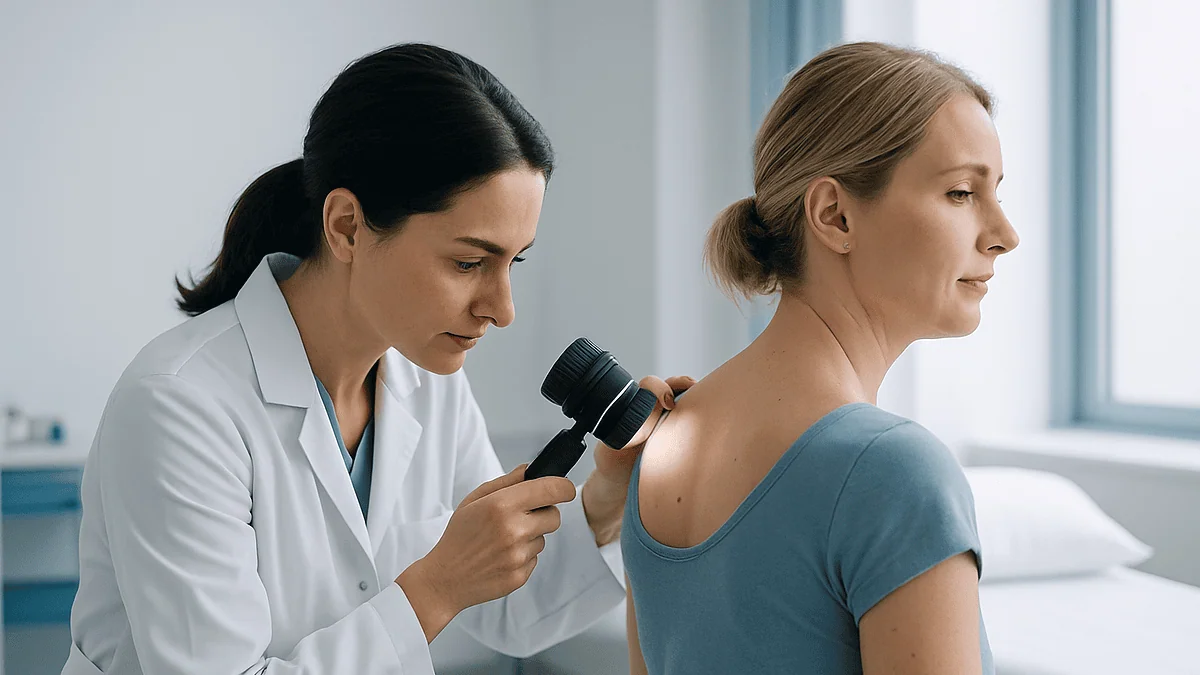
Skin care during IMRT centers on a few evidence-based habits: wash the treated area gently with lukewarm water and a mild, fragrance-free cleanser, pat dry, apply a plain fragrance-free moisturizer as your radiation team advises, keep the skin out of direct sun and covered with loose soft clothing, and avoid heat, friction and harsh products. Report blistering, weeping or spreading redness to your care team promptly.
On the drive home from her third session, she catches herself scratching just below the collarbone. Nothing hurts yet. The skin looks the way it always has. But someone in the waiting room mentioned a friend whose chest “peeled like a sunburn” by week four, and now every itch feels like a warning. She wonders whether the lotion in her bathroom cabinet is quietly making things worse.
That mix of calm skin and rising worry is exactly where most people begin. Skin care during IMRT is one of the few parts of radiation treatment a patient can actively shape, which is why so many questions cluster around it: which cream, how often, whether to skip deodorant, whether a pool is allowed, and what a scary reaction actually looks like.
The good news is that the guidance has become simpler and kinder than it was a generation ago. Much of what circulates online is leftover advice from the era of cobalt machines. This explainer walks through what mainstream evidence supports, what remains uncertain, and how to work with your team rather than around them.
What is IMRT, and why does the skin still react to it?
Intensity-modulated radiation therapy, or IMRT, is a form of external beam radiation in which a computer shapes the beam into many small segments of varying strength so the dose hugs the tumor and spares more of the nearby healthy tissue. The machine, a linear accelerator, rotates around you while dozens of tiny metal leaves slide in and out of the beam path, sculpting it in real time.
That precision changes the dose to skin, but it does not remove it. Any beam that reaches a tumor beneath the surface has to pass through skin on its way in. For breast, chest wall, head and neck, anal and vulvar treatments, the target may sit close to the surface or include the skin itself, so the skin is deliberately treated rather than avoided.
The reaction, called radiation dermatitis, happens because radiation damages the rapidly dividing cells in the basal layer of the epidermis, the deepest layer of the outer skin. Those cells normally replace the surface every few weeks. When their replacement slows, the skin thins, dries and can eventually break down. Small blood vessels dilate too, which is why redness appears before any peeling.
Unlike a sunburn, which is a single insult, radiation dermatitis is cumulative. Each daily session adds to the total, and the visible reaction lags behind the dose by days to weeks. That lag is the source of the classic surprise: skin that looked fine on the last treatment day can look its worst a week later.
Understanding this mechanism matters because it explains the whole skin care strategy. The goal is not to “heal” the skin mid-treatment, which the beam will not allow, but to protect a thinning, fragile surface from every avoidable extra stress: friction, heat, harsh chemicals, sun and infection.
Skin care during IMRT: what "fragrance-free" actually means
Fragrance is the single most common cause of contact allergy from cosmetics in the general population, and irradiated skin has a weakened barrier that lets irritants penetrate more easily. That is why nearly every radiation department repeats the same phrase: fragrance-free.
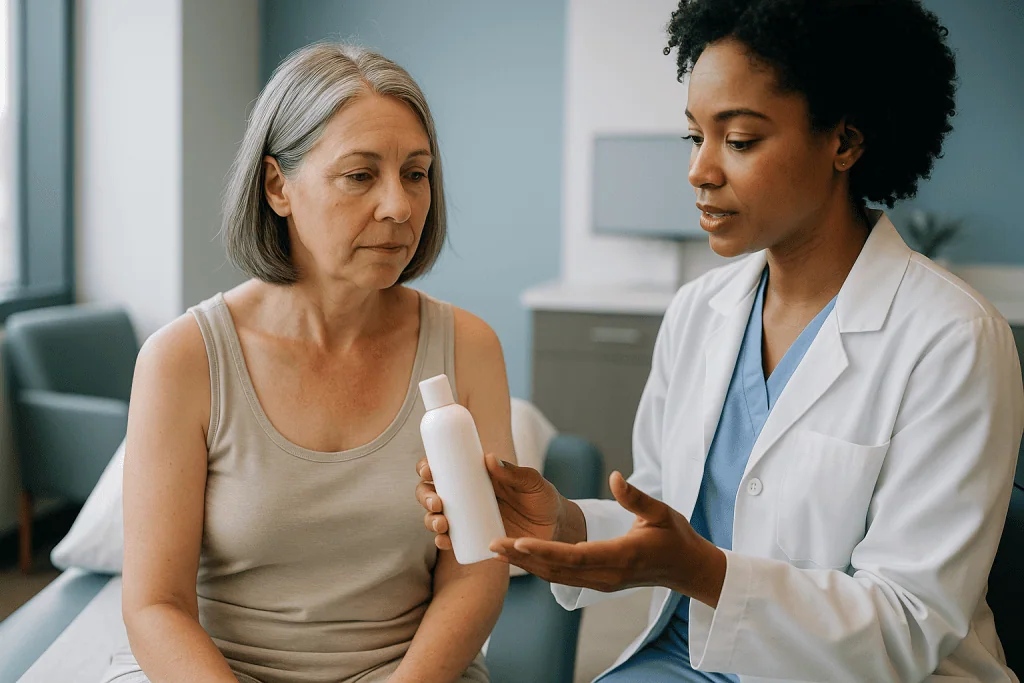
The label wording is trickier than it sounds. “Unscented” often means a masking fragrance has been added to hide the smell of raw ingredients. “Fragrance-free” is the claim you want, and even then it is worth glancing at the ingredient list for words such as parfum, fragrance, essential oil, or botanical extracts like lavender or citrus, all of which can sting or sensitize.
Other ingredients your team may ask you to avoid on the treatment field include alcohol (drying), menthol or camphor (cooling sensation but irritating), retinoids and alpha-hydroxy acids (they thin skin further), and anything with exfoliating grains. Petroleum-based ointments are generally acceptable, but check with your team about timing before sessions, since some departments prefer skin be free of thick product at treatment time.
MedlinePlus and the NHS both frame the ideal product as simple: a bland, fragrance-free moisturizer or emollient recommended by your radiation team. No named product has been shown to outperform another in mainstream guidance, and marketing claims about “radiation creams” are not a substitute for that conversation.
A practical rule many nurses share: if you would not put it on a newborn’s face, keep it off the treatment field. The same logic covers laundry. A fragrance-free, dye-free detergent for the shirts and bras that touch treated skin removes a quiet daily source of irritation.
One more distinction: fragrance-free is about irritants, not about sterility. Ordinary clean skin and clean hands are enough. You do not need medical-grade antiseptics unless your team prescribes them, and many antiseptic washes are themselves drying.
Can you wash the treated area during radiation?
Yes, and you should. This is the myth that refuses to die. Decades ago, patients were told not to wash the treated area at all, partly to protect ink marks and partly out of fear that water would worsen reactions. Randomized trials since then have found that gentle washing does not increase skin reactions and can reduce itching and infection risk by clearing sweat and debris. Current NHS and MedlinePlus guidance both advise washing gently with lukewarm water and a mild, unperfumed soap or none at all.
Technique matters more than frequency. Use your hand rather than a washcloth or sponge, which drag across the surface. Let water run over the area instead of scrubbing. Pat dry with a soft towel, or let the skin air dry if it is already tender. Skip loofahs, exfoliating gloves and anything labeled “deep cleansing”.
Temperature is easy to overlook. Hot water dilates the same vessels the radiation is already stressing and strips lipids from the barrier. Lukewarm is the goal, and short showers beat long baths. If you love a bath, keep the water comfortable rather than steaming and avoid bubble bath, bath oils and salts on the treated side.
Skin folds deserve special attention: under the breast, in the groin, behind the ear, in the neck creases. Moisture trapped in a fold accelerates breakdown, so gently dry these spots and, if your team agrees, use a soft cotton pad or lint-free gauze to keep two surfaces from rubbing.
What about the marks or small tattoos your team placed for positioning? Pen marks can fade with washing, so avoid soaping directly over them and tell the radiographers if they blur. Permanent tattoo dots are unaffected by water. Never redraw a faded mark yourself; that is a job for the treatment team, who will re-mark you against the planning scan.
Which moisturizer for radiation skin, and when to apply it?
Moisturizing is the daily habit with the most consistent support in guidance from MedlinePlus, the NHS and the National Cancer Institute, and the least agreement on brand. That is not a gap in the evidence; it reflects a genuine finding. Comparisons between plain emollients have generally shown similar results, so most teams simply recommend a bland, fragrance-free cream or ointment and ask you to use it from the first week rather than waiting for redness.
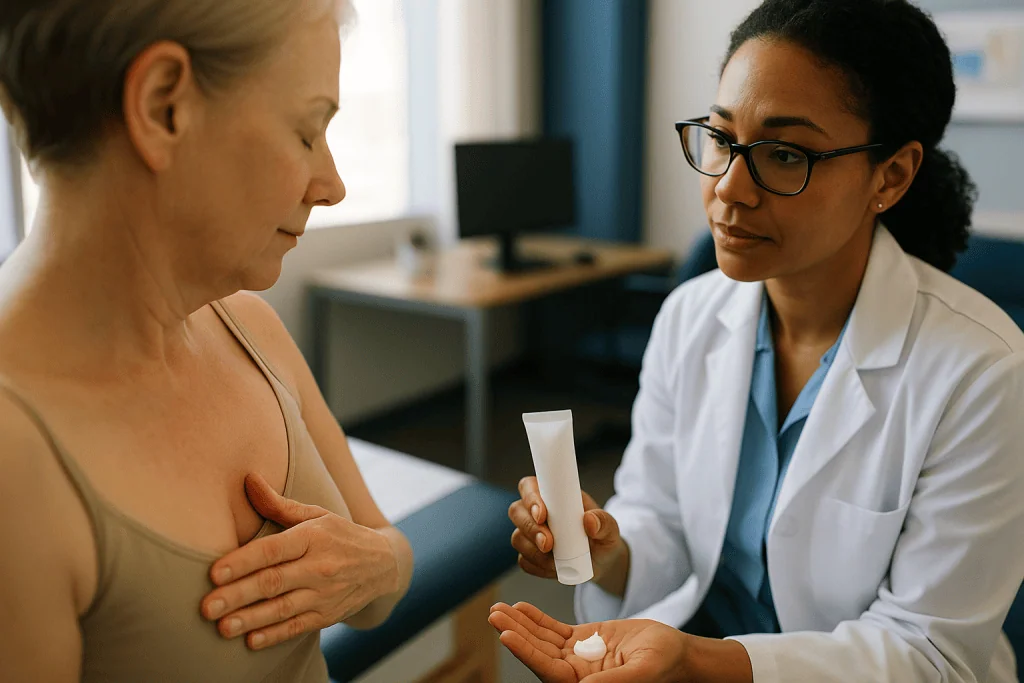
Why start early? An emollient works by trapping water in the outer layer and replacing the lipids that hold skin cells together. Once the barrier is already cracked, you are repairing rather than protecting. Starting on day one, on skin that looks perfectly normal, is the whole point.
How often is typically framed as two or more times a day, with a common suggestion to apply after washing and again at bedtime, but the exact routine should come from your own team. Apply a thin layer with clean hands and smooth it on gently in one direction rather than rubbing in circles. Thick layers do not protect more; they just sit on the surface and can transfer onto clothing.
Timing around treatment is where departments differ. Some ask that skin be free of product for a few hours before each session; others no longer restrict it, because studies suggest a thin layer does not meaningfully alter the dose at the surface. Follow your own department’s instruction rather than a forum post.
Texture is a practical choice. Lighter creams and lotions spread easily on intact skin and feel less greasy under clothing. Thicker ointments hold moisture longer and suit very dry or flaking areas, but they can feel occlusive in hot weather. Many people use a cream by day and an ointment at night.
If a product stings on application, stop using it and tell your team. Stinging on irradiated skin is a signal, not something to push through. Cooling the tube in the refrigerator is a simple comfort trick some nurses suggest for itching, though never use ice or cold packs directly on the field.
Sun protection after radiotherapy: how careful do you need to be?
Think of the treatment field as skin that has already used up its tolerance. Ultraviolet light adds a second injury on top of the first, and irradiated skin also loses some of its ability to tan protectively. Both the NHS and MedlinePlus advise keeping the treated area out of direct sun during treatment and for a period afterward.
During treatment, the simplest protection is fabric. A loose, closely woven cotton top, a soft scarf for a neck field, or a wide-brimmed hat for a scalp or face field blocks ultraviolet far more reliably than any cream. Sunscreen on skin that is red or peeling can sting and is generally not advised on the field while the reaction is active, which is another reason clothing does the heavy lifting.
Once the skin has healed, sunscreen becomes appropriate. MedlinePlus recommends a broad-spectrum product with SPF 30 or higher on treated skin whenever it is exposed. Mineral formulas containing zinc oxide or titanium dioxide are often better tolerated on sensitive skin than chemical filters, and fragrance-free versions are widely available. Apply generously and reapply after sweating or swimming.
How long does the extra caution last? Guidance is deliberately open-ended. Treated skin can remain more sun-sensitive for many months, and the National Cancer Institute notes that some changes in texture and color can persist long term. A reasonable approach many teams suggest is to treat the field as permanently high-risk skin: cover it, shade it, and use sunscreen for years rather than weeks.
Tanning beds are off the table entirely. They deliver concentrated ultraviolet A, which penetrates deeper than sunlight and carries its own cancer risk.
Indirect sun counts too. Reflection off water, sand and snow reaches skin under a hat brim, and a car window blocks most UVB but far less UVA. If you drive with a treated arm or neck against the window, a light sleeve or scarf is a small habit with a real payoff.
Who needs the most intensive skin care during IMRT, and who is asked to wait?
Everyone receiving external beam radiation benefits from the basic routine of gentle washing, moisturizing and sun avoidance. Beyond that baseline, some people are watched more closely because their risk of a significant reaction is higher.
Site is the biggest factor. Fields over the breast and chest wall, head and neck, anus, vulva and groin involve skin close to or inside the target, and skin folds where sweat and friction concentrate. A prostate or brain field, by contrast, usually produces milder surface changes because the beam paths spread across a larger area of skin and the target sits deeper.
Treatment factors add up: higher total dose, a “bolus” (a soft gel sheet placed on the skin to deliberately pull dose to the surface, used when the skin itself needs treating), and concurrent chemotherapy or targeted drugs that sensitize skin. Certain drug classes used alongside head and neck radiation are well known to intensify dermatitis.
Personal factors matter too. Larger breast size, higher body weight where folds are deeper, smoking, diabetes, poor nutrition and some connective tissue conditions are associated with more pronounced reactions. Previous radiation to the same area changes the picture entirely and is something your oncologist will have planned around.
Who is asked to hold off on certain steps? People with broken, weeping skin are usually asked to pause ordinary moisturizers on that patch and switch to a dressing or prescribed product, because emollients can trap fluid on open skin. Anyone with a suspected infection is asked to wait for assessment before applying anything. And patients whose team has specified product-free skin before sessions are asked to time their moisturizing rather than skip it.
None of this is a reason to change your routine on your own. It is a reason to ask your team, on the first day, which category you fall into and what your specific plan looks like. Higher-risk fields often come with weekly skin checks and a lower threshold for prescribed treatments.
Radiation dermatitis timeline: what the following weeks usually look like
Because the reaction is cumulative and delayed, it follows a fairly predictable arc. Knowing the shape of that arc turns frightening surprises into expected milestones.
In the first week or two, most skin looks unchanged. Some people notice mild warmth, a faint pink flush or dryness. This is the window to build the moisturizing habit while the barrier is still intact.
Within the first few weeks, according to MedlinePlus and the National Cancer Institute, visible changes commonly begin: redness that deepens over days, tightness, itching, and sometimes a darkening of the skin, particularly in people with more melanin, where “redness” may read as a deepening or grayish tone rather than pink. Fine dry flaking, called dry desquamation, often follows.
Toward the end of a multi-week course, and often for one to two weeks after the final session, the reaction typically peaks. In higher-dose fields and skin folds this can progress to moist desquamation, where the surface layer peels away and the skin beneath weeps clear fluid. This is the stage that alarms people most and the stage where dressings and prescribed products come into play. It is uncomfortable and it is expected in some sites; it is not a sign that something has gone wrong.
Healing then begins fairly quickly once the beam stops adding injury. The NHS notes that skin problems usually settle within 2 to 4 weeks of treatment ending, though deeper reactions can take longer, and pigment changes may take months to fade. New skin often looks shiny, pink and slightly thinner at first.
Two points of nuance. First, the peak after treatment ends is the moment people are most tempted to stop their routine, having “finished”. Keep moisturizing and covering until your team says the skin has recovered. Second, timelines vary with total dose, fractionation (how the dose is divided into daily sessions) and individual factors, so treat these ranges as a map rather than a schedule.
Can you use deodorant during radiation treatment?
For decades the answer was a flat no, and many people still arrive at their first session expecting to give up antiperspirant for two months. The reasoning was twofold: aluminum-based antiperspirants were thought to scatter the beam and increase the skin dose, and fragranced products were thought to irritate. The first concern has been tested directly and has not held up. Measurements and randomized trials have found no meaningful increase in skin dose or in skin reactions when antiperspirant is used during breast and chest wall radiation.
As a result, most contemporary guidance has softened. The NHS notes that deodorant may be used on intact skin in the treated area, while advising against it if the skin becomes broken or sore. Some departments still prefer you avoid it, and MedlinePlus lists deodorant among products to check with your team before using. Both positions are defensible; what matters is that you follow your own team’s instruction rather than an internet vote.
If you are permitted to use one, choose a fragrance-free, alcohol-free roll-on or stick over an aerosol, since the propellants and fragrance in sprays are more likely to sting. Apply to dry, intact skin only, and stop immediately if the skin begins to crack, weep or feel raw. At that point the axilla is an open wound and needs the same care as any other broken area.
The armpit is worth extra vigilance regardless of deodorant. It is a fold, it is warm, it sweats, and in breast treatment it may receive a substantial dose. Keep it dry, wear loose sleeves, and consider an electric razor rather than a blade if you shave, since a nick in irradiated skin heals slowly and invites infection. Many people simply pause shaving there until the skin has recovered.
Daily habits that protect irradiated skin: clothing, heat, shaving and swimming
The most protective habits are unglamorous. They reduce friction, heat and chemical load on a surface that is quietly losing its ability to cope.
Clothing comes first. Soft, loose, breathable natural fibers such as cotton or bamboo let air circulate and slide rather than rub. Avoid tight waistbands over a pelvic field, underwired bras over a breast field, stiff collars over a neck field, and synthetic fabrics that trap sweat. Many people with breast treatment switch to a soft cotton camisole or a front-fastening bra without wire, or go without when at home. Seams and labels can be surprisingly abrasive; turning a garment inside out is a small fix.
Heat and cold are both to be avoided directly on the field. No heating pads, hot water bottles, electric blankets on the treated side, saunas, steam rooms or ice packs. The skin’s thermal regulation is impaired, so extremes cause damage before you feel discomfort.
Shaving on the field is best paused or switched to an electric razor. Waxing, depilatory creams and laser hair removal on treated skin are off limits during treatment and for a period afterward, until your team confirms recovery.
Swimming raises two issues: chlorine and bromine dry and irritate skin, and salt water stings anything already cracked. The NHS advises checking with your team before swimming; many departments allow it while the skin is intact and ask you to rinse immediately and moisturize after, then stop once any redness or peeling appears.
Adhesives matter more than people expect. Medical tape, bandage strips and wound dressings with strong adhesive can lift fragile skin when removed. If a dressing is needed, ask about silicone-based or non-adherent options, and never apply an adhesive product over your positioning marks.
Finally, the field is not a place for cosmetics, perfume, aftershave, hair dye, self-tanner or essential oils until the skin has fully recovered and your team has agreed.
What do doctors prescribe for radiation skin reactions, and how do they work?
When a reaction outpaces what an emollient can do, your team has several tools. Understanding how each works helps the conversation, but every choice about starting, stopping or combining them belongs to the prescribing clinician.
Topical corticosteroids, a class of anti-inflammatory creams, are the intervention with the strongest evidence for reducing the severity of radiation dermatitis and easing itching, particularly in breast and head and neck fields. They work by calming the inflammatory cascade that follows cell damage, reducing redness and swelling. Because prolonged use can thin skin, they are used on a schedule set by the team, typically on intact or dry-flaking skin rather than open areas, and are stopped once healing is established.
Barrier films and creams form a breathable protective layer over intact skin to reduce friction and moisture loss. Some contain silicone; others are dimethicone-based. Evidence for preventing severe reactions is mixed, but many teams use them in high-friction folds.
For moist desquamation, the goal shifts to wound care: keep the area clean and moist but not soggy, protect it from rubbing, and watch for infection. Non-adherent dressings, hydrogel or hydrocolloid sheets and soft silicone dressings are common choices. Silver-containing dressings or creams may be used when infection is a concern because silver is antimicrobial. The National Cancer Institute and NHS both describe this stage as manageable and expected in certain fields.
Antibiotics, topical or oral, are prescribed only when infection is suspected. Antihistamines are sometimes used for itching that disrupts sleep.
Products often promoted online deserve a note. Aloe vera has been studied in several trials and has not been shown to prevent or reduce radiation dermatitis. Calendula results are mixed. Trolamine-based creams have not outperformed simple emollients in comparative studies. None of these is dangerous on intact skin in fragrance-free forms, but none should replace what your team recommends, and any “natural” product should be run past them first.
Skin care during IMRT by treatment site: a comparison at a glance
The basic routine is universal, but each site brings its own pressure points. This table summarizes where the effort usually goes. Your own plan may differ, and your team’s instructions take priority over any general summary.
| Treatment site | Typical skin pressure points | Habits that usually matter most |
|---|---|---|
| Breast and chest wall | Fold under the breast, axilla, nipple area; bolus may be used after mastectomy | Soft wire-free support, keeping folds dry, electric razor or no shaving, deodorant only as permitted |
| Head and neck | Neck creases, behind the ears, beard area; skin may be sensitized by concurrent drugs | Loose collars and scarves, no wet shaving, careful drying of creases, early attention to sun |
| Pelvis, anus and vulva | Groin folds, perineum, buttock cleft; moisture from sweat and toileting | Loose cotton underwear, gentle rinsing after toileting, patting dry, prompt reporting of soreness |
| Scalp and brain | Hair loss in the field, dry scalp, sun exposure to newly bare skin | Soft hats, fragrance-free scalp moisturizer, strict shade and later sunscreen |
| Limbs and trunk sarcoma fields | Large areas of thin skin, movement friction, dressings after surgery | Loose sleeves or trousers, non-adherent dressings, avoiding tape on the field |
Two patterns run through every row. Folds fail first, because moisture and rubbing combine there, so drying and separating skin surfaces is the single highest-yield habit for most people. And every field eventually meets the sun, so the covering habit started in week one becomes the sunscreen habit that continues for years.
Where bolus is used, expect a brisker reaction on that patch and a lower threshold for prescribed dressings. Your team will usually tell you in advance so the peak does not come as a shock.
What people often get wrong about radiation skin care
Most myths in this area are outdated truths. They made sense once and were never retired. Here are the ones that cause the most trouble.
“Do not wash the area.” Retired. Gentle washing with lukewarm water and mild fragrance-free soap does not worsen reactions and helps prevent infection. What remains true is to avoid scrubbing and hot water.
“It is a burn, so treat it like a burn.” Radiation dermatitis is not a thermal burn. Cold packs, burn sprays and the impulse to “cool it down” can damage skin whose temperature regulation is impaired. The care is closer to protecting fragile skin than to first aid for a kitchen accident.
“Wait until it turns red to start moisturizing.” By then the barrier is already compromised. Emollients work best as prevention from the first session.
“Any natural cream is safer than a medical one.” Plant extracts and essential oils are among the most common skin sensitizers, and aloe vera has not been shown to help in trials. Bland and fragrance-free beats botanical.
“IMRT means no skin reaction.” IMRT reduces dose to some healthy tissue, but any field that includes or sits under skin will still produce a reaction, and some fields treat the skin on purpose.
“Peeling means the treatment is too strong.” Dry and even moist desquamation are expected in higher-dose fields and folds. They signal that the skin has reached its tolerance, not that the plan is wrong. Your team will still want to see and manage it.
“Once the sessions end, the skin is done reacting.” The peak often arrives one to two weeks after the last session. Keep the routine going until your team confirms recovery.
“Antiperspirant will scatter the beam.” Measurements have not supported this. Whether you use it is now a departmental and skin-integrity decision rather than a physics one.
Each correction points the same way: toward gentle consistency and an open line to the team, and away from dramatic interventions.
Questions to ask your care team before and during treatment
Radiation teams answer skin questions all day, and the ones that produce the most useful answers are specific. Bring these to your planning visit or first treatment, and revisit them as your skin changes.
- Which part of my skin is inside the treatment field, and will a bolus be used on any of it?
- Do you want me to start moisturizing on the first day, and which type of product do you recommend for my skin and my field?
- Should the skin be free of cream for a set time before each session, or does timing not matter here?
- May I use antiperspirant or deodorant, and what change in my skin would mean I should stop?
- What is your advice on swimming, bathing and shaving for my particular site?
- How will you check my skin during treatment, and how often?
- Which changes should I photograph or report between visits, and who do I call?
- If my skin breaks down, what dressings or prescribed products would you typically consider, and how would I use them?
- Am I taking any medicine or receiving any other therapy that makes a skin reaction more likely?
- After treatment, how long should I keep the area covered from sun, and when can I start sunscreen?
- When can I return to my usual soaps, cosmetics, hair removal and clothing?
- Will you tell me what pigment or texture changes to expect long term, and which ones would be worth a follow-up look?
Write the answers down or ask for them in writing; instructions blur by week three. If you receive advice from a nurse, radiographer and oncologist that seems to conflict, say so. Departments have their own protocols, and a quick clarification beats guessing. And if a friend’s experience or an online forum contradicts your team, the team’s guidance is tailored to your dose, your field and your skin; the forum’s is not.
When to call your doctor
Most skin changes during IMRT are expected and are managed at routine visits. Some signs, though, need same-day contact with your radiation team, or urgent care if you cannot reach them.
Call promptly if you notice any of the following on or near the treated area:
- Skin that is blistering, peeling in sheets, or weeping fluid that soaks through a dressing or clothing
- Redness or swelling that spreads beyond the treatment field, especially with warmth or streaking
- Yellow or green discharge, a foul smell, or a thick crust forming over an open area
- Increasing pain that is not controlled by what your team has already advised
- Fever or chills, which can signal infection in broken skin
- Bleeding from the treated skin
- A rash, hives or sudden stinging after applying a new product, suggesting a reaction to it
- Skin changes appearing in an area you were told is outside the field
Contact your team the same day, without waiting for your next scheduled visit, if you cannot keep the area clean or covered, if dressings are not staying in place, or if the discomfort is stopping you from sleeping or eating, which matters more than it sounds during treatment.
After treatment ends, keep the same threshold. Skin that is not improving by around 2 to 4 weeks after the last session, per the NHS timeframe for typical settling, or that worsens rather than heals, should be seen. Months or years later, a new sore that does not heal, a thickened or hard area, a persistent open wound, or a change in a mole within the old field also deserves a look; irradiated skin remains a site where problems can develop late.
The treating team, not this article, decides what any change means for your plan. Their job includes hearing about symptoms that turn out to be nothing, so err toward calling.
Radiation dermatitis skin care after treatment: healing, pigment and the long view
The last session is a milestone, not a finish line for the skin. Over the following days the reaction may still deepen, then, once the beam stops adding injury, repair takes over. Basal cells begin dividing again, new epidermis spreads in from the edges of any raw area, and redness starts to fade.
During this stretch, keep everything the same: gentle washing, fragrance-free moisturizer, loose clothing, no sun. If your team prescribed a corticosteroid cream or dressings, follow their instructions on when to taper and stop rather than deciding on your own. Stopping too early can let a settling reaction flare; continuing too long has its own downsides. Both are their call.
New skin often looks pink, shiny and slightly thin at first, and it may feel tight or itchy as it matures. Moisturizing supports this phase. Pigment changes are common: the area may look darker (hyperpigmentation) or, less often, lighter than surrounding skin, and the National Cancer Institute notes these can take months to fade and sometimes persist. Hair in the field may regrow more slowly, finer, or not at all if the dose was high.
Later changes, appearing months to years afterward, can include a firmer texture from fibrosis (thickening of the tissue under the skin), tiny visible blood vessels called telangiectasia, and dryness because sweat and oil glands in the field may work less well. These are not signs of ongoing damage; they are the skin’s long-term memory of the dose. Regular moisturizing and sun protection remain the mainstays.
Once the skin has healed, sunscreen joins clothing as protection. MedlinePlus advises a broad-spectrum product with SPF 30 or higher on treated skin. Ask your team before returning to hair removal, cosmetics, perfumes, saunas or swimming, and before any procedure on the area, including tattoos, since irradiated skin heals more slowly.
A small habit that many people find steadying: photograph the field at the same time each week from the first session through recovery. It turns a vague sense of “is it worse?” into something you can show your team, and it usually reveals that healing is happening faster than it feels.
Frequently asked questions
What is the best moisturizer for radiation skin during IMRT?
There is no single best product; mainstream guidance recommends a bland, fragrance-free cream or ointment chosen with your radiation team. Comparative studies of plain emollients have generally shown similar results, so simplicity matters more than brand. Avoid fragrance, essential oils, alcohol, menthol, retinoids and exfoliating acids on the field, and stop any product that stings. Ask your team whether they want skin product-free before sessions.
Can you use deodorant during radiation treatment for breast cancer?
Often yes, on intact skin, if your department permits it. Trials have not found that antiperspirant increases skin dose or reactions, and the NHS allows deodorant on unbroken skin. Some teams still prefer you avoid it, so follow their instruction. Choose a fragrance-free, alcohol-free roll-on rather than a spray, and stop as soon as the armpit skin becomes red, cracked or sore.
How long does radiation dermatitis take to heal after IMRT ends?
Skin problems usually settle within about 2 to 4 weeks after the last session, according to NHS guidance, though the reaction may worsen for one to two weeks before it starts to improve. Deeper moist reactions can take longer, and pigment or texture changes may persist for months. Keep your skin care routine going until your team confirms the area has recovered.
Is sun protection after radiotherapy really necessary if the skin looks normal?
Yes. Irradiated skin loses some of its natural protection and remains more sun-sensitive for months and sometimes much longer. During treatment, rely on loose clothing and shade, since sunscreen can sting on reactive skin. Once healed, MedlinePlus advises a broad-spectrum sunscreen with SPF 30 or higher on the treated area whenever it is exposed. Tanning beds should be avoided entirely.
Should I stop washing the treated area during radiation?
No. Current guidance supports gentle daily washing with lukewarm water and a mild, unperfumed soap or none at all. Washing removes sweat and debris that raise infection risk and has not been shown to worsen reactions. Use your hand rather than a cloth, avoid hot water and scrubbing, pat dry gently, and take care not to soap directly over positioning marks.
Does IMRT cause less skin damage than regular radiation?
IMRT can reduce dose to some healthy tissue by shaping the beam more precisely, and in some sites this lessens skin reactions. It does not eliminate them, because any beam reaching a tumor beneath the surface passes through skin, and some fields deliberately treat the skin. Expect a reaction proportional to your site and total dose, and follow the same protective routine.
What does radiation dermatitis skin care involve when the skin starts peeling?
Dry flaking is usually managed by continuing gentle washing and moisturizing. If the skin weeps or peels away in sheets, called moist desquamation, care shifts to wound management: keeping the area clean, protected from friction and covered with non-adherent or silicone dressings chosen by your team. Ordinary moisturizers are often paused on open patches. Report this stage promptly rather than treating it alone.
Can I swim during radiation treatment?
Check with your team first. Many departments allow swimming while the skin is intact and ask you to rinse immediately afterward and moisturize, because chlorine and salt water dry and irritate irradiated skin. Once any redness, flaking or soreness appears, swimming is usually paused until the skin has recovered. Hot tubs and saunas should be avoided throughout because of heat.
Is aloe vera good for radiation skin reactions?
Trials have not shown that aloe vera prevents or reduces radiation dermatitis, so it is not recommended over a plain fragrance-free emollient. Pure, fragrance-free aloe gel is unlikely to harm intact skin, but many commercial aloe products contain fragrance, alcohol or botanical extracts that can sting or sensitize. Ask your team before adding any product, natural or otherwise, to the treatment field.
Why does my skin look worse after radiation has finished?
Because the reaction lags behind the dose. Radiation damages the skin’s dividing cells over weeks, and the visible effect often peaks one to two weeks after the final session before healing begins. This late peak is expected, not a sign of ongoing damage. Continue your routine and contact your team if the skin blisters, weeps, spreads beyond the field or shows signs of infection.
References
This article is for general information only and is not a substitute for professional medical advice. Please consult a qualified doctor about your individual situation.

More from the Blog
Ablation or Surgery for Liver Cancer? What Makes Each Option Suitable
Ablation and surgery are both used to treat liver cancer that has not spread beyond the liver. Ablation destroys a small tumor in place…

How Doctors Choose Between HDR and LDR Brachytherapy: Temporary Source or Permanent Seeds
Doctors choose between HDR and LDR brachytherapy based on the cancer type and size, how the tumor sits next to healthy organs, the patient's…

Immunotherapy Cycles Explained: Why Infusions Repeat Every Few Weeks and for How Long
Immunotherapy is usually given in cycles because the drugs are cleared from the body over days to weeks and the immune response they trigger…
How to Support Someone Through Radiation Therapy: Rides, Meals and Watching for Fatigue
To support someone going through radiation, take on the repeatable jobs: a shared ride rota for daily weekday appointments, small frequent meals matched to…
Recovery After Melanoma Surgery: Stitches, Skin Grafts and Getting Back to Activity
Recovery after melanoma surgery usually takes about one to three weeks for a wound closed with stitches, and several weeks longer when a skin…
Who Sits on a Head Cancer Tumor Board and How the Group Reaches a Recommendation
A head and neck cancer tumor board is a scheduled meeting where surgeons, radiation oncologists, medical oncologists, radiologists, pathologists, and supportive specialists review one…