

After TURBT: What Is Expected in the First Days and Which Symptoms Need a Call

Key Takeaways
- Pink urine that lightens each day is expected after TURBT, and a brief return of pink around one to two weeks later reflects the scab lifting from the healing area.
- Symptoms usually settle within one to two weeks, but the bladder lining takes several more weeks to resurface, which is why the first check cystoscopy is typically placed around three months after surgery.
- The depth of the tumor on the pathology report, specifically whether it reached the muscle wall, is the single finding that most shapes what happens next.
- A planned repeat TURBT for high-grade tumors or when no muscle is in the specimen is a recognized quality step, not evidence that the first operation failed.
- Bladder cancer recurs more readily than many cancers because the whole lining has been exposed to the same carcinogens, so surveillance cystoscopy is the core of care rather than an optional extra.
- Inability to pass urine with a painful full bladder, fever with chills, or clots that block the stream are the three signs that most reliably need a same-day call.
After TURBT, it is normal to pass pink or light red urine, feel burning or urgency when you pee, have brief cramping bladder spasms, and feel tired for several days. Light bleeding can return around one to two weeks later as the healed area sheds its scab. Call your urology team for heavy bleeding with clots, inability to pass urine, fever, or worsening pain, and leave all treatment decisions with them.
The first time you use the bathroom at home, you look down and the water is the color of rosé. Nobody warned you it would be quite that pink. The discharge sheet says “some blood is expected,” which is true and also not very reassuring at eleven at night with the house asleep.
This is the moment most people start searching “after TURBT what is normal.” A transurethral resection of bladder tumor, or TURBT, is a procedure in which a surgeon passes a thin telescope up the urethra and shaves growths off the inside of the bladder. It leaves no cut on the skin, which is why the recovery can feel deceptively easy from the outside and surprisingly odd from the inside.
What follows is an honest map of the first days and weeks: what the bladder is doing while it heals, why the urine changes color in waves, and which handful of signs genuinely need a phone call rather than a wait-and-see.
What actually happens during a TURBT
Start with the geography. The bladder is a muscular bag lined with a thin, smooth layer called the urothelium. Most bladder tumors begin in that lining, which is why a surgeon can often reach them without opening the abdomen at all.
Under general or spinal anesthesia, the urologist passes a cystoscope, a slim telescope with a camera, through the urethra (the tube you urinate through) and into the bladder. The bladder is filled with fluid so its walls unfold like a tent. A wire loop at the tip of the instrument, heated by electric current, then shaves the tumor away in slivers, and the same current seals the small vessels underneath. The Mayo Clinic describes the procedure as both diagnostic and therapeutic: the tissue removed is sent to a pathologist, who reports the type of cell, how abnormal it looks (the grade) and how deep it reached (the stage).
That depth question matters more than anything else. If the tumor stayed in the lining and the layer just beneath it, it is called non-muscle-invasive. If it reached the thick muscle wall, it is muscle-invasive, and the plan changes substantially. The surgeon usually resects a little of the underlying muscle on purpose so the pathologist can answer this with confidence.
At the end, a catheter, a soft tube that drains urine into a bag, is often left in place for a short period. According to NHS guidance, many people are able to go home the same day or after a night in hospital. What you carry out the door is not a wound you can see but a raw patch inside the bladder, roughly the footprint of the tumor, that will take weeks to resurface with new lining.
After TURBT what is normal in the first 24 to 48 hours
The first two days are about the bladder registering its complaint. Three sensations dominate, and each has a mechanical explanation.
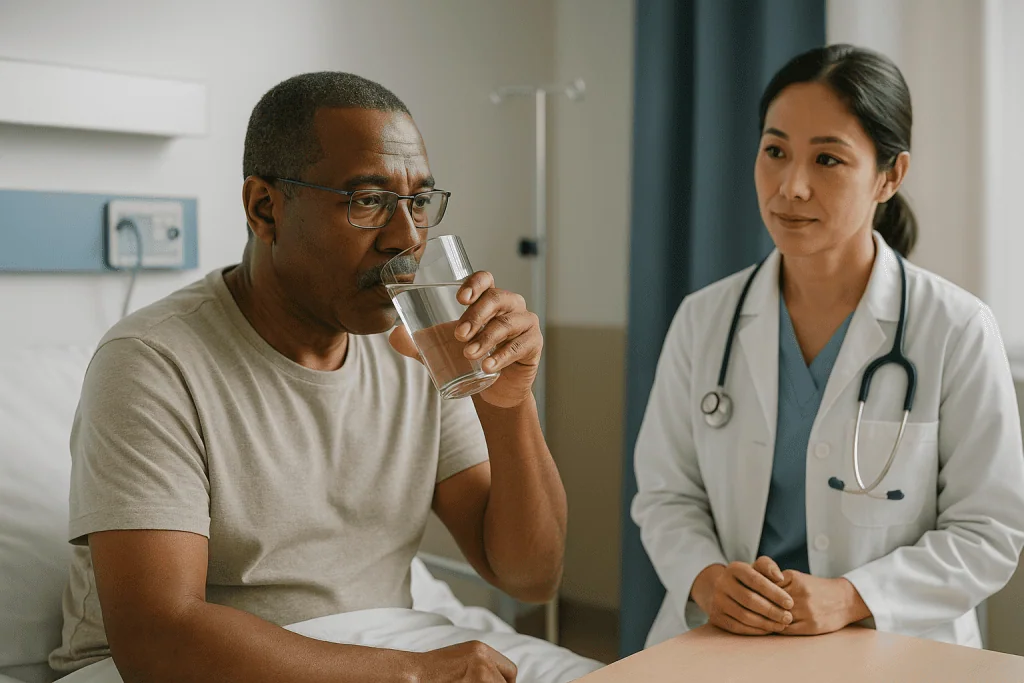
First, the urine is bloody. The resected area is essentially a graze on the inside of a wet organ, and grazes ooze. Pink, rosé or light cranberry urine is expected, and a few small flecks or threads of clot are common. Second, urination stings or burns, particularly at the end of the stream, because the urethra has been stretched by the instrument and the bladder neck is irritated. Third, there is urgency: a sudden, insistent need to go, sometimes producing only a splash. An inflamed bladder lining sends “full” signals long before the bladder is actually full.
Tiredness is the other common companion. Anesthesia, a disrupted night and the emotional weight of the word “tumor” all land at once. The Cleveland Clinic notes that fatigue after bladder procedures is common and generally eases over days, not hours.
Some people are surprised by mild lower-abdominal ache or a dull pressure just above the pubic bone, as if the bladder has been bruised, which in a sense it has. Others notice a small amount of blood at the tip of the urethra after the catheter comes out. Both settle.
What is not part of the ordinary picture, even on day one: urine that looks like undiluted red wine or ketchup, clots the size of a coin, an inability to pass urine despite a strong urge, or a temperature that climbs. Those belong in the “call” column and are covered in detail further on.
Blood in urine after TURBT: how much is too much?
Hematuria, the medical word for blood in the urine, is the symptom that generates the most anxious searches after TURBT, and the most honest answer is that it behaves in waves rather than a straight line.
The first wave is immediate: the raw resection bed weeps into the urine for the first several days. Color is a poor guide to volume, because a teaspoon of blood in a full bladder turns the whole thing red. Urologists tend to think in terms of trend and texture rather than shade. Urine that lightens across each day, even if it darkens after activity, is following the expected course. Urine that darkens across days, or that carries clots large enough to slow or stop the stream, is not.
The second wave often catches people off guard. Around one to two weeks after surgery, the scab (technically eschar) that formed over the cauterized area begins to lift as fresh lining grows underneath. As it separates, small vessels can bleed again, so urine that had cleared may turn pink for a day or two. NHS patient guidance on bladder procedures describes this delayed bleeding as a recognized part of healing rather than a sign something has gone wrong.
Hydration is the practical lever. Drinking steadily dilutes the urine, keeps clots from forming and flushes the bladder. Tea, coffee and alcohol can irritate an already inflamed lining, so many teams suggest water as the mainstay for the first week or so, though your own team’s instructions take precedence.
The threshold for concern, in plain terms: bright red urine that does not lighten after an hour or two of drinking, clots you can see and feel, or any bleeding paired with an inability to urinate.
Catheter, burning and bladder spasms after TURBT
A urinary catheter is a soft tube passed through the urethra so urine drains continuously into a bag. Not everyone has one after TURBT; it depends on the size and position of the tumor and how much bleeding the surgeon saw at the end. When one is used, MedlinePlus describes the typical course as short, often a day or two, though larger resections can mean longer.
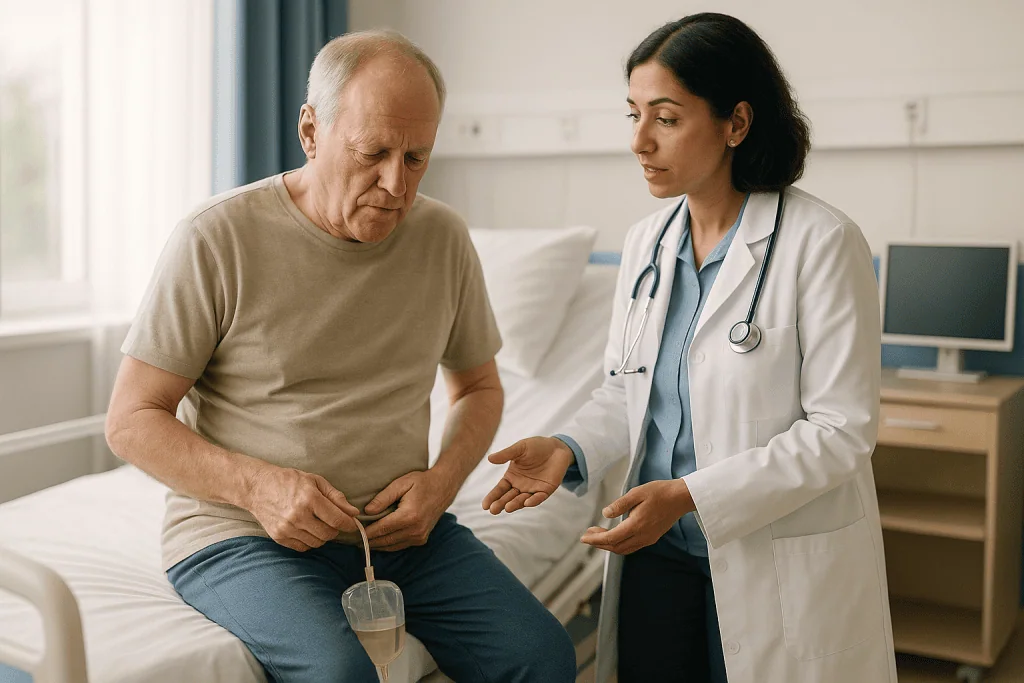
Catheters are safe and unglamorous. The bag fills with pink fluid, the tube can feel like a persistent need to urinate, and the balloon that holds it in place can trigger spasms. Bladder spasms are sudden, cramping contractions of the bladder muscle, felt as a sharp pressure low in the pelvis that builds and releases over a minute or so. They can push a little urine or blood out around the catheter, which looks alarming and is usually harmless.
Why do spasms happen? The bladder wall is irritated by the resection, by the catheter balloon and by the small clots it is trying to expel. It responds the way any irritated muscle does: it squeezes. A class of medicines called antispasmodics or anticholinergics, which dampen bladder muscle contractions, is sometimes prescribed. Whether you receive one, and for how long, is a decision for the prescribing clinician.
Once the catheter is out, burning on urination usually peaks in the first day or two and then fades. Some people notice a weak or split stream briefly; this reflects urethral swelling and settles. Passing urine more often than usual, including at night, is also expected while the bladder is inflamed and holding less comfortably.
What should prompt a call: a catheter that stops draining for more than an hour despite drinking, severe pain that painkillers do not touch, or spasms that escalate rather than ease.
Who has a TURBT, and who is usually asked to wait
TURBT is the standard first step for almost anyone in whom a cystoscopy has shown a growth in the bladder. It serves two purposes at once: it removes what can be seen, and it provides the tissue that decides everything afterward. According to the NHS, it is the main treatment for non-muscle-invasive bladder cancer and the essential staging procedure when muscle invasion is suspected.
Because it is done under anesthesia, fitness for anesthesia is the first gate. People with unstable heart or lung conditions may be asked to wait until those are optimized, and the anesthesia team makes that call.
Blood-thinning medicines are the second common reason for a pause. Anticoagulants and antiplatelet drugs, which reduce clotting to protect against stroke or heart attack, increase bleeding from the raw resection bed. Some are stopped for a period before surgery, some are continued, and some are bridged with a different agent. Never adjust these yourself; the surgeon and the doctor who prescribes them coordinate the plan.
Active urinary infection is the third. Resecting through infected tissue risks driving bacteria into the bloodstream, so a positive urine test before surgery often means treatment first and the procedure afterward.
A repeat TURBT is sometimes scheduled deliberately, a few weeks after the first, when the pathology shows a high-grade tumor or no muscle in the specimen. This is not a sign the first operation failed. It is a recognized quality step to confirm depth and remove anything missed while the field was bloody.
Alternatives exist for specific situations: watchful waiting for very small, low-grade recurrences in older adults, or moving directly to more extensive surgery when imaging strongly suggests muscle invasion. Each is a conversation, not a default.
Normal recovery vs. warning signs: a side-by-side table
People remember columns better than paragraphs at midnight, so here is the practical version. The left column describes the ordinary course as set out in mainstream patient guidance from the NHS, Mayo Clinic and Cleveland Clinic. The right column lists the signs those same sources flag as reasons to contact the team.
| Symptom | Usually within normal | Contact your team |
|---|---|---|
| Urine color | Pink to light red, lightening over days; brief return of pink around 1–2 weeks | Deep red or brown that does not lighten with fluids; darkening trend |
| Clots | Small flecks or threads | Coin-sized or larger clots; clots that block the stream |
| Passing urine | Frequent, urgent, stinging | Unable to pass urine for several hours with a full, painful bladder |
| Pain | Dull ache above pubic bone; brief cramping spasms | Severe or steadily worsening pain; pain with fever |
| Temperature | Normal | Fever, shaking chills, feeling faint |
| Catheter | Pink drainage, occasional leak around tube | No drainage for over an hour despite drinking; tube falls out |
| Energy | Tired for several days | Dizziness, racing heart, shortness of breath |
Two notes. Nothing in the left column requires you to prove it is fine; if worry persists, calling is always allowed. And nothing in the right column requires you to be certain; the team would far rather hear about a false alarm than about a bladder full of clot at three in the morning.
Keep the after-hours number for your urology unit on the fridge, not buried in a folder. The single most useful thing you can tell them is the trend: better than yesterday, same, or worse.
How long does the bladder take to heal after TURBT?
The honest answer has two layers, because “healed” means different things to you and to your surgeon.
For you, healing means the symptoms stop. Patient guidance from the NHS and Mayo Clinic describes urgency, burning and light bleeding easing over the first one to two weeks for most people, with the caveat that larger or multiple resections take longer. The second episode of pink urine, as the scab separates, tends to fall inside that window. By the end of the second or third week, many people report that urination feels close to normal, though a slightly smaller bladder capacity and occasional night waking can linger.
For the surgeon, healing means the resection bed has re-epithelialized: new lining has grown across the raw muscle and the area looks smooth on cystoscopy. That biological process runs behind your symptoms, generally over several weeks, which is one reason the first check cystoscopy is usually placed around three months after the operation according to NHS follow-up schedules. Looking earlier would show a healing scar that is hard to distinguish from new growth.
What speeds or slows the process? Hydration keeps clots from sitting on the wound. Avoiding heavy straining, from lifting or from constipation, reduces pressure spikes that can restart bleeding. Smoking slows tissue repair everywhere in the body and is also the leading risk factor for bladder cancer in the first place, which makes the recovery period a genuinely good moment to ask about support for quitting; the CDC and NHS both provide free resources.
What does not help: forcing extra fluids to the point of nausea, or the opposite instinct of drinking less so you pass urine less often. Steady is the word.
TURBT recovery time: driving, lifting, work, sex and travel
Because there is no external incision, people often feel ready to resume life faster than the bladder is ready to let them. A few practical thresholds, all of which your own team may adjust:
Driving. Not on the day of anesthesia, and not while a catheter is in. Beyond that, the usual test is whether you could perform an emergency stop without hesitation from pain. Many people are comfortable within a few days; check your insurer’s rules where relevant.
Lifting and exercise. Straining raises pressure inside the abdomen and the bladder, which can dislodge the healing scab and restart bleeding. Most guidance suggests avoiding heavy lifting and vigorous exercise for at least two weeks, with gentle walking encouraged from day one because it lowers the risk of blood clots in the legs after any anesthesia.
Work. Desk-based roles are often manageable within a week; physically demanding jobs tend to need longer. Fatigue is the limiter more than pain.
Sex. Sexual activity, including ejaculation, involves pelvic muscle contraction and can provoke bleeding early on. A pause until the urine has been clear for a few days is commonly advised; ask if you want a specific timeline.
Travel. If a trip is unavoidable soon after surgery, the priorities are medical rather than geographic: stay well hydrated, move and stretch regularly on long journeys to reduce clot risk, know how you would reach a doctor at your destination, and make sure your follow-up appointment and pathology discussion are already scheduled before you leave. Nobody should be far from care while the second wave of bleeding is still possible.
Constipation deserves its own line. Straining on the toilet is one of the more common triggers for fresh bleeding, so fluids, fiber and gentle movement matter in a way they rarely do after other minor procedures.
What the pathology report tells you, and what it cannot
The waiting is often harder than the recovery. Results typically take one to two weeks, and the appointment that follows is where the real plan is made. Knowing the vocabulary in advance takes some of the fear out of the page.
Type. Most bladder cancers are urothelial carcinoma, arising from the lining cells. Rarer types exist and are treated differently.
Grade. Low grade means the cells look relatively close to normal and tend to grow slowly; high grade means they look markedly abnormal and behave more aggressively. Grade is the strongest single predictor of how the disease behaves over time.
Stage. This is depth. Ta means confined to the lining; T1 means it reached the connective tissue beneath but not the muscle; T2 and beyond mean muscle invasion. A separate category, carcinoma in situ, describes a flat, high-grade change in the lining that cannot be seen as a lump.
Muscle present in specimen. A line that sounds like filler and is anything but. Without muscle in the sample, the pathologist cannot rule out invasion, and a repeat TURBT is often recommended.
The NHS groups non-muscle-invasive cancers into low, intermediate and high risk using these features plus tumor size and number, and each group has a different follow-up intensity and treatment path.
What the report cannot tell you is what will happen to you personally. It describes a tissue sample at one moment. Questions such as “what is the life expectancy after TURBT” have no honest single answer, because the range spans from small low-grade tumors managed with surveillance for decades to muscle-invasive disease requiring major treatment. Your team can place your result within that range; a website cannot.
Can bladder cancer come back after TURBT, and how fast?
Yes, it can, and this is the part of bladder cancer that surprises people most. The Mayo Clinic describes bladder cancer as having a high tendency to recur, which is why follow-up is built around repeated looks inside the bladder rather than a single all-clear.
Why so prone to returning? Three mechanisms. The entire bladder lining has been exposed to the same carcinogens, chiefly tobacco smoke chemicals filtered into the urine, so new tumors can arise at fresh sites; this is sometimes called a field effect. Microscopic tumor cells shed during resection can settle elsewhere on the lining and implant, which is the rationale for a single instillation of chemotherapy into the bladder soon after surgery. And flat carcinoma in situ can be invisible to the naked eye and left behind.
How fast? There is no fixed speed. Low-grade tumors commonly grow slowly, and many recurrences found at surveillance cystoscopy are only a few millimeters across. High-grade tumors can recur and progress more quickly, which is why their follow-up is closer. The NHS notes that the first check cystoscopy is usually around three months after TURBT, precisely because that interval catches early recurrence while most healing has finished.
The surveillance schedule after that depends on risk group. Low-risk disease may need only a handful of cystoscopies over a few years; intermediate and high-risk disease need them more often and for longer, sometimes with urine tests and imaging of the upper urinary tract, since the same lining cells extend up into the kidneys.
Recurrence is not the same as failure. A small recurrence found on schedule and resected is the system working as designed. Progression, meaning a tumor returning at a deeper stage or higher grade, is the outcome surveillance exists to prevent or catch early.
Treatments that may follow TURBT: single-dose chemotherapy and BCG
TURBT is frequently only the first move. Two categories of treatment delivered directly into the bladder, called intravesical therapy, are commonly discussed afterward. Both are described here by mechanism and general timeline; whether either applies to you is a decision for your team.
A single instillation of chemotherapy. For many non-muscle-invasive tumors, a liquid chemotherapy drug is placed into the bladder through the catheter shortly after resection, according to NHS guidance usually within the first 24 hours. The aim is to destroy floating tumor cells before they can implant on the raw lining. Because the drug stays in the bladder and is then drained, whole-body side effects are minimal; the main effects are extra bladder irritation for a day or two. You may be asked to sit to urinate and to flush twice for a short period afterward. This is not the same as systemic chemotherapy and does not cause hair loss.
BCG. Bacillus Calmette-Guérin is a weakened strain of a bacterium related to tuberculosis. Placed in the bladder as a course of treatments over weeks, sometimes followed by maintenance treatments over a longer period, it provokes an immune reaction in the lining that reduces the chance of intermediate and high-risk tumors coming back or progressing. Flu-like symptoms and bladder irritation after each treatment are expected; fever that persists is not, and is a reason to call.
For muscle-invasive disease the conversation moves to different options, including removal of the bladder or combinations of chemotherapy and radiotherapy. That is a separate article. The point here is simpler: the plan after TURBT is shaped by the pathology, and it is normal for the treatment path to be discussed only once the report is back.
What people often get wrong about recovery after TURBT
Recovery forums are full of hard-won wisdom and a fair amount of folklore. A few corrections, grounded in the sources at the end of this article.
“If the urine is clear, the bladder is healed.” Symptoms settle before tissue does. Clear urine by day five is good news, but the resection bed is still resurfacing for weeks, and the second wave of pink around the two-week mark is common. Do not read early clear urine as permission to lift furniture.
“Any blood means the cancer is back.” Bleeding during the first few weeks is the wound, not the disease. Recurrence is judged at cystoscopy, not by color in the bowl.
“Drinking less will reduce the burning.” Concentrated urine irritates a raw lining more, and clots form more readily in a bladder that sits partly full. Steady fluids are the better path, unless your team has restricted fluids for a specific reason.
“A repeat TURBT means the surgeon missed something.” A planned second resection for high-grade or incompletely staged tumors is a recognized quality standard, not an admission of error.
“Once the tumor is out, follow-up is optional.” Bladder cancer’s tendency to recur makes surveillance the core of care, not an afterthought. Skipping the three-month cystoscopy because you feel well removes the safety net at exactly the point it matters.
“The chemotherapy in the bladder is the same as chemo for other cancers.” Intravesical treatment stays where it is put. Its side effects are local and short-lived.
“Bladder spasms are a sign of infection.” Spasms are a muscle response to irritation and are expected. Infection announces itself differently: fever, foul-smelling or cloudy urine, and burning that worsens rather than improves after the first few days.
Questions to ask your care team
Good questions do more than fill an appointment; they tell your team what you are worried about so they can calibrate the answer. Bring a written list, and bring someone to take notes if you can.
- Was there muscle in the specimen, and will I need a repeat TURBT?
- What was the grade and stage, and which risk group does that put me in?
- Did I receive a single instillation of chemotherapy after surgery, and is further intravesical treatment being considered?
- When is my first follow-up cystoscopy, and how often after that?
- How much bleeding, and for how long, would you consider normal in my particular case given the size of the resection?
- Which of my regular medicines, especially blood thinners, should restart and when? Who coordinates that?
- Is there anything specific about my anatomy or the tumor’s position that changes the usual advice on lifting, sex or travel?
- Whom do I call after hours, and what exactly should make me call rather than wait?
- Are there imaging or urine tests planned for the upper urinary tract?
- Would help with stopping smoking be part of my plan, and can you refer me?
Two questions are worth asking even when they feel awkward. First: “What is the range of outcomes for someone with my exact result?” That reframes the unanswerable life-expectancy question into one your team can address honestly. Second: “What would make you change the plan?” Knowing the decision points in advance turns surveillance from a source of dread into a process you understand.
Write down the answers. The information density of a results appointment is high, and most people retain far less than they think.
When to call your doctor
Most of what happens after TURBT is uncomfortable rather than dangerous. A small number of situations are different, and the guidance from the NHS, Mayo Clinic and Cleveland Clinic converges on the same list.
Call your urology team the same day, or use the after-hours number, if you notice any of the following:
- Heavy bleeding: urine that is deep red or brown and does not lighten after an hour or two of drinking, or bleeding that is getting worse rather than better across a day.
- Clots that you can see and feel, particularly if the stream slows, stutters or stops.
- Being unable to pass urine for several hours despite a strong urge, with a full and painful lower abdomen. This is clot retention until proven otherwise and needs prompt attention.
- A catheter that stops draining for more than an hour, or that falls out.
- Fever, shaking chills, or feeling suddenly unwell, faint or confused. Infection after bladder surgery can spread to the bloodstream and is treated as urgent.
- Severe or steadily worsening pain in the lower abdomen, back or side, especially with fever or vomiting. Rarely, the resection can breach the bladder wall, and this is how it presents.
- Calf pain, swelling, chest pain or breathlessness, which can indicate a blood clot after any anesthesia.
Go to an emergency department or call emergency services if you cannot pass urine and are in significant pain, if you are passing large clots continuously, if you have chest pain or trouble breathing, or if fever comes with confusion, a racing heart or feeling close to collapse.
Everything else, from lingering urgency to a return of pink urine in week two, is worth mentioning at your next contact but rarely needs a midnight call. When in doubt, call anyway. The decision about what to do next always rests with the team who knows your bladder and your pathology.
Frequently asked questions
How long does the bladder take to heal after TURBT?
Symptoms such as burning, urgency and light bleeding usually ease over one to two weeks, according to NHS and Mayo Clinic patient guidance, though larger resections can take longer. The lining itself keeps resurfacing for several weeks after that, which is why the first follow-up cystoscopy is generally scheduled around three months later rather than sooner.
Is blood in urine after TURBT normal two weeks later?
A return of pink or light red urine around one to two weeks after surgery is common and usually reflects the scab separating from the healing resection area as new lining grows underneath. It typically lasts a day or two. Bright red urine that does not lighten with fluids, or clots that block the stream, should prompt a call to your team.
What causes bladder spasms after TURBT and how long do they last?
Bladder spasms are sudden cramping contractions of the bladder muscle triggered by irritation from the resection, a catheter balloon or small clots. They usually build and release within a minute and settle over the first days, often improving once the catheter is removed. Antispasmodic medicines are sometimes prescribed; that decision belongs to your clinician.
What is a typical TURBT recovery time before returning to work?
Many people with desk-based work return within about a week, while physically demanding jobs often need two weeks or more because straining and heavy lifting can restart bleeding from the healing area. Fatigue tends to limit people more than pain. Your surgeon can tailor the timeline to the size of your resection.
Can bladder cancer come back after TURBT?
Yes. The Mayo Clinic describes bladder cancer as having a high tendency to recur, because the entire bladder lining has been exposed to the same risk factors and new tumors can arise at fresh sites. This is why follow-up relies on repeated cystoscopies, with intensity depending on the grade and stage of the original tumor.
How fast do bladder tumors grow back?
There is no fixed speed. Low-grade tumors commonly grow slowly and many recurrences are only a few millimeters when found at surveillance. High-grade tumors can recur and progress more quickly, which is why their follow-up is closer. The three-month check cystoscopy exists to catch early recurrence once most healing has finished.
What is the life expectancy after TURBT?
It depends almost entirely on the grade and stage in the pathology report, so no single figure applies. Small, low-grade, non-muscle-invasive tumors are often managed with surveillance for many years, while muscle-invasive disease follows a different and more intensive pathway. Ask your team to describe the range of outcomes for your exact result.
Why do I need a second TURBT?
A repeat resection is often recommended when the first pathology shows a high-grade tumor or when no bladder muscle was included in the specimen, so invasion cannot be ruled out. Performed a few weeks later, it confirms depth and removes anything obscured by bleeding the first time. It is a recognized quality standard, not a sign of failure.
Is chemotherapy put into the bladder after TURBT the same as regular chemo?
No. Intravesical chemotherapy is a liquid drug placed into the bladder through the catheter, usually within the first 24 hours according to NHS guidance, and then drained. It targets loose tumor cells before they can implant. Because it stays in the bladder, side effects are mainly local irritation for a day or two, not hair loss or nausea.
How much should I drink after TURBT?
Steady fluid intake, mostly water, helps dilute the urine, reduces clot formation and flushes the healing area. Forcing large volumes to the point of nausea is unnecessary, and drinking less to urinate less often tends to worsen burning and clot risk. Follow any specific limits your team gives you, especially if you have heart or kidney conditions.
References
- NHS: Bladder cancer, Treatment
- Cleveland Clinic: Bladder Cancer
- MedlinePlus: Urinary catheters
- NHS: Cystoscopy
This article is for general information only and is not a substitute for professional medical advice. Please consult a qualified doctor about your individual situation.

More from the Blog

Which Blood and Genetic Tests Guide Lymphocytic Leukemia Treatment Choices?
Treatment choices in chronic lymphocytic leukemia rest on a small set of tests: a complete blood count with flow cytometry to confirm the diagnosis,…
When Is Graft-Versus-Host Disease Suspected? Fever, Rash and Diarrhea After Transplant
Graft-versus-host disease is suspected when someone who has received donor stem cells develops a new rash, persistent watery diarrhea, nausea, or rising liver tests,…

Mohs Surgery Recovery: Pressure Dressing, Stitches and the First Two Weeks of Wound Care
Mohs surgery recovery usually begins with a firm pressure dressing worn for about one to two days, followed by daily gentle cleaning, ointment and…

Why Genetic and Molecular Testing Comes First in Acute Myelogenous Leukemia Treatment
Genetic and molecular testing comes first in acute myelogenous leukemia because the chromosome changes and gene mutations found in the leukemia cells decide which…
Why a Dental Check Comes Before IMRT for Head and Neck Cancer
A dental check comes before IMRT for head and neck cancer because radiation permanently reduces the jawbone's blood supply and its ability to heal.…

Why Immunotherapy Side Effects Can Look Like an Infection: What the Care Team Checks
Immunotherapy side effects can look like an infection because both are driven by inflammation, so fever, cough, diarrhea, and fatigue overlap. Immune related adverse…