

Teledentistry Before You Travel for Dental Treatment: What a Remote Review Can Plan in Advance
Key Takeaways
- A remote review can collect records, spot prerequisites such as gum disease and outline stages, but it cannot measure gum pockets, test tooth vitality or confirm bone volume without a recent 3D scan.
- The Mayo Clinic describes implant treatment as a staged process in which bone heals around the post over several months, so a single short visit rarely covers everything.
- NHS guidance does not support antibiotics alone for a dental abscess; the infection needs drainage, root canal treatment or extraction, all of which require in-person care.
- The often-quoted 3-3-3 rule does not appear in mainstream dental guidance; the NHS recommends brushing twice a day for about two minutes with fluoride toothpaste.
- The CDC advises against flying too soon after any surgery because of clot risk and recommends agreeing the waiting interval with the surgeon before booking travel.
- The NHS advises anyone considering treatment abroad to arrange named follow-up care at home before leaving, with copies of surgical notes and implant details.
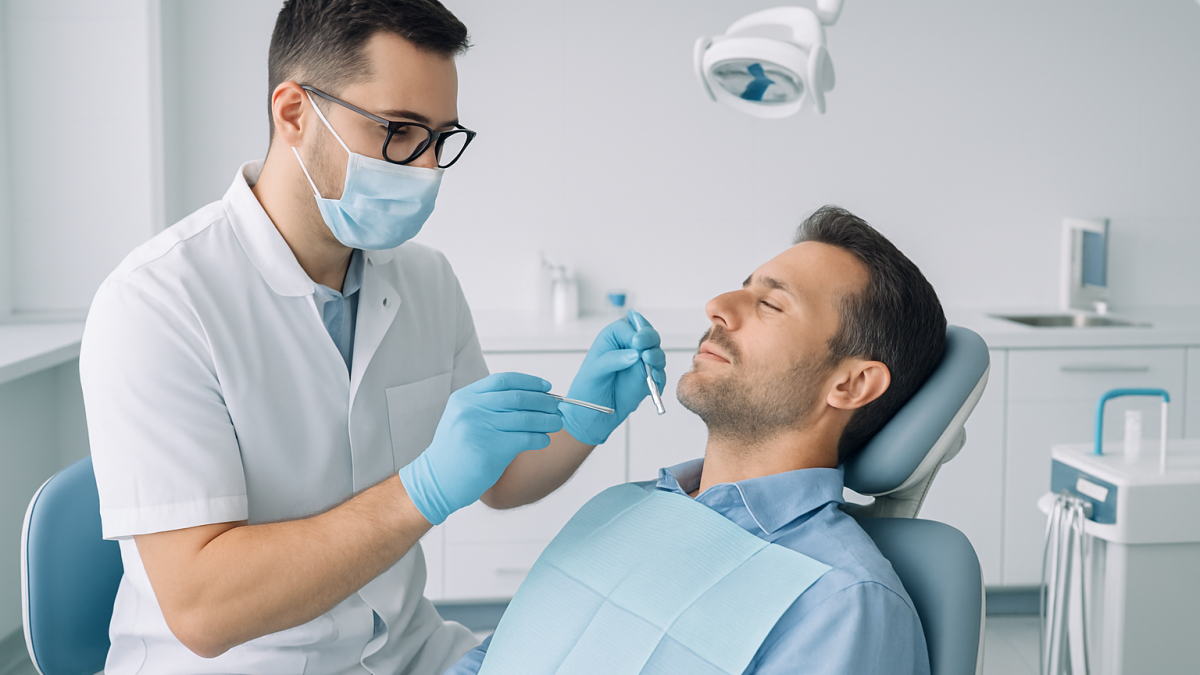
Teledentistry before traveling for treatment is a video or photo-based review with a dentist that happens before you leave home. It can gather your dental records, scans and medical history, flag conditions such as gum disease or uncontrolled diabetes that may delay implant surgery, and sketch a provisional plan. It cannot replace a hands-on examination, and any final decision rests with the treating team you eventually meet in person.
The photo is taken in a bathroom mirror at half past ten at night: mouth stretched wide, phone torch glaring, a gap where a molar used to be. It is not flattering. It is also, increasingly, how the first conversation about a dental implant begins for someone who is thinking about having the work done a long way from home.
That mirror selfie usually leads to a scheduled video call, a request for X-rays, a medical history form and, if the dentist is careful, a list of things that need sorting out before anyone books a flight. This is teledentistry before traveling for treatment, and it deserves a more honest description than the glossy ones.
Done well, a remote review is a planning tool. It can save a wasted journey and surface problems while there is still time to treat them. Done badly, it becomes a sales funnel with a webcam. The difference lies in what the dentist asks for, what they admit they cannot see, and how much of the plan they are willing to leave open until they have actually put a mirror in your mouth.
What teledentistry before traveling for treatment actually means
Teledentistry is dental care delivered at a distance using video calls, uploaded photographs, shared scans and secure messaging. It is not one thing. A live video consultation, a dentist reviewing your X-rays overnight and sending a written opinion, and a chat-based triage service are all filed under the same word, and they offer very different levels of insight.
In the context of travel, the remote review sits at the front of a longer process. Someone has lost a tooth, or several, and is weighing up an implant: a titanium post placed into the jawbone that acts as an artificial root, with a crown fitted on top once the bone has healed around it. The Mayo Clinic describes this as a staged procedure that unfolds over months, not days, because bone needs time to fuse to the post in a process called osseointegration.
A pre-travel teledentistry appointment tries to answer four practical questions. Is an implant a plausible option for this person at all? What information is missing? Which health issues need attention first? And roughly how many in-person stages, spread over what timeframe, would the plan involve? Notice what is absent from that list: a firm diagnosis, a guaranteed timeline and a promise of outcome. A conscientious remote dentist will say so out loud.
The distinction matters because the phrase is used loosely online. Some services describe a ten-minute call as a full consultation. Others quietly do the more valuable work of collecting records and coordinating with a dentist near you. Knowing which kind you are dealing with is the first piece of planning worth doing.
How a virtual dental consultation before travel works, step by step
Most remote reviews follow a recognizable sequence, even when the technology varies. The first contact is usually an intake form: what is missing, for how long, whether there is pain, swelling or looseness, and a medical and medication history. Take this form seriously. Bleeding disorders, medicines that affect bone turnover, heart conditions and diabetes all shape what an implant surgeon can safely do, and a form that skips them is a warning sign in itself.
Next comes imaging. Intraoral photographs help, but the dentist will almost always ask for radiographs. A panoramic X-ray shows both jaws in one sweep. A cone beam CT, often shortened to CBCT, is a three-dimensional scan that shows bone height, width and density, and the position of nerves and sinuses. Without one of these, no one can honestly tell you whether there is enough bone for an implant or whether grafting might be needed.
Then the live element: a video call where the dentist looks at your mouth as best a webcam allows, asks you to bite, open and point, and talks through your goals. Expect this part to be more about listening than looking.
Finally, a written summary. The useful version lists what was reviewed, what was provisionally proposed, what remains unknown and what should happen before travel. If a summary reads like a confirmed treatment plan with no caveats, ask why. A remote dentist working within accepted standards knows that the in-person examination may overturn any of it.
What a remote review can plan in advance, and what it cannot
The strongest case for a remote review is logistics. Implant treatment is a chain of appointments, and a video call can map the chain before you commit to it. The Mayo Clinic outlines the typical stages: removal of a damaged tooth if one remains, bone grafting when needed, implant placement, a healing period of several months, fitting of the abutment (the connector that sits between post and crown), and finally the crown itself. Knowing which of these stages apply to you tells you how many trips, or how long a single stay, a plan might realistically require.
A remote review can also identify prerequisites. Active gum disease, untreated decay in neighboring teeth, a heavy smoking habit or poorly controlled blood sugar are all things a dentist can spot or ask about from a distance and advise you to address at home first. That is time well spent regardless of where treatment eventually happens.
What a screen cannot do is assess gum firmness, probe pocket depths around teeth, test how a tooth responds to cold, or feel the quality of bone. It cannot detect an early fracture in a neighboring tooth or judge how your bite loads a particular area. The Harvard Health overview of telehealth is blunt on this point: a remote visit works best when a physical examination is not essential, and it works poorly when it is.
So the realistic output of teledentistry before traveling for treatment is a provisional plan and a to-do list, not a signed contract. Treat any plan that arrives without a clear list of unknowns as incomplete.
Who teledentistry before traveling for treatment suits, and who is asked to wait
Remote planning tends to work best for people whose situation is already stable. A single missing tooth in a healthy mouth, records that are less than a year old, no active infection and a medical history without major flags: that is the profile where a video review can genuinely move things forward.
Several groups are commonly asked to slow down. Anyone with current pain or swelling needs an in-person examination first, because infection changes everything about timing. People with untreated periodontitis, the form of gum disease that destroys the bone supporting teeth, are usually told to have it treated and stabilized before implants are considered, since the same bacteria can threaten an implant. The Mayo Clinic also lists heavy smoking, uncontrolled chronic conditions and certain medicines affecting bone as factors that a surgeon will weigh carefully.
Then there is the person who has not seen a dentist in years and has no imaging at all. A remote review can still be useful for them, but its useful output is a single instruction: get a proper examination and up-to-date X-rays locally before anything else is discussed.
Children and adolescents are a separate case. Implants are generally not placed until jaw growth is complete, so remote planning for a young person is really a conversation about interim options and timing, not about surgery.
Being asked to wait is not a rejection. In implant dentistry, the groundwork is where most of the avoidable problems are prevented, and a remote dentist who tells you to pause is doing the job properly. The final call on readiness always sits with the surgeon who examines you in person.
Why the implant timeline matters when you are planning around a trip
The single most common misunderstanding in travel-linked implant planning is time. People imagine one visit. The biology says otherwise.
After an implant post is placed, the surrounding bone needs to grow onto its surface. The Mayo Clinic describes this healing phase as taking several months, and notes that the whole process from first surgery to final crown can stretch across many months, longer still if a bone graft is needed first. A graft, in which bone material is added to a thin or shallow ridge, may need its own healing period before an implant can even be placed.
Some protocols place a temporary crown on the day of surgery. Others fit the implant beneath the gum and leave it undisturbed. Which route is appropriate depends on bone quality, the position in the mouth and how the bite loads that area, and it is not a decision a remote dentist can safely finalize from a photograph.
What this means for planning is straightforward. A video review should give you a sense of whether your case is likely to involve one stay or two, and roughly how far apart those stays might fall. It should also make clear who handles the months in between: the healing checks, the stitch removal, the reassurance when something feels odd. A plan that compresses all of this into a fixed number of days, before anyone has examined you, is optimistic at best.
The honest phrasing is a range tied to your own biology, revised once the surgeon has seen the scan and the mouth together.
What records to gather before an online dental consultation abroad
A remote review is only as good as what you feed it. Assembling records ahead of time turns a vague chat into a useful planning session, and most of what is needed already exists somewhere in a filing system.
- Recent radiographs, ideally a panoramic X-ray and, if you have had one, a CBCT scan. Ask your local dentist for the original files rather than screenshots.
- A written history of the tooth or teeth in question: when they were lost or extracted, whether there was infection, whether a graft or socket preservation was done at the time.
- Your full medication list, including anything for bones, blood thinning, diabetes or the heart, plus over-the-counter products and supplements.
- Relevant medical letters, especially for heart valve conditions, immune suppression, radiotherapy to the head or neck, or previous complications with anesthesia.
- Clear photographs in daylight: front teeth together, upper arch, lower arch, and the gap from the side.
The medication list deserves particular care. Some medicines used for osteoporosis and certain cancers can affect how jawbone heals after surgery. A remote dentist needs to know about them by name and duration, and the decision about how they influence surgery sits with the prescriber and the surgeon together. No one should stop or alter a prescribed medicine on the strength of a video call.
Bring dates, too. An X-ray from four years ago tells the dentist about the past, not the present. Bone changes after a tooth is lost, and a remote review built on old imaging is planning for a jaw that no longer exists in quite that shape.
Remote review versus in-person examination: what each can and cannot do
A side-by-side view makes the limits clearer than paragraphs can. The table below reflects what mainstream telehealth guidance, including the Harvard Health overview, says about the strengths and gaps of screen-based care applied to dentistry.
| Task | Remote review | In-person examination |
|---|---|---|
| Take medical and dental history | Fully possible | Fully possible |
| Review existing X-rays and CBCT | Possible if files are shared | Possible, with new imaging available |
| Assess bone volume for an implant | Only from a recent 3D scan | Scan plus clinical assessment |
| Measure gum pocket depths | Not possible | Standard |
| Test tooth vitality or tenderness | Not possible | Standard |
| Detect early cracks or hidden decay | Unreliable | Reliable with imaging and probing |
| Assess bite and jaw movement | Limited | Standard |
| Discuss options and expectations | Well suited | Well suited |
| Identify prerequisites to treat first | Often possible | Standard |
| Confirm the final treatment plan | Not appropriate | Required |
The pattern is consistent. Anything that relies on talking, reading and looking at existing images translates reasonably to a screen. Anything that relies on touch, instruments or fresh imaging does not. Implant surgery draws heavily on the second column, which is why the in-person visit is not a formality.
The practical lesson is to use the remote review for what it does well, and to expect the examining dentist to add, remove or reorder steps once they have seen you. That revision is not a failure of the remote process. It is the remote process working as intended.
The disadvantages of teledentistry nobody puts in the brochure
Enthusiasm for remote care is understandable, but the drawbacks are real and worth stating plainly.
The first is diagnostic blind spots. Webcam images compress detail, colour balance shifts, and the back of the mouth is largely invisible. A dentist may see a healthy-looking gap and miss a thinning ridge or an adjacent tooth quietly failing. Harvard Health notes that telehealth can lead to gaps in care precisely when a physical examination would have changed the plan.
The second is fragmented responsibility. If a remote dentist gives an opinion, a local dentist takes the X-rays and a surgeon somewhere else operates, who owns the follow-up when the gum around an implant becomes sore three months later? Unless this is agreed in advance, the answer is often nobody, and the patient becomes the coordinator of their own care.
The third is commercial pressure. Many remote services are attached to a treatment provider, and the incentive to convert a call into a booking is not always aligned with the incentive to say, gently, that someone should wait. The signs of a review tilted toward sales are familiar: no request for imaging, no discussion of alternatives, a plan finalized before examination, and urgency around booking.
Privacy and record-keeping are the fourth. Dental images and medical histories are sensitive data, and the standards that protect them vary. Ask where your files will be stored and who can see them.
None of this means remote review is useless. It means its value depends on the honesty of the person on the other end of the call, and on you knowing what a good one looks like.
Can you do telehealth for a tooth infection?
Partly, and the part that cannot be done remotely is the part that matters.
A dental abscess is a collection of pus caused by bacterial infection inside a tooth or in the gum beside it. The NHS describes the typical picture as intense throbbing pain, tenderness on biting, sometimes swelling of the face or gum, and a general sense of being unwell. A video call can help a dentist recognize that picture, judge how urgent it is and advise on immediate steps.
What a video call cannot do is treat the cause. NHS guidance is clear that antibiotics are not usually recommended as the sole treatment for a dental abscess, because the infection is sealed inside a space that antibiotics reach poorly. Treatment means removing the source: draining the abscess, performing root canal treatment to clean out the infected pulp, or extracting the tooth. Every one of those requires a chair, instruments and a dentist’s hands. Where an antibiotic is prescribed alongside, it is to control spread while definitive treatment is arranged, and the decision belongs to the prescribing clinician who has assessed you.
For someone planning implant treatment elsewhere, an infection changes the sequence entirely. Surgeons do not place implants into infected bone. A remote dentist who spots an abscess should redirect you to local, in-person care first and reset the timeline afterward.
An infection that is spreading is a medical emergency rather than a dental one. Swelling extending toward the eye or down the neck, difficulty swallowing or breathing, fever, or trouble opening the mouth all warrant urgent in-person attention rather than another video call.
Is it safe to fly after dental treatment, from root canal to implant surgery?
People searching this question are usually asking about two separate risks: the mouth and the rest of the body.
Start with the mouth. Cabin pressure changes can provoke pain in a tooth that has trapped air or gas beneath a temporary filling, a phenomenon called barodontalgia. After root canal treatment, which the NHS describes as cleaning and sealing the infected pulp space, sometimes across more than one appointment with a temporary filling in between, a tooth may be tender for a few days and can ache on ascent or descent. This is uncomfortable rather than dangerous, and it is worth telling the treating dentist your travel plans so that any temporary seal is placed with that in mind.
After an extraction or implant placement, the concern is disturbing the healing site. Bleeding that restarts, a dislodged clot, or swelling that peaks in the first two to three days are easier to manage close to the person who did the work. Surgeons typically prefer to review the site before a patient departs, and the wait they suggest is theirs to set.
Now the body. Any surgery raises the risk of blood clots in the legs, and long flights add to it. The CDC’s medical tourism guidance advises against flying too soon after a procedure and recommends discussing timing with the surgeon beforehand. On any long journey, the CDC’s general advice applies: move about regularly, stay hydrated, and know the signs of a clot, including one-sided calf swelling or pain and sudden breathlessness.
There is no universal number of days that suits everyone. The right interval depends on the procedure, your health and the length of the flight, and the treating team should state it before you book.
What the following days and weeks usually look like, and who looks after you at home
A remote review that never mentions aftercare is missing half the story. Here is the shape of what commonly follows implant surgery, drawn from the Mayo Clinic’s description of the procedure.
In the first few days, expect swelling of the gum and face, some bruising, minor bleeding and discomfort at the site. Soft foods are usual while the area settles. Stitches, if they are not the dissolving kind, are typically removed at a follow-up visit within a couple of weeks. The surgeon may check that the gum is closing cleanly over or around the implant.
Over the following months, the visible part of the process goes quiet while osseointegration happens beneath the surface. Nothing feels different day to day, which is exactly why people are tempted to skip check-ups. Yet this is when early signs of trouble, such as persistent tenderness, a loose healing cap or gum recession, are easiest to catch.
Then come the restorative stages: uncovering the implant if it was buried, fitting the abutment, taking impressions, and finally seating the crown. Each is an in-person appointment.
The planning question a remote review should answer is who covers this stretch. The NHS advice on going abroad for medical treatment stresses arranging follow-up before you travel, and asking what happens if complications develop after you return. In practice that means a named local dentist who has agreed to see you, has copies of the surgical notes and implant specifications, and knows what the surgeon expects at each stage. Without that arrangement, the months of healing become months of uncertainty.
What people often get wrong about remote dental planning
Myths cluster around this topic, and some of them cost people real time.
“The video call is the consultation.” It is the beginning of one. The examining dentist will repeat much of it, and may reach different conclusions with better information. That is normal.
“Photos are enough to plan an implant.” Photographs show teeth and gums. They do not show bone. Bone volume, density and the position of nerves and sinuses come from radiographs and, ideally, a 3D scan. No surgeon plans placement without them.
“There is a 3-3-3 rule that tells you what to do.” Various versions circulate online, usually about brushing three times a day for three minutes, or waiting three days before worrying about pain. None of them appears in mainstream guidance. The NHS recommends brushing twice a day for about two minutes with a fluoride toothpaste, and advises seeing a dentist rather than waiting out pain that is severe or lasts more than a couple of days.
“Antibiotics from a telehealth visit will sort out an infected tooth.” They may reduce spread temporarily. They do not remove the source, and NHS guidance does not support them as sole treatment for an abscess.
“An implant is a same-week job.” The Mayo Clinic describes healing measured in months. Same-day temporary crowns exist for selected cases, but the bone still takes its time underneath.
“Remote dentists are neutral by default.” Some are. Others work for the provider they are steering you toward. Ask who employs the person reviewing your case.
Each of these misunderstandings shortens the plan on paper and lengthens it in reality.
Questions to ask your care team during and after the remote review
A good remote review invites questions rather than deflecting them. These are the ones that tend to expose whether a plan is genuinely provisional or merely presented that way.
- Which imaging have you actually reviewed, and how recent is it? Would you want a CBCT before deciding anything?
- What do you not know yet about my case that only an in-person examination can answer?
- Are there conditions in my mouth or medical history that should be treated or stabilized before implant surgery is considered?
- Based on what you can see, how many stages might my treatment involve, and roughly how far apart could they fall? Please give ranges, not dates.
- What are the alternatives to an implant for my situation, such as a bridge or a removable denture, and why might one be preferred?
- Who will be responsible for my follow-up care once I am home, and will they receive my surgical notes and implant details?
- What is the process if something goes wrong after I return: pain, loosening, infection, a lost crown?
- Do you work for, or receive payment from, the provider who would carry out the surgery?
- How will my records and images be stored, and who can access them?
- What would make you advise me not to proceed, or not yet?
Write the answers down. Then take the same list to the dentist who examines you in person and compare. Consistency between the two conversations is reassuring. Contradictions are information, and they belong in the open before any decision is made. Whatever the answers, the choice about whether and when to proceed remains with you and the treating team, not with the screen.
When to call your doctor: red-flag signs before, during and after treatment
Remote planning is for calm situations. Some signs mean the planning should stop and in-person care should start, whether you are still at home, mid-treatment or recently returned.
Seek urgent care the same day, in person, for any of the following:
- Facial swelling that is spreading, especially toward the eye or down into the neck, or swelling under the tongue.
- Difficulty swallowing, difficulty breathing, or a voice that has changed with the swelling.
- Fever with dental pain, or feeling generally unwell alongside a tooth or gum problem.
- Inability to open the mouth more than a finger or two wide.
- Bleeding from a surgical site that does not settle with firm pressure on a clean gauze pad.
- After a flight or long journey: pain or swelling in one calf, chest pain, or sudden shortness of breath, which the CDC lists as possible signs of a blood clot.
Contact your dentist or surgeon promptly, though not necessarily as an emergency, for pain that is getting worse rather than better after the first few days, a bad taste or discharge from the site, an implant or healing cap that feels loose, numbness that persists beyond what you were told to expect, or a temporary filling or crown that has come off.
Before travel, do not proceed with a trip if new pain, swelling or an abscess appears; the sequence changes and the treating team needs to reassess.
If you are unsure whether something counts as urgent, the NHS advice on dental abscesses is to err on the side of being seen. A video call can help you describe the problem, but it cannot examine it, and every decision about treatment sits with the clinician who can.
Frequently asked questions
What are the disadvantages of teledentistry before dental implant treatment?
The main disadvantages are diagnostic blind spots, fragmented responsibility and commercial pressure. A webcam cannot probe gums, test teeth or assess bone, so problems can be missed. When several providers share a case, follow-up can fall through the gaps. Some remote services are tied to a treatment provider, which can tilt advice toward booking rather than waiting. Harvard Health notes telehealth works poorly when a physical examination would change the plan.
Is it safe to fly after a root canal treatment?
Most people can fly after root canal treatment, but the tooth may ache with cabin pressure changes, particularly if a temporary filling is in place between appointments, a discomfort known as barodontalgia. The NHS notes that root canal treatment can take more than one visit. Tell your dentist about travel plans so the temporary seal and timing account for it, and confirm with them how soon after your appointment flying is reasonable.
What is the 3-3-3 rule in dentistry?
There is no 3-3-3 rule in mainstream dental guidance. Versions online variously suggest brushing three times a day for three minutes, or waiting three days before acting on tooth pain. Neither comes from a recognized body. The NHS advises brushing twice a day for about two minutes with fluoride toothpaste, and seeing a dentist for severe pain or pain lasting more than a couple of days rather than waiting.
Can you do telehealth for a tooth infection?
A telehealth call can help a dentist recognize a likely abscess, judge urgency and direct you to care, but it cannot treat the infection. The NHS says antibiotics alone are not usually recommended for a dental abscess; the source needs draining, root canal treatment or extraction, which require in-person care. Spreading swelling, fever, or difficulty swallowing or breathing need urgent face-to-face attention rather than a video appointment.
What can a virtual dental consultation before travel actually decide?
Very little definitively. It can review your history and existing imaging, identify conditions to treat first, discuss alternatives such as bridges or dentures, and outline how many stages an implant plan might involve. It cannot confirm bone volume without a recent 3D scan, and it cannot finalize a treatment plan. The examining dentist may add, remove or reorder steps once they have seen you, and that revision is expected.
Which records should I gather for an online dental consultation abroad?
Gather recent radiographs, ideally a panoramic X-ray and any CBCT scan, as original files rather than screenshots; a written history of the missing tooth including any infection or grafting; a complete medication list including bone, blood-thinning and diabetes medicines; relevant medical letters; and clear daylight photographs of your teeth from several angles. Old imaging is less useful because bone changes after tooth loss.
How long does dental implant treatment usually take from start to finish?
The Mayo Clinic describes dental implant treatment as a staged process that can take many months, because bone must heal around the implant post before a permanent crown is fitted. A bone graft, if needed, adds its own healing period beforehand. Exact timing depends on bone quality, the position in the mouth and your general health, and only the surgeon who examines you can give a realistic range for your case.
Who handles follow-up care if I have implant surgery away from home?
That should be agreed before you travel, not after. The NHS advice on going abroad for treatment recommends arranging follow-up in advance and asking what happens if complications develop once you return. In practice this means a named local dentist who has agreed to see you, has copies of the surgical notes and implant specifications, and knows the surgeon’s expectations for each healing check.
Can a remote dentist tell if I have enough bone for an implant?
Only from a recent three-dimensional scan, and even then the assessment is provisional. Photographs show teeth and gums, not bone. A panoramic X-ray gives a two-dimensional overview, while a cone beam CT shows bone height, width and density and the position of nerves and sinuses. The Mayo Clinic notes that thin or soft bone may require grafting before an implant can be placed, a decision made in person.
What are the alternatives to a dental implant that a remote review should mention?
A remote review should discuss a fixed bridge, which uses neighboring teeth to support a replacement, and a removable partial or complete denture. Each has trade-offs in how it affects adjacent teeth, how it feels and how it is maintained. In some cases leaving a gap is also a reasonable option. Which is appropriate depends on your mouth and health, and the choice belongs to you and the treating team.
References
This article is for general information only and is not a substitute for professional medical advice. Please consult a qualified doctor about your individual situation.

More from the Blog
The Day Before Dental Implant Surgery: Eating Rules, Medication Questions and What to Bring
The day before dental implant surgery is mostly about following the fasting and medication instructions your surgical team gave you, not inventing new ones.…
How to Prepare for a Teledentistry Appointment: Photos, X-Rays and Your Dental History
To prepare for a teledentistry appointment, write down the one question you most want answered, then gather clear phone photos of the area (front,…
Who Needs a Dental Bone Graft Before Implants? Ridge Width, Height and Timing After Extraction
A dental bone graft is usually suggested before implants when the jaw ridge is too thin, too short, or has shrunk after tooth loss,…
Reading a Dental Prosthetics Plan: Materials, Sequence of Visits and Questions Worth Asking
A dental prosthetics treatment plan sets out which teeth are being replaced, the type of prosthesis proposed (crown, bridge, denture or an implant-supported restoration),…

Non-Surgical vs Surgical Peri-Implantitis Treatment: How Dentists Decide Which You Need
Dentists usually try non-surgical peri-implantitis treatment first: cleaning the implant surface below the gum with instruments designed for titanium, followed by re-evaluation. Surgery is…
Maxillofacial Prosthetics After Radiotherapy: Dry Mouth, Tissue Changes and Timing the Fitting
Maxillofacial prosthetics after radiotherapy are custom devices, such as palatal obturators, facial prostheses and implant-retained dentures, that replace parts of the mouth or face…