

The VO2 Max Test: What Peak Oxygen Uptake Says About Longevity
Key Takeaways
- In a study of more than 122,000 adults, low cardiorespiratory fitness carried a mortality risk comparable to or greater than smoking, diabetes, or coronary artery disease.
- Each 1-MET gain in exercise capacity, about 3.5 mL/kg/min, is associated with roughly a 10 to 15 percent lower risk of death from any cause in large cohorts.
- VO2 max declines around 10 percent per decade after the twenties in inactive adults, but masters athletes who keep training lose fitness at roughly half that rate.
- The Cooper 12-minute test estimates VO2 max from distance alone: covering 2,400 meters works out to about 42 mL/kg/min.
- Smartwatch VO2 max estimates typically land within 5 to 10 percent of lab values, so trust the trend over months more than any single reading.
- In the NIH-funded HERITAGE study, identical 20-week training produced gains ranging from near zero to over 40 percent, with about half the variation explained by genetics.
A VO2 max test measures the largest amount of oxygen your body can use during hard exercise, usually in milliliters per kilogram per minute. Large studies link higher values with substantially lower risk of early death, which is why some cardiology groups treat fitness like a vital sign. You can measure it precisely in a lab, or estimate it with validated field tests such as a timed one-mile walk.
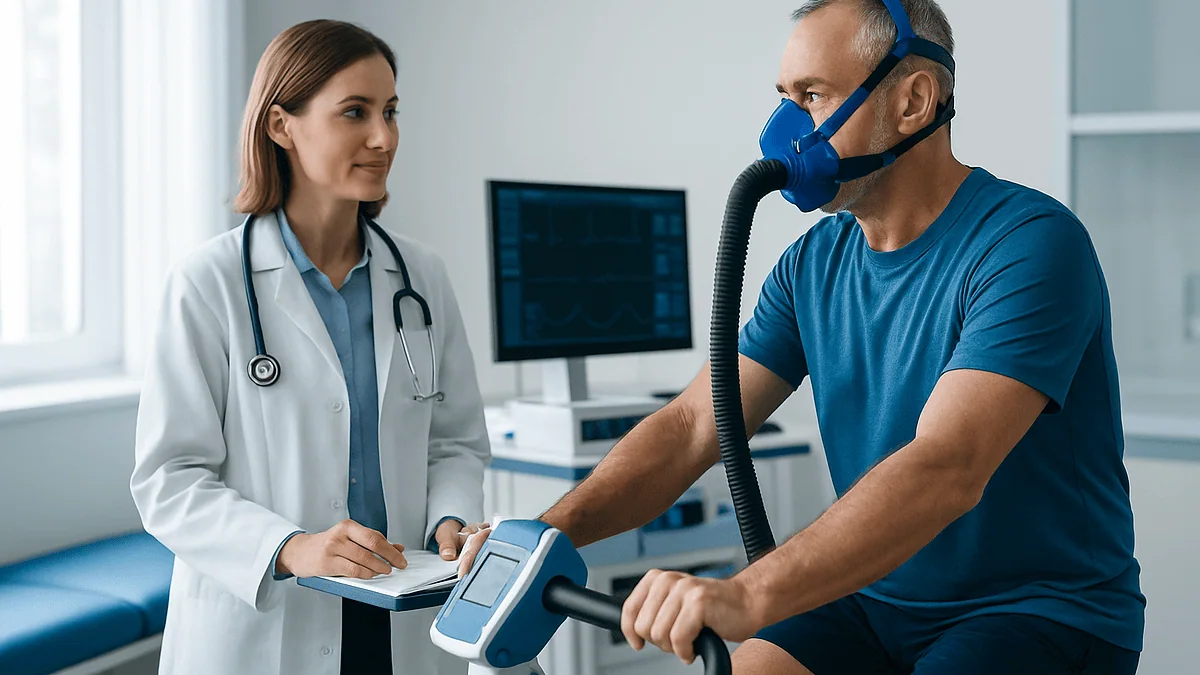
The mask is the part nobody warns you about. You’re on a treadmill, breathing through a snug silicone seal connected to a hose, while a technician nudges the incline up every minute and a screen quietly charts every liter of air moving through your lungs. Somewhere around minute nine, your legs start filing complaints. That’s the point of the whole exercise: the test only counts when you approach your limit.
What comes out of that uncomfortable half hour is a single number that researchers have been unusually excited about for decades. Not cholesterol, not blood pressure, oxygen. Specifically, how much of it your heart, lungs, blood, and muscles can put to work when everything is running flat out.
The evidence behind that number is stronger than most things sold as longevity science. It’s worth understanding what it can tell you, what it can’t, and how to get a version of it without a laboratory.
What does a VO2 max test actually measure?
VO2 max is the maximum volume of oxygen your body can consume during intense exercise, typically expressed in milliliters of oxygen per kilogram of body weight per minute (mL/kg/min). It’s a summary score for an entire supply chain: lungs pulling in air, blood carrying oxygen, the heart pumping that blood, and muscle cells extracting and burning the oxygen to make energy.
That’s what makes it different from most health metrics. A blood pressure cuff tells you about your arteries at rest. A VO2 max test tells you how the whole cardiorespiratory system performs under real demand, climbing four flights of stairs with groceries, chasing a toddler across a park, or hiking at altitude.
In a laboratory version, you exercise on a treadmill or stationary bike while wearing a mask connected to a metabolic cart. The machine measures exactly how much oxygen you inhale and how much carbon dioxide you exhale, breath by breath. Intensity increases in stages until you can’t sustain the effort. The highest rate of oxygen use recorded, often confirmed when the number plateaus even as the workload keeps rising, is your VO2 max.
Physiologists sometimes call it cardiorespiratory fitness, or CRF, and in a clinical setting the full procedure is known as a cardiopulmonary exercise test (CPET). Different names, same core question: how big is your aerobic engine?
Why do researchers link VO2 max to longevity?
The association is one of the most consistent findings in preventive medicine. A 2018 analysis published in JAMA Network Open followed more than 122,000 adults who underwent maximal treadmill testing, tracking them for a median of about eight years. People in the lowest fitness category had a risk of death during follow-up that rivaled or exceeded the risk associated with smoking, diabetes, or established coronary artery disease. And the benefit didn’t flatten at the top: the fittest group outlived even the ‘high’ fitness group below them.
Cardiologists have taken notice. In a 2016 scientific statement, the American Heart Association argued that cardiorespiratory fitness may be a stronger predictor of mortality than traditional risk factors and recommended clinicians treat it as a routine vital sign, alongside blood pressure and heart rate.
Why would one number carry so much weight? Because a high VO2 max is hard to fake. It generally reflects a heart that pumps a large volume per beat, flexible blood vessels, efficient lungs, healthy mitochondria, and enough regular movement to maintain all of the above. Low fitness, by contrast, often signals early trouble across several systems at once.
One honest caveat: these are observational data. They show that fitter people live longer, not that raising your VO2 max by five points guarantees extra years. Still, exercise training reliably improves the number, and the dose-response pattern across dozens of studies is steep enough that most researchers consider fitness one of the most modifiable longevity factors we have.
What happens during a lab VO2 max test?
Plan on 60 to 90 minutes at the facility, though the hard part lasts only 8 to 15 minutes. Here’s the typical sequence:
- Setup. A technician records your height, weight, and resting heart rate, and fits you with a heart-rate monitor and the breathing mask. In clinical versions, ECG electrodes track your heart’s electrical activity throughout.
- Warm-up. A few easy minutes of walking or light pedaling.
- The ramp. Speed, incline, or pedal resistance increases at set intervals, often every one to three minutes. You keep going as the effort climbs from comfortable to conversational-but-hard to genuinely maximal.
- The finish. The test ends when you signal you’re done or when the staff sees objective signs you’ve hit your ceiling: oxygen uptake plateaus, your heart rate stops climbing, or the ratio of carbon dioxide out to oxygen in crosses a threshold.
- Cool-down and results. Most labs review your numbers the same day, often including submaximal markers like your ventilatory thresholds, useful for setting training zones.
Practical prep matters more than people expect. Skip heavy meals for two to three hours beforehand, avoid hard workouts the day before, arrive hydrated, and wear shoes you’d actually run in. Caffeine habits are best kept normal, testing on an unusual amount in either direction muddies the result.
How can I get a VO2 max test?
Two broad routes exist, and they serve different purposes.
The clinical route is a cardiopulmonary exercise test ordered by a physician, usually performed in a hospital cardiology or pulmonary department with ECG monitoring. Doctors use it to evaluate unexplained shortness of breath, assess heart or lung conditions, or gauge readiness for certain surgeries. If you have symptoms or a known cardiac history, this is the appropriate setting: the medical supervision is the point, not an add-on.
The performance route runs through university exercise physiology labs, sports medicine centers, and commercial fitness-testing facilities. Many universities with kinesiology programs open their human performance labs to the public, often at lower cost than commercial options. Prices in the United States commonly fall between roughly $100 and $300, and the test is rarely covered by insurance when done for fitness purposes.
A few questions worth asking before you book: Does the lab use a metabolic cart with breath-by-breath gas analysis (the gold standard), or an estimate based on heart rate alone? Can you choose treadmill or bike? Cyclists usually score 5 to 10 percent lower on a treadmill than runners do, and vice versa, because the test favors muscles you’ve trained. Will you receive ventilatory threshold data along with the max number? For anyone planning to train seriously, the thresholds are arguably the more actionable output.
Consistency is the final consideration. If you plan to retest, use the same lab, same equipment, and a similar time of day.
What's a good VO2 max by age?
Normative tables come from decades of population testing, and while cut-points vary slightly between sources, the pattern is stable: values decline with age, men average higher than women largely because of differences in hemoglobin and muscle mass, and ‘above average’ is achievable for most people who train consistently.
| Age | Men: average (mL/kg/min) | Men: very good | Women: average (mL/kg/min) | Women: very good |
|---|---|---|---|---|
| 20–29 | 42–46 | 52+ | 33–37 | 44+ |
| 30–39 | 40–43 | 49+ | 31–35 | 41+ |
| 40–49 | 37–41 | 46+ | 29–32 | 38+ |
| 50–59 | 34–38 | 43+ | 27–30 | 35+ |
| 60–69 | 31–35 | 39+ | 25–28 | 32+ |
Approximate ranges drawn from commonly used normative data; individual labs may classify slightly differently.
For perspective, elite male endurance athletes often test between 70 and 85 mL/kg/min, and elite women between 60 and 75. At the other end, values below roughly 15 to 18 make independent daily living difficult, one reason geriatric researchers watch this number closely.
The comparison that matters most isn’t the athlete column. It’s your own trajectory. Moving from ‘below average’ to ‘average’ for your age bracket is associated with a meaningful drop in mortality risk in cohort studies: a bigger relative gain than moving from good to excellent.
How accurate is the VO2 max estimate on my watch?
Useful, with an asterisk. Fitness watches don’t measure oxygen at all: they estimate it from the relationship between your heart rate and your pace or power output, run through proprietary algorithms. When your heart rate is low relative to how fast you’re moving, the algorithm infers a bigger aerobic engine.
Validation studies generally find that wrist-based estimates land within roughly 5 to 10 percent of laboratory values for many users, but individual error can be considerably larger. Accuracy tends to be best for steady outdoor runners with reliable heart-rate data, and weaker for cyclists, walkers, interval-heavy exercisers, and anyone whose optical heart-rate sensor struggles, which happens more often with tattoos, cooler skin temperatures, and loose bands.
A few habits improve the estimate: wear the band snugly above the wrist bone, log several steady runs or brisk walks of at least 10 to 15 minutes in mild weather, and enter an accurate weight, since the number is weight-adjusted and an outdated entry skews it directly.
Here’s the honest framing: treat the watch number as a trend line, not a lab value. If it reads 44 today, your true VO2 max might be 40 or 48. But if that same watch shows a climb from 44 to 49 over six months of training, the direction of change is probably real, and the direction is what carries most of the health information anyway.
How can I test my VO2 max at home?
Field tests have estimated aerobic capacity since the 1960s, and the better ones correlate reasonably well with lab results. Three options, in rough order of intensity:
- The Rockport one-mile walk test. Walk one mile on a flat course as briskly as you can, then record your time and your heart rate at the finish. A validated formula converts your age, sex, weight, time, and heart rate into a VO2 max estimate. This is the gentlest option and the sensible starting point for anyone who hasn’t exercised hard recently.
- The 1.5-mile run test. Run 1.5 miles as fast as you can sustain; your finishing time maps to an estimated VO2 max. Long used in military and public-safety fitness screening.
- The Cooper 12-minute test. Cover as much distance as possible in 12 minutes on a track. The classic formula: VO2 max ≈ (meters covered − 504.9) ÷ 44.73, means a runner covering 2,400 meters lands around 42 mL/kg/min.
Ground rules apply to all three. Warm up for five to ten minutes first. Choose a flat, measured course: a standard 400-meter track is ideal. Don’t attempt a maximal running test if you’re currently sedentary, recovering from illness, or have any cardiac symptoms; start with the walk test or, better, a conversation with your clinician.
Expect field estimates to differ from a lab value by a few points in either direction. Their real strength is repeatability: same course, same protocol, every eight to twelve weeks, and you have a personal trend line that costs nothing.
How do I read the numbers: mL/kg/min and METs?
Two units show up on reports, and they’re directly convertible. One MET, metabolic equivalent, is defined as resting oxygen consumption, standardized at 3.5 mL/kg/min. Divide your VO2 max by 3.5 and you get your peak MET capacity. A VO2 max of 35 equals 10 METs, meaning you can sustain work ten times your resting metabolism at full effort.
METs make the number tangible. Brisk walking runs about 3 to 4 METs, doubles tennis around 5, running a 10-minute mile roughly 10. If your peak capacity is 10 METs, that 10-MET run isn’t a workout: it’s your absolute ceiling, sustainable for only minutes. Comfortable daily life generally requires activities to sit well below your maximum, which is why a shrinking VO2 max eventually turns stairs into an event.
The prognostic math is striking. Across multiple large cohorts, each 1-MET improvement in exercise capacity has been associated with roughly a 10 to 15 percent lower risk of death from any cause. One MET is about 3.5 mL/kg/min: an amount many previously inactive adults can gain within a few months of regular training.
Note the weight adjustment, too. Because the standard unit divides by body weight, losing fat mass raises the number even if your heart and lungs haven’t changed, and gaining weight lowers it. Labs can also report absolute VO2 max in liters per minute, which separates engine size from body size.
How do I improve my VO2 max?
Aerobic training, applied consistently, with intensity doing the heavy lifting. The research points to a practical recipe with three layers.
First, build the base. The American Heart Association and CDC both recommend at least 150 minutes of moderate-intensity aerobic activity per week (or 75 minutes of vigorous activity), and for someone starting from a sedentary baseline, simply hitting that target reliably raises VO2 max. Brisk walking, cycling, swimming, rowing: the modality matters far less than the weekly minutes.
Second, add intensity once the base is stable. Interval training, repeated bouts of hard effort separated by recovery, improves VO2 max more per minute than steady moderate exercise in head-to-head trials, because it forces the heart to operate near its maximal stroke volume repeatedly. A widely studied format: four intervals of about four minutes at an effort where speaking is limited to short phrases, with three minutes of easy recovery between, once or twice weekly. Shorter formats, such as 30 seconds to 1 minute hard with equal rest, also work.
Third, keep most training easy. Endurance athletes typically spend roughly 80 percent of their volume at genuinely conversational intensity, reserving hard sessions for one or two days a week. That distribution supports recovery, keeps injury risk down, and, counterintuitively, tends to produce better long-term VO2 max gains than making every workout hard.
Strength training won’t move VO2 max much by itself, but it preserves the muscle that uses the oxygen, which matters more with every decade.
How fast can VO2 max improve, and what about genetics and age?
Faster than most health numbers, slower than most people hope. Previously inactive adults who begin structured aerobic training commonly gain 10 to 20 percent over three to six months. Someone starting at 30 mL/kg/min might realistically reach 33 to 36, enough, per the MET math, to shift mortality-risk categories in the cohort data.
Genetics set both the floor and the responsiveness. The NIH-funded HERITAGE Family Study put hundreds of sedentary people through identical 20-week training programs and found improvements ranging from almost nothing to gains above 40 percent, with roughly half of that variation attributable to heredity. If your number climbs slowly despite honest work, that’s biology, not failure, and importantly, low responders still gained other benefits, from blood pressure to insulin sensitivity.
Age applies steady downward pressure. VO2 max typically peaks in the twenties and declines around 10 percent per decade in inactive adults, with the slide accelerating after 70. Training changes the arithmetic in two ways: it starts you from a higher peak, and masters athletes who keep training lose fitness at roughly half the rate of their sedentary peers. A trained 65-year-old can carry the aerobic capacity of an untrained 40-year-old.
That reframing is the practical takeaway. You’re not just raising a number; you’re buying decades of margin above the threshold where ordinary life gets hard.
Does VO2 max matter more than my other health numbers?
It’s a strong signal, not a solo act. In head-to-head statistical comparisons, cardiorespiratory fitness often outperforms individual risk factors, cholesterol, blood pressure, even smoking status in some analyses, as a predictor of all-cause mortality. That’s partly because it integrates so many systems, and partly because it captures behavior: a high number is nearly impossible to maintain without regular movement.
But prediction and completeness are different things. VO2 max says little about bone density, muscle mass, balance, or metabolic health beyond what fitness implies. Grip strength and walking speed independently predict longevity in older adults. Blood pressure can be dangerous at levels that don’t yet dent exercise capacity. A lean marathoner can still carry high LDL cholesterol driven by genetics.
The sensible mental model is a dashboard, not a scoreboard:
- VO2 max (or a field-test estimate) for cardiorespiratory fitness
- Blood pressure, lipids, and blood glucose for vascular and metabolic risk
- Strength measures, grip, or something as simple as sit-to-stand repetitions, for musculoskeletal reserve
- Sleep and waist circumference as everyday context
Where VO2 max earns special status is modifiability with a clear dose-response. Few numbers on that dashboard respond as predictably to effort, and few carry as much prognostic weight per point of improvement. If you were to pick one metric to actively train rather than merely monitor, the evidence favors this one.
Common VO2 max myths worth retiring
“It’s only for athletes.” Backwards, arguably. Elite athletes sit so far up the curve that a few points barely change their risk profile. The steepest health returns occur at the bottom, moving from the lowest fitness quintile to the next one up is associated with the largest relative drop in mortality in cohort studies.
“My watch already tells me, so a lab test is pointless.” The watch gives a trend; the lab gives a measurement plus training thresholds. Whether that precision is worth $100 to $300 depends on your goals, but the two aren’t interchangeable.
“Higher is always better, forever.” The observational data show benefits continuing into very high fitness levels, with no clear upper harm threshold in the largest studies. But chasing elite numbers brings real costs in training time and injury exposure. For health purposes, ‘above average for your age, maintained for decades’ captures most of the benefit.
“VO2 max is fixed by genetics.” Genetics shape the ceiling and the pace of improvement, the HERITAGE data are clear on that, but nearly everyone moves the number with training. Fixed potential, flexible position.
“A good VO2 max means my heart is healthy.” Mostly reassuring, not a guarantee. Fitness doesn’t rule out structural heart issues, arrhythmias, or genetically driven cholesterol problems. It complements screening; it doesn’t replace it.
When should I see a doctor before testing or training?
Maximal exercise is safe for most people, and supervised testing has an excellent record, serious complications during clinical exercise testing are rare, on the order of a few events per 10,000 tests. Still, pushing to your limit is exactly the wrong moment to discover an undiagnosed heart problem. Talk with a clinician before attempting a maximal test, at home or in a lab, if any of the following apply:
- Chest pain, pressure, or unusual tightness during exertion, even if it fades with rest
- Shortness of breath that seems out of proportion to the effort, or that wakes you at night
- Fainting, near-fainting, or unexplained dizziness during exercise
- A racing, fluttering, or irregular heartbeat
- Known heart, lung, or kidney disease, or diabetes with limited recent activity
- A family history of sudden cardiac death or heart disease before age 50
- You’ve been sedentary for a year or more and plan to jump straight into vigorous intervals
Seek urgent care, don’t schedule a fitness test, for chest pain at rest, chest pain with sweating or nausea, or fainting during exertion.
For people with symptoms or cardiac history, the physician-ordered version of this test exists precisely for this scenario: a cardiopulmonary exercise test with continuous ECG monitoring turns the unknown into data, under supervision. And if you’re healthy but cautious, the Rockport walk test is a low-intensity way to establish a baseline while you build toward harder efforts.
The bottom line: what to actually do with this number
Here’s the editorial opinion, grounded in the evidence above: VO2 max is the rare longevity metric where the hype and the data mostly agree, but the test matters less than the training it motivates.
A reasonable sequence for most healthy adults looks like this. Establish a baseline this month using whatever tool you have: a watch estimate, a Rockport walk, or a Cooper test if you’re already running. Find your bracket in the age table and note honestly where you sit. Then train for twelve weeks: 150-plus minutes weekly, mostly easy, with one or two harder sessions once your body has adapted, and retest under identical conditions.
Spring for a lab test if you want precision, personalized training zones, or a memorable data point to defend over the coming decades. Skip it without guilt if the cost stings; the field tests and the trend line will tell you what you need to know.
And hold the number loosely. The research doesn’t say a 45 guarantees more birthdays than a 40. It says that people who keep their aerobic engines large tend to stay alive, independent, and capable far longer than people who let them shrink, and that the engine responds to use at every age studied. The stairs, the hike, the flight sprinted for at gate B12: that’s the test you’re really training for.
Frequently asked questions
How can I test my VO2 max at home?
Use a validated field test: the Rockport one-mile walk (gentlest), the 1.5-mile timed run, or the Cooper 12-minute distance test. Each converts your performance, and in some cases your heart rate, into an estimated VO2 max via published formulas. Warm up first, use a flat measured course, and repeat the same protocol every eight to twelve weeks. Skip maximal running tests if you’re sedentary or have any cardiac symptoms, start with the walk test.
What's a good VO2 max for my age?
For adults in their forties, roughly 37 to 41 mL/kg/min is average for men and 29 to 32 for women, with values above 46 and 38 respectively considered very good. Norms drop with each decade, average for men in their sixties is around 31 to 35. The most meaningful goal for health purposes is reaching at least the above-average band for your age and holding it there over time.
How do I improve my VO2 max?
Combine a consistent aerobic base with regular intensity. Accumulate at least 150 minutes of moderate exercise weekly, keep most sessions at conversational effort, and add one or two interval workouts, for example, four rounds of four hard minutes with three easy minutes between. Previously inactive adults commonly gain 10 to 20 percent in three to six months. Intensity drives the biggest per-minute gains, but only once your body tolerates it.
How can I get a professional VO2 max test?
Book through a university exercise physiology lab, a sports medicine center, or a commercial fitness-testing facility; costs typically run $100 to $300 and insurance rarely covers fitness-purpose testing. If you have symptoms or heart or lung disease, ask your physician about a cardiopulmonary exercise test instead, which adds continuous ECG monitoring. Confirm the lab uses breath-by-breath gas analysis rather than a heart-rate-only estimate.
Is a VO2 max test safe?
For most people, yes, serious complications during supervised exercise testing are rare, on the order of a few events per 10,000 tests. The test is strenuous by design, so screening matters. Anyone with chest pain, exertional dizziness, fainting episodes, an irregular heartbeat, or known heart or lung disease should be evaluated by a clinician first and tested in a medically supervised setting rather than a fitness lab or at home.
How accurate is my smartwatch's VO2 max?
Typically within about 5 to 10 percent of a lab measurement, though individual error can be larger. Watches estimate the number from heart rate relative to pace, so accuracy is best for steady outdoor runners with a snug band and good sensor contact, and weaker for cyclists, interval training, and walking. Treat it as a trend line: a sustained rise over months of training is meaningful even if the absolute value is off.
How often should I retest my VO2 max?
Every three to six months is enough to capture real change; meaningful improvements take at least eight to twelve weeks of training to appear. Retest under matched conditions, same lab or same course, similar time of day, similar caffeine and sleep, because day-to-day factors can shift results by a few percent. Testing more often mostly measures noise, not fitness.
Does VO2 max inevitably decline with age?
The decline is real but negotiable. Inactive adults lose roughly 10 percent per decade after their twenties, with a steeper drop after 70. Consistent aerobic training slows that rate substantially, studies of masters athletes show losses closer to 5 percent per decade, and starting from a higher trained peak means you cross functional thresholds decades later. Training at any age raises the number from wherever it currently sits.
Is a higher VO2 max always better for health?
The largest observational studies found benefits continuing into very high fitness levels, with no clear harm threshold: the fittest group had the lowest mortality. That said, health returns are steepest at the low end: escaping the bottom fitness category is associated with a bigger relative risk reduction than moving from good to elite. For most people, above-average fitness for their age, maintained for decades, captures the bulk of the benefit.
What's the difference between a VO2 max test and a cardiac stress test?
Both involve graded treadmill or bike exercise, but they answer different questions. A standard cardiac stress test monitors your heart’s electrical activity and symptoms to look for signs of restricted blood flow; it usually doesn’t measure oxygen uptake. A VO2 max test adds breath-by-breath gas analysis to quantify aerobic capacity. A cardiopulmonary exercise test (CPET) combines both, which is why physicians order it when symptoms need a fuller explanation.
This article is for general information only and is not a substitute for professional medical advice. Please consult a qualified doctor about your individual situation.

More from the Blog

Vitamin D Test: What Level Is Actually Deficient and Who Needs Testing
A vitamin D test measures 25-hydroxyvitamin D in blood. Most US laboratories and the NIH call a level below 12 ng/mL (30 nmol/L) deficient…
Preventive Care Checklist: The Screenings and Vaccines Recommended by Age
Preventive care is the set of screenings, vaccines and counseling that find or prevent disease before symptoms appear. For most adults that means blood…

Whole Genome Sequencing and Polygenic Risk Scores: What Consumer Genomics Can Predict
Whole genome sequencing reads nearly all 3 billion letters of a person's DNA and can reliably identify rare single-gene variants linked to conditions such…

Protein in Urine: What a Urinalysis Finding Means for Your Kidneys
Protein in urine, called proteinuria, means the kidneys' filters are letting protein such as albumin leak through. A single positive result on a urinalysis…
Lynch Syndrome: The Inherited Cancer Risk Worth Knowing About
Lynch syndrome is an inherited condition, caused by a change in one of the DNA mismatch repair genes, that raises lifetime risk of colorectal,…

Genetic Testing: What It Can Detect and How Long Results Take
Genetic testing can detect single-gene conditions such as cystic fibrosis, sickle cell disease and Huntington disease, chromosome differences such as Down syndrome, inherited cancer…