

TMS vs VNS: How a Non-Invasive Magnetic Coil Differs From an Implanted Nerve Stimulator
Key Takeaways
- TMS acts directly on a chosen surface region of the brain from outside the skull, while VNS acts indirectly by stimulating a nerve in the neck that relays signals to the brainstem.
- A standard rTMS course for depression typically runs five weekday sessions for four to six weeks with no anesthesia, whereas VNS requires an operation of roughly one to two hours followed by years of continuous stimulation.
- For depression, TMS is usually offered after at least one failed antidepressant trial; VNS approval requires failure of four or more adequate treatments.
- VNS remains the more established option in drug-resistant focal epilepsy, where most people do not become seizure-free but a proportion see fewer or shorter seizures that may keep improving over one to two years.
- The most common VNS side effects, hoarseness, cough and throat tingling, recur each time the device cycles on, while TMS side effects such as scalp discomfort and headache are confined to the sessions and usually fade.
- Handheld non-invasive VNS devices for cluster headache and migraine involve no surgery, so the letters VNS in a headache clinic do not mean an implant.
TMS and VNS are both brain stimulation treatments, but they differ in kind. TMS uses a magnetic coil held against the scalp during outpatient sessions, with no surgery or anesthesia. VNS requires an operation to implant a pulse generator in the chest, wired to the vagus nerve in the neck, delivering stimulation for years. They are approved for different conditions and stages of treatment; the choice rests with the treating team.
The two leaflets arrived in the same envelope. One showed a person reading a magazine in a padded chair, a curved plastic arm resting against the side of their head. The other showed a diagram of a neck, a thin wire, and a disc the size of a pocket watch tucked beneath the collarbone. Same referral, same diagnosis, two completely different ideas of what treatment could look like.
If you have been asked to weigh tms vs vns, you are probably several treatments into a long illness, and you are tired. That is worth saying plainly, because the comparison is not really about magnets versus electricity. It is about how much you are prepared to take on, for how long, and what the evidence can honestly promise in return.
This explainer walks through what each procedure involves, who tends to be offered which, how the weeks afterward typically unfold, and the myths that cause the most confusion. It does not tell you which to choose. That conversation belongs with your treating team, who know your history in a way no article can.
TMS vs VNS at a glance: two different kinds of brain stimulation
Both treatments belong to a family called neuromodulation, which simply means changing the activity of nerves or brain circuits using electricity or magnetism rather than a chemical. That shared label hides a wide gulf.
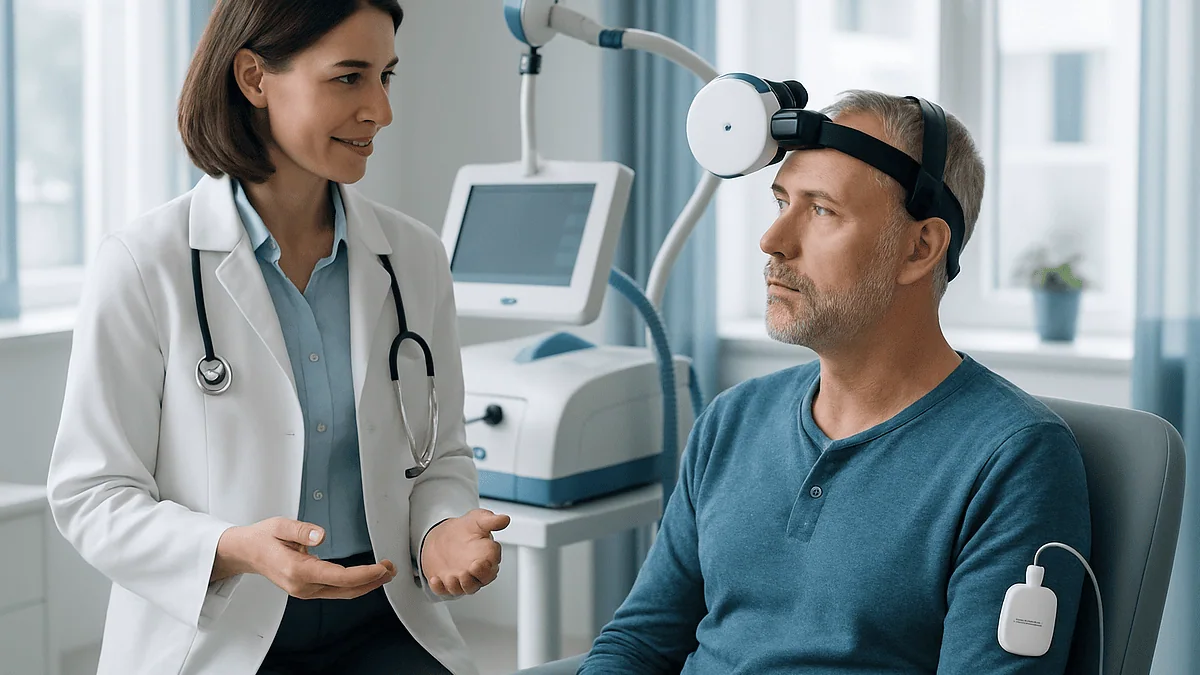
TMS stands for transcranial magnetic stimulation. A coil rests against the outside of the head and delivers brief magnetic pulses that pass painlessly through the skull. Nothing is implanted, no anesthesia is needed, and you drive yourself home afterward. When the pulses are delivered in a rapid, repeated pattern over a course of sessions, the technique is called repetitive TMS, or rTMS, which is the form used for depression and obsessive-compulsive disorder.
VNS stands for vagus nerve stimulation. The vagus nerve is a long cranial nerve that runs from the brainstem down the neck into the chest and abdomen, carrying signals between the brain and the heart, lungs and gut. In VNS, a surgeon wraps a slim electrode around the left vagus nerve in the neck and connects it to a small battery-powered generator placed under the skin of the chest. Once programmed, the device works around the clock, for years.
So the first practical difference is time. TMS asks for a concentrated block of weekday appointments over roughly a month or more, then stops. VNS asks for an operation and a recovery, then runs quietly in the background with periodic adjustments at follow-up visits.
The second difference is reversibility. If TMS does not help, you simply stop attending. If VNS does not help, the device can be switched off, and the generator can be removed, though the electrode is often left in place because it becomes embedded in scar tissue around the nerve.
The third, and in my view the most important, is that they were not built to answer the same clinical question, which the next sections unpack.
How TMS actually works: a magnetic pulse that nudges a brain circuit
Picture the coil as a very short-lived electromagnet. When current surges through it, a magnetic field forms and collapses within a fraction of a second. Because the skull and scalp do not block magnetic fields, that field reaches the outer layer of the brain, the cortex, and induces a tiny electrical current there. Neurons respond to electrical current by firing. Repeat this thousands of times across a session, and the targeted circuit begins to change how readily it activates, a property neuroscientists call plasticity.
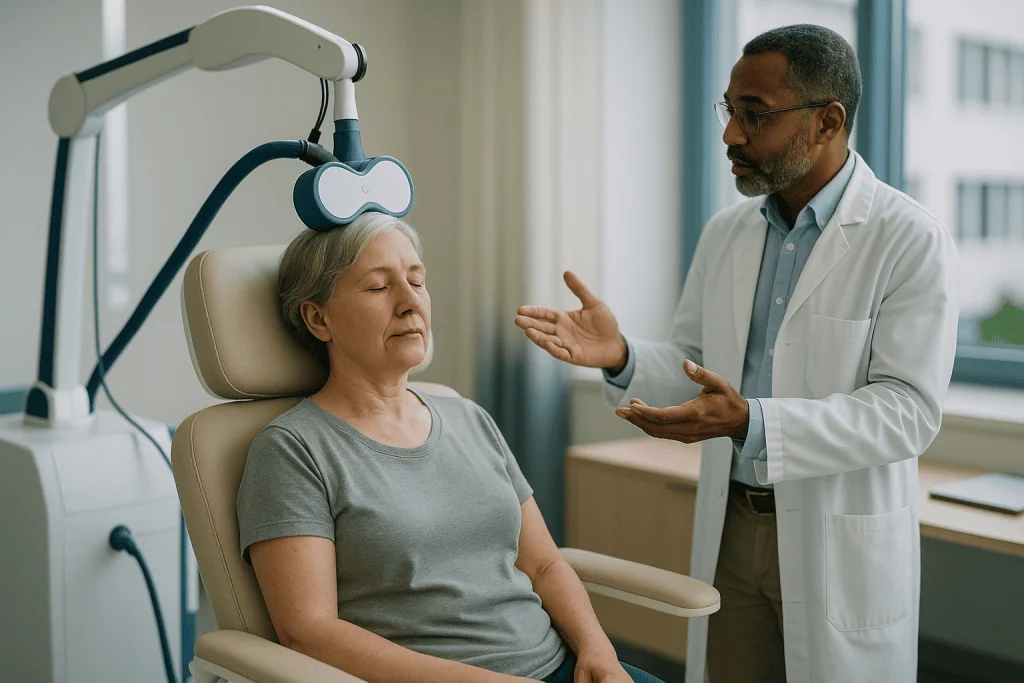
The reach is shallow. The field affects tissue only a few centimeters below the coil, which is why TMS targets surface regions rather than deep structures (Cleveland Clinic). For depression, the usual target is the left dorsolateral prefrontal cortex, an area behind the forehead involved in mood regulation and decision-making that tends to be underactive in people with depression. For OCD, coils designed to reach slightly deeper regions of the frontal lobe are used.
Before the first full session, the team finds your motor threshold. They move the coil over the part of the brain that controls the hand and slowly increase the intensity until your thumb twitches. That twitch calibrates the machine to your own brain, so that treatment intensity is set relative to you rather than to a generic setting. It is a curious moment for most people, watching a finger move on its own.
During treatment you are awake and seated. Each pulse feels like a firm tap on the scalp and sounds like a woodpecker. Sessions last roughly 20 to 40 minutes depending on the protocol, and newer patterned protocols such as theta-burst stimulation compress the same number of pulses into a shorter sitting (Mayo Clinic).
What TMS does not do is deliver electricity through the head in the way electroconvulsive therapy does, and it does not induce a seizure. The two are often confused, and they are not the same treatment.
How VNS actually works: a pacemaker-style device wired to a nerve in the neck
If TMS is a hand pressing directly on a doorbell, VNS is a message sent up a telephone line. The device never touches the brain. It stimulates a nerve in the neck, and the nerve carries the signal upward.
The vagus nerve is mostly a sensory nerve, meaning the majority of its fibers run toward the brain rather than away from it. When the electrode delivers gentle electrical pulses, those fibers relay the signal to a hub in the brainstem called the nucleus tractus solitarius. From there, connections fan out to regions involved in seizure threshold, mood and arousal, including the locus coeruleus, which releases norepinephrine, and the raphe nuclei, which release serotonin. Researchers believe this widespread, indirect effect is why a single nerve in the neck can influence conditions as different as epilepsy and depression, though the exact mechanism is still being worked out (Mayo Clinic).
Surgeons use the left vagus nerve rather than the right because the right side sends more fibers to the heart, and stimulating it carries a higher chance of slowing the heartbeat (Mayo Clinic).
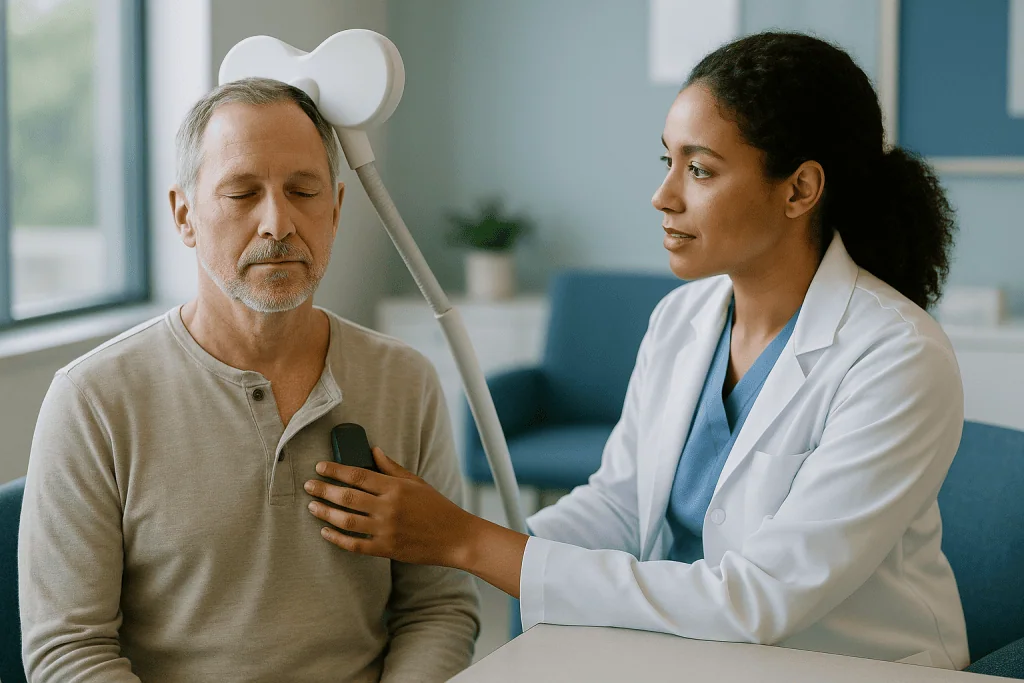
The hardware has three parts: the electrode coiled around the nerve, a lead running under the skin, and the generator in the chest. The generator is programmed wirelessly by a clinician using a wand held over the skin, so adjustments never require another operation. It cycles on and off in a fixed rhythm all day and night.
Many people are also given a handheld magnet. Swiping it over the generator triggers an extra burst of stimulation, which someone with epilepsy might use at the first warning of a seizure. Holding the magnet in place pauses stimulation, useful before public speaking if the device makes the voice hoarse. Newer generators can also detect a rapid rise in heart rate, which often accompanies seizures, and respond automatically.
Transcranial magnetic stimulation vs vagus nerve stimulation: side-by-side table
The table below sets the two treatments next to each other on the questions people raise most often. Read it as a map of differences, not a scorecard. Neither column is better in the abstract; each answers a different clinical situation.
| Feature | TMS (rTMS) | VNS |
|---|---|---|
| What it is | Magnetic coil on the scalp inducing current in the cortex | Implanted electrode on the left vagus nerve plus a chest generator |
| Surgery or anesthesia | None | Yes, usually under general anesthesia |
| Where it acts | Directly on a targeted surface brain region | Indirectly, via nerve signals to the brainstem and beyond |
| Course | Daily weekday sessions for several weeks, then stops | Continuous cycling stimulation for years, with periodic reprogramming |
| Main approved uses | Treatment-resistant depression, OCD, smoking cessation, migraine with aura (single-pulse devices) | Drug-resistant epilepsy, treatment-resistant depression, upper-limb rehabilitation after ischemic stroke |
| Typical side effects | Scalp discomfort, headache, facial twitching during sessions | Hoarseness, cough, throat tingling during stimulation; surgical risks |
| Reversibility | Simply stop attending | Device can be switched off or removed; electrode often stays |
| Effect on daily life | Time off for appointments during the course | Ongoing device checks; some MRI and medical-device precautions |
Two rows deserve a second look. The first is where it acts. TMS is precise and shallow; the team chooses a spot and stimulates it. VNS is diffuse; it influences many regions at once through the brain’s own wiring. The second is course. A TMS course has a beginning and an end, and if symptoms return, a further course may be discussed. VNS is a long-term relationship with a device, and the benefit in depression and epilepsy tends to build slowly over months rather than weeks (Mayo Clinic). Which pattern suits a person depends as much on their life as on their diagnosis.
Who TMS is usually for, and who is usually asked to wait
The most common route to TMS runs through depression that has not responded to standard care. Regulatory approval and most clinical guidance describe rTMS for adults with major depressive disorder who have not improved with at least one antidepressant medicine given at an adequate dose and duration, a situation often called treatment-resistant depression (National Institute of Mental Health). In practice, many people arrive after several medicine trials and a course of talking therapy.
Beyond depression, rTMS protocols are approved for obsessive-compulsive disorder and for smoking cessation, and a different, single-pulse handheld device is approved for migraine with aura (Cleveland Clinic). Research is active in stroke rehabilitation, chronic pain, tinnitus and post-traumatic stress disorder, but those uses remain investigational; if you are offered TMS for one of them, it is reasonable to ask whether it is within a clinical trial.
Who is usually asked to wait, or steered elsewhere? The clearest concern is metal in or near the head. Aneurysm clips, cochlear implants, deep brain stimulators, metal fragments from injury and some stents are typically listed as reasons TMS cannot proceed, because the magnetic field can heat or move them. Dental fillings and braces are generally not a problem (Mayo Clinic).
A personal history of epilepsy or seizures does not automatically rule TMS out, but it prompts a careful discussion, since the treatment can lower seizure threshold. Recent heavy alcohol use, sleep deprivation and certain medicines that lower seizure threshold are also weighed. Pregnancy is not an absolute barrier, but the evidence is limited and teams decide case by case.
People with psychotic symptoms, severe suicidal thoughts requiring urgent care, or bipolar disorder in a manic phase are often directed toward faster-acting or more intensive treatments first. TMS takes weeks to work, and when someone is in immediate danger, weeks are too long.
Who VNS is usually for, and who is usually asked to wait
VNS earned its first approval in epilepsy, and that remains its most established use. The typical candidate has focal seizures, meaning seizures that begin in one area of the brain, which continue despite trials of several anti-seizure medicines, and is not a suitable candidate for surgery to remove the seizure focus, or has declined that operation (Mayo Clinic). Children from around four years of age can be considered under the approval, which makes VNS one of the few device treatments used in pediatric epilepsy.
For depression, the bar is higher than for TMS. Approval covers adults with chronic or recurrent major depression that has not responded to four or more adequate treatments, which may include medicines, psychotherapy or electroconvulsive therapy (National Institute of Mental Health). In other words, VNS in depression is rarely a first device someone tries; TMS often comes earlier in the pathway.
A newer indication pairs VNS with intensive physiotherapy for weakness in the arm and hand after an ischemic stroke, a stroke caused by a blocked blood vessel. The stimulation is timed to coincide with rehabilitation exercises, with the aim of reinforcing the brain’s relearning (Mayo Clinic).
Who is usually asked to wait? Because VNS involves surgery, general health matters. Active infection, bleeding disorders, or conditions that make anesthesia risky are reasons to pause. People who have had a previous operation on the left side of the neck, such as certain vascular or thyroid surgeries, may have scarring that complicates access. A history of significant heart rhythm problems, breathing disorders such as sleep apnea, or difficulty swallowing prompts extra evaluation, since stimulation can affect voice, breathing and heart rate. Anyone who cannot attend follow-up for programming, or who is unable to avoid certain medical procedures that interact with the device, will need that discussed before surgery rather than after.
VNS vs TMS for depression: what the evidence actually shows
Depression is the one condition where both treatments are approved, so it is where the comparison gets asked most. Here is the honest version.
For rTMS, evidence comes from multiple randomized trials comparing active stimulation with sham stimulation, in which the coil is angled or shielded so that it clicks and taps without delivering an effective pulse. Across these trials, active rTMS produced greater improvement in depressive symptoms than sham in people whose depression had not responded to medicine (National Institute of Mental Health). The effect is real but partial: a meaningful proportion of people improve, some reach remission, and others feel no change. Benefit can fade over months, and repeat or maintenance courses are sometimes discussed. Trials generally excluded the most severely ill, so the evidence base is strongest for moderate-to-severe depression in outpatients.
For VNS, the evidence is more complicated. The main randomized trial compared active VNS with implanted devices switched off over a short period and did not show a clear difference at that early time point. Longer, non-randomized follow-up studies suggested that improvement accumulates slowly, with some people responding after many months, and that benefit, once present, tends to persist. Because those longer studies lacked a sham group, they carry more uncertainty (Mayo Clinic; National Institute of Mental Health).
What does that mean in practice? TMS has a cleaner short-term evidence base and a lower burden, which is why it is usually offered first. VNS is generally reserved for people whose depression has outlasted many other options and who are prepared for a long horizon.
One more point matters. Neither treatment is normally used instead of medicine or therapy. Both are added to ongoing care, and no one should adjust or stop a prescribed antidepressant because a device has been offered. That decision belongs to the prescribing clinician.
Beyond depression: epilepsy, stroke recovery, OCD and headache
Step outside depression and the two treatments stop overlapping almost entirely, which is a useful reminder that the question is rarely a straight choice.
Epilepsy is VNS territory. In people with drug-resistant focal epilepsy, the aim is to reduce how often seizures occur and how severe they are. The evidence is consistent that most people do not become seizure-free with VNS, but a proportion experience fewer or shorter seizures, and the effect often improves over the first year or two of stimulation (Mayo Clinic). The handheld magnet also gives people a sense of agency, a way to act at the first sign of an aura. TMS, by contrast, is not an epilepsy treatment; it is studied in research settings, but its ability to lower seizure threshold means it is used with caution in anyone with a seizure history.
Obsessive-compulsive disorder is TMS territory. Deep rTMS protocols aimed at frontal regions are approved as an add-on for people whose OCD has not responded adequately to medicine and cognitive behavioral therapy (Cleveland Clinic). VNS has no established role in OCD.
Stroke recovery is a newer chapter for both. VNS paired with rehabilitation is approved for moderate-to-severe upper-limb weakness after ischemic stroke, with stimulation delivered during therapy sessions (Mayo Clinic). TMS is being studied in stroke rehabilitation as well, sometimes to dampen the healthy hemisphere and sometimes to boost the injured one, but this remains investigational.
Headache brings a twist. A handheld single-pulse TMS device is approved for migraine with aura. A separate handheld non-invasive VNS device, applied to the skin of the neck without any surgery, is approved for cluster headache and migraine. So a person with cluster headache may encounter the letters VNS without ever being offered an implant, a source of real confusion in waiting rooms.
What a course of TMS looks like, week by week
The first appointment is longer than the rest. After a review of your history and a check for metal, the team maps your motor threshold, finds the treatment spot by measuring from that point or by using imaging-guided navigation, and marks the position so it can be reproduced. Many people describe this visit as more curious than uncomfortable.
From then on, a standard course runs on weekdays, typically five sessions a week for four to six weeks (Mayo Clinic). You sit in a reclining chair with the coil held against your head by an adjustable arm. Earplugs are offered because the clicking is loud. Once the session starts, you can talk, listen to music or simply sit. No sedation, no fasting, no one needs to drive you.
The first week is when scalp tenderness and mild headache are most common, and for most people these settle as the scalp habituates. Facial or jaw twitching during pulses is normal and stops when the pulse stops. Some people feel lightheaded briefly on standing.
Mood does not usually shift in the first days. Teams generally say that improvement, when it comes, is often noticed between the second and fourth week, sometimes first by family members who notice changes in energy or engagement before the person does (Mayo Clinic). Some respond later still, which is one reason courses are not cut short at the first sign of nothing happening.
Toward the end, many programs taper the frequency over a week or two rather than stopping abruptly. Afterward, you and your clinician review how symptoms have changed using rating scales completed at the start, midpoint and end. If benefit has been clear, a plan for what to do if symptoms return is worth agreeing before you leave; if there has been no change, that is information too, and it guides the next step.
What the days and weeks after VNS surgery usually look like
The operation itself is usually done as a day case or with a single overnight stay, under general anesthesia, and typically takes between one and two hours (Mayo Clinic). You wake with two small dressings: one on the left side of the neck, one on the upper left chest. The device is usually left switched off at first.
The first week is about the wounds. Expect soreness, some swelling, and a stiff feeling on turning the head. Most people are encouraged to walk the same day, avoid heavy lifting and vigorous arm movement on the left side until the incisions have healed, and keep the dressings dry as instructed. Bruising along the path of the lead under the skin is common and fades.
Around two weeks after surgery, once the incisions are checked, the clinician switches the generator on at a low setting using the programming wand (Mayo Clinic). This is the moment people meet the sensation of stimulation for the first time: a tickle or tightness in the throat, a change in voice pitch, sometimes a cough, each time the device cycles on. Many find it strange for a few days and then stop noticing, in the same way one stops hearing a ticking clock.
Over the following months, settings are raised gradually at successive visits, balancing effect against side effects. In epilepsy, seizure diaries become the shared language between you and the team. In depression, rating scales are used, and expectations are set for a slow build; meaningful change may not be evident for many months (Mayo Clinic).
Long-term, the routine settles into periodic device checks, battery monitoring, and eventually a shorter operation to replace the generator when the battery nears its end, with the electrode and lead usually left in place (Cleveland Clinic). Carry the device identification card; it matters in emergencies and before scans.
TMS side effects and vagus nerve stimulator side effects, compared honestly
The side-effect profiles are as different as the treatments themselves, and the difference comes down to one word: hardware.
TMS has no hardware left behind, so its side effects happen during or shortly after sessions. Scalp discomfort at the coil site, headache, tingling and twitching of facial muscles, and lightheadedness are the common ones, and they usually ease as the course progresses (Mayo Clinic). Hearing can be affected by the loud clicks if ear protection is skipped, which is why it is not optional. The serious risk is seizure. It is rare, and it is more likely when known risk factors such as certain medicines, sleep deprivation or heavy alcohol use are present, which is why screening is thorough (Cleveland Clinic). Mania has occasionally been triggered in people with bipolar disorder. There is no evidence of lasting harm to memory or thinking; if anything, concentration often improves as depression lifts.
VNS carries two layers of risk. The first is surgical: infection at the incisions, bleeding, pain, and, uncommonly, injury to the vagus nerve or nearby structures that can leave the voice hoarse or the vocal cord weakened, sometimes for months. A brief slowing of the heart during device testing in the operating room has been reported (Mayo Clinic).
The second layer is stimulation-related, and it is ongoing rather than fleeting. Hoarseness, a change in voice, cough, throat pain, tingling in the neck and mild shortness of breath, each occurring when the device cycles on, are the most frequently reported vagus nerve stimulator side effects (Cleveland Clinic). Swallowing difficulties and worsening of sleep apnea have been described. Most of these can be softened by lowering the settings, though that may also lower the benefit, a trade-off made together with the team.
Neither treatment causes the muscle aches or metabolic effects some people associate with medicines, and neither involves the memory disturbance linked to electroconvulsive therapy.
What people often get wrong about TMS vs VNS
Myth: they are versions of the same thing. They share the word stimulation and little else. One acts on a chosen brain region from outside; the other acts on a nerve in the neck and relies on the body’s own wiring to carry the signal upward. A person who is a good candidate for one is not automatically a candidate for the other.
Myth: TMS is electroconvulsive therapy with better branding. ECT delivers electricity through the head under anesthesia to induce a controlled seizure. TMS delivers magnetic pulses to an awake person and is designed not to cause a seizure. They differ in mechanism, setting, side effects and the severity of illness for which they are usually chosen.
Myth: VNS means a wire in the brain. Nothing in VNS enters the skull. That is deep brain stimulation, a separate procedure for conditions such as Parkinson’s disease. Confusing the two causes needless fear before consultations.
Myth: if it works, you can stop your medicine. Both treatments are studied and used alongside existing care. Any change to a prescribed medicine is a decision for the prescriber, made on its own evidence, not a reward for a device working.
Myth: results come fast, or not at all. TMS typically needs weeks; VNS typically needs months, and in epilepsy the benefit can still be growing a year or two in (Mayo Clinic). Patience is part of the treatment, not a sign it is failing.
Myth: all VNS involves surgery. Handheld non-invasive VNS devices for cluster headache and migraine are pressed against the skin of the neck and leave nothing behind. Ask which kind is being discussed.
Myth: a device replaces effort. In stroke, VNS is paired with rehabilitation because the exercise is the treatment and the stimulation is the amplifier. In depression, both TMS and VNS work best as part of a broader plan that still includes therapy, sleep and support.
Questions to ask your care team
A good consultation leaves you knowing not just what is being offered but why this, why now, and what the alternatives were. These questions help get there.
- Which of my treatments so far count as adequate trials, and does that history make me a candidate for TMS, VNS, both or neither?
- What is the specific target or indication you have in mind, and is it an approved use or part of a research study?
- For TMS: which protocol are you proposing, how many weeks will the course run, and how will we measure whether it is helping?
- For VNS: how long is the operation, what does recovery look like for someone with my other health conditions, and when would the device be switched on?
- What side effects do you see most often with this treatment, and which would make you want to hear from me the same day?
- If the treatment does not help, what is the next option, and does trying this one close any doors?
- How will this affect my current medicines and therapy, and who decides on any changes?
- Are there scans, dental procedures or other medical devices I would need to be careful about afterward?
- How much time off work or caregiving should I plan for, and is there support for arranging it?
- If I improve and then relapse, what is the plan: a repeat course, an adjustment of settings, something else?
- Who is my point of contact between appointments, and how quickly can I reach them?
Write the answers down or bring someone who will. People facing long illnesses often report that they remember the room and the diagram but not the numbers. A second set of ears is not a sign of weakness; it is good practice.
When to call your doctor
Both treatments are generally well tolerated, and most side effects are expected and mild. A few situations should not wait for the next scheduled visit.
During or after a course of TMS, contact the team the same day if you experience any episode of loss of awareness, unusual jerking movements or a sensation you recognize as a seizure warning; a sudden marked lift in mood with reduced need for sleep, racing thoughts or unusually impulsive behavior, which may signal mania; a severe or unusual headache that does not ease with rest; or a new change in hearing. Seek emergency care immediately for a seizure lasting more than a few minutes, or one followed by confusion that does not clear.
After VNS surgery, call the surgical team the same day if either incision becomes increasingly red, hot, swollen or leaks fluid, or if you develop a fever, since wound infection near an implant needs prompt attention. Also report new or worsening difficulty swallowing, hoarseness that does not improve over the expected weeks, stimulation that suddenly feels much stronger or painful, or a sensation that the device has stopped cycling. Seek emergency care for chest pain, fainting, a very slow or irregular heartbeat, or shortness of breath at rest.
For either treatment, and for anyone living with depression, worsening thoughts of self-harm or suicide are always a reason to reach out immediately, to your team, a crisis line or emergency services. A device being in place, or a course being underway, does not change that rule.
Every decision about starting, adjusting, pausing or stopping these treatments, and about any medicine you take alongside them, sits with the clinicians who know your history. This article can help you ask better questions; only they can answer them for you.
Frequently asked questions
Is TMS or VNS better?
Neither is better in the abstract; they answer different clinical questions. TMS has the stronger short-term randomized evidence in treatment-resistant depression and carries a lower burden, so it is usually offered earlier. VNS is the established device option in drug-resistant epilepsy and is reserved, in depression, for people who have not responded to many treatments. Your history, other conditions and tolerance for surgery shape which, if either, your team suggests.
What is the main difference between transcranial magnetic stimulation vs vagus nerve stimulation?
The main difference is where and how the stimulation is delivered. Transcranial magnetic stimulation uses a coil outside the head to induce current in a specific surface region of the brain during outpatient sessions. Vagus nerve stimulation uses a surgically implanted electrode on the left vagus nerve in the neck, powered by a chest generator, and influences the brain indirectly through nerve pathways over years.
How does VNS vs TMS for depression differ in how quickly people notice change?
TMS tends to act over weeks; teams often describe improvement, when it occurs, becoming noticeable in the second to fourth week of a course. VNS tends to act over months, with studies suggesting benefit accumulating slowly during the first year of stimulation. Neither works for everyone, and neither replaces existing medicine or therapy, which remain decisions for the prescribing clinician.
What are the most common vagus nerve stimulator side effects?
The most frequently reported side effects are hoarseness or a change in voice, cough, throat tingling or pain, and mild shortness of breath, each occurring when the device cycles on. Surgical risks include wound infection, bleeding and, uncommonly, vocal cord weakness. Many stimulation-related effects can be reduced by adjusting settings, though this is balanced against benefit by the treating team.
Does TMS hurt?
Most people describe TMS as a firm tapping on the scalp with a loud clicking sound rather than pain. Scalp tenderness and mild headache are common in the first week and usually ease as sessions continue. Facial twitching during pulses is normal and stops when the pulse stops. Ear protection is used because of the noise. No anesthesia or sedation is needed, and people drive themselves home afterward.
Can VNS stop seizures completely?
Complete seizure freedom with VNS is uncommon. The realistic goal in drug-resistant focal epilepsy is fewer, shorter or less severe seizures, and evidence suggests this effect can continue to improve over the first year or two of stimulation. Anti-seizure medicines are generally continued alongside the device, with any changes decided by the neurologist based on seizure diaries and clinical review.
Can I have an MRI with a vagus nerve stimulator?
Often yes, but with specific conditions. Many VNS systems allow MRI of certain body regions using particular scanner settings and coil types, and the device usually needs to be programmed off beforehand and checked afterward. Requirements vary by device model. Always tell the imaging team you have an implant and carry your device identification card so the correct protocol can be followed.
Can someone have both TMS and VNS?
In principle both can be part of one person’s care over time, since they are approved for overlapping conditions. Whether TMS can be given to someone with an implanted VNS depends on the device and lead position relative to the coil, and the team assesses this individually. In practice most people are offered one at a time, with the sequence guided by their history and response.
Is TMS the same as ECT?
No. Electroconvulsive therapy passes electric current through the head under general anesthesia to induce a controlled seizure and is typically reserved for severe or life-threatening depression. TMS delivers magnetic pulses to an awake person, is designed not to cause a seizure, and does not involve anesthesia or the memory effects associated with ECT. They differ in mechanism, setting and the illness severity for which they are chosen.
How long does a VNS battery last, and what happens when it runs out?
The generator battery lasts a number of years, with the exact lifespan depending on the model and the stimulation settings used. The team monitors battery status at follow-up visits. When it nears its end, a shorter operation replaces the generator in the chest; the electrode around the nerve and the connecting lead are usually left in place, so the neck is not reopened.
References
- Cleveland Clinic – Vagus Nerve Stimulation (VNS)
- Cleveland Clinic – Transcranial Magnetic Stimulation (TMS)
- National Institute of Mental Health – Brain Stimulation Therapies
This article is for general information only and is not a substitute for professional medical advice. Please consult a qualified doctor about your individual situation.

More from the Blog

What Does DBS Usually Improve in Parkinson’s Disease, and What Does It Leave Unchanged?
Deep brain stimulation (DBS) in Parkinson's disease usually improves the symptoms that respond to levodopa: tremor, stiffness, slowness, and the swings between 'off' periods…

Aphasia Recovery: What Progress Usually Looks Like Across the First Months of Therapy
Aphasia recovery after a stroke usually follows a curve: the fastest gains appear in the first weeks and months, the pace slows around three…

Demyelinating Diseases Treatment: How Relapse Control and Long-Term Monitoring Are Planned
Demyelinating diseases are treated in three layers: a short course of corticosteroids, or plasma exchange for severe attacks, to settle an acute relapse; longer-term…

Bringing Your Baby Home After Congenital Hydrocephalus Surgery: Feeding, Wound Care and Checks
Caring for a baby after hydrocephalus surgery means feeding on demand while watching for repeated or forceful vomiting, keeping the scalp and abdominal incisions…

How Tethered Cord Release Surgery Is Performed and Why Nerve Monitoring Guides the Surgeon
A tethered cord release procedure is spinal surgery in which a neurosurgeon opens the lower back, locates the tissue holding the spinal cord under…

How Is FND Different From Epilepsy or MS, and Why Does That Change the Treatment?
Functional neurological disorder (FND), epilepsy and multiple sclerosis (MS) can all cause seizure-like episodes, weakness or numbness, but they arise from different problems. Epilepsy…