

Toric Lens Implant vs Laser Reshaping for Astigmatism: Two Routes Compared Plainly

Key Takeaways
- Laser reshaping corrects astigmatism by removing corneal tissue, so the cornea must be thick enough and the astigmatism regular; irregular patterns such as keratoconus are generally not treated this way.
- A toric intraocular lens is most often used during cataract surgery, where the natural lens is being replaced anyway and the astigmatism correction is built into the implant.
- Mayo Clinic guidance lists age under 18, an unstable prescription, thin or irregular corneas, significant dry eye, pregnancy and uncontrolled medical conditions among the reasons laser is declined or delayed.
- A toric lens only works at the axis it is placed on, so rotation in the early weeks can reduce its effect, which is why surgeons check lens position at follow-up and discourage straining and eye rubbing.
- Vision after laser typically settles over about two to three months, while full healing after lens surgery is around eight weeks according to the Mayo Clinic, with the NHS describing recovery at two to six weeks.
- Neither route stops the ageing lens from losing near focus, so reading glasses remain likely after laser in later life and are usual from the outset with a monofocal toric implant.
Both routes can correct astigmatism, but they work in different parts of the eye. Laser reshaping changes the curve of the cornea and generally suits adults with stable prescriptions and healthy corneas. A toric lens implant sits inside the eye and is usually chosen when the natural lens is being replaced for cataract, or when the cornea is unsuitable for laser. An eye surgeon weighs age, lens clarity, corneal thickness and dry eye before advising either.
She had come in expecting a new glasses prescription. Instead, the optometrist leaned back, pointed at a wavy pattern on the screen and said two things in one breath: her astigmatism had crept up, and an early cataract was forming in the right eye. On the drive home she remembered a colleague who had laser surgery at thirty and never looked back. Was that still on the table at fifty-six? Or had she quietly crossed into lens-implant territory?
That is the real shape of the toric lens vs LASIK for astigmatism question. It rarely arrives as a tidy choice between two equal options. More often it arrives tangled up with age, with the clarity of the natural lens, with how dry the eyes get in winter, and with a vague worry that one of the two must be the ‘better’ one.
Neither is better in the abstract. Each corrects the same optical error in a different place, for a different kind of eye. The job of this article is to show where that line usually falls, and why.
Why the toric lens vs LASIK for astigmatism question comes up at all
Astigmatism is an eye that focuses light unevenly because one of its curved surfaces is shaped more like the back of a spoon than a ball. Most of the time the uneven surface is the cornea, the clear window at the front of the eye. Less often it is the natural lens behind the pupil. Either way, light lands as a smear rather than a point, and distance and near objects can both look slightly stretched or ghosted. The National Eye Institute describes it as one of the most common refractive errors, often present alongside short-sightedness or long-sightedness.
Glasses and contact lenses fix it from the outside. Surgery fixes it by changing something inside the optical system, and there are only two surfaces a surgeon can realistically alter: the cornea, or the lens. That single fact explains why the comparison exists. Laser reshaping works on the cornea. A toric lens implant replaces or supplements the lens with one that has the opposite ‘spoon’ built in. Toric simply means the lens has different powers in two directions, like the surface of a rugby ball rather than a football.
The amount of astigmatism is measured in diopters, a unit of lens power, and its direction is recorded as an axis in degrees. Both numbers matter. A small amount at an awkward axis can be more bothersome than a larger amount at a ‘with-the-rule’ axis the brain handles well. When you hear a surgeon say your astigmatism is corneal or lenticular, mild or significant, regular or irregular, they are already narrowing which route makes sense. The rest of this piece unpacks that reasoning so it feels less like a verdict and more like a conversation.
How laser reshaping actually corrects astigmatism
Laser reshaping is a family of procedures, not one operation. LASIK, the best known, creates a thin hinged flap in the surface of the cornea, lifts it, and uses an excimer laser (an ultraviolet laser that removes tissue with extreme precision) to sculpt the layer beneath. The flap is then laid back down and seals itself without stitches. PRK and LASEK skip the flap and remove the surface cells instead, so the same sculpting happens on top of the cornea and the surface regrows over several days. A third approach cuts a tiny lens-shaped sliver from within the cornea and removes it through a small keyhole incision.
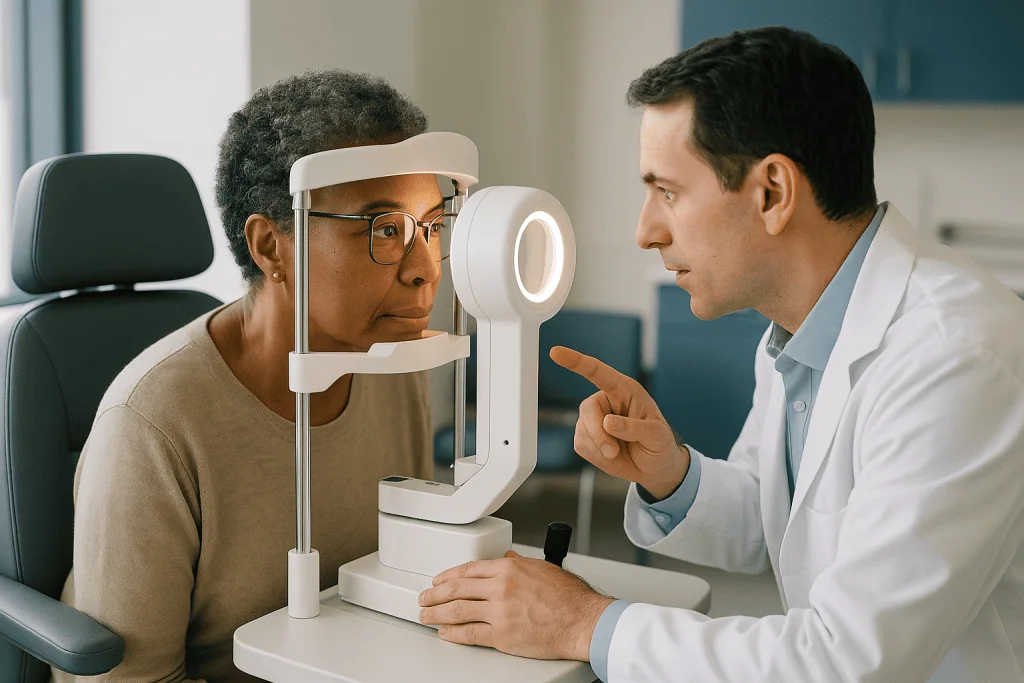
Whatever the technique, the aim is identical: flatten the cornea’s steeper meridian and leave the flatter one alone, so the two directions end up focusing at the same point. The treatment map is built from a scan of your individual cornea taken before surgery, which is why a thorough pre-operative assessment is not an optional extra.
According to the Mayo Clinic, the procedure itself usually takes about 30 minutes or less for both eyes, performed under numbing drops with the patient awake. The surgeon asks you to fix your gaze on a light so the eye stays centred; modern lasers also track small eye movements.
What laser cannot do is add tissue. It only removes it, so the cornea must be thick enough to spare, and the astigmatism must be regular, meaning the steep and flat directions sit roughly at right angles. Irregular astigmatism, as in keratoconus (a condition where the cornea progressively bulges), is generally not treated by laser reshaping because thinning an already weak cornea can make it worse.
How a toric lens implant actually works inside the eye
A toric lens implant corrects astigmatism from behind the cornea rather than by changing it. The most common version is a toric intraocular lens, or IOL, placed during cataract surgery. In that operation the cloudy natural lens is broken up with ultrasound and removed through a small incision, and a folded artificial lens is slid into the same thin capsule that held the original. If the surgeon chooses a toric IOL, it carries cylinder power oriented to match the eye’s astigmatism axis. The lens is rotated into position using alignment marks, so the built-in ‘rugby ball’ cancels out the eye’s own.
The same lens can be used in refractive lens exchange, which is cataract surgery performed on a clear lens purely to change the prescription. Surgeons tend to reserve this for people whose natural lens has already lost most of its ability to change focus, since the artificial lens does not flex the way a young lens does.
A different kind of implant, a phakic toric lens, is placed in front of the natural lens without removing it. It is sometimes considered for younger adults whose astigmatism or short-sightedness is too high, or whose corneas are too thin, for laser reshaping.
The NHS notes that cataract surgery usually takes around 30 to 45 minutes and is normally done as a day case under local anaesthetic. The eye is not reshaped and the cornea is left essentially as it was, which is why the approach suits eyes that a laser would be asked to thin too far. The trade-off is that the operation enters the eye itself, with the different risk profile that implies, covered later in this article.
Do toric lenses correct astigmatism completely?
Do toric lenses correct astigmatism? Yes, and they are designed for precisely that purpose. Whether they correct it completely in a given eye depends on three things that patients rarely hear spelled out.

The first is measurement. The surgeon must know not only how much astigmatism the cornea has on its front surface, but also what the back surface contributes, and how the small surgical incision itself will nudge the curve. Modern biometry (the set of eye measurements used to choose lens power) estimates all of this, but it remains an estimate. Small residual astigmatism after surgery is common and usually manageable with glasses for specific tasks.
The second is alignment. A toric lens only works at the axis it was placed on. If it rotates inside the capsule in the early weeks, part of its correcting effect is lost, and a large rotation can leave the eye with astigmatism in a new direction. Surgeons check the lens position at follow-up; if it has shifted enough to matter, a short second procedure to rotate it back is sometimes offered. This is one of the practical differences between the two routes, because a laser treatment has no part that can move afterwards.
The third is what the lens cannot do. A standard toric IOL is monofocal, set for one distance, so most people still need reading glasses, or glasses for the distance not chosen. Multifocal and extended-depth toric lenses exist and spread focus across more distances, at the cost of some contrast and a higher chance of halos around lights at night. The Mayo Clinic’s cataract surgery guidance makes the point plainly: the lens type is chosen with the surgeon based on lifestyle and eye health, not picked from a menu.
What disqualifies you from LASIK, and who is asked to wait
Laser reshaping is usually considered for adults with a stable prescription and a healthy, adequately thick cornea. The Mayo Clinic lists age under 18 as a reason to wait, and notes that many surgeons want the prescription to have been stable for at least a year, because an eye that is still changing will drift again after treatment.
Beyond age and stability, several findings commonly lead a surgeon to advise against laser or to pause:
- A cornea that is too thin to leave a safe amount of tissue after sculpting, or one with an irregular shape suggesting early keratoconus.
- Moderate to severe dry eye, which laser can worsen, especially LASIK with its flap.
- Pregnancy or breastfeeding, when hormonal shifts can temporarily change the prescription.
- Uncontrolled diabetes, autoimmune conditions or medicines that slow healing.
- Cataract, glaucoma that is not controlled, or other eye disease that would limit the benefit.
- Very large pupils or a very high prescription, which raise the chance of night glare and under-correction.
Some of these are permanent reasons to choose another route. Others are temporary: a person with poorly controlled dry eye may be treated for it first and reassessed. What disqualifies you from LASIK is therefore not a fixed list but a judgement about whether the cornea can safely carry the change and whether the result is likely to last.
A point worth making with some emphasis: a ‘no’ to LASIK is not a ‘no’ to correction. Surface laser without a flap suits some eyes that a flap would not. A phakic toric lens suits thin corneas. And for anyone over the age where the natural lens is beginning to cloud, the conversation moves naturally toward a lens-based route rather than a corneal one.
Who a toric lens implant is usually for, and who is asked to wait
The clearest candidate for a toric IOL is someone who already needs cataract surgery and has a meaningful amount of regular corneal astigmatism. The lens has to be replaced anyway; choosing a toric version simply folds the astigmatism correction into an operation that is already happening. The NHS describes cataract surgery as the point at which astigmatism can be addressed by lens choice, and this is where most toric implants are used.
Refractive lens exchange in a clear lens is a more deliberate decision. It is generally reserved for people in middle age or beyond who have lost near focusing (presbyopia), whose prescription is too high or whose cornea is too thin for laser, and who understand that a monofocal lens fixes one distance only. Younger people with clear lenses are usually steered away, because they would give up natural focusing they still have, and because the operation carries an entry-into-the-eye risk that laser does not.
A phakic toric lens fills a narrower gap: adults with stable, high prescriptions and healthy internal eye structures, but corneas unsuitable for sculpting. It requires enough space in the front of the eye to sit without touching the natural lens or the cornea’s inner lining, so depth measurements decide eligibility.
People commonly asked to wait or to consider alternatives include those with:
- Irregular astigmatism that a toric lens cannot match, where a specialist contact lens may serve better.
- Active inflammation inside the eye or unstable glaucoma.
- Conditions of the lens capsule, such as weak supporting fibres, which make a toric lens more likely to rotate or tilt.
- Unrealistic expectations of spectacle independence from a single-focus implant.
In every case the decision belongs to the treating ophthalmologist, who sees the whole eye, not just the astigmatism number on the prescription.
Toric lens vs LASIK for astigmatism: a side-by-side table
Laid next to each other, the two routes look less like rivals and more like tools for different jobs. The table below summarises the points most often raised in consultations, with timelines drawn from Mayo Clinic and NHS patient guidance.
| Feature | Laser reshaping (LASIK, PRK, LASEK) | Toric lens implant (IOL) |
|---|---|---|
| Where correction happens | Cornea, at the front of the eye | Inside the eye, replacing or in front of the natural lens |
| Tissue removed | Yes, a thin layer of cornea | Cornea left intact; natural lens removed (IOL) or kept (phakic) |
| Typical candidate | Adult with stable prescription, healthy cornea | Person with cataract, or lens-based correction after near focus is lost |
| Procedure time | About 30 minutes or less for both eyes (Mayo Clinic) | About 30–45 minutes per eye (NHS) |
| Anaesthetic | Numbing drops | Numbing drops, sometimes with an injection or light sedation |
| Vision stabilises | Roughly 2–3 months (Mayo Clinic) | Full healing around 8 weeks (Mayo Clinic); recovery 2–6 weeks (NHS) |
| Dry eye afterwards | Common, often easing over about 6 months (Mayo Clinic) | Possible, usually milder |
| Can the result move? | No moving part; prescription can drift with age | Lens can rotate; may need repositioning |
| Reading vision later | Reading glasses still needed with age | Monofocal toric: reading glasses usual; multifocal toric: possible halos |
| Reversibility | Not reversible; enhancements sometimes possible | Lens can be exchanged, with added risk |
Two cells deserve a second look. ‘Can the result move’ is the practical difference most patients have not heard of: a laser result is fixed in the tissue, while a lens sits in a capsule and relies on staying put. And ‘reading vision later’ is where disappointment most often creeps in, because neither route stops the ageing lens from losing its near focus, and a lens implant swaps that focusing ability for a single fixed point.
Is 0.75 astigmatism worth correcting?
A reading of 0.75 diopter sits firmly at the mild end of the scale. Many people carry this much without noticing, and plenty of glasses prescriptions quietly include it. So is 0.75 astigmatism worth correcting? The honest answer is that it depends on what else the eye is doing and what you are asking the surgery to achieve.
Consider the two routes separately. In laser reshaping, the astigmatism is treated as part of the overall prescription, not as a separate decision. If you are having laser for short-sightedness anyway, a small cylinder is folded into the treatment plan, and the question of ‘worth it’ barely arises. Laser purely for 0.75 diopter of astigmatism with no other refractive error is unusual, because the visual gain is small and the risks of surgery, including dry eye, are not.
In cataract surgery the calculation is different. Here the lens must be replaced regardless. Leaving 0.75 diopter uncorrected means most people would still want glasses for sharp distance vision, while correcting it with a toric lens may bring them closer to clear unaided distance sight. Surgeons also consider the axis: astigmatism oriented ‘against the rule’, the pattern that tends to increase with age, degrades vision more at the same power, so a small amount in that direction is often felt to be more worth addressing.
Two caveats apply. First, measurement error at this level is real, and a surgeon may advise against a toric lens if the corneal scans disagree with each other. Second, the choice is never urgent. A mild astigmatism that is not bothering you does not harm the eye, and the National Eye Institute lists glasses and contact lenses as perfectly adequate correction for most people. Whether a surgical fix is sensible is a conversation about preference, not a medical necessity.
What the first days and weeks look like after laser reshaping
The early period after laser differs sharply between the flap and no-flap techniques, and it helps to know which you are having. After LASIK, the Mayo Clinic describes itching, a gritty feeling, watering and blurred vision in the first hours, with discomfort that usually eases quickly. Many people see noticeably better by the next day, though ‘better’ is not the same as ‘final’.
After PRK or LASEK the surface cells have been removed, so the eye is sore for several days while they regrow under a protective contact lens. Vision clears more slowly and can fluctuate for weeks. People choosing the no-flap route in exchange for a stronger cornea should plan time off and expect a longer wait before driving comfortably.
The typical arc for either technique, drawn from Mayo Clinic guidance, looks like this:
- First day or two: rest, protective shields when sleeping, no rubbing, prescribed drops as directed by the surgeon.
- First week: a follow-up visit to check the flap or surface, with screen use and reading allowed in moderation.
- First few weeks: swimming, hot tubs, eye make-up and contact sports are usually paused until the surgeon clears them.
- Two to three months: vision settles and the final prescription can be assessed; an enhancement, if ever needed, is not considered before this point.
Dry eye is the symptom that lingers longest. The Mayo Clinic notes it can persist for around six months as corneal nerves recover, and it is the main reason surgeons examine the tear film so carefully beforehand. Glare and halos around lights at night are also common early on and tend to fade as the cornea heals, though a minority find them persistent. None of this is a sign that something has gone wrong; it is the expected cost of asking tissue to remodel.
What the first days and weeks look like after a toric lens implant
Recovery after a toric IOL follows the pattern of cataract surgery, because that is what it is, with one extra concern. In the first day the eye may feel scratchy and look slightly red, and vision is often blurred by the dilating drops and mild swelling of the cornea. The Mayo Clinic notes vision commonly begins to improve within a few days, while the NHS puts full recovery at around two to six weeks and the Mayo Clinic describes complete healing at roughly eight weeks.
The extra concern is rotation. The capsule that holds the lens gradually shrinks around it over the early weeks, which is what eventually locks it in place. Before that happens the lens can turn, so surgeons check its axis at the first follow-up. This is one reason heavy lifting, straining and eye rubbing are discouraged early on. If a rotation is found and the visual effect is significant, a short repositioning procedure is sometimes offered rather than waiting.
Drops are the main daily task. A combination of anti-inflammatory and antibiotic drops is typical, tapered over a few weeks on the schedule the surgeon prescribes. How long and in what order is a decision for the prescribing clinician; the point for patients is that missing doses raises the risk of inflammation, so it helps to set reminders.
Glasses are usually updated once the eye has settled, because even a well-placed monofocal toric lens leaves most people needing reading glasses or a fine-tuning distance pair. If the second eye also needs surgery, it is often scheduled after the first has stabilised. The NHS advises against driving until the surgeon confirms the legal standard of vision, which usually means waiting for that follow-up rather than guessing from how the eye feels.
Toric IOL vs LASIK: what the evidence says about risks
Both operations are long established, and serious complications are uncommon with either. The nature of the risks is different, though, and that difference is often more useful to a patient than any single percentage. Figures for sight-threatening events exist in surgical registries, but they vary by study population and are not quoted here as promises.
Laser reshaping risks, as listed by the Mayo Clinic, cluster around the cornea:
- Dry eye, usually temporary but sometimes persistent.
- Glare, halos and reduced night vision.
- Under-correction, over-correction or a new astigmatism from uneven tissue removal.
- Flap problems in LASIK, including wrinkles or cells growing beneath it.
- Regression, where the eye drifts back toward its old prescription.
- Rarely, corneal weakening (ectasia) or vision loss.
Lens implant risks follow from entering the eye, as described in Mayo Clinic and NHS cataract guidance:
- Infection inside the eye, rare but serious and the reason early red-flag symptoms matter.
- Inflammation, raised eye pressure or swelling at the back of the eye.
- Rotation or decentration of the toric lens, reducing its effect.
- Posterior capsule thickening months or years later, treatable with a brief laser procedure.
- Retinal detachment, uncommon but more likely in very short-sighted eyes.
- For phakic lenses, cataract formation or loss of cells on the cornea’s inner lining over time.
Where a surgeon has a choice, the deciding factor is usually which set of risks the particular eye can best absorb. A thin cornea pushes toward a lens; a young clear lens pushes toward laser; an eye with early cataract settles the matter on its own. Framed that way, toric IOL vs LASIK stops being a contest and becomes a question of fit.
What people often get wrong
Astigmatism attracts more folklore than almost any other refractive error, partly because the word sounds alarming and partly because the correction options are easy to muddle. A few corrections worth making.
‘Laser can’t fix astigmatism.’ It can, and has for decades. The myth dates from early laser systems that treated only spherical error. Modern excimer profiles correct regular astigmatism routinely, and the Mayo Clinic lists it among the errors LASIK addresses. What laser cannot safely treat is irregular astigmatism or very high amounts in a thin cornea.
‘A toric lens is a premium upgrade, so it must be better.’ Toric describes a shape, not a grade. A toric monofocal lens does one job: it corrects astigmatism at a single distance. It is ‘better’ only for an eye that has astigmatism worth correcting and a surgeon confident of the measurements.
‘Once it’s done, I’ll never need glasses.’ Neither route stops the natural ageing of the eye. After laser in your thirties, reading glasses still arrive in your forties. After a monofocal toric implant, reading glasses are usually needed from day one. Spectacle independence is a reasonable hope for specific distances, not a guarantee across all of them.
‘Astigmatism gets worse if you don’t correct it.’ Uncorrected mild astigmatism does not damage the eye. It can cause eye strain and headaches, but the National Eye Institute is clear that glasses and contacts are fully adequate treatment for most people, with surgery as an option, not a requirement.
‘If I’m turned down for LASIK, that’s the end of it.’ A refusal usually reflects the cornea, not the person. Surface laser, phakic toric lenses and, in time, a toric IOL are all routes the same surgeon may raise.
Questions to ask your care team
A consultation about toric lens vs LASIK for astigmatism goes better when you arrive with questions that reveal the surgeon’s reasoning, rather than questions that invite a sales pitch. These are the ones that tend to open the most useful conversations.
- Is my astigmatism corneal, lenticular or both, and is it regular? This single answer explains why one route is being favoured.
- How thick is my cornea, and how much would laser need to remove? Ask for the numbers and what margin would be left.
- Do my different corneal scans agree on the amount and axis? Disagreement is a reason for caution with a toric lens.
- How stable has my prescription been over the past year or two?
- How dry are my eyes on testing, and would that change your advice?
- Is there any sign of early cataract? If so, does that make laser a short-term fix?
- Which specific technique are you recommending, and why that one rather than the alternatives?
- What distance would a toric implant be set for, and what will I still need glasses for?
- What is your plan if the lens rotates, or if the laser result needs fine-tuning?
- What are the realistic timelines for driving, working and screen use in my case?
- Which symptoms after surgery should make me call you the same day?
- If you were advising a family member with my eyes, which route would you suggest, and what would make you change your mind?
Write the answers down or ask for them in a summary letter. The point is not to test the surgeon but to make sure the choice rests on your measurements. A good team will welcome the questions and may add a few you had not thought to ask, which is usually a sign you are in careful hands.
When to call your doctor
Most recovery symptoms after either procedure are mild and fade on their own: grittiness, watering, light sensitivity, fluctuating blur and glare around lights at night. A short list of symptoms is different. They can signal infection, raised pressure, a displaced flap or lens, or a retinal problem, and all of them call for a same-day phone call to the surgical team or an urgent eye service, not a wait for the next scheduled visit.
Contact your eye team urgently if you notice any of the following, drawn from NHS and Mayo Clinic post-operative guidance:
- Vision that was improving and then suddenly worsens, or a new blur that keeps deepening.
- Pain that increases rather than eases, particularly if it is deep or throbbing.
- A red eye that becomes redder, or a yellow or white discharge.
- Marked sensitivity to light that is new or getting worse.
- A shower of new floaters, flashes of light, or a dark curtain or shadow across part of the vision.
- Any blow to the eye, or a sense that something has moved after rubbing or straining.
- Nausea with eye pain and blurring, which can accompany a sharp rise in eye pressure.
Outside the recovery window, the same red flags apply at any time, because retinal detachment and infection do not keep to a schedule. If you cannot reach the operating team, the NHS advises attending an emergency department or urgent eye clinic. Keep the surgeon’s out-of-hours number somewhere obvious before the day of surgery, and tell whoever is with you what to watch for.
Decisions about treatment, follow-up and any further procedure sit with the treating team, who can see what is happening inside the eye. This article can explain the routes; only an examination can judge yours.
Frequently asked questions
Do toric lenses correct astigmatism?
Yes. A toric lens carries different powers in two directions, oriented to cancel the eye’s own uneven curve. Used as an implant during cataract or lens replacement surgery, it corrects regular astigmatism from inside the eye. How completely it works depends on accurate measurement and the lens staying at its intended axis. Residual small amounts are common and usually addressed with glasses for particular tasks.
What disqualifies you from getting LASIK?
The most common reasons are a thin or irregularly shaped cornea, an unstable prescription, significant dry eye, pregnancy or breastfeeding, uncontrolled diabetes or autoimmune disease, and existing eye conditions such as cataract or unstable glaucoma. Mayo Clinic guidance also lists age under 18. Some reasons are temporary and can be reassessed; others point toward a surface laser technique or a lens-based route instead.
Is 0.75 astigmatism worth correcting?
It is mild, and many people live comfortably with it uncorrected or in glasses. Laser surgery purely for 0.75 diopter is unusual because the gain is small. During cataract surgery the question is different, since a lens must be chosen anyway and a toric option may reduce the need for distance glasses. The axis, your other prescription and how much it bothers you all feed into the decision.
Is a toric lens more expensive than a standard lens or laser?
This article does not give cost or price information, because it varies widely by country, insurer and whether the lens is part of medically necessary cataract surgery. The honest answer is to ask the care team for a written breakdown of what is included, what counts as an optional upgrade, and what any follow-up or repositioning procedure would involve, before deciding.
Can LASIK fix astigmatism completely?
Laser reshaping corrects regular astigmatism routinely and is listed by the Mayo Clinic among the errors LASIK treats. Whether the result is complete depends on how much tissue the cornea can spare, the accuracy of the treatment map and how the eye heals. Small residual errors occur, and an enhancement is sometimes considered once vision has stabilised, typically after two to three months.
Which is safer, a toric IOL or LASIK?
Both are established procedures with uncommon serious complications, but the risks differ in kind. Laser risks centre on the cornea: dry eye, glare, under- or over-correction and flap issues. Lens surgery enters the eye, with rare but serious risks of infection, raised pressure or retinal problems, plus possible lens rotation. The safer option is the one whose risks your particular eye can best absorb.
Can you have LASIK after a toric lens implant?
In some cases, yes. If residual astigmatism remains after a toric lens, surgeons sometimes use a laser touch-up on the cornea to fine-tune the result, provided the cornea is healthy and thick enough. The reverse also happens: people who had laser years earlier can later have cataract surgery with a toric lens, although the earlier reshaping makes lens power calculations more complex.
Will I still need reading glasses after either procedure?
Usually, yes, at some point. Laser does not stop the natural lens losing near focus with age, so reading glasses typically arrive in the mid-forties regardless. A monofocal toric implant is set for one distance, so most people need reading glasses straight away. Multifocal toric lenses spread focus across distances but can bring halos at night and some loss of contrast.
How long does it take to recover from toric lens surgery?
Vision often starts to improve within a few days, according to the Mayo Clinic, with full recovery described by the NHS at around two to six weeks and complete healing at roughly eight weeks. Drops are used for several weeks on the surgeon’s schedule, heavy lifting and rubbing are avoided early on, and driving waits until the team confirms vision meets the legal standard.
Can astigmatism come back after surgery?
It can change. After laser, the eye may regress slightly toward its old prescription, and age-related shifts in the cornea continue. After a toric implant, the lens itself does not change, but early rotation can reduce its effect, and the cornea can still drift over decades. Neither route freezes the eye; both correct the error present at the time of surgery.
References
- NHS: Laser eye surgery and lens surgery
- NHS: Cataract surgery
- National Eye Institute (NIH): Astigmatism
This article is for general information only and is not a substitute for professional medical advice. Please consult a qualified doctor about your individual situation.
Add us as a Preferred Source to see more of our trusted health content across Google Search, AI Overviews and Discover.

More from the Blog
How Biometry Measurements Decide Your Intraocular Lens Power Before Surgery
Before cataract surgery, the eye is measured with optical or ultrasound biometry to obtain its axial length, the curvature of the cornea and the…

When Is a Vitrectomy Needed? Retinal Detachment, Macular Holes, Bleeding and Scar Tissue
A vitrectomy is needed when the gel inside the eye, the vitreous, must be removed to reach or relieve a problem at the retina.…
Farsightedness (Hyperopia): How It Develops and How Eye Doctors Plan Correction
Farsightedness, also called hyperopia or long-sightedness, is a refractive error in which light focuses behind the retina, usually because the eyeball is slightly short…

LASIK, SMILE or PRK for Myopia: A Neutral Comparison of the Three Laser Routes
LASIK, SMILE and PRK all treat myopia by using a laser to flatten the cornea so light focuses on the retina. LASIK lifts a…
Smart Lens Recovery: Drops, Adaptation Weeks and When Both Eyes Work Together
Smart lens recovery, meaning recovery after a multifocal or trifocal intraocular lens is implanted during cataract or lens-replacement surgery, usually involves a protective shield…
How Long Does a Black Eye Last? Healing Stages by Color and Signs That Need Care
A typical black eye lasts about 2 to 3 weeks, according to NHS guidance. Swelling peaks within the first two days, the bruise darkens…