

Vascular Lesion Laser Recovery: Cool Compresses, Bruising and the Crusts You Must Not Pick
Key Takeaways
- Vascular lasers target hemoglobin in blood beneath the surface, so the skin is not deliberately removed and recovery differs sharply from laser resurfacing.
- The purple spot-shaped marks after treatment are purpura, blood leaked from the treated vessels, and NHS guidance describes them settling over roughly one to two weeks.
- Cool compresses in the first day or two ease swelling and stinging, while ice applied directly can injure freshly heated skin.
- Crusts are a natural dressing over a closing wound; picking them reopens it and raises the risk of scarring and post-inflammatory hyperpigmentation, especially in darker skin.
- Swelling usually peaks on the second morning and settles over two to three days, so the day after treatment often looks worse than the day of it.
- Mayo Clinic notes laser-treated skin can stay sun-sensitive for up to a year, making daily broad-spectrum sunscreen the single most protective habit for the result.
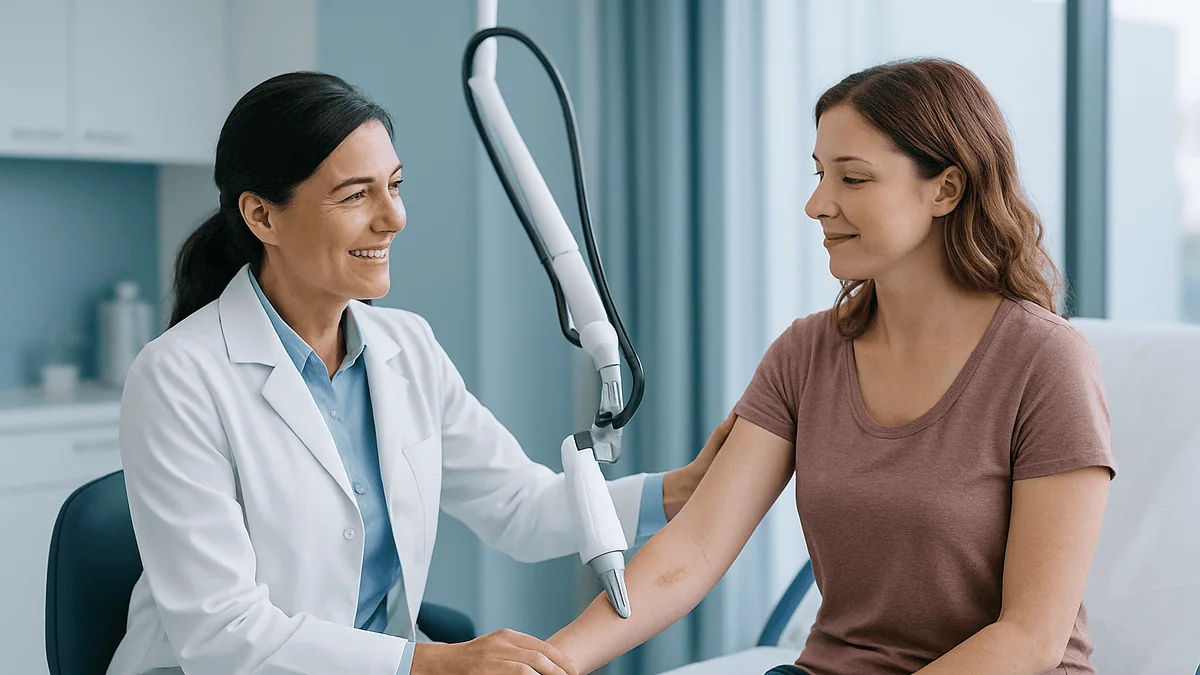
After vascular laser treatment, expect redness, swelling and sometimes a deep purple bruise-like mark called purpura that typically fades over one to two weeks. Cool (not icy) compresses in the first day or two ease swelling, gentle cleansing and plain moisturizer protect the skin, and any crusts should be left to fall off on their own. Strict sun protection follows for weeks. Your treating team's written instructions take priority.
The mirror in the treatment room is unforgiving. Twenty minutes ago there was a spray of fine red vessels across the side of a nose; now there are small purple ovals, a little swelling, and a face that looks as if it has been out in a cold wind. The clinician says this is exactly what it should look like. The patient nods, takes the aftercare leaflet, and spends the drive home wondering how long “exactly what it should look like” is going to last.
That gap between what you were told and what you see is where most vascular laser recovery worry lives. The marks are dramatic, the instructions are brief, and the internet is crowded with pages about recovery from everything except this.
This explainer walks through what is happening beneath those purple ovals, why cool compresses help and ice does not, what bruising and crusting mean, and the one rule that protects your result more than any cream: leave the crusts alone.
What actually happens during vascular laser treatment
A vascular laser is a light source tuned to a color that blood absorbs strongly and surrounding skin absorbs weakly. Hemoglobin, the oxygen-carrying pigment that makes blood red, soaks up yellow and green light far more readily than the skin’s own pigment does. The laser fires a pulse lasting a fraction of a second; the light passes through the outer skin layer, or epidermis, and is absorbed inside the tiny vessel below. That energy becomes heat, the vessel wall is injured, and over the following weeks the body clears the damaged vessel the way it clears any bruise.
Dermatologists call this principle selective photothermolysis: heat delivered selectively to a target, with the pulse kept short enough that the heat does not spread into the surrounding tissue. The pulsed dye laser, which uses a liquid dye to produce yellow light, is the most studied device for conditions such as port-wine stains and facial redness (MedlinePlus, NHS). Green-light lasers and intense pulsed light, a broad-spectrum flash filtered to the useful colors, work on the same idea with different trade-offs.
Most devices spray a cooling mist or press a chilled tip against the skin a split second before each pulse. That protects the epidermis and is the reason the treatment feels like a series of sharp snaps rather than a burn. A session for a scattering of vessels may take minutes; a large birthmark takes longer and, per the NHS, usually needs several sessions spaced weeks apart.
Two details of the physics matter for recovery. First, the target is under the surface, so the skin is not deliberately removed. Second, the injured vessels leak a little blood into the surrounding tissue. That leak is the purple mark you may see afterward, and it is a sign the light found its target, not a sign that something went wrong.
Why vascular laser recovery is not the same as laser resurfacing recovery
Much of the aftercare advice online belongs to a different procedure. Ablative laser resurfacing vaporizes the outer layers of skin to treat wrinkles and scars; Mayo Clinic describes raw, weeping skin, crusting for around a week and redness that can persist for months. Non-ablative resurfacing heats the deeper skin without removing the surface and recovers in days. Vascular lasers sit in a third category: the surface is intended to stay intact while the target below is heated.

The practical differences are large. After resurfacing, the wound is open and the priority is keeping it moist and free of infection. After a vascular laser, the skin barrier is usually unbroken, so the priorities are controlling swelling, protecting the bruised area from sun and friction, and resisting the urge to interfere with any small crusts that form where a vessel sat close to the surface.
The distinction also explains the timeline. Bruising from a vascular laser fades on the schedule of any bruise, while resurfacing redness follows the slower schedule of skin regrowth. It explains the appearance too: resurfaced skin looks sunburned all over, whereas vascular-treated skin shows discrete marks tracing the exact shape of the vessels or birthmark.
If your treatment combined approaches, for example a vascular pass followed by a resurfacing pass, your team’s instructions will reflect the more demanding recovery. When in doubt, the leaflet you were handed outranks anything you read here or elsewhere, because it was written for the device settings actually used on your skin (Cleveland Clinic).
Laser bruising: how long does purpura last and what does it look like?
Purpura is the medical name for bruise-like discoloration caused by blood escaping small vessels into the skin. After a vascular laser it appears within minutes to hours, often as gray-purple ovals the size and shape of each laser spot, or as a uniform dusky patch across a treated birthmark. Some settings are chosen to produce it deliberately because a visible purpuric endpoint is associated with more complete vessel clearance; others, particularly for fine facial redness, are set to avoid it in exchange for gentler results per session.
The color changes are predictable because they follow the chemistry of any bruise. Fresh purpura is purple or almost black. Over days the leaked hemoglobin breaks down into greenish and then yellow-brown pigments before the body reabsorbs them. Guidance from the NHS on laser treatment for port-wine stains describes this bruising as settling over roughly a week or two, and that range matches what most people experience; darker skin, larger treated areas and more aggressive settings tend toward the longer end.
A few features are normal and unsettling in equal measure:
- Marks looking darker on the second morning than on the first evening.
- A slightly raised, firm feel over each spot in the first days.
- Puffiness that pools around the eyes when the cheeks or nose were treated.
- Faint pink where the purpura has faded, which can linger for weeks.
What purpura is not is a burn. A burn blisters, weeps or turns white or gray at the moment of treatment and hurts more with each passing hour. Purpura is tender to the touch on day one and then mostly a cosmetic nuisance. If you cannot tell which you have, photograph the area in daylight each morning; a bruise improves over the week, and a wound that is worsening is a reason to call.
Cool compress after laser: how, when and why cold helps
Cooling does two useful things in the first hours after a vascular laser. It narrows surface vessels, which limits further leakage and swelling, and it dampens the burning sensation that the heated tissue produces as it settles. Both effects are temporary, which is why compresses help most in the first day or two and matter less thereafter.

“Cool” is the operative word. A clean cloth soaked in cool tap water, or a soft gel pack wrapped in a towel, pressed gently and lifted after a few minutes, is enough. Ice placed directly on treated skin can cause cold injury to tissue that has just been heated, and firm pressure on fresh purpura can push more blood into the surrounding tissue. Many clinics suggest cycles of a few minutes on and a longer stretch off, repeated several times across the first day; follow the exact rhythm your team gave you.
A few practical points reduce the risk of doing harm while trying to help:
- Use a fresh cloth each time, or launder between uses, so that damp fabric does not become a home for bacteria.
- Keep compresses off any area that has blistered or opened; cover those only as directed.
- Do not add witch hazel, alcohol or essential oils to the water; irritants slow healing and can darken the skin.
- Sleep with the head raised on an extra pillow for the first couple of nights, which lets gravity do some of the work that cooling does by day.
Cooling is comfort care, not treatment. It does not speed the clearance of vessels or the fading of bruises, and nothing is lost by stopping once the stinging passes. What speeds nothing at all is warmth: hot showers to the face, saunas and steam rooms dilate vessels and can worsen swelling in the early days, so save them for later in the recovery.
The crusts you must not pick: what they are and why picking scars
Where a treated vessel lay very close to the surface, or where a small spot received a little more energy, the overlying skin may form a thin dark crust over the following days. The crust is dried serum and blood sitting on top of a wound that is closing beneath it. It is, in effect, a biological bandage the body made for free, and it is doing three jobs at once: keeping the new skin cells moist so they can migrate across the gap, keeping bacteria out, and protecting the pink, fragile surface from friction.
Pull the crust off early and all three jobs are undone. The wound reopens, new cells are torn away, and the body responds with more inflammation. Inflammation in healing skin is the main driver of two outcomes nobody wants: a small pale or depressed scar, and post-inflammatory hyperpigmentation, the dark patch that inflamed skin can leave behind and that is more common and longer lasting in medium and darker skin tones (Cleveland Clinic). A crust that was going to be gone in a week can, once picked, become a mark that lasts months.
Crusts detach when the skin beneath is ready, which after vascular treatment is usually within one to two weeks (Mayo Clinic describes a similar window for laser-treated skin). They should be left dry, cleansed around rather than scrubbed, and never softened deliberately to hasten their fall. A little plain ointment applied by dabbing keeps the edges from cracking; that is as active as care should get.
People do not pick because they are careless. They pick because a dark speck on the face is impossible to ignore, because hands drift there during a phone call, because a corner lifts in the shower. Cutting nails short, keeping a moisturizer nearby to occupy the hand, and covering a tempting crust with a small hydrocolloid dressing if your team approves are unglamorous strategies that work.
Vascular laser recovery timeline: what the first weeks usually look like
Recovery from a vascular laser follows a fairly consistent arc, though the intensity varies with the condition treated, the settings used and your skin. The table below summarizes what most people describe; treat the timings as typical ranges drawn from NHS and Mayo Clinic patient guidance, not as promises.
| Stage | What you commonly see and feel | What usually helps |
|---|---|---|
| First hours | Stinging like a sunburn, redness, spot-shaped purple marks beginning to darken, mild swelling | Cool compresses, head elevated, no makeup, avoid heat |
| Days 1-3 | Purpura at its darkest, swelling peaks around the second morning, tenderness fading | Gentle cleansing, plain moisturizer, broad-spectrum sunscreen once skin is intact |
| Days 3-7 | Bruises turn green-yellow, small crusts may form on some spots, itching common | Leave crusts alone, dab ointment on crust edges, mineral makeup if permitted |
| Weeks 1-2 | Most purpura gone, crusts detach, treated vessels may look fainter or briefly more visible | Continue sun protection, note any persistent dark or pale patches for follow-up |
| Weeks 2-8 | Gradual fading of treated vessels as the body clears them; residual pink resolves | Review appointment, planning of further sessions if needed |
Two moments in this arc reliably cause alarm. The second morning, when swelling and color peak, often looks worse than the day of treatment. And the second or third week, when some vessels appear again as the bruise clears, can feel like failure; in reality, the body’s clearance of damaged vessels is a slow process, and clinicians generally assess results only after several weeks (NHS). Judging the outcome earlier than that judges the bruise, not the treatment.
Skin treated with lasers also remains more sensitive to sunlight for a prolonged period; Mayo Clinic notes this can last up to a year after resurfacing, and vascular-treated skin deserves the same caution while any pinkness persists.
Who is vascular laser usually for, and who is usually asked to wait
Vascular lasers are used for conditions in which abnormal or dilated blood vessels are the problem. Port-wine stains, the flat pink or purple birthmarks caused by malformed capillaries, are the classic indication and are often treated from infancy (MedlinePlus). Facial telangiectasia, the fine visible vessels on the nose and cheeks, and the persistent redness of rosacea are common adult reasons, and Mayo Clinic lists laser therapy among rosacea treatments for visible vessels. Cherry angiomas, small red domes of clustered vessels, and some spider veins on the legs are also treated this way, though leg veins often respond better to other approaches.
The best candidates share a few features: the vessels sit near the surface, the surrounding skin is healthy, and there is no tan on the treated area. Melanin, the skin’s own pigment, competes with hemoglobin for the laser’s light. A tan or naturally darker skin raises the risk of burns and pigment change, so clinicians adjust settings, choose different wavelengths or defer treatment accordingly.
People are usually asked to wait, or are steered toward an alternative, when:
- the area has recently tanned or been sunburned;
- there is an active infection, cold sore or open wound at the site;
- they are pregnant, since elective procedures are generally deferred and vascular changes of pregnancy may resolve on their own;
- they have taken medicines that make skin photosensitive, or have a history of keloid scarring, until the team has assessed the risk;
- the redness has a cause that needs treating first, such as an untreated inflammatory skin condition.
A consultation that includes a test patch on a hidden area is standard practice for larger treatments and for darker skin. Whether to proceed, with which device and at which settings, is a decision for the treating clinician who has examined the skin, not one to be made from a description online.
Cleansing, moisturizer and makeup during vascular laser recovery
Skin care after a vascular laser is deliberately boring. The barrier is bruised and inflamed, and the fewer variables introduced, the easier it is for the team to interpret anything unexpected.
Cleanse with cool or lukewarm water and a mild, fragrance-free wash, using fingertips rather than a cloth, and pat dry with a clean towel. Skip anything that exfoliates: scrubs, cleansing brushes, and washes containing acids or retinoids. Cleveland Clinic advises keeping laser-treated skin away from products that could irritate it until the clinician says otherwise, and that includes many everyday “active” skincare ingredients such as vitamin C serums, glycolic acid and retinol, which are usually paused for a week or more and restarted only with the team’s agreement.
Moisturize with a plain, fragrance-free cream or ointment. Its job is to keep the surface supple so that swelling does not crack the skin and so that any crusts stay pliable at their edges. Apply by dabbing rather than rubbing across bruised areas, and avoid heavy occlusive layers over spots that are weeping unless you have been told to dress them that way.
Makeup is the question people most want answered and the one with the most variable advice. Where the skin is intact and merely bruised, many teams permit mineral-based makeup after the first day or two to camouflage purpura; where crusts or open spots exist, makeup should stay off those areas because pigments and applicators can seed infection and pull crusts loose. Brushes and sponges should be freshly cleaned. Remove makeup gently at night, never with wipes that require scrubbing.
Shaving over treated skin should wait until crusts have gone and tenderness has passed. An electric razor is gentler than a blade when you do resume.
Sun protection after vascular laser treatment: why it is not optional
Ultraviolet light is the single most controllable threat to a good result. Inflamed skin produces more pigment in response to UV, so a treated patch exposed to sun in the weeks after a laser can darken into a brown mark that outlasts the redness it was meant to remove. The reverse can happen too: sun on healing skin occasionally leaves pale patches. Both are far harder to correct than to prevent.
The CDC’s sun-safety guidance is the sensible baseline: seek shade in the middle of the day, wear a wide-brimmed hat and protective clothing, and use a broad-spectrum sunscreen of at least SPF 15, reapplying at least every two hours and after sweating or swimming. Many dermatology teams ask for SPF 30 or higher on the face after laser treatment. Mineral sunscreens containing zinc oxide or titanium dioxide are often better tolerated on freshly treated skin than chemical filters, though this is a comfort preference rather than a rule.
Timing matters in both directions. Sunscreen should go on once the skin surface is intact, usually the day after treatment unless there are open spots, and it should continue for as long as the area remains pink. Mayo Clinic notes that laser-treated skin can stay sun-sensitive for up to a year, and the practical translation is that daily sunscreen becomes a habit rather than a phase.
Before the session counts as well. Treating tanned skin raises the risk of burns and blistering, which is why teams ask for several weeks of sun avoidance beforehand and may postpone if you arrive with a tan. Self-tanner is a problem for the same reason: it darkens the surface layer and competes with the laser’s target. Window glass blocks most UVB but not all UVA, so long car journeys and desk seats by a sunny window deserve sunscreen too.
Swelling after facial laser: eyes, lips and the second-morning surprise
Swelling is the body’s fluid response to heat injury and is greatest where skin is loose and vessels are numerous, which on the face means the eyelids, the area under the eyes and the lips. Treatment of the nose or cheeks often produces puffy eyes the next morning even though the eyes themselves were untouched, because fluid drains downhill overnight and pools in the thin skin around the sockets.
The pattern is predictable. Swelling begins within an hour, peaks around the second morning and drains over the following two to three days; Mayo Clinic describes a comparable arc for laser-treated skin. It looks alarming on a face and is rarely a problem in itself. It does interfere with contact lenses, glasses that press on treated cheeks, and any activity that involves bending forward for long periods.
Practical measures that help:
- Sleeping on the back with the head raised on two pillows for the first few nights.
- Cool compresses during the day, as described above, especially over the eyes and cheeks.
- Avoiding salty meals and alcohol for a couple of days, both of which encourage fluid retention.
- Skipping hot baths, saunas and vigorous exercise until the swelling has settled, because heat and raised blood pressure push more fluid into the tissue.
Some clinicians prescribe a short course of a corticosteroid, an anti-inflammatory medicine that reduces the fluid response, when a large area of the face has been treated. Whether that is appropriate is a decision for the prescribing clinician, who weighs it against the rest of your health; it is not something to source or take on your own.
Swelling that is one-sided and increasing after day three, that is hot and tight rather than soft and puffy, or that comes with fever is a different matter, and belongs in the red-flag section below rather than here.
Pain relief and medicines: what to tell your clinician
Discomfort after a vascular laser is usually mild and short-lived: a sunburn-like sting for the first evening and tenderness over the bruises for a day or two. Cool compresses and a plain moisturizer manage most of it. When something more is needed, clinicians commonly suggest a simple over-the-counter pain reliever, and which one matters.
Nonsteroidal anti-inflammatory drugs, the class that includes ibuprofen and aspirin, work by blocking an enzyme involved in inflammation and also reduce the stickiness of platelets, the blood cells that plug small leaks. That second effect is why some teams prefer people avoid them around the time of treatment: more platelet inhibition can mean more purpura and a longer-lasting bruise. Acetaminophen, known as paracetamol in much of the world, relieves pain by a different mechanism and does not affect platelets, which is why it is often the suggested option. The right choice for you depends on your kidneys, liver, stomach and other medicines, and only your clinician can make it.
The same logic applies to anything that thins the blood. Prescribed anticoagulants and antiplatelet medicines should never be stopped for a cosmetic procedure without the prescriber’s explicit agreement, because the risk of a clot outweighs the inconvenience of a bigger bruise; instead, tell the laser team what you take so they can set expectations and adjust settings. Fish oil, vitamin E, ginkgo and high-dose garlic supplements also have mild antiplatelet effects (NIH Office of Dietary Supplements), so mention those too.
Medicines that increase sensitivity to light deserve a separate conversation. Some antibiotics, acne treatments and diuretics make skin react more strongly to laser energy. A complete medicine and supplement list at consultation is not paperwork for its own sake; it is one of the few things you can do to make the treatment safer.
Exercise, heat, alcohol and getting back to everyday life
Most people return to desk work, school runs and shopping the same day or the next, wearing sunscreen and perhaps a hat. The question is less “when can I resume life” and more “which parts of life are worth pausing for a few days.”
Anything that raises the heart rate or heats the face falls into the pause category during the first two or three days. Vigorous exercise, hot yoga, saunas, steam rooms and very hot showers dilate vessels and increase blood flow to the skin, which can extend swelling and deepen purpura while the treated vessels are still leaky. A brisk walk in the shade is fine; a spin class is better left until swelling has settled. Sweat itself is not dangerous to intact skin, but salt in sweat stings inflamed skin, and towels rubbed across a crusted area do exactly what the crust is there to prevent.
Swimming is generally deferred until crusts have detached, because pool chemicals irritate healing skin and open water carries bacteria to any tiny break in the surface. Alcohol in the first couple of days works against you in two ways: it dilates vessels and it encourages fluid retention. Smoking slows wound healing by narrowing vessels and reducing oxygen delivery, which is a reason to pause it, or at least not to increase it, while skin recovers.
Travel is usually manageable after a small facial treatment, provided you can keep sunscreen and a hat with you and can reach your team by phone if something changes. Flying does not affect laser-treated skin specifically, though cabin air is dry and a plain moisturizer helps. For large treatments, or for children who have had a birthmark treated, staying within reach of the treating team for the first week is the more comfortable choice.
Social confidence is the last thing to return, and photographs help: comparing day six with day two is the fastest way to believe the bruises really are leaving.
What people often get wrong about vascular laser aftercare
Aftercare myths cluster around the same few misunderstandings, most of them borrowed from other procedures or from general wound lore.
“Ice it hard and often.” Cold that is comfortable is helpful; cold that numbs can injure heated tissue. Cool compresses, not ice packs pressed against the skin.
“Bruising means the laser was set too high.” For many vascular conditions, purpura is the intended endpoint and correlates with vessel clearance. Its absence is not a mark of a gentler, better treatment, and its presence is not a mark of a mistake.
“A scab needs air, so leave it dry and uncovered.” Wounds heal faster when kept moist; a little plain ointment on crust edges keeps them from cracking and lifting. What crusts do not need is picking, soaking or exfoliating.
“Arnica, vitamin K cream or bromelain will clear bruises quickly.” The evidence for these is weak and inconsistent (NIH Office of Dietary Supplements summarizes the general state of evidence for such supplements). Nothing has been shown to reliably shorten purpura beyond time, sun protection and avoiding things that make it worse. Using them is unlikely to harm intact skin, but they are not a substitute for patience.
“The vessels are still there at two weeks, so it didn’t work.” Clearance of damaged vessels takes weeks, and assessment happens after several, per NHS guidance on laser treatment of birthmarks. Judging early judges the bruise.
“Once the redness has gone, sunscreen can stop.” Skin stays vulnerable to pigment change for months (Mayo Clinic). Sunscreen is the cheapest insurance on the result.
“One session should do it.” Fine facial vessels sometimes clear in one or two treatments; port-wine stains and rosacea redness commonly need a series, and some lesions never clear completely. Anyone promising a number of sessions or a percentage improvement before examining you is guessing.
Risks, side effects and alternatives in neutral terms
Vascular lasers have a long safety record, and the great majority of side effects are the expected ones already described: redness, swelling, purpura and small crusts that resolve within about two weeks. A smaller group of problems is less common and worth knowing about.
- Blistering and burns occur when energy is too high for the skin, most often on tanned or darker skin. They heal but raise the risk of scarring and pigment change.
- Post-inflammatory hyperpigmentation, a brown mark where the skin was inflamed, is more common in medium and darker skin tones and can persist for months (Cleveland Clinic). Sun protection reduces the risk; it does not remove it.
- Hypopigmentation, pale patches where pigment cells were affected, is less common and can be longer lasting.
- Scarring is uncommon with appropriate settings and is most often linked to picked crusts, infection or blistering.
- Infection is rare on intact skin and is signaled by increasing pain, spreading redness, warmth, pus or fever.
- Reactivation of cold sores can follow treatment near the lips in people who carry the virus; tell your team about any history so they can plan.
- Eye injury is prevented by protective eyewear during treatment, which is why it is never optional.
Alternatives depend on the condition. Fine facial vessels can be treated with intense pulsed light, with electrosurgery using a fine needle, or with sclerotherapy, an injection that seals the vessel, for some leg veins (Mayo Clinic). Rosacea redness may respond to prescribed topical medicines that narrow vessels, alongside trigger avoidance and skin care. Port-wine stains are primarily treated with pulsed dye laser, and camouflage makeup remains a legitimate choice for people who prefer not to treat. Doing nothing is also an option for lesions that are harmless, and a good consultation should say so plainly.
Weighing these against one another is the treating team’s job, done with your skin in front of them and your priorities in the room.
Questions to ask your care team before and after vascular laser
The most useful aftercare tool is a set of answers written down before the first pulse. People who know what their clinician expects to see are far less likely to panic at the second-morning mirror or to reach for a remedy that makes things worse. Consider asking:
- Which device and wavelength will you use, and are the settings intended to cause purpura or to avoid it?
- What should the treated area look like on the first evening, the second morning and the end of the first week?
- How do I tell the difference between expected bruising and a burn, and what should I photograph to show you?
- Exactly how do you want me to cool the skin, how often, and for how long?
- Which cleanser, moisturizer and sunscreen do you recommend, and which of my current products should I pause?
- If a crust forms, what do you want me to do, and what do I do if one comes off by accident?
- When can I wear makeup, shave, exercise, swim and use heat again?
- Do any of my medicines or supplements affect bruising, healing or light sensitivity, and should any of them be discussed with the prescriber?
- How many sessions do you anticipate for my condition, how far apart, and when will you assess whether it is working?
- What are the specific risks for my skin tone, and did the test patch tell you anything?
- Who do I contact out of hours if I am worried, and what symptoms would you want to hear about the same day?
- What happens if the result is incomplete, and what are the alternatives at that point?
Write the answers on the aftercare sheet itself so they travel together. Bring the sheet and your daily photographs to the review appointment; the pictures are more reliable than memory, and they let the team judge the recovery, not just the result.
When to call your doctor: red-flag signs after vascular laser
Normal recovery gets a little better every day after the second morning. Anything that reverses that direction deserves a phone call, and the team would far rather hear about a false alarm than see a complication late.
Contact your treating team the same day if you notice:
- Pain that increases after the first day instead of easing, or pain out of proportion to what you can see.
- Redness spreading beyond the treated area, skin that feels hot and tight, or streaks running away from the site.
- Pus, cloudy fluid, yellow crusting that keeps returning, or a bad smell.
- Fever or feeling generally unwell in the days after treatment.
- Blisters, or areas that turn white, gray or dark and leathery, which suggest a deeper burn.
- Clusters of small painful blisters near the lips, which may indicate a cold sore outbreak.
- Any change in vision, eye pain or a gritty sensation if the treatment was near the eyes.
- A crust that comes away leaving a deep or widening open area rather than pink new skin.
Seek urgent medical care, by emergency services if needed, for signs of a severe allergic reaction to any dressing, cream or medicine: swelling of the lips, tongue or throat, difficulty breathing, widespread hives or feeling faint.
Less urgent but still worth reporting at the review, or sooner if they trouble you, are dark or pale patches that persist after the bruising has cleared, any raised or thickened area over a treated spot, and vessels that appear unchanged or more prominent after the several-week window your team gave you for assessment. These are exactly the observations that shape the next decision about settings, timing or alternatives, and that decision belongs to the clinician who treated you, informed by what you saw and photographed along the way.
Frequently asked questions
How long does laser bruising last after vascular laser treatment?
Purpura, the bruise-like mark left when treated vessels leak, typically fades over one to two weeks according to NHS guidance on laser treatment for birthmarks. It is darkest around the second day, then turns green and yellow before clearing. Larger treated areas, higher settings and medicines that thin the blood can extend it. Faint pinkness may linger for several weeks after the purple has gone.
Should I use a cool compress after laser, and for how long?
Yes, cool compresses are widely recommended in the first day or two to reduce swelling and stinging. Use a clean cloth soaked in cool water or a wrapped gel pack, applied gently for a few minutes at a time, and avoid direct ice or firm pressure on bruised skin. Once the burning sensation has passed, usually within a day or two, cooling adds little and can be stopped.
When do laser scabs fall off, and what if one comes off early?
Small crusts after vascular laser usually detach on their own within about one to two weeks, once new skin has formed beneath them, a window Mayo Clinic also describes for laser-treated skin. If one comes off by accident, keep the area clean, dab on a plain ointment, protect it from sun and do not pick at the edges. Let your team know at review, or sooner if the area looks deep or angry.
What does pulsed dye laser aftercare involve day to day?
Pulsed dye laser aftercare is deliberately simple: cool compresses on the first day, gentle cleansing with a mild fragrance-free wash, a plain moisturizer, and broad-spectrum sunscreen once the skin is intact. Pause exfoliants, retinoids and acid serums until your team clears them, avoid heat and vigorous exercise for a few days, and leave any crusts to fall off untouched. Your clinic’s written sheet takes priority over general advice.
Is it normal for the treated area to look worse the day after?
Yes. Swelling and purpura both peak around the second morning, so many people find the first full day after treatment more alarming than the treatment day itself. From that point the trend should be steady improvement. What is not normal is worsening pain after day one, spreading heat and redness, blistering, pus or fever, all of which warrant a same-day call to your treating team.
Can I wear makeup over laser bruising?
Often yes, once the skin surface is intact and your team agrees, which for many people is after the first day or two. Mineral-based makeup applied with clean tools is usually preferred. Makeup should stay off any crusted, weeping or open spots because pigments and applicators can carry bacteria and lift crusts. Remove it gently at night without scrubbing, and stop if the skin stings or reddens.
Why is sun protection so strict after vascular laser?
Inflamed skin produces extra pigment when exposed to ultraviolet light, so a treated area caught in the sun can darken into a brown mark that lasts longer than the redness it replaced. Pale patches can also result. Mayo Clinic notes laser-treated skin may stay sun-sensitive for up to a year, and the CDC advises broad-spectrum sunscreen of at least SPF 15 reapplied every two hours alongside shade and a hat.
Can I exercise after vascular laser treatment?
Gentle activity such as walking is fine the same day, but most teams suggest holding off vigorous exercise, hot yoga, saunas and very hot showers for two or three days. Heat and a raised heart rate dilate vessels and increase blood flow to the skin, which can deepen purpura and prolong swelling while treated vessels are still leaky. Sweat and towel friction also irritate crusted areas.
Do arnica or vitamin K creams speed up laser bruise healing?
The evidence is weak and inconsistent. Small studies of arnica, vitamin K cream and bromelain have produced mixed results, and no remedy has been reliably shown to shorten purpura beyond time, sun protection and avoiding heat, alcohol and blood-thinning supplements. Applying them to intact skin is unlikely to harm, but they are not a substitute for patience, and anything applied to broken skin should be cleared with your team.
The vessels are still visible two weeks after treatment. Did it fail?
Not necessarily. The body clears damaged vessels slowly over several weeks, and vessels can briefly look more prominent as the surrounding bruise fades. NHS guidance describes assessment after the healing window rather than in the first fortnight, and conditions such as port-wine stains and rosacea redness commonly need a series of sessions. Bring your daily photographs to the review so the team can judge the true change.
References
- MedlinePlus: Port-wine stain
- NHS: Birthmarks (including laser treatment for port wine stains)
- CDC: Sun Safety
This article is for general information only and is not a substitute for professional medical advice. Please consult a qualified doctor about your individual situation.

More from the Blog
Is Masseter Botox Right for Teeth Grinding? Who Tends to Benefit and Who Should Wait
Masseter Botox, meaning botulinum toxin injected into the main chewing muscle, is generally considered for adults whose grinding or clenching causes jaw pain, muscle…
Who Is a Candidate for LASIK? Corneal Thickness, Stable Prescription and Eye Pressure
A typical LASIK candidate is an adult whose glasses or contact lens prescription has stayed stable for at least a year, whose cornea is…

Plexr Recovery Day by Day: The Grid of Crusts, Swelling and When Makeup Can Return
Plexr recovery usually follows a predictable arc: a grid of tiny brown carbon crusts forms within hours, swelling peaks around the second or third…

How to Choose Among Non-Surgical Cosmetic Procedures: Matching Concern to Treatment
Choosing among non-surgical cosmetic procedures starts with naming the specific concern rather than the treatment. Lines that appear with expression usually point toward botulinum…

Preparing for Cryoablation: Fasting, Blood Thinner Adjustments and the Anesthesia Review
Preparing for cryoablation usually involves three steps set by your treating team: fasting for a defined window before sedation or anesthesia, a planned review…
Laser, Injections or Minor Surgery for Scars: Comparing the Main Treatment Routes
No single scar treatment suits every scar. Lasers reshape scar texture, color and surface by delivering controlled heat or light; corticosteroid injections soften and…