

Vaser Liposuction Recovery Timeline: Compression, Early Walking and the Return to Sport

Key Takeaways
- MedlinePlus states that a compression garment is usually worn for three to four weeks after liposuction, and removing it early is a common cause of fluid collection and loose skin.
- Cleveland Clinic advises avoiding strenuous exercise for about four weeks, while walking is encouraged from the day of surgery to reduce the risk of deep vein thrombosis.
- The NHS notes that liposuction typically takes one to three hours and that the treated area can take up to six months to settle completely, so results should not be judged before then.
- Ultrasound-assisted liposuction loosens fat by rupturing fat cell walls with ultrasonic energy, according to Mayo Clinic, but the healing process afterwards follows the same timeline as other techniques.
- Firm lumps and uneven areas in weeks two to six are usually early scar tissue and fluid, not fat left behind, and they typically soften over the following months.
- Mayo Clinic is explicit that liposuction is not a weight-loss treatment, does not tighten skin or remove cellulite, and that results last only if weight stays stable.
After ultrasound-assisted (Vaser) liposuction, most people are walking within hours, wear a compression garment for roughly three to four weeks, return to desk work in one to two weeks and resume strenuous exercise after about four weeks, according to Mayo Clinic, MedlinePlus and Cleveland Clinic guidance. Swelling can take up to six months to settle fully. Exact timing depends on the areas treated and your surgeon's instructions.
The garment arrives before the surgery does. It sits folded on the chair for a week, a firm beige thing with more hooks than seems reasonable, and every time she passes it she wonders the same thing: how long, honestly, until life goes back to normal? Not the brochure version. The real one, with the school run and the gym membership and the wedding in the spring.
That question is what a vaser liposuction recovery timeline should answer, and most of what circulates online answers it badly. Some pages promise you will be “back to everything” in days. Others read like a list of catastrophes. The truth sits in the middle and, helpfully, it is fairly well described by mainstream medical sources.
What follows is the honest version: what the ultrasound step actually does to fat, why the garment matters more than almost anything else you do, why your first slow walk to the kitchen is a medical act rather than a chore, and when the trainers and the pool are usually back on the table.
What is Vaser liposuction, and how does the ultrasound step actually work?
All liposuction shares one basic mechanism. A surgeon makes small incisions, passes a thin hollow tube called a cannula under the skin, and uses suction to draw out fat. What varies is how the fat is loosened first.
In the tumescent technique, which Mayo Clinic describes as the most common approach, the surgeon injects a large volume of dilute salt-water solution containing a local anaesthetic and a medicine that narrows blood vessels. The tissue swells and firms, bleeding is reduced, and the fat becomes easier to remove.
Ultrasound-assisted liposuction adds a step. A slim metal probe is inserted beneath the skin and emits ultrasonic energy, which Mayo Clinic explains ruptures the walls of fat cells and turns the fat into a more liquid form before suction. Vaser is one manufacturer’s name for a device that does this; the biology of recovery afterwards follows the same rules as any other liposuction, because the body is healing the same kind of injury: disrupted fat, small bruised vessels and channels where the cannula travelled.
The procedure typically lasts one to three hours, according to the NHS, and can be carried out under general anaesthesia or, for smaller areas, local anaesthesia with sedation. Some people go home the same day; others stay one night, depending on how much was treated and how they recover from the anaesthetic.
Two details about the ultrasound step matter for what comes later. The energy generates heat, so surgeons work carefully to protect skin and deeper tissue. And because more tissue is disrupted than with suction alone, swelling can be pronounced in the first weeks. Neither is a reason for alarm. Both are reasons the timeline below is measured in weeks, not days.
Who is Vaser liposuction usually for, and who is asked to wait?
Liposuction is a contouring operation, not a weight-loss treatment. Mayo Clinic frames the typical candidate as someone at or near a stable weight who has pockets of fat that have not responded to diet and exercise: the lower abdomen, flanks, thighs, upper arms, chin or back. Good skin elasticity matters too, because skin has to shrink back over the smaller volume underneath.

Surgeons commonly ask certain people to wait, or to consider a different route altogether:
- Anyone still actively losing weight. Contours change as weight falls, and removing fat before a plateau can leave unpredictable results.
- People who smoke or use nicotine products. Nicotine narrows small blood vessels and slows wound healing; the NHS advises stopping before any cosmetic surgery.
- Those with loose, stretched skin after pregnancy or major weight loss. Mayo Clinic notes that liposuction does not tighten skin, so a procedure that removes skin may be discussed instead of, or alongside, liposuction.
- Anyone with a personal or family history of blood clots, uncontrolled diabetes, heart disease or bleeding disorders, where the anaesthetic and fluid shifts carry more risk and pre-operative assessment is essential.
- People expecting cellulite to vanish. Mayo Clinic is explicit that liposuction does not improve dimpled skin.
Expectations are part of candidacy. The NHS describes liposuction as an operation that changes body shape rather than health, and Mayo Clinic notes that results are generally long-lasting only if weight stays stable. A surgeon who spends more time on why you want the change than on which areas to treat is doing the job properly. The decision to proceed, and on what schedule, belongs to you and the treating team after a proper medical history and examination.
Vaser liposuction recovery timeline at a glance
Every recovery is individual, and every figure here is a typical range drawn from published guidance rather than a promise. Treating several large areas, or combining liposuction with fat transfer or skin removal, pushes every milestone later. Your surgeon’s written instructions override anything in a magazine.
| Stage | What usually happens | Typical timing |
|---|---|---|
| Day of surgery | Procedure of one to three hours; short walks encouraged once awake; fluid drainage from incisions begins | Same day (NHS) |
| Days 1–3 | Peak soreness and drainage; garment worn continuously; frequent short walks | First 72 hours (Cleveland Clinic) |
| Week 1–2 | Bruising colours shift; many return to desk work; light walking increases | Return to work in a few days to two weeks (MedlinePlus) |
| Weeks 3–4 | Garment often reduced or stopped on surgeon’s advice; low-impact exercise reintroduced | Compression three to four weeks (MedlinePlus) |
| Weeks 4–6 | Strenuous exercise usually cleared; firm, uneven areas soften gradually | About four weeks for strenuous activity (Cleveland Clinic) |
| Months 3–6 | Swelling resolves; contour becomes clearer; numbness usually fades | Up to six months to settle (NHS) |
Read the table as a shape rather than a schedule. The early phase is about safety: keeping fluid moving, watching for clots and infection, protecting the incisions. The middle phase is about comfort and function. The long tail is about appearance, and it is longer than most people expect. Mayo Clinic notes that final contour may take several months to emerge, which is why surgeons typically hold off on judging results, or discussing any revision, until that point.
The first 48 hours: drainage, numbness and the first walk
The strangest part of the first day is the leaking. Tumescent fluid, tinged pink with a small amount of blood, drains from the tiny incisions for a day or two. Surgeons often leave these openings unstitched precisely so the fluid can escape rather than pool. Absorbent pads inside the garment catch it. This is expected and, counterintuitively, a good sign: fluid leaving the body is fluid that will not sit under the skin as swelling.
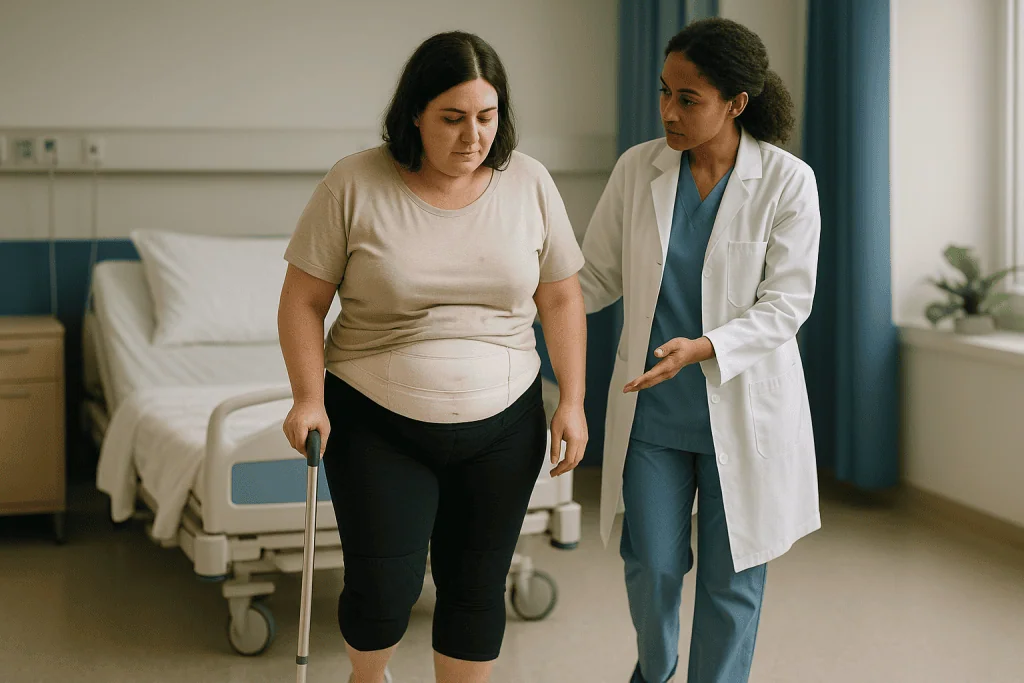
Soreness is real but usually manageable. Most people describe it as a deep ache or the feeling of a heavy workout, worst when moving from lying to standing. Pain relief is prescribed by the surgical team and is a matter for them; what matters here is that pain should be improving, not escalating, by the second and third day.
Numbness across the treated area is common. The cannula disturbs small sensory nerve branches, and the NHS lists altered sensation among the expected effects, usually easing over weeks to months. Some people feel odd tingling or a wooden quality to the skin. Persistent numbness beyond several months is described as a less common risk.
Then there is the walk. Within hours of waking, nursing staff will encourage you to stand and take slow steps. This is not cruelty. Calf muscles pump blood back toward the heart, and immobility after surgery is one of the strongest predictors of deep vein thrombosis, a clot in a deep leg vein. The NHS lists surgery and long periods of inactivity as key risk factors. Short, frequent walks, a few minutes every hour or two while awake, do more for your safety on day one than anything else you can control.
Sleeping propped up, keeping fluids up and having someone at home for the first night are standard advice for good reason.
How long to wear compression garment after liposuction, and why it matters so much
If one piece of advice separates a smooth recovery from a frustrating one, it is the garment. MedlinePlus states that patients are usually asked to wear a compression garment for three to four weeks after liposuction; Mayo Clinic and the NHS describe a period of several weeks. Some surgeons prefer a longer, lighter second stage. Follow the plan you were given.
Why so insistent? Three mechanisms:
- Fluid control. When fat is removed, it leaves an empty space between skin and muscle. Fluid naturally seeps in. Steady external pressure limits how much collects and encourages what does collect to be reabsorbed or to drain, lowering the chance of a seroma, a pocket of clear fluid that Mayo Clinic lists as a recognised complication and which sometimes needs needle drainage.
- Skin adherence. The skin has to settle onto its new, smaller foundation. Compression holds it there while early scar tissue forms, reducing the risk of loose or rippled skin.
- Comfort and support. Swollen tissue moves when you move. A garment holds it still, which most people find eases the ache noticeably.
Practical points people wish they had known: the garment should feel snug, not painful, and should never cause numbness, blue toes or a fold that digs into skin, since a rolled edge under the ribs or groin can create an indentation that lasts. Two garments make washing simpler. Sizing down too aggressively is not “extra effective”; it can impair circulation and worsen swelling below the garment line.
Removing it early is one of the most common self-inflicted setbacks surgeons see. The itch to check the result is understandable, but the garment is doing its most valuable work precisely in the weeks when you look most swollen.
Early walking: why the first steps are your best clot protection
Walking gets its own section because it is the part of a liposuction recovery timeline that carries genuine medical weight, not just comfort.
Any operation raises the risk of venous thromboembolism, the umbrella term for a clot in a deep vein and its dangerous cousin, a pulmonary embolism, where part of the clot travels to the lungs. The NHS lists a blood clot in the lungs among the serious risks of liposuction. Mayo Clinic adds a related concern specific to fat removal: fat embolism, where loosened fat enters the bloodstream. Both are uncommon. Both are why surgeons care about movement.
The mechanism is straightforward. When you sit or lie still, blood pools in the calves. When you walk, the calf muscles squeeze the deep veins and push blood upward, past the valves, back toward the heart. Moving blood does not clot easily; stagnant blood does.
A sensible early-walking pattern, always subject to your team’s instructions:
- Day of surgery: stand and walk a few steps as soon as staff say it is safe, then short indoor walks every couple of hours while awake.
- Days one to three: gentle laps of the home or garden, gradually lengthening, still every couple of hours. Avoid stairs in bulk and any bending that strains the treated area.
- Week one: short outdoor walks on flat ground, stopping before you feel exhausted.
Walking is not the same as exercising. Heart rate should stay conversational; the purpose is circulation, not fitness. Some surgeons prescribe compression stockings on the legs, separate from the body garment, and in higher-risk patients may use a clot-preventing medicine; both decisions rest with the surgical team based on your individual risk assessment.
Ankle circles and calf pumps while seated help on long sitting stretches, especially if a car journey home is unavoidable. Break any drive of more than an hour with a walk.
Week one to two: swelling, bruising and going back to work
By the end of the first week, drainage has stopped and the small incisions are sealing. Bruising, which Mayo Clinic and the NHS list as expected, moves through its colour chart: purple to green to yellow, fading over two to three weeks in most people. Ultrasound-assisted techniques are sometimes described as producing less bruising than suction alone, but the evidence for this is mixed and individual variation is wide, so plan for bruising rather than hoping to avoid it.
Swelling, meanwhile, is often at its most disheartening. The treated area may look fuller than before surgery. This is the classic week-two moment when people wonder whether anything was removed at all. It was. What you are seeing is inflammatory fluid and disrupted tissue, not fat.
Returning to work depends on the job. MedlinePlus puts the usual range at a few days to two weeks; Cleveland Clinic suggests most people need one to two weeks away. Desk-based roles at the earlier end, physical jobs at the later end or beyond. Fatigue is common and underestimated. Healing consumes energy, and a full day of concentration can feel harder than expected in week one.
Useful markers of normal progress across these two weeks:
- Pain easing day by day and controlled by the prescribed plan.
- Incisions dry, with no spreading redness or thick discharge.
- Temperature normal.
- Ability to walk further each day without breathlessness or calf pain.
Firm, tender lumps under the skin often appear around now. These are areas of early scar tissue and fluid, sometimes called fibrosis, and they typically soften over the following weeks. Some surgeons recommend gentle massage or manual lymphatic drainage, a light massage technique aimed at moving fluid through the lymph vessels. Evidence for its effect on final results is limited, so treat it as comfort care, done only when your team says the tissue is ready.
When can I exercise after liposuction? Weeks three to six
This is the question surgeons hear most in the follow-up clinic, and the honest answer has two halves: sooner than you fear for gentle movement, later than you hope for anything that makes you sweat.
Cleveland Clinic advises avoiding strenuous exercise for about four weeks after liposuction. The NHS frames it as a few weeks. Mayo Clinic advises waiting for the surgeon’s clearance before resuming exercise beyond walking. The reasoning is mechanical. Vigorous movement raises blood pressure and heart rate, increases blood flow to healing tissue and jostles the treated area. All three encourage bleeding into the space where fat was, and fluid accumulation, at exactly the stage when the skin is trying to adhere.
A graded return that many surgical teams describe, always adjusted to your case:
- Weeks one to two: walking only, increasing duration, no lifting beyond light household objects.
- Weeks two to three: longer brisk walks, stationary cycling at low resistance if the treated area is not the inner thigh or knee, gentle stretching that avoids pulling on incisions.
- Weeks three to four: light resistance work for untreated body regions; for example, seated upper-body exercises after abdominal liposuction, once the surgeon agrees.
- Week four onwards: gradual reintroduction of jogging, moderate weights and core work, with the garment often still worn during exercise for support.
Two rules make this safer. Stop if the treated area becomes hot, tight or suddenly more swollen after a session; that is a signal to step back a stage and tell your team. And do not swim, in pools, lakes or the sea, until every incision is fully closed and the surgeon confirms it, because open wounds in water invite infection.
People who were very fit before surgery often find the pace frustrating. Fitness returns quickly once cleared; a seroma or a set of rippled skin does not resolve so easily.
The return to sport: lifting, running, swimming and contact
General exercise and organised sport are different animals. Sport adds intensity, impact, competition and, in some cases, other people’s elbows.
Running. Impact transmits vibration through soft tissue, and swollen, tender areas do not enjoy it. Most surgeons treat the four-week mark cited by Cleveland Clinic as the earliest reasonable point for easy jogging, building from short intervals. Supportive garments during runs help with comfort for many people. Thigh and buttock liposuction tends to tolerate running later than abdominal work does, simply because those tissues are loaded with every stride.
Strength training. Heavy lifting raises intra-abdominal pressure and blood pressure sharply. After abdominal or flank liposuction, surgeons often ask for a longer delay on maximal lifts than on cardio. Start with lighter loads and more repetitions, and avoid exercises that stretch or compress the treated area directly until it has softened.
Swimming. Excellent low-impact exercise once permitted, but only after incisions have fully healed and the surgeon has cleared water immersion. Chlorinated pools are not sterile, and hot tubs are worse.
Contact and collision sports. Football, rugby, martial arts and similar sports carry a risk of direct blows to the treated area while tissue is still fragile and vessels are healing. Many surgeons ask for six weeks or longer before contact, and longer still if the skin is not yet firmly adhered. This is individual advice territory; ask directly.
Yoga, pilates and stretching. Generally reintroduced early in gentle forms, with deep twists and poses that stretch incision lines held back until healing is confirmed.
Elite or serious amateur athletes should raise their training calendar at the consultation, before surgery, not after. Scheduling the procedure in an off-season, and building a phased return with the surgical team and any coach or physiotherapist, is far easier than negotiating a compressed timeline afterwards. No competitive goal is worth a seroma drained the week before an event.
Liposuction swelling stages: when do results actually show?
Nothing in the whole vaser liposuction recovery timeline tests patience like the swelling, so it helps to know its shape in advance.
Stage one, days one to seven: the surge. Inflammatory fluid floods the area. The body treats the operation as an injury and sends fluid, immune cells and repair proteins. Compression and walking limit how much accumulates.
Stage two, weeks two to six: the plateau and the lumps. Swelling stops increasing but does not obviously fall. Tissue feels firm, uneven, sometimes with distinct hard ridges. This is normal scar maturation. Cleveland Clinic notes that early contour changes become visible in the first one to three months, so glimpses of the result may start to appear toward the end of this stage, often first thing in the morning before daytime fluid settles.
Stage three, months two to four: the reveal. Firmness softens, unevenness smooths, numbness recedes. Mayo Clinic describes contour improvements becoming apparent as swelling subsides over weeks, with several months for all swelling to clear.
Stage four, months four to six and beyond: the settle. The NHS advises that it can take up to six months for the area to settle completely. Skin continues to tighten modestly if elasticity was good beforehand. Only now is a fair assessment of the result, or any conversation about touch-up surgery, sensible.
Fluid naturally gravitates downward, so abdominal liposuction can produce surprising swelling of the pubic area, and thigh work can swell the knees or ankles. This is dependent oedema, not a complication, and usually eases with elevation and time. Persistent, one-sided calf swelling is a different matter and is covered in the red-flag section below.
Photographs taken by the surgical team at consistent intervals are more reliable than the mirror, which lies most convincingly at week two.
What recovery does not change: weight, metabolism and skin
Recovery advice tends to focus on what heals. It matters just as much to be clear about what liposuction does not do, because misplaced expectations drive more disappointment than any complication.
It is not weight loss. Mayo Clinic states plainly that liposuction is not a treatment for obesity and does not substitute for diet and exercise. The volume removed in a typical procedure is modest, and surgeons limit it for safety; large-volume removal carries higher risks of fluid imbalance and complications. People often see little change on the scale even when their shape changes noticeably.
It does not fix metabolic health. Fat under the skin is not the fat most associated with diabetes and heart disease; that is visceral fat, deep in the abdomen around the organs, which liposuction does not reach. Research summarised in mainstream medical sources has found that removing subcutaneous fat does not reliably improve insulin sensitivity, blood pressure or cholesterol in the way that losing weight through diet and activity does. Anyone hoping for a health benefit rather than a shape change should talk to their doctor about other routes.
It does not tighten skin or remove cellulite. Mayo Clinic is explicit on both. Ultrasound-assisted devices are sometimes marketed as encouraging skin retraction; any such effect is modest and unproven as a substitute for skin-removal surgery where laxity is significant.
Fat cells removed do not return, but remaining ones can grow. Mayo Clinic notes that results last as long as weight stays stable; with weight gain, fat distribution may shift, sometimes to untreated areas.
The most valuable thing you can do in the months after surgery, then, is exactly what protects health anyway: stable weight, regular activity once cleared, and a realistic sense that the operation changed a contour, not a constitution.
What people often get wrong about the Vaser liposuction recovery timeline
Some myths are harmless. Several of these can slow healing or hide a genuine problem.
“Ultrasound liposuction means no real recovery.” The ultrasound step changes how fat is loosened, not how tissue heals. The same fluid, swelling, garment and activity rules apply, and the NHS and Mayo Clinic describe recovery for liposuction in general without a separate faster track for energy-assisted devices.
“If I still look swollen at two weeks, it didn’t work.” Two weeks is the peak of the plateau. Cleveland Clinic’s one-to-three-month window for visible change and the NHS’s six-month settling period are the honest yardsticks.
“Taking the garment off early to see the result is fine.” A few minutes to shower is expected. Hours or days off in the first weeks invites fluid collection and loose skin. MedlinePlus’s three-to-four-week guidance exists for a reason.
“Hard lumps mean the surgeon left fat behind.” Early firmness is scar tissue and fluid. Most softens over weeks to months. Judging contour before six months is judging an unfinished process.
“Resting completely is safest.” Bed rest is one of the riskiest things you can do after surgery because of clot risk. Rest from exertion, yes; rest from walking, no.
“Any pain is normal, so I shouldn’t bother anyone.” Improving pain is normal. Worsening pain, one-sided calf pain or chest pain are never “just recovery” and need same-day contact with your team or emergency services.
“Massage makes the result.” Manual lymphatic drainage may ease comfort and swelling; evidence that it changes final contour is limited. It is a supplement to compression and time, not a replacement.
“The scale should drop.” It often will not, and may rise briefly with fluid. Shape, not weight, is the measure.
Questions to ask your care team before and after surgery
A good consultation is a conversation, and the recovery portion deserves as much airtime as the before-and-after photographs. Bring these, written down, and bring someone to help you remember the answers.
Before surgery
- Which technique do you plan to use for my areas, and why ultrasound-assisted rather than another method for my particular case?
- How many areas and roughly how much volume do you intend to treat in one session, and how does that change my recovery?
- Will I be under general or local anaesthesia, and will I stay overnight?
- What is my personal risk of blood clots, and will I need stockings or a clot-preventing medicine?
- Exactly how long should I wear the garment, day and night, and when does that change?
- What written aftercare instructions will I receive, and who do I call at 2am?
After surgery
- Is this amount of swelling and bruising within the range you expect for me?
- When may I shower, and how should I care for the incisions?
- When may I drive, return to my specific job, lift my child, or sit for a long journey?
- What is my personal plan for exercise, from walking through to my sport?
- Are these firm areas normal, and should I do anything about them?
- When will you assess the final result, and what happens if we are both unhappy with an area?
Notice what is not on the list: guarantees. A trustworthy surgeon will not offer a promised outcome or a fixed day you will look “done”, because the NHS and Mayo Clinic both describe results that take months to become clear. Answers that acknowledge uncertainty are a sign you are in careful hands.
Ask, too, about the qualifications and regulation of the surgeon and facility in your country; the NHS advises checking a surgeon’s registration and specialism before any cosmetic operation.
When to call your doctor: red flags after Vaser liposuction
Most recoveries are uneventful. The point of knowing the warning signs is not to worry; it is so that the rare serious problem is recognised early, when it is most treatable. Contact your surgical team the same day for any of the following, and call emergency services for the items marked urgent.
- Urgent: chest pain, sudden breathlessness, coughing up blood, or a racing heartbeat. These can signal a pulmonary embolism, which the NHS lists as a serious risk of liposuction.
- Urgent: pain, warmth, redness or swelling in one calf or thigh, especially if one leg is noticeably larger than the other. These are the NHS’s signs of deep vein thrombosis.
- Urgent: fainting, confusion, severe abdominal pain, or vomiting that will not settle. Mayo Clinic notes that internal puncture and fluid shifts are rare but serious complications.
- A temperature above normal with chills, or feeling generally unwell in a way that is getting worse.
- Spreading redness, increasing heat, thick or foul-smelling discharge from an incision, or an incision that reopens.
- Pain that increases after the first few days rather than easing, or that is out of proportion to what you were told to expect.
- A soft, fluctuant swelling under the skin that grows, sloshes or feels like a water balloon, which may be a seroma needing drainage.
- Large, rapidly expanding, tense bruising, which may indicate a haematoma, a collection of blood under the skin.
- Skin over the treated area turning dark, blistered or unusually pale, or any area that has lost sensation and is not improving.
- Persistent nausea, dizziness on standing, or very little urine, which can point to fluid imbalance.
Never wait to see whether something settles overnight if it appears on the urgent list. Emergency staff would far rather see a false alarm than a late presentation. For everything else, your surgical team’s aftercare line exists precisely for the phone call you feel embarrassed to make. Make it.
Frequently asked questions
How long does ultrasound assisted liposuction recovery take compared with traditional liposuction?
Recovery timelines are broadly the same. The ultrasound step changes how fat is loosened before suction, not how the body heals afterwards, so guidance from Mayo Clinic, the NHS and Cleveland Clinic on garments, walking and exercise applies to both. Some patients report less bruising with energy-assisted methods, but evidence is mixed. Plan for one to two weeks off work and about four weeks before strenuous activity.
How long to wear compression garment after liposuction?
MedlinePlus states that compression garments are usually worn for three to four weeks, while Mayo Clinic and the NHS describe several weeks. Many surgeons ask for continuous wear at first, then daytime-only or a lighter garment later. The garment limits fluid build-up, helps skin adhere to its new contour and eases discomfort. Follow your surgeon’s specific schedule rather than a general figure.
When can I exercise after liposuction?
Gentle walking starts on the day of surgery and is actively encouraged for clot prevention. Cleveland Clinic advises avoiding strenuous exercise for about four weeks. Between those points, most teams allow gradually longer walks, then low-impact activity, then light resistance work for untreated areas, with the surgeon clearing each step. Stop and call your team if the treated area becomes hot, tight or suddenly more swollen after activity.
What are the liposuction swelling stages, and when does swelling go down?
Swelling surges in the first week, plateaus with firm lumps in weeks two to six, then gradually recedes. Cleveland Clinic describes visible contour changes emerging over one to three months, and the NHS advises that the area can take up to six months to settle completely. Morning is usually the least swollen time of day, and fluid may shift downward to nearby areas such as the pubic region or knees.
Why is early walking so important after Vaser liposuction?
Walking uses the calf muscles to pump blood back toward the heart, which reduces the pooling that allows clots to form in deep leg veins. The NHS lists surgery and inactivity as major risk factors for deep vein thrombosis and names a lung clot among liposuction’s serious risks. Short walks every couple of hours while awake, from the day of surgery, are among the most effective safety steps in your control.
When can I return to work after Vaser liposuction?
MedlinePlus gives a range of a few days to two weeks, and Cleveland Clinic suggests most people need one to two weeks. Desk-based roles typically return earlier; physically demanding jobs later, sometimes beyond two weeks. Fatigue is common in the first week even when pain is well controlled, so building in a lighter schedule for the first days back is sensible.
When can I swim or use a hot tub after liposuction?
Only after every incision has fully closed and your surgeon has confirmed it is safe to immerse the area. Pools, lakes, the sea and especially hot tubs carry bacteria that can infect healing wounds. For many people this coincides with the general clearance for exercise at around four weeks, but the deciding factor is wound healing, which your team will check at follow-up.
Are hard lumps after liposuction normal?
Firm, tender or uneven areas in the weeks after surgery are common and usually represent early scar tissue and trapped fluid rather than fat left behind. Most soften over two to six months. A soft, growing, sloshing swelling is different and may be a seroma needing drainage, and rapidly expanding tense bruising may be a haematoma; both warrant a call to your surgical team.
Will Vaser liposuction help me lose weight or improve my health?
No. Mayo Clinic states that liposuction is not a treatment for obesity and does not replace diet and exercise. It removes fat under the skin, not the deeper visceral fat linked to diabetes and heart disease, and studies summarised by mainstream sources have not shown reliable metabolic benefits. Expect a change in contour, often with little movement on the scale.
When can I return to contact sports or heavy lifting after liposuction?
Later than general exercise. Heavy lifting raises blood pressure and internal pressure and is often delayed beyond the four-week mark for strenuous activity, especially after abdominal or flank treatment. Contact and collision sports risk direct blows to fragile tissue, and many surgeons ask for six weeks or more. Athletes should raise their training calendar before surgery so the team can plan a phased return.
References
This article is for general information only and is not a substitute for professional medical advice. Please consult a qualified doctor about your individual situation.

More from the Blog

Preparing for Vaginoplasty: The Pelvic Exam, Blood Work and Habits to Pause Beforehand
Preparing for vaginoplasty usually involves a pelvic and genital examination, routine blood tests such as a blood count, kidney and liver measures, blood sugar…

Is Tumescent Liposuction Right for You? Small Areas, Stable Weight and Honest Limits
Tumescent liposuction is usually considered for adults at or near a stable, healthy weight who have a few well-defined fat pockets that have not…

Is Classic Liposuction Right for You? Skin Elasticity, Stable Weight and Realistic Areas
A typical classic liposuction candidate is an adult at or near a stable weight for several months, with localized fat pockets that resist diet…

What the Tumescent Solution Does in Tumescent Liposuction: Bleeding, Bruising and Comfort
Tumescent solution is a large volume of very dilute salt water carrying a local anesthetic and epinephrine, infused into the fat before liposuction. It…
How Monsplasty Is Performed: Liposuction, Skin Removal and Where the Incision Sits
Monsplasty reshapes the mons pubis, the soft fatty mound over the pubic bone, using one of two approaches or both together. Liposuction removes excess…

Who Is a Candidate for Vaginoplasty? Childbirth Changes, Symptoms and Surgical Timing
A candidate for vaginoplasty is usually someone who has finished childbearing, has persistent looseness or bulging of the vaginal wall (often after vaginal birth),…