

Exercise After Arm Liposuction: Upper-Body Training and When the Compression Sleeves Come Off

Key Takeaways
- The tunnels left by the cannula need days to seal and weeks to drain, which is why walking is encouraged from day one while arm loading waits.
- Mainstream guidance describes swelling easing over a few weeks and the treated area taking up to about six months to settle fully, so arms often look larger before they look smaller.
- Compression sleeves do their least visible but most important work after bruising fades, holding skin flat against the healing tissue beneath.
- Removed fat cells do not regrow in meaningful numbers, but remaining cells enlarge with weight gain, so exercise protects the result by holding weight stable rather than by guarding the arm.
- Movements that press or shear the back of the arm, such as planks, dips and leaning on handlebars, are typically cleared later than free-arm movements like curls and raises.
- Soreness that peaks around day three and eases is expected; pain that worsens after day five, or any calf swelling or breathlessness, needs same-day medical attention.
Exercise after arm liposuction is usually reintroduced in stages: short walks within a day or two, light daily activity over the first one to two weeks, and gradual upper-body training over roughly four to six weeks as swelling and bruising settle. Compression sleeves are typically worn for several weeks. The exact timing depends on the extent of treatment and the surgeon's assessment, so follow your own team's clearance rather than a general schedule.
The kettlebell has been sitting by the front door for nine days. Its owner has arm liposuction stitches under two snug compression sleeves, a wardrobe of loose shirts, and a growing list of questions nobody quite answered at the pre-op visit. Can I lift this yet? Why does my upper arm feel like a firm, numb sponge? And how long before these sleeves stop being part of my outfit?
Those are sensible questions, because exercise after arm liposuction sits in an awkward middle ground. Move too little and recovery feels slower, stiffer and more anxious. Load the treated tissue too early and you risk more swelling, more bruising and a longer wait for the shape you paid for in time and discomfort.
This explainer walks through what actually happens inside the arm after the procedure, how surgeons typically phase activity, what the compression sleeves are for, and where the common advice from gym friends and comment sections goes wrong. The timing for your own arms belongs to the team that treated them. The reasoning behind that timing is what follows.
What actually happens to the arm during liposuction?
Liposuction removes subcutaneous fat, the layer that sits between skin and muscle, through a thin hollow tube called a cannula. On the upper arm, the usual target is the back and underside of the arm, the area that continues to swing after the hand has stopped waving.
Most arm procedures use a tumescent technique. The surgeon first infuses a large volume of dilute salt water containing a local anesthetic and a small amount of epinephrine, a hormone that narrows blood vessels. The anesthetic numbs the area, the epinephrine limits bleeding and bruising, and the fluid itself firms the fat so the cannula can pass through it more evenly. Then the cannula is moved back and forth in a fan pattern through small incisions near the elbow or armpit, breaking up fat and suctioning it away. The Mayo Clinic describes these mechanics and the common variations, including ultrasound-assisted and laser-assisted versions that liquefy fat before removal.
What matters for exercise is what the cannula leaves behind: thousands of tiny tunnels through the fat layer, torn small blood vessels and disrupted lymphatic channels, the fine drainage pipes that carry tissue fluid back toward the heart. The body treats this as a controlled injury. Over the first days it floods the area with fluid and inflammatory cells. Over weeks it lays down new collagen to knit the tunnels closed, and the skin gradually re-adheres to the tissue beneath it.
Every training decision in the weeks ahead comes back to those tunnels. Vigorous arm movement in the first days pumps more fluid into a space that is already struggling to drain. Gentle movement later on helps that fluid clear and encourages the skin to settle smoothly. Timing, not willpower, is the whole game.
Why does exercise after arm liposuction need a plan at all?
Nobody schedules a recovery plan for a scraped knee. Liposuction is different because the injured tissue is spread across a wide area under intact skin, where you cannot see what is happening, and because the arms are involved in nearly everything you do.

Three physiological jobs need to finish before heavy upper-body work is wise. The first is sealing. Small vessels torn during the procedure clot and heal within days, but a sharp rise in blood pressure or a hard muscular contraction near the surface can reopen them and create a hematoma, a pocket of trapped blood. The second is drainage. Lymphatic channels regrow slowly, and until they do, fluid pools in the treated space. Repetitive arm movement early on increases the leak into that space faster than it increases the drainage out. The third is adhesion. The skin has to reattach to the underlying tissue in its new, flatter position; shearing it with early stretching or heavy load can leave ripples or a lingering fluid pocket called a seroma.
At the same time, complete rest brings its own risks. Immobility after any surgery raises the chance of a blood clot in a deep leg vein, known as deep vein thrombosis or DVT. The NHS lists surgery and reduced mobility among the main risk factors. Gentle walking from the first day lowers that risk and improves circulation to the healing arm as well.
So the plan is not about restriction for its own sake. It is a sequence that protects the sealing and drainage work in the first two weeks, then uses movement to speed the settling work in the weeks after. Surgeons disagree on exact dates, and your own timeline should come from the person who knows how much tissue was treated and how your arm looked at follow-up.
Who is usually cleared to move early, and who is asked to wait longer?
Two people can leave the same operating room on the same morning and receive different exercise instructions. The variables are predictable, even if the dates are not.
People who are typically cleared for the standard progression had a modest volume of fat removed from the upper arms alone, have good skin elasticity, do not smoke, have well-controlled blood pressure and no bleeding tendency, and had an uneventful first follow-up visit with symmetrical swelling and no fluid collection. Younger skin tends to re-drape more readily, which shortens the settling phase, though age alone is not a rule.
People commonly asked to wait longer, or to progress in smaller steps, include those who:
- had liposuction of the arms combined with other areas in the same session, which increases total tissue injury and fluid shifts;
- had an arm lift (brachioplasty) at the same time, since a long incision on the inner arm needs far more protection from stretch than cannula punctures do;
- developed a seroma or hematoma that needed drainage, because the cavity needs time to close;
- smoke or use nicotine, which constricts small blood vessels and slows healing;
- have diabetes, a connective tissue condition, or take medicines that affect clotting, all of which the prescribing clinician weighs case by case.
There is also a group that is asked to wait before the procedure itself. Mainstream guidance from the Mayo Clinic and NHS describes liposuction as a contouring procedure for people near a stable weight, not a weight-loss method. Someone whose weight is still changing, or who has not yet addressed a medical cause of weight gain, is usually encouraged to reach stability first. That advice is not a judgment; it reflects the fact that the result is far more predictable on a body that is not in flux.
Arm liposuction recovery time: what the first two weeks usually feel like
The first 48 hours are about fluid. The tumescent solution infused during the procedure has to go somewhere, and much of it drains out through the small incisions, often tinged pink. Dressings may be soaked and changed more than once. The arms feel heavy, tight and oddly numb, because the local anesthetic lingers and small sensory nerves have been disrupted. Walking around the house is encouraged from the first day; reaching overhead is not.
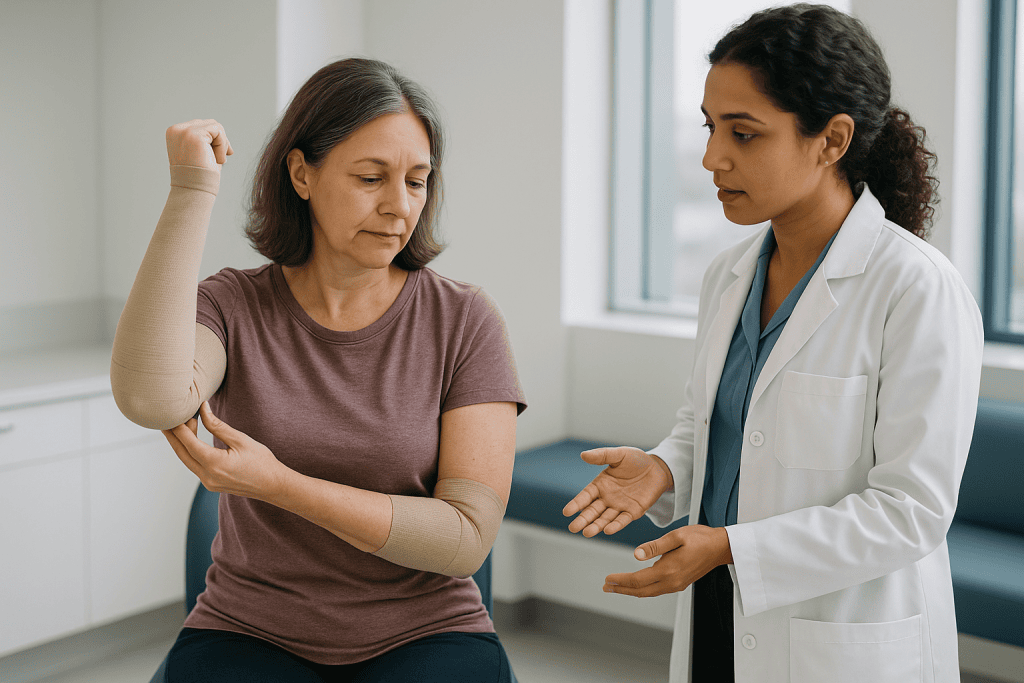
Days three to five are when most people feel worst. Bruising blooms as blood that leaked into the tissue spreads under the skin, swelling peaks, and the area becomes tender to touch. Some describe a deep ache like an overdone workout; others notice sharp twinges as nerves wake up. Sleep is awkward because lying on an arm hurts and lying flat can feel congested.
By the end of week one the drainage has usually stopped, bruising is turning yellow and green at the edges, and the arms feel firm rather than soft. That firmness is normal. It is the early collagen scaffold the body builds before it remodels into softer tissue.
The NHS notes that people commonly need about one to two weeks off work after liposuction depending on the job, and that the treated area can take up to six months to settle fully. The Mayo Clinic describes swelling typically easing over a few weeks, with the leaner contour emerging over several months. Those ranges are averages across all body areas; arms often feel functional sooner because the muscles beneath were not touched, but they can look swollen for longer because fluid pools easily at the elbow when the arm hangs.
Exercise during this window means walking, gentle finger and wrist movement, and short, pain-free shoulder rolls. Nothing else is gained by pushing, and quite a lot can be lost.
When to start exercising after liposuction: a typical phased timeline
Surgeons rarely hand over a single date. They describe phases, and the table below pulls together the ranges that appear across mainstream guidance. Treat it as a map of the usual terrain, not a schedule for your own arm.
| Phase | Typical window | What is usually allowed | What is usually avoided |
|---|---|---|---|
| Immediate | Days 1–3 | Walking indoors several times daily, gentle hand and wrist movement, sleeping with arms slightly elevated | Lifting, reaching overhead, driving if arms are stiff or sedating medicines are in use |
| Early recovery | Days 4–14 | Longer walks outdoors, light household tasks, slow pain-free shoulder range of motion | Running, cycling, carrying groceries or children, any sweating workout that soaks the garment |
| Gradual loading | Weeks 2–4 | Brisk walking, stationary cycling without leaning on handlebars, lower-body strength work, very light resistance bands for the arms if cleared | Push-ups, overhead presses, pull-ups, swimming or hot tubs until incisions are fully closed |
| Full return | Weeks 4–6 onward | Progressive upper-body training beginning well below previous loads, swimming once cleared | Returning straight to prior weights; ignoring new swelling after a session |
The NHS describes avoiding strenuous activity for several weeks after liposuction and wearing compression for a similar period; the Mayo Clinic frames the return to normal activity as gradual over a few weeks. The precise boundaries move depending on how much fat was removed and how your tissue is behaving at each follow-up.
A simple test guides the transition between phases: an activity is probably too early if the arm is visibly more swollen or sore the next morning. Settled tissue tolerates load without protest. Healing tissue complains, and the complaint is worth listening to.
Walking first: why the best early arm exercise does not involve the arms
It sounds like a loophole, but the single most useful form of exercise after arm liposuction in the first two weeks is a walk. The reason sits in the legs, not the arms.
After any surgery, blood flow in the deep veins of the calves slows when a person lies or sits for long stretches. Slow flow lets clots form, and a clot that breaks loose can travel to the lungs. The NHS identifies recent surgery, immobility and dehydration as common contributors to deep vein thrombosis. Walking engages the calf muscles, which squeeze the deep veins and keep blood moving. Even a lap of the kitchen every hour while awake makes a difference.
Walking also helps the arms indirectly. Rhythmic movement of the whole body raises heart rate modestly, improves circulation to healing tissue, and encourages lymphatic fluid to shift. Most lymph vessels rely on body movement and breathing rather than a dedicated pump, so a person who walks tends to drain swelling faster than one who sits still, provided the arms themselves are not being worked hard.
Practical details matter more than distance. Keep the compression sleeves on. Let the arms hang loosely or rest them lightly in pockets rather than pumping them. Choose flat ground for the first week, since stumbling and instinctively grabbing a rail with a tender arm is a genuinely unpleasant experience. Stay hydrated; the body is still shifting fluid, and dehydration thickens blood.
By the second week many people are walking 20 to 30 minutes at an easy pace without fuss. That is not a target, just a common observation. Someone who treated multiple areas or had a lot of bruising may be walking far less, and that is also fine. The aim is frequent gentle movement, not a step count.
How to rebuild upper-body training without stressing the treated tissue
When the team clears arm work, the temptation is to pick up where you left off. The treated tissue has other ideas. The muscles under the fat layer are intact and surprisingly strong; the tissue above them is still remodeling and dislikes two things in particular, shear and sustained pressure.
Shear happens when skin slides over the deeper layers, as in a deep triceps stretch or a wide-grip movement that drags the back of the arm. Sustained pressure happens when the back of the arm is braced against a bench, a cable pad or a yoga mat. Both can irritate the healing interface and provoke fluid collection, which is why many surgeons clear standing and seated movements before lying ones.
A sensible return follows a few principles rather than a rigid program:
- Start with range of motion, not resistance. Slow arm circles and overhead reaches, stopping at the first pull in the skin, restore mobility first.
- Use light bands or very light dumbbells for high repetitions before adding load. The goal is blood flow and confidence, not fatigue.
- Favor movements where the arm is free in space, such as biceps curls and lateral raises, before movements that press the back of the arm into a surface.
- Delay push-ups, dips and heavy pressing until the skin feels fully attached and the firmness has softened.
- Check the arms the next morning. New swelling or a tender area means the last session was too much.
The CDC recommends that adults include muscle-strengthening activity on at least two days a week as part of general health. Returning to that baseline over several weeks, rather than reclaiming it in one session, is the pattern most compatible with a smooth result. Strength lost over a month of lighter training comes back quickly. A contour irregularity, an uneven dip or ridge in the healed tissue, does not resolve so easily.
Compression garment after liposuction: what the sleeves do and when they usually come off
Compression sleeves are the least glamorous part of arm liposuction and arguably the most important piece of aftercare you control. They have three jobs.
First, they limit swelling. By applying steady external pressure, they reduce how much fluid leaks into the tunnels left by the cannula and encourage what is there to move toward the lymphatic channels. Second, they reduce bruising and hematoma risk by supporting small vessels while they seal. Third, and this is the part people underestimate, they hold the skin against the underlying tissue so it heals in a smooth, flat position rather than draping loosely over fluid.
Mainstream guidance agrees on the principle and leaves the duration to the surgeon. The NHS describes wearing an elasticated support garment for several weeks after liposuction; the Mayo Clinic describes compression garments as a standard part of recovery for a few weeks. Many surgeons describe two stages: near-continuous wear in the early period, then daytime-only or exercise-only wear as swelling subsides. Arms are awkward because sleeves ride down and bunch at the elbow, so fit matters more than brand, and a garment that creases hard across the inner elbow can leave its own indentation.
The question of when the sleeves come off is really a question of what the tissue is doing. Surgeons typically look for stable, symmetrical swelling, no fluid pockets on examination, and skin that feels adherent rather than loose before stepping down compression. Some people are advised to keep wearing sleeves during workouts for a few additional weeks, since exercise raises blood flow and can cause temporary swelling even in settled tissue.
Taking the sleeves off early because they are hot, itchy or inconvenient is the most common self-inflicted setback in arm liposuction recovery. If a garment is genuinely intolerable, the fix is a better-fitting one chosen with your team, not an empty drawer.
What are the worst days after liposuction, and why do they arrive late?
People expect the hardest day to be the first. For most it is the third or fourth. Understanding why removes some of the fear.
On the day of surgery, the local anesthetic in the tumescent fluid is still active and the epinephrine has clamped down small vessels. The arm feels numb and heavy but not especially painful. Over the next 24 to 48 hours the anesthetic wears off, the vessels relax, and inflammation ramps up as the body sends fluid and repair cells to the area. Swelling peaks, bruises that were forming under the surface appear, and the whole arm becomes tender. Many people also feel generally wiped out around this point, which is a normal response to tissue injury rather than a sign of something wrong.
Discomfort in this window is typically described as a deep, bruised soreness rather than sharp pain. Clinicians often compare it to the ache after an unusually hard upper-body workout. Pain relief, if prescribed, is intended to take the edge off this phase; its use, timing and duration are decisions for the prescribing clinician, not something to adjust alone.
From day five onward most people notice steady improvement. Bruising changes color and fades, swelling begins to move downward toward the elbow and forearm under gravity, and the firm sponge-like feel sets in as collagen forms. Itching often arrives in week two as nerves recover; it is annoying and usually benign.
The pattern to watch is direction, not intensity. Soreness that peaks around day three and then eases is expected. Pain that worsens after day five, concentrates in one spot, or comes with heat, spreading redness or fever is not part of the normal curve and belongs in the red-flag list later in this article.
Do my arms still look bigger after arm lipo? Swelling and the arm liposuction results timeline
It is one of the most searched and least discussed questions. Yes, in the first weeks the arms very often look larger than they did before surgery, and the reason is fluid, not fat.
The tumescent solution, inflammatory swelling and lymphatic congestion together can add more volume than the fat that was removed. The treated area is also firmer, which makes it look fuller under clothing. Add compression sleeves and a bruise or two, and the mirror can be genuinely discouraging around week two.
The Mayo Clinic describes swelling typically easing over a few weeks and the leaner contour becoming apparent over several months; the NHS gives up to six months for the area to settle completely. Within those ranges, arms follow a recognizable sequence. Gross swelling drops first, usually across the first month. A firmer, slightly lumpy phase follows as collagen remodels. Residual puffiness around the elbow and inner arm lingers longest because fluid pools where the arm hangs lowest. The final shape, the one worth photographing, is a late arrival.
Exercise interacts with this timeline in both directions. Gentle, progressive movement after the early phase helps fluid clear and may shorten the puffy period. Hard arm work too early does the opposite, re-inflaming tissue and adding fresh swelling to old. Some people notice their arms look larger for a day after a workout even months out; that is usually transient exercise-related swelling in tissue that still has fewer lymphatic channels than before.
A practical way to stay sane: take consistent photos in the same light and pose every two weeks, and compare month to month rather than day to day. Week-to-week changes are hard to see. The difference between week two and week twelve usually is not.
How to maintain results: does exercise actually keep the arms lean?
Gym lore insists that exercise is a must to keep liposuction results. The evidence is more nuanced, and more useful.
Liposuction permanently removes fat cells from the treated area. The Mayo Clinic notes that remaining fat cells, both in the arm and elsewhere, can still enlarge if a person gains weight. So the arm will tend to stay proportionally slimmer than it would have been, but it is not immune to overall weight change, and gain may redistribute to untreated areas. Exercise, then, protects the result mainly by helping to hold weight stable, not by defending the arm itself.
Strength training adds something liposuction cannot. Fat removal changes the shape of the layer over the muscle; training changes the shape of the muscle beneath. A modest increase in triceps and deltoid tone fills the skin from below and often gives the arm a more defined line than fat removal alone. This is also where unrealistic expectations go wrong: liposuction does not produce muscular definition, and training does not remove a stubborn fat pocket. They do different jobs.
The CDC’s physical activity guidelines for adults describe at least 150 minutes a week of moderate-intensity aerobic activity, or 75 minutes of vigorous activity, plus muscle-strengthening work on two or more days. Those figures are population health targets, not a liposuction maintenance formula, but a person who meets them is likely to hold a stable weight more easily than one who does not.
The honest answer to how to stay lean after liposuction is unglamorous: the same eating patterns and activity habits that would have maintained weight before surgery maintain it after. The procedure changes a proportion. The habits determine the total.
Spin class, swimming, yoga and lifting after arm liposuction: a sport-by-sport view
Different activities stress the treated arm in different ways, which is why a blanket return-to-exercise date never quite fits. The following is how each type typically interacts with healing tissue; the clearance for each still comes from your team.
Indoor cycling. The legs do the work, which makes it tempting early. The problem is the handlebars. Leaning on the arms loads the triceps region and presses the back of the arm, and sprints push heart rate and blood pressure high enough to aggravate bruising in the first two weeks. Upright cycling with little handlebar pressure is often cleared before leaning positions and sprint intervals.
Swimming. Water is gentle on joints but not on fresh incisions. Pools, lakes and hot tubs carry bacteria, and soaking softens the small wounds. Most surgeons ask people to wait until every incision is fully closed and dry, and open water is usually later still. Once cleared, the repetitive overhead reach of freestyle is a demanding arm movement and should be reintroduced slowly.
Yoga and Pilates. Weight-bearing on the hands in plank, downward dog and side planks places pressure and shear on the back of the arm. Standing and seated sequences are commonly cleared earlier than floor work. Hot yoga adds heat and heavy sweating under a compression sleeve, which irritates skin and increases swelling.
Running. Impact itself does not harm the arms, but the arm swing is constant and a sweaty sleeve chafes. Many people start with brisk walking in week two or three and progress as the garment tolerates it.
Resistance training. Covered earlier, but worth repeating: free movements before braced ones, light before heavy, and the next-morning swelling check after every session for the first several weeks.
In all cases the sign to stop is the same: new swelling, new pain or a feeling of fullness that was not there before the session.
What people often get wrong about exercise after arm liposuction
The comment sections under arm liposuction videos are a reliable catalog of confident misinformation. A few corrections, with the evidence behind them.
Myth: sweating it out speeds recovery. Sweat is temperature regulation, not detoxification. Hard early workouts raise blood pressure and fluid leak into the treated space, and soaked garments irritate skin. The body clears tumescent fluid and inflammatory swelling through the lymphatic system and kidneys regardless of how much you sweat.
Myth: if you do not exercise, the fat comes back to the arm. Fat cells removed by liposuction do not regenerate in meaningful numbers. The Mayo Clinic is explicit that the risk is weight gain enlarging remaining fat cells, including in untreated areas. Exercise protects the overall result by supporting weight stability, not by guarding the arm.
Myth: the final result is visible at one month. Swelling eases over weeks, but the NHS describes up to six months for the area to settle. Judging the outcome, or scheduling a revision, before that point is judging swelling.
Myth: compression is optional once the bruises fade. Bruising resolves well before the skin has finished re-adhering. Sleeves do their most subtle work in the weeks after the arm looks and feels better.
Myth: liposuction builds defined arms. It removes fat over the muscle. Definition comes from the muscle itself and from how the skin drapes over it. People who want visible contour usually need both the procedure and a strength habit, and sometimes the strength habit alone was the missing piece.
Myth: numbness means nerve damage. Patchy numbness and odd tingling are expected as small sensory nerves recover, and the Mayo Clinic lists temporary numbness among common effects. Persistent dense numbness beyond several months is worth raising with the team, but early numbness is the rule rather than the exception.
Questions to ask your care team before you pick up a weight
A surgeon who has seen hundreds of arms heal can give far more precise guidance than any article, but only if asked the right questions. Bring this list to the pre-operative consultation and again to the first follow-up, when the team can see how your tissue is actually behaving.
- How much fat was removed, and does that volume change the usual activity timeline you give?
- Which specific movements do you want me to avoid, and for roughly how long? Overhead reaching, pressing, stretching the back of the arm, or all three?
- When can I walk briskly, and when can I do lower-body training that does not involve the arms?
- What is your usual compression schedule, and what will you look for before stepping it down?
- Should I wear the sleeves during workouts after I stop wearing them in daily life?
- When do you consider the incisions sealed enough for a pool, and later for open water?
- Do you recommend manual lymphatic drainage, a gentle massage technique aimed at moving tissue fluid, and if so, is there evidence for it in your experience or is it optional comfort care?
- What does normal swelling after a workout look like, and what should make me stop and call?
- Are any of my regular medicines or supplements relevant to bleeding, clotting or healing in a way that affects when I can train? This is a question for the prescribing clinician, not something to adjust alone.
- If I notice a firm lump or a soft fluid pocket, do you want to see it at the next visit or sooner?
- When do you consider the result final, and when would you take photographs for comparison?
Write the answers down. Instructions given while you are groggy on the day of surgery rarely survive the drive home, and a clear written timeline removes most of the anxiety that drives people to either push too hard or sit too still.
When to call your doctor: red-flag signs after arm liposuction
Most of what the arm does in the first weeks, from swelling and bruising to numbness, firmness and itching, is expected. A short list of signs is not, and each warrants a same-day call to the surgical team or, for the most serious, emergency care.
Contact the team promptly if you notice:
- pain that increases after day five, or pain concentrated in one spot rather than spread across the treated area;
- spreading redness, warmth or a foul-smelling or cloudy discharge from an incision, or a fever, which the Mayo Clinic and NHS list among signs of infection after liposuction;
- a rapidly enlarging, tense or very painful swelling on one arm, which can indicate a hematoma;
- a soft, shifting fluid pocket that persists or grows, suggesting a seroma that may need drainage;
- skin over the treated area that turns dusky, dark or blistered, since compromised skin circulation needs early assessment;
- numbness or weakness in the hand that is new or worsening rather than patchy and stable.
Seek emergency care without waiting for a callback if you develop sudden shortness of breath, chest pain, coughing up blood, a racing heart, or a swollen, painful, warm calf. The NHS describes these as possible signs of deep vein thrombosis and pulmonary embolism, a clot that has traveled to the lungs. Surgery and reduced mobility raise the risk, and early treatment matters.
Also seek urgent care for fainting, confusion, a very fast heartbeat with lightheadedness, or vomiting that prevents you from keeping fluids down, since large fluid shifts after liposuction can occasionally cause dehydration or low blood pressure.
Two guiding thoughts. First, the team would always rather hear about a false alarm than miss a real one. Second, exercise is the most common trigger for a worried call in week two or three, and the usual answer is simply to rest the arm, keep the compression on and be seen if it does not settle within a day. Every decision about pausing, resuming or modifying activity rests with the people who treated you.
Frequently asked questions
How long does it take for arm liposuction to heal?
Most people are back to light daily activity within one to two weeks, with the NHS describing up to six months for the treated area to settle completely. Early healing, meaning sealed incisions and fading bruises, happens in the first few weeks. The slower part is remodeling, as firm tissue softens and the skin re-drapes, which is why the final contour is a late arrival.
When can I start exercising after arm liposuction?
Gentle walking usually begins within a day, light daily tasks over the first two weeks, and gradual upper-body training around four to six weeks in many surgical protocols. The exact timing depends on how much fat was removed, whether other areas were treated, and how the arm looks at follow-up. Your surgeon’s clearance overrides any general timeline.
What is the arm liposuction recovery time before heavy lifting?
Heavy pressing, dips and push-ups are commonly among the last movements cleared, often after the skin feels fully attached and the firmness has softened, which for many people means a month or more. Even then, surgeons typically advise starting well below previous loads and checking for new swelling the next morning before progressing.
Do my arms still look bigger after arm lipo?
In the first few weeks, often yes. Tumescent fluid, inflammatory swelling and lymphatic congestion can add more volume than the fat that was removed, and compression sleeves make the arm look fuller under clothing. The Mayo Clinic describes swelling easing over a few weeks and the leaner shape appearing over several months, with puffiness near the elbow lingering longest.
What are the worst days after liposuction?
Days three to five are usually the most uncomfortable. By then the local anesthetic has worn off, inflammation has peaked, and bruising that formed under the skin becomes visible. Discomfort is typically a deep bruised ache rather than sharp pain, and it should ease steadily from about day five. Pain that worsens after that point should be reported to your team.
How long do I wear a compression garment after liposuction?
The NHS describes several weeks of compression after liposuction, and the Mayo Clinic frames it as a few weeks, with the exact schedule set by the surgeon. Many protocols move from near-continuous wear to daytime or exercise-only wear as swelling settles. Surgeons look for stable swelling, no fluid pockets and well-adhered skin before stepping compression down.
How to stay skinny after liposuction?
The same habits that maintain weight before surgery maintain it afterward. Liposuction removes fat cells from the arm permanently, but remaining cells anywhere in the body enlarge with weight gain. The CDC’s general adult guidance of at least 150 minutes of moderate aerobic activity weekly plus two strength sessions supports weight stability, and strength work also adds muscle shape under the slimmer arm.
When can I go to spin class after arm liposuction?
Upright cycling with little handlebar pressure is often cleared before leaning positions and sprint intervals, which load the back of the arm and spike blood pressure. Many people return to easy spinning around two to four weeks and to full-intensity classes after four to six, but the timing for your arm is your surgeon’s call, and new swelling after a session means it was too soon.
What does the arm liposuction results timeline look like month by month?
Gross swelling typically drops across the first month, followed by a firm, slightly lumpy phase as collagen remodels through months two and three. Residual puffiness at the elbow and inner arm fades last. The NHS gives up to six months for complete settling. Comparing photographs month to month, rather than day to day, shows the change far more clearly.
Can exercise cause lumps or unevenness after arm liposuction?
Early hard arm work can increase swelling and fluid collection, and shearing or pressing the healing tissue may contribute to irregular contours. Temporary firmness and small lumps are a normal part of remodeling and usually soften with time. Persistent firm areas or a soft, shifting fluid pocket should be shown to your surgical team rather than massaged or trained through.
References
- NHS: Liposuction
- MedlinePlus: Liposuction
- CDC: Adult Activity: An Overview (Physical Activity Guidelines)
- NHS: Deep vein thrombosis (DVT)
This article is for general information only and is not a substitute for professional medical advice. Please consult a qualified doctor about your individual situation.

More from the Blog

Brazilian Tummy Tuck vs BBL: Two Very Different Procedures Behind Similar Names
A "Brazilian tummy tuck" is a marketing name for an abdominoplasty, an operation that removes loose abdominal skin, tightens the muscle wall and often…
Tummy Tuck Scars: Placement, Healing Stages and Realistic Long-Term Appearance
Tummy tuck scars are permanent, but they typically fade substantially over time. The main scar runs low across the abdomen from hip to hip,…
How Long Do Mommy Makeover Results Last? Weight, Future Pregnancy and Aging Explained
Mommy makeover results typically last many years, but they are not frozen in time. Tummy tuck and liposuction changes hold best when weight stays…
Who Is a Candidate for an Arm Lift? Loose Upper-Arm Skin, Weight Stability and Skin Quality
An arm lift candidate is usually an adult whose upper-arm looseness comes mainly from excess skin rather than fat alone, whose weight has held…

Is CoolSculpting for Weight Loss? Why It Only Suits Pinchable Fat and a Stable Weight
No. CoolSculpting, the brand name for a technique called cryolipolysis, is not a weight loss treatment. It cools a small, pinchable pocket of fat…
J Plasma vs Tummy Tuck: When Skin Tightening Energy Is Enough and When It Is Not
Energy-based skin tightening, including helium plasma devices sold under the J Plasma name, heats the underside of the skin to shrink mild to moderate…