

Warning Signs After Breast Reconstruction: Redness, Swelling and Flap Changes to Report Fast

Key Takeaways
- The CDC counts most surgical site infections as appearing within 30 days of surgery, and extends that window when an implant has been placed, so late redness or swelling over an implant still counts.
- A thin pink band hugging the incision is normal healing; redness that crosses a line you drew a few hours earlier, feels warm and grows more tender is the pattern to report the same day.
- A congested flap looks purple and refills instantly when pressed, while a flap starved of arterial blood looks pale, feels cool and refills slowly; both need a call within hours, not days.
- Bacteria on an implant surface form a biofilm that antibiotics struggle to penetrate, which is why implant infections often require washout, exchange or removal rather than medicine alone.
- Reduced chest sensation after mastectomy makes pain an unreliable alarm, so a daily mirror check for color, swelling and symmetry is more informative than waiting for discomfort.
- Fever with confusion, fast breathing, a racing heart or mottled skin is a sepsis pattern that the Mayo Clinic classes as a medical emergency, and recent breast surgery should be the first thing you tell responders.
After breast reconstruction, report spreading redness, new warmth, swelling that grows rather than settles, pain that worsens after day three, cloudy or foul-smelling drainage, fever or chills, and any change in a flap's color or temperature to your surgical team the same day. These signs are easier to treat when caught early, and only the treating team can judge what each one means for you.
Two days home from the hospital, standing in bathroom light that seems designed to make skin look worse, she notices a pink crescent beside the drain tube. It was not there this morning. Is it the tape? Is it the start of something? Her discharge sheet says to call about “redness,” but there is already a line of pink along the whole incision, and that was there yesterday too.
This is the gap most leaflets never close. Breast reconstruction infection signs rarely announce themselves with a siren; they begin as a shade of pink, a degree of warmth, a tightness that was not there at breakfast. Flap changes are subtler still, a dusky patch or a cooler-than-expected feel that is easy to explain away.
What follows is a plain account of what normal healing looks like, what a surgical team actually wants to hear about, and why a phone call made on a quiet Tuesday evening usually beats a brave wait until Friday’s clinic.
What actually happens in your body in the first days after breast reconstruction
Every reconstruction, whatever the method, starts with the same event: a controlled injury. Tissue has been cut, moved and stitched, and the body responds with inflammation, the chemical cascade that brings blood, fluid and immune cells to a wound so it can knit back together. Inflammation is why a fresh incision is pink, slightly swollen and warm. Those three features are expected, and their job is to fade.
The method you had changes what is healing underneath. A flap is a block of your own skin, fat and sometimes muscle moved from the abdomen, back or thigh to the chest; it either keeps its original blood vessels attached (a pedicled flap) or has them reconnected to chest vessels under a microscope (a free flap). A tissue expander is a temporary, adjustable implant placed under skin or muscle and filled with saline over several appointments to stretch the pocket before a permanent implant replaces it. A direct-to-implant reconstruction skips the expander stage.
Drains, the soft tubes leading to small bulbs, carry away fluid the body produces in response to all this rearranging. Their output usually starts red, turns pinkish and then straw-colored as the days pass, which is one of the clearest everyday signals of healing on track.
The first days are also when a flap’s survival is decided. Freshly reconnected vessels can kink, clot or spasm, which is why hospital staff check flap color, temperature and refill frequently and why the Mayo Clinic describes a hospital stay of several days for flap surgery. Once you are home, that monitoring becomes partly yours, and knowing the baseline matters more than memorizing a list.
Breast reconstruction infection signs: what the redness is telling you
Redness is the sign people worry about most and read least accurately. A thin band of pink hugging the incision, often a finger’s width, is the normal inflammatory halo of a healing wound. Mild pinkness under adhesive dressings or where tape has pulled is common too; it tends to be sharply bordered to the dressing’s shape and does not feel hot.
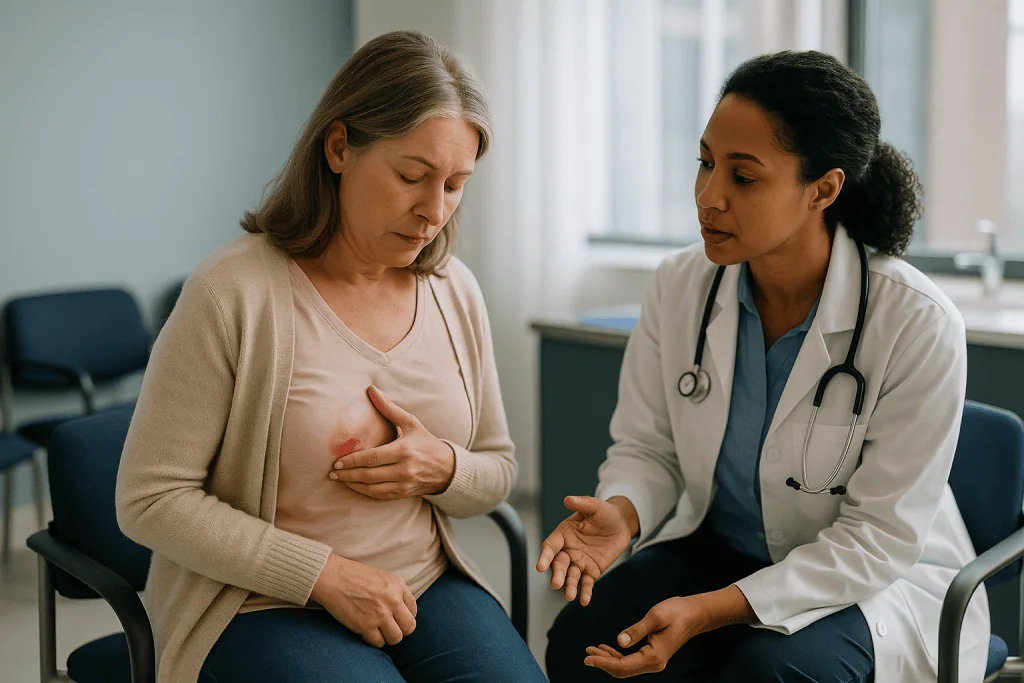
Cellulitis, a bacterial infection of the skin and the layer beneath it, behaves differently. Its redness spreads outward from the incision rather than fading, the skin feels warmer than the surrounding chest, and the area becomes increasingly tender rather than less. Some patients notice a blotchy, deeper red or a shiny, tight look. Red streaks running toward the armpit can indicate infection tracking along lymphatic channels.
Timing helps. According to the CDC, most surgical site infections show up within 30 days of an operation, and the window extends longer when an implant has been placed. Redness that appears or expands between roughly day three and day fourteen, while the rest of you feels increasingly unwell, deserves a same-day call.
A practical habit many surgical nurses recommend: with a skin-safe marker, trace the outer edge of the pink area and note the time. Check it a few hours later. Redness that stays inside the line is reassuring; redness that has crossed it is information your team needs today, not at the next scheduled visit.
One caution for anyone who has had radiation to the chest: irradiated skin can stay pink, dry or darkened for weeks, which makes infection harder to read by color alone. Warmth, spreading and worsening pain become the more reliable clues.
Swelling after breast reconstruction: expected puffiness or a problem?
Some swelling after reconstruction is simply physics. Fluid follows the tissue trauma, gravity pulls it downward, and the lower half of the reconstructed breast or the abdominal donor site can look fuller than you expected for a while. The NHS notes bruising and swelling are usual after reconstruction and settle over the following weeks. The flap or implant side will not match the other side early on, and chasing symmetry in the first month is a reliable way to worry unnecessarily.
Problem swelling has a different character, and three features set it apart.
- Speed. A breast that is noticeably larger over hours, not days, suggests bleeding into the pocket (a hematoma) or a fast-collecting fluid pocket.
- Tension. Skin that becomes tight, shiny or difficult to pinch is being stretched from underneath; a flap under that pressure can lose its blood supply.
- Company. Swelling that arrives with new redness, warmth, fever or a drain that suddenly turns cloudy is more likely to be infection than ordinary fluid.
The donor site deserves the same attention. Abdominal swelling that is firm and painful on one side, or thigh swelling with calf pain, needs assessment, because a blood clot in a deep leg vein (deep vein thrombosis) can present as one-sided leg swelling after any major operation.
Pain is the useful companion to swelling. Discomfort usually peaks in the first few days and then eases step by step. Pain that climbs again after it had started to fall, especially on one side only, is the pattern that surgical teams ask to hear about promptly.
Flap failure warning signs: color, temperature and the refill test
A flap lives or dies by its blood supply, and the NHS lists flap failure, where the moved tissue does not get enough blood, among the recognized risks of this surgery. Two different problems can threaten it, and they look different on the skin.
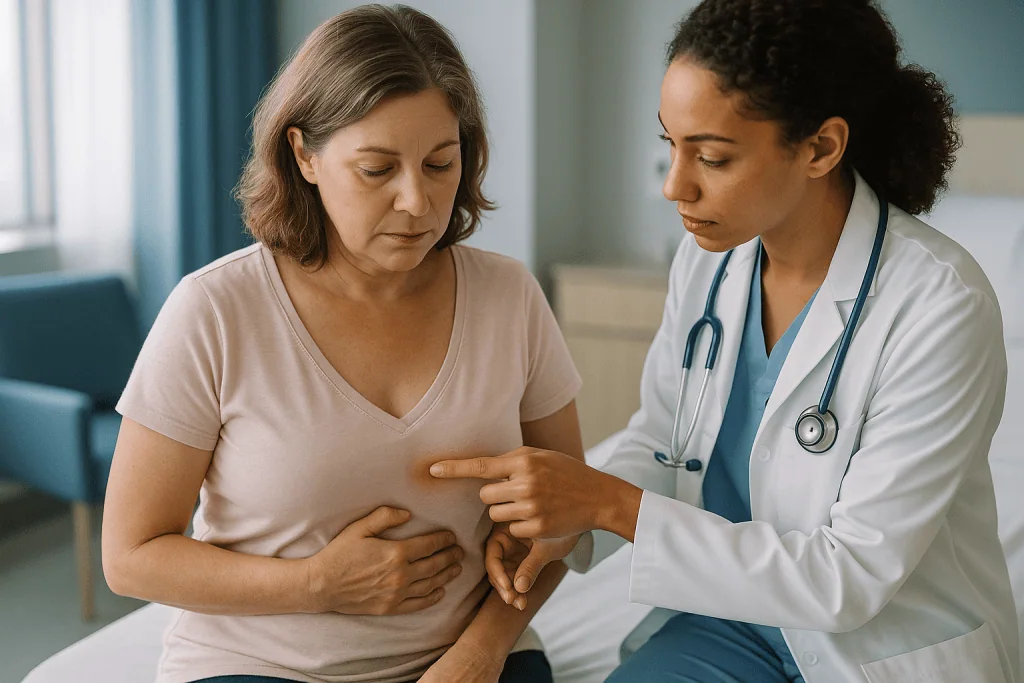
Venous congestion means blood is flowing in but cannot drain out. The flap turns purple, blue or mottled, feels tense and swollen, and when you press a fingertip on it the pale spot refills with color almost instantly, faster than the surrounding skin. Tiny dark blisters or oozing at the edges can follow.
Arterial insufficiency means blood is not getting in. The flap looks pale or white, feels cool compared with your own chest skin, and the pressed spot refills slowly or not at all. The tissue may feel soft and flat rather than tense.
Capillary refill is the test nurses use for both: press gently for a couple of seconds, release, and watch the color return. Your team can show you the normal speed for your flap before discharge, which turns an abstract instruction into something you can actually compare against.
Timing again matters. Vessel problems cluster in the first days after surgery, which is why hospital monitoring is so frequent then, but later changes still happen and still count. At home, report any of these the same day, or sooner if advised:
- a new dusky, purple or pale patch on the flap
- a flap that feels distinctly cooler than nearby skin
- rapid firmness or swelling of the flap
- darkening or blackening at the edges or along the incision
Partial flap loss, where only an edge or the fatty core suffers, can be managed in several ways; a whole-flap problem is a surgical emergency, and the window to act is measured in hours.
Signs of infection after mastectomy with an implant or tissue expander
Implants and expanders change the rules, for one reason: bacteria that settle on a foreign surface can form a biofilm, a sticky protective layer that shields them from both the immune system and antibiotics circulating in the blood. This is why an infected implant does not always respond to the same treatment that would clear a skin infection over a flap, and why implant infections often need a surgical decision rather than a prescription alone.
The CDC extends its surgical site infection surveillance window beyond 30 days when an implant is left in place, reflecting how these infections can appear later and more quietly. The signs to report include:
- redness or warmth over the implant rather than just along the incision
- a breast that becomes increasingly firm, swollen or painful days or weeks after it had been settling
- cloudy, thick or foul-smelling fluid from the incision or drain, or a drain that restarts heavy output
- thinning skin over the implant, or any point where the implant looks close to the surface
- a sudden decrease in size or a change in shape of an expander, which may mean a leak rather than infection but still needs assessment
- fever, chills or feeling generally ill
The expander’s fill port and the days following each fill are moments of slightly higher risk, since a needle passes through skin to reach it. Redness or pain that develops after a fill appointment should be mentioned to the clinic the same day.
Many people who have had a mastectomy also have reduced sensation across the chest, so an implant pocket can become tense without feeling painful. Looking matters as much as feeling: a quick daily check in a mirror, both sides, same light, is worth more than waiting for discomfort to announce a problem.
Fever, chills and feeling unwell: when the whole body joins in
Local signs tell you about the wound; whole-body signs tell you the infection is no longer staying put. A fever in the first day or so after surgery is common and often relates to the lungs reinflating after anesthesia rather than infection. A fever that starts later, returns after settling, or arrives with shaking chills is a different story and should be reported the same day. Your team will tell you the temperature threshold they use.
Sepsis is the body’s extreme, damaging response to infection, and the Mayo Clinic describes it as a medical emergency. Its early signs can be easy to dismiss as post-surgical tiredness, which is exactly why they need naming:
- confusion, unusual drowsiness or difficulty waking
- fast breathing or breathlessness at rest
- a racing heart, or feeling faint on standing
- skin that is clammy, mottled or unusually pale
- passing much less urine than usual
- severe pain or a sense that something is seriously wrong
These signs warrant emergency care, not a clinic message. Tell the first responder or emergency department that you have had recent breast surgery and whether an implant or expander is in place; it changes how quickly they look for the source.
Toxic shock syndrome deserves one sentence of its own. It is a rare, rapidly progressing illness caused by bacterial toxins, and surgical wounds are among its recognized sources. High fever, vomiting or diarrhea, a sunburn-like rash and dizziness within days of surgery form a pattern that needs the emergency department immediately, even if the incision itself looks unremarkable.
Feeling worse rather than better is the thread through all of this. Recovery is rarely a straight line, but the overall direction should be upward. When the direction reverses, make the call.
Seroma after breast reconstruction and hematoma: two fluid problems that look alike
Both are collections of fluid in the space the surgery created, and both can masquerade as infection or as a flap problem. Telling them apart is the team’s job; recognizing that something has collected is yours.
A seroma is a pocket of clear, straw-colored fluid, the same fluid drains carry away, that accumulates once drains are removed or in a space a drain was not reaching. It is especially common at the abdominal donor site after flap surgery and under mastectomy skin. A seroma feels like a soft, sometimes sloshing swelling. Small ones are frequently reabsorbed by the body; larger ones can be drained with a needle in clinic, often more than once. The signal to report is growth, discomfort, or any redness or fever alongside it, because a seroma can become infected and because a tense seroma can stress a flap or thin the skin over an implant.
A hematoma is a collection of blood. It tends to arrive earlier, often within the first day or two, and it feels firmer. The skin above may bruise deeply, the breast enlarges quickly on one side, and pain is more pronounced than with a seroma. A large or expanding hematoma usually needs surgical evacuation, both to relieve pressure on the flap or skin and because pooled blood is an ideal medium for bacteria.
A quick comparison helps when you are deciding how urgently to call.
| Feature | Seroma | Hematoma |
|---|---|---|
| Usual timing | After drains are removed, over days | Early, often first 24–48 hours |
| Feel | Soft, may slosh | Firm, tense |
| Skin | Usually normal color | Deep bruising, may be shiny |
| Pain | Mild to moderate | Often marked, worsening |
| Report when | Growing, red, feverish | Same day, always |
A reporting guide: what can wait, what to call about today, what needs urgent care
Discharge instructions usually say “call if you are concerned,” which is kind but vague. The table below sorts common observations into three lanes. It reflects general surgical guidance and does not replace the thresholds your own team set, which always take priority.
| What you notice | Usually expected | Call your team today | Seek urgent or emergency care |
|---|---|---|---|
| Redness | Thin pink band along incision, fading over days | Spreading beyond a marked line, warm, more tender | Red streaks with fever, or rapidly spreading with severe pain |
| Swelling | Mild, both breast and donor site, slowly settling | Growing over a day, tight skin, one-sided | Sudden enlargement over hours with severe pain |
| Flap color | Matches surrounding skin, normal refill | New dusky, purple or pale patch; cooler to touch | Flap cold, dark or black; rapid change |
| Drainage | Red to pink to straw-colored, decreasing | Cloudy, thick, foul-smelling, or sudden increase | Pus with fever or chills |
| Pain | Peaks early, eases day by day | Climbing again after improving | Severe, unrelenting, or with breathlessness or chest pain |
| Temperature | Low-grade in first day or so | Fever after day two, or returning fever | Fever with confusion, fast breathing, rash or dizziness |
| Leg or chest | Stiffness, tiredness | One-sided calf swelling or tenderness | Sudden breathlessness, chest pain, coughing blood |
Two notes on using it. First, most teams would rather receive five calls that turn out to be nothing than miss the one that mattered; nobody keeps score. Second, “today” means before the clinic closes, not after you have waited to see whether tomorrow looks different. The last column is for emergency services, and the recent surgery should be the first thing you tell them.
Who is at higher risk, and who is usually asked to wait
Infection and flap complications do not strike at random. Surgical teams weigh a known set of factors before scheduling reconstruction, and understanding them explains some of the decisions that can feel frustrating from the patient’s side.
Smoking sits at the top of nearly every list. Nicotine narrows small blood vessels, and carbon monoxide reduces the oxygen blood can carry, which is exactly what freshly moved tissue and healing skin edges cannot afford. The Mayo Clinic identifies smoking as a factor that raises the risk of wound-healing and flap problems, and many teams ask patients to stop well before surgery and to stay stopped through recovery; vaping and nicotine replacement are usually discussed individually with the surgeon rather than assumed to be safe.
Radiation therapy, past or planned, changes skin and vessel quality in the treated field and raises the chance of wound breakdown and implant complications. This is the most common reason a team recommends delayed reconstruction, or a flap rather than an implant, when radiation is part of the cancer plan.
Other factors that commonly prompt extra planning rather than refusal:
- diabetes, particularly when blood sugar control is unstable
- higher body weight, which is associated with wound complications at both chest and donor sites
- long-term steroid or other immune-suppressing medicines, including some cancer treatments
- a previous surgical site infection or current infection elsewhere in the body
- poor nutrition or recent significant weight loss
None of these is a verdict. They are inputs to a conversation about timing, technique and preparation. When a team asks someone to wait, the usual aim is to move one or more of these factors in a better direction first, and the final decision about whether and when to proceed always rests with the treating team and the patient together.
What the following weeks usually look like, including sleeping and sensation
Timelines vary with the procedure, the person and whether cancer treatment continues alongside, so what follows are typical ranges rather than promises. The Mayo Clinic describes a hospital stay of a few days after flap reconstruction and a recovery of several weeks before most normal activities resume; implant-based reconstruction is generally a shorter operation with a shorter stay, though the expander stage adds clinic visits for fills over weeks to months before the exchange surgery.
Drains typically come out once daily output falls below the volume your team specifies, commonly within the first couple of weeks. After that, the seroma watch described earlier begins. Steri-strips or glue on incisions lift on their own; scabs should be left alone.
Sleeping is one of the most searched questions and the least standardized. Most teams ask for back sleeping, often propped up, while drains are in and the flap or implant pocket settles, then allow side sleeping once drains are out and the surgeon is satisfied with healing. Flap patients are often asked to wait longer than implant patients because of the donor site. Ask for your own clearance rather than a general rule.
Numbness is normal and expected. Mastectomy divides the small nerves that supply the chest skin, so a reconstructed breast, implant or flap, usually has reduced or absent sensation. The Mayo Clinic notes that some feeling can return over months as nerves regrow, and that it may never return fully. Tingling, zapping or itching along the way is typically nerve recovery rather than a warning sign; new numbness paired with a swelling, color or temperature change is different and worth reporting.
Fatigue outlasts almost everything else. Expect good days followed by flat ones for a while, and treat a steadily rising baseline, not a perfect week, as the sign that things are going as they should.
What people often get wrong about breast reconstruction infection signs
“If it doesn’t hurt, it isn’t infected.” After mastectomy, chest sensation is reduced or absent, so pain is an unreliable alarm. Looking, touching for warmth and checking temperature matter more than how it feels.
“Antibiotics will sort out an infected implant.” Sometimes a course of antibiotics is enough for a skin infection over an implant, but bacteria in biofilm on the implant surface are shielded from them. Many implant infections end up needing drainage, washout, exchange or temporary removal. This is a surgical judgment, not a sign that treatment failed.
“All redness means infection.” Radiation dermatitis, allergic reaction to adhesive or antiseptic, an inflammatory reaction to dissolving sutures, and the normal healing halo are all red and none is infection. The pattern, the spread and the company it keeps distinguish them, and the team is better placed to make that call than a search engine.
“Flaps only fail in the hospital.” Vessel problems concentrate in the first days, but late partial loss, fat necrosis (firm lumps where fat in the flap lost its blood supply) and infection can appear weeks later.
“A reconstructed breast can’t get cancer.” Reconstruction does not increase cancer risk, but mastectomy leaves some breast tissue behind on the chest wall and skin, so recurrence remains possible, and any new lump, skin change or thickening should be assessed. Separately, a rare lymphoma of the scar capsule around certain textured implants, BIA-ALCL, has been recognized and typically presents as late swelling or fluid around an implant; the Mayo Clinic describes it as uncommon.
“Breast implant illness is proven.” Some people report fatigue, joint pain and other symptoms they attribute to implants, and some improve after removal. The current evidence does not establish a cause-and-effect relationship or a diagnostic test, which is precisely why these symptoms deserve a careful medical review for other causes rather than a quick verdict either way.
How surgical teams respond when something is wrong
Knowing what tends to happen next removes some of the fear from making the call. The exact plan always belongs to the treating team, but the pathways are fairly consistent.
For suspected skin or wound infection without an implant, the usual first steps are examination, marking the edge of the redness, often a swab of any discharge to identify the organism, sometimes blood tests, and a course of antibiotics chosen to cover the skin bacteria most commonly responsible. Which medicine, how long and whether by mouth or into a vein are decisions the prescribing clinician makes from the findings, and a patient who has already started antibiotics should never stop or adjust them without checking first.
For a suspected implant or expander infection, the same assessment applies, with a lower threshold for returning to the operating room. Options range from washing out the pocket and placing a new device in the same operation to removing the implant, treating the infection and reconstructing again later. Teams weigh how far the infection has spread, how the skin looks and the patient’s overall condition.
For a flap in trouble, speed is everything. A team suspecting a vessel problem will typically examine the flap, sometimes use a handheld Doppler (an ultrasound device that makes blood flow audible) and may return to surgery within hours to relieve a kink or clot. Partial losses may be managed with dressings and later tidying procedures.
Seromas are usually aspirated in clinic with a fine needle; hematomas that are large or growing are evacuated surgically. Suspected clots in the leg or lung are imaged and treated with blood-thinning medicines under the medical team’s direction.
None of this is punishment for calling too soon. Early assessment is the single factor most within a patient’s control, and it tilts every one of these pathways toward the simpler end.
Questions to ask your care team before you go home
Most of the uncertainty in those first weeks at home comes from instructions that were general when they needed to be specific. These questions turn “call if concerned” into something you can actually act on. Write the answers on the discharge sheet or in your phone before you leave.
- What does my flap, or the skin over my implant, look like right now, and can you show me the normal capillary refill speed so I have a baseline?
- Which temperature counts as a fever for you, and what should I do if I reach it outside clinic hours?
- How much redness along the incision is expected, and would you like me to mark the edge with a pen?
- What drain output, in color and daily volume, should make me call, and who removes the drains?
- Who do I call during the day, who do I call at night and on weekends, and when should I go straight to the emergency department instead?
- If I have had radiation, how will that change how my skin looks while it heals, and what should I not mistake for infection?
- When can I shower, when can I sleep on my side, and when can I lift my arms above my head or carry anything?
- Am I on any medicine to prevent blood clots, and what leg or chest signs should prompt a call?
- If I have an expander, what should I expect after each fill, and what would make you worry?
- Is there anything about my own history, smoking, diabetes, steroids, prior infection, that puts me at higher risk and changes what you want me to watch?
- If I notice a change in a photo from day to day, can I send it, and to whom?
A short follow-up question is worth adding to each answer: “and if that happens, what will you probably do?” Knowing the likely next step is what makes the phone call feel like a plan rather than a confession.
When to call your doctor: the red flags to report fast
Keep this list where you will see it. It is not a tool for diagnosing yourself; it is a list of observations that your surgical team has asked, in one form or another, to hear about without delay. The team decides what they mean.
Call your surgical team the same day, including out of hours through the number they gave you, for any of the following:
- redness spreading beyond the incision, or beyond a line you marked, especially with warmth or increasing tenderness
- swelling of the breast or donor site that grows over a day, feels tight, or is clearly one-sided
- a flap that turns dusky, purple, blue, mottled or pale, feels cooler than nearby skin, or develops dark edges or blisters
- drainage from the incision or drain that becomes cloudy, thick, foul-smelling or suddenly much heavier
- pain that worsens after it had been improving, or pain the prescribed plan no longer controls
- fever or chills after the first day or two, or a fever that returns
- an incision that opens, or skin over an implant that looks thin or shiny
- a sudden change in implant or expander position, shape or size, a popping or shifting sensation, or a new bulge, any of which could reflect a torn internal stitch, a device problem or fluid and all of which need examination rather than guesswork
- one-sided calf swelling, warmth or tenderness
Seek emergency care immediately, and say you have had recent breast reconstruction, for:
- sudden breathlessness, chest pain, or coughing up blood
- fever with confusion, fast breathing, a racing heart, mottled or clammy skin, dizziness or very little urine
- high fever with vomiting and a sunburn-like rash
- a flap that is cold, dark or black, or a breast that has enlarged dramatically within hours with severe pain
- heavy bleeding that soaks dressings
If in doubt, call. The worst realistic outcome of an unnecessary call is a few minutes of a nurse’s time; the worst outcome of a delayed one is measured in tissue.
Frequently asked questions
What are the first signs of infection after mastectomy and reconstruction?
The earliest signs are usually local: redness spreading outward from the incision, new warmth, increasing tenderness and cloudy or foul-smelling drainage. Fever, chills and feeling generally unwell tend to follow. After mastectomy, sensation is reduced, so looking and feeling for warmth matters more than waiting for pain. Report any of these to your surgical team the same day.
When can I sleep on my side after mastectomy and reconstruction?
There is no universal date; it depends on your procedure and how healing is progressing. Most teams ask for back sleeping, often propped up, while drains are in and the flap or implant pocket settles, and allow side sleeping once drains are out and the surgeon is satisfied. Flap patients are often asked to wait longer because of the donor site. Ask your team for your own clearance.
Is numbness normal after breast reconstruction or augmentation surgery?
Yes. Mastectomy and breast surgery divide small skin nerves, so reduced or absent sensation over a reconstructed breast is expected, and the Mayo Clinic notes that feeling may return partially over months or may not return fully. Tingling or zapping is usually nerve recovery. New numbness alongside swelling, color change or coolness is different and should be reported.
Can a reconstructed breast get cancer?
Reconstruction does not raise cancer risk, but mastectomy cannot remove every cell, so recurrence in remaining chest skin or tissue is possible and any new lump, thickening or skin change needs assessment. Separately, a rare lymphoma of the capsule around certain textured implants (BIA-ALCL) typically presents as late swelling or fluid around the implant and should be evaluated by your team.
What are the symptoms of a torn internal stitch after breast implant surgery?
People often describe a popping or shifting sensation followed by a new bulge, a change in implant position or shape, or sudden asymmetry. The same picture can come from fluid, bleeding or a device problem, so it cannot be diagnosed at home. Report it to your surgical team the same day; examination, and sometimes imaging, decides what it is and what to do.
What does swelling after breast reconstruction feel like when it is a problem?
Problem swelling grows over hours rather than days, makes the skin tight or shiny, is clearly one-sided, and often arrives with worsening pain, redness, warmth or fever. Expected swelling is mild, affects both the breast and the donor site, and settles gradually over weeks. Rapid, tense, painful enlargement should be reported immediately because it may indicate bleeding into the pocket.
How can I tell seroma after breast reconstruction from infection?
A seroma is a soft, sometimes sloshing pocket of clear fluid that usually appears after drains come out and is often painless. Infection adds redness, warmth, increasing pain, cloudy discharge or fever. A seroma can itself become infected, so one that is growing, tender or accompanied by any of those signs should be assessed; small, quiet seromas are frequently reabsorbed or drained in clinic.
What are flap failure warning signs I should check for at home?
Check color, temperature and refill once or twice a day. A flap turning purple, blue, mottled or pale, feeling cooler than nearby skin, becoming rapidly firm or swollen, or developing dark edges or blisters needs a same-day call, and a cold or black flap needs emergency care. Your team can show you the normal refill speed before discharge so you have a baseline.
Will antibiotics clear an infection around a breast implant or expander?
Sometimes, particularly when the infection is confined to the skin, but bacteria on an implant surface form a protective biofilm that antibiotics struggle to reach. Many implant infections therefore need washout, exchange or temporary removal in addition to medicine. Which approach, and which antibiotic, is the surgical team’s decision based on examination and test results; never start, stop or change antibiotics on your own.
How long after surgery can breast reconstruction infection signs appear?
The CDC notes that most surgical site infections develop within 30 days of an operation, and that the surveillance window extends well beyond that when an implant has been placed. In practice, the days between roughly three and fourteen are the busiest for new redness and fever, but late infections around implants and expanders do occur and deserve the same prompt call.
References
This article is for general information only and is not a substitute for professional medical advice. Please consult a qualified doctor about your individual situation.

More from the Blog
Recovering From Accessory Breast Treatment: Arm Movement, Garments and Return to Work
Recovery after accessory breast removal usually means a few days of underarm soreness and swelling, gentle arm movement from the first day, a compression…

Which Breast Lift (Mastopexy) Technique Suits You? Crescent, Donut, Lollipop and Anchor
Breast lift techniques are named for their incision shapes. A crescent lift removes a sliver of skin above the areola, a donut lift circles…
Liposuction Alone or Gland Excision? How Gynecomastia Surgery Is Matched to Tissue Type
Liposuction removes fatty tissue, while surgical excision removes the firmer glandular disc behind the nipple, so surgeons choose based on what the chest actually…
Breast Imaging Around Fat Transfer: Why Scans Are Taken First and Reviewed Later
A mammogram after fat transfer is usually arranged so radiologists can compare the new images with a baseline scan taken before surgery. Grafted fat…

Gynecomastia Surgery Prep: Smoking, Supplements and the Tests Booked Beforehand
Preparing for gynecomastia surgery usually means stopping all nicotine for the period your surgeon sets, giving the team a complete list of medicines and…
How Does the Chest Settle After Gynaecomastia Treatment? Results Over the First Months
After gynaecomastia treatment, the chest settles in stages rather than all at once. Swelling and bruising are most noticeable in the first one to…