

What a Rehabilitation Robot Actually Does: Guided Repetition for Legs, Arms and Balance
Key Takeaways
- A rehabilitation robot combines a motor, joint sensors and 'assist-as-needed' software that adds force only when the limb slows, drifts or starts to drop.
- Exoskeletons strap along the whole limb and control each joint directly; end-effector devices hold only the foot or hand and let your own joints find the path.
- A Cochrane review of 62 trials found that adding electromechanical gait training to physiotherapy after stroke made independent walking more likely, mainly for people who could not walk at the start and within the first three months.
- A Cochrane review of 45 arm trials found small but real improvements in daily activities, arm function and strength, with adverse events reported as rare.
- The AHA and ASA stroke rehabilitation guideline lists robot-assisted training as something that 'may be considered' alongside conventional therapy, not as a replacement for it.
- The harness and body-weight support are what make early, high-volume stepping possible for someone who cannot yet stand, turning a near-fall into practice rather than injury.
A rehabilitation robot is a motorized, sensor-equipped device that supports a person's leg, arm or trunk while they practice walking, reaching or balancing. It measures how much effort the person produces, adds only the assistance needed to complete the movement, and allows many more safe repetitions than hands-on therapy alone. It supplements, rather than replaces, a physical or occupational therapist, who sets the goals and adjusts the program.
Four weeks after her husband’s stroke, Maria watched a therapist wheel him toward something that looked like a treadmill wearing a suit of armor. Straps, a harness, a screen showing two cartoon footprints. ‘We’d like to try him on the robot,’ the therapist said, and Maria nodded while quietly wondering whether anyone would explain how robotic rehabilitation works before her husband was strapped into it.
That question deserves a fuller answer than most brochures give. The machines have a certain glamour, and glamour tends to crowd out plain mechanics: what the sensors measure, why the harness matters, who tends to benefit and who is told to wait.
This explainer walks through the devices used for legs, arms and balance, what the pooled trial evidence does and does not show, and the questions worth asking before a first session. The decision about whether and when to use one stays, as it should, with the treating team.
How robotic rehabilitation works, in plain language
Strip away the futuristic shell and a rehabilitation robot is three things working together: a motor that can move a joint, sensors that measure what the person is doing, and software that decides, many times a second, how much help to give. That is the core of how robotic rehabilitation works. The therapist chooses the task, walking on a treadmill, reaching for a target on a screen, shifting weight from one foot to the other. The device then holds the limb in a safe path and fills in whatever the muscles cannot yet manage.
The patient is never passive cargo. Most modern systems use an ‘assist-as-needed’ setting: the motor stays almost idle while the person is producing the movement and steps in only when the limb slows, wanders off its path or starts to collapse. Pull a little harder and the robot pulls less. The aim is a pattern of movement that looks and feels close to normal, repeated far more often than a therapist could safely cue by hand.
Think of training wheels on a child’s bicycle, but training wheels that can sense wobble and lift away from the ground a millimeter at a time as balance improves. A physical or occupational therapist still runs the session, sets the goals, watches posture and decides when to make the task harder. The robot supplies consistency, measurement and stamina. Hands-on care supplies judgment.
Where this matters most is in people who cannot yet move a limb on their own. Without a device, practicing a full step or a full reach may be impossible at the start. With one, the practice can begin earlier and continue longer within a session, which is what the recovering nervous system appears to need.
How does the robot arm know when to move?
People often picture a pre-programmed machine marching the limb through a fixed loop. The reality is closer to a conversation. Inside each joint sit force sensors, which measure how hard the person is pushing or pulling, and position encoders, small devices that report the exact angle of the joint. Some systems add surface electromyography, abbreviated EMG, which picks up the faint electrical signal a muscle produces when it tries to contract, even when the limb barely moves.
The software compares what the sensors report with a reference movement, the arc of a normal step or reach, and calculates the gap. If the person is on track, the motors stay quiet. If the limb lags behind, drifts sideways or begins to drop, the controller adds just enough torque, the technical word for rotational force, to close the gap. This loop repeats many times per second, which is why the help feels smooth rather than jerky.
Three broad control modes are common:
- Passive: the robot moves the limb with little or no input from the person, used very early or to keep joints supple.
- Assist-as-needed: the robot supplements effort, scaling its help to the shortfall.
- Resistive or challenge mode: the robot pushes back, adding load once strength returns.
In EMG-triggered systems the sequence is even more personal. The person thinks about opening the hand, the muscle fires a weak signal, the sensor detects it and only then does the motor complete the movement. That pairing of intention and sensation is thought to matter: the brain receives confirmation that its command produced a real result. The therapist adjusts thresholds so the task stays hard enough to demand effort but achievable enough to avoid frustration.
Exoskeleton or end-effector: what kinds of rehabilitation robots exist?
Rehabilitation robots fall into two engineering families, and knowing which one you are being offered explains a lot about what the session will feel like.
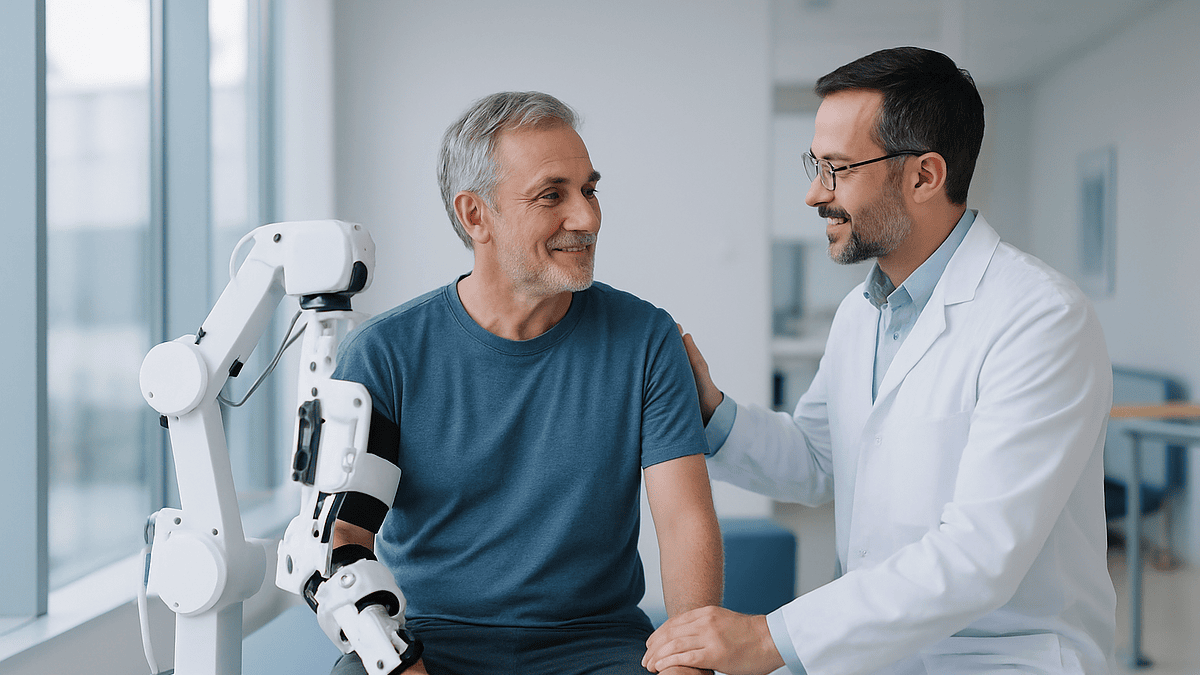
An exoskeleton is a wearable frame strapped along the limb, with motorized joints aligned to your own hip, knee, elbow or finger joints. Because it controls each joint separately, it can shape the movement precisely, keeping the knee from snapping back or the shoulder from hitching upward. Fitting takes time, since every segment must match your limb length.
An end-effector device holds only the end of the limb, the foot or the hand, on a footplate or handle, and moves that point through space. Your own joints find their path. Setup is quicker and the movement is less constrained, which some people find more natural, though the device cannot directly correct what happens at the knee or elbow.
| Feature | Exoskeleton | End-effector |
|---|---|---|
| Where it attaches | Along the whole limb, joint by joint | Foot or hand only |
| Control of individual joints | Direct | Indirect, through the limb’s own mechanics |
| Setup time | Longer, needs careful alignment | Shorter |
| Typical use | Treadmill gait training, arm and hand training, some overground walking | Footplate gait trainers, tabletop arm-reaching devices |
| Who it often suits | People needing joint-level guidance early on | People with some control who need volume of practice |
A third, smaller group covers soft robotics: fabric gloves or sleeves with air chambers or cables that bend fingers or support an elbow without rigid struts. They are lighter and easier to wear, and research on them is still maturing. Your therapist’s choice usually comes down to what you can already do, which joint needs the most protection and what the center has available.
Robot assisted gait training: what actually happens on the treadmill
The first session is mostly fitting. You are measured, a harness is secured around the pelvis and chest, and you are lifted gently so that a chosen fraction of your body weight is carried by the overhead frame rather than by your legs. The exoskeleton or footplates are strapped on. Only then does the treadmill belt start, slowly.
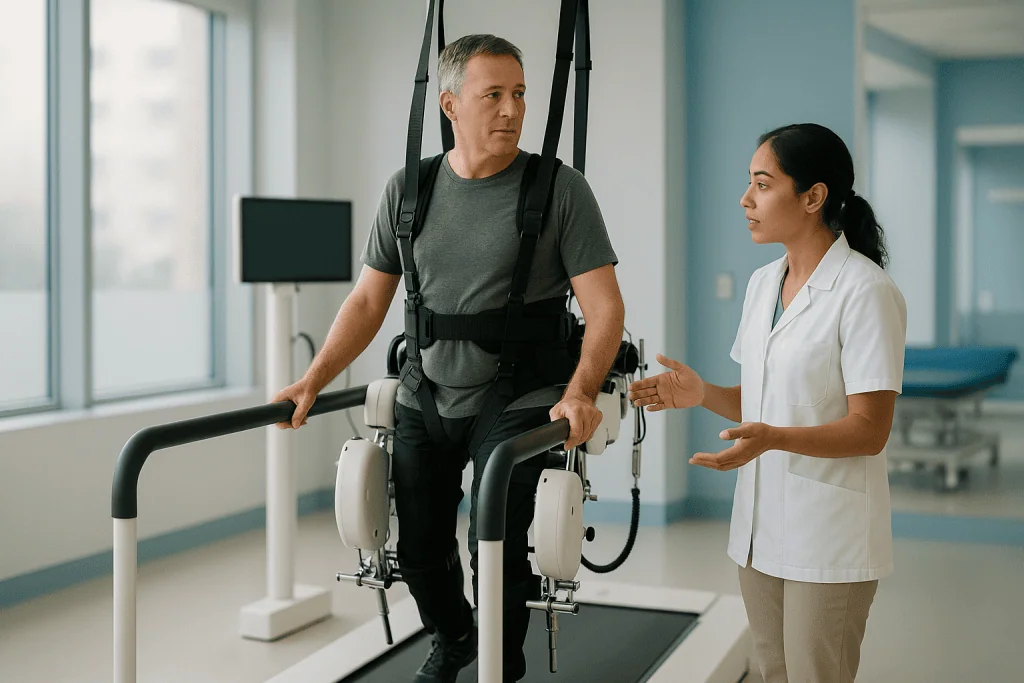
Body-weight support is the quiet hero of robot assisted gait training. Taking some load off the legs means a person who cannot stand unaided can still practice a full, symmetrical stepping pattern: heel strike, weight shift, push-off, swing. The therapist typically starts with more support and more robotic guidance, then reduces both as control returns. Belt speed, the amount of help at hip and knee, and the share of weight carried are all adjustable mid-session.
Meanwhile the therapist is not idle. One may stand at the side cueing posture (‘look ahead, not at your feet’), another may guide the pelvis so the hips rotate properly. Many systems show a screen with a simple game or avatar that rewards even timing between the two legs, giving the brain immediate feedback it would not get from the legs alone.
The clinical rationale is specific. A Cochrane systematic review pooling 62 trials with 2,440 participants found that people who received electromechanical-assisted gait training combined with physiotherapy after stroke were more likely to walk independently than those who had physiotherapy alone, with the clearest difference in those who could not walk at the start and in the first three months after stroke. The same review was candid that benefit for people already walking was uncertain and that walking speed and endurance did not clearly improve. In other words, the machine earns its place mainly by making early, high-volume stepping possible for people who otherwise could not do it.
Robotic therapy for arms and hands: which device is used for hand rehabilitation?
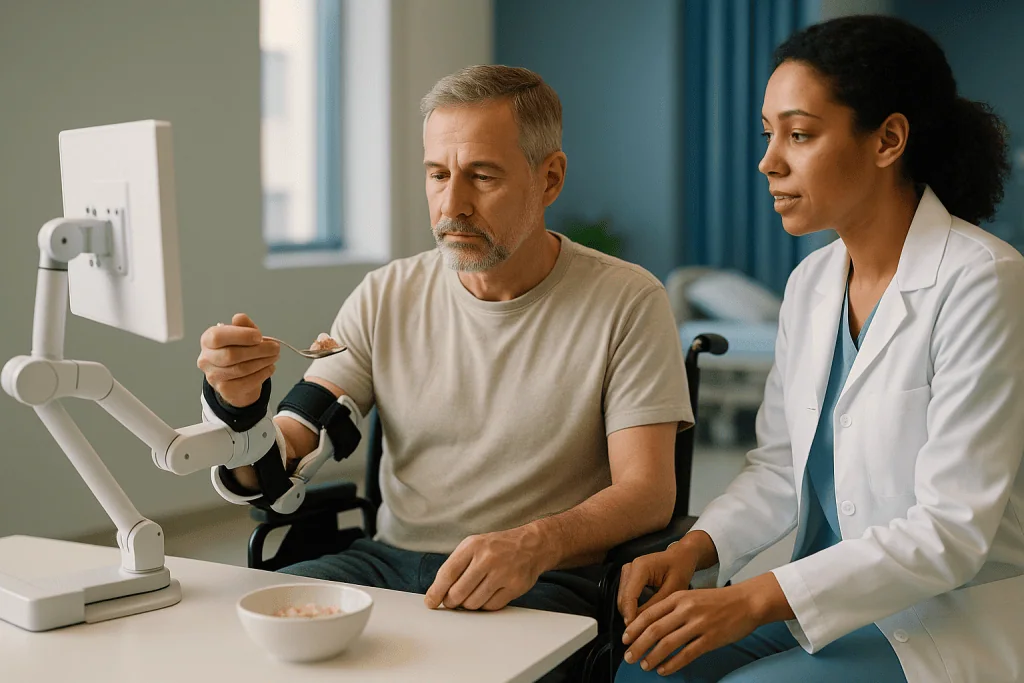
Arm recovery is often slower and more frustrating than leg recovery, because a hand must do fine, varied things rather than one repetitive cycle. Upper limb robots are built around that problem. Tabletop end-effector devices hold the hand on a handle and guide it toward targets on a screen; shoulder-and-elbow exoskeletons carry the weight of the arm so a person can practice reaching without fighting gravity; hand devices move individual fingers through grasp and release.
A common search asks for ‘the name of the robotic device used for hand rehabilitation.’ There is no single device. The honest answer is a category: motorized hand exoskeletons with linkages for each finger, end-effector finger trainers, and soft robotic gloves that use air pressure or cables to curl and straighten the fingers. Some are triggered by EMG, so a weak attempt to open the hand produces a complete opening. Others alternate between the robot moving the hand and the person trying to repeat the movement. Clinicians choose by what the hand can already do and whether spasticity, the involuntary muscle tightness that often follows stroke, is the main barrier.
Gravity compensation deserves a plain explanation. A weak arm is heavy, and much of a person’s early effort goes into simply not letting it drop. By carrying that weight, the robot frees the remaining strength for the actual task of reaching, which is where relearning happens.
The evidence for the arm is encouraging but modest. A Cochrane review of 45 trials with 1,619 participants after stroke concluded that electromechanical and robot-assisted arm training improved activities of daily living, arm function and arm muscle strength compared with other interventions, while noting that the gains were small and that the trials varied widely in device and intensity. Whether a given person regains a useful grasp depends far more on their starting point than on the model of machine.
How does a rehabilitation robot work for balance and trunk control?
Balance is a skill of anticipation, not just strength. Standing up, turning or stepping over a threshold requires the trunk and hips to adjust a fraction of a second before the limbs move. When that anticipatory system is damaged, people stiffen, widen their stance and avoid turning their head. Robots for balance work on exactly this layer.
Several designs exist. Dynamic standing platforms tilt or shift under the feet while sensors track how the body responds; the therapist can make the surface more or less predictable. Pelvic robots attach around the hips and apply gentle forces that nudge weight from side to side or resist a shift, forcing the trunk to correct. Overground exoskeletons with a wheeled frame or a ceiling-mounted harness let a person walk on a real floor and turn corners while a safety system catches any fall before it happens.
So how does a rehabilitation robot work for balance when the risk of falling is the whole problem? The harness changes the equation. A fall, or the fear of one, normally ends practice. With body-weight support, a person can be allowed to lose balance slightly, feel the moment of correction and recover, dozens of times, without consequence. That repeated exposure to near-failure is thought to be the ingredient that stretches balance, and it is close to impossible to provide safely with a single therapist and a gait belt.
Feedback matters here too. Many balance systems display the center of pressure, the point under the feet where body weight is concentrated, as a dot on a screen. Steering that dot into a target teaches weight shift in a way words alone rarely can. The therapist still decides how much disturbance is appropriate and when real-world practice on stairs and uneven ground should take over.
Why guided repetition matters: the neuroplasticity behind the machine
Neuroplasticity is the nervous system’s ability to reorganize its connections in response to experience. After a stroke, spinal cord injury or brain injury, surviving circuits can take over some functions of damaged ones, but only if they are asked to, repeatedly and specifically. The principle rehabilitation scientists summarize as ‘use it or lose it’ has a companion: ‘use it and improve it.’
Three features of practice appear to drive this rewiring. Volume: many repetitions. Specificity: practicing the real movement, a step or a reach, rather than an unrelated exercise. Engagement: the person is trying, attending and receiving feedback, not being moved like a mannequin. Robots are designed to deliver the first two in abundance, and the better ones protect the third by scaling help to effort.
This explains why an active mode usually matters more than a passive one. If the motor does all the work, the muscles move but the brain receives little useful signal about cause and effect. When the person initiates and the robot completes, the sensory feedback (the feeling of the foot landing, the hand closing) arrives paired with the motor command that produced it. That pairing is what the brain appears to learn from.
Timing is the final piece. Rehabilitation guidelines from the American Heart Association and American Stroke Association recommend beginning organized rehabilitation early, once a person is medically stable, and the Mayo Clinic notes that this often starts within 24 to 48 hours of a stroke. Robots are one way to put meaningful stepping or reaching into that early period for people who could not otherwise manage it. The NHS is equally clear that recovery does not stop at a fixed date, and that improvement can continue for months and years with ongoing practice.
Who is robotic rehabilitation usually for, and who is usually asked to wait?
Rehabilitation robots were developed largely for stroke, and that remains the most common use. People recovering from spinal cord injury, traumatic brain injury, multiple sclerosis, Parkinson’s disease and some childhood conditions such as cerebral palsy are also treated with them in many centers, though the evidence base is strongest for stroke. The common thread is not the diagnosis but the problem: a person who has movement to recover and cannot yet practice it enough on their own.
Typical candidates share a few features. They are medically stable, meaning blood pressure, heart rhythm and breathing are settled. They can follow simple instructions and stay engaged for the length of a session. For gait robots, the hip and knee joints need enough range of movement to be strapped into the device, and the skin over bony points must be intact so straps and harness do not cause pressure injuries. Bone density matters too, since a long-paralyzed limb can be fragile.
Others are usually asked to wait, or offered something different. Reasons a team may hold off include:
- Unstable heart or blood pressure problems, or a recent clot in the leg.
- Open wounds or fragile skin where the device attaches.
- Severe joint contracture, a fixed shortening of muscle and tendon, that the frame cannot accommodate.
- Severe spasticity or uncontrolled seizures that make strapping into a machine unsafe.
- Confusion, agitation or fatigue so marked that the person cannot participate.
- Body size or weight outside the limits a particular device is engineered for.
None of these are judgments about a person’s potential. Many are temporary. A wound heals, blood pressure settles, a contracture is stretched over weeks, and the robot becomes an option later. The decision about readiness, device and timing rests with the treating team, who weigh the whole medical picture rather than a single test.
What the evidence actually shows about how robotic rehabilitation works
Enthusiasm for technology tends to run ahead of data, so it is worth stating plainly what mainstream reviews conclude about how robotic rehabilitation works in practice, and where they stop.
For walking after stroke, the Cochrane review already mentioned found that adding electromechanical-assisted gait training to physiotherapy increased the proportion of people who regained independent walking, with the benefit concentrated in those not walking at the start and in the first three months. It did not find convincing improvement in walking speed or distance, and it rated the evidence as moderate quality because of variation between trials. The reviewers were explicit that the ideal frequency, duration and device remained unclear.
For the arm, the companion review reported improvements in daily activities, arm function and strength with robot-assisted training, rated the quality of that evidence as high, and still described the effects as small. It also reported that adverse events were rare and that people assigned to robotic training were not more likely to drop out than those in comparison groups, a reasonable proxy for acceptability.
The American Heart Association and American Stroke Association guideline on adult stroke rehabilitation lists robot-assisted movement training as something that may be considered to improve motor function and mobility when used alongside conventional therapy, not as a replacement for it. The wording is deliberate: a supplementary tool with supportive evidence, not a standard every person must receive.
Two honest caveats remain. Most trials compared robot plus therapy against therapy alone, so part of the benefit may simply be extra practice time. And trials in other conditions, such as spinal cord injury or multiple sclerosis, are fewer and smaller. A center that describes its robot as ‘proven’ for every diagnosis is overstating the literature; one that frames it as a way to deliver more guided repetition to the right person is on solid ground.
What the first weeks of robotic physiotherapy for stroke usually look like
Ask what a course looks like and the frank answer is that it varies with the person, the device and the setting. Still, a recognizable pattern appears across inpatient and outpatient programs.
Before the first session, the therapist completes an assessment: joint range, muscle tone, skin condition, blood pressure sitting and standing, and your own goals. Expect to be measured for the device. The first one or two sessions are short and dominated by fitting, with only a few minutes of actual walking or reaching while everyone checks comfort and alignment.
Over the following sessions the dose increases. Belt speed rises, body-weight support falls, robotic assistance is turned down and the number of steps or reaches per session climbs. Many people are surprised by how tiring a session is even when the machine is ‘doing the work’; the effort of attention and trunk control is real. Mild muscle soreness the next day is common. Skin is checked after each session where straps sat.
Robotic physiotherapy for stroke is almost never the whole program. A typical day in an inpatient unit mixes a robot session with conventional physiotherapy, occupational therapy for daily tasks, speech therapy if needed and rest. The robot’s value lies in the volume it adds; the transfer to real life happens in the hallway, the bathroom and the kitchen.
As control returns, the team usually tapers robot use and shifts toward overground walking, stairs, uneven surfaces and real objects. Progress is measured with standard tests of walking, balance and arm function repeated at intervals, so you and the team can see the trend rather than guess. The trials pooled in the Cochrane reviews generally delivered programs over several weeks, but the right length for an individual is set by response and goals, not by a fixed calendar. The NHS notes that recovery after stroke can continue long after formal therapy ends, which is why a home exercise plan usually outlasts the machine.
Is a rehabilitation robot safe? Risks, side effects and what the harness is for
Serious harm from rehabilitation robots is uncommon in published trials; the Cochrane arm review described adverse events as rare, and the gait review did not identify a higher rate of problems in the robot groups. That said, ‘uncommon’ is not ‘none,’ and knowing the realistic risks helps you speak up early.
The most frequent complaints are mechanical and minor. Straps and cuffs can rub, leaving redness or, if ignored, a pressure sore, especially over the shin, the pelvis and the inner thigh where the harness sits. Numb skin after a stroke may not report the problem, which is why therapists inspect it. Muscle soreness, fatigue and transient joint ache are expected after early sessions.
Less common but more important are cardiovascular responses. Standing upright after weeks in bed can drop blood pressure, causing lightheadedness or fainting; teams monitor this and may start with a tilt table before the gait robot. Exertion raises heart rate and blood pressure, so medical clearance comes first for anyone with heart disease. Rarely, forcing a joint beyond its comfortable range can strain ligaments or, in a person with very low bone density, cause a fracture; proper fitting and conservative ranges are the safeguards.
The harness and the emergency stop are not optional accessories. The harness exists so that a stumble becomes a learning moment rather than a fall; the stop button, within reach of both patient and therapist, halts the motors instantly. You should be shown both before your first session.
Alternatives exist for anyone who cannot or prefers not to use a robot: body-weight-supported treadmill training guided by therapists, constraint-induced movement therapy for the arm, task-specific practice, electrical stimulation and conventional strengthening and balance work. None is ‘lesser.’ The treating team’s job is to match the method to the person and the moment.
What people often get wrong about rehabilitation robots
Confusion about these devices is understandable; the word ‘robot’ does a lot of work in headlines. Several misconceptions come up again and again.
‘A rehabilitation robot is a surgical robot.’ People searching for ‘the procedure of robotic surgery’ sometimes land on rehabilitation pages. The two have almost nothing in common. A surgical robot is a set of instruments controlled by a surgeon seated at a console; it operates inside the body, under anesthesia, during an operation. A rehabilitation robot is a therapy device worn or held while you are awake and working: no incisions, no anesthesia, no surgeon. The only shared word is ‘robot.’
‘The machine does the exercise for you.’ In passive mode it can, briefly, but the modes with the best evidence require effort. The robot’s job is to make your attempt succeed, not to replace it.
‘Robots have replaced physiotherapists.’ Every session is run by a therapist who fits the device, sets parameters, watches movement quality and decides when to progress. The AHA and ASA guideline frames robotic training as an addition to conventional therapy.
‘If my center does not have a robot, my recovery will suffer.’ The evidence shows benefit for specific groups, mainly non-walking people early after stroke, and modest arm gains. Intensive, task-specific practice delivered by skilled hands remains the foundation, and many people recover well without ever seeing a robot.
‘It is too late for me.’ The largest measured effects are early, but trials have included people months or years after stroke, and NHS guidance stresses that improvement can continue with practice over the long term. What changes later is the goal: often function and confidence rather than dramatic new movement.
‘The robot will repair the brain.’ No device mends damaged tissue. What it can do is deliver the repeated, guided practice that gives surviving circuits a reason to reorganize. The brain does the rewiring; the robot sets up the conditions.
Questions to ask your care team before the first session
A good conversation with your rehabilitation team turns a mysterious machine into a shared plan. These questions are worth bringing, in writing if memory or fatigue is an issue.
- Which type of device are you proposing, exoskeleton, end-effector or a balance system, and why that one for my pattern of weakness?
- What specific goal is the robot meant to serve: standing, stepping, reaching, grasp or balance?
- Will I be working actively, or will the device be moving me, and when will that change?
- How will you decide when to reduce body-weight support and robotic assistance?
- How will progress be measured, and how often will we review it?
- What are the signs that this is not the right approach for me, and what would we do instead?
- How does the robot session fit alongside my conventional physiotherapy and occupational therapy?
- Who checks my skin and blood pressure, and what should I report between sessions?
- Are there medical reasons, such as my heart, bones or skin, that need clearing first?
- What should I practice at home between sessions so the gains carry over?
Families and caregivers can usefully ask how to help without interfering: where to stand, what cues the therapist is using and what not to say (‘be careful’ tends to stiffen people). Ask too about fatigue management; a hard robot session in the morning may mean a quieter afternoon, and that is a reasonable trade.
Finally, ask what the team expects in plain terms. A reply along the lines of ‘we hope to see supported steps within a few weeks, then we reassess’ is more honest and more useful than any percentage, and it leaves room for the reality that recovery is individual. If an answer sounds like a guarantee, it is worth asking what the evidence behind it is.
When to call your doctor
Rehabilitation is physically demanding, and the people doing it often have other serious conditions in the background. Most sensations after a robot session, mild soreness, tiredness and a little stiffness, settle within a day. The following are different and deserve a prompt call to your doctor or the rehabilitation team, or emergency services where noted.
Call emergency services immediately for any sign of a new stroke: sudden facial drooping, new weakness or numbness in an arm or leg, sudden trouble speaking or understanding, sudden loss of vision or a severe, unusual headache. Do the same for chest pain or pressure, sudden breathlessness, fainting or a seizure.
Contact your doctor or team the same day for:
- A calf or thigh that becomes swollen, warm, red or painful, especially on one side, which can signal a blood clot.
- Skin under a strap or harness that is broken, blistered, purple or not fading within a few hours.
- Joint pain that is sharp, worsening or accompanied by swelling or deformity, which can indicate a sprain or fracture.
- Repeated dizziness or near-fainting when standing.
- A sudden increase in spasticity, or a new tremor or involuntary movement.
- Fever, or burning and urgency when passing urine, since infection often shows up first as a drop in function.
- Any fall at home, even without obvious injury, if you take blood-thinning medicines.
Mention mood changes as well. Low mood and anxiety are common after stroke and brain injury and can quietly drain the effort that rehabilitation depends on; they can be treated, and the team would rather know.
One last point: never stop or alter a prescribed medicine because a session went badly or well. Blood pressure and anticoagulant plans in particular affect how safely you can exercise, and those decisions belong with the prescribing clinician, who can weigh them against your rehabilitation goals.
Frequently asked questions
How do robotic arms know when to move?
They read sensors rather than follow a fixed script. Force sensors measure how hard you push or pull, position encoders report each joint angle, and some systems add EMG electrodes that detect the electrical signal of a muscle trying to contract. Software compares your movement with a reference path many times a second and adds motor force only to close the gap. If you do the work, the motor stays quiet.
Is the procedure of robotic surgery the same as robotic rehabilitation?
No. Robotic surgery uses instruments controlled by a surgeon at a console to operate inside the body under anesthesia. Robotic rehabilitation is a therapy device worn on or held by the limb while you are awake, practicing walking or reaching with a therapist. There are no incisions and no surgeon involved; the two share only the word ‘robot.’
What is the name of the robotic device used for hand rehabilitation?
There is no single device, and this article does not name brands. Hand rehabilitation robots fall into categories: motorized hand exoskeletons with a linkage for each finger, end-effector finger trainers, and soft robotic gloves that bend and straighten fingers using air pressure or cables. Some are triggered by muscle signals so a weak attempt to open the hand is completed by the motor. Your therapist chooses by what your hand can already do.
How does the robot arm work in an upper limb trainer?
Most upper limb trainers support the weight of your arm, which frees your limited strength for the task of reaching, and then guide your hand toward targets on a screen. Sensors track your effort so the device helps only when you fall short. As control returns, the therapist reduces support and may switch to a resistive mode where the robot pushes back to build strength.
Is an exoskeleton for stroke rehabilitation better than a treadmill gait trainer?
The evidence does not clearly favor one design. Exoskeletons control hip and knee joints directly, which suits people who need joint-level guidance early; footplate end-effector trainers set up faster and allow more natural joint movement for people with some control. The Cochrane walking review found the overall benefit was similar across device types and said the ideal device remains unclear. Your team’s choice depends on your pattern of weakness.
Can robotic rehabilitation still help years after a stroke?
It may, though the largest measured effects are within the first few months. Trials pooled in Cochrane reviews included people at later stages, and NHS guidance notes that recovery can continue over months and years with practice. Later goals usually center on function, confidence and endurance rather than dramatic new movement. Whether it is worth trying for you is a judgment for your rehabilitation team.
Does a rehabilitation robot replace my physiotherapist?
No. A therapist fits the device, chooses the settings, watches your posture and movement quality, decides when to reduce support and connects the practice to real tasks like stairs and dressing. The AHA and ASA guideline describes robot-assisted training as an addition to conventional therapy. The robot supplies repetition and measurement; the therapist supplies judgment.
Is robotic rehabilitation only used after stroke?
Stroke is the most common and best-studied use, but many centers also use these devices for spinal cord injury, traumatic brain injury, multiple sclerosis, Parkinson’s disease and cerebral palsy. The evidence in those conditions is smaller and less certain. The deciding factor is usually the problem, a person with movement to recover who cannot yet practice it enough, rather than the diagnosis itself.
Can I take a rehabilitation exoskeleton home?
Most gait and arm robots are clinic-based because they need trained supervision, overhead harness systems and careful fitting. Some lighter wearable devices and soft gloves are being studied for home use, but research on them is still developing. Your home program will usually be built from exercises your therapist shows you, with the robot reserved for supervised sessions.
Does robotic rehabilitation hurt?
It should not be painful, though it is tiring, and mild muscle soreness the next day is common. Straps can rub, so therapists check skin after each session. Sharp joint pain, dizziness on standing or skin that stays red or blisters are not expected and should be reported straight away. You can ask for the session to pause at any time, and an emergency stop is within reach.
References
This article is for general information only and is not a substitute for professional medical advice. Please consult a qualified doctor about your individual situation.

More from the Blog

What Is Physiotherapy? What Physiotherapists Actually Do, Session by Session
Physiotherapy (called physical therapy in the United States) is a regulated health profession that restores movement, strength, and everyday function after injury, surgery, or…

When Does a Sports Injury Need Supervised Rehabilitation Rather Than Rest Alone?
A sports injury usually needs supervised rehabilitation rather than rest alone when pain, swelling or weakness has not clearly improved after about two weeks…
Gait Training and Gait Analysis: Relearning to Walk, Properly
Gait training is supervised, task-specific physical therapy that rebuilds a safe, efficient walking pattern after injury, surgery, stroke, or a neurological condition. Gait analysis…

What to Bring to Your First Therapeutic Exercise Session: Reports, Restrictions and Shoes
For a first therapeutic exercise session, bring any imaging or surgical reports, a written list of your current medicines and health conditions, and any…

Bobath Neurodevelopmental Treatment Between Sessions: The Daily Home Program and Positioning
A Bobath home program is the between-session part of neurodevelopmental treatment: positioning, handling and short bouts of task practice that a therapist designs for…

Dry Needling: What It Is, What It Helps, What the Evidence Says
Dry needling is a technique in which a trained clinician inserts thin, solid filament needles into tight, tender bands of muscle called trigger points,…