

What Are the Levels of Pediatric Dental Sedation and How Is Each One Monitored?

Key Takeaways
- Pediatric sedation is defined on a four-level continuum, minimal, moderate, deep and general anesthesia, and children can slide from one level to the next without warning.
- The AAP-AAPD guideline requires every team to be equipped and trained to rescue a child from one level deeper than the one intended.
- Nitrous oxide alone is minimal sedation with onset and offset measured in minutes and little effect on breathing, which is why it needs the least monitoring.
- From moderate sedation onward, continuous pulse oximetry and a second trained person are required, with capnography encouraged because breathing changes appear on the carbon dioxide trace before oxygen falls.
- Standard fasting cutoffs before sedation are 2 hours for clear liquids, 4 for breast milk, 6 for formula or a light meal and 8 for fatty foods.
- The Rule of 7 is an informal rule of thumb about developmental readiness around age seven, not a published guideline, and it should never replace an individual assessment.
Pediatric dental sedation is described on a four-level continuum: minimal sedation (such as nitrous oxide), moderate sedation (often an oral medicine), deep sedation, and general anesthesia. Monitoring intensifies with each step, from observation and intermittent vital signs at the minimal level to continuous pulse oximetry, exhaled carbon dioxide tracking, blood pressure, heart tracing and a dedicated observer trained in advanced pediatric life support for deep sedation and general anesthesia.
The pediatric dentist has just said the words a parent dreads hearing in a small, bright room: your five-year-old needs four fillings and a crown, and she will not open her mouth for more than a few seconds. Then comes a second sentence, said gently: we should talk about sedation. Suddenly a routine appointment has become a decision about your child’s breathing, her heart rate and who will be watching both.
Most parents in that chair have the same two questions. How deep will she go, and who is making sure she is safe? The answers are more structured than they feel in the moment. The levels of pediatric dental sedation are defined on a continuum used by anesthesiologists and pediatric dentists alike, and each level comes with a matching set of monitors, staff and recovery rules.
This explainer walks through that continuum honestly: what each level does, what equipment should be in the room, where the evidence is firm and where it is thin.
What are the four levels of sedation, and where does pediatric dentistry sit on them?
Sedation is not an on-off switch. Anesthesiologists describe it as a continuum, and the American Academy of Pediatrics (AAP) and the American Academy of Pediatric Dentistry (AAPD) adopt the same four levels in their joint guideline for children.
Minimal sedation, once called anxiolysis, is a medication-induced state in which a child answers normally to voice and may simply feel calmer. Breathing, airway reflexes and heart function are unaffected. Nitrous oxide breathed through a small nasal mask is the everyday example.
Moderate sedation, formerly called conscious sedation, goes one step deeper. The child is drowsy but responds purposefully to speech or a light touch. No help is needed to keep the airway open, and breathing on their own is adequate. Most oral sedation in dental offices aims for this level.
Deep sedation means the child cannot be easily roused and responds only to repeated or painful stimulation. The ability to breathe independently may be impaired, so someone must be ready to support the airway at any moment.
General anesthesia is a medically controlled state of unconsciousness. Protective reflexes are lost, and the airway is usually secured with a breathing tube or similar device. For dentistry, this nearly always happens in a hospital or ambulatory surgery center.
The single most important idea in the whole guideline is that children slide along this continuum unpredictably. A dose intended to produce moderate sedation can tip a small child into deep sedation. That is why the AAP-AAPD guideline requires every team to be prepared to rescue a child from one level deeper than they intended (Coté and Wilson, Pediatrics, 2019). Everything about monitoring flows from that one principle.
How is each of the levels of pediatric dental sedation monitored?
Monitoring is where the four levels stop being abstract. The guideline ties specific equipment and staffing to each depth, and the table below summarizes what should be present. Two terms first: pulse oximetry is a clip on a finger or toe that shines light through the skin to estimate blood oxygen; capnography measures carbon dioxide in each exhaled breath, which shows whether a child is actually moving air, often before oxygen levels fall.

| Level | Child’s response | Core monitoring | Who is watching |
|---|---|---|---|
| Minimal (e.g., nitrous oxide) | Normal response to voice | Direct observation; intermittent vital signs as indicated | Dentist and trained assistant |
| Moderate | Purposeful response to voice or light touch | Continuous pulse oximetry and heart rate; intermittent blood pressure and breathing rate; capnography encouraged | Dentist plus a second person trained to monitor, at least one with pediatric advanced life support skills |
| Deep | Responds only to repeated or painful stimulus | Continuous pulse oximetry, capnography, heart tracing (ECG), blood pressure, temperature as needed; precordial stethoscope option | A separate observer whose only job is monitoring, trained in pediatric advanced life support |
| General anesthesia | Unresponsive; airway usually secured | Full anesthesia monitoring including all of the above | Anesthesiologist or other qualified anesthesia provider, plus the operating dentist |
Notice the pattern. At the minimal level, the dentist’s own eyes and ears are the main monitor, which is reasonable because nitrous oxide at dental concentrations does not depress breathing. From moderate sedation onward, the guideline requires a machine that never blinks and a person who is not holding a drill. Source: Coté and Wilson, Pediatrics, 2019.
What actually happens in the room, step by step
Picture the moderate-sedation appointment, because it is the one families most often experience in an office setting. It begins before any medicine: a review of the child’s health history, allergies, current medicines, prior anesthesia, snoring or sleep apnea, and a focused exam of the airway, heart and lungs. The dentist assigns a physical status class, a standard grading of overall health; healthy children and those with mild, well-controlled conditions are generally considered appropriate for office sedation (Coté and Wilson, 2019).
Weight is recorded, fasting is confirmed, and consent is signed. Only then is the sedative given, usually by mouth. Oral medicines take time to absorb, so there is a waiting period during which a parent often sits with the child in a quiet room while a staff member checks periodically.
Once the child is drowsy, the pulse oximeter clip goes on, sometimes with a blood pressure cuff and a small nasal sampling line for capnography. Nitrous oxide is frequently added at this point, and a local anesthetic is still injected into the gum, because sedation controls fear and movement, not pain.
Throughout the work, a second trained person watches the monitor readouts, the child’s chest rising and falling, skin color and responsiveness, recording vital signs at set intervals. If oxygen readings dip or the breathing trace flattens, the team pauses, repositions the head, gives oxygen and, if needed, supports breathing with a bag and mask. Every office performing sedation must have this rescue equipment, sized for children, within reach.
When the dental work ends, the child moves to recovery, where the same monitoring continues until discharge criteria are met. That last step matters more than it sounds, and it gets its own section below.
Is laughing gas a sedative? Nitrous oxide and minimal sedation
Nitrous oxide is the mildest and most familiar option. It is a gas, mixed with oxygen and breathed through a soft nasal hood, that dampens anxiety and dulls the perception of pain while leaving a child awake, talking and able to follow instructions. It counts as minimal sedation when used alone in the concentrations typical of dentistry.
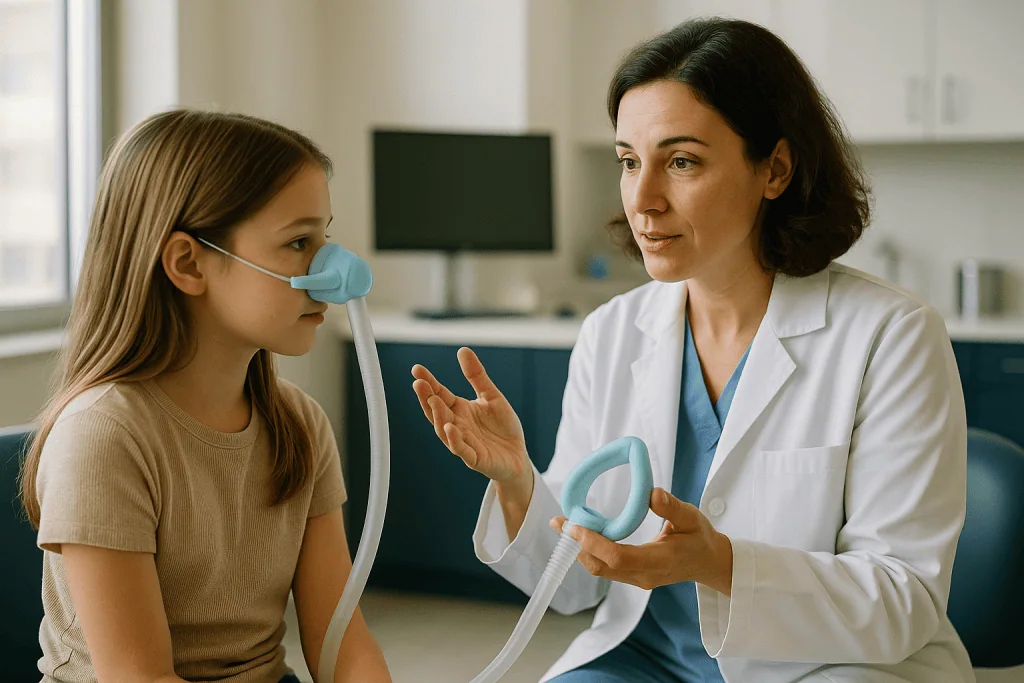
Two properties explain its popularity. First, it works fast: because it enters and leaves the blood through the lungs rather than the digestive system, effects begin within minutes and fade within minutes once the gas is turned off. Second, it does not depress breathing at dental concentrations, so the monitoring burden is light. The AAP-AAPD guideline notes that nitrous oxide alone in a healthy child can be managed with direct observation and does not require the full moderate-sedation monitoring package (Coté and Wilson, 2019).
That changes the moment it is combined with anything else. Nitrous oxide layered on top of an oral sedative can deepen the overall effect, and the guideline treats the combination as moderate sedation with all the monitoring that implies.
What parents notice: a child may giggle, say their hands feel tingly or heavy, or describe a floating feeling. Nausea is the most common side effect, more likely after a large meal, which is one reason clinicians ask about recent food even for gas alone. At the end, the child breathes plain oxygen for several minutes to clear the gas and reduce the brief headachy, foggy feeling that can follow.
Nitrous oxide has limits. A child who is too frightened to accept the nasal hood, has a blocked nose, or cannot breathe through the nose will get little from it. It calms; it does not immobilize.
Conscious sedation for children at the dentist: what oral sedation involves
When a family is offered a medicine to drink before the appointment, the target is usually moderate sedation, still widely called conscious sedation in patient information. MedlinePlus describes the state plainly: relaxed and drowsy, able to respond to questions, often with little memory of the procedure afterward.
Several drug classes are used, and clinicians choose based on the child’s age, weight, health and the length of the planned work. Benzodiazepines reduce anxiety and cause amnesia; antihistamines add drowsiness; some teams use other sedative agents with different profiles. Which medicine, and how much, is entirely the prescribing dentist’s or anesthesiologist’s decision after examining your child, and it should never be adjusted at home.
Oral sedation has a built-in trade-off that shapes the whole visit. Because the medicine is absorbed through the gut, its onset is slow and its depth is hard to fine-tune. A dentist cannot turn it down the way nitrous oxide can be dialed back. If a child ends up more sedated than planned, the team must be ready to manage a deeper level, which is exactly why the guideline insists on continuous pulse oximetry, a second trained person and rescue equipment for every moderate-sedation case (Coté and Wilson, 2019).
The guideline’s more recent update also encourages capnography during moderate sedation, because studies in children found that breathing changes show up on the carbon dioxide trace before the oxygen reading falls, giving the team a head start.
Effects last longer than the appointment. Drowsiness, unsteadiness and irritability commonly persist for the rest of the day, and a small number of children react paradoxically, becoming agitated rather than calm. Both possibilities should be discussed before the day arrives.
Deep sedation and general anesthesia: when a child is fully asleep
For a toddler with widespread decay, a child with significant special healthcare needs, or one who has not been able to tolerate lighter options, the team may recommend deep sedation or general anesthesia. Both are anesthesia-level care, and the monitoring reflects that.
Deep sedation is usually delivered intravenously, through a small tube placed in a hand or arm vein, so that the depth can be adjusted moment to moment. The child is unlikely to remember anything and may need help keeping the airway open. The AAP-AAPD guideline requires, for deep sedation, an individual whose sole responsibility is to observe the child and the monitors, trained in pediatric advanced life support, with continuous pulse oximetry, capnography, heart tracing and blood pressure readings (Coté and Wilson, 2019).
General anesthesia takes the last step: complete unconsciousness under an anesthesiologist or nurse anesthetist, typically with a breathing tube. It is delivered in a hospital or accredited surgery center, with the dentist working on the teeth while the anesthesia team manages breathing, fluids and vital signs. Mayo Clinic notes that general anesthesia is chosen when a procedure is long, requires stillness, or would be distressing to experience awake; all three apply to extensive dental work in a very young child.
Why choose general anesthesia over deep sedation? Predictability. A secured airway removes the risk of a partially blocked one, and the whole mouth can be treated in a single session instead of several sedated visits. The cost is a bigger event: fasting, an intravenous line, a recovery room and a groggier day. The NHS points out that modern general anesthesia is very safe for most children, while noting that sore throat, nausea and confusion on waking are common and short-lived.
Who is pediatric dental sedation usually for, and who is asked to wait?
Sedation is a tool for a specific problem: a child who needs treatment but cannot safely receive it awake. Typical candidates include very young children with multiple cavities, children with strong gag reflexes, children with dental anxiety that has not responded to behavior guidance, and children with developmental, physical or medical conditions that make sitting still or cooperating difficult.
Two questions drive the choice of level. How much work is needed, and how much can this particular child tolerate? A single small filling in a nervous eight-year-old may go smoothly with nitrous oxide and patient coaching. Eight teeth in a three-year-old is a different conversation.
Some children are asked to wait or are referred to a hospital setting rather than sedated in an office. The AAP-AAPD guideline flags several risk factors that shift a child up the monitoring ladder or out of the office altogether: a current cold or chest infection, which makes airway reflexes twitchier; snoring or diagnosed sleep apnea; obesity; enlarged tonsils; poorly controlled asthma; certain heart conditions; and infants, whose airways are small and who desaturate quickly (Coté and Wilson, 2019).
A postponed appointment because of a runny nose is frustrating for a family who arranged time off work, but it is a sign the team is taking the guideline seriously. Respiratory infections are one of the more common reasons sedation is rescheduled, and the decision protects the child.
Children with complex medical histories are usually seen by an anesthesiologist before any plan is made. The right level is the lightest one that allows safe, complete treatment, chosen by the treating team with the family, not the deepest one available.
What is the Rule of 7 in pediatric dentistry?
Parents searching for this phrase often expect a formal guideline. It is not one. The “Rule of 7” is an informal rule of thumb that some pediatric dentists use in conversation, and it appears in no AAP, AAPD or anesthesia society document.
The idea, in its usual form, goes like this: around age seven, most children have developed enough reasoning and impulse control to accept local anesthetic and routine dental work with good behavior guidance and perhaps nitrous oxide. Below that age, and especially when the treatment plan is long, the odds that a child can cooperate through several appointments fall, so deeper options are discussed earlier. Some clinicians extend the heuristic to the number of teeth involved, treating roughly seven or more needing work as a threshold for considering a single general anesthesia session rather than repeated sedated visits.
Treat it as shorthand, not science. Children develop at different rates, and a calm four-year-old may sail through a filling while an anxious ten-year-old cannot. Formal guidance does not rely on an age cutoff; it relies on the assessment described earlier, covering health status, airway, the child’s behavior in the chair and the extent of treatment (Coté and Wilson, 2019).
What the rule captures correctly is a real pattern. Developmental readiness matters, and repeated moderate sedation carries cumulative fasting, medication and scheduling burdens for a young child. What it gets wrong is the implication that a number can decide. If a dentist mentions the Rule of 7, ask what specifically about your child and this treatment plan points toward one level over another. A thoughtful clinician will welcome the question and answer it in terms of your child, not the calendar.
What do the AAP pediatric sedation guidelines actually require?
The document families hear cited is the joint AAP-AAPD guideline, Guidelines for Monitoring and Management of Pediatric Patients Before, During, and After Sedation for Diagnostic and Therapeutic Procedures, most recently updated by Coté and Wilson in Pediatrics. It applies to any setting where a child is sedated for a procedure, dental offices included. Its requirements cluster around five themes.
Assessment. A health history, physical exam with airway evaluation, and a documented physical status class before any sedative is given.
Fasting. The guideline adopts the anesthesia-society fasting intervals: clear liquids up to 2 hours before, breast milk up to 4 hours, infant formula and light meals up to 6 hours, and fatty or fried meals up to 8 hours before sedation. The purpose is to lower the chance of vomiting and inhaling stomach contents if reflexes are blunted.
Personnel. At least two people for moderate sedation, one of them able to monitor and to start rescue. For deep sedation, a dedicated observer with pediatric advanced life support training who does nothing else.
Equipment. Child-sized airway equipment, suction, oxygen, a bag-valve-mask, reversal agents where applicable, and a way to summon emergency help. The guideline uses a memory aid for the pre-sedation check that runs through suction, oxygen, airway, pharmacy, monitors, equipment and staffing.
Recovery and discharge. Monitoring continues until the child is close to their usual level of alertness, with stable vital signs and a protected airway. If a reversal medicine was given, the guideline calls for observation of at least 2 hours afterward, because the sedative can outlast the reversal.
Nothing in the guideline names a preferred drug or fixes a dose in stone. Those judgments belong to the clinician examining the child.
How do you prepare a child for dental sedation?
Preparation is mostly practical, and the details matter because a missed instruction can cancel the appointment.
Fasting is the big one. Write the times down and set alarms. Clear liquids such as water or apple juice without pulp are usually allowed until 2 hours before; milk, formula and food have longer cutoffs, as described in the guideline section above (Coté and Wilson, 2019). A sip of water to swallow a regularly prescribed medicine is often permitted, but ask the team specifically, and never stop a prescribed medicine on your own.
Health check the night before. Fever, cough, wheeze, a heavy cold or vomiting are reasons to call the office in the morning rather than show up. The team would rather reschedule than sedate a child with a irritable airway.
Clothing and comfort. Loose, short-sleeved clothing makes monitor placement easy. A favorite stuffed animal or blanket helps; screens can distract during the wait for an oral medicine to take effect. Nail polish should be removed from at least one finger because it can interfere with the pulse oximeter.
Talking to your child. Keep it honest and brief. Words like “a medicine that helps you feel sleepy and calm while the dentist fixes your tooth” work better than promises that nothing will be felt. Avoid the word “shot” if possible; many teams say “sleepy juice” or “a little pinch.”
Logistics. Two adults are ideal for the ride home after moderate or deeper sedation: one to drive, one to watch the child, who may slump in a car seat and need the head supported. Clear the rest of the day. Plan soft, bland foods and expect naps.
MedlinePlus and Mayo Clinic both provide general pre-anesthesia checklists for children that mirror this list.
What do the hours and days after sedation look like?
Recovery follows the same continuum as the sedation itself, in reverse.
After nitrous oxide alone, children typically walk out within minutes of breathing plain oxygen and can return to a normal day, including school, if the dental work itself allows.
After oral moderate sedation, the office keeps the child under monitoring until discharge criteria are met: near-baseline alertness, stable oxygen readings and vital signs, able to sit up and, for older children, to talk and drink. Expect the rest of the day at home. Drowsiness, wobbliness, clinginess and irritability are common for several hours, and some children sleep much of the afternoon. The guideline advises that a child be watched by an adult throughout this period, positioned so the head does not fall forward and block the airway, and kept away from bikes, stairs and bathtubs (Coté and Wilson, 2019).
After deep sedation or general anesthesia, the child wakes in a recovery area with nurses monitoring breathing and oxygen. The NHS lists sore throat from the breathing tube, nausea, shivering and a period of confusion or tearfulness on waking as common effects that settle within hours. Most children go home the same day once they are drinking and alert, though anyone with a complicating condition may be observed longer.
Over the following days, the dental work dominates: numb lips for a few hours (watch for lip-biting in small children), mild soreness where teeth were treated, and dietary adjustments if crowns or extractions were done. Appetite and mood are usually back to normal by the next day. Persistent vomiting, breathing changes or unusual sleepiness beyond the first day are not part of normal recovery and belong in the red-flag section below.
What are the risks, and what are the alternatives?
Neutral language is important here, because both fear and false reassurance do families a disservice.
The main risks of sedation in children are respiratory. Sedatives can slow breathing, relax the muscles that hold the airway open, or provoke laryngospasm, a reflex spasm of the vocal cords. Vomiting with inhalation of stomach contents is the reason fasting exists. Allergic reactions are rare. Paradoxical agitation, in which a child becomes more distressed rather than calmer, occurs with some oral agents. Serious harm is uncommon when guideline standards are met; the AAP-AAPD authors emphasize that reported adverse outcomes have clustered around inadequate monitoring, insufficient staff, sedation of medically complex children outside hospitals, and drug combinations that pushed children deeper than intended (Coté and Wilson, 2019). That is a strong argument for asking about monitoring before asking about medicine.
General anesthesia carries its own short-term effects, and the NHS and Mayo Clinic describe a low but real rate of serious complications that rises with underlying illness. Questions about long-term effects of anesthesia on the developing brain have been studied; current guidance from Mayo Clinic and others notes that a single, relatively brief exposure in an otherwise healthy child has not been shown to cause lasting harm, while research continues.
Alternatives exist and should be on the table. Behavior guidance techniques such as tell-show-do, positive reinforcement and distraction work for many children. Treatment can be staged, starting with the least invasive work to build trust. Minimally invasive approaches, including fluoride-based treatments that slow decay in baby teeth, can sometimes postpone drilling until a child is older. Local anesthetic alone remains the standard for cooperative children. Protective stabilization is controversial and requires explicit informed consent. The treating team should explain why sedation, at the level proposed, is preferable to these for your child.
What people often get wrong about levels of pediatric dental sedation
“Sedation means my child won’t feel anything.” Sedation manages fear and movement. Pain control comes from local anesthetic, which is still injected even under moderate sedation. Only general anesthesia removes the need for the child to be numb, and many anesthesiologists still ask for local anesthetic to reduce pain on waking.
“Laughing gas is the same as sedation medicine.” Nitrous oxide is minimal sedation with rapid on and off effects and little breathing impact. Oral sedatives are slower, less adjustable and deeper. Monitoring requirements differ accordingly (Coté and Wilson, 2019).
“An oral sedative is safer than general anesthesia because it’s lighter.” Lighter is not automatically safer. An oral medicine given in an office cannot be turned down, and a child who slips into deep sedation without deep-sedation monitoring is at more risk than one under general anesthesia with a secured airway and a full anesthesia team. Safety depends on matching the setting and monitoring to the depth reached, not on the label.
“A little extra at home will help.” Never give a child any sedating medicine, including over-the-counter antihistamines, before a dental visit unless the treating clinician has specifically prescribed it. Unplanned combinations are among the most common contributors to serious events.
“The Rule of 7 decides it.” As discussed above, it is an informal heuristic, not a guideline.
“My child was fine last time, so this time is routine.” Weight, health and airway change as children grow; a cold that was absent last year may be present now. Every sedation gets a fresh assessment.
“If the office does it, it must be standard.” Practices vary. Asking directly who monitors, with what, and what training they hold is not rude; it is exactly what the guideline expects families to be told.
Questions to ask your care team
A good consultation leaves you knowing the level, the setting, the people and the plan B. These questions cover all four.
- Which level of sedation are you aiming for with my child, and why that level rather than a lighter or deeper one?
- Have you considered nitrous oxide alone, staged treatment or minimally invasive options first? What makes them less suitable here?
- Who will give the medicine, and who will monitor my child during the procedure? Is that person’s only job to monitor?
- What training in pediatric emergencies does the monitoring person hold, and how recently was it renewed?
- Which monitors will be used: pulse oximetry, blood pressure, capnography, heart tracing?
- What child-sized emergency equipment and reversal medicines are on site, and how would you summon additional help?
- How do my child’s snoring, weight, asthma, recent colds or other conditions affect the plan?
- If my child becomes more deeply sedated than intended, what happens?
- What are the exact fasting cutoffs for water, milk and food, and how should regular medicines be handled that morning?
- What side effects are common with the planned medicine, including paradoxical agitation, and how long do they usually last?
- How will you decide my child is ready to go home, and what should the ride and the afternoon look like?
- Who do I call after hours if something worries me tonight?
- If sedation is postponed for illness, how quickly can we reschedule, and does the treatment plan change while we wait?
Bring the list, and bring a pen. The answers you want to hear are specific: named monitors, named training, a named person in the room whose job is to watch. Vague reassurance is a reason to ask again. Whatever is decided, the decision about level, setting and medicine belongs to the treating team working with you, and a team that welcomes these questions is showing you how it will behave when your child is in the chair.
When to call your doctor
Most children recover from dental sedation with nothing more dramatic than a long nap and a grumpy evening. A short list of signs, though, should prompt a call to the dental team, the anesthesia team or your child’s pediatrician the same day, and a few mean calling emergency services immediately.
Call emergency services now if your child has difficulty breathing, noisy or gasping breathing, blue or gray color around the lips or face, cannot be roused at all, has a seizure, or shows signs of a severe allergic reaction such as facial swelling, widespread hives with breathing trouble, or collapse.
Contact the treating team or your pediatrician promptly if you notice:
- sleepiness that is deepening rather than lifting several hours after discharge, or a child who is hard to wake for a drink
- repeated vomiting, or inability to keep any fluids down for more than a few hours
- fever developing after the procedure
- agitation, confusion or hallucinations that persist beyond the first few hours
- bleeding from the mouth that does not settle with gentle pressure on gauze
- a lip or cheek that has been bitten while numb and is swelling markedly
- pain that is not controlled with the measures the team recommended
- any breathing pattern, color or behavior that simply does not look right to you
Trust that last instinct. Parents are the most sensitive monitor a child has once they leave the office, and the guideline explicitly places an adult observer at the child’s side through the recovery period for this reason (Coté and Wilson, 2019). The team that sedated your child should have given you a direct number; use it. If you cannot reach them, your pediatrician or an urgent care or emergency department can assess a child after anesthesia or sedation.
Every judgment about whether a symptom is expected or concerning rests with clinicians who can see your child. This article explains the framework; it does not replace that call.
Frequently asked questions
What are the four levels of sedation?
The four levels are minimal sedation, moderate sedation, deep sedation and general anesthesia. Minimal sedation leaves a child awake and responding normally; moderate sedation produces drowsiness with purposeful response to voice or touch; deep sedation means the child responds only to repeated or painful stimulation and may need airway support; general anesthesia is full unconsciousness with a secured airway.
What is the Rule of 7 in pediatric dentistry?
The Rule of 7 is an informal rule of thumb, not a guideline. It suggests that around age seven most children can cooperate with routine dental work using local anesthetic, behavior guidance and perhaps nitrous oxide, while younger children with extensive needs are considered earlier for deeper options. Formal guidance relies on individual health, airway and behavioral assessment instead.
What are the AAP guidelines for pediatric sedation?
The joint AAP-AAPD guideline requires a pre-sedation health and airway assessment, fasting, at least two trained people for moderate sedation and a dedicated observer with pediatric advanced life support training for deep sedation, continuous pulse oximetry with capnography encouraged, child-sized rescue equipment, and monitored recovery until the child is near baseline alertness with stable vital signs.
Is conscious sedation for children at the dentist the same as being put to sleep?
No. Conscious sedation, now called moderate sedation, keeps a child drowsy but able to respond to voice or light touch and breathing on their own. Being put to sleep refers to general anesthesia, in which the child is fully unconscious with a protected airway, usually in a hospital or surgery center under an anesthesia provider.
How is a child monitored during moderate dental sedation?
A pulse oximeter clip tracks blood oxygen and heart rate continuously, blood pressure and breathing rate are checked at intervals, and capnography, which measures exhaled carbon dioxide, is encouraged. A second trained person, not the one doing the dental work, watches the monitors and the child’s chest, color and responsiveness throughout and records vital signs at set intervals.
How long does a child need to fast before dental sedation?
Typical intervals adopted in the AAP-AAPD guideline are 2 hours for clear liquids, 4 hours for breast milk, 6 hours for infant formula or a light meal and 8 hours for fatty or fried food. Your child’s team will confirm the exact times, and any regular medicine should be handled only as they instruct.
Does laughing gas need the same monitoring as other sedation?
No. Nitrous oxide alone, in the concentrations used in dentistry, is minimal sedation and does not depress breathing, so direct observation by the dentist and a trained assistant is considered sufficient for a healthy child. Once nitrous oxide is combined with an oral sedative, the combination is treated as moderate sedation with full monitoring.
What happens if my child gets more sedated than planned?
The team pauses, repositions the head, gives oxygen and, if breathing is inadequate, supports it with a bag and mask; reversal medicines exist for some drug classes. Guidelines require every sedating team to be trained and equipped to rescue a child from one level deeper than intended, which is why staffing and equipment questions matter before the visit.
How long will my child be sleepy after oral dental sedation?
Drowsiness, unsteadiness and irritability commonly last for the rest of the day, and many children nap for several hours. The office monitors the child until they are near their usual alertness before discharge, and an adult should watch them continuously at home. Sleepiness that deepens rather than lifts, or a child who is hard to wake, warrants a call.
Is general anesthesia safe for a young child's dental work?
For most healthy children, general anesthesia delivered by an anesthesia team in a hospital or surgery center is considered very safe, with common short-lived effects such as sore throat, nausea and confusion on waking. Serious complications are uncommon and more likely with underlying illness. Whether it is the right level for your child is a decision for the treating team.
References
- Coté CJ, Wilson S. Guidelines for Monitoring and Management of Pediatric Patients Before, During, and After Sedation for Diagnostic and Therapeutic Procedures. Pediatrics (PubMed)
- MedlinePlus: Conscious sedation for surgical procedures
- MedlinePlus: General anesthesia
- NHS: General anaesthesia
This article is for general information only and is not a substitute for professional medical advice. Please consult a qualified doctor about your individual situation.

More from the Blog

How Can Parents Comfort a Child With Viral Croup? Calm Positions, Fluids and Rest
To comfort a child with croup, stay calm and hold the child upright on your lap, because crying and lying flat can tighten the…

Bronchiolitis Warning Signs: Fast Breathing, Blue Lips and Feeding Drops Needing Urgent Care
Take a child with bronchiolitis to hospital, or call emergency services, if breathing becomes fast or labored with the chest sucking in, there are…

Baby Poop Colors and Textures: What Is Normal
Normal baby poop varies widely: sticky greenish-black meconium in the first days, then mustard-yellow and seedy stools in breastfed babies or tan, pasty stools…

What Does Growing Up With Pediatric Chronic Kidney Disease Involve? Nutrition, School and Play
Growing up with pediatric chronic kidney disease usually involves regular clinic visits, close tracking of growth and blood pressure, a dietitian-guided eating plan that…

Pediatric Chronic Kidney Disease Stage by Stage: How Care Changes as Kidney Function Falls
Pediatric chronic kidney disease stages describe how much filtering ability a child's kidneys still have, measured as estimated glomerular filtration rate (eGFR). Stages 1…

After ROP Treatment: Eye Redness, Swelling and the Follow-Up Retinal Examinations Ahead
After ROP treatment, most premature babies have puffy eyelids, red or bloodshot eyes and light sensitivity for a short period while the surface heals;…