

What Are the Risks of Lipedema Surgery? Clots, Seroma and Honest Expectations

Key Takeaways
- Lipedema liposuction shares the recognized risks of all liposuction, which the NHS lists as bleeding under the skin, numbness, fluid build-up, infection, blood clots and uneven results.
- Blood clots are the one potentially fatal complication; the CDC counts as many as 900,000 Americans affected by DVT or pulmonary embolism each year, and leg surgery is a well-established trigger.
- A seroma is a pocket of tissue fluid in the space left by removed fat; most are absorbed with compression and movement, but a hot, red or increasingly painful one needs same-day review.
- Whole-limb procedures are usually staged across several sessions because blood loss and fluid shifts from very large single-session volumes can cause anemia and strain the circulation.
- The NHS notes that liposuction results can take up to 6 months to appear, and lipedema surgeons commonly ask patients to wait a full year before judging contour or planning revision.
- Surgery removes diseased fat but not the underlying chronic condition, so compression, exercise and lymphatic care usually continue for life afterwards.
Lipedema surgery, usually a specialized form of liposuction, carries the general risks of any liposuction: bleeding, infection, blood clots, fluid collections called seromas, prolonged swelling, numbness and uneven contours. Removing large volumes of tissue over several sessions adds the risk of fluid shifts and anemia. Serious complications are uncommon in published reports, but long-term evidence is still limited, so every decision belongs with an experienced treating team.
The consultation letter arrives on a Tuesday, and by Wednesday night you have read every forum thread you can find. One person is three weeks past a second operation and feeling low; another is describing a complication nobody warned her about. Between them sit a dozen glossy pages promising a new life. Somewhere in that noise is the honest answer you actually need.
Lipedema surgery risks are real, mostly manageable and rarely explained calmly. Lipedema is a long-term condition in which fat builds up abnormally and painfully, almost always in the legs and sometimes the arms, and almost always in women. The surgery designed for it removes that diseased fat with modified liposuction. It can reduce pain and heaviness for many patients, and it can also cause clots, fluid collections, months of swelling and results that look different from the brochure.
This article walks through each risk in plain language, what the mainstream evidence supports, and the questions worth asking before you sign anything.
How safe is lipedema surgery? An honest baseline
Start with the frame that matters: this is elective surgery on a chronic condition, not an emergency operation. Nobody has to decide quickly, and the safest version of the procedure is the one planned carefully with time to prepare.
Lipedema liposuction is performed under local tumescent anesthesia (a large volume of dilute numbing fluid injected into the fat), under sedation, or under general anesthesia, depending on how much tissue is being removed. The Cleveland Clinic describes the goal as removing the abnormal fat while protecting the lymphatic vessels, the fine channels that drain tissue fluid, because damaging them can worsen swelling rather than relieve it.
How safe is that in practice? The general liposuction literature is the best guide we have. The NHS lists the recognized complications of liposuction as bleeding under the skin, persistent numbness, fluid build-up in the treated area, infection, blood clots and uneven or lumpy results. Serious complications such as pulmonary embolism, a clot travelling to the lung, are uncommon but are the ones that turn an elective procedure into a life-threatening event.
The specific lipedema evidence is thinner. The NHS notes that liposuction for lipoedema is not routinely available in its system, and that the UK regulator NICE concluded more evidence is needed before it can be recommended outside research settings. That is not a verdict that the surgery is unsafe; it is a statement that large, long-term, independently run studies are still lacking. Most published series come from surgical centers reporting on their own patients, which tends to make outcomes look better than they might be across the board.
A fair summary: the procedure itself carries known, mostly short-term risks that an experienced team can reduce but not eliminate; the long-term benefit is promising but not yet proven to a guideline standard. Both halves of that sentence should be part of any conversation with your surgeon.
What actually happens during lipedema liposuction
Picture the leg as layers: skin, then a thick band of fat threaded with tiny blood vessels and lymphatic channels, then muscle. In lipedema the middle layer is enlarged, tender and often nodular. The surgeon’s job is to thin that layer without shredding what runs through it.
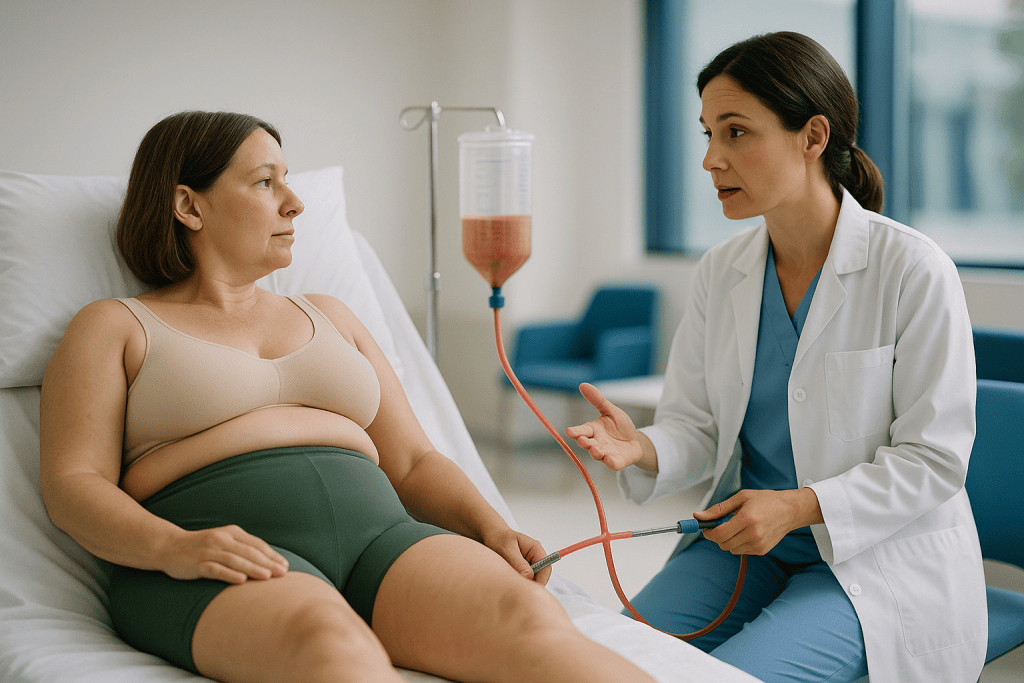
The operation usually begins with tumescent infiltration. Large volumes of saline containing a local anesthetic and a vessel-constricting medicine are pumped into the fat until the tissue is firm and swollen. The Mayo Clinic explains that this both numbs the area and shrinks blood vessels, which is why tumescent liposuction typically causes less bleeding than older techniques.
Fat is then removed through small incisions using a cannula, a thin hollow tube attached to suction. Two variants are common in lipedema care. Water-assisted liposuction uses a pulsing jet of fluid to loosen fat before it is suctioned, and power-assisted liposuction uses a vibrating cannula that moves through fibrous tissue with less force. Surgeons who treat lipedema tend to prefer these gentler methods because the fat is often tougher and more fibrous than ordinary fat, and because moving the cannula along the length of the limb rather than across it is thought to spare more lymphatic vessels.
Volume is the other distinctive feature. A cosmetic liposuction session might remove a modest amount from a small area. Lipedema procedures often address whole limbs, and the total removed can be many times larger. That is why many surgeons split treatment across two, three or more sessions spaced weeks or months apart. Spreading the load reduces the strain of fluid shifts and blood loss on the body during any single anesthetic.
The final steps are compression and mobilization: the limb is wrapped or fitted with a garment, and patients are encouraged to walk within hours. Both are risk-reduction measures, not afterthoughts, and the next sections explain why.
Who is usually offered surgery, and who is usually asked to wait
Surgery sits at the end of a pathway, not the beginning. The Cleveland Clinic and the NHS both describe conservative management as the first line: compression garments, manual lymphatic drainage (a specialized gentle massage that encourages fluid to move), regular low-impact exercise, skin care and support for pain. Surgeons generally want to see that a patient has genuinely tried these for a sustained period, partly because they matter after surgery too.
People usually considered good candidates share a few features. Their lipedema has been formally diagnosed rather than assumed. Pain, heaviness, easy bruising or mobility limits persist despite consistent conservative care. Their general health allows a long procedure and a recovery that demands walking and self-care. Their expectations are realistic: relief of symptoms and improved function, not a guarantee of a particular shape.
Others are commonly asked to wait or to prepare first. That includes anyone with an untreated clotting disorder or a personal history of deep vein thrombosis, because the baseline clot risk is already elevated. Uncontrolled diabetes, active infection, heavy smoking and severe anemia each impair healing or raise anesthetic risk. Significant lymphedema, a separate condition where lymphatic fluid pools because drainage has failed, needs careful assessment; operating on a limb whose drainage is already compromised can make swelling worse. Recent pregnancy, planned pregnancy and major hormonal transitions are often reasons to defer, since the Cleveland Clinic notes lipedema tends to flare around puberty, pregnancy and menopause.
Weight is discussed frankly but should never be a source of shame. Some surgeons ask patients living with obesity alongside lipedema to work on general health first, not because the lipedema fat responds to dieting (it largely does not), but because anesthetic and clot risks rise with body mass and because results are easier to protect afterwards.
None of these are absolute rules. They are the reasons a thoughtful team says “not yet” rather than “never”, and each deserves an explanation you understand.
Blood clots: the lipedema surgery risk worth taking most seriously
Of every complication on the list, venous thromboembolism is the one that can kill. It deserves the most attention before and after surgery.

Deep vein thrombosis, or DVT, is a clot forming in a deep vein, usually in the calf or thigh. If part of it breaks loose and lodges in the lung, the result is a pulmonary embolism. The CDC estimates that as many as 900,000 Americans are affected by these clots each year, and surgery is one of the best-recognized triggers because it combines three ingredients: injury to vessel walls, slowed blood flow from lying still, and a temporary shift in the blood toward clotting.
Lipedema surgery stacks several of those ingredients. The operation is on the legs, where clots most often start. It can be long. Large fluid volumes move in and out of the body. Compression garments, if poorly fitted, can pinch rather than support. And many patients arrive with additional risk factors such as higher body mass, hormonal contraception or hormone therapy, previous clots, or limited mobility from years of painful legs.
Prevention is layered. Teams assess each patient’s risk before surgery and decide whether medicines that thin the blood are needed around the operation; the choice, timing and duration belong entirely to the anesthetist and surgeon. Mechanical measures matter just as much: calf pumps during and after surgery, early walking, and graduated compression that is snug but never tight enough to leave deep grooves or numb toes.
Your part is movement and vigilance. MedlinePlus lists the classic DVT signs as swelling, pain or tenderness, warmth and redness in one leg, and the pulmonary embolism signs as sudden breathlessness, chest pain that worsens with breathing, rapid heartbeat and coughing up blood. After lipedema surgery both legs are usually swollen and sore, which can mask a clot, so the warning to watch for is change: one leg suddenly worse than the other, or any new breathing symptom. Those are emergency signs, not questions for the next follow-up appointment.
Seroma after liposuction: why fluid collects and what is done about it
A seroma is a pocket of clear or straw-colored fluid that gathers in the space left behind after tissue is removed. Think of it as the body’s response to an empty room: raw surfaces weep tissue fluid and lymph, and with nowhere to drain, it pools. On the thigh or lower leg it feels like a soft, sometimes sloshing swelling that may appear a few days to a couple of weeks after the operation.
Liposuction is especially prone to seromas because it creates a broad, thin cavity rather than a single deep one. The NHS lists fluid build-up as one of the expected complications of the procedure. Lipedema adds to the tendency in two ways: the volumes removed are larger, and the lymphatic vessels that would normally carry fluid away may be already impaired by the disease or bruised during the surgery.
Most seromas are more nuisance than danger. Small ones are absorbed on their own over weeks, helped by firm, even compression that closes the empty space and by gentle movement that encourages lymph to flow. Larger or persistent collections may need to be drained with a fine needle in clinic, occasionally more than once. Some surgeons leave small drains in place after surgery for the first days to prevent the problem forming; others prefer to rely on compression alone. Neither approach is proven superior across all patients, and your team’s choice will reflect their experience and your anatomy.
The complication to watch for is an infected seroma. Stagnant fluid is an inviting environment for bacteria, and an infected collection typically becomes warm, red, more painful and may be accompanied by fever or a cloudy discharge from an incision. That combination needs same-day assessment, because it can require drainage and antibiotics chosen by the treating team.
A practical note many patients wish they had known: a seroma can make one area look puffier than the rest for weeks, and that asymmetry is temporary. It is not the final result, and it is not a sign the surgery failed.
Bleeding, anemia and fluid shifts when large volumes are removed
The tumescent technique was a genuine advance in liposuction safety precisely because it reduced bleeding. The Mayo Clinic notes that the vessel-constricting medicine in the infiltration fluid limits blood loss. Even so, lipedema procedures remove enough tissue that blood loss and fluid balance remain live concerns.
Bruising is universal and can be dramatic. Blood leaks from thousands of tiny vessels into the surrounding tissue, tracking downward with gravity so that bruises appear at the ankle even when the thigh was treated. The NHS describes bleeding under the skin as an expected effect that fades over weeks. A hematoma, a firm, painful, rapidly enlarging collection of blood rather than a spreading bruise, is different and should be reported promptly.
Anemia, a shortage of red blood cells, is the quieter issue. Each session sheds some blood in the aspirated fat, and when sessions are spaced only weeks apart the body may not fully recover its red cell count between them. Symptoms are easy to dismiss as ordinary post-operative tiredness: fatigue, breathlessness on stairs, dizziness on standing, a racing heart. Teams often check blood counts before each stage and may adjust the interval between operations accordingly. Iron status is frequently part of that conversation, and any supplement decision belongs with the clinician who sees your results.
Fluid shifts cut both ways. Tumescent infiltration puts liters of fluid into the tissue; some is suctioned back out, some is absorbed into the bloodstream over the following hours, and some drains from incisions overnight, which is why the first night’s dressings can be alarmingly wet. Too much retained fluid strains the heart and lungs; too little, combined with blood loss, drops blood pressure. Anesthetists manage this balance during surgery, and it is one reason large-volume procedures are safer with overnight monitoring than as a same-day discharge.
For the patient, the takeaway is simple: drink as advised, keep moving, and treat lightheadedness or breathlessness as information to pass on rather than something to push through.
Infection, wound healing and skin changes
Liposuction incisions are small, often under a centimeter, and infection rates for the procedure overall are low. The risk in lipedema surgery is shaped less by the incisions themselves than by the terrain around them.
Lipedema legs frequently have stretched skin, poor tissue oxygenation and a history of easy bruising. Add a long operation, a large raw surface beneath the skin, drainage fluid soaking dressings, and compression garments worn day and night, and the conditions for skin breakdown or bacterial entry are present. The NHS lists infection among the recognized complications of liposuction. Signs are the familiar ones: spreading redness, increasing rather than easing pain, warmth, pus or a foul smell from an incision, and fever or shivering.
Wound healing can be slow at the ankles and inner knees, where skin is thin and movement constant. Small incisions occasionally gape or scar more visibly than expected. Numbness around scars is common and usually improves over months.
Skin quality after surgery is a frequent disappointment that deserves honest discussion beforehand. Removing a large volume of fat from beneath skin that has been stretched for years does not make the skin shrink back completely. Some retraction occurs over the following months, but loose or wrinkled skin, particularly on the inner thighs and knees, is a realistic possibility. Surgeons cannot reliably predict how much any individual’s skin will tighten; age, sun exposure, smoking, genetics and how long the skin has been stretched all play a part. Some patients later consider separate skin-removal procedures, which carry their own scars and risks and are a different decision entirely.
Two rarer skin problems are worth naming. Fat necrosis, where a patch of fat dies and hardens into a firm lump, can develop weeks later and usually softens over time. Skin necrosis, where the skin itself loses its blood supply and darkens, is uncommon and more likely in smokers or where compression has been too tight. Both are reasons for an early review rather than watchful waiting at home.
Numbness, lumps and uneven contours: the slow-to-settle problems
Ask people a year after lipedema surgery what bothered them most, and clots or infection rarely top the list. The lingering complaints are subtler: patches of numb or tingling skin, firm lumps under the surface, and areas that look uneven.
Numbness happens because the cannula unavoidably disturbs small sensory nerves in the fat. Most recover, but the Mayo Clinic notes that numbness after liposuction can be temporary or, occasionally, permanent. Odd sensations are common during recovery: itching, burning, hypersensitivity to fabric, or a feeling that the leg belongs to someone else. These usually settle over months as nerves regrow, but nobody can promise a specific timeline for any individual.
Firmness and lumpiness are part of normal healing. The cavity left by liposuction fills with scar tissue that feels hard and irregular before it remodels. Surgeons and lymphatic therapists often describe this as the tissue “going through cardboard” before it softens. The NHS describes lumpy or uneven results as a recognized liposuction outcome, and in lipedema the fibrous nature of the disease makes some residual firmness more likely than in cosmetic cases.
Contour irregularity is the visible version of the same problem. Dents where too much was removed, ridges where too little was, or asymmetry between legs can appear once swelling settles. Some irregularities even out over the first year; others persist. Revision procedures exist but carry the same risks again and cannot always correct a dent because there is no fat left to remove around it. This is a strong argument for a surgeon who prioritizes evenness over maximum volume in any single session.
Finally, there is the question of recurrence. Lipedema fat that has been removed does not regrow in the same place, but the underlying condition persists. Remaining fat cells can enlarge, especially with hormonal change or weight gain. The Cleveland Clinic frames surgery as a way to reduce symptoms and improve mobility, not as a way to eliminate the disease, and that framing protects patients from the cruelest disappointment of all.
Lipedema liposuction complications at a glance: what happens when
Timing matters as much as probability. A problem that appears in the first 48 hours needs a different response from one that shows up at week six. The table below organizes the main risks by the window in which they usually declare themselves, drawing on the complication lists published by the NHS and the Mayo Clinic for liposuction generally, adjusted for what is distinctive about lipedema procedures.
| Complication | Typical window | What it usually looks like | Urgency |
|---|---|---|---|
| Bleeding or hematoma | First 24–48 hours | Rapidly enlarging, tense, painful swelling; soaked dressings beyond what the team described | Same day |
| Fluid overload or low blood pressure | First 24 hours | Breathlessness lying flat, or faintness on standing | Immediate |
| Deep vein thrombosis | Days to about 4 weeks | One leg newly more swollen, warm, tender than the other | Emergency |
| Pulmonary embolism | Days to about 4 weeks | Sudden breathlessness, chest pain, rapid heart, coughing blood | Emergency |
| Seroma | Days to 2–3 weeks | Soft, fluid-filled swelling; may slosh | Routine review; same day if red or hot |
| Infection | Days to 2 weeks | Spreading redness, pus, fever, worsening pain | Same day |
| Anemia between stages | Weeks | Fatigue, dizziness, breathlessness on exertion | Report at review |
| Numbness, firmness, irregular contour | Weeks to a year | Patches of altered sensation; hard lumps; dents or asymmetry | Discuss at follow-up |
| Loose skin | Months | Wrinkling or laxity, often inner thigh and knee | Discuss once settled |
The pattern is instructive. Life-threatening problems cluster early and announce themselves loudly; the disappointing but survivable ones arrive quietly and late. Recovery plans should be built around both: strict vigilance and mobility in the first month, then patience and realistic reassessment through the first year before judging the result.
Lipedema surgery recovery time: what the first days and weeks usually look like
Recovery from lipedema surgery is longer and messier than most cosmetic liposuction descriptions suggest, and knowing that in advance prevents a great deal of three-weeks-in despair.
The first two days are about fluid and movement. Incisions leak pink tumescent fluid, sometimes copiously, and absorbent pads are changed frequently. Compression is worn continuously. Walking begins within hours, usually a slow shuffle to the bathroom and back, and is the single most important clot-prevention measure a patient controls. Pain is typically described as deep bruising and tightness rather than sharp; the treating team manages pain relief and any decision about medicines rests with them.
The first two weeks bring peak swelling and bruising. Legs feel heavy, tight and often heavier than before surgery, which is normal and alarming in equal measure. The NHS advises that people generally need time off work and should avoid strenuous activity for a few weeks after liposuction; for whole-limb lipedema procedures, many patients need the upper end of that guidance. Manual lymphatic drainage often starts in this window if the surgeon recommends it.
Weeks three to six are the emotional trough. Bruising fades but firmness sets in, sensation is strange, and the visual result is obscured by residual swelling. This is when the forum posts about feeling dismal are written. It is also when compression is often stepped down from day-and-night wear to daytime only, and gentle exercise such as walking or pool work resumes with the team’s blessing.
From about six weeks to six months, tissue softens and contours emerge. The NHS states that it can take up to 6 months to see the final result of liposuction, and the Mayo Clinic similarly notes that swelling settles over weeks while the improved contour appears over months. For lipedema, where the volumes are larger and the lymphatics slower, many surgeons ask patients to wait a full year before judging a limb or planning any revision.
Every one of these ranges is a typical pattern, not a schedule. Your body, your surgeon and your other health conditions will set the actual pace.
Is it better to sit or stand with lipedema, before and after surgery?
Neither, for long. The honest answer to this common question is that the enemy of a lipedema leg is stillness in any position, and the friend is rhythmic movement.
Standing motionless lets blood and lymph pool under gravity. Sitting with knees bent at ninety degrees and thighs pressed into a chair edge compresses the veins behind the knee and slows return toward the heart. Both leave legs heavier and achier by evening, and both raise clot risk in the weeks after surgery. Calf muscles are the pump that pushes fluid uphill; when they are not contracting, nothing moves.
Before surgery, the Cleveland Clinic and NHS both emphasize regular low-impact exercise as a cornerstone of conservative care. Walking, swimming, cycling and water-based exercise are commonly suggested because they activate the calf pump without pounding tender tissue. Elevating the legs above heart level when resting helps drainage, and breaking up desk time with a short walk every hour or so keeps fluid from settling.
After surgery, the same principles become non-negotiable. Short, frequent walks beat one long effort. When sitting, keep legs elevated where possible and pump the ankles up and down, a movement so simple it feels pointless and is anything but. Long car journeys and flights in the first weeks carry particular clot risk because they combine immobility, dependent legs and, in aircraft, lower cabin pressure; if travel is unavoidable, the treating team should advise on timing, and the basics of hourly movement, hydration and correctly fitted compression apply.
Sleep position comes up too. Many surgeons suggest lying with legs slightly raised on pillows during the swollen weeks, though comfort and the ability to actually sleep matter as much as the theoretical benefit.
None of this is a cure for the underlying condition, and none of it replaces medical advice for your circumstances. It is simply the physiology of fluid, and understanding it turns a frustrating instruction (“keep moving”) into something that makes sense.
What people often get wrong about lipedema surgery
Misconceptions cause more distress after this surgery than the complications do. A few deserve direct correction.
The first myth is that it is cosmetic liposuction with a medical label. The technique overlaps, but the purpose, volumes, tissue quality and lymphatic precautions differ substantially. Treating it as a body-shaping procedure sets up expectations about neat contours that lipedema tissue often cannot deliver, and it can lead patients toward surgeons whose experience lies in a different kind of case.
The second is that surgery removes the disease. It removes diseased fat. The Cleveland Clinic describes lipedema as a chronic condition, and the hormonal and genetic drivers remain after every session. Symptom relief can be substantial and durable for many people, but the remaining tissue can still change with time, hormones and weight, and conservative care usually continues for life.
The third is that one operation is enough. Whole-limb treatment is routinely staged over several sessions, each with its own recovery, its own clot window and its own bill of energy. Anyone told they can “get it all done” in one long procedure should ask searching questions about anesthetic time, blood loss and fluid management.
The fourth is that swelling means failure. Legs are commonly larger at two weeks than they were before surgery. That is inflammation and fluid, not returned fat, and it recedes over months.
The fifth is that compression is optional once the wounds close. Garments do more than hold dressings in place; they close the empty space where seromas form and support the damaged lymphatics while they recover. Stopping early is one of the most common self-inflicted setbacks.
The sixth is that a bad forum experience predicts yours. Online communities are invaluable for solidarity and practical tips, but people with complications post more than people who are quietly fine, and no two lipedema bodies, surgeons or plans are identical. Use them for questions to ask, not for prognosis.
Finally, and most importantly: the absence of long-term trial evidence is not proof the surgery does not work. It is a reason for humility on all sides, and a reason to choose a team that speaks in probabilities rather than promises.
Questions to ask your care team before agreeing to lipedema surgery
A good consultation should leave you with fewer illusions and more specific answers. These questions are designed to draw out the information that matters most for safety, and a team confident in its practice will welcome them.
- How many lipedema procedures, as distinct from cosmetic liposuction, does the surgeon perform in a typical year, and what proportion of patients have needed a return to the operating room for a complication?
- How will my personal clot risk be assessed, and what combination of medicines, calf pumps, compression and mobilization will be used around each session? Who decides, and who do I call if I have a concern at night?
- How much tissue is planned per session, how many sessions are anticipated, and how far apart? Will I stay overnight for monitoring, and what would change that plan?
- Will blood counts be checked between stages, and what happens if anemia is found?
- What is the approach to seromas: drains, compression alone or both? How and where would a seroma be drained if one forms?
- What technique is used, why, and how are lymphatic vessels protected?
- How much loose skin is realistic for my legs, and what are the options and risks if that becomes a problem later?
- What does the team consider a realistic outcome for someone with my stage of lipedema and my other health conditions? What would they consider a disappointing result?
- What conservative care will I need to continue afterwards, and for how long?
- If I develop a complication after I have gone home, exactly who provides that care and how quickly?
Write the answers down. Compare them across more than one consultation if you can, not to shop for the most reassuring surgeon but to notice where explanations diverge. The team that names its own limits, explains its complication management in detail and declines to promise a particular appearance is usually the one taking your safety most seriously. The decision to proceed, to stage differently or to wait remains yours and theirs together, and it should never feel rushed.
When to call your doctor after lipedema surgery
Most recovery days bring nothing worse than discomfort and impatience. A small number bring signs that need same-day or emergency attention, and knowing them in advance is part of a safe plan.
Call emergency services, or have someone take you to the nearest emergency department, for any of the following: sudden shortness of breath, chest pain that worsens when you breathe in, a racing or pounding heart with lightheadedness, coughing up blood, fainting, or confusion. These are the warning signs of pulmonary embolism and severe blood loss or fluid overload described by MedlinePlus and the CDC, and they do not wait for office hours.
Contact your surgical team the same day, using the after-hours number you were given, if you notice one leg becoming suddenly more swollen, warm, tender or discolored than the other, which can signal a deep vein thrombosis; a firm, rapidly enlarging, painful swelling that could be a hematoma; dressings soaked with fresh bright red blood well beyond what you were told to expect; a fever, chills or shivering; spreading redness, heat, pus or a foul smell from an incision; a fluid collection that has become hot, red or increasingly painful; an area of skin turning dark, purple-black or blistered; toes that are numb, cold, pale or blue under a compression garment; or vomiting that stops you keeping fluids down.
Raise at your next scheduled review, or sooner if worried, persistent dizziness or breathlessness on exertion that might suggest anemia, a soft fluid swelling that is not settling, new hard lumps, or sensation changes that seem to be worsening rather than improving.
Trust the instinct that something has changed. Post-operative legs are swollen and sore by definition, which is exactly why a new asymmetry, a new fever or a new breathing symptom stands out and should be reported. Your treating team would far rather hear about a false alarm than learn about a missed clot, and they alone can decide what your symptoms mean and what to do next.
Frequently asked questions
How safe is lipedema surgery compared with ordinary liposuction?
The procedure shares the same recognized complications as any liposuction, but larger volumes, longer operations and pre-existing lymphatic changes raise the stakes for clots, fluid shifts, seromas and anemia. Serious events are uncommon in published series, most of which come from surgical centers reporting their own results. Independent long-term studies are still limited, which is why regulators such as NICE have called for more evidence.
What do people wish they knew before lipedema liposuction?
Most commonly: that legs look bigger, not smaller, for the first few weeks; that firmness and numbness can last months; that compression is needed far longer than expected; and that several sessions are usually required. Many also wish they had understood that loose skin is a realistic possibility and that the underlying condition persists, so conservative care continues afterwards.
What are the most common lipedema liposuction complications?
Bruising, swelling, temporary numbness and firm areas are almost universal and are part of healing rather than complications. True complications include seroma, infection, hematoma, anemia between staged sessions, contour irregularity and, less often, blood clots. Skin laxity after large-volume removal is common enough that it should be discussed before surgery rather than discovered afterwards.
What causes a seroma after liposuction and how is it treated?
A seroma forms when tissue fluid and lymph collect in the cavity left by removed fat, particularly when lymphatic drainage is already impaired. Small collections usually resolve with consistent compression and gentle movement over weeks. Larger or persistent ones may be drained with a fine needle in clinic, sometimes repeatedly. Any collection that becomes hot, red or more painful may be infected and needs prompt assessment.
How long is lipedema surgery recovery time?
Typical patterns: continuous compression and short frequent walks in the first days; peak swelling and bruising over the first two weeks; firmness and strange sensations through weeks three to six; and gradual softening over months. The NHS notes liposuction results can take up to 6 months to appear, and many lipedema surgeons ask patients to wait a year before judging the result. Individual timelines vary.
Is it better to sit or stand with lipedema?
Prolonged stillness in either position lets fluid pool in the legs; what helps is regular calf-muscle movement. Walking, swimming and cycling are commonly recommended, along with elevating the legs when resting and breaking up long periods of sitting or standing with short walks. After surgery the same habits also reduce clot risk, and the treating team should guide how quickly activity increases.
Is lipedema a disability?
It can be, depending on how much pain, swelling and reduced mobility affect daily life and work, and on how disability is defined in your country’s legal and benefits systems. Lipedema is recognized as a chronic medical condition by major health bodies including the NHS and the Cleveland Clinic. Whether an individual qualifies for accommodations or support is a legal and administrative question best raised with your clinician and a benefits adviser.
Can blood clots after lipedema surgery be prevented?
Risk can be lowered substantially but not removed. Teams assess each patient beforehand and combine measures such as calf compression pumps during surgery, early walking, correctly fitted graduated compression and, where judged appropriate, medicines that reduce clotting around the operation. Those medicine decisions rest with the surgeon and anesthetist. Patients contribute most by moving frequently and reporting any one-sided leg change or breathing symptom immediately.
Will the fat come back after lipedema surgery?
Fat cells that are removed do not regrow, but lipedema is a chronic condition and the remaining cells can enlarge, especially with hormonal changes or weight gain. The Cleveland Clinic frames surgery as a way to reduce symptoms and improve mobility rather than eliminate the disease. Continuing compression, exercise and lymphatic care afterwards helps protect the result, though no outcome can be guaranteed.
Why do I feel low a few weeks after lipedema surgery?
Weeks three to six are widely described as the emotional trough: bruising fades but legs remain swollen, firm and numb, the visual result is hidden, and the effort of compression and restricted activity wears on. Fatigue from anemia or disturbed sleep can add to it. This phase usually passes as tissue softens, but persistent low mood is worth mentioning to your team.
References
This article is for general information only and is not a substitute for professional medical advice. Please consult a qualified doctor about your individual situation.

More from the Blog

Preparing for Vaginoplasty: The Pelvic Exam, Blood Work and Habits to Pause Beforehand
Preparing for vaginoplasty usually involves a pelvic and genital examination, routine blood tests such as a blood count, kidney and liver measures, blood sugar…

Is Tumescent Liposuction Right for You? Small Areas, Stable Weight and Honest Limits
Tumescent liposuction is usually considered for adults at or near a stable, healthy weight who have a few well-defined fat pockets that have not…

Is Classic Liposuction Right for You? Skin Elasticity, Stable Weight and Realistic Areas
A typical classic liposuction candidate is an adult at or near a stable weight for several months, with localized fat pockets that resist diet…

What the Tumescent Solution Does in Tumescent Liposuction: Bleeding, Bruising and Comfort
Tumescent solution is a large volume of very dilute salt water carrying a local anesthetic and epinephrine, infused into the fat before liposuction. It…
How Monsplasty Is Performed: Liposuction, Skin Removal and Where the Incision Sits
Monsplasty reshapes the mons pubis, the soft fatty mound over the pubic bone, using one of two approaches or both together. Liposuction removes excess…

Who Is a Candidate for Vaginoplasty? Childbirth Changes, Symptoms and Surgical Timing
A candidate for vaginoplasty is usually someone who has finished childbearing, has persistent looseness or bulging of the vaginal wall (often after vaginal birth),…