

What Do Anorectal Manometry and Ultrasound Show in Fecal Incontinence Testing?

Key Takeaways
- Anorectal manometry separates the main mechanisms of fecal incontinence, weak sphincters, blunted or heightened rectal sensation, and poor push coordination, because each points to a different management path.
- Resting pressure mostly reflects the involuntary internal sphincter, while squeeze pressure reflects the voluntary external sphincter and pelvic floor, which are the muscles biofeedback training targets.
- Endoanal ultrasound shows the sphincters as concentric rings, so a gap, thinning or scar is visible directly, most often the legacy of childbirth injury or earlier anal surgery.
- There is no pass or fail; a retained expulsion balloon or an early stop to inflation is recorded as a measurement, not a shortfall, and often points toward retraining rather than surgery.
- The test involves no sedation and, according to Cleveland Clinic, takes roughly half an hour, after which people return to normal activities immediately.
- Many people with fecal incontinence never need manometry, because diet, stool consistency, medicine review and a bowel routine, which NHS guidance places first, bring control on their own.
An anorectal manometry test measures how strongly the anal sphincter muscles squeeze and relax, how well the rectum senses stool, and whether the nerves and muscles coordinate during a push. Endoanal ultrasound adds a picture of the sphincter muscles themselves, showing tears, thinning or scarring. Together they help a care team explain why leakage happens and which management options are worth discussing.
Her calendar shows a grandson’s swim meet, a long-haul flight and a book-club dinner, and she has quietly declined all three. Not because she is unwell in any way she can name, but because she no longer trusts her body to hold on until the next restroom. She has told no one. When she finally mentions it to her doctor, the response is not a lecture but a plan, and the plan begins with an anorectal manometry test and an ultrasound scan.
That moment, when a private worry turns into a measurable question, is where this article starts. Fecal incontinence has a physiology, and physiology can be examined. A thin catheter and a small ultrasound probe can describe, in numbers and images, what the muscles, nerves and rectum are actually doing.
What follows explains what those two tests show, what they feel like, how to get ready, and what happens once the results are in. It also clears up a stubborn misunderstanding: nobody passes or fails these tests.
What is an anorectal manometry test, and why does it matter in fecal incontinence?
Anorectal manometry is a pressure study. A slim, flexible catheter carrying pressure sensors sits in the rectum and anal canal, and a computer records how the muscles around it behave at rest, during a squeeze, during a cough and during a simulated bowel movement. Think of it as a blood pressure cuff for the anal sphincter, except that it reads dozens of points at once and watches them change over time.
Why start here? Because fecal incontinence, which is the accidental passage of stool or gas, is not a single problem. It can come from a weak internal sphincter, a torn external sphincter, a rectum that has lost its sense of fullness, a rectum that empties incompletely and then leaks the remainder, or damaged nerves that no longer relay the signal in time. Each of those mechanisms points toward a different conversation about management, and the treatments are not interchangeable.
Mayo Clinic lists anorectal manometry among the first-line investigations for fecal incontinence precisely because it separates a strength problem from a sensation problem from a coordination problem. NIDDK describes the same logic: the test tells the clinician which part of the continence mechanism is underperforming.
The test does not treat anything. What it does is turn a vague complaint, such as leakage after meals or urgency that cannot be delayed, into a physiological description. That description shapes whether the next step is a bowel-habit program, pelvic floor physiotherapy with biofeedback, a discussion about medicines that firm stool, or a surgical consultation. In fecal incontinence, the value of manometry lies in that sorting role rather than in any single number it produces.
How does the anorectal manometry test actually work, step by step?
The room is usually a quiet outpatient lab rather than an operating theatre. You change into a gown, lie on your left side with knees drawn up, and a nurse or technologist explains each step before it happens. Cleveland Clinic describes the whole visit as taking roughly 30 minutes, with the recording itself a smaller part of that.
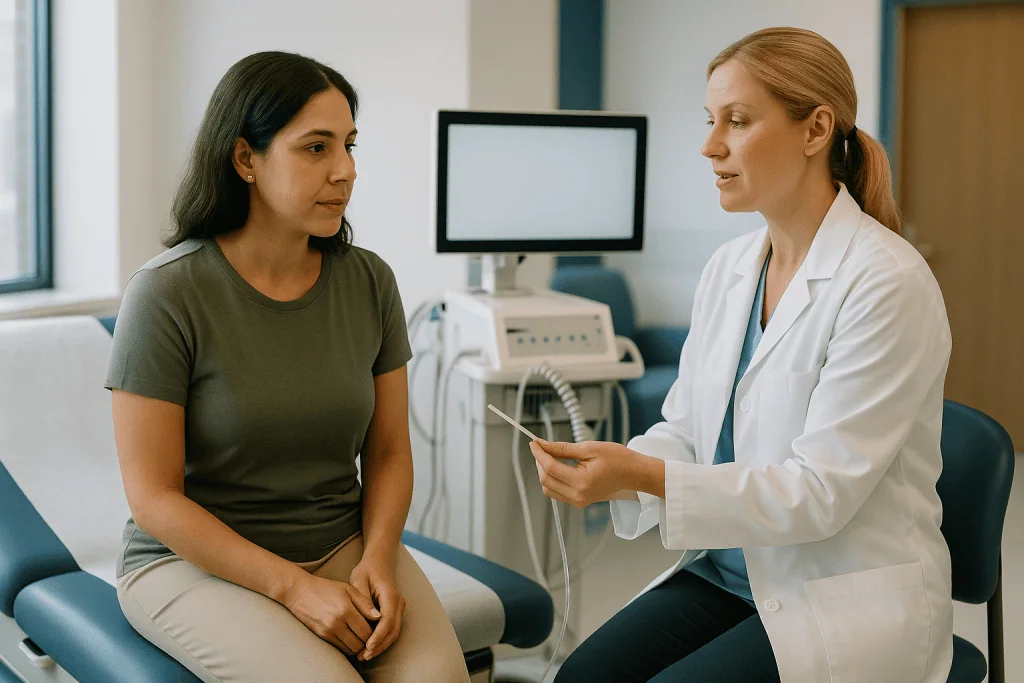
The catheter is about the width of a drinking straw and is lubricated before it is passed gently through the anus into the rectum. At its tip sits a small deflated balloon. Once in position, the technologist asks you to do very little at first: simply rest and breathe while the sensors record baseline pressure. This resting phase captures the internal anal sphincter, the involuntary ring of smooth muscle that provides most of the closing pressure without you thinking about it.
Next come instructions. Squeeze as if holding back gas, and hold it. Squeeze again for as long as you can. Cough. Then bear down as though passing a bowel movement. Each maneuver lights up a different part of the system, and the software plots pressures along the length of the anal canal as a colored map.
The balloon is then inflated in stages with air or water. You are asked to report the first moment you feel something, the moment it feels like an urge, and the point at which you would want it removed. Some labs finish with a balloon expulsion test: a water-filled balloon is placed in the rectum and you are asked to pass it while seated on a commode in private. The catheter slides out easily, and most people dress and leave without any recovery period.
What does the catheter measure during the test?
Every reading on the screen answers a specific question about continence. It helps to know the vocabulary, because the report will use it.
Resting pressure is the closing force of the anal canal when you are doing nothing. It reflects mainly the internal sphincter. Low resting pressure is a common finding in passive leakage, the kind that happens without warning, often after childbirth injury or previous anal surgery.
Squeeze pressure is the extra force you generate on command. It comes from the external anal sphincter and the puborectalis, voluntary muscles you can train. A weak or brief squeeze often accompanies urge incontinence, where you feel the need but cannot hold it long enough.
Squeeze duration measures endurance. A strong squeeze that fades within seconds tells a different story from a modest squeeze that lasts.
The rectoanal inhibitory reflex is the automatic relaxation of the internal sphincter when the rectum stretches. It lets the sensitive upper anal canal sample what has arrived, gas or stool, and it is a nerve-dependent reflex that can be absent in certain conditions.
Rectal sensation is recorded as the balloon volumes at which you first notice, feel urge and reach maximum tolerance. Blunted sensation means stool can arrive unannounced. Heightened sensation, where small volumes provoke urgent need, is common in irritable bowel and after radiation.
The push maneuver watches whether the sphincter relaxes when you bear down. If it tightens instead, the pattern is called dyssynergia, a coordination problem that leaves stool behind and can paradoxically cause leakage later. High-resolution systems display all of this as a pressure map, which is why the report may include an image as well as a table of numbers.
Anorectal manometry results explained: what the numbers mean
A manometry report reads like a lab panel: your value, the laboratory’s normal range, and a comment. Normal ranges differ between systems and between men and women, and they shift with age, so a number that looks low in isolation may be unremarkable for a person in their seventies. This is one reason results are always interpreted alongside your history and, where available, ultrasound images.

Broadly, the report groups findings into patterns. Low resting pressure with a normal squeeze suggests an internal sphincter problem. Low squeeze pressure with normal resting tone suggests external sphincter weakness or nerve injury. Both low together points to a more global weakness. Normal pressures with blunted sensation shifts attention to the rectum and its nerve supply rather than the muscle. Normal pressures with a failed push or a retained balloon suggests that incomplete emptying, not weakness, is driving the leakage.
Absence of the rectoanal inhibitory reflex is a specific finding that prompts further evaluation, and your clinician will explain what it means in your case.
Two cautions matter. First, manometry describes function on one day; a bad night’s sleep, anxiety, or a full rectum can move the numbers. Second, pressures do not map neatly onto symptoms. NIDDK and Mayo Clinic both note that some people with clearly abnormal readings have mild symptoms, while others with near-normal pressures leak frequently because of stool consistency or sensation issues. The report is evidence for a conversation, not a verdict. Ask the clinician to walk through each line with you; a good explanation turns an intimidating page into a map of what can be strengthened, retrained or compensated for.
What does endoanal ultrasound for fecal incontinence show?
Manometry tells you how the muscles perform. Ultrasound shows you the muscles themselves. Endoanal ultrasound uses a narrow probe, inserted a short distance into the anal canal, that sends out sound waves and builds a circular cross-sectional picture of the wall around it. Mayo Clinic describes it as a way of seeing the structure of the sphincters that a physical exam cannot reach.
On the image, the internal sphincter appears as a dark ring and the external sphincter as a brighter ring outside it. A healthy canal looks like a set of concentric circles. When something has gone wrong, the pattern breaks: a gap in the bright ring marks a tear in the external sphincter; a thin or irregular dark ring points to internal sphincter damage; a patch of mixed echoes often represents scar tissue from an old injury or operation.
Childbirth is the classic cause of the defects seen. A tear during delivery may be repaired at the time yet still leave a gap that only becomes symptomatic decades later, when age and menopause reduce muscle reserve. Previous anal surgery, such as procedures for fistula or fissure, is another common source of a visible defect. The scan can also measure sphincter thickness, which helps distinguish a torn muscle from a thinned, degenerated one, a distinction that matters when surgical repair is being weighed.
Some centers use transperineal ultrasound, with the probe held against the skin between the anus and genitals, or MRI instead. Each has trade-offs the radiologist can explain. Whatever the method, the goal is the same: to pair the functional story from manometry with an anatomical one, so that a weak squeeze can be attributed to a torn muscle, a nerve problem or something else.
Manometry vs ultrasound vs other tests: which shows what?
People are often surprised by how many tests can be involved in what feels like a single problem. Each answers a different question, and few patients need all of them. The table below summarizes what your care team may consider, drawing on the diagnostic pathways described by Mayo Clinic and NIDDK.
| Test | What it examines | What it can reveal | Typical experience |
|---|---|---|---|
| Anorectal manometry | Pressure, reflexes, sensation, coordination | Weak or uncoordinated sphincters, blunted or heightened sensation, absent reflex | Thin catheter, balloon inflation, about half an hour |
| Balloon expulsion | Ability to empty | Difficulty passing stool that may cause overflow leakage | Water-filled balloon passed in private |
| Endoanal ultrasound | Sphincter structure | Tears, thinning, scarring | Short probe, a few minutes, no radiation |
| MRI of the pelvis or anal canal | Muscle structure and surrounding pelvic organs | External sphincter atrophy, complex anatomy | Lying still in a scanner |
| Defecography (X-ray or MRI) | Rectum and pelvic floor during a bowel movement | Prolapse, rectocele, incomplete emptying | Contrast paste, seated on a special commode |
| Colonoscopy or sigmoidoscopy | Lining of the bowel | Inflammation, polyps, other causes of urgency | Sedated scope, separate bowel prep |
| Anal electromyography | Nerve supply to the sphincter | Nerve damage as the cause of weakness | Small electrode, brief sensations |
Manometry and ultrasound are usually the pair that begins the specialist work-up because they are quick, do not need sedation and answer the two most fundamental questions: does the muscle work, and is it intact? The others are added only when the history or the first results leave a gap that needs filling.
Is anorectal manometry painful? What it really feels like
The honest answer is that it is uncomfortable in places and awkward throughout, but it is rarely painful. Cleveland Clinic and MedlinePlus both describe the sensations as pressure, fullness and the urge to pass stool, rather than pain. The catheter is thin and lubricated; its passage is usually the moment of most anxiety and least sensation.
The balloon inflation is the part people notice. As it fills, the feeling mimics the need to have a bowel movement, and at the higher volumes it can feel insistent. That is the point. The lab is measuring exactly when your rectum registers those signals, so being asked to describe them is not a test of endurance but a recording of perception. You can ask for the inflation to stop at any time, and stopping does not spoil the study; it simply marks your maximum tolerated volume.
The squeeze and push maneuvers can feel strange because you are doing something private on request, with a catheter in place, while a stranger watches a screen. Technologists who do this all day are matter-of-fact about it, and most patients report that the embarrassment fades within the first minute or two.
Pain during the procedure is unusual and worth mentioning at once. An anal fissure, active hemorrhoids, an abscess or a recent operation can make catheter insertion sore, and the lab may adjust technique or postpone. Sharp pain is not expected and should never be pushed through.
Afterwards, some people feel a mild, brief sense of fullness or pass a little air or water from the balloon. Bleeding, fever or persistent pain are not expected outcomes and should prompt a call, as covered in the final section.
Anorectal manometry preparation: how do you get ready?
Preparation is lighter than for a colonoscopy, and that surprises people. There is no day of clear fluids and no large volume of laxative. The aim is simply an empty rectum so that the catheter and balloon can record accurately rather than register stool.
Cleveland Clinic’s instructions are typical of many labs: a small enema a few hours before the appointment, and a short window without food beforehand. Some centers skip the enema entirely and ask only that you attempt a bowel movement that morning. Follow the sheet you were given rather than a generic version, because protocols differ.
Medicines deserve a specific conversation. Drugs that affect bowel muscle tone or sensation, including some laxatives, anti-diarrheal agents, opioid pain relievers and certain antispasmodics, can alter the readings. That does not mean stopping them; it means asking the ordering clinician whether any adjustment is wanted and, if so, exactly how. Never change a prescribed medicine on your own initiative before the test.
Tell the lab if you have a latex allergy, since some balloons contain latex, and if you have had recent anal surgery, an active fissure, or a pacemaker, which matters for some electromyography equipment. Pregnancy should be disclosed as well.
Practical details make the day easier: wear clothing that is simple to remove, bring a list of your medicines, and consider bringing a change of underwear for peace of mind. No sedation is used, so you can drive yourself and return to normal activities immediately, as Cleveland Clinic notes. Bringing a companion is a personal choice rather than a requirement.
Finally, prepare mentally for the balloon expulsion component if your lab includes it. Knowing you will be left alone to pass the balloon in privacy removes most of the dread.
Who is usually offered these tests, and who is asked to wait?
Most people with fecal incontinence never need manometry. NHS and Mayo Clinic guidance both begin with simpler measures: reviewing diet and fluids, adjusting stool consistency, treating constipation that causes overflow, checking medicines, and teaching a regular bowel routine. When those steps bring control, testing is unnecessary.
Referral for manometry and ultrasound typically follows when leakage persists despite those first-line measures, when a specialist needs to distinguish weakness from sensation loss before recommending pelvic floor physiotherapy with biofeedback, or when surgery is being considered and the surgeon needs to know whether the sphincter is torn, thin or intact. Women with a history of a significant tear during childbirth, people with leakage after anal surgery, and those with neurological conditions affecting the pelvic nerves are common referrals. Manometry is also used to investigate certain childhood constipation patterns, though that is a different pathway.
Some people are asked to wait. A recent flare of inflammatory bowel disease, an active anal fissure or abscess, or an operation in the past several weeks can make the test both uncomfortable and unreliable, so the lab may reschedule until tissues have settled. Ongoing diarrhea from an infection or a new medicine is another reason to pause, because loose stool can overwhelm even normal sphincters and the results would describe the diarrhea rather than the muscle.
Bleeding, weight loss or a change in bowel habit that has not been explained sometimes redirects the order of investigations: a colonoscopy to examine the bowel lining may come first, with manometry afterwards. None of this is a rejection. The sequencing decision rests with the treating team, who are trying to make each test as informative as possible.
What happens if you fail the anorectal manometry test?
Type that question into a search engine and you will find thousands of people worrying about it. It rests on a misunderstanding worth dismantling completely: there is no pass or fail. Manometry is a measurement, not an exam. A low squeeze pressure is information, exactly as an elevated blood pressure reading is information, and neither reflects effort or character.
What people usually mean is one of three things. The first is inability to pass the expulsion balloon. Some people cannot pass it in the lab’s expected time even though they empty adequately at home; the seated position, the artificial setting and the awareness of being timed all play a part. NIDDK notes that this result is interpreted alongside the rest of the study, and a retained balloon with a paradoxical tightening on the push maneuver points toward a coordination problem that responds to retraining rather than to any surgical fix.
The second worry is stopping the balloon inflation early because it became too uncomfortable. That simply records your maximum tolerated volume. A low tolerance is itself a meaningful finding about sensation and rectal capacity.
The third is leaking during the test. It happens, the staff are entirely used to it, and the recording still captures the pressures that matter.
An abnormal result changes the conversation, not your standing. Weakness may lead to a pelvic floor program with biofeedback, in which manometry equipment itself is used to show you your muscles working. A sphincter defect on ultrasound may prompt a surgical opinion. Sensory loss may shift the focus to scheduled emptying. Whatever the pattern, the results belong to you and your care team together, and the plan that follows is a shared decision.
What are the early signs of anorectal issues, and when should you ask about testing?
Fecal incontinence rarely arrives fully formed. Mayo Clinic and NHS describe a gradual pattern in most adults: first, difficulty holding gas; then a small smear on underwear discovered later; then urgency that turns a walk to the restroom into a race. Many people rationalize each stage for years. Studies summarized by NIDDK consistently find that a large share of affected adults never mention it to a clinician, which is why the condition is often called the last taboo of continence care.
Rather than a checklist to diagnose yourself with, it is more useful to notice the shape of the change. Leakage that appears without warning and without urge suggests a passive mechanism. Leakage that follows a strong, unmanageable urge suggests a different one. Leakage of liquid stool after a formed bowel movement often reflects incomplete emptying. Each of these is a clinical clue, and each is a good reason to have a conversation with a primary care clinician rather than a reason to conclude anything on your own.
Timing matters because early management is often simpler. Adjusting fiber and fluids, treating constipation, reviewing medicines and learning a bowel routine are low-burden steps that NHS guidance places first, and they work best before habits and skin problems become entrenched. Testing is appropriate when those steps have not brought control, when the pattern is unusual, or when there is a history of childbirth injury, anal surgery or neurological disease that makes a structural cause likely.
New bleeding, unexplained weight loss, a sudden change in bowel habit or pain should not wait for a trial of dietary changes; those warrant prompt medical assessment, as the final section explains.
What do the days and weeks after testing usually look like?
The immediate aftermath is undramatic. Cleveland Clinic notes that people return to work, driving and normal eating straight away, because nothing has been sedated, cut or dilated. A trace of lubricant and, occasionally, a little water or air from the balloon may be passed over the following hour. Mild, brief soreness at the anus is possible if insertion was awkward. That is the full extent of what most people experience.
The results are usually not given on the spot. A physician reviews the pressure tracings and the ultrasound images, compares them against the lab’s reference ranges and against each other, and writes a report. Depending on the center, that report reaches the referring clinician within days to a few weeks. Ask the technologist, before you leave, how and when you will hear, so that silence does not become a source of worry.
The follow-up appointment is where the tests earn their value. Expect the clinician to explain which mechanism appears to be driving the leakage and to propose a first plan. For many people that is a course of pelvic floor physiotherapy with biofeedback, often spread across several sessions over a few months, alongside stool-consistency measures. For some it is a referral to a colorectal surgeon to discuss options for a sphincter defect. For others, whose pressures and anatomy look normal, attention shifts to diet, medicines and bowel routine, and the tests have usefully ruled out a structural problem.
Repeat manometry is sometimes requested later to measure the effect of a retraining program, and in that setting it doubles as a progress report. Whether and when that happens is the treating team’s call, guided by how your symptoms respond.
What people often get wrong about anorectal testing
Misconceptions cluster around this topic, partly because so few people talk about it. Correcting them is worth a section of its own.
It is like a colonoscopy. No. There is no sedation, no long bowel preparation and no camera inside the colon. The catheter reaches only a few centimeters into the rectum, and the whole visit is roughly half an hour according to Cleveland Clinic.
You can fail it. Covered above, but it bears repeating: a measurement cannot be failed. Abnormal readings guide treatment; they do not judge the patient.
Ultrasound and manometry show the same thing. They are complementary. Ultrasound shows structure; manometry shows function. A person can have a visible tear with adequate pressures, or normal-looking muscles that squeeze weakly because the nerve supply is damaged. Only together do the two tests explain why.
Weak pressures mean surgery. Most people with weak sphincters are offered conservative measures first, including pelvic floor retraining with biofeedback, which NHS and Mayo Clinic describe as a standard early option. Surgery is discussed for selected people, usually where a defined defect is present and other approaches have not brought control.
Incontinence is a normal part of aging. It becomes more common with age, as Mayo Clinic notes, but common is not the same as inevitable or untreatable. Age is a reason to investigate, not to accept.
Only women are affected. Childbirth injury makes women more likely to develop the condition, yet men develop it too, particularly after prostate treatment, anal surgery or neurological disease.
The test hurts. Discomfort, yes; pain, rarely. Anyone with an active fissure or abscess should say so beforehand, and the lab will adapt or defer.
Questions to ask your care team
A test is more useful when you know what it is meant to answer. Bring these questions to the appointment where testing is proposed, and again when the results are discussed. Write the answers down; the details fade quickly.
- Which specific question are you hoping the anorectal manometry test will answer for me: strength, sensation, coordination or something else?
- Will you also arrange an endoanal ultrasound or MRI, and if not, what would make you add one later?
- Do you want me to adjust any of my medicines before the test, and if so, exactly how and for how long?
- What preparation does this particular lab require, and will the balloon expulsion test be part of my study?
- Who will interpret the results, how will I receive them, and roughly when should I expect to hear?
- If the pressures are low, what would the first-line plan usually look like, and how long before we judge whether it is helping?
- If the ultrasound shows a tear, does that automatically mean a surgical conversation, or are there other options first?
- Are there other causes you want to rule out, such as inflammation or a change in the bowel lining, before we attribute my symptoms to the sphincter?
- Could my results be affected by my current bowel pattern, and should the test wait until that has settled?
- What symptoms after the test, or in the coming weeks, would you want me to report straight away?
Notice that several of these questions ask about sequencing and interpretation rather than about the test itself. That is deliberate. The measurements are only as useful as the plan they inform, and clinicians generally welcome patients who want to understand that plan. Every decision about testing, timing and treatment remains with the team looking after you; these questions simply help you take a full part in it.
When to call your doctor
Manometry and endoanal ultrasound are low-risk outpatient tests, and serious complications are uncommon. Even so, certain signs afterwards should prompt a same-day call to the clinic that performed the test or to your usual doctor. Bleeding from the anus that is more than a trace on tissue paper, or that continues beyond the first day, is one. Worsening or persistent anal pain, rather than the mild soreness that fades within hours, is another. A fever, chills, or new swelling and tenderness around the anus could indicate infection and should not be watched at home. Inability to pass urine, or severe abdominal pain, is unexpected after these tests and warrants urgent assessment.
Separate from the tests themselves, some symptoms of the underlying condition need prompt attention regardless of where you are in the investigation. Mayo Clinic and NHS both flag rectal bleeding, dark or black stool, unexplained weight loss, a marked and persistent change in bowel habit, and new severe abdominal or pelvic pain as reasons to seek medical assessment promptly rather than continuing a trial of dietary measures. Sudden loss of bowel control accompanied by numbness in the legs or saddle area, new leg weakness, or loss of bladder control together is a neurological emergency and requires immediate emergency care.
Skin breakdown around the anus from repeated leakage, or a drop in mood and withdrawal from daily life because of the symptoms, are also legitimate reasons to call. Neither is trivial, and both have practical remedies your team can offer.
If you are unsure whether something counts, call anyway. The clinicians who order and perform these tests would far rather field an unnecessary question than miss a preventable problem, and every next step, from reassurance to further investigation, is theirs to guide with you.
Frequently asked questions
What happens if you fail the anorectal manometry test?
You cannot fail it, because it is a measurement rather than an exam. If you could not pass the expulsion balloon, stopped the inflation early, or leaked during the study, each of those becomes part of the record and helps explain your symptoms. Abnormal findings guide the next step, most often pelvic floor retraining, and the plan is agreed with your care team.
Is anorectal manometry painful?
It is usually uncomfortable rather than painful. The thin, lubricated catheter causes pressure, and the inflating balloon produces a feeling of needing to pass stool that becomes insistent at higher volumes. You can ask to stop at any time. Sharp pain is unexpected and should be reported, especially if you have a fissure, hemorrhoids or recent surgery, which the lab needs to know about beforehand.
How do you prepare for an anorectal manometry?
Preparation is light. Most labs ask for a small enema a few hours beforehand and a short period without food, though some simply ask you to try to open your bowels that morning. Follow your own center’s instructions. Ask the ordering clinician whether any medicines should be adjusted, and never change them on your own. No sedation is used, so you can drive afterwards.
What are the early signs of anorectal issues that should prompt a conversation?
Difficulty holding gas, small smears on underwear noticed later, and urgency that is hard to delay are the patterns clinicians most often hear about first. These are reasons to talk to your doctor, not a basis for self-diagnosis. Bleeding, weight loss, a marked change in bowel habit or new pain should be assessed promptly rather than managed with dietary changes alone.
What does endoanal ultrasound for fecal incontinence show that manometry cannot?
Ultrasound shows the structure of the sphincter muscles: whether they are intact, torn, thinned or scarred. Manometry shows only how they perform. A torn external sphincter may still generate reasonable pressure, and an intact-looking muscle may squeeze weakly because of nerve damage. Seeing both function and anatomy lets the team explain why leakage occurs and whether a repairable defect exists.
Can you have anorectal manometry results explained the same day?
Usually not. A physician reviews the pressure tracings, the sensation thresholds and any ultrasound images against reference ranges before writing a report, which then goes to the referring clinician. Turnaround varies by center from days to a few weeks. Ask before you leave how and when you will hear, so that you are not left waiting without knowing what to expect.
How long does the anorectal manometry test take?
Cleveland Clinic describes the visit as taking about 30 minutes, including positioning, explanation and the recording itself. If a balloon expulsion test is included, a little extra time is needed for you to attempt it in private. There is no recovery period, and people generally leave straight afterwards and continue their normal day.
Does a low squeeze pressure mean I need surgery?
Not by itself. Low squeeze pressure indicates weakness of the voluntary sphincter and pelvic floor, and the usual first response is a retraining program with biofeedback alongside measures to firm stool. Surgery is generally discussed for selected people, typically when ultrasound shows a defined defect and conservative approaches have not brought control. That decision sits with your treating team.
Is anorectal manometry used for constipation as well as incontinence?
Yes. The same test detects dyssynergia, where the sphincter tightens instead of relaxing during a push, and it is also used to check the rectoanal inhibitory reflex in certain childhood constipation evaluations. In adults with incontinence, identifying incomplete emptying matters because retained stool can later leak, so a coordination problem may be the real driver of what looks like weakness.
Who should not have anorectal manometry right now?
The lab may postpone if you have an active anal fissure or abscess, recent anal or rectal surgery, a flare of inflammatory bowel disease, or ongoing diarrhea from infection or a new medicine, because results would be uncomfortable to obtain and hard to interpret. Unexplained bleeding or weight loss may mean a colonoscopy is arranged first. Timing is decided by your care team.
References
- NIH NIDDK: Diagnosis of Bowel Control Problems (Fecal Incontinence)
- NHS: Bowel incontinence
- MedlinePlus: Bowel incontinence
This article is for general information only and is not a substitute for professional medical advice. Please consult a qualified doctor about your individual situation.

More from the Blog

Bowel Prep Before Robotic Colorectal Surgery: Colonoscopy, Blood Thinners and the Day Before
Bowel prep before colorectal surgery usually means a colonoscopy to confirm and mark the site, a clear-liquid day with an osmotic laxative and often…

Why Does Your Shoulder Hurt After Robotic Gallbladder Surgery? Gas Pain and Relief
Shoulder pain after robotic gallbladder surgery is usually referred pain from carbon dioxide gas used to inflate the abdomen. The gas irritates the diaphragm,…

Why Might Pain Continue After Gallbladder Removal? Retained Stones and What Comes Next
Pain that persists or returns months after gallbladder removal is usually not caused by the surgery itself. Common explanations include a stone left behind…

Preparing for Hepatopancreatobiliary Surgery: Scans, Blood Thinners and Diabetes Medicines
Preparing for liver, pancreas or bile duct surgery usually involves detailed contrast scans to map the anatomy, blood tests and a fitness assessment, and…

Managing Pain After Hemorrhoidectomy: Sitz Baths, Anesthesia Choices and the First Week
Pain after hemorrhoidectomy is expected because the wounds sit in nerve-rich skin at the anal opening, and it usually peaks in the first two…

Fecal Incontinence Treatment Ladder: Diet and Pelvic Floor Therapy Before Any Surgery
Fecal incontinence treatment options usually follow a stepped ladder. Most people start with diet changes, fiber adjustment, a regular toilet routine and, where needed,…