

What Does an Aphasia Assessment Test? Speaking, Understanding, Reading and Writing

Key Takeaways
- An aphasia assessment measures four separate channels, speaking, understanding, reading, and writing, because each can be damaged independently.
- Aphasia does not affect intelligence; a person who cannot produce a word may understand everything said about them, and testing documents that for the whole team.
- Fluent aphasia means speech that flows easily but carries little reliable meaning, usually with reduced comprehension, while Broca's aphasia produces short, effortful phrases with comprehension largely intact.
- Screening tests flag the need for a fuller evaluation in the first days; comprehensive batteries and functional measures build the therapy plan once the person is medically stable.
- Recovery after stroke is typically fastest in the first few months, and the NIDCD notes that symptoms lasting beyond two to three months are less likely to resolve completely, though gains can continue for years.
- Bringing hearing aids and glasses, and letting the person struggle without prompting, are the two most useful things a family member can do to keep results accurate.
An aphasia assessment is a structured evaluation, usually led by a speech-language pathologist, that tests four language channels: speaking (fluency, naming, repetition), understanding spoken language, reading, and writing. It also checks everyday communication and rules out problems such as hearing loss or muscle weakness. Results describe the type and severity of aphasia, guide therapy, and give a baseline for tracking recovery after stroke or brain injury.
The coffee is exactly how she likes it, and she cannot tell him so. Four days after a stroke, a retired music teacher looks at the cup, looks at her husband, and produces a word that is almost “thank” but lands somewhere else. He understands anyway. The therapist who arrives at ten with a folder of pictures and a notepad understands too, but she needs more than a guess. She needs to know which parts of language survived, which are wounded, and which are simply hidden behind fatigue.
That is what an aphasia assessment is for. Families often imagine a pass-or-fail exam. In practice it is closer to a detailed map: where can words still get in, where can they get out, and which routes are blocked? The answers shape everything that follows, from how the family speaks to her tonight to how therapy is built over the coming weeks.
Here is what actually gets tested, why each task exists, and what the results can and cannot tell you.
What is an aphasia assessment and why does it happen so early?
Aphasia is a language disorder caused by damage to the parts of the brain that handle words, most often the left hemisphere. It affects the ability to speak, understand, read, or write, in any combination, while intelligence itself is not the problem. The National Institute on Deafness and Other Communication Disorders (NIDCD) estimates that about 1 million people in the United States live with aphasia and roughly 180,000 acquire it each year, mostly after stroke.
An aphasia assessment is the formal process of measuring which language abilities are affected and how severely. It answers three practical questions. Is this aphasia at all, or something that resembles it, such as confusion, hearing loss, or weakness of the speech muscles? If it is aphasia, what pattern does it follow? And how do we know, in three weeks, whether things are moving?
The timing matters because language recovery after stroke is fastest in the first weeks and months, according to both the NIDCD and Mayo Clinic. A baseline taken early lets the team see real change rather than rely on memory or hope. It also protects the person from being misjudged. Someone who cannot say “yes” reliably may still understand every word spoken about them, and an assessment is how that gets documented in the chart for every nurse, doctor, and relative who follows.
Assessments are not one-off events. A brief screen may happen within a day of admission, a fuller evaluation once the person is medically stable, and repeat measures at intervals during rehabilitation. Each version asks a slightly different question, which is why the tools differ so much in length and depth.
How is aphasia diagnosed, and who carries out the testing?
Diagnosis is a team effort. A doctor, often a neurologist, establishes what caused the brain injury and orders imaging. A speech-language pathologist (SLP), sometimes called a speech and language therapist, carries out the detailed language testing and interprets it. The NHS describes this as the usual route: a therapist assesses speech, comprehension, reading, and writing, and combines that with the medical picture.
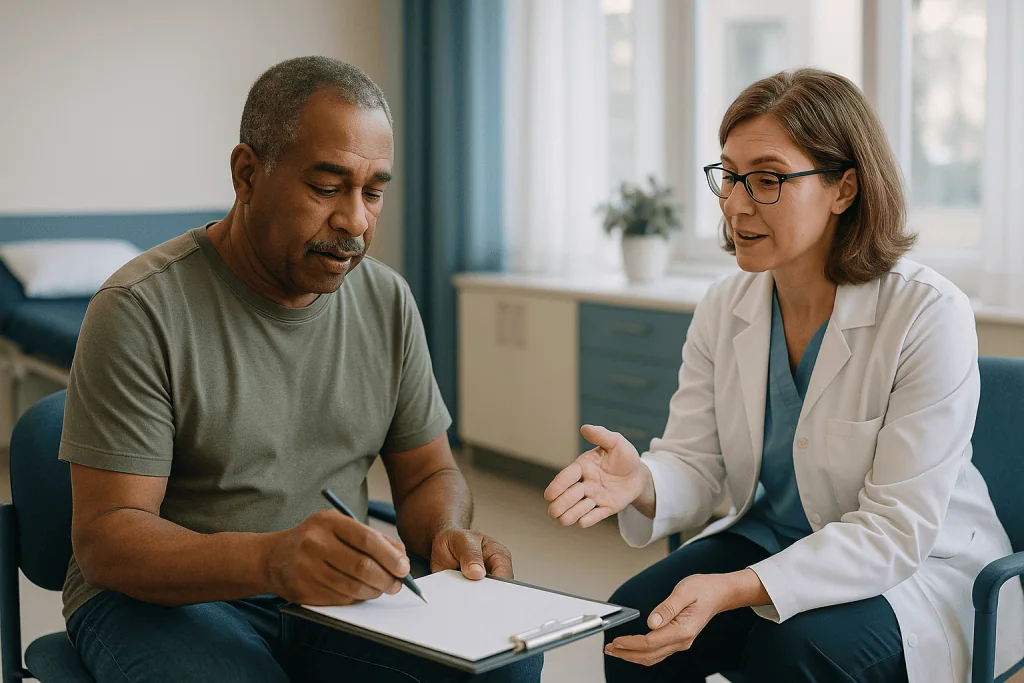
The SLP starts before the formal test opens. Watching how the person greets them, whether they turn toward speech, how they handle a simple social exchange, and whether they try to gesture all provide clues. A short conversation about something ordinary, such as what happened that morning, is itself a test of connected speech: word-finding, grammar, and how effortful talking looks.
Only then do the structured tasks begin. The clinician may use a published battery, a screening tool, or a set of informal tasks chosen to fit the person’s energy and medical state. Someone two days after a stroke, on a ward, may manage fifteen minutes. Someone in outpatient rehabilitation may be tested across more than one session so fatigue does not distort the picture.
Other specialists contribute. An audiologist may check hearing if there is any doubt, because a person who cannot hear instructions will fail comprehension tasks for the wrong reason. An occupational therapist may assess whether hand weakness, rather than language, explains poor writing. A neuropsychologist may test memory and attention when the pattern of errors looks broader than language alone. Mayo Clinic notes that this layered approach helps distinguish aphasia from conditions that mimic it, including dysarthria (weak or uncoordinated speech muscles) and apraxia of speech (difficulty planning the movements for speech).
What actually happens during an aphasia assessment, step by step
Most evaluations follow a recognizable arc, even when the specific tool differs.
The clinician begins with history: the person’s dominant hand, education, languages spoken, prior hearing or vision problems, and what communication looked like before the injury. A bilingual person, for example, may show different patterns in each language, and the SLP needs to know which one was strongest.
Next comes spontaneous speech. The person is asked open questions or shown a picture of a busy scene and invited to describe it. The clinician listens for rate, pauses, grammar, word substitutions, and whether the speech carries meaning.
Then the tasks narrow. In naming, the person identifies pictured objects or actions. In repetition, they repeat words and sentences of rising length. In comprehension, they point to named pictures, answer yes-or-no questions, and follow spoken commands that grow more complex. Reading tasks move from matching a written word to a picture, through reading aloud, to answering questions about a short passage. Writing moves from signing a name to copying, writing to dictation, and composing a sentence.
Throughout, the clinician notes not only whether an answer is right but how it goes wrong. Saying “spoon” for “fork” is a different error from saying “forp,” and both differ from silence. Errors are data.
The session usually ends with the clinician explaining, in plain words and often with the family present, what they observed. According to Mayo Clinic, the goal of testing is to identify which abilities are affected and how, so the plan that follows fits the actual person rather than a textbook category. The written report typically includes scores, a description of strengths, and recommended therapy goals.
Testing speaking: fluency, naming, and repetition
Speech gets the most attention because it is what families notice first, and because it splits aphasia into two broad groups.

Fluency describes the flow of speech, not its accuracy. The clinician judges whether phrases run to a normal length, whether grammar words such as “the” and “is” appear, and whether talking looks effortful. Halting, telegraphic speech with mostly nouns points toward nonfluent aphasia. Long, easy-sounding sentences that drift or contain invented words point toward fluent aphasia.
Naming is tested with pictures, questions (“What do you use to cut paper?”), and sometimes by asking the person to list as many animals as they can in a set time. Trouble finding words is called anomia, and the NIDCD describes it as the most common feature across all aphasia types. The SLP notes what helps: does the first sound of the word unlock it? Does a written version? These clues become therapy strategies.
Repetition is quietly one of the most informative tasks. The person is asked to repeat single words, then phrases, then a sentence with unusual word order. Repetition depends on a specific pathway connecting the hearing and speaking regions of the brain. When comprehension and spontaneous speech are relatively spared but repetition fails, the pattern suggests a particular lesion location, a finding that is described in standard references from Johns Hopkins Medicine and Cleveland Clinic.
The clinician also separates language errors from motor ones. A person with dysarthria slurs consistently and knows exactly what they mean. A person with apraxia of speech gropes for the right mouth position, often producing different errors each attempt. A person with aphasia may say a clearly articulated but wrong word. Each needs different therapy, and this is where careful listening earns its place.
Testing understanding: what "comprehension tasks" really measure
Understanding is harder to see from the outside, which is why it is so often misjudged. A person who nods politely may be following nothing. A person who cannot answer may be following everything.
Comprehension testing starts simple and climbs. Single words come first: the person hears “cup” and points to it among several pictures. Yes-or-no questions follow, some obvious (“Is your name Robert?”) and some requiring knowledge (“Does snow fall in summer?”). Then commands lengthen: “Point to the door,” then “Point to the window and then the ceiling,” then “Before touching your nose, tap the table twice.” Each step adds words to hold in mind and grammar to unpack.
Some tests use colored shapes rather than everyday objects so that no real-world knowledge can help; only pure decoding of the sentence counts. This isolates grammatical understanding from guessing based on context. Others read a short paragraph aloud and ask questions about it, testing whether meaning survives across several sentences.
The clinician controls for other explanations. Hearing is checked or confirmed. Instructions are given without helpful gestures or eye movements that might cue the answer. Fatigue is watched, because comprehension often fades before the person reports being tired.
Why does this level of detail matter? Because it directly changes how everyone around the person should communicate. The NHS advises that people supporting someone with aphasia use short sentences, one idea at a time, and allow extra time to respond. An assessment tells the family how short and how slow. Someone who reliably understands three-word commands but loses longer ones can be included in conversations that are shaped to that level, rather than excluded from them.
Testing reading and writing: the parts people forget to ask about
Reading and writing are language, and they can be damaged separately from speech. A person may speak reasonably well yet be unable to read a menu, or read fine but be unable to write a shopping list. The NIDCD lists reading and writing difficulty as core features of aphasia, alongside speaking and understanding, which is why any complete aphasia assessment covers them.
Reading tasks begin with recognition: matching a printed word to a picture or a spoken word to its written form. They progress to reading aloud, where the clinician listens for whether the person sounds words out letter by letter, guesses from the shape of the word, or substitutes related words (“dog” for “cat”). Reading a sentence and choosing the matching picture tests whether grammar survives on the page. A short passage with questions checks whether meaning holds across paragraphs.
Writing tasks start with the person’s own name and signature, then copying letters and words, then writing to dictation, then writing a description of a picture. The clinician separates spelling errors (a language problem) from illegible strokes (a motor problem, especially when the dominant hand is weak). Many people are asked to write with their non-dominant hand after a stroke, and the assessment accounts for that.
Numbers may be included too: reading a clock, writing a phone number, or doing a simple written sum. These matter for safety and independence in ways that are easy to overlook on a ward.
Findings here shape practical advice. If reading single words is preserved, written key words can support conversation. If writing is stronger than speech, a notepad becomes a communication tool. Mayo Clinic notes that identifying such relative strengths is part of building a realistic therapy plan.
Aphasia screening test vs. comprehensive battery: which tools are used?
People searching “what assessments are used for aphasia” find a long list of names. The names matter less than the categories. Broadly, tools fall into screeners, comprehensive batteries, focused tests, and functional measures.
Screeners are short and designed for the bedside in the first days. They flag whether a fuller evaluation is needed. Several stroke-unit protocols also include a language item within a broader neurological scale, such as the National Institutes of Health Stroke Scale, which the American Heart Association references in acute stroke care.
Comprehensive batteries take longer, sometimes across sessions, and produce a profile across all four language channels plus a severity rating and, in some, a suggested aphasia type. Widely used examples include the Western Aphasia Battery–Revised, the Boston Diagnostic Aphasia Examination, and the Comprehensive Aphasia Test. Focused tests zoom in on one skill, such as the Boston Naming Test for word retrieval or the Token Test for comprehension of commands.
Functional measures ask a different question: how does this person actually communicate in daily life, with gestures, writing, and partner support included?
| Tool type | Typical setting | What it covers | Main purpose |
|---|---|---|---|
| Screening test | Acute ward, first days | Brief checks of speech, comprehension, naming | Decide whether full assessment is needed |
| Comprehensive battery | Rehabilitation, once stable | All four channels; severity; often a type | Baseline, therapy planning, tracking change |
| Focused test | Any | One skill in depth (e.g., naming) | Pinpoint a target for therapy |
| Functional measure | Rehabilitation, community | Real-life communication with all strategies | Judge everyday impact and goals |
No single tool is “best.” The clinician chooses based on the person’s stamina, the setting, and what decision the result must support.
What the results mean: Broca's, fluent vs nonfluent aphasia, and other types
Once the profile is complete, the clinician often describes it using classic labels. These are useful shorthand, though the NIDCD and Cleveland Clinic both caution that many people do not fit neatly into one category, and labels can shift as recovery unfolds.
Broca’s aphasia, a form of nonfluent aphasia, is marked by short, effortful phrases with grammar words dropped: “walk dog” for “I will take the dog for a walk.” Comprehension is relatively preserved, so the person usually knows what they want to say and is aware of errors, which can be deeply frustrating. Weakness of the right arm or leg often accompanies it, because the responsible brain region sits near motor areas.
Wernicke’s aphasia is the best-known fluent aphasia. Speech flows easily with normal rhythm, but sentences may not make sense and may include invented words. Understanding is significantly impaired, and the person may not realize their speech is unclear. So when people ask “what is fluent aphasia,” the honest answer is: speech that sounds effortless but carries little reliable meaning, paired with reduced comprehension.
Global aphasia involves severe difficulty across all channels and typically follows large strokes. Anomic aphasia is milder: grammar and comprehension are largely intact, but finding specific words, especially nouns, is a constant struggle. Conduction aphasia shows the repetition failure described earlier.
Primary progressive aphasia is different in kind. It is a gradual language decline caused by neurodegenerative disease rather than a sudden injury, and Johns Hopkins Medicine describes it as requiring separate diagnostic pathways, including detailed imaging and sometimes cognitive testing over time.
The label is less important than the profile beneath it. Two people with “Broca’s aphasia” may need very different therapy depending on how much reading, writing, and naming survived.
Who is usually assessed, and who is asked to wait?
Anyone with a sudden change in language after a stroke, head injury, brain tumor, or brain infection is a candidate for assessment. The NHS notes that aphasia is a common consequence of stroke, and most stroke units aim to screen communication early because it affects safety, consent, and swallowing evaluations.
Assessment is also appropriate when language decline is gradual. A person who has increasingly struggled to find words over a year, without a stroke, may be referred to rule out or characterize primary progressive aphasia. Here the SLP evaluation sits alongside neurology and imaging, and the picture may take longer to become clear.
Some people are asked to wait, and the reasons are usually medical rather than dismissive.
- Someone drowsy, medically unstable, or with fluctuating alertness cannot give a reliable performance; results would understate their true ability.
- A person in the first hours after a stroke may still be undergoing urgent treatment; a brief bedside screen may happen, but a full battery is deferred.
- Untreated hearing or vision problems are addressed first when possible, because they distort comprehension and reading scores.
- When delirium (acute confusion) is present, the team usually waits for it to settle, since delirium can mimic aphasia and clear on its own.
Waiting is not the same as doing nothing. Nurses and family can still use simple communication strategies, and the SLP may offer informal observation until formal testing makes sense.
Children with acquired language loss, for example after a head injury or epilepsy surgery, are assessed with age-adjusted tools and with parents present. The core principle is the same: measure what is preserved, not only what is lost, and repeat the measurement over time. The treating team decides on timing.
Brain scans and other tests that sit alongside the language evaluation
Language testing shows what the brain can do. Imaging shows where the injury is. Both are needed, and they answer different questions.
A CT scan, which uses X-rays to build a cross-sectional image of the brain, is usually done first in suspected stroke because it is fast and shows bleeding clearly. An MRI, which uses magnetic fields and radio waves, gives finer detail and can reveal smaller strokes or changes in specific language regions. Mayo Clinic lists both as standard steps in evaluating aphasia, particularly to confirm the cause and its location.
Why does location matter for a language test? Because it helps the team interpret the pattern. A stroke near the front of the left hemisphere makes nonfluent aphasia likely and lets the clinician anticipate co-occurring arm weakness. Damage further back predicts comprehension problems. Imaging does not replace the language assessment, though. Two people with similar-looking scans can have very different abilities, and the plan is built on the abilities.
Other tests may be added. Blood work checks for infection, metabolic problems, or clotting issues that might explain or complicate the picture. An electroencephalogram (EEG), which records the brain’s electrical activity, is sometimes used when seizures are suspected, because some seizures cause temporary language loss that resolves within hours. Hearing tests confirm that comprehension failures are not simply unheard words.
When the cause is progressive rather than sudden, the workup broadens. Johns Hopkins Medicine describes evaluation for primary progressive aphasia as including neurological examination, detailed imaging, and neuropsychological testing to see whether memory and other thinking skills are also affected. Cleveland Clinic notes that identifying the underlying cause guides which treatments, if any, address the disease itself, while speech-language therapy addresses the communication effects regardless of cause.
How long does aphasia last? What the days and weeks after assessment usually look like
This is the question every family asks, and honesty matters more than comfort here.
After a stroke, some early language problems improve substantially within days as swelling settles and the brain’s blood flow stabilizes. The NIDCD reports that most people show some degree of spontaneous recovery, and that this recovery is typically most rapid in the first few months. The same source notes that when aphasia symptoms persist beyond two or three months after a stroke, complete resolution becomes less likely, though many people continue to make meaningful gains for years, particularly with therapy. Mayo Clinic offers a similar summary: improvement can continue over a long period, and the pace differs widely between individuals.
What shapes the trajectory? Cause, size and location of the injury, age, general health, and the intensity of rehabilitation all contribute, according to the NIDCD. Aphasia after a transient ischemic attack or a small stroke often resolves quickly; aphasia from a large hemorrhage or from a progressive disease does not follow that curve.
The weeks after an initial assessment usually look like this. Therapy begins once the person is medically stable, sometimes on the ward, sometimes after discharge. Sessions target the specific weaknesses the assessment found, using the strengths it uncovered as scaffolding. Family members are coached in supported conversation. Reassessment happens at intervals, often using the same tool so that changes in score are comparable.
Nobody can promise a timeline, and an assessment does not predict the future with precision. What it provides is a starting point and a way to see movement. A change from pointing to one picture out of four to pointing to three out of four is progress that would otherwise be invisible in the noise of daily life. The treating team interprets those changes and adjusts the plan.
What people often get wrong about aphasia and its assessment
Misunderstandings about aphasia cause real harm, because they change how people are treated at the bedside and at the dinner table.
The first error is equating aphasia with lost intelligence. Aphasia is a disorder of language, not of thinking. The NIDCD is explicit that it does not affect intelligence. A person who cannot produce the word “daughter” still knows exactly who is holding their hand. Assessment results should be read as a description of communication channels, never as a measure of the mind behind them.
The second is assuming that speaking louder helps. Aphasia is not deafness. Slower speech, shorter sentences, one question at a time, and patience help; volume does not.
The third is believing that a fluent speaker must understand well. In Wernicke’s-type aphasia, speech flows while comprehension is significantly impaired. Families are often reassured by the easy talking and then confused by responses that miss the point. The assessment exists partly to catch this.
The fourth is treating the aphasia type as fixed. Profiles change, sometimes quickly, in the early weeks. A label given on day three may not fit by week six. Repeat assessment is how the team keeps up.
The fifth is the idea that testing itself is a hurdle to pass, and that a low score means therapy is pointless. The opposite is true. The score identifies where to work and, crucially, which strengths remain. Someone with severe speech loss but preserved reading has a route into communication that a careful test will find.
The last is assuming the person is unaware. Many people with nonfluent aphasia are painfully aware of every error. Speaking about them as if they are absent, or finishing every sentence for them, is felt. The assessment report often includes guidance on this, and it is worth asking for.
How to prepare, and how family can help without skewing the results
There is little a person needs to do before an aphasia assessment, but a few things make it more accurate and less exhausting.
Bring glasses and hearing aids if they are used. A surprising number of “comprehension failures” on the ward turn out to be a hearing aid left in a bedside drawer. Reading and writing tasks are meaningless without the right glasses.
Tell the clinician about the person’s background: education, occupation, languages, handedness, and any prior reading difficulty such as dyslexia. Someone who never wrote much before a stroke should not be judged against a standard that assumes daily writing. Bilingual speakers may perform differently in each language, and the SLP may test in both or arrange an interpreter.
Choose the time of day thoughtfully when there is any choice. Fatigue reduces scores in every channel, and many people are sharpest in the morning after rest. If a full battery is planned, ask whether it can be split across sessions.
During the testing itself, family members are often welcome, but with a specific role: observe rather than help. Supplying the word, nodding toward the right picture, or repeating the instruction in a different way will make the results look better than reality and lead to a plan that does not fit. The kindest thing a relative can do in the room is sit quietly and let the person struggle a little, then ask questions afterward.
Afterward, ask for the findings in plain language and for concrete communication tips. The NHS recommends strategies such as keeping sentences short, using gestures and pictures, and giving time to respond; the assessment tells you which of these will matter most for this person. Write the tips down and share them with everyone who visits, including the nurse on the night shift.
Questions to ask your care team after the aphasia assessment
A good report is only useful if the people living with it understand it. These questions turn scores into a plan.
- Which of the four channels, speaking, understanding, reading, and writing, is strongest right now, and how can we use it?
- What kind of aphasia does this pattern suggest, and how confident are you that the label fits?
- Did you rule out hearing loss, vision problems, dysarthria, or apraxia of speech as alternative explanations for any of the results?
- How should we speak at home: how many words per sentence, how long to wait for a reply, whether to offer choices or open questions?
- Are there errors we should correct, or should we let conversation flow and save correction for therapy?
- When will the assessment be repeated, and will the same tool be used so we can compare?
- What does therapy target first, and how often will sessions happen?
- Is the person safe to make their own medical decisions, and how will consent be supported?
- Can we have a written summary of communication strategies to share with other visitors and caregivers?
- Are there signs of change, better or worse, that should prompt us to contact you before the next scheduled review?
One question deserves special attention: how the assessment relates to swallowing. Speech-language pathologists frequently evaluate both, and families sometimes assume that a language test has also cleared eating and drinking. It has not; swallowing is assessed separately.
Ask also about mood. Depression is common after stroke and can flatten performance on any test, and a person who cannot easily describe their feelings may show them in withdrawal instead. The team can screen for this and address it. Every decision about therapy, timing, and next steps rests with the treating clinicians, and these questions help you take part in those decisions rather than watch them from outside.
When to call your doctor: red-flag signs during and after aphasia recovery
Aphasia itself is usually the result of an event that has already happened. What matters is spotting a new event or a complication early.
Call emergency services immediately, do not wait for a scheduled appointment, if any of these appear suddenly: new or abruptly worsening difficulty speaking or understanding; drooping on one side of the face; weakness or numbness in an arm or leg; sudden confusion, severe headache unlike previous ones, trouble seeing, dizziness, or loss of balance. The American Heart Association and CDC describe these as warning signs of stroke, and a person who has had one stroke is at higher risk of another. Time lost is brain lost; call first, then think.
Contact the care team promptly, the same day where possible, for the following:
- Language that was improving and then clearly steps backward over a day or two without an obvious cause such as illness or exhaustion.
- New trouble swallowing, coughing during meals, or a wet-sounding voice after eating or drinking, which can signal aspiration risk.
- Episodes of staring, unresponsiveness, or brief loss of language that come and go, which may indicate seizures.
- Fever, chest symptoms, or a sudden decline in alertness, since infection is common after stroke and can worsen communication temporarily.
- Signs of low mood that persist, withdrawal from family, or any expression, verbal or otherwise, of hopelessness.
Gradual, slow decline in language over months in someone who never had a stroke also deserves a doctor’s visit, since it can point to a progressive condition that benefits from earlier evaluation, as Johns Hopkins Medicine describes.
Families should never feel they are overreacting. A quick phone call that turns out to be nothing costs little. A missed second stroke costs a great deal. The treating team would rather hear from you.
Frequently asked questions
What assessments are used for aphasia?
Clinicians use screening tools for a quick bedside check, comprehensive batteries such as the Western Aphasia Battery–Revised, the Boston Diagnostic Aphasia Examination, or the Comprehensive Aphasia Test for a full profile, focused tests such as the Boston Naming Test for single skills, and functional measures that rate real-life communication. The choice depends on the setting, the person’s stamina, and which decision the result needs to support. A speech-language pathologist usually selects and interprets them.
How is aphasia diagnosed?
Aphasia is diagnosed by combining a medical evaluation, usually including a CT or MRI scan to identify the brain injury, with a structured language assessment by a speech-language pathologist. The language testing covers speaking, understanding, reading, and writing and rules out lookalikes such as hearing loss, dysarthria, or confusion. Mayo Clinic and the NHS describe this joint approach as the standard route; the treating team confirms the diagnosis and its cause.
How long does aphasia last?
It varies enormously. After a stroke, some language problems improve within days or weeks, and the NIDCD notes recovery is usually fastest in the first few months. When symptoms persist beyond two or three months, complete resolution becomes less likely, but many people continue to improve for years, especially with therapy. Aphasia from progressive brain disease follows a different course. No assessment can promise a timeline; it provides a baseline to track change.
What are the signs and symptoms of Broca's aphasia?
Broca’s aphasia is a nonfluent type marked by short, effortful phrases that drop grammar words, so “want water now” replaces a full sentence. Understanding is relatively preserved, and the person is usually aware of errors, which can be frustrating. Repetition and naming are impaired, and writing often mirrors speech. Weakness on the right side of the body frequently accompanies it because the affected brain region lies near motor areas.
What is fluent aphasia?
Fluent aphasia describes speech that flows at a normal rate and rhythm but carries little reliable meaning, often including wrong words or invented ones. Wernicke’s aphasia is the classic example, and comprehension is significantly impaired, so the person may not recognize that their speech is unclear. This contrasts with nonfluent aphasia, where speech is halting but understanding is better. The distinction between fluent vs nonfluent aphasia is one of the first judgments a clinician makes.
Is an aphasia screening test the same as a full assessment?
No. A screening test is brief, designed for the bedside in the first days after a stroke or injury, and answers one question: does this person need a fuller evaluation? A comprehensive assessment takes longer, sometimes across several sessions, and produces a detailed profile of speaking, understanding, reading, and writing, along with severity and therapy targets. Both have a role, and most people receive a screen first and a full assessment once medically stable.
Can an aphasia assessment be wrong?
Results can misrepresent ability if the person is fatigued, drowsy, in pain, missing hearing aids or glasses, or tested in a language that was not their strongest. Delirium and depression can also lower scores. That is why clinicians check these factors, note the conditions of testing, and repeat assessments over time rather than relying on a single snapshot. If you believe a result understated someone’s ability, tell the team; reassessment is routine.
Does aphasia mean a person has lost intelligence or memory?
No. Aphasia is a language disorder, and the NIDCD states it does not affect intelligence. Memory and reasoning can be intact even when words are hard to find or understand. Some people do have additional cognitive changes from the same brain injury, which is why a neuropsychologist may be asked to test memory and attention separately. Assessment results describe communication channels, not the mind behind them.
What happens in a speech therapy evaluation for aphasia after the first assessment?
A speech therapy evaluation for aphasia builds on the baseline by identifying specific therapy goals, such as improving naming of everyday objects, following two-step commands, or using writing to support conversation. The therapist tests which cues help, for example the first sound of a word or a written prompt, and coaches family members in supported communication. Progress is re-measured at intervals, often with the same tool so scores can be compared directly.
Can aphasia get worse after it has improved?
Sudden worsening should always be treated as an emergency, because it may signal a new stroke or a seizure; call emergency services rather than waiting. Temporary dips can occur with infection, exhaustion, dehydration, or low mood and often settle once the cause is treated. Gradual decline over months in someone without a stroke may point to a progressive condition and warrants prompt medical review. The treating team should hear about any clear backward step.
References
- Aphasia: National Institute on Deafness and Other Communication Disorders (NIH)
- Aphasia: Diagnosis: NHS
- Aphasia: Cleveland Clinic
- Aphasia: MedlinePlus (NIH)
This article is for general information only and is not a substitute for professional medical advice. Please consult a qualified doctor about your individual situation.

More from the Blog

Second Opinions in Neurodegenerative Diseases: When a Diagnosis Deserves Another Look
A neurodegenerative disease second opinion is a fresh review of your history, examination and test results by another neurologist, often one who focuses on…

Neuroinfectious Diseases Treatment: How Meningitis and Encephalitis Care Is Planned
A meningitis encephalitis treatment plan starts within minutes of suspicion, usually before tests confirm the cause. Doctors give intravenous antibiotics, and often an antiviral,…

Who May Be a Candidate for Peripheral Nerve Surgery? Injury, Compression and Tumor Cases
Peripheral nerve surgery is considered for three groups: people with a nerve that has been cut, torn or crushed and shows no sign of…

Can You Keep Working With Multiple Sclerosis? Fatigue, Heat and Pacing Strategies Explained
Many people with multiple sclerosis continue working, often for years, though the path varies with symptoms, job demands and disease course. Fatigue and heat…

Can Home and Work Routines Be Adapted in Motor Neuron Disease? Mobility Aids, Meals and Rest
Yes. Most people with motor neuron disease can adapt home and work routines for a considerable time by pacing activity, changing how meals are…

Questions to Ask Before Agreeing to a Cerebrovascular Disease Treatment Plan
Before agreeing to a cerebrovascular disease treatment plan, ask what the imaging showed (clot, bleed, narrowing or small vessel damage), why this option was…