

What Does Hearing Sound Like With a Cochlear Implant? Realistic Expectations After Activation
Key Takeaways
- A cochlear implant bypasses damaged hair cells and stimulates the auditory nerve electrically, which is why it can help when hearing aids cannot and why it sounds different from natural hearing.
- Mechanical, tinny, or high-pitched voices at activation are the expected starting point, not a sign of device failure, and they typically shift toward a more natural register over weeks to months.
- Activation usually occurs two to six weeks after surgery, according to Mayo Clinic, with the first settings deliberately kept gentle and raised at follow-up mapping visits.
- Environmental sounds and familiar voices in quiet are usually understood first; speech in background noise and melody in music remain the hardest for most users.
- Daily wearing time and structured listening practice are the strongest factors within a person's control, because the brain, not the hardware, does most of the learning.
- Loss of residual natural hearing, temporary balance disturbance, changes in tinnitus, and rare infection including meningitis are recognized risks that belong in every informed-consent conversation.
A cochlear implant does not restore natural hearing. At activation, most people describe sound as mechanical, tinny, or cartoon-like, with voices that are hard to tell apart. Because the device stimulates the hearing nerve directly with a limited set of electrodes, the brain must learn to interpret a new signal. Over weeks to months of daily use and listening practice, speech typically becomes clearer and more natural, though experiences vary widely.
The audiologist clicks a button, and a man who has not heard his wife’s voice in eleven years turns toward her. His face does not light up. It scrunches. “You sound like a duck,” he says, and the room laughs a little too loudly, because everyone had hoped for something else.
That scene, or a version of it, plays out in hearing clinics every week. People arrive at activation carrying two things: the memory of how hearing used to feel and a mental picture of the viral video where someone weeps with joy. Neither prepares them for the actual experience. If you are asking what does a cochlear implant sound like, the honest answer is that it starts strange and changes over time, and the strangeness is not a sign that something went wrong.
This explainer walks through the first day, the first weeks, and the slower months that follow, using what the published evidence and major medical bodies actually say about that journey.
What does a cochlear implant sound like on the very first day?
Ask a dozen newly activated adults and you will get a dozen answers, but the same handful of words keep surfacing: beeps, chipmunks, robots, a kazoo, someone speaking through a tin can. MedlinePlus notes that sounds through the device may seem mechanical or robotic at first, and the National Institute on Deafness and Other Communication Disorders (NIDCD) is direct that hearing through an implant is different from normal hearing and takes time to learn or relearn.
What surprises people most is not the pitch of voices but the loss of distinction. A refrigerator hum, a spouse’s question, and a door closing can all arrive as variations on the same buzzing texture. Some people cannot tell whether the person in front of them is speaking or just moving. Others hear rhythm before they hear words: they know a sentence has ended because the beeping stopped.
A smaller group hears recognizable speech within hours. This tends to happen in adults who lost hearing recently and whose auditory memory is fresh, though no clinic can promise it, and audiologists are usually careful not to. The variation is enormous and largely unpredictable at the individual level.
The first fitting is also deliberately conservative. Audiologists typically set stimulation levels lower than the eventual target, because a nerve that has been quiet for years can find full input overwhelming. What you hear on day one is therefore a muted, incomplete version of what the device will eventually deliver once the settings are adjusted over subsequent visits.
Put plainly: the first day is a calibration, not a verdict. Whatever you hear in that room says very little about where you will be in six months.
How a cochlear implant actually works, in plain language
Normal hearing depends on the cochlea, a snail-shaped organ in the inner ear lined with thousands of hair cells. These cells convert vibrations into electrical signals that travel along the auditory nerve, the cable connecting the ear to the brain. In most severe sensorineural hearing loss, those hair cells are damaged or gone, and no amount of amplification can wake them up.
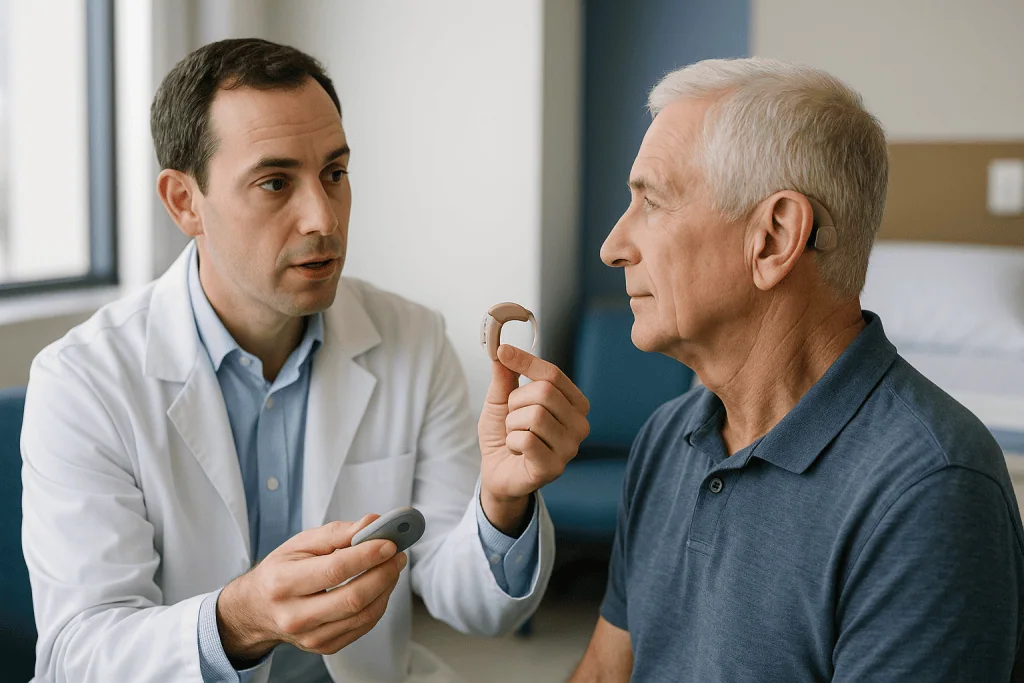
A cochlear implant skips the damaged cells entirely. According to the NIDCD, the system has two parts. An external sound processor, worn behind the ear or on the head, captures sound with a microphone, converts it into digital code, and sends it through the skin to an internal receiver. The internal part, placed under the skin during surgery, passes those signals to an electrode array, a thin flexible wire threaded into the cochlea. Each electrode stimulates a section of the auditory nerve directly.
The elegance and the limitation live in the same fact. The cochlea normally sorts sound by pitch along its spiral, high tones near the entrance and low tones deeper in. An electrode array mimics that map, but with a small number of contact points standing in for thousands of hair cells. Imagine repainting a photograph using only a few dozen colors. The shape is right. The gradations are coarse.
Surgery itself is usually a couple of hours under general anesthesia, and Johns Hopkins Medicine describes most patients going home the same day or after one night. The implant stays switched off while the incision heals. Mayo Clinic notes activation typically happens two to six weeks later, when the audiologist connects the processor for the first time and begins setting the electrical levels, a process called mapping or programming.
Everything you subsequently hear is the brain interpreting that coarse electrical map, which is why the brain, not the hardware, determines most of the outcome.
Do cochlear implants sound robotic, and why?
The robot description is so common it has become a cliché in implant forums, and it has a real physiological explanation rather than being a quirk of expectation.
Natural pitch perception relies on fine detail: the precise place in the cochlea that fires and the exact timing of nerve impulses. An implant delivers a simplified envelope of the sound, the rise and fall of loudness within a handful of frequency bands, and drops much of the fine structure. The result preserves rhythm and the broad outline of speech while flattening the subtle harmonics that make a voice sound warm or a friend sound like themselves. Harmonic richness is what separates a cello from a synthesizer, and it is precisely what a new implant user hears least.
There is also a mismatch problem. The electrode array rarely sits at exactly the position where the brain expects a given frequency to arrive. A sound the processor labels as middle-range may stimulate a nerve region that, in the person’s memory, used to signal something higher. Early on, this shifts every voice upward, which is why so many people report chipmunks, Mickey Mouse, or helium.
The encouraging part is that the shift does not stay put. The brain is remarkably willing to remap. With consistent daily wear, most adults report that voices settle toward a more natural register over weeks to months, though NIDCD is careful to say this learning period varies widely and some adaptation continues for a year or longer. Audiologists also fine-tune the frequency allocation at follow-up visits, nudging the map closer to what the brain expects.
So yes, cochlear implants often sound robotic at first. The word most experienced users reach for later is not robotic but different, and many eventually stop noticing the difference at all in ordinary conversation.
What cochlear implant activation day usually involves
Activation is quieter and more technical than the internet suggests. Expect a long appointment, often an hour or two, spent mostly watching a screen while an audiologist works through each electrode.
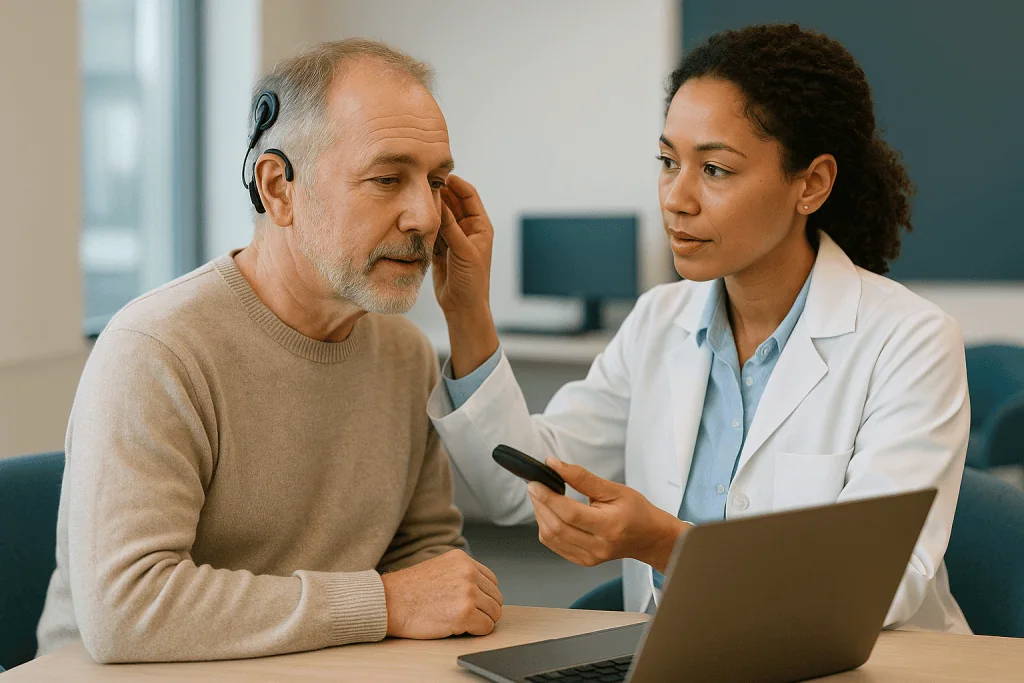
The audiologist first checks that the internal device is communicating with the processor. Then comes the part that feels like a hearing test in reverse. Each electrode is stimulated individually, and you report when you first sense something and when it becomes comfortably loud. Early sensations are frequently not sound at all. People describe a tickle, a pressure, a faint buzz somewhere behind the ear. That is normal; the brain has not yet decided to file these signals under hearing.
Once the levels are set, the audiologist switches on the microphone and speaks. This is the moment the videos capture, and it is also the moment expectations collide with physiology. Some people hear a voice. Many hear a pattern of beeps that changes when lips move. A few hear nothing recognizable for the first several minutes and then, quite suddenly, realize that the beeping has a cadence.
You will typically leave with the processor programmed at a gentle starting point, instructions on wearing it during all waking hours, and a series of return visits scheduled over the following weeks and months. Cleveland Clinic describes this as an ongoing process rather than a single fitting: settings are adjusted repeatedly as the nerve and brain adapt.
Practical details matter on this day. Bring a companion whose voice you know well, because familiar voices are easier to interpret than a stranger’s. Bring realistic expectations, because disappointment on activation day is common and does not predict the long-term result. Many audiologists explicitly warn against comparing your first hour with anyone else’s highlight reel, and that warning is grounded in how variable early responses are.
The weeks after activation: how the sound typically changes
The most useful mental model for the first months is not recovery, which implies returning to a previous state, but acquisition, like learning to read a new script. Progress is rarely linear.
In the first week or two, many people describe exhaustion. Listening takes conscious effort, and the brain is working hard to sort meaningful signal from noise. Household sounds that had disappeared from awareness, a clock ticking, a dishwasher cycling, water in the pipes, arrive loudly and all at once. Some users find this thrilling; others find it intrusive and need to take breaks. Both reactions are ordinary.
Follow-up mapping visits, often clustered in the first month and then spaced out, raise the stimulation levels as tolerance grows. Each adjustment can briefly make things sound strange again before they settle. NIDCD notes that learning to interpret the signals takes time and practice, and that the process continues well beyond the early appointments.
A rough pattern many clinicians describe, without promising it to any individual, runs like this: environmental sounds become identifiable first, then the rhythm and some vowels of familiar speech, then consonants and unfamiliar voices, then speech in quieter settings without lipreading. Speech in background noise and appreciation of music tend to come last and remain the hardest for most users.
The single strongest predictor of steady progress within a person’s control is wearing time. A processor used for ten waking hours a day gives the brain far more material to learn from than one worn for two. Audiologists also generally recommend structured listening practice, which the next sections cover, because passive exposure alone tends to be slower.
Plateaus happen. So do sudden leaps, sometimes months in. Neither should be read as the final word.
Cochlear implant vs hearing aid: what is different about the sound
People with long experience of hearing aids often assume an implant is simply a more powerful version of the same thing. It is not, and the difference explains a great deal about the adjustment.
A hearing aid amplifies sound acoustically and delivers it through whatever hair cells remain. The signal is louder but still processed by the natural cochlea, so it retains natural pitch structure. A cochlear implant bypasses the cochlea’s hair cells and stimulates the nerve electrically, which is why it can help when hearing aids no longer provide benefit, and also why it sounds fundamentally different.
| Feature | Hearing aid | Cochlear implant |
|---|---|---|
| How sound reaches the nerve | Amplified acoustic sound through remaining hair cells | Direct electrical stimulation of the auditory nerve |
| Typical candidates | Mild to severe hearing loss | Severe to profound loss with limited hearing-aid benefit |
| Initial sound quality | Natural pitch, louder | Mechanical or tinny at first; improves with adaptation |
| Surgery required | No | Yes, under general anesthesia |
| Learning period | Days to weeks | Weeks to months, sometimes longer |
| Effect on natural hearing in that ear | None | Residual hearing may be reduced or lost |
Two consequences follow. First, a person who does well with hearing aids is usually not an implant candidate, because the trade in sound quality would not be worth the surgery. Second, someone who moves from a hearing aid to an implant should expect an initial step backward in how natural things sound before the longer-term gain in clarity emerges.
Many people use a hearing aid in the non-implanted ear alongside the implant. Mayo Clinic describes this bimodal arrangement as common, and users often report that the acoustic ear supplies warmth and pitch while the implanted ear supplies clarity, the two blending over time into a single percept.
Who a cochlear implant is usually for, and who is usually asked to wait
The World Health Organization estimates that more than 5% of the world’s population lives with disabling hearing loss, yet only a fraction of that group are implant candidates. Candidacy is a clinical judgment made by a team, typically an ear surgeon and an audiologist, and it rests on more than an audiogram.
Mayo Clinic describes the usual profile: severe to profound sensorineural hearing loss in one or both ears, limited benefit from appropriately fitted hearing aids after a proper trial, and no medical condition that makes surgery unsafe. A key test measures how well someone understands sentences with hearing aids in place; people scoring poorly on that test despite good amplification are the ones most likely to be considered.
Motivation matters as much as measurement. The NIDCD emphasizes that success depends on rehabilitation and consistent use, so teams look for realistic expectations and willingness to attend follow-ups and practice listening. A person expecting natural hearing on day one is often counseled at length before any decision.
Children are assessed differently. For those born deaf, early implantation is generally preferred because the brain’s capacity to learn spoken language is greatest in the first years of life, and NIDCD notes that children who receive implants early tend to develop language skills closer to their hearing peers. Assessment involves audiology, imaging, and often speech and language and developmental specialists.
Who is asked to wait? Someone whose hearing aids still deliver good speech understanding. Someone with an active middle-ear infection until it clears. Someone whose imaging shows an anatomical reason the electrode cannot be placed, or whose auditory nerve is absent, since the device needs a nerve to stimulate. Someone with an unstable medical condition that makes anesthesia unwise for now.
None of these is a permanent no. Hearing changes, and candidacy is revisited. That decision, in every case, sits with the treating team.
What does a cochlear implant sound like in noisy places?
If the quiet clinic room is the honeymoon, the restaurant is the reality check. Nearly every implant user, including those who understand speech well one-to-one, describes background noise as the last and hardest frontier.
The reason traces back to the coarse map. Normal hearing separates competing voices partly by their fine pitch structure, the way you can pick out a friend’s timbre across a crowded room. An implant strips much of that fine structure away, so two voices overlapping tend to blur into one wash of electrical stimulation. Add clattering plates and a ventilation hum, and the brain has far less to grip.
Modern processors include features designed to help: directional microphones that favor sound from the front, noise-reduction algorithms that dampen steady background hum, and wireless connections to remote microphones or phones. These are engineering aids, not solutions, and the evidence for their benefit varies by setting. Your audiologist can explain what your particular processor offers without any of this being a recommendation for one system over another.
Strategies that consistently help are older than the technology. Sit with your back to the wall so noise comes from one direction. Choose a seat where you can see faces, because lipreading remains a powerful supplement even for skilled users. Ask companions to take turns rather than talk over one another. Pick restaurants with soft furnishings over hard, echoing rooms.
Expect fatigue. Following conversation in noise is effortful for anyone with hearing loss, and NHS guidance on hearing loss acknowledges the social and emotional toll of that effort. Building in quiet breaks is a strategy, not a failure.
Over months, many users report that noise tolerance improves as the brain learns to prioritize speech. It rarely reaches the ease of natural hearing, and honest counseling says so up front.
Cochlear implant music perception: what to realistically expect
Music is where the gap between electrical and natural hearing is widest, and it is the area where realistic expectations matter most, because disappointment here can be sharp.
Rhythm survives well. The processor tracks changes in loudness over time with reasonable fidelity, so a drumbeat or a marching band comes through recognizably. Pitch is another matter. Melody depends on fine frequency differences, often a few percent between adjacent notes, and an implant with a limited set of electrodes cannot resolve steps that small. Two neighboring notes may stimulate the same electrode and sound identical. Harmony, which layers several pitches at once, suffers further.
The practical result, described by many users, is that familiar songs are recognized by their rhythm and lyrics rather than their tune, that instruments blend into a single texture, and that complex orchestral music can sound like noise. Simpler arrangements with a clear vocal line and sparse accompaniment tend to fare better than dense productions.
Timbre, the quality that distinguishes a flute from a violin playing the same note, is partly preserved through the pattern of loudness across electrodes, so some instrument identification does return with practice.
Does it improve? Evidence suggests that dedicated music listening practice can sharpen pitch and instrument discrimination over time, though the ceiling is real and varies between individuals. Research is ongoing into processing strategies that preserve more fine structure, and NIDCD describes music perception as an active area of investigation rather than a solved problem.
Musicians and devoted listeners often grieve this loss, and that grief deserves acknowledgment rather than a pep talk. Some rediscover pleasure in music through new routes: live performance where sight adds information, songs learned before hearing loss whose memory fills in the tune, or simply the rhythm and lyrics of a favorite record. Others decide music is not where the implant earns its keep, and that conversation remains the point.
What happens to your natural hearing, balance, and tinnitus
Inserting an electrode into the cochlea is not a neutral act for whatever natural hearing remains in that ear, and this is one of the first things a surgeon should raise.
Mayo Clinic lists loss of residual hearing, meaning any natural hearing still present in the implanted ear, as a recognized risk. Surgical techniques aimed at preserving that hearing exist, and some people retain low-frequency acoustic hearing alongside electrical stimulation, but preservation cannot be guaranteed. For most candidates the trade is acceptable because the remaining hearing was not useful for speech, yet it is a trade, and it should be named as one.
Balance can be affected. The inner ear houses both the cochlea and the vestibular organs that sense head movement, and they share fluid and nerves. Mayo Clinic notes dizziness or balance problems as possible after surgery. For most people these settle over days to weeks, and clinicians ask about balance at follow-up specifically because it can be missed.
Tinnitus, the perception of ringing or buzzing without an external source, moves in either direction. Many people with severe hearing loss already have it, and a good number report it fades when the processor is on and the nerve is receiving real input. A minority find tinnitus worsens after surgery. Mayo Clinic lists both outcomes as possible, and no one can predict which way an individual will go.
Other recognized risks include infection, facial nerve weakness because that nerve runs close to the surgical route, taste disturbance from a small nerve near the ear, and device failure requiring revision. Mayo Clinic also flags meningitis, and the CDC recommends that implant recipients keep pneumococcal vaccinations current for that reason. Your surgeon will discuss which vaccinations apply to you.
None of this is fear; it is the standard content of informed consent, delivered so the decision belongs to you and your team.
Why rehabilitation matters more than the hardware
Here is the opinion this article is most willing to defend: the electrode array is the smaller half of the story. The larger half is what you do with the signal in the months afterward.
NIDCD is explicit that hearing with an implant requires learning, and Cleveland Clinic describes auditory rehabilitation, structured practice in interpreting sound, as part of the standard pathway rather than an optional extra. The brain has spent years or decades either receiving no input from that ear or receiving a fading acoustic version. It now has to build a new dictionary linking electrical patterns to meaning, and dictionaries are built through repetition.
Effective practice tends to share a few features. It uses material with immediate feedback, such as listening to an audiobook while following the printed text, so the brain can check its guesses. It begins with familiar voices and simple content and adds difficulty gradually. It happens daily in short sessions rather than in occasional marathons. And it deliberately includes situations the person actually needs: a partner’s voice across the kitchen, a colleague on the phone, announcements in a station.
Speech and language therapists and audiologists can supply structured programs, and many people also use self-directed exercises with app-based training or recorded materials. What they have in common is active attention. Sitting in a room with the television on is exposure; trying to identify each word of a news bulletin is training.
Family involvement changes outcomes in ways that are hard to measure but easy to observe. A household that speaks facing the implant user, one at a time, at a normal pace, provides hundreds of teaching moments a day. One that shouts from other rooms provides confusion.
Children need this even more, and their rehabilitation is typically woven into speech and language therapy and educational support over years.
What people often get wrong about cochlear implant sound
Several beliefs circulate widely enough to deserve direct correction.
“It restores normal hearing.” It does not. The NIDCD states plainly that an implant does not restore normal hearing but provides a useful representation of sound. Users who expect a return to their pre-loss experience are the most likely to be disappointed; those who expect a new and learnable form of hearing tend to adjust better.
“The activation video is typical.” Viral clips show the emotional outliers, usually adults with recent hearing loss and strong auditory memory. The more common first reaction is puzzlement or a flat “that’s weird.” Neither reaction predicts the eventual result.
“If it sounds bad on day one, the surgery failed.” Mechanical, tinny, or high-pitched sound at activation is the expected starting point, not a malfunction. Device problems are checked electronically by the audiologist and are uncommon; strange sound quality alone is not evidence of one.
“Once it’s programmed, you’re done.” Mapping continues over many visits as the nerve and brain adapt, and Cleveland Clinic describes ongoing adjustment as routine. Skipping follow-ups leaves the device running on settings designed for an earlier version of your hearing.
“You can’t have an MRI.” An MRI is a scan using strong magnets. Many current implants are compatible with MRI under specific conditions, but requirements differ between devices and scanner strengths. Always tell imaging staff you have an implant; the manufacturer’s guidance and your surgeon determine what is safe.
“Older adults don’t benefit.” Age alone is not a barrier in major candidacy guidance. Duration of deafness and general health matter more than the number on a birth certificate, and many people are implanted in later life.
“It works the same in both ears.” Two implants can differ in sound quality, and a second ear implanted after years without input may take longer to adapt. That is expected rather than alarming.
Questions to ask your care team before and after activation
A good implant team welcomes questions, and the quality of your questions shapes the quality of your preparation. These are the ones experienced users most often wish they had asked earlier.
Before surgery, ask what the team expects for your individual situation given how long you have had hearing loss and how much auditory memory you likely retain, and ask them to be honest about the range rather than the best case. Ask whether any natural hearing in the ear is likely to be preserved and whether the surgical approach is designed to try. Ask which ear is proposed and why, and whether a hearing aid in the other ear is planned. Ask what vaccinations are recommended beforehand and how far ahead.
About activation, ask when it is scheduled and how many follow-up mapping visits are typical in the first year, so you can plan work and travel. Ask who to contact between visits if something feels wrong, and how quickly they respond. Ask what rehabilitation resources the team offers or can point you toward, and whether a speech and language therapist is part of the pathway.
About daily life, ask about MRI compatibility of your specific device and what documentation you should carry. Ask about water, sports, and airport security. Ask how the external processor is powered, how long batteries or charges typically last, and what happens if the external part is lost or damaged.
About the long term, ask how the internal device is monitored, what signs would suggest a problem, and what revision surgery would involve if it were ever needed. Ask how the team handles processor upgrades as technology changes, since the internal part is designed to last many years while external components evolve.
Write the answers down. Activation day is overwhelming, and memory of what was said tends to be poor.
When to call your doctor: red flags after cochlear implant surgery and activation
Most recovery after implant surgery is uneventful, and most oddities of early hearing are simply the brain learning. A short list of signs, however, should prompt a call to your surgical team or audiologist rather than a wait-and-see approach.
Contact your team the same day for redness, swelling, warmth, or discharge at the incision or over the internal device, or for fever after surgery, because these can indicate infection. Sudden severe or worsening pain at the surgical site also warrants a call.
Seek urgent care immediately for a stiff neck, severe headache, high fever, confusion, or sensitivity to light, especially in combination. Mayo Clinic lists meningitis, an infection of the membranes around the brain, as a rare but serious complication, and it needs emergency assessment.
Report new weakness or drooping on the operated side of the face promptly. The facial nerve passes close to the surgical route, and any change in facial movement should be assessed.
Tell your team about clear watery fluid leaking from the ear or nose, dizziness that is severe or does not settle, or a spinning sensation that arrives suddenly. Ongoing imbalance beyond the first few weeks is also worth reporting.
On the device side, call your audiologist if sound stops entirely, becomes painfully loud or distorted without warning, or if you feel electrical sensations elsewhere, such as twitching in the face or a tickle in the throat when the processor is on. These can indicate a programming issue or, rarely, electrode contact outside the cochlea, and they are checked electronically rather than guessed at.
A sudden drop in how well you understand speech after a period of steady progress should also be reported. Fluctuation is normal; a marked, persistent decline is worth investigating.
When uncertain, call. Implant teams expect these calls and would rather hear from you unnecessarily than late.
Frequently asked questions
What does a cochlear implant sound like compared to normal hearing?
It sounds coarser and less richly pitched than natural hearing, especially at first. The implant conveys the rhythm and rough shape of sound well but drops much of the fine harmonic detail that makes voices warm and music melodic. Over time the brain learns to interpret this simplified signal, and many users describe speech becoming clear and familiar, even though it never becomes identical to natural hearing.
Do cochlear implants sound robotic forever?
Usually not. The robotic or chipmunk quality at activation comes from the brain receiving an unfamiliar electrical pattern and from a mismatch between where electrodes sit and where the brain expects each pitch. With consistent daily wear and follow-up programming, most adults report voices settling toward a more natural sound over weeks to months, though the pace and endpoint vary widely between individuals.
What happens on cochlear implant activation day?
The audiologist connects the external processor, tests each electrode individually to find comfortable stimulation levels, then switches on the microphone. Early sensations may feel like tickles or buzzes rather than sound. Most people leave with conservative settings, instructions to wear the device all waking hours, and several follow-up appointments scheduled to adjust the programming as the brain adapts.
How long does it take to understand speech with a cochlear implant?
There is no fixed timeline. The NIDCD says learning to interpret the implant’s signals takes time and varies from person to person. Some adults with recent hearing loss understand speech within days; others need many months of practice. Environmental sounds and familiar voices in quiet typically come first, followed by unfamiliar voices, with speech in noise arriving last.
Cochlear implant vs hearing aid: which sounds more natural?
A hearing aid sounds more natural because it amplifies sound acoustically through the remaining hair cells, preserving natural pitch. A cochlear implant stimulates the nerve electrically and sounds mechanical at first. Implants are considered only when hearing aids no longer provide adequate speech understanding, so the comparison is between a natural-sounding signal that is too unclear to use and a strange-sounding signal that can become clear.
Is cochlear implant music perception ever good?
Rhythm and lyrics usually come through well; melody and harmony are harder because the limited electrode array cannot resolve small pitch differences. Many users recognize songs by their beat and words rather than their tune. Dedicated music practice can improve instrument and pitch discrimination for some people, but honest counseling acknowledges that music is generally the area where implants fall furthest short of natural hearing.
Will a cochlear implant make my tinnitus better or worse?
It can go either way. Many people find tinnitus fades when the processor is switched on and the auditory nerve receives real input. A minority report tinnitus worsening after surgery. Mayo Clinic lists both possibilities among recognized outcomes, and no test currently predicts which an individual will experience. Report any significant change to your care team.
Why does everything sound loud and overwhelming after activation?
The brain has spent years without input from that ear and has stopped filtering out background sounds. When the implant delivers clocks, pipes, and dishwashers all at once, it has not yet learned which to ignore. This settles for most people over weeks as attention recalibrates. Taking short listening breaks is a reasonable strategy, and your audiologist can adjust settings if loudness is uncomfortable.
Can I have an MRI with a cochlear implant?
Often yes, but under conditions specific to your device. An MRI uses strong magnets, and implant magnets can interact with the scanner. Many current implants are approved for MRI at certain scanner strengths, sometimes with precautions. Always tell imaging staff about your implant, carry your device documentation, and let your surgeon and the manufacturer’s guidance determine what is safe for you.
Does the sound keep improving after the first year?
For many users, yes, though gains slow. Most rapid change happens in the first months, but the NIDCD notes adaptation can continue for a year or longer, and users often describe subtle improvements in noise tolerance and voice recognition well beyond that. Continued daily wear, periodic mapping visits, and occasional structured practice support this ongoing adjustment.
References
- Cochlear Implants: National Institute on Deafness and Other Communication Disorders (NIH)
- Cochlear implant: MedlinePlus Medical Encyclopedia
- Cochlear Implants: Cleveland Clinic
- Deafness and hearing loss: World Health Organization
This article is for general information only and is not a substitute for professional medical advice. Please consult a qualified doctor about your individual situation.

More from the Blog

When Does Vertigo Need an ENT Specialist Rather Than Waiting for It to Pass?
See a doctor promptly for any first episode of vertigo, and seek same-day or emergency care if spinning arrives with a severe new headache,…
When Is Earwax Build Up a Job for an ENT Specialist Rather Than Ear Drops?
Most earwax build up clears on its own or with a few days of softening ear drops, so an ENT is not the first…
After an Intratympanic Steroid Injection: Ear Fullness, Dizziness and What to Report
After an intratympanic steroid injection, most people notice temporary ear fullness, muffled hearing and brief dizziness that settle within hours to a few days,…

Living With an Implantable Hearing Aid: Swimming, Skin Care Around the Post and Daily Use
Living with an implantable hearing aid usually means a short daily routine: the external sound processor comes off before swimming, bathing or sleeping, and…

Flying and Pressure Changes After Stapedectomy Surgery: What International Patients Ask
Most surgeons ask patients to avoid flying after stapedectomy for a period of weeks, not days, because cabin pressure changes stress the healing eardrum…

Mastoid Surgery Recovery: Dressings, Ear Drops and When Dizziness and Fullness Settle
Mastoidectomy recovery usually means a padded head dressing for the first day or so, dissolvable or removable packing in the ear canal for several…