

What Happens at a Contact Lens Fitting: Tear Film Checks, Trial Lenses and Wear Rules

Key Takeaways
- A contact lens fitting adds corneal curvature and diameter measurements, tear film testing, trial lenses and a follow-up check that a glasses exam does not include.
- The power on a glasses prescription often differs from the power needed in a contact lens because the contact sits directly on the cornea rather than half an inch in front of it.
- The CDC reports that about one in three wearers sleep or nap in lenses, a habit that raises the risk of serious corneal infection several-fold.
- Tap water, showers and pools can carry Acanthamoeba, an organism that causes a painful corneal infection, which is why lenses should never touch water.
- A well-fitting soft lens moves a small, consistent amount with each blink; a lens that does not move at all may be too tight and can starve the cornea of oxygen.
- Lens cases should be replaced at least every three months and solution should never be topped off, according to CDC care guidance.
A contact lens fitting appointment is a separate visit, or an add-on to an eye exam, in which an eye care professional measures the curve and size of your cornea, checks your tear film, chooses trial lenses, examines how they sit and move on the eye, teaches insertion and removal, and sets wear and replacement rules before finalizing a prescription at a follow-up check.
The receptionist asks the question that stops most first-timers short: “Is this for glasses, or do you want to be fitted for contacts too?” The person at the desk was expecting to read letters off a chart and leave with a prescription. Instead they learn that contacts add a whole second layer to the visit, with its own measurements, a pair of trial lenses, and a lesson in touching your own eye.
That reaction is reasonable. A contact lens fitting appointment looks, from the outside, like a formality. In practice it is where the fitter decides whether a thin disc of plastic can safely sit on the clear front window of your eye for ten or twelve hours a day, and which disc that should be.
Here is what actually happens in the chair, why the tear tests matter more than most people expect, and which wear rules protect your sight.
What a contact lens fitting appointment actually is, and why it is separate from an eye exam
A routine eye exam answers two questions: how well do you see, and is the eye healthy? The refraction, the part where lenses click in and out in front of you, produces a glasses prescription. That number describes the lens power your eye needs when the lens sits about half an inch in front of it, in a frame.
A contact lens sits directly on the cornea, the clear dome at the front of the eye, floating on a thin layer of tears. That changes almost everything. The power often needs adjusting because the lens is closer to the eye. The lens also has a physical shape that must match yours: a curve, a diameter, a thickness, a material that lets oxygen through. None of those are part of a glasses prescription.
So the contact lens fitting appointment is the bridge between “what power do you need” and “what specific lens will your eye tolerate.” It adds measurements of the corneal surface, an assessment of the tear film, a period of wearing trial lenses, and a re-check once the eye has settled. Because these are distinct clinical tasks, offices in the US usually list and bill them separately from the exam itself.
Eye care bodies in the US treat contact lenses as medical devices that require a valid prescription written specifically for contacts. The National Eye Institute, part of the NIH, describes contacts as safe when they are prescribed and cared for properly, and unsafe when they are not. The fitting is where that “prescribed properly” part happens.
A useful way to think about it: the eye exam tells the fitter what your eye needs. The fitting tests whether a particular lens delivers it without harming the surface it rests on.
Do you really need a contact lens fitting?
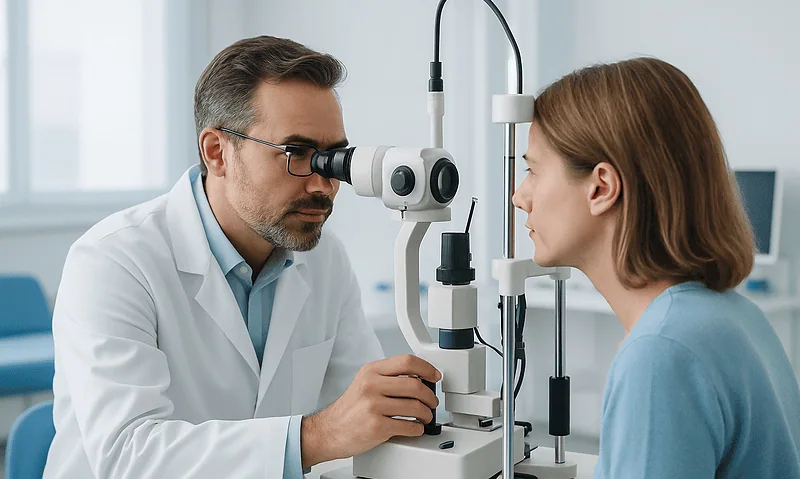
Yes, and the reason is anatomical rather than bureaucratic. Corneas are not all the same shape. The front surface varies in curvature from person to person, and a lens that is too flat for a given cornea will slide and edge into the white of the eye, while one that is too steep can grip the surface, trap debris underneath and starve the tissue of oxygen. Neither problem is visible to the wearer in a mirror. Both are obvious to a fitter looking through a slit lamp, the bright microscope on an arm that lets a clinician see the eye’s surface in fine detail.
People sometimes ask whether they can simply order lenses in their glasses power. Two things go wrong. First, the power is often different. A glasses lens sits away from the eye, so the number on that prescription would land slightly off when transferred to the cornea, particularly at higher powers. Second, and more seriously, a lens bought without a fit check may be the wrong curve. The person may see reasonably well and feel fine for weeks while the cornea beneath is quietly swelling or developing fine blood vessels at its edge in response to low oxygen.
The CDC notes that contact lenses are prescription devices in the US and that buying them without a prescription, including decorative or costume lenses, raises the risk of eye infection and injury. Those cautions exist because clinicians have seen the outcomes.
A fitting also protects people who turn out not to be good candidates right now: someone with an undiagnosed dry eye condition, an allergic reaction on the inner eyelid, or a cornea with an irregular shape. Finding that out in the chair is far better than finding it out after a week of sore, red eyes.
What happens at a contact lens fitting appointment, step by step
The sequence varies a little between practices, but most fittings follow a recognizable arc, and knowing it takes the strangeness out of the visit.
It opens with conversation. The fitter asks how you plan to use lenses: all day at a screen, only for sports, weekends only, or to replace glasses entirely. They ask about allergies, dry or watery eyes, medications that can dry the surface, past lens experience, and your work environment. Someone who spends eight hours under air conditioning or in a dusty workshop needs a different plan from someone who wants lenses twice a week for the gym.
Next come the measurements. A keratometer or a corneal topographer maps the curvature of the cornea; the fitter also measures the visible diameter of the cornea and often the size of the pupil in normal and dim light. Then the tear film is assessed, usually with a dye and the slit lamp, sometimes with a paper strip that wicks tears from the lower lid.
With those numbers, the fitter selects a trial lens. It goes on, you blink, and after a few minutes the fitter examines it under magnification: how much it moves with each blink, whether it centers over the pupil, whether the edge lifts or digs in. A quick vision check with the lens in confirms the power is close.
If you are new to lenses, a staff member then teaches you to insert, remove and handle them, and does not sign off until you can do it independently. You leave with trial lenses, written care instructions and a follow-up date. The final prescription is typically written only after that follow-up, once the fitter has seen how your eye responded to real-world wear.
Why the tear film check matters so much
Every contact lens rides on tears. The tear film is a layered coating, a fraction of a millimeter thick, made of an oily outer layer that slows evaporation, a watery middle layer, and a mucus-like inner layer that helps the whole thing cling to the eye. A soft lens sits inside that coating, drinking from it, and the layer left on top of the lens is what keeps the eyelid gliding and the vision sharp.
If the film is thin or unstable, the lens dries, vision blurs late in the day, the eye feels gritty and the lid drags. That is the single most common reason people abandon contacts, so fitters test for it before they choose a lens.
Two tests are common. In one, a drop of orange dye is placed in the eye and the fitter watches, under blue light, how quickly dry patches appear on the surface after a blink; the longer the film holds, the more stable it is. Mayo Clinic describes this tear break-up assessment, along with the Schirmer test, in which a small strip of paper rests under the lower lid for a set time to measure how much tear volume is produced. The fitter also looks at the lid margins, where tiny oil glands can become blocked, and checks the surface for dry spots that take up dye.
None of this rules you out automatically. A borderline tear film often shifts the choice toward a daily disposable lens, a material that holds water differently, or a shorter recommended wear time. Sometimes the fitter suggests treating the dryness first and fitting later. Mayo Clinic lists contact lens wear itself among the factors that can aggravate dry eye symptoms, which is exactly why the check comes before the lens, not after the complaint.
Measuring the cornea: keratometry and corneal topography explained
Keratometry is the measurement of the cornea’s curvature, usually along its two main meridians, like measuring a slightly squashed ball across its widest and narrowest points. Corneal topography goes further: a device projects a pattern of rings onto the eye and a camera reads how those rings distort, producing a color map of the entire surface in the way a relief map shows hills and valleys.
These numbers do practical work. The base curve of a contact lens, the curvature of its back surface, is chosen to match the cornea’s shape closely enough to center and move properly but not so tightly that it grips. Soft lenses drape and forgive small mismatches; rigid lenses do not, so the measurements matter more for them.
The corneal diameter, the visible width of the clear dome, guides the overall lens diameter. A soft lens typically extends a little beyond the cornea onto the white of the eye, so a larger cornea usually needs a larger lens to stay stable.
Topography also reveals astigmatism, which Mayo Clinic describes as an imperfection in the curvature of the cornea or lens that causes blurred vision at all distances. On the map it shows up as an hourglass or bow-tie pattern. Knowing its amount and its axis tells the fitter whether a spherical soft lens will do or whether a toric lens, one built with different powers in different meridians and weighted to stay oriented, is needed. In a minority of people, the map shows an irregular shape rather than a smooth bow tie. That finding changes the conversation entirely and usually points toward specialty rigid or scleral lenses, or toward further evaluation of the cornea before any lens is chosen.
Trial lenses: how the fitter judges fit and movement
The first time a lens goes onto the eye, most people expect discomfort. What they usually notice instead is awareness: a faint sense that something is there, plus watering for a minute or two. A modern soft lens, once it settles, is often close to unnoticeable, which is part of what makes overwear so tempting later.
The fitter lets the lens sit for several minutes so the tears equilibrate, then examines it with the slit lamp. They watch how far the lens shifts when you blink. A well-fitting soft lens moves a small, consistent amount and glides back to center; a lens that barely moves may be too tight, and one that swings widely or slips low may be too loose. They check whether the edge lifts, whether air bubbles are trapped underneath, and whether the lens sits centered over the pupil.
For toric lenses, the fitter also checks orientation. These lenses carry small marks at set positions, and by noting how far a mark has rotated from where it should be, the fitter can adjust the prescription axis so the lens corrects your astigmatism in the position it actually settles.
Then comes an over-refraction: with the trial lens on, the fitter flips extra lenses in front of the eye to fine-tune the power. Because the lens on the eye may not be exactly the power you need, this step confirms the final number.
Vision is judged with the chart, but the fitter also asks how it feels and looks in real terms. Ghosting around letters, fluctuation with each blink, or a lens that feels fine until you look up all steer the next choice. Sometimes two or three trial lenses are tried in one session before one is sent home with you.
Which lens for which eye: soft, toric, multifocal, rigid and scleral compared
Lens types are chosen by the shape and health of the cornea, the prescription, and how you live. The categories below cover most fittings. Which one suits you is a clinical decision for your fitter, made after the measurements, not before.
| Lens type | What it is | Usually considered for | Typical trade-offs |
|---|---|---|---|
| Soft spherical | Flexible water-containing or silicone-based lens with one power throughout | Nearsightedness or farsightedness with little astigmatism | Comfortable quickly; dries on borderline tear films |
| Soft toric | Soft lens with different powers along two meridians, weighted to stay oriented | Moderate astigmatism | Vision can flicker if the lens rotates; fit takes more checking |
| Soft multifocal | Soft lens with zones or gradients for near and distance | Age-related loss of near focus | Compromise between distance and near clarity; adaptation period |
| Rigid gas-permeable | Small, firm lens that holds its own shape and lets oxygen through | Higher astigmatism, irregular corneas, some high prescriptions | Crisp optics; longer adaptation and a stronger initial awareness |
| Scleral | Large rigid lens that vaults over the cornea and rests on the white of the eye | Irregular corneas, severe dry eye, corneas that cannot tolerate other lenses | Specialty fitting, more handling steps, longer visits |
Two further distinctions run across the table. Replacement schedule: daily disposables are discarded after one wear, while reusable lenses are replaced on the interval their manufacturer sets, commonly every two weeks or every month. Wearing schedule: daily wear means lenses come out before sleep; extended wear means a lens is approved for overnight use. The CDC cautions that sleeping in any lens, even one approved for it, raises the risk of eye infection, so many fitters recommend daily wear even with extended-wear materials.
Who is usually a good candidate, and who is usually asked to wait
Most people with healthy eyes and a stable prescription can be fitted. Motivation matters as much as anatomy: contacts demand daily handling and honest hygiene, and a fitter will gently probe whether that fits the person in front of them.
Certain findings prompt a pause rather than a refusal. Active eye infection or inflammation is the clearest; a lens placed on an inflamed eye can worsen the problem and hide its progress. Significant dry eye is another. Mayo Clinic notes that dry eye can make contacts uncomfortable and that treating the surface may come first. Allergic conjunctivitis flaring in pollen season, blocked oil glands along the lids, and a recent eye injury or surgery all commonly lead to “let us settle this first, then fit.”
Some situations call for more specialized fitting rather than waiting. An irregular cornea, a history of corneal transplant, or very high astigmatism often means rigid or scleral lenses and a fitter with experience in them. People who work in environments with heavy dust or chemical fumes may be advised toward daily disposables or toward glasses at work.
Children and teenagers can be fitted; the National Eye Institute notes that readiness depends on the young person’s ability to handle lenses and follow care rules rather than on a fixed age. Fitters typically involve a parent in the training and often start with daily disposables to remove the cleaning step.
People with conditions that affect healing or immunity, or who take medications that dry the eye, are not excluded but are watched more closely, with shorter follow-up intervals. The point of the fitting is to sort these situations honestly. A fitter who says “not this month” is protecting the cornea you will need for the rest of your life.
Learning to insert and remove lenses: the training part of the visit
Handling training is the part first-timers dread and the part that, once learned, becomes automatic. Practices usually set aside dedicated time with a trained staff member, a mirror, a sink and a box of trial lenses, and they generally will not release you with lenses until you can put them in and take them out on your own.
The lesson starts before the lens. Washing hands with soap and drying them with a lint-free towel is presented as non-negotiable, and the CDC lists it first in its healthy wear guidance because most contamination arrives on fingertips. You learn to check that a soft lens is right side out (a correct lens curves like a bowl; an inverted one flares at the rim like a saucer), to look for tears or debris, and to balance it on the tip of a dry index finger.
Insertion is taught as a two-handed move: one hand holds the upper lid against the brow so blinking is impossible, the middle finger of the other hand pulls the lower lid down, and the lens is placed while you look straight ahead or slightly upward. Removal for soft lenses involves sliding the lens down onto the white of the eye and pinching it gently between thumb and forefinger. Rigid lenses come out differently, often with a blink-and-pull technique or a small suction tool, and that is taught separately.
Expect it to take several attempts. Reflex blinking, watering and a sense of “I cannot touch my own eye” are universal on the first day and fade quickly. Trainers also cover what to do when a lens folds, sticks to a finger or slides under the upper lid, and how to tell the lens is actually out rather than displaced. Written instructions go home with you, because nobody remembers all of it under pressure.
Wear rules you will be asked to follow: hours, sleep, water and replacement
The wear rules are where fittings turn into long-term eye safety, and they are worth taking literally.
Wearing time is set by the fitter, usually building from a few hours on the first days toward full-day wear, with the ceiling depending on the lens material and your tear film. Lenses come out if the eye becomes red, painful or unusually blurry, and they stay out until the eye is comfortable again.
Sleep is the big one. The CDC reports that about one in three contact lens wearers say they sleep or nap in their lenses, and that sleeping in lenses makes serious eye infection several times more likely. During sleep the closed lid cuts oxygen to the cornea and the tear flow that normally washes microbes away slows down; a lens sitting there compounds both. Unless a fitter has specifically prescribed overnight wear and explained why, lenses come out before bed.
Water is the second. Tap water, showers, lakes, pools and hot tubs can carry a microscopic organism called Acanthamoeba, which can cause a painful, hard-to-treat infection of the cornea. The CDC advises keeping lenses away from all water, never rinsing or storing them in tap water, and taking them out before swimming or showering.
Replacement means two things. Lenses are discarded on the schedule for that product, whether that is after one day, two weeks or a month, and not stretched because they “still feel fine.” The case is rinsed with fresh solution, air-dried face down, and replaced regularly; the CDC’s care guidance is to replace cases at least every three months. Solution is never topped off; the old solution goes out and fresh goes in each time. Fitters repeat these rules because the CDC has found that most wearers admit to at least one habit that raises infection risk.
How long does a contact lens fitting take, and what the following days and weeks look like
Ask how long the fitting will take and most offices will quote a range rather than a fixed time, because it depends on how many trial lenses are needed and whether you are learning handling from scratch. A straightforward soft-lens fit on an experienced wearer is short; a first-time toric or multifocal fit with training runs considerably longer, and specialty rigid or scleral fittings can take more than one visit before a lens is even sent home. Your office can tell you what to expect when you book.
The first days at home are an adjustment period. Slight awareness of the lens, mild dryness late in the day and some variability in vision are common while the eye and lens settle into each other. Rigid lenses provoke more awareness at first and take longer to feel ordinary than soft lenses; fitters warn about this so people do not give up in the first week.
Follow-up is built in. Wearers are typically asked to return with lenses on, having worn them for several hours, so the fitter can examine the cornea after real-world use: looking for dryness patterns, redness, any tiny surface disturbances that take up dye, and how the lens has settled. Vision is re-checked and the power fine-tuned. If all is well, the prescription is finalized; if not, a different lens or schedule is trialed and another check scheduled.
After that, contact lens wearers are asked to return for regular re-evaluation, because the eye changes and so does tolerance. Contact lens prescriptions in the US carry an expiration date set by federal rules, and reordering after that date requires a new check. The National Eye Institute and the CDC both advise wearers to see their eye care provider regularly and sooner if problems arise. Multifocal wearers in particular often need one or two adjustment visits before near and distance vision are both acceptable.
Contact lens exam vs eye exam: what about cost and insurance?
People searching for a fitting often want to know what it will cost and whether insurance pays. This magazine does not publish price figures for any service, and for good reason: fees vary widely between practices, lens types and regions, and any number printed here would be wrong for most readers. What we can explain is how the billing is usually structured, so the questions you ask are the right ones.
In most US practices the comprehensive eye exam and the contact lens fitting are separate services. The exam covers the refraction and the health check; the fitting covers the measurements, trial lenses, training and follow-up visits needed to finalize a contact lens prescription. Specialty fittings for toric, multifocal, rigid or scleral lenses generally involve more chair time and more visits than a basic soft spherical fit, and practices usually reflect that in how they categorize the service.
Insurance is where the variation is largest. Many medical health plans treat routine refraction and fitting as vision benefits rather than medical care, so coverage depends on whether you carry a separate vision plan and what that plan allows toward a fitting and toward lenses each year. Some plans cover a fitting only when it accompanies an exam; some distinguish standard from specialty fittings; and when lenses are medically necessary, for example for an irregular cornea, medical rather than vision coverage sometimes applies.
The useful move is to call your plan, or ask the office to check, before the appointment, with two specific questions: is a contact lens fitting a covered service under my plan, and is a specialty fitting covered differently from a standard one? Ask the office what its fitting includes, particularly how many follow-up visits and trial lenses are part of the service, so you can compare like with like.
What people often get wrong about contact lens fittings
Myth: my glasses prescription is my contact prescription. The powers are related but often not identical, and the glasses prescription says nothing about curve, diameter or material. A contact lens prescription names a specific lens with specific parameters.
Myth: once fitted, I am fitted for life. Corneas change, tear films change with age and medications, and lens materials evolve. The prescription expires and the eye is re-examined for a reason.
Myth: if the lens feels fine, the eye is fine. The cornea has an extraordinary density of nerve endings, yet early oxygen deprivation and early infection can be painless. Fitters look for signs under magnification that wearers cannot feel.
Myth: extended-wear lenses make sleeping in contacts safe. Some lenses are approved for overnight wear, but the CDC’s guidance is that sleeping in any contact lens raises the risk of serious infection. Approval is a ceiling, not a recommendation.
Myth: colored or costume lenses without a prescription are just cosmetics. They are the same devices, sitting on the same cornea, and the CDC treats them as prescription lenses. A one-night costume lens bought without a fit has caused corneal infections that lasted far longer than the party.
Myth: rinsing a lens under the tap when solution runs out is harmless. Tap water is not sterile, and Acanthamoeba lives in it. This is one of the specific behaviors the CDC singles out.
Myth: astigmatism means contacts are not an option. Toric soft lenses correct moderate astigmatism routinely, and rigid designs handle higher amounts. A contact lens fitting for astigmatism takes more checking, not a different answer.
Myth: red eyes after a long day are a normal part of wearing lenses. Occasional mild redness can happen, but recurring redness is a signal to shorten wear, change lenses or see the fitter, not something to push through.
Questions to ask your care team at the fitting
A fitting goes better when the person in the chair asks pointed questions. The list below is a starting point; write down the answers, because they form your personal wear rules.
- What did my tear film tests show, and did they influence which lens you chose?
- Is this lens for daily wear only, or is it approved for overnight use, and what do you recommend for me specifically?
- How many hours a day should I wear it during the first week, and what is the ceiling once I have adapted?
- What replacement schedule does this lens carry, and what solution and case routine should I use?
- What symptoms mean I should take the lens out immediately, and which mean I should call you the same day?
- How many follow-up visits are part of this fitting, and when is the first one?
- If this lens does not suit me, what are the next options you would consider, and would any of them count as a specialty fitting?
- Should I have a pair of up-to-date glasses as a backup, and does my glasses prescription need refreshing?
- Do any of my medications or health conditions change how you want me to wear these?
- Is there anything about my cornea or eyelids that you want to monitor at future visits?
Two questions deserve a follow-up if the answer is vague. The first is the overnight question: the CDC’s position is that sleeping in lenses raises infection risk, so if you are told overnight wear is fine, ask why in your case. The second is the follow-up question: a fitting that ends without a scheduled re-check is incomplete, because the whole point of the trial period is to see how your eye responded.
It is also fair to ask the fitter how comfortable they are with the lens type you are being offered, especially for rigid or scleral designs, which involve more specialized fitting skills. Every decision about which lens, which schedule and when to re-fit sits with your eye care team; these questions simply make sure you understand the reasoning.
When to call your doctor: red-flag signs during and after lens wear
Contact lenses are safe for most wearers most of the time, but the complication that matters, an infection of the cornea called microbial keratitis, can progress within hours and can leave a permanent scar in the line of sight. Mayo Clinic describes keratitis as inflammation of the cornea that may be caused by infection, with contact lens wear among the leading risk factors, and notes that prompt treatment is what protects vision.
Take the lens out and call your eye care provider the same day, or seek urgent care if the office is closed, for any of the following:
- Eye pain that persists after the lens is removed, or pain that is worsening rather than settling.
- Redness that does not fade within a short time after removing the lens, or redness in one eye that keeps returning.
- Sensitivity to light that makes you want to keep the eye closed.
- A sudden drop in vision, a new haze, or a white or gray spot visible on the colored part of the eye.
- Discharge that is thick, colored or sticks the lids together, rather than ordinary watering.
- A sensation that something is in the eye that does not resolve once the lens is out.
Keep the lens and its case rather than discarding them; clinicians sometimes want them for testing. Do not put the lens back in to “see if it feels better,” and do not use leftover drops from a previous episode. If you cannot reach your fitter, an emergency department or urgent care can examine the eye and start treatment, and the specifics of any medicine, including which one and for how long, belong to the clinician who examines you.
Milder signs deserve a routine call rather than an emergency: lenses that feel dry earlier each day, vision that is consistently blurrier at the end of the day than the start, or itching and a stringy mucus that suggest an allergic reaction to the lens or solution. Each of these can usually be managed by changing something about the lens or the routine, but only after the eye has been looked at. The CDC’s summary is the right one to keep in mind: when in doubt, take them out.
Frequently asked questions
What happens at a contact lens fitting appointment?
The fitter measures your cornea’s curvature and diameter, checks your tear film, places trial lenses and examines how they center and move under a slit lamp, fine-tunes the power with the lens on, teaches you insertion and removal if you are new, and sets wear and replacement rules. A follow-up visit after several days of wear confirms the eye has tolerated the lens before the prescription is finalized.
Do you really need a contact lens fitting if you already have a glasses prescription?
Yes. A glasses prescription gives lens power at a distance from the eye and says nothing about the curve, diameter or material a lens on the cornea needs. A poorly matched lens can sit too tight or too loose without you feeling it, and in the US contact lenses are prescription medical devices that require a fitting and a contact-specific prescription.
How long does a contact lens fitting take?
It depends on the lens type and your experience. A simple soft-lens fit for an experienced wearer is brief; a first-time fit with toric or multifocal lenses plus handling training takes noticeably longer, and specialty rigid or scleral fittings may need more than one visit. Ask the office for its typical range when you book, and expect a separate follow-up appointment.
What is the difference between a contact lens exam and an eye exam?
An eye exam assesses vision and eye health and produces a glasses prescription. A contact lens exam, or fitting, adds corneal measurements, tear film assessment, trial lens evaluation, training and follow-up to produce a contact lens prescription naming a specific lens. Most US practices list and bill them as separate services, even when performed on the same day.
How much does a contact lens fitting usually cost?
We do not publish price figures, because fees vary widely by practice, region and lens type, and specialty fittings for toric, multifocal, rigid or scleral lenses generally involve more visits than a standard soft fit. Ask the office exactly what its fitting includes, particularly the number of follow-up visits and trial lenses, so you can compare offerings fairly.
Does insurance pay for a contact lens fitting?
It varies. Many medical plans classify routine refraction and fitting as vision benefits, so coverage depends on whether you have a separate vision plan and what it allows for a fitting each year. Some plans treat specialty fittings differently from standard ones, and medically necessary lenses may fall under medical coverage. Call your plan before the visit and ask specifically about fitting coverage.
Can you get a contact lens fitting for astigmatism?
Yes. Moderate astigmatism is routinely corrected with soft toric lenses, which carry different powers along two meridians and are weighted to stay oriented. The fitter checks how the lens rotates on your eye and adjusts the axis accordingly. Higher or irregular astigmatism often points toward rigid gas-permeable or scleral lenses, which hold their shape over the cornea.
Why does the fitter test my tears before choosing a lens?
Because every lens rides on the tear film, and an unstable or scant film is the most common reason lenses become dry, blurry and uncomfortable by afternoon. Tear break-up and Schirmer tests, which Mayo Clinic describes, tell the fitter whether to choose a daily disposable, a different material, shorter wear hours, or to treat dry eye first.
Is it safe to sleep in contact lenses if they are approved for overnight wear?
The CDC advises that sleeping in any contact lens, including those approved for extended wear, raises the risk of serious eye infection, because the closed lid reduces oxygen and tear flow to the cornea. Approval means a lens can be worn overnight under supervision, not that it is risk-free. Follow your fitter’s specific instruction for your eyes.
What are the warning signs that I should take my lenses out and call the doctor?
Remove the lens and call the same day for eye pain that persists after removal, redness that does not settle, light sensitivity, a sudden drop in vision, a white or gray spot on the cornea, or thick discharge. These can signal keratitis, an infection of the cornea that Mayo Clinic notes needs prompt treatment to protect sight. Keep the lens and case for testing.
This article is for general information only and is not a substitute for professional medical advice. Please consult a qualified doctor about your individual situation.

More from the Blog

Esotropia, Exotropia and Beyond: How Strabismus Disorders Differ and How Care Is Planned
Strabismus is a misalignment of the eyes, and the main types of strabismus are named for the direction of the turn: esotropia (inward), exotropia…
Preparing for an Eye Examination: Glasses, Old Reports, Medication Lists and a Driver
For an eye exam, bring the glasses and contact lenses you actually use, any previous prescriptions or eye reports, a complete list of your…
Laser, Injections or Vitrectomy: How Retina Specialists Match the Treatment to the Problem
Retinal treatment options fall into three main groups: laser, which seals tears or treats leaking blood vessels; injections into the eye, which block the…

Observation, Laser, Injections or Surgery: How Diabetic Retinopathy Treatment Is Chosen
Diabetic retinopathy treatment options are chosen by stage and by what is threatening sight. Early disease without swelling of the central retina is usually…

When an Intraocular Lens Needs Repositioning or Exchange: What Happens Next
An intraocular lens exchange is an operation to remove an artificial lens implanted during earlier cataract surgery and replace it with a new one.…

ILASIK Step by Step: The Femtosecond Flap, the Excimer Laser and the Minutes in Between
ILASIK is an all-laser, wavefront-guided form of LASIK. The typical procedure steps are: detailed corneal and wavefront mapping, numbing drops and an eyelid holder,…