

What Happens During a Therapeutic Apheresis Session: Access, the Circuit and Return
Key Takeaways
- Only plasma leaves the body during exchange; red cells, white cells and platelets are separated by centrifuge or filter and returned continuously with a replacement fluid.
- A single therapeutic plasma exchange session usually takes two to four hours, with sessions typically spaced a day apart across a course whose length depends on the diagnosis.
- Tingling around the lips and fingertips comes from citrate, the anticoagulant in the circuit, binding calcium; reporting it early lets the team adjust before cramps develop.
- Albumin replacement carries low allergic risk but no clotting factors, while donor plasma supplies clotting factors and enzymes at the cost of a higher reaction risk.
- Plasma exchange removes circulating antibodies but does not stop the body making more, so its benefit in antibody-driven conditions typically lasts weeks and is usually paired with longer-acting treatment.
- Because exchange can wash out protein-bound medicines and some vaccines, timing of every drug around sessions is decided by the prescribing clinician, never by the patient.
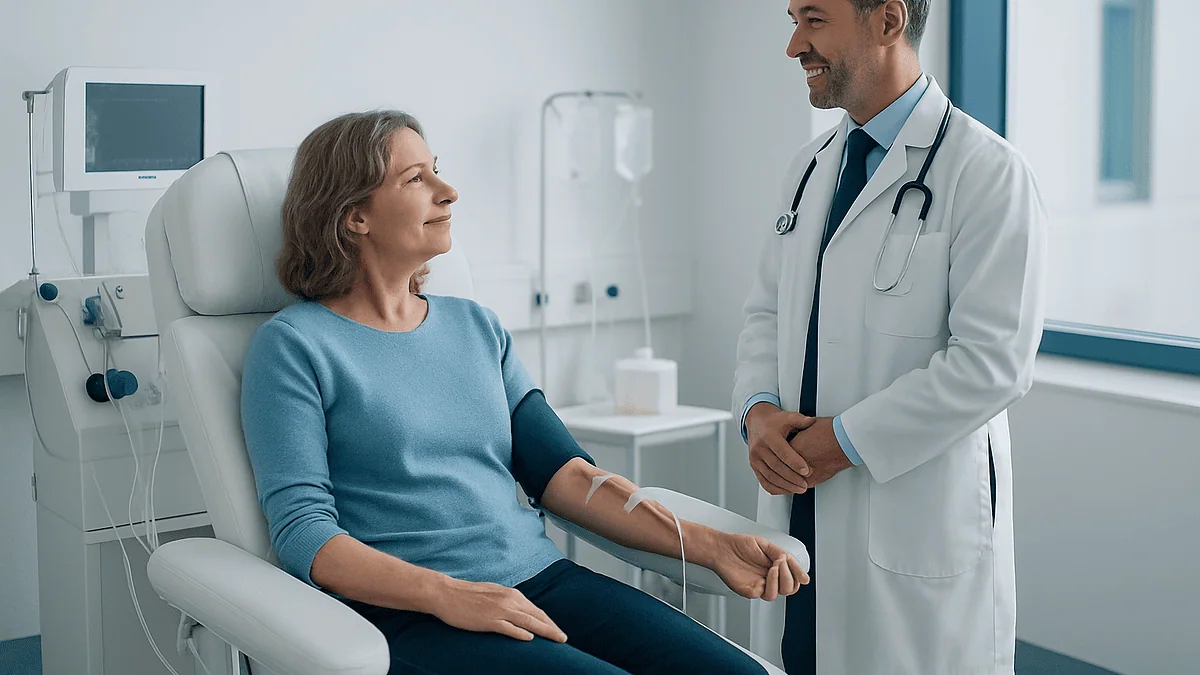
During a therapeutic plasma exchange session, blood leaves the body through a needle or catheter, passes through a machine that separates the liquid plasma from the blood cells, and the cells are returned with a replacement fluid such as albumin or donor plasma. A single session usually takes two to four hours, and most people are awake, seated and monitored throughout.
The chair looks a lot like the one at a blood donation drive, which is the first surprise. The second is the machine beside it: a cabinet of spinning tubing, colored clamps and a screen that reads out numbers a nurse checks every few minutes. Someone who has just been told they need therapeutic apheresis usually gets about a day, sometimes only hours, to understand what is about to happen to their blood.
Most people ask the same three things: Where do the needles go? What does the machine actually do in there? And does the blood really come back? This article walks through exactly what happens during plasma exchange, the most common form of therapeutic apheresis, from the first vein check to the moment the last of your blood cells return.
None of it is mysterious once it is laid out in order. It is plumbing, gravity and careful chemistry, watched by people who do this every day.
What happens during plasma exchange, step by step
Apheresis is a Greek-rooted word meaning “to take away.” In therapeutic apheresis, blood is drawn out, one component is removed or treated, and the rest goes back. Plasma exchange (also called plasmapheresis or TPE) is the version where the component taken away is plasma: the pale yellow liquid that carries antibodies, clotting proteins and other dissolved substances around the body.
The session has a fixed order. First comes a set of checks: blood pressure, pulse, temperature, weight and a recent blood count. Then access is established, either two needles in the arm veins or a previously placed central catheter. The machine primes its tubing with sterile fluid, connects to you, and begins drawing blood at a steady rate.
Inside the device, blood mixes with a small stream of anticoagulant so it cannot clot in the tubing. It then enters either a spinning bowl or a filter. Plasma is lighter than red cells, white cells and platelets, so a centrifuge layers them apart; a membrane filter does the same job by pore size. The separated plasma drains into a waste bag. Your cells, meanwhile, are mixed with a replacement fluid, usually a protein solution called albumin or donor plasma, and returned through the second line.
This continues in a loop until roughly one “plasma volume” has been swapped, a target the treating team calculates from your height, weight and blood count. According to the American Society for Apheresis guidelines on PubMed, exchanging about one to one and a half plasma volumes per session is the usual approach for most indications. When the target is reached, the machine returns the blood still in the circuit, the lines come out, and you sit for a short observation before leaving.
Who is plasma exchange usually for, and who is asked to wait
Plasma exchange is chosen when something harmful is dissolved in the plasma itself and removing it quickly is expected to help. The clearest examples are autoantibodies (antibodies that mistakenly attack the body’s own tissue) in conditions such as myasthenia gravis and Guillain-Barré syndrome, both of which the NHS lists as situations where plasma exchange is a standard treatment option. In thrombotic thrombocytopenic purpura, a rare clotting disorder described by MedlinePlus, exchange removes the antibody and supplies a missing enzyme at the same time.

In cancer care the picture is a little different. Some blood cancers, especially those that produce large amounts of abnormal protein, can thicken the plasma so much that circulation slows, a state called hyperviscosity. Exchange is sometimes used to thin the blood temporarily while treatment directed at the cancer takes effect. Related apheresis procedures, such as collecting stem cells for a transplant or lowering a very high white cell count, use the same machines with different settings.
The American Society for Apheresis grades each use into categories, from Category I (accepted first-line therapy) to Category IV (evidence suggests it is ineffective or harmful). That grading, published in the Journal of Clinical Apheresis and indexed on PubMed, is what most teams consult when deciding whether exchange fits a given diagnosis.
Who is asked to wait? People whose blood pressure is unstable, who have an active infection at a catheter site, whose calcium is already low, or whose veins and overall condition make safe access uncertain. Someone taking a particular class of blood pressure medicine called an ACE inhibitor is often asked to pause it beforehand because of a known reaction with certain exchange circuits; that decision belongs to the prescribing clinician, never to the patient alone.
Access: how the blood gets out and back in
Everything depends on access, meaning a reliable route for blood to leave and return at a steady flow. There are two broad choices, and the team decides between them before the first session.
Peripheral access uses veins in the arms, typically one large vein at each elbow. One needle draws, the other returns. It is the least invasive option and works well for people with sturdy veins who need only a handful of sessions. The drawback is practical: you must keep both arms fairly still for the duration, and small veins may not tolerate the flow rate the machine needs.
Central access uses a catheter, a soft double-channel tube placed into a large vein in the neck, upper chest or groin, usually under local anesthetic and imaging guidance. One channel draws and the other returns, so your arms stay free. Cleveland Clinic notes that a central line is commonly chosen when many sessions are planned or when arm veins are unsuitable. Catheters carry their own responsibilities: the exit site needs to stay clean and dry, and any redness, swelling or fever must be reported promptly because infection and clotting are the main risks.
How much does the needle hurt? Most people compare it to a blood draw with a slightly larger needle: a sharp pinch that fades within seconds. Catheter placement is uncomfortable rather than painful once the local anesthetic works, and the site may ache for a day or two. A nurse will ask you to report any burning or pressure around the access point during the run, since that can signal a needle has shifted.
Access is checked at every session. If flow becomes sluggish, the team may reposition a needle, adjust your arm, or pause briefly. This is routine, not a sign that something has gone wrong.
Inside the circuit: how the machine separates plasma from cells
Once blood enters the tubing it travels through what apheresis nurses simply call “the circuit,” a sealed, single-use kit of plastic lines and chambers threaded through the machine before you arrive. Nothing in the kit is shared between patients; it is discarded after each session.
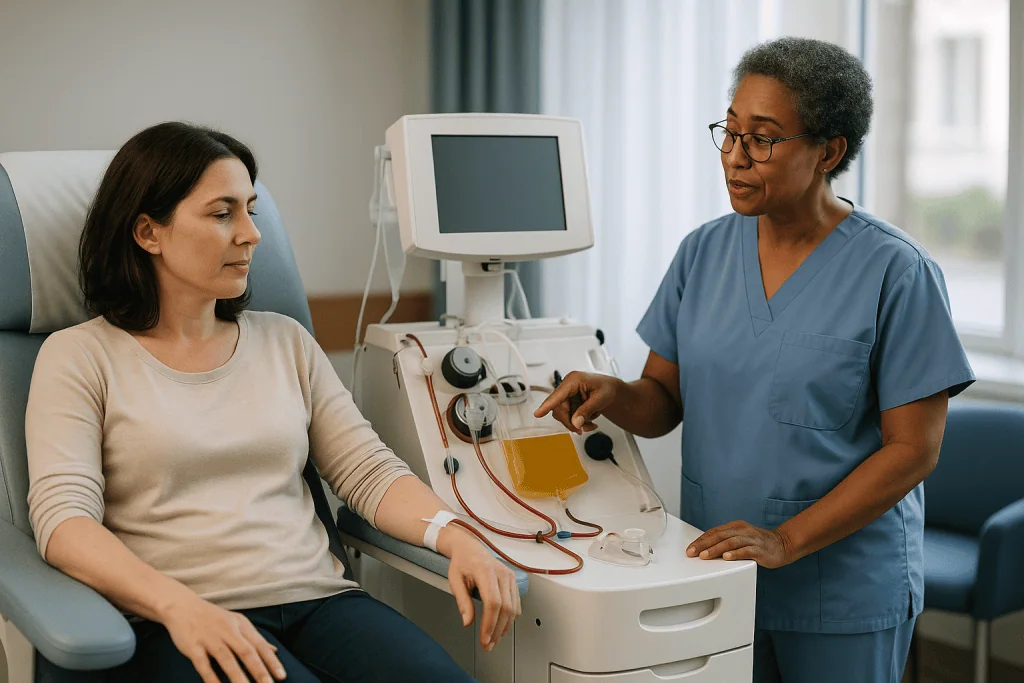
Two technologies do the separating. Centrifugal devices spin the blood in a chamber at high speed. Red cells are densest and move to the outer wall, then white cells and platelets form a thin band, and plasma, the lightest layer, sits innermost. Sensors watch the boundary between layers and a small pump skims plasma off while leaving the cells behind. This is the same principle a laboratory uses when it spins a blood tube and the sample separates into layers.
Membrane devices pass blood along a hollow-fiber filter whose pores are large enough for plasma proteins to pass through but too small for cells. Plasma seeps out through the wall; cells continue along the fiber to the return line. Membrane systems are often paired with dialysis-type equipment, which is why plasma exchange is sometimes delivered by kidney teams.
Either way, the machine tracks volumes continuously. It knows how much plasma has been removed, how much replacement fluid has gone in, and how much of your blood is outside the body at any moment. That extracorporeal volume is kept small, typically a few hundred milliliters, which is why most people feel little more than a coolness in the return arm.
Alarms are frequent and mostly benign. A kinked line, a bent elbow, a change in pressure or an air sensor trigger a pause and a nurse’s attention. Cleveland Clinic describes the process as closely monitored throughout, and the alarms are part of that monitoring rather than a fault.
The anticoagulant and the tingling around your lips
Blood outside the body wants to clot. To prevent this, the machine adds an anticoagulant, a substance that temporarily blocks clotting, to the blood as it enters the circuit. The most common choice is citrate, the same compound found in citrus fruit, which works by binding calcium. Clotting cannot proceed without free calcium, so while citrate is present the blood stays liquid in the tubing.
Here is the catch. Some of that citrate returns to you along with your cells, and for a while it binds calcium in your bloodstream too. The result is the single most common sensation people report during plasma exchange: tingling around the lips, fingertips or toes, sometimes a metallic taste or a feeling of slight vibration. Cleveland Clinic lists this among the expected side effects and notes it is usually mild.
Tell the nurse the moment you notice it. Teams have several ways to respond: slowing the draw rate, giving calcium by mouth or into the return line, or adjusting the citrate ratio. Left unmentioned, low calcium can progress to muscle cramps, a fluttering heartbeat or, rarely, spasm of the hands. Speaking up early keeps it at the tingling stage.
Some centers use heparin, a different anticoagulant class that acts on clotting proteins rather than calcium, either alone or alongside citrate. It does not cause tingling but carries a slightly greater bleeding tendency for a few hours afterward. The choice depends on your diagnosis, your platelet count and whether you are already on a blood thinner; it is made by the treating team, not by preference.
The liver clears citrate within hours. Most people notice the tingling fade before they leave the unit.
What replaces the plasma: albumin, donor plasma or a mix
Removing a liter or more of plasma without replacing it would drop blood pressure quickly and strip away proteins the body needs. So the machine returns a replacement fluid, matched in volume to what leaves. The choice of fluid is one of the more consequential decisions in the whole procedure, and it is worth understanding.
Albumin is a purified protein solution derived from pooled donor plasma but processed so that it carries virtually no infection risk and no antibodies. It keeps fluid in the bloodstream and maintains pressure. Because it contains no clotting factors, several sessions close together can lower those factors temporarily, so teams check clotting tests between runs. Albumin is the default for most autoimmune indications listed in the ASFA guidelines.
Donor plasma (often called fresh frozen plasma) contains everything plasma normally has, including clotting factors and, importantly for thrombotic thrombocytopenic purpura, the missing enzyme that condition requires. MedlinePlus describes plasma replacement as central to treating TTP. The trade-off is a higher chance of allergic reaction, hives or fever, and the small risks that come with any transfused blood product.
| Feature | Albumin | Donor plasma |
|---|---|---|
| Contains clotting factors | No | Yes |
| Allergic reaction risk | Low | Higher |
| Typical use | Most autoimmune and hyperviscosity indications | TTP, active bleeding, low clotting factors |
| Blood type matching | Not required | Required |
Some sessions use a blend, or start with one and finish with the other. Whatever is chosen, the bag hangs in plain view and the nurse can tell you what it is; asking is entirely reasonable.
The return: what you actually feel while blood comes back
The return line is the quieter half of the circuit, but it is where most physical sensations happen. Blood and replacement fluid re-enter at a controlled rate, slightly below body temperature unless the machine has a warmer attached. Many people describe a cool feeling traveling up the arm, sometimes reaching the shoulder, that passes within a minute or two of the run settling. Blankets are standard issue on apheresis units for exactly this reason.
Blood pressure can dip, particularly in the first half hour as the body adjusts to fluid shifting between the circuit and the bloodstream. Lightheadedness, yawning, a faint nausea or a sudden feeling of warmth are the usual early signs. Cleveland Clinic lists low blood pressure among the expected side effects of plasmapheresis. The response is almost always simple: the chair tilts back, the draw slows, and a small volume of saline goes in through the return line. Eating a normal meal beforehand and arriving well hydrated makes dips less likely; skipping food to “be safe” tends to have the opposite effect.
Toward the end of the session the machine performs a “rinseback,” pushing sterile saline through the tubing to return the blood cells still in the circuit. You may feel a final wave of coolness. Then the lines are clamped, needles come out, and pressure is applied for several minutes because the anticoagulant is still active. Bruising at a peripheral site is common and harmless; a firm lump that keeps growing is not, and staff will check for it before you stand.
Most units keep you seated for a short observation period afterward, checking blood pressure once more before you go. If a central catheter stays in place, it is flushed and capped, and the dressing is refreshed.
How long does plasma exchange take, and how many sessions are typical
A single session usually runs two to four hours from connection to disconnection, according to Cleveland Clinic. Add time before for checks and machine setup, and time after for observation, and a realistic block is closer to half a day. Sessions with a central catheter often run at the shorter end because flow rates are more consistent; peripheral access, small veins or frequent alarms push toward the longer end.
Duration is governed by two things the team can partly control: the volume of plasma to be exchanged and the rate at which blood can safely be drawn. Larger people have more plasma, so their sessions are longer at the same flow rate. Speeding the draw shortens the run but increases citrate delivery and the chance of tingling or pressure dips, so nurses adjust in small steps rather than aiming for the fastest possible time.
How many sessions? That varies with the diagnosis far more than with the individual. Mayo Clinic notes that for Guillain-Barré syndrome the treatment is typically given as a series of sessions over roughly two weeks. Myasthenia gravis courses are often similar in length. Thrombotic thrombocytopenic purpura is usually treated daily until blood counts recover, which can mean a longer, less predictable run. Hyperviscosity from a blood cancer may need only one or two sessions while cancer-directed treatment begins.
Sessions are typically spaced a day apart rather than back to back. That gap allows antibodies that have moved into the bloodstream from the tissues to be captured by the next exchange, and it gives clotting factors time to rebuild when albumin is the replacement fluid. The ASFA guidelines describe this every-other-day rhythm as the common pattern for most indications, adjusted by the treating team based on blood tests and how you are responding.
How long does it take for plasma exchange to work?
This is the question people most want answered and the one where honesty matters most. Plasma exchange removes what is circulating in the blood right now. It does not stop the body from making more of it. So the speed of any benefit depends on how directly the removed substance was causing the problem, and on what treatment is running alongside to slow production.
Where the culprit is an antibody acting on nerves or muscle, as in myasthenia gravis, the NHS describes improvement as often appearing within days, with the effect lasting a matter of weeks before antibody levels climb back. That is why exchange in these conditions is usually a bridge: it buys time while longer-acting immune treatments take hold. Some people notice a change after the second or third session; others need the full course before the difference is clear.
In thrombotic thrombocytopenic purpura, the response is tracked by daily blood counts rather than by how you feel, and MedlinePlus notes that treatment continues until those counts normalize. For hyperviscosity in blood cancers, symptoms such as blurred vision or headache may ease quickly because the plasma is physically thinner after a single exchange, but the underlying cancer still needs its own treatment.
Two things are worth stating plainly. First, feeling no different after one session is not a sign of failure; the treating team will tell you what timeline they expect for your specific diagnosis. Second, no one can promise an outcome. The evidence supports exchange as effective for Category I indications in the ASFA guidelines, but individual responses vary, and the team’s judgment about whether to continue, pause or add other treatment is based on your tests and examination, not on a fixed schedule.
Plasmapheresis side effects: how serious is plasma exchange really?
Plasma exchange sits in an unusual place: it is an invasive procedure, yet the large majority of sessions pass with nothing worse than tingling and a chilly arm. Understanding which problems are common and which are rare is the best way to judge how serious it is.
Common and usually mild, as listed by Cleveland Clinic: tingling from low calcium, lightheadedness or low blood pressure, fatigue for the rest of the day, bruising at needle sites and mild nausea. These respond to adjustments made in the chair and rarely stop a session.
Less common but important: allergic reactions to donor plasma (hives, itching, fever, occasionally wheeze), which is why the nurse watches more closely when plasma rather than albumin is the replacement fluid. Bleeding tendency can rise for a day or so after albumin-based exchanges because clotting factors were removed; that matters most for anyone already on a blood thinner or heading for a procedure.
Rare but serious: infection or clot at a central catheter, a significant drop in blood pressure that does not respond to simple measures, and a severe allergic reaction. Anaphylaxis, a whole-body allergic response, is very uncommon but is the reason emergency medicines and trained staff are always in the room.
One further point: exchange removes medicines as well as antibodies. Drugs that travel bound to plasma proteins, including some antibiotics and anti-seizure medicines, can be partly washed out. The treating team times doses around sessions or checks blood levels; this is handled by them and is another reason to give a complete medication list.
So how serious is it? Serious enough to deserve trained staff and continuous monitoring; routine enough that most people read, nap or scroll through it.
Plasma exchange vs dialysis, and plasmapheresis vs IVIG
Two comparisons come up constantly, and both are worth untangling.
Plasma exchange and dialysis look alike from the chair. Both draw blood through a catheter or needles, run it through a machine and return it. The difference is what is removed. Dialysis filters small dissolved waste products and excess water across a membrane, doing the work of failing kidneys; large proteins such as antibodies stay in the blood because they are far too big for dialysis pores. Plasma exchange removes the entire liquid fraction, proteins included, and replaces it. Dialysis is a long-term substitute for an organ; exchange is a short course aimed at a specific circulating problem. Some people with kidney-affecting autoimmune disease receive both, sometimes in the same unit, which is where the confusion often begins.
Plasmapheresis versus intravenous immunoglobulin (IVIG) is the more consequential comparison because they are often alternatives for the same conditions. IVIG is a concentrated preparation of antibodies pooled from many donors, given as an infusion over several hours. Rather than removing harmful antibodies, it appears to dampen the immune attack through several mechanisms. Mayo Clinic notes that for Guillain-Barré syndrome the two are considered equally effective, and the NHS describes both as options for myasthenia gravis.
Why choose one over the other? Exchange needs vascular access and apheresis equipment; IVIG needs only a standard drip but carries its own risks, including headache, kidney strain and, rarely, clotting. Someone with fragile veins or unstable blood pressure may be steered toward IVIG; someone with a condition where physically removing the plasma matters, such as TTP, will be steered toward exchange. Combining them is generally avoided in sequence that would wash out the infused antibodies. The treating team weighs these factors; neither option is universally “better.”
The days and weeks after a course of plasma exchange
The rest of the day after a session is usually quiet. Fatigue is the most common report, partly from the fluid shifts and partly from sitting still for hours. Most people are advised to eat a normal meal, drink fluids, and avoid heavy lifting with the arm that held the needles until any bruising settles. If a central catheter stays in, the dressing must be kept dry; showering arrangements are explained by the unit, and swimming or soaking is off until it is removed.
Between sessions, blood tests track the things exchange disturbs: calcium, clotting measures, platelets and, when relevant, the antibody or protein being removed. These results drive the team’s decisions about whether to continue, change replacement fluid or stop. The NHS notes that for antibody-driven conditions the benefit of a course typically lasts several weeks, which is why longer-acting immune treatments are usually started or continued alongside.
The end of a course is not always a clean line. Some people finish a planned series and move to maintenance treatment; others in conditions like TTP taper from daily to less frequent sessions as counts recover, guided by MedlinePlus-described monitoring of blood results. Occasionally exchange is repeated later if symptoms return; that is a recognized pattern, not a setback.
Catheter removal is a brief procedure, often done on the unit, followed by pressure on the site and a dressing for a day or two. Medicines that were paused, such as an ACE inhibitor, are restarted only on the prescribing clinician’s instruction. If exchange was given for hyperviscosity in a blood cancer, follow-up shifts to the cancer team, whose treatment now carries the longer-term work.
Vaccinations and new medicines are sometimes timed around a course because exchange can remove them; ask before scheduling either.
What people often get wrong about plasmapheresis
Plasma exchange attracts a surprising number of myths, partly because it looks dramatic and partly because it shares a chair with blood donation.
“They take my blood away.” No. Cells are returned continuously throughout the session; only plasma leaves, and it is replaced volume for volume. At any moment the amount outside your body is roughly a cup or two, not the liters people imagine.
“It cleans out toxins.” Exchange removes specific large molecules that are in the plasma: antibodies, abnormal proteins, some medicines. It does nothing for the vague “toxins” of wellness marketing, and the ASFA guidelines list conditions where the evidence says it does not help. A team offering it for a Category IV indication is going against that evidence.
“One session fixes it.” For most antibody-driven conditions a course of several sessions is needed, and even then the effect is temporary because the body keeps producing the antibody. The NHS is explicit that the benefit lasts weeks, not permanently.
“It’s the same as dialysis.” Different target, different purpose, as the earlier comparison explains.
“It’s extremely painful.” Needle placement stings; the run itself is mostly boredom, coolness and occasional tingling. People who have had both often describe it as easier than a long IV infusion.
“I should stop my medicines before it.” Some are paused and some are timed around sessions, but that is the prescribing clinician’s call, made drug by drug. Stopping anything on your own can be dangerous.
“Donor plasma is always safer because it’s ‘natural.'” Albumin carries a lower allergic and infection risk precisely because it is processed; donor plasma is chosen when its clotting factors or enzymes are specifically needed.
The common thread is that exchange is precise, temporary and targeted. It works best understood as one tool in a plan, not a reset button.
Questions to ask your care team before the first session
A good apheresis team expects questions and will usually answer them before you sit in the chair. These are the ones that make the most difference to how the experience feels.
- Which ASFA category does my condition fall into, and what evidence supports exchange for it?
- Will I have arm needles or a central catheter, and why is that the choice for me?
- What replacement fluid will be used, and what should I watch for with that particular fluid?
- How many sessions are planned, how far apart, and what results will tell you whether to continue or stop?
- Which of my medicines will be paused, timed around sessions or monitored, and who will tell me when to restart them?
- What is being used as the anticoagulant, and how do you manage tingling or low calcium if it happens?
- What other treatment is running alongside, and how does exchange fit with it?
- What symptoms after I leave should prompt a call, and what number do I call at night or on a weekend?
- Can I eat and drink before and during the session, and can someone sit with me?
- If I have a catheter, how do I care for it at home and when will it come out?
Write the answers down or ask permission to record them. People consistently underestimate how little they retain from a conversation held on the day of a new diagnosis. Bring a complete medication list, including supplements, because exchange can remove some of them and the team needs to plan around that.
One more question is worth asking directly: “What are the alternatives, and why is this the recommendation for me?” A team confident in its reasoning will welcome it. The decision to proceed, pause or choose IVIG instead rests with the treating clinicians in discussion with you, and understanding their reasoning is part of giving genuine consent.
When to call your doctor: red-flag signs during and after plasma exchange
During a session, you are surrounded by people trained to spot problems, but they rely on you to report what they cannot see. Tell the nurse immediately about tingling or numbness, cramps, a fluttering or racing heartbeat, chest tightness, difficulty breathing, dizziness, sudden warmth or flushing, itching or hives, or any burning, swelling or pressure at a needle or catheter site. None of these should be endured quietly; all of them have straightforward responses when caught early.
After you leave, contact the apheresis unit or your treating team the same day if you notice bleeding that does not stop with ten minutes of firm pressure, a bruise that keeps enlarging, persistent dizziness or fainting, ongoing tingling or muscle cramps, hives or a rash, or a fever. With a central catheter, any redness, warmth, discharge or pain at the exit site, a swollen or painful arm or neck on that side, or a fever are reasons to call promptly, because catheter infection and clot are the most serious complications and are time-sensitive.
Seek emergency care without waiting for a callback if you develop chest pain, severe shortness of breath, swelling of the face or throat, confusion, a seizure, heavy bleeding, or if a catheter comes out or is damaged and bleeding cannot be controlled with pressure.
Symptoms of the underlying condition returning, such as worsening weakness, double vision, swallowing difficulty, easy bruising or new headaches and visual changes in someone treated for hyperviscosity, should also be reported rather than waiting for the next scheduled appointment. Exchange is a temporary measure and the team will want to know if its effect is fading sooner than expected.
Keep the unit’s contact number where you can find it. Calling about something that turns out to be minor is always the right decision.
Frequently asked questions
How long does it take for plasma exchange to work?
It depends on the condition being treated. For antibody-driven disorders such as myasthenia gravis, the NHS describes improvement as often appearing within days, with the benefit lasting weeks before antibody levels rise again. In thrombotic thrombocytopenic purpura the response is judged by daily blood counts rather than symptoms. Feeling unchanged after one session is common and not a sign of failure; the treating team will explain the timeline they expect for your diagnosis.
How serious is plasma exchange?
It is an invasive procedure that requires trained staff and continuous monitoring, yet most sessions pass with only mild effects such as tingling, a chilly arm, lightheadedness or fatigue. Serious complications, including catheter infection or clot, significant blood pressure drops and severe allergic reactions, are uncommon but are the reason emergency equipment is always at hand. Your team weighs these risks against the expected benefit before recommending it.
How painful is plasmapheresis?
Most people describe it as uncomfortable rather than painful. Needle placement feels like a blood draw with a slightly larger needle, a sharp pinch that fades in seconds. Central catheter placement is done under local anesthetic and may leave the site aching for a day or two. During the run, the usual sensations are coolness in the return arm, tingling from the anticoagulant and boredom. Burning or pressure at an access site should be reported at once.
How much does a plasma exchange treatment typically cost?
This article does not publish prices, because costs vary enormously by country, insurer, access type, replacement fluid and number of sessions, and any figure quoted here could be misleading. The right source is your treating hospital’s financial counselor or billing office, who can give an estimate specific to your plan of care and your coverage. Ask them before the first session so there are no surprises.
How long does plasma exchange take per session?
Cleveland Clinic gives a typical range of two to four hours from connection to disconnection. Pre-session checks, machine setup and a short observation period afterward add to that, so planning for around half a day is realistic. Larger plasma volumes, peripheral arm veins and frequent machine alarms lengthen the run; a well-functioning central catheter usually shortens it.
What are the most common plasmapheresis side effects?
Tingling around the lips, fingers or toes from citrate binding calcium is the most frequent, followed by lightheadedness or low blood pressure, fatigue for the rest of the day, bruising at needle sites and mild nausea. When donor plasma is the replacement fluid, hives, itching or fever from an allergic reaction are more likely than with albumin. All of these are watched for and usually managed in the chair.
What is the difference between plasma exchange vs dialysis?
Both draw blood through a machine and return it, but dialysis filters small waste products and excess water to replace kidney function, leaving large proteins in the blood. Plasma exchange removes the entire liquid plasma, including antibodies and abnormal proteins, and replaces it with albumin or donor plasma. Dialysis is usually long-term; exchange is a short course aimed at a specific circulating problem.
Plasmapheresis vs IVIG: which is better?
Neither is universally better. Mayo Clinic notes that for Guillain-Barré syndrome the two are considered equally effective, and the NHS lists both as options for myasthenia gravis. Exchange physically removes antibodies and needs vascular access; IVIG infuses pooled donor antibodies through a standard drip and carries different risks such as headache and kidney strain. Your team chooses based on your condition, veins, blood pressure and other health factors.
Can I eat and drink before plasma exchange?
In most cases yes, and it is encouraged. Arriving after a normal meal and well hydrated makes drops in blood pressure less likely during the fluid shifts of the session. Some units allow light snacks and drinks during the run. Fasting is not usually required unless a catheter is being placed under sedation the same day, so ask your unit for their specific instructions.
Will plasma exchange remove my medicines?
It can. Drugs that travel bound to plasma proteins, including some antibiotics, anti-seizure medicines and certain immune treatments, are partly removed along with the plasma. This is why the treating team asks for a complete medication list and times doses around sessions or checks blood levels. Never pause or adjust a medicine on your own; those decisions belong to the prescribing clinician.
References
This article is for general information only and is not a substitute for professional medical advice. Please consult a qualified doctor about your individual situation.

More from the Blog
Questions to Ask Your Gynecologic Oncologist Before Vulvar Cancer Treatment
Before vulvar cancer treatment, ask your gynecologic oncologist what type and stage of cancer you have, whether surgery, radiation, chemotherapy or a combination is…
Your First Cancer Rehabilitation Visit: What to Bring and Which Daily Tasks to Write Down
For a first cancer rehab appointment, bring your treatment summary, a current list of medicines and supplements, any recent scan or lab reports, comfortable…
Inside a Breast Cancer Tumor Board: Who Sits at the Table and What Gets Decided
A breast cancer tumor board is a scheduled meeting where a surgeon, medical oncologist, radiation oncologist, radiologist and pathologist, often with a nurse navigator,…

Medicines After a Bone Marrow Transplant: Anti-Rejection, Antivirals and What Blood Tests Track
After a bone marrow (stem cell) transplant, most people take a combination of immunosuppressants to prevent graft-versus-host disease, plus preventive antiviral, antifungal and antibiotic…

Why Is a Fever During Chemotherapy Treated as Urgent? What to Do the Moment It Starts
A fever during chemotherapy is treated as an emergency because chemotherapy can lower neutrophils, the white blood cells that fight bacteria, so an ordinary…

What Molecular Response Means in Myeloid Leukemia and How Often It Is Measured
In chronic myeloid leukemia, molecular response describes how far the level of BCR-ABL1, the abnormal gene that drives the disease, has fallen in the…