

What Happens During Professional Teeth Whitening: Gum Protection, Gel and Shade Checks
Key Takeaways
- The whitening gel, not the light, does the work: reviews comparing light-activated and unlit gel of the same strength find little or no lasting shade difference.
- A gum barrier of light-set resin is painted along the gumline before gel is applied, and it is the main reason supervised whitening spares the gums better than strips.
- Yellow and brown staining from coffee, tea, wine, tobacco and age responds best; gray banding from childhood tetracycline and single darkened teeth often respond poorly.
- Crowns, veneers and white fillings do not lighten, so whitening can make existing restorations look darker by contrast.
- The NHS states results are not permanent and typically last from a few months up to about three years, with smoking and staining drinks shortening that range.
- Teeth look brighter immediately after the procedure because enamel is dehydrated; the true shade settles over the next day or two as saliva rehydrates it.
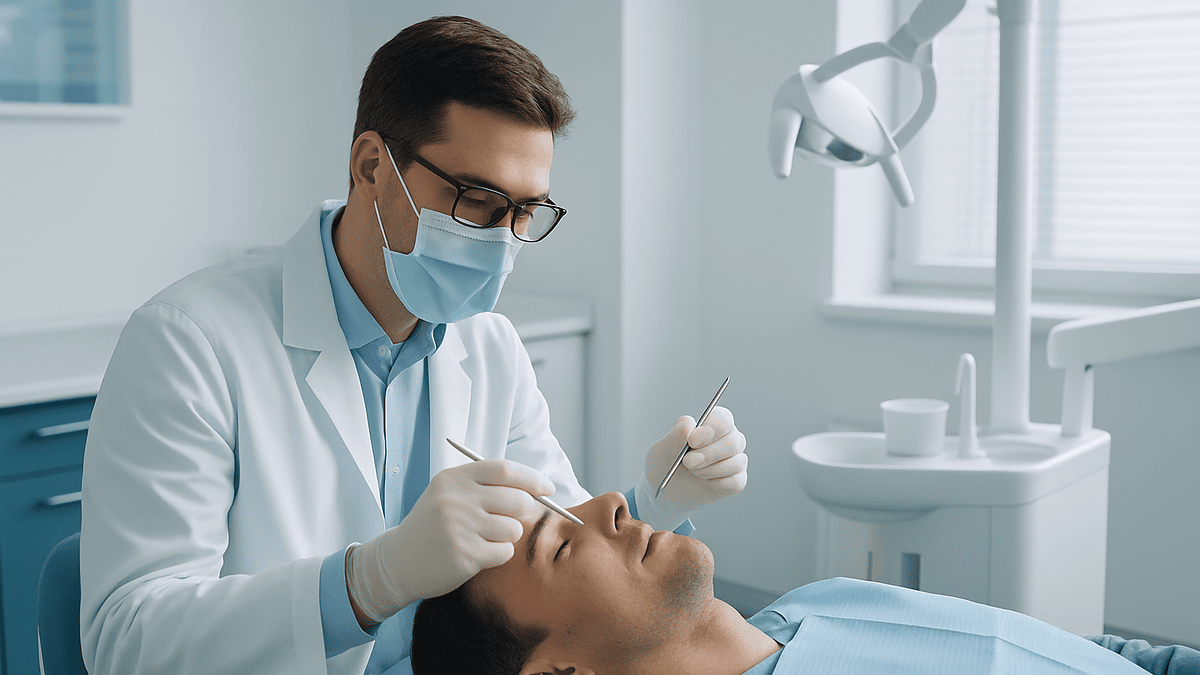
A professional teeth whitening procedure usually starts with a dental exam and a shade check against a standard guide. The dentist isolates the lips and cheeks, paints a protective barrier over the gums, then applies a peroxide-based gel to the teeth in timed cycles, sometimes with a light. The gel is removed, the shade is rechecked, and temporary sensitivity is common in the days afterward.
The photo that finally did it was taken at a friend’s wedding. Everyone was laughing, the light was kind, and yet all he could see was the faint yellow of his front teeth against a crisp white shirt. A decade of coffee, a stretch of smoking in his twenties, and simple aging had done their quiet work. Now he was sitting in a dental chair with a mirror in his hand, wondering what the next hour would involve.
A professional teeth whitening procedure is one of the most requested elective dental treatments, and one of the least well understood. People picture a bright blue light and a dramatic reveal. The real appointment is slower, more methodical and, frankly, more interesting: a careful exam, a shade measured against a standard guide, a rubbery barrier painted along the gumline, and a gel whose chemistry has been studied for decades.
This article walks through each of those steps, what the evidence says about lights, lasers and lasting results, who is usually asked to wait, and the signs that mean it is time to pick up the phone.
What actually happens during a professional teeth whitening procedure, step by step
Most in-office visits follow the same sequence, whatever the gel or equipment. The Cleveland Clinic describes the appointment as taking roughly an hour, though your dentist will tell you what to expect for your own mouth.
It begins with a look, not a gel. The dentist examines your teeth and gums for decay, cracks, leaking fillings or inflamed tissue, because peroxide seeping into an open cavity or under a loose filling can cause sharp pain. Plaque and surface stain are often cleaned away first so the gel meets enamel rather than debris.
Next comes the shade check. A small fan of tooth-colored tabs, called a shade guide, is held beside your teeth and the closest match is recorded, often with a photograph. That baseline is what the final result will be compared with.
Then the mouth is isolated. A plastic retractor holds the lips and cheeks away from the teeth, cotton rolls or gauze keep saliva off the enamel, and the dentist paints a soft resin along the gumline and hardens it with a light. This gum barrier, sometimes called a gingival dam, is the step that separates a supervised procedure from a strip you buy at a pharmacy.
Only now is the whitening gel brushed onto the front surfaces of the teeth. It stays in place for a timed period, may be exposed to a light, and is then suctioned or wiped off. The cycle is usually repeated two or three times during the visit. At the end, the barrier is peeled away, the teeth are rinsed, a desensitizing agent may be applied, and the shade guide comes out again.
None of this is rushed. The chemistry works on its own clock, and the protective steps around it are where the skill lies.
Why the shade check comes before anything else
The shade guide looks almost quaint: a plastic handle fanned with tabs in graded tones of white, yellow, gray and brown. Its job is to replace impressions with a record. Human eyes are poor at remembering color, and a smile always looks brighter in the minutes after a procedure because the teeth are temporarily dry and dehydrated. Dehydrated enamel appears whiter than it will once saliva rehydrates it over the following day or two.
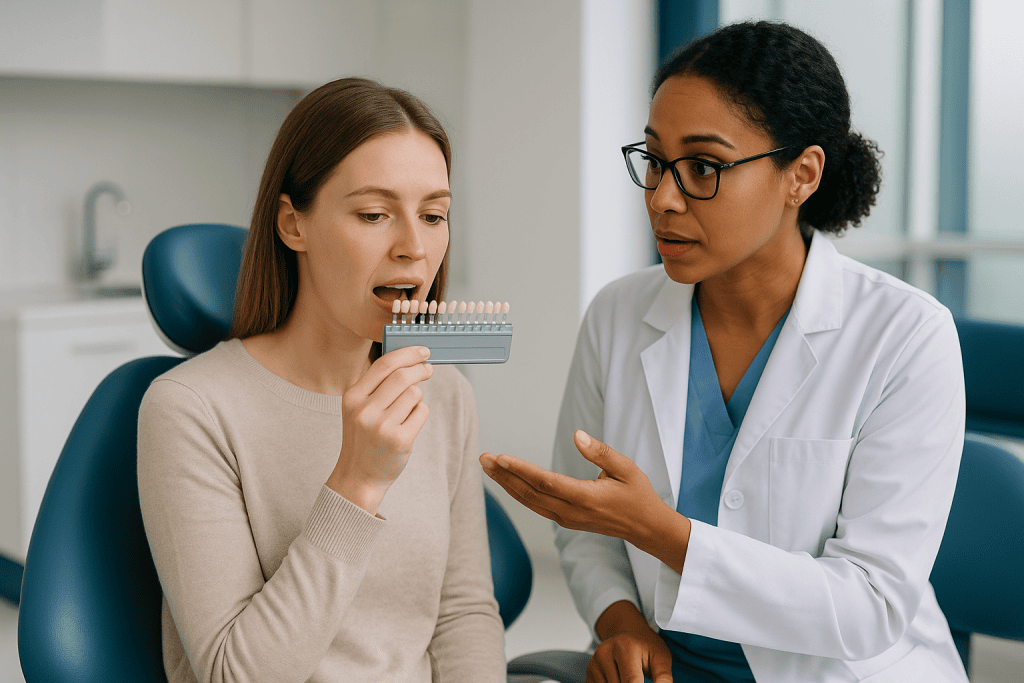
Recording the starting shade, under consistent lighting and ideally with a photograph, does three things. It lets you and the dentist agree on an honest baseline. It shows how far the shade actually moved, rather than how far it seemed to move in the chair. And it helps set a realistic target. Teeth do not become paper white; they lighten a number of steps along the guide, and the ceiling is set by your own enamel and dentin.
The shade check is also where the type of discoloration is judged. MedlinePlus separates external stains, from coffee, tea, red wine, tobacco and certain foods, from internal ones caused by aging, trauma, fluorosis or antibiotics taken while the teeth were forming. Yellow and brown tones from surface staining tend to respond well to peroxide. Gray tones, banding, or a single dark tooth after an injury often do not, and a dentist who spots this at the shade check will say so before any gel is opened.
Some practices use a digital shade-matching device instead of the handheld guide. Either way, the principle is the same: measure first, whiten second, measure again. If your dentist skips this step, it is reasonable to ask for it.
How the gum protection barrier works and why it matters
Peroxide gel is designed to act on enamel, which is mineral and has no nerve supply of its own. Gum tissue is different. It is living, blood-rich and thin, and concentrated peroxide sitting on it for several minutes causes chemical irritation: a white, blanched patch, stinging, and sometimes a small ulcer that takes a few days to settle. The NHS lists sore gums among the common side effects of whitening, and most of that soreness comes from gel contact rather than from the teeth.
The gum barrier is the answer. A gingival dam is a flowable resin, roughly the texture of thick nail polish, that the dentist paints along the margin where tooth meets gum, usually extending slightly onto the tooth itself and into the gaps between teeth. A curing light then sets it into a firm but flexible seal within seconds. When the gel is later applied, it stops at that wall.
Other protective steps run alongside it. The cheek retractor keeps the soft tissue of the lips physically away from the teeth. Petroleum-based balm is often smeared on the lips because they dry out quickly under the retractor. Cotton and gauze absorb saliva, which would otherwise dilute the gel and let it run. A dental assistant keeps suction ready, so any gel that strays is removed immediately.
This is the piece that at-home strips, pens and kiosk treatments cannot replicate. A strip has no idea where your gumline is. A trained clinician does, and the difference shows up not in the shade result but in what your gums feel like the next morning.
If you have receding gums or exposed root surfaces, mention it. Root surface is softer than enamel and reacts differently, and your dentist may extend the barrier to cover it.
How does professional teeth whitening work? The chemistry of the gel
The active ingredient in virtually every whitening gel is one of two related compounds: hydrogen peroxide, or carbamide peroxide, which breaks down into hydrogen peroxide once it is in the mouth. In plain terms, peroxide is a bleaching agent that releases reactive oxygen molecules.
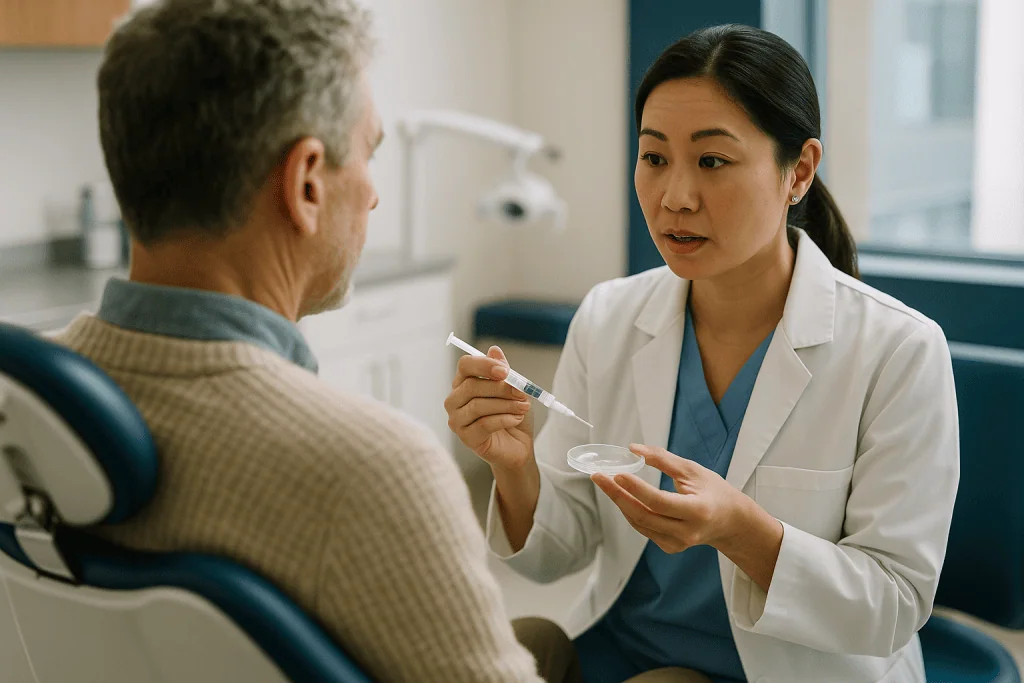
Enamel is not a solid wall. It is a dense lattice of mineral crystals with microscopic channels running through it, and the yellow-brown stains that dull a smile are large pigment molecules lodged in those channels and in the dentin beneath. Peroxide is small enough to diffuse into the tooth. There, the oxygen it releases breaks the long chemical bonds in the pigment molecules into shorter fragments. Shorter fragments reflect light differently and appear lighter. The stain is not scrubbed off; it is chemically disassembled from within.
This explains several things patients notice. It explains why the gel needs time, because diffusion is slow. It explains why results build over repeated cycles and why the shade may look slightly different a day later, once the enamel rehydrates. And it explains why crowns, veneers and white fillings do not change color: those materials are ceramic or plastic, not porous tooth, and peroxide has nothing to bleach in them.
The gels used under a dentist’s supervision are more concentrated than those sold for unsupervised home use, which is precisely why the gum barrier and isolation steps exist. Higher concentration means faster action but also a greater capacity to irritate soft tissue. Regulations on what strength can be used, and by whom, vary by country. The NHS notes that in the UK only registered dental professionals may carry out whitening, and that the concentration allowed for non-professional sale is strictly limited. Your dentist will choose the gel; this article does not.
Do the lights and lasers actually do anything?
The blue light is the most photographed part of a professional teeth whitening procedure and, according to the evidence, the least important. Manufacturers describe the light as activating or accelerating the gel by warming it, which in theory speeds the release of oxygen.
What the research shows is more modest. Reviews of in-office whitening have generally found that when a light-activated gel is compared with the same gel left to work without a light, the final shade difference is small or not statistically meaningful once the teeth have rehydrated. Some studies report a slightly faster result in the chair; others report no difference and a higher rate of sensitivity when heat is added. Mayo Clinic’s dental guidance is cautious about marketing claims for whitening technologies, emphasizing that the peroxide, not the device, does the lightening.
Lasers occupy the same territory. The word sounds precise and powerful, but in whitening it refers to a light source of a particular wavelength used to warm gel. It does not vaporize stain or alter enamel in a way an ordinary light cannot.
This does not make a light-assisted appointment wrong or unsafe. Many dentists use lights and are satisfied with the workflow. The honest summary is that the light is optional, the gel and the protective steps are not, and a shade result should never be promised on the basis of the equipment.
If a light is used, expect protective eyewear for you and the team, a slightly warm sensation on the teeth, and cycles of a set number of minutes. Ask your dentist what the light is for in your case and whether the same result could be reached without it. A good answer will acknowledge the uncertainty rather than dismiss the question.
In office teeth whitening vs take home trays: what the comparison really looks like
Dentists offer two supervised routes, and many combine them. In-office whitening is the single-visit procedure described above. Dentist-supervised take-home whitening uses custom trays made from an impression or digital scan of your teeth, filled with a lower-strength gel and worn for set periods over one to a few weeks. Both are professional treatments; the difference is speed, supervision and where the work happens.
| Feature | In-office whitening | Dentist-supervised take-home trays |
|---|---|---|
| Where the gel is applied | In the chair, by the dental team | At home, by you, in custom trays |
| Gel strength | Higher; requires gum barrier and isolation | Lower; trays limit gum contact |
| Time to visible change | Usually within the visit, with rehydration settling the shade over the next days | Gradual, typically over 1–3 weeks per the Cleveland Clinic |
| Sensitivity pattern | Often sharper but short-lived | Often milder, can recur with each wear |
| Control over endpoint | Dentist decides when to stop during the visit | You stop when the agreed shade is reached |
| Typical use | A time-sensitive event, or a start before trays | Maintenance, or people who prefer gradual change |
The evidence comparing the two is reassuring rather than dramatic. Systematic reviews of peroxide whitening have generally found that both approaches lighten teeth and that the eventual shade is similar when the total exposure to gel is comparable; the in-office route simply concentrates that exposure into one sitting.
Which suits you depends on how quickly you want change, how sensitive your teeth are, and how reliably you would wear a tray each evening. That is a conversation for your dentist, who can also tell you whether a combined approach makes sense.
Who professional teeth whitening is usually for, and who is usually asked to wait
Whitening is an elective cosmetic treatment on healthy teeth. That single sentence covers most of who is a good candidate: adults with permanent teeth, sound enamel, healthy gums and staining that comes from diet, tobacco or age.
Several groups are routinely asked to wait, and the reasons are practical rather than cautious for its own sake.
- People with untreated decay, cracked teeth or leaking fillings. Peroxide entering these spaces causes pain and can inflame the nerve. The fix is to treat the underlying problem first and whiten afterward.
- People with active gum disease or inflamed, bleeding gums. Sore tissue reacts poorly to gel, and the gum barrier seals less reliably against swollen margins.
- People who are pregnant or breastfeeding. There is no evidence of harm, but there is also no research demonstrating safety, so professional bodies generally advise postponing elective whitening. The Cleveland Clinic lists pregnancy among reasons to delay.
- Children and teenagers. Young permanent teeth have larger nerve chambers and more porous enamel, making sensitivity more likely. In the UK the NHS notes whitening is not offered to people under 18 except on clinical grounds.
- People whose front teeth are mostly crowns, veneers or large fillings. These will not lighten, and whitening the surrounding teeth can leave the restorations looking darker by contrast.
- People with significant sensitivity already, or with exposed roots, who may need a desensitizing plan first.
Being asked to wait is not a refusal. It is usually a sequence: treat, stabilize, then whiten. The dentist examining you decides this, and the exam at the start of the appointment is exactly where such decisions are made.
Can yellow teeth be professionally whitened? What responds and what does not
Yes, and yellow is in fact the color that responds best. The reason lies in where the color comes from. MedlinePlus notes that teeth naturally yellow with age as enamel thins and the darker dentin beneath shows through, and that coffee, tea, red wine, colas, tobacco and some foods stain the outer surface. Both processes produce yellow and light brown tones made of organic pigment, which is exactly what peroxide breaks down.
The teeth that disappoint are the ones with discoloration built into their structure. Tetracycline-class antibiotics taken in childhood, while the permanent teeth were still forming, bind to developing dentin and can leave gray, blue or banded staining that peroxide reaches only slowly and incompletely. Fluorosis, from too much fluoride during tooth development, can produce white flecks or brown patches; whitening may make the surrounding enamel lighter and the flecks more visible before the overall effect evens out. A single tooth that has darkened after a knock or a root canal is discolored from the inside, and standard external whitening often has little effect on it; a dentist may discuss a different, internal approach for that tooth alone.
Gray also behaves differently from yellow. Gray tones reflect less light to begin with, and lightening them tends to produce a paler gray rather than a bright white.
This is why the shade check and the exam matter more than the gel brand. A dentist who has identified the cause of your discoloration can give you an honest sense of how many steps on the guide are realistic, and whether whitening alone will get you there or whether bonding, veneers or simply a professional cleaning would serve you better. Yellow from a lifetime of coffee is a good story to bring into the chair. Gray from childhood medicine is a harder one, and it deserves a frank conversation.
How long does teeth whitening last, and what the first days and weeks usually look like
The first 24 to 48 hours set the tone. Enamel dehydrates during the procedure, so the shade you see immediately is usually a little brighter than the one you will settle into once saliva rehydrates the teeth. Expect a slight, normal softening of the result over the first couple of days; this is not the whitening failing.
Sensitivity is the other early feature. The NHS lists sensitivity to cold as the most common side effect, and it typically shows up as brief, sharp twinges triggered by cold air, cold drinks or even breathing in. Peroxide temporarily opens the microscopic channels in dentin, letting temperature changes reach the nerve more easily. For most people this fades within a few days as the channels close again. Your dentist may suggest a desensitizing toothpaste or apply a fluoride varnish; follow their advice rather than a friend’s.
Many dentists recommend a period of avoiding strongly colored food and drink in the first days because freshly whitened enamel is more porous and picks up stain more readily. Coffee, tea, red wine, curry, berries and tobacco are the usual suspects. The evidence for exactly how long this window lasts is thin, so treat the advice as sensible caution rather than a rule with a proven cutoff.
Over the following weeks the shade stabilizes. How long it stays depends heavily on habits. The NHS states that whitening is not permanent and that results can last from a few months up to about three years, with smoking and staining drinks shortening the range considerably. Some people return for a brief top-up, either in the chair or with supervised trays, when the shade drifts.
If sharp sensitivity persists beyond a week, or a specific tooth throbs rather than twinges, that is not the normal pattern and belongs in the section on when to call.
Is professional teeth whitening safe? Risks in plain clinical language
Performed by a dental professional on healthy teeth, peroxide whitening has a long safety record. The two most frequent problems are the ones already mentioned: temporary tooth sensitivity and gum irritation. Both are usually mild and both usually resolve within days. Neither is trivial to the person experiencing it, which is why the barrier, isolation and post-treatment care exist.
Less common risks deserve honest mention. Chemical burns to the gums or lips can occur if gel escapes the barrier and is not removed promptly; they present as a white patch that stings and typically heals over several days. Existing cracks, worn enamel or exposed roots can produce sharper or longer-lasting sensitivity. Whitening can make old fillings and crowns stand out because they do not change color. And in a tooth with an unrecognized problem such as decay or a dying nerve, peroxide can provoke pain that reveals the issue rather than causes it.
Concerns that whitening permanently damages enamel are not supported by mainstream evidence when concentrations and contact times are those used by dental professionals. Laboratory studies show transient surface changes that remineralize with saliva. The Mayo Clinic emphasizes that problems tend to arise from overuse or from products applied without supervision, not from a properly conducted procedure.
The greater risks sit outside the dental office: unregulated kiosks, imported gels of unknown strength, and repeated use of over-the-counter products far beyond their instructions. The NHS specifically warns about whitening carried out by anyone other than a registered dental professional, and about buying kits online whose contents cannot be verified.
Safety is therefore less a property of whitening itself than of who does it, on what teeth, and how often. That is a judgment for the dentist examining you.
Is it worth it to get your teeth professionally whitened? An evidence-first way to decide
Worth is personal, and no article can settle it for you. What evidence can do is clear away the wrong reasons and sharpen the right ones.
Start with the goal. If the teeth are yellowed by diet, tobacco or age, whitening has a good chance of lightening them by several shades, and a dentist can estimate how many after the shade check. If the problem is gray banding, a single dark tooth, or crowns and veneers at the front, whitening may not address it and other options should be on the table. Being clear about which situation you are in prevents the most common disappointment.
Consider your mouth’s readiness. Untreated decay, gum inflammation or existing sensitivity are reasons to treat first and whiten later, not reasons to abandon the idea.
Consider durability. The NHS range of a few months to about three years means whitening is maintenance, not a one-time fix, and the habits that stained your teeth will keep doing so. Someone who drinks coffee all day and smokes will be at the short end of that range; someone who does neither may be at the long end.
Consider the alternative you are actually choosing between. Often the honest comparison is not whitening versus nothing, but professional whitening versus months of unsupervised strips, or versus a thorough professional cleaning that removes surface stain and may be all that was needed.
People also ask about the average cost. This publication does not print prices, and for good reason: fees vary widely by region, by method and by how many visits are involved, and any figure quoted here would mislead more readers than it helped. Ask the practice for a written estimate that includes any follow-up, and treat it as one input rather than the deciding one.
What people often get wrong about professional teeth whitening
Myths about whitening are durable, partly because the procedure is so visible and so heavily advertised. A few deserve direct correction.
Whitening strips the enamel. It does not. Peroxide diffuses into enamel and breaks down pigment; it does not dissolve mineral in the way acid does. Transient surface changes seen in laboratory studies remineralize with normal saliva. Damage in real life comes from overuse or unsupervised high-strength products, not from a properly conducted procedure.
The light does the whitening. The gel does. Evidence comparing light-activated and non-activated gel of the same strength shows small or no lasting difference in shade.
Everyone ends up the same white. Enamel has a natural ceiling set by its thickness and the dentin beneath. Two people with the same gel and time will finish at different shades, which is why a promised endpoint is a warning sign, not a reassurance.
Whitening fixes crowns, veneers and fillings. Restorations are ceramic or plastic and do not respond. Whitening around them can leave them looking darker by contrast, and a dentist may suggest replacing visible restorations after the natural teeth have settled at their new shade.
Whitening toothpaste does the same thing. Mayo Clinic explains that whitening toothpastes remove surface stain with mild abrasives and sometimes low levels of peroxide, and can make teeth look slightly brighter, but they do not change the color of the tooth itself the way a supervised peroxide treatment does.
The result is permanent. It is not. Staining resumes the day you resume coffee, and the NHS range of a few months to a few years reflects that.
Brighter always looks better. Very white teeth against natural skin tone and the whites of the eyes can look artificial. The shade guide exists partly to help you stop at the right point, not the brightest one.
How to keep the results, and what wears them down fastest
Whitening works on pigment already in the tooth; it does nothing to stop new pigment arriving. Maintenance, therefore, is mostly about the same habits that protect teeth in general, with a few additions.
The heaviest hitters are predictable. Tobacco in any form stains enamel quickly and is the single habit most likely to push you toward the short end of the NHS durability range. Coffee, black tea, red wine and dark colas follow; drinking them through a straw or rinsing with water afterward reduces contact time, though the evidence for how much this helps is modest. Acidic drinks soften enamel briefly, so brushing immediately after them can wear the surface; waiting a while before brushing is the usual advice.
Routine care matters more than any product. Brushing twice daily with a fluoride toothpaste, cleaning between the teeth daily, and attending regular dental check-ups with professional cleaning removes the surface film in which new stain accumulates. MedlinePlus dental health guidance places these basics at the center of maintaining tooth appearance as well as health.
Whitening toothpastes can help remove fresh surface stain between visits, but they are abrasive by design and Mayo Clinic advises against expecting them to change the underlying tooth color. Using them constantly can contribute to sensitivity in some people.
Top-ups are the professional answer to fading. Many dentists offer custom trays after an in-office procedure specifically so that a short supervised course at home can restore the shade when it drifts. How often that is appropriate for you depends on your teeth and sensitivity history, and it is a decision for your dentist rather than a calendar rule.
Finally, accept a little drift as normal. A shade that settles one step darker than the day of the procedure is teeth rehydrating, not a failure, and chasing the immediate post-chair brightness leads people into overuse.
Questions to ask your care team before a professional teeth whitening procedure
A good consultation should leave you with answers to most of the following. Bring the list; no one remembers everything in the chair.
- What is causing my discoloration, and does that type usually respond to whitening?
- Roughly how many shades on the guide is realistic for my teeth, and can you show me on the guide?
- Do I have any decay, cracks, gum inflammation or exposed roots that should be treated before whitening?
- Will any of my fillings, crowns or veneers be visible afterward, and what happens to them?
- Are you recommending in-office whitening, supervised take-home trays, or both, and why for me specifically?
- How will my gums be protected during the procedure?
- Will a light be used, and what do you expect it to add in my case?
- What sensitivity should I expect, for how long, and what do you suggest if it is worse than expected?
- What should I avoid eating, drinking or doing in the first days?
- How long do results typically last for someone with my habits, and what does a top-up involve?
- What signs after the procedure would you want me to call about?
- Can I have a written plan including any follow-up visits?
Notice what is not on the list: a request for a guaranteed shade, a comparison with another practice, or the name of a gel. A dentist who welcomes these questions, shows you the shade guide, and is candid about uncertainty, particularly around lights and durability, is giving you the honest version of this procedure. One who promises a specific result or discourages questions is not.
The decision to go ahead, to wait, or to choose a different approach rests with you and your treating dentist together, informed by the exam rather than by advertising.
When to call your doctor or dentist after teeth whitening
Most people notice mild, brief cold sensitivity and perhaps a little gum tenderness for a few days after whitening, and nothing more. The following signs fall outside that normal pattern and warrant a call to your dental practice, or to a doctor if the practice is closed.
- Sharp or throbbing pain in one tooth that lasts more than a few days, wakes you at night, or is triggered by heat or biting rather than cold. This can signal a nerve problem or hidden decay rather than ordinary whitening sensitivity.
- Sensitivity that is getting worse rather than better after the first week.
- A white, gray or ulcerated patch on the gums or lips that is spreading, bleeding, or has not begun to heal within a few days; a small blanched spot that fades within hours is common, a persistent sore is not.
- Swelling of the gums, face or jaw, or pus near a tooth.
- Fever, feeling generally unwell, or difficulty swallowing alongside mouth symptoms.
- Signs of an allergic reaction such as swelling of the lips or tongue, hives, or difficulty breathing. Difficulty breathing is an emergency; call emergency services.
- Accidental swallowing of a significant amount of gel with nausea, vomiting or throat pain.
- A tooth that has changed color unevenly or turned darker, or a filling that feels loose or rough after the procedure.
Do not try to manage these by whitening again, by stopping a prescribed medicine, or by using someone else’s remedy. The dental team that treated you knows what was used and can decide whether you need to be seen, what to apply, and whether a different problem has been uncovered. Whitening is elective; pain and infection are not, and they deserve prompt professional attention.
Frequently asked questions
How does professional teeth whitening work?
It works by letting a peroxide-based gel diffuse into the enamel and break down the pigment molecules trapped inside it. Enamel is microscopically porous, and stains from food, drink and aging lodge in those channels. Hydrogen peroxide, or carbamide peroxide which converts to it, releases oxygen that splits the pigment into smaller, lighter-reflecting fragments. The dentist protects the gums first, applies the gel in timed cycles, then compares the result with a shade guide.
Is professional teeth whitening safe?
Under a dental professional’s supervision, on healthy teeth, peroxide whitening has a long safety record. The common side effects are temporary cold sensitivity and gum irritation, both usually settling within days. Mainstream evidence does not support claims of permanent enamel damage at professional concentrations and contact times. The greater risks come from unregulated kiosks, unverified online kits and repeated overuse, which is why the NHS advises whitening only through registered dental professionals.
Can yellow teeth be professionally whitened?
Yes, and yellow is generally the most responsive color. Yellow and light brown tones usually come from surface stains or from age-related thinning of enamel, both of which peroxide addresses. Gray tones, banding from antibiotics taken during tooth development, and a single tooth darkened after injury respond less predictably. A dentist identifies the type of discoloration at the shade check and can give a realistic sense of how many shades are achievable.
What is the most effective teeth whitening procedure?
For most people, supervised peroxide whitening, either in the chair or with custom take-home trays, is the approach with the strongest evidence for changing tooth color. Systematic reviews find both routes lighten teeth to a similar degree when total gel exposure is comparable; in-office treatment simply works faster. Lights and lasers add little lasting benefit in the evidence. The most effective choice for you depends on your discoloration type, sensitivity and habits, which your dentist assesses.
In office teeth whitening vs take home trays: which should I choose?
In-office whitening concentrates treatment into a single visit of roughly an hour using stronger gel and a gum barrier, giving a faster visible change. Take-home trays use lower-strength gel worn over one to three weeks and offer gradual change with often milder sensitivity. Eventual shade tends to be similar. Your dentist will weigh how quickly you want results, your sensitivity history and whether you would wear trays reliably; many practices combine the two.
How long does teeth whitening last?
The NHS states that whitening is not permanent and that results can last from a few months up to about three years. Where you fall in that range depends largely on habits: tobacco, coffee, tea, red wine and dark colas shorten it, while good daily hygiene and regular professional cleaning extend it. Many dentists provide custom trays so a brief supervised top-up can restore the shade when it drifts.
Does professional teeth whitening hurt?
The procedure itself is usually not painful, though many people feel occasional sharp twinges in the teeth during or after treatment and some warmth if a light is used. Afterward, the NHS lists cold sensitivity and sore gums as the most common effects, typically lasting a few days. Pain that throbs, wakes you at night, worsens after a week or is focused on one tooth is not the normal pattern and should be reported to your dentist.
Will whitening change the color of my crowns, veneers or fillings?
No. Peroxide bleaches pigment inside natural tooth structure; crowns, veneers and tooth-colored fillings are ceramic or plastic and have nothing for it to act on. As the natural teeth around them lighten, existing restorations can appear darker by contrast. Dentists often suggest whitening first, allowing the shade to settle for a couple of weeks, and then discussing whether visible restorations should be replaced to match.
What is the average cost to get your teeth professionally whitened?
This publication does not print prices, because fees vary widely by region, by whether in-office treatment, take-home trays or both are used, and by how many visits are involved. Any single figure would be misleading. The practical step is to ask the dental practice for a written estimate that includes the examination, any preparatory treatment, the whitening itself and follow-up or top-up trays, so you can compare like with like.
Can I have professional teeth whitening while pregnant or under 18?
Most dentists ask people who are pregnant or breastfeeding to postpone elective whitening. There is no evidence of harm, but there is also no research establishing safety, so waiting is the standard advice. For under-18s, young permanent teeth have larger nerve chambers and more porous enamel, making sensitivity more likely; the NHS notes whitening is not offered to under-18s except on clinical grounds. Your dentist makes the final call.
References
This article is for general information only and is not a substitute for professional medical advice. Please consult a qualified doctor about your individual situation.

More from the Blog
Replacing an Old Dental Filling: Cracks, Leaks and What Happens if Decay Returns
Old dental fillings are not replaced on a schedule; they are replaced when there is a clear problem, most often decay creeping in beneath…
Daily Life With a Removable Appliance: Wear Schedule, Cleaning and Storing It Safely
A removable appliance stays healthiest when you rinse it every time it comes out, brush it daily with a soft brush and mild soap…
Eating After a Dental Filling: Numbness, Hard Foods and When the Tooth Feels Normal
With a composite (white) filling you can usually eat as soon as the numbness fades, typically within a few hours; with a silver amalgam…

Who Is a Candidate for Clear Aligners? Bite Types, Gum Health and Wear Commitment
Clear aligners candidates are usually adults and teenagers with healthy gums, no untreated tooth decay, and mild to moderate problems such as crowding, gaps…
What a Root Canal X-Ray Shows: Infection at the Root Tip and How It Shapes the Plan
A root canal X-ray shows the tooth's inner canals, the bone around the root tip, and any dark area (a radiolucency) where infection has…

How Orofacial Myology Retrains Tongue Thrust and Mouth Breathing Patterns
Orofacial myology, also called myofunctional therapy, retrains tongue thrust and mouth breathing through supervised exercises that teach the tongue to rest on the palate,…