

What Happens in Robotic Hair Surgery: Follicle Mapping, Harvesting and the Surgeon’s Role
Key Takeaways
- In robotic FUE the machine harvests grafts under supervision, but hairline design, recipient incisions and graft placement remain in the surgeon's hands.
- Follicle mapping software estimates each follicle's angle and depth to reduce transection, and it works best on darker, straighter hair with good skin contrast.
- MedlinePlus describes a hair transplant as taking roughly 4 to 8 hours under local anesthesia, and the NHS notes it is usually completed in a single day.
- The NHS says transplanted hair commonly sheds between 2 and 8 weeks after surgery before regrowing, with results visible over 6 to 12 months.
- Transplanted follicles keep their resistance to thinning, but native hair around them continues to miniaturize, so long-term planning and possible further treatment are part of the picture.
- Published comparisons between robotic and skilled manual FUE are small and observational; consistency across a long harvest is plausible, but superior growth is not established.
In a robotic hair surgery procedure, a surgeon-supervised robotic arm uses cameras and software to map follicular units on the back of the scalp, then removes them one by one with a small punch. The surgeon still plans the hairline, decides which grafts to take, creates the recipient sites and oversees placement. The robot changes how grafts are harvested, not the underlying biology or the need for expert judgment.
A man in his late thirties sits in a consultation room with his phone face down on his knee. He has spent two evenings reading about robotic hair surgery, and what he wants to know is not whether a machine is impressive but what it will actually do to the back of his head, and who is in charge while it does it.
That is the right question. The phrase robotic hair surgery procedure suggests a scene from science fiction, but the reality is more grounded: a camera, an algorithm, a rotating punch about the width of a pencil lead, and a surgeon watching every move on a screen. The robot handles one repetitive stage of a long day. A person handles everything that requires taste, anatomy and judgment.
This article walks through that day in order, from the mapping software to the final graft, and is honest about what the published evidence can and cannot tell you.
What is a robotic hair surgery procedure, in plain words?
A hair transplant moves hair from a part of the scalp that keeps its hair for life, usually the back and sides, to a part that is thinning. The moved hair is called a graft. The place it comes from is the donor area, and the place it goes is the recipient area. Robotic hair surgery is a version of one specific technique, follicular unit extraction, in which a computer-guided arm rather than a human hand performs the removal of those grafts.
Follicular unit extraction, or FUE, means taking hair in its natural bundles. A follicular unit is a small cluster of one to four hairs that grow from a shared opening in the skin, and most hair on a scalp grows this way. The older method, strip surgery, removes a thin band of scalp and then dissects it under a microscope into those same units. FUE skips the strip and takes each bundle individually through a tiny circular incision, which is why the donor area heals as scattered dots rather than a line. The NHS describes both approaches as the two main types of hair transplant carried out today.
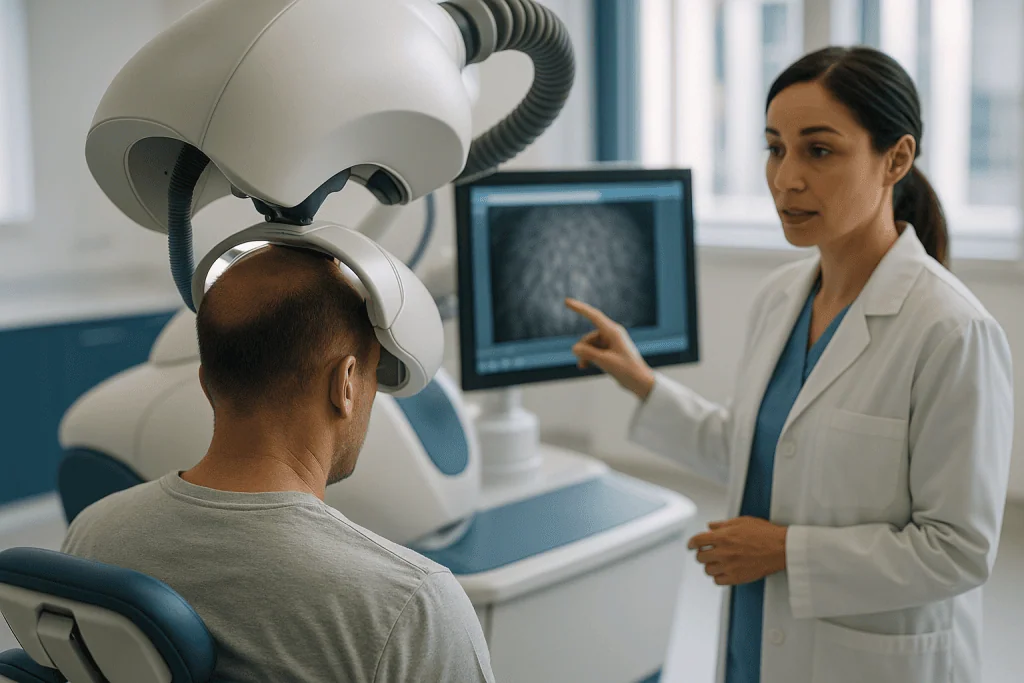
The robotic system adds three things to FUE: a high-resolution camera that photographs the shaved donor area many times per second, software that identifies each follicular unit and calculates its angle and depth, and a mechanical arm that positions a punch over the chosen unit and cores around it. A human being loads the parameters, approves the plan, watches the harvest in real time and can pause or override at any point.
What the robot does not do is equally important. It does not decide whether you are a good candidate, design your hairline, or make the small incisions where the grafts will live. On the systems in clinical use, those steps remain manual or surgeon-directed, and the difference between a natural and an artificial result still lives in those hands.
How does the robotic hair surgery procedure actually work, step by step?
The day begins before the robot is switched on. Hair in the donor area is trimmed very short, typically to around a millimeter, because the camera needs to see the exit angle of each shaft against the skin. Local anesthetic is injected across the back of the scalp; MedlinePlus notes that hair transplants are generally performed under local anesthesia, sometimes with light sedation, so you are awake but should not feel sharp pain during the procedure itself.
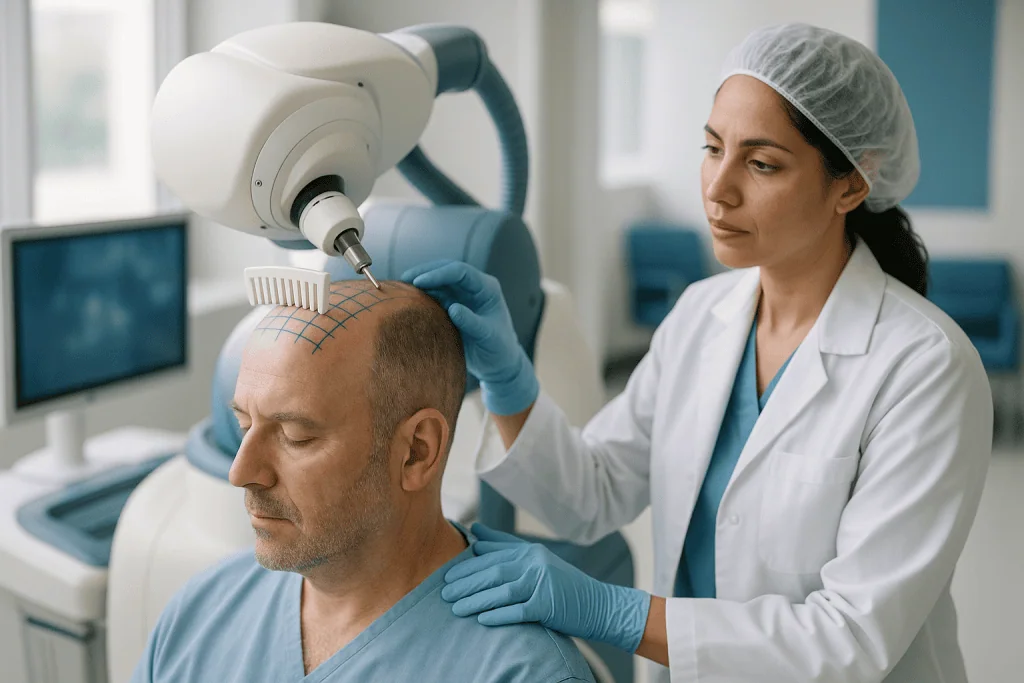
Next comes the tensioner. This is a small rectangular frame, secured to the scalp with skin-safe adhesive or gentle grips, that stretches the skin flat and gives the camera a fixed reference grid. Skin that is taut and still allows the software to keep its coordinates accurate while the punch works. The surgical team positions the frame over one section of the donor area at a time and moves it as each section is harvested.
Once the frame is in place, the imaging system scans the field. In a matter of seconds it identifies the follicular units within the grid, counts the hairs in each, and calculates how the follicle sits beneath the surface. The surgeon reviews this on a monitor and sets the rules: how densely to harvest, which sizes of unit to prioritize, and which areas to leave alone.
Harvesting then proceeds under supervision. The arm lowers a two-part punch over each selected unit: a sharp inner needle scores the skin surface, then a blunter outer punch follows the follicle down and frees it from the surrounding tissue. Grafts sit loosened in their sockets until an assistant lifts them out with forceps and places them in a chilled holding solution.
After the donor area is complete, the second half of the day is largely conventional. The surgeon makes recipient incisions in the thinning zone, and a team places each graft by hand. MedlinePlus describes the total procedure as lasting roughly 4 to 8 hours, and the NHS notes that it is usually completed in a single day without an overnight stay.
What does follicle mapping mean, and what does the software actually see?
Follicle mapping is the part of robotic hair surgery that most surprises patients when they see it on the screen. The camera does not see hair the way you do in a mirror. It sees short dark shafts emerging from pale skin at particular angles, and it converts those images into a three-dimensional model of where each follicle is likely to be sitting below the surface.
Why does depth and angle matter so much? A follicle is not a straight peg. It sits at a slant, often 30 to 50 degrees from the skin surface, and it can curve on the way down. If a punch enters at the wrong angle, it slices through the follicle instead of around it. That cut is called transection, and a transected graft frequently cannot grow. Human surgeons judge this angle by eye and by feel, thousands of times in a session. The software estimates it from the visible shaft and adjusts the punch trajectory for each unit before it descends.
The mapping also keeps a running tally. Because it knows where every unit is, it can space extractions so that no single patch is thinned too heavily. Over-harvesting is one of the quieter long-term risks of FUE; take too many grafts from one zone and the donor area itself can look moth-eaten years later. A program that enforces minimum distances between extractions is one way to guard against that, provided the surgeon sets sensible limits.
A few honest caveats belong here. The software works best on dark, straight hair against lighter skin, because contrast is what the camera relies on. Very light blond, gray or white hair may need temporary dyeing to be mapped, and tightly curled hair, which spirals under the skin, has historically been more challenging for automated punches. Many surgeons still prefer manual extraction in those cases. Mapping is impressive, but it is a tool with a range of conditions under which it performs well, not a universal solution.
How robotic harvesting works: the punch, the tensioner and the grid
Watch a robotic harvest for ten minutes and a rhythm emerges. The arm moves, dips, withdraws and moves again, several times a minute, with a soft mechanical click at each extraction. The steadiness is the point. A human hand tires over a four-hour harvest; a servo motor does not, and the last graft of the day is taken with the same precision as the first.
The punch itself is small, generally in the range of 0.8 to 1.0 millimeters in diameter for most systems, which is similar to the punches used in careful manual FUE. Smaller punches leave smaller healing dots but carry more risk of transection; larger punches are safer for the follicle but leave more visible scarring. The surgeon chooses the size for each patient, and that choice is one of the less glamorous but more consequential decisions of the day.
The tensioner deserves more attention than it usually gets. Skin under tension behaves like a drum: it resists the punch evenly and does not bunch or slide. Without that tension, the camera’s coordinates would drift as the skin moved, and the punch might land a fraction of a millimeter off target. Each tensioner window covers a modest patch of scalp, so a full harvest involves repositioning it many times, with the team checking alignment at every move.
Graft handling after extraction is where a good team shows. Once cored, a follicular unit is fragile and dries out quickly. Technicians lift each one, inspect it under magnification for damage or missing hairs, and place it in a cooled saline-based solution. Time outside the body is kept as short as practical because dehydration and warmth reduce the chance that a graft will survive transplantation.
None of this eliminates risk. Transection still happens with robotic systems, and published comparisons with skilled manual FUE are limited to small series and single-center reports rather than large randomized trials. The realistic claim is consistency across a long day, not perfection.
Robotic FUE vs manual FUE: what changes and what does not
Robotic FUE vs manual FUE is the comparison most people are really trying to make when they research this topic, and it helps to separate the stages of the operation, because the robot touches only some of them.
| Stage | Manual FUE | Robotic FUE |
|---|---|---|
| Candidate assessment | Surgeon | Surgeon |
| Hairline and density design | Surgeon | Surgeon |
| Donor area preparation | Trimmed short | Trimmed very short for camera |
| Identifying follicular units | Surgeon by eye and magnification | Software, reviewed by surgeon |
| Angle and depth judgment | Surgeon by feel | Algorithm per graft |
| Punch operation | Handheld motorized or manual punch | Robotic arm, surgeon supervising |
| Graft removal and sorting | Technicians | Technicians |
| Recipient site creation | Surgeon | Surgeon, or surgeon-approved robotic sites on some systems |
| Graft placement | Surgeon and team by hand | Surgeon and team by hand |
| Hair types suited | All, including curly and light hair | Best with darker, straighter hair |
Two things stand out in that table. First, the majority of the rows are identical. Second, the rows where the robot differs are all in the harvest, which is the stage most prone to fatigue-related error over a long session. That is a real advantage in principle, though the published evidence for a difference in graft survival between the two approaches is thin and comes mainly from small observational series.
The cost of that consistency is flexibility. A surgeon harvesting by hand can adapt instantly to a follicle that curves unexpectedly, a patch of scar tissue or an unusual hair type. The robotic system needs the surgeon to notice and intervene. Neither approach is superior for every scalp, which is exactly why the assessment stage matters more than the machinery.
Where does the surgeon fit in? Design, recipient sites and judgment
If you remember one idea from this article, make it this: the robot harvests, the surgeon transplants. Everything that determines whether a result looks like hair or like a hairpiece happens in the decisions the machine does not make.
Design comes first. A hairline that suits a 30-year-old can look odd on the same person at 55, when the surrounding hair has continued to thin. Surgeons plan for the scalp you will have in twenty years, not the one you have today, which usually means a slightly higher, softer and more irregular front edge than patients initially request. Single-hair units go at the very front to mimic the fine hairs of a natural hairline, and larger two- and three-hair units sit behind them to build density. Those choices are drawn on the scalp with a marker before any anesthetic is given.
Recipient site creation is the next surgeon-controlled stage. Using a fine blade or needle, the surgeon makes thousands of tiny incisions across the thinning area, each at a precise angle and direction. Hair does not grow straight up; it lies in whorls and sweeps that differ from person to person and from one part of the head to another. Matching those directions is what lets transplanted hair fall the way the original did. Some robotic platforms can create recipient sites from a surgeon-designed digital plan, but the plan itself, and the approval of every parameter, remains a human act.
Judgment runs through the whole day. The surgeon decides how many grafts the donor area can safely give without leaving it thin, when to stop harvesting a section, whether a particular graft is healthy enough to place, and how to respond if bleeding or an anatomical surprise changes the plan. When you evaluate a team, the relevant question is not which machine they own but who is making those calls and how much of the day they spend in the room.
Who is a robotic hair transplant usually for, and who is asked to wait?
Most people who have hair transplants have androgenetic alopecia, the inherited pattern of thinning that MedlinePlus estimates affects around 50 million men and 30 million women in the United States. In this condition, hair follicles at the front and crown gradually shrink under the influence of hormones, a process called miniaturization, while follicles at the back and sides are largely spared. That spared zone is what makes transplantation possible, because the moved follicles carry their resistance with them.
The typical robotic FUE candidate therefore has three things: a stable or predictable pattern of loss, a donor area dense enough to supply the grafts needed, and hair characteristics the imaging system reads well. Realistic expectations belong on that list too. Transplantation redistributes hair; it does not create more of it, and the donor supply is finite.
Several groups are commonly asked to wait or to consider other paths. Younger adults, particularly those in their early twenties, are often advised to hold off because their final pattern of loss is not yet clear and an early hairline can become stranded as thinning progresses behind it. People with hair loss from causes other than androgenetic alopecia, such as scarring alopecias, active autoimmune conditions or medication effects, usually need diagnosis and management of the underlying cause first; Mayo Clinic notes that treatment for hair loss depends on identifying the cause, and that some forms may respond to medical treatment alone.
Women with diffuse thinning across the whole scalp, rather than a distinct pattern with a spared donor zone, may not have a reliable donor area, and Harvard Health observes that surgical options for female pattern hair loss depend heavily on the distribution of the thinning. People with bleeding disorders, uncontrolled diabetes or a tendency toward abnormal scarring will need a careful medical review. In every case the go or wait decision rests with the assessing surgeon, informed by examination and sometimes by scalp imaging or blood tests.
Is hair transplant painful? What robotic surgery feels like
Is hair transplant painful is one of the most searched questions in this field, and the honest answer has two halves. The procedure itself should not be painful once the anesthetic has taken effect. The hours and days afterward involve discomfort that most people describe as manageable, though it is real.
The most uncomfortable moments for many patients are the anesthetic injections themselves. The scalp is sensitive, and numbing an area the size of two hands takes a series of injections that sting for a few seconds each. Teams often use vibration, cooling or a slow injection technique to blunt this. After that, the sensation during robotic harvesting is usually described as pressure or a faint tugging rather than pain. Because the procedure is long, boredom and stiffness from sitting or lying still become the main complaints, which is why patients are encouraged to bring headphones and take breaks.
Once the anesthetic wears off, typically within a few hours, the donor area tends to feel tight and sore, similar to sunburn, and the recipient area can throb. MedlinePlus lists pain, swelling and bruising among the expected short-term effects. Because FUE leaves scattered small wounds rather than a sutured line, the tightness in the donor area is often milder than after strip surgery, though this varies by person and by how many grafts were taken.
Pain relief is a conversation to have with your team before the day, not after. They will advise what is appropriate for you given your health and any other medicines you take, and this article deliberately does not suggest specific medications or amounts. What you can do is arrange a quiet first two days, sleep with your head slightly elevated as instructed, and avoid anything that raises pressure in the scalp such as heavy lifting or bending.
Numbness or altered sensation over the donor area is common for weeks and occasionally months as small nerves recover; it is expected, but mention it if it persists.
What does robotic hair transplant recovery look like in the first weeks?
Robotic hair transplant recovery follows the same arc as any FUE recovery, because the grafts and the recipient sites are biologically identical. The machine leaves no special mark of its own. What follows are typical ranges from the NHS and MedlinePlus, not promises, and your own team’s instructions take priority.
Days one to three are about protecting the grafts. Each transplanted follicle sits in a tiny incision held only by clotted blood and early tissue, and rubbing, scratching or knocking the area can dislodge it. The donor area is usually covered or left open with a light dressing. Small scabs form at every recipient site, and mild swelling of the forehead, sometimes drifting toward the eyes by day three, is common and settles on its own. The NHS suggests most people can return to work after roughly 3 days, though many choose longer if their job is physical or public-facing.
Days four to fourteen involve gentle washing according to the team’s protocol, which softens and lifts the scabs. Strenuous exercise, swimming and direct sun on the scalp are typically avoided for around a month, per NHS guidance. Numbness, itching and pinkness across the donor area are expected. The robotic punch sites heal as small dots that fade toward the surrounding skin over the following weeks.
Then comes the part that unsettles almost everyone. The NHS notes that transplanted hairs commonly fall out between 2 and 8 weeks after surgery. This is called shock loss and it is normal: the hair shaft detaches, but the follicle beneath survives and enters a resting phase. Around 3 months, the recipient area may look thinner than it did before surgery. New growth generally begins within a few months and continues to thicken, with the NHS describing final results as visible somewhere between 6 months and a year, sometimes later for the crown.
Follow-up visits are usually scheduled in the first week and again at several months so the team can check healing and growth.
How long do hair transplants last, and what happens 10 years later?
How long do hair transplants last is usually the second question after pain, and the biology gives a reassuring but incomplete answer. Transplanted follicles from the back of the head keep the genetic instructions that made them resistant to miniaturization; this principle, known as donor dominance, is why the moved hair typically continues to grow in its new location for as long as it would have grown in its old one. The NHS describes the results of a hair transplant as long-lasting.
The incomplete part concerns the hair around the grafts. Androgenetic alopecia is progressive. The native hairs behind and between the transplanted ones will continue to thin at whatever pace your genetics dictate, and Cleveland Clinic notes that people may need further procedures or ongoing medical treatment to address continuing loss. Ten years after a transplant, a person may have a front hairline that looks much as it did at the one-year mark, sitting in front of a crown that has thinned further. Surgeons plan for this, which is why conservative design and an honest estimate of your long-term donor supply matter more than a dramatic first result.
Aging also affects transplanted hair the ordinary way. Hairs gray, and the shaft can become finer, just as the untouched donor hair would have. The donor area itself will carry its small scattered scars indefinitely; they are usually hidden by hair kept at a modest length but can show if the head is shaved closely.
Medical treatments are frequently used alongside surgery to slow the loss of native hair. Mayo Clinic describes two broad approaches: a topical agent applied to the scalp that appears to prolong the growth phase of follicles, and oral medicines that reduce the hormonal signal driving miniaturization. Both require months of use before any effect is visible and lose their effect if stopped. Whether either is appropriate for you, and for how long, is a decision for the prescribing clinician, not for an article.
What are the risks of robotic hair surgery, and what are the alternatives?
Every operation carries risk, and a long day of thousands of tiny incisions is no exception. The NHS lists the main complications of hair transplant surgery as bleeding, infection, swelling, bruising around the eyes, a crust that forms on the scalp, numbness or lack of sensation over the treated areas, itching, folliculitis (inflammation or infection of hair follicles), and shock loss of hair around the treated site. Most of these are temporary. Scarring is permanent, though FUE scars are small and dispersed.
Robotic harvesting adds a few considerations of its own. Because the punch follows a computed trajectory, an error in mapping can transect follicles or leave an uneven pattern of extraction. The tensioner can cause temporary marks or, rarely, minor skin irritation. Systems perform less reliably on hair types with low contrast or tight curl, and pushing the technology on an unsuitable scalp can lead to a poorer harvest than a skilled manual approach would have achieved. A candid surgeon will tell you if your hair is a better match for a hand-held punch.
Poor outcomes that are cosmetic rather than medical, such as an unnatural hairline direction, visible plugginess from placing large units at the front, or a donor area harvested too thinly, are usually failures of planning rather than of equipment.
Alternatives deserve equal airtime. Medical treatment alone can stabilize thinning for many people and is often recommended before or instead of surgery, particularly for younger patients. Strip surgery remains a valid option and can yield large graft numbers in a single session for people who wear their hair long enough to cover a linear scar. Low-level light devices are marketed for hair loss; Mayo Clinic notes the evidence for them is limited and more study is needed. Scalp micropigmentation, hair systems and simply accepting the pattern are legitimate choices too. The task of the consultation is to lay these side by side without steering.
What people often get wrong about robotic hair surgery
The marketing around this technology has produced a set of misunderstandings worth correcting one at a time.
The robot does the whole operation. It does not. It harvests grafts under supervision, and on some systems creates recipient sites from a surgeon’s plan. Design, anesthesia, graft placement and every judgment call remain with people. A robotic platform in the hands of an inexperienced team is not a shortcut to a good result.
Robotic means newer, and newer means better. What is the newest hair transplant technique is a common search, and robotic FUE is indeed one of the more recent ways to remove grafts. But the follicle does not know how it was extracted. The published comparisons between robotic and skilled manual FUE are small, mostly single-center and observational, and they do not establish that one approach grows more hair than the other. Consistency over a long session is a plausible benefit; superiority is not proven.
The results are permanent and complete. Transplanted hair is long-lasting, but the surrounding native hair keeps thinning, and a single session rarely restores the density of a full head. Most people who pursue surgery are told to expect either further sessions over the years or ongoing medical treatment, or both.
Recovery is invisible. For the first week or two it is not. Scabbing, redness, forehead swelling and a very short donor trim are visible, and the shedding phase at 2 to 8 weeks can be alarming if no one warned you.
It works for everyone. It works best for people with a stable pattern, a strong donor area and hair the camera can see well. It is not a treatment for scarring alopecias, active autoimmune hair loss or diffuse thinning without a donor zone, and it is generally deferred in people whose pattern has not yet settled.
A machine removes the need to choose a surgeon carefully. If anything, it raises the stakes on that choice, because the person setting the parameters and drawing the hairline is doing the part that shows.
Questions to ask your care team before a robotic hair transplant
A good consultation should leave you with fewer questions, not more. If you walk in with a list, you are more likely to walk out with honest answers. The following are worth asking, in roughly the order they arise.
- What is causing my hair loss, and how confident are you in that diagnosis? Has anything other than androgenetic alopecia been ruled out?
- Is my pattern stable enough to operate on now, or would you prefer I wait or try medical treatment first?
- Given my hair color, texture and curl, is robotic harvesting a good match for me, or would manual FUE or strip surgery serve me better?
- Who will be in the room, and who does each stage: design, anesthesia, supervision of the robot, recipient sites and placement?
- How many grafts do you propose, how did you estimate my donor capacity, and what will my donor area look like if I shave my head in the future?
- Where exactly will the hairline sit, and how does that account for the hair I may lose over the next two decades?
- What pain relief plan do you use, and what should I do if pain is worse than expected?
- What is your protocol for washing, sleeping, exercise, sun and returning to work, and for how long?
- What should I expect at 2 weeks, 3 months and 12 months, and when are my follow-up visits?
- Which complications do you see most often, how do you handle them, and who do I contact out of hours?
- Do you recommend medical treatment alongside surgery, and who will prescribe and monitor it?
- If the result is uneven or thinner than hoped, what happens next?
You are entitled to clear, specific answers to each of these. Vague replies about technology are not a substitute for a plan built around your scalp, and any team worth trusting will welcome the scrutiny. The final decision to proceed, and every detail of how, belongs to you and the surgeon together.
When to call your doctor after robotic hair surgery
Most of what you will feel in the first two weeks is expected: tightness, soreness, itching, small scabs, pink dots across the donor area and some forehead swelling that may drift toward the eyes around day three. Numbness over the back of the head can persist for weeks. These are part of ordinary healing and are not by themselves reasons for alarm.
Some signs, however, warrant a prompt call to your surgical team, or to urgent care if you cannot reach them.
- Bleeding that does not stop with gentle pressure after several minutes, or that soaks through a dressing.
- Increasing rather than decreasing pain after the first two or three days, especially if focused in one spot.
- Spreading redness, warmth or hardness of the skin around the donor or recipient area, or pus draining from any site.
- Fever, chills or feeling generally unwell.
- Swelling that involves the eyelids to the point of affecting vision, or any sudden facial swelling with difficulty breathing or swallowing, which requires emergency care.
- A rash, hives or wheezing after taking any medicine you were given.
- Clusters of small pimple-like bumps across the treated area that persist or worsen, which may indicate folliculitis needing assessment.
- Any dislodged grafts with bleeding after a knock or fall.
Infection after hair transplant surgery is uncommon but is listed by the NHS among recognized complications, and it is far easier to manage early. Do not try to treat a suspected infection yourself with leftover medicines or home remedies.
Beyond the physical, contact your team if your mood drops sharply during the shedding phase or if the appearance of the healing scalp is causing significant distress. Reassurance from someone who has seen thousands of recoveries is part of aftercare, and a good team will not consider the call a nuisance.
Keep the out-of-hours number you were given somewhere accessible, and when in doubt, call. The judgment about whether something is normal healing or a problem belongs to the clinicians who know your case.
Frequently asked questions
How painful is robotic hair implant surgery?
The procedure itself should not be painful once local anesthetic is working; most people describe pressure or tugging during harvesting. The anesthetic injections sting briefly, and after the numbness wears off the scalp usually feels tight and sore for a few days, with swelling and bruising listed by MedlinePlus as expected effects. Your team will advise on appropriate pain relief for your situation.
How long do surgical hair transplants last?
Transplanted follicles usually keep growing long term because they retain the genetic resistance of the donor area, a principle called donor dominance. The NHS describes results as long-lasting. The hair around the grafts, however, continues to thin with age, so many people need further sessions or ongoing medical treatment to maintain overall density. No fixed lifespan can be promised for any individual.
What is the newest hair transplant technique?
Robotic follicular unit extraction is among the more recent methods of harvesting grafts, using cameras and software to guide a punch. Newer does not automatically mean better: the follicle is the same whether removed by hand or machine, and published comparisons are small and observational. The most important variables remain candidate selection, hairline design and the experience of the surgical team.
What happens 10 years after a hair transplant?
Ten years on, transplanted hair typically remains where it was placed, though it grays and may become finer with age like any other hair. The native hair behind and between the grafts often continues to thin, so the overall pattern can change and some people choose additional procedures or medical treatment. Small donor-area scars persist but are usually hidden by hair of modest length.
What is the difference in robotic FUE vs manual FUE?
Both remove individual follicular units through tiny punch incisions. In manual FUE the surgeon judges angle and depth by eye and hand; in robotic FUE software maps each unit and a supervised arm performs the punch. Design, recipient sites and placement are the same in both. Robotic systems offer steadiness over a long harvest but are less flexible with curly or very light hair.
Does robotic hair transplant recovery differ from ordinary FUE?
Not in any meaningful way, because the grafts and wounds are the same. The NHS suggests most people return to work after about 3 days, avoid strenuous activity for around a month, and expect transplanted hair to shed at 2 to 8 weeks before regrowing over 6 to 12 months. The donor area may need a shorter trim for the camera, which is the main visible difference early on.
Who is not a good candidate for robotic hair surgery?
People whose hair loss pattern is not yet stable, often those in their early twenties, are usually asked to wait. Those with scarring alopecias, active autoimmune hair loss or diffuse thinning without a spared donor zone are generally not suitable. Very light or tightly curled hair may be better served by manual extraction. Bleeding disorders and uncontrolled medical conditions require careful review first.
Will the robot make mistakes a surgeon would not?
It can. Mapping errors may transect follicles, and the system performs less reliably on low-contrast or curly hair. A surgeon monitors the harvest and can pause or override it, which is why supervision matters. Conversely, the arm does not tire over a long session. Neither approach is error-free, and the published evidence does not show one produces more surviving grafts than the other.
Do I still need medication after a hair transplant?
Often it is discussed, because surgery moves hair but does not stop the underlying thinning of native hair. Mayo Clinic describes topical and oral treatments that work by prolonging follicle growth or reducing hormonal signals, both requiring months before any effect and losing effect if stopped. Whether either is appropriate for you is a decision for your prescribing clinician after weighing benefits and side effects.
What are the red flags after robotic hair surgery?
Call your team promptly for bleeding that will not stop with gentle pressure, pain that worsens after the first few days, spreading redness or pus, fever, or pimple-like bumps that persist. Seek emergency care for facial swelling with breathing or swallowing difficulty, or any severe allergic reaction to a medicine. Ordinary tightness, itching, scabbing and mild forehead swelling are expected and settle on their own.
References
This article is for general information only and is not a substitute for professional medical advice. Please consult a qualified doctor about your individual situation.

More from the Blog
How Scalp Micropigmentation Is Done: Pigment Dots, Session Spacing and Matching Your Hair Shade
Scalp micropigmentation is a cosmetic tattooing technique in which a trained practitioner deposits thousands of tiny pigment dots into the upper layer of the…
Hair Transplant Repair for International Patients: Photo Review, Staged Sessions and Follow-Up
Hair transplant repair for international patients usually begins with a remote photo review, followed by an in-person examination that checks the donor area, scar…
Hair Transplants for a Receding Hairline: Timing, Design and Realistic Density
A hair transplant can restore a receding hairline by moving follicles from the back of the scalp, where hair is genetically resistant to balding,…

Norwood 5: Planning Coverage When the Bridge Is Going
Norwood 5 describes advanced male pattern hair loss in which the band of hair separating the receded hairline from the thinning crown, the so-called…
Non-Surgical Hair Restoration Results: Why Months of Consistency Matter More Than One Session
Non-surgical hair restoration works with the hair growth cycle, so results unfold over months rather than after a single session. Topical minoxidil typically needs…

When Can Coloring, Heat Styling and Ponytails Resume After a Hair Transplant for Women?
Most surgical teams ask women to wait until the scalp has fully healed before coloring hair after a hair transplant, which usually means several…