

What Anesthesia for an FUE Hair Transplant Feels Like: Numbing Injections and Post-Op Soreness
Key Takeaways
- FUE hair transplants are performed under local anesthesia, which numbs the scalp while you stay awake; general anesthesia is rarely used for this procedure.
- The injections sting for a few seconds each, and each subsequent needle hurts less because it enters skin already partially numbed by the previous one.
- Tumescent fluid, a large volume of dilute anesthetic and saline, makes the scalp feel tight and heavy and is the main reason forehead swelling appears in the days afterward.
- A small amount of a vasoconstrictor in the anesthetic reduces bleeding and prolongs numbness, and can briefly raise heart rate, which is why heart and blood pressure history is reviewed.
- Numbness wears off over a few hours; the donor area at the back of the head is usually the sorest part on the first night, and many people return to desk work after about three days.
- Transplanted hairs typically shed a few weeks after surgery and regrow over the following months, so early shedding is expected rather than a sign of failure.
FUE hair transplant anesthesia is typically local rather than general: a series of small injections numbs the back and top of the scalp while you stay awake, sometimes with light sedation for anxiety. Most people describe brief stinging and pressure for a few minutes, then numbness for the rest of the multi-hour procedure. Afterward, tightness and tenderness are common for a few days and usually ease as swelling settles.
The night before his procedure, a 38-year-old accountant sat at his kitchen table reading the same consent form for the third time. He was not worried about the surgeon, or the result, or even the shaved head he would walk out with. He was worried about the needle. Specifically, about being awake for it.
That is the question most people quietly carry into a consultation about fue hair transplant anesthesia, and it rarely gets an honest answer. Marketing pages promise a ‘pain-free’ morning. Forum threads describe the opposite. The truth sits somewhere in the middle, and it depends on which stage of the day you are talking about.
This explainer walks through what the numbing actually does to the scalp, what the injections feel like minute by minute, why the top of the head can feel waterlogged and tight, and what the soreness afterward is really like. It is written for the person at the kitchen table, not for the brochure.
Why the needle is the part of FUE hair transplant anesthesia people dread most
Follicular unit extraction, or FUE, is a hair transplant method in which individual hair follicles are removed one by one from the back and sides of the head and placed into thinning areas. Because the work is done on the surface of the scalp and nowhere near a body cavity, it is almost always performed under local anesthesia, which means medicine injected into the skin to block pain signals in one region while you remain conscious (NHS).
That single fact shapes the whole emotional experience. With general anesthesia you are asleep before anything happens. With local anesthesia you are present for the setup, the injections and the hours of quiet work that follow. People who have had dental anesthesia usually recognize the pattern: the discomfort is concentrated in the first few minutes, and the rest is a strange, numb absence of sensation.
The scalp is also densely supplied with nerves, and the skin over the skull is tight with little fat beneath it. Injecting fluid into a firm, well-innervated surface stings more than injecting into a soft forearm. Surgeons know this, which is why so much of the craft of scalp anesthesia is about how the medicine is delivered rather than which medicine is used.
Finally, there is the anticipation. Patients frequently report that the wait in the chair, listening to the team prepare, is worse than the injections themselves. Knowing exactly what will happen, and in what order, tends to shrink that anxiety. The sections that follow lay out that order.
How local anesthesia for a hair transplant actually works
Local anesthetics are medicines that temporarily stop nerve fibers from sending electrical signals. They do this by blocking sodium channels, the tiny gates in the nerve membrane that must open for a pain impulse to travel. When enough of those gates are blocked along a nerve, the message from the scalp never reaches the brain, so you feel touch and pressure only as vague sensations, or not at all (Cleveland Clinic).
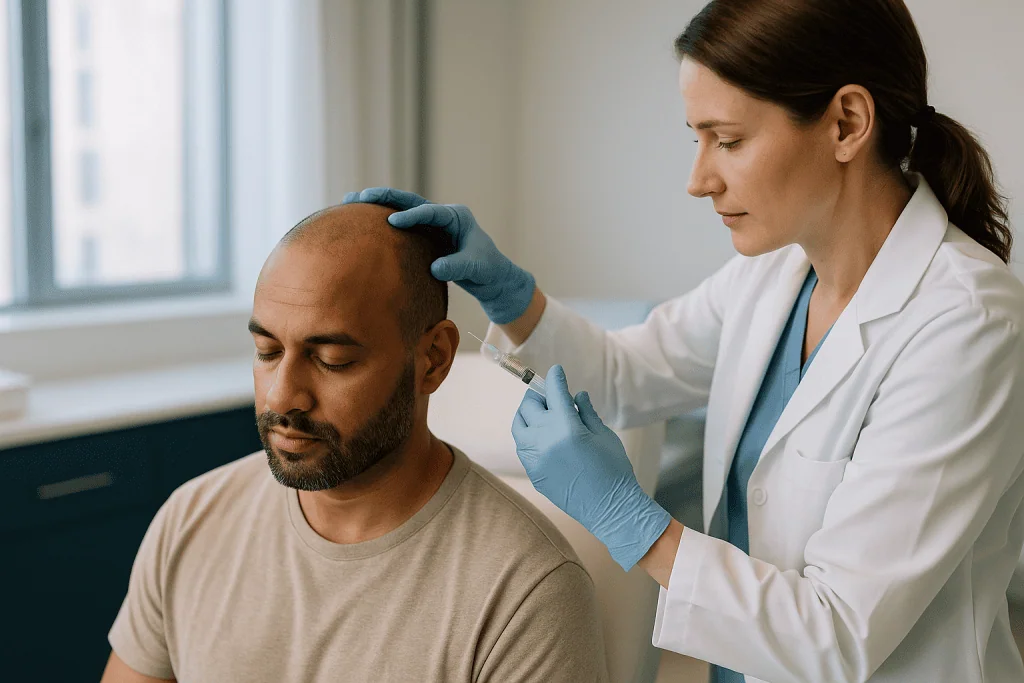
The medicines most often used in scalp surgery belong to a group called amide local anesthetics, of which lidocaine is the best known. Some act quickly and wear off in a few hours; others take longer to start but last longer. Surgical teams commonly combine them so that numbness begins fast and persists through a long session. The choice, mix and quantity are clinical decisions made by the surgeon and anesthesia team based on your weight, health history and the planned length of surgery, and they are not something a patient needs to negotiate.
Most scalp anesthesia also contains a small amount of a vasoconstrictor, a substance that narrows blood vessels. On the scalp this does two useful things. It keeps the anesthetic where it was injected, so the block lasts longer, and it reduces bleeding, which matters when a surgeon is making hundreds or thousands of tiny openings. Epinephrine is the vasoconstrictor generally used for this purpose.
The effect is regional, not systemic. You remain fully awake, can talk, and can ask for a break. Your heart rate may bump up briefly after the injections, a known and usually harmless response to the vasoconstrictor rather than a sign that something has gone wrong (MedlinePlus).
What the numbing injections feel like, step by step
The day usually begins face down or seated, with the donor area at the back of the head prepared first. This is where the grafts, the individual follicles or small groups of follicles, will be harvested. A hair transplant procedure typically runs several hours from start to finish, so the numbing is planned in stages rather than all at once (MedlinePlus).
The first sensation is a pinprick, followed almost immediately by a spreading sting. That sting is the anesthetic solution itself, which is mildly acidic, pushing into tight tissue. It builds over a second or two and then fades as the medicine begins to work. Patients often compare it to a bee sting or a strong flu shot. It is sharp, but it is short.
Then comes the part people do not expect: the second injection near the first hurts less, because the area is already partially numb. Surgeons work outward along a line, each new needle entering skin the previous one has started to deaden. Within a few minutes the back of the head feels thick, heavy and oddly distant, as if you were wearing a padded helmet.
Once harvesting is complete, usually after a break, the process repeats at the front and top. Here the skin is often tighter and the injections can sting more, especially along the hairline and temples. Many people describe pressure more than pain at this stage, a firm pushing sensation as fluid is placed under the skin. Some feel a brief dull ache at the crown. After that, sensation drops away and the rest of the placement is felt, if at all, as faint tapping.
Tumescent fluid: why your scalp feels tight and waterlogged
If you read about tumescent anesthesia and picture something exotic, relax. Tumescent simply means swollen, and the technique involves injecting a larger volume of very dilute anesthetic and salt water beneath the scalp so that the tissue puffs up and becomes firm. It is the same principle used in some other skin procedures, adapted to the scalp.

The purpose is mechanical as much as pharmacological. Lifting the skin away from the bone with a cushion of fluid gives the surgeon a firmer, more even surface to work on, spaces the follicles slightly apart so they are easier to remove individually, and compresses small blood vessels to limit bleeding. The dilute anesthetic in the fluid extends the numbness, and the vasoconstrictor within it keeps the area clearer and drier.
What you feel is distinctive. As the fluid goes in, the scalp becomes tight and stretched, a sensation people describe as a swimming cap two sizes too small, or like the skin has been inflated. There is pressure, sometimes a dull ache along the forehead, and a cool, heavy quality to the whole area. It is rarely painful once the initial numbing has taken hold, but it is strange, and strange is easier to tolerate when you know it is coming.
The fluid does not stay. Over the following hours and days the body absorbs it, though gravity can pull some of it forward. This is one reason forehead and eyelid swelling is so common in the days after a transplant, and why many teams ask patients to sleep with the head elevated. The puffiness is fluid, not injury, and it settles on its own in most people as the tissue drains.
Sedation for a hair transplant: do you stay awake, and does it change the pain?
Sedation means medicine given to make you calm or drowsy without putting you fully to sleep. It is separate from the numbing. Local anesthesia stops the pain signal; sedation changes how much you care about it, and how much you remember. Some patients are offered a mild sedative to take before the injections begin, particularly if they are anxious (MedlinePlus).
Oral sedation is the lighter option. You remain awake and able to follow instructions, but the edge of anxiety softens and time seems to pass faster. Intravenous sedation, given through a small line in the arm, produces a deeper drowsiness in which people often drift in and out and remember little of the injections. Both require monitoring of breathing, oxygen level and heart rate, and both mean you cannot drive afterward and will need someone to take you home.
General anesthesia, in which you are unconscious and often breathing through a tube, is rarely used for FUE. The procedure is long, the risks of general anesthesia rise with duration, and the surgeon benefits from a patient who can shift position or say when something is uncomfortable. It is generally reserved for specific medical circumstances the anesthesia team identifies in advance.
Whether sedation is offered, and which kind, depends on the setting, the staff available to monitor you, your medical history and your own preference. It is a reasonable thing to ask about at your consultation. It is not a reasonable thing to arrange for yourself: taking any calming medicine you have at home before surgery, without telling the team, can interact with what they give you and is unsafe. Leave that decision with the people who will be in the room.
Who FUE under local anesthesia is usually for, and who is asked to wait
Local scalp anesthesia suits most adults who are otherwise well and whose hair loss follows a stable pattern. The typical candidate has a healthy donor area at the back and sides, realistic goals, and no medical reason to avoid a long procedure in a chair. Hair transplant surgery is generally considered for people with pattern hair loss or hair lost to injury, rather than for hair thinning caused by an active medical condition (Mayo Clinic).
Several groups are usually asked to wait or to be assessed more carefully first. People taking blood thinners need a plan agreed with the prescriber, because the vasoconstrictor in the anesthetic controls bleeding only so far; no one should stop such a medicine on their own. Those with heart rhythm problems or uncontrolled blood pressure may need clearance, since epinephrine can briefly raise heart rate. Anyone who has had a previous reaction to a local anesthetic, whether at the dentist or elsewhere, should say so plainly; true allergy is uncommon but must be ruled out.
A scalp condition that is active, such as an inflamed or scarring form of hair loss, is usually treated and stabilized before any transplant is considered, because operating on inflamed skin can make matters worse. Very young adults whose loss is still progressing are often advised to wait, not because the anesthesia is riskier but because the pattern of future loss is unpredictable and the design may not age well.
Pregnancy, recent major illness, poorly controlled diabetes and some autoimmune conditions also prompt a pause or a conversation with the relevant specialist. None of this is a verdict. It is the surgical team making sure a long day under local anesthesia is a safe day.
Techniques teams use to take the sting out of the injections
Because the first few minutes are the hardest, a lot of quiet effort goes into softening them. Not every team uses every method, and the evidence behind some is stronger than others, but the following are common and worth understanding.
Slow, shallow injection is the foundation. Pushing anesthetic quickly stretches tissue and stings; a slower push through a very fine needle spreads the fluid gently. Working outward from an already numb spot means each new needle enters skin that is partly anesthetized. Buffering, which means adjusting the acidity of the solution closer to that of body tissue, is used by some surgeons to reduce the burning sensation. Cooling the skin with ice or a cold pack, or applying vibration next to the injection site, uses the same distraction principle as rubbing a bumped elbow: the nerves are busy carrying cold or vibration and have less capacity for pain. Topical numbing creams applied beforehand can dull the surface, although they do not reach the deeper tissue where most of the sting arises.
| Component | What it is | What you typically feel | Awake? |
|---|---|---|---|
| Local infiltration | Anesthetic injected directly into scalp skin | Brief sting, then numbness | Yes |
| Ring or nerve block | Injections around the edge of the area to block nerves feeding it | Several pinpricks, pressure | Yes |
| Tumescent fluid | Large volume of dilute anesthetic and saline under the skin | Tightness, heaviness, coolness | Yes |
| Oral sedation | Calming medicine by mouth | Relaxed, drowsy, aware | Yes |
| IV sedation | Calming medicine through a vein | Sleepy, patchy memory | Partly |
| General anesthesia | Fully unconscious, monitored airway | Nothing during surgery | No, rarely used |
Needle-free jet injectors, which push anesthetic through the skin under pressure, appear in some marketing. They may reduce the initial pinprick, but they do not eliminate the pressure of fluid entering tissue, and evidence for their advantage on the scalp remains limited. Treat any ‘completely painless’ claim with caution.
Does a hair transplant hurt during the procedure itself?
Once the scalp is numb, the honest answer from most patients is no, not in the way they feared. The harvesting phase, in which a small punch device removes each follicular unit, is felt as faint pressure or a tapping rhythm, if it is felt at all. The placement phase, when tiny openings are made in the recipient area and grafts are set into them, is similar. Many people watch a film, listen to music or doze.
What people do notice is everything around the pain. Lying face down for a long stretch stiffens the neck and shoulders. Sitting still for hours makes the lower back ache. The scalp itself can feel heavy and cold from the tumescent fluid. Hunger, boredom and the need to use the bathroom are more common complaints than surgical pain, which is why sessions are broken up with breaks and a meal.
Numbness does not always cover every square millimeter. Occasionally a patient feels a sharp pinch in one spot as the surgeon works toward the edge of the numbed field, or as the earliest injections begin to wear off during a long session. This is normal and expected. The right response is to say so immediately; a small top-up injection restores the block within a minute or two. Surgeons would far rather add anesthetic than have a patient grit their teeth.
People sometimes ask whether FUE hurts more or less than the strip method, in which a band of scalp is removed and stitched closed. Anesthesia for both is local and feels much the same at the start. The difference tends to arrive afterward, when a stitched wound at the back of the head is generally more tender than a field of tiny punch sites (NHS).
Hair transplant pain after surgery: what the first night feels like
The anesthetic does not switch off all at once. Over a few hours the numbness thins into pins and needles, then into a dull, tight ache, and by evening most people have full sensation back (Cleveland Clinic). That transition is when the day catches up with you.
The donor area at the back is usually the sorest part. It has had the most manipulation and the most punch sites, and it presses against a pillow when you lie down. People describe it as a sunburn that has been rubbed, or the feeling after a very tight haircut with clippers pressed too hard. The recipient area at the front tends to feel tight and tender rather than painful, partly because the swelling from the tumescent fluid is still present and partly because the grafts sit in fresh openings that are beginning to clot and seal.
Sleep is the practical challenge. Most teams ask patients to sleep propped up on several pillows or in a recliner for the first nights, both to reduce forehead swelling and to keep the new grafts from rubbing. Some people find a travel pillow that supports the neck without touching the back of the head makes this easier.
Your care team will usually give you a written plan for managing discomfort, which may include a common over-the-counter pain reliever or, less often, a short prescription. Which medicine, how much, and how long are decisions for the prescriber based on your history; some ordinary painkillers thin the blood slightly and are avoided after surgery, which is exactly why you should not improvise. If the plan is not controlling the soreness, call rather than guess.
What the following days and weeks usually look like
The pattern after FUE is fairly predictable, even if the timing varies from person to person.
The first two or three days are the sore, swollen, self-conscious stretch. Tiny crusts form around each graft. The donor area itches and feels tender to touch. Fluid from the tumescent injections can migrate forward, so a puffy forehead or heavy eyelids on the second or third morning is a well-known phenomenon rather than a complication. Numb patches on the top of the head are also common at this stage; small sensory nerves in the skin were disturbed, and they usually recover gradually over the following weeks or months.
Many people are able to return to desk work about three days after the procedure, though the visible crusting means some choose to wait longer for appearance reasons (NHS). Soreness typically fades to mild tightness within the first week. The grafted area needs careful handling for roughly the first two weeks, during which gentle washing as instructed and avoiding pressure, scratching or hats that rub are the main tasks (NHS).
Then comes the part no one warns you about strongly enough: the transplanted hairs fall out. This shedding, a few weeks in, is a normal response of a follicle that has been moved, and it does not mean the graft has failed (NHS). New growth starts a few months later, and it can take around six months or more before the outcome can be judged (MedlinePlus). Lingering scalp tightness or occasional tingling during this period is common and generally not a cause for concern unless it is worsening or accompanied by other symptoms.
Sex, exercise, sweating and sleep: activity after the anesthesia wears off
One question people type into search engines but rarely ask their surgeon is whether masturbation or sex is all right after a hair transplant. The honest medical answer is that sexual activity is just another form of exertion. It raises heart rate and blood pressure, which can increase oozing from fresh graft sites and worsen swelling, and it produces sweat, which is uncomfortable on a crusted scalp. The greater risk is mechanical: a headboard, a pillow or a partner’s hand brushing across the recipient area can dislodge grafts before they have anchored.
For that reason most teams group sex with other strenuous activity and ask patients to avoid it during the early healing window, while the grafts are most vulnerable, which broadly aligns with the period of careful handling in the first couple of weeks that general guidance describes (NHS). Your own team’s instruction takes precedence over anything online, including this article.
The same logic applies to gym sessions, running, cycling and heavy lifting. Bending forward with the head down increases pressure in scalp vessels; heavy sweating softens crusts and invites rubbing when you wipe your brow. Gentle walking is usually encouraged from the first day because it helps circulation and mood without any of these downsides.
Alcohol and smoking deserve a specific mention. Alcohol widens blood vessels and can increase bleeding and swelling in the days after surgery; nicotine narrows them and reduces blood flow to healing tissue. Many surgeons ask patients to avoid both for a period before and after the procedure. If you are unsure whether a particular activity counts as strenuous, the simplest rule is this: if it makes you sweat, breathe hard or touch your head, ask first.
What people often get wrong about FUE hair transplant anesthesia
‘It’s completely painless.’ No local anesthetic is painless to inject; the numbness that follows is what makes the rest of the day comfortable. A team that promises zero sensation is describing an aspiration, not a fact. A team that says ‘a few minutes of stinging, then nothing’ is being straight with you.
‘Needle-free means pain-free.’ Pressure devices change the delivery, not the physics. Fluid still has to enter tight tissue, and that pressure is felt. The evidence that jet injectors materially reduce discomfort on the scalp is limited.
‘More grafts means more anesthesia risk.’ Larger sessions do require careful attention to the total amount of anesthetic and vasoconstrictor used, which is precisely why teams calculate it against body weight and plan breaks. The number of grafts is a surgical planning question, not something a patient should relate to a particular volume or figure.
‘A famous person had it, so it must be the right choice.’ Speculation about which celebrities or executives have had FUE is a favorite of internet forums, and none of it is verifiable or relevant. No one knows another person’s medical history from photographs, and the right procedure for your scalp depends on your hair, your donor supply and your health, not on anyone else’s hairline.
‘You’ll be asleep.’ You will most likely be awake. Sedation, if used, calms you; it does not replace the numbing injections.
‘The numb patches mean nerve damage.’ Temporary reduced sensation on the crown is an expected result of small skin nerves being disturbed, and it typically improves over weeks to months. Persistent, worsening or painful numbness is a different matter and should be reported.
‘If it still hurts on day three, something went wrong.’ Tightness and tenderness in the first few days are normal. Pain that escalates rather than eases, or that comes with fever or discharge, is not.
Questions to ask your care team about local anesthesia and comfort
A good consultation should leave you able to describe your own surgical day in plain words. If it does not, ask. The following questions are ones patients often wish they had raised.
- Which type of anesthesia will I have, and will I be awake for the whole procedure?
- Who administers the anesthetic, and who monitors me during the session, particularly if sedation is used?
- What steps do you take to make the injections themselves more comfortable?
- How long is the session expected to last, and how are breaks and meals arranged?
- What should I do during surgery if I feel a sharp pain in one area?
- Which of my current medicines, supplements or herbal products should I mention or discuss with my prescriber before the day?
- Have you reviewed my history for reactions to local anesthetics, heart rhythm problems or blood pressure concerns?
- What will the soreness be like that night, and what is the plan for managing it?
- Which everyday painkillers should I avoid after surgery, and why?
- How should I sleep, wash and protect the grafts in the first two weeks?
- When can I return to work, exercise and sexual activity?
- What symptoms should prompt me to call you the same day, and how do I reach someone after hours?
Notice what is not on this list: questions about how many grafts a competitor would do, or which country has the best surgeons. Those are sales conversations, and they distract from the medical ones. Bring a written list, bring a companion if you can, and ask the team to confirm anything important in writing. The decision about how your anesthesia is delivered belongs to the people who will be responsible for your safety in the room, and a team worth trusting will welcome the scrutiny.
When to call your doctor
Most discomfort after FUE is expected and short-lived, but a small number of symptoms need same-day attention. Contact your surgical team, or seek urgent care if you cannot reach them, if you notice any of the following.
During or shortly after the injections: ringing in the ears, a metallic taste, tingling or numbness around the mouth, light-headedness, confusion, blurred vision, muscle twitching, a racing or irregular heartbeat, or chest tightness. These can be early signs of too much local anesthetic reaching the bloodstream, a rare but serious event that the team is trained to recognize and manage. Report them immediately rather than waiting to see whether they pass (Cleveland Clinic).
Signs of an allergic reaction: hives or a spreading rash, swelling of the lips, tongue or face, wheezing or difficulty breathing. Call emergency services for any trouble breathing.
In the days after surgery: pain that is getting worse rather than better, fever or chills, spreading redness or warmth around the donor or recipient area, pus or foul-smelling discharge, bleeding that does not stop with gentle pressure for several minutes, or swelling that is rapidly increasing or closing one eye. Numbness that is worsening, painful, or spreading beyond the operated area should also be reported.
Anytime: if you are unsure whether something is normal, call. Surgical teams expect these calls and would rather hear from you unnecessarily than late. Keep the after-hours number somewhere visible before the day of surgery, and make sure the person driving you home has it too.
Frequently asked questions
How painful is the anesthesia for a hair transplant?
The injections themselves are the most uncomfortable part, and most people describe a sharp sting lasting a few seconds per needle, similar to a strong vaccination or dental injection. Each additional injection tends to hurt less as the area numbs. After the first few minutes the scalp is numb, and the hours of harvesting and placement are usually felt as pressure or tapping rather than pain.
Does a hair transplant hurt after the anesthesia wears off?
Some soreness is expected. As numbness fades over a few hours, most people feel tightness across the top of the head and a tender, sunburn-like ache at the donor area in the back. This is typically most noticeable the first night and eases over the following days. Your care team will give you a plan for managing it; follow that rather than choosing painkillers yourself, since some common ones are avoided after surgery.
Is local anesthesia for a hair transplant safe?
Local anesthesia has a long safety record when the amount is calculated against body weight and the patient is monitored. Serious reactions are rare. The team reviews your medical history, current medicines and any past reactions to numbing injections beforehand. Report symptoms such as ringing ears, metallic taste, tingling around the mouth or a racing heartbeat immediately during the procedure, as these can signal too much anesthetic in the bloodstream.
Can I be put to sleep for an FUE hair transplant?
Full general anesthesia is rarely used for FUE because the procedure is long and the surgeon benefits from a patient who can shift position and speak up. Some teams offer oral or intravenous sedation to reduce anxiety and drowsiness while the local anesthetic does the numbing. Whether sedation is available depends on the setting, monitoring staff and your health, and the decision rests with the surgical and anesthesia team.
How long does the numbness last after a hair transplant?
The injected anesthetic typically wears off over a few hours, shifting from full numbness to pins and needles and then to a dull ache by the evening. Separately, patches of reduced sensation on the top of the head can persist for weeks or months because tiny skin nerves are disturbed during surgery. This usually improves gradually. Numbness that worsens, spreads or becomes painful should be reported to your team.
Is sedation for a hair transplant necessary?
No. Many people have FUE with local anesthesia alone and manage well, especially once they understand that discomfort is concentrated in the first few minutes. Sedation is an option for people who are very anxious about needles or about being awake for a long procedure. It is not a replacement for the numbing injections. Discuss your preference at the consultation, and never take a calming medicine of your own before surgery without telling the team.
Why is my forehead swollen a few days after the procedure?
The swelling is usually fluid from the tumescent anesthesia, a large volume of dilute anesthetic and saline placed under the scalp during surgery, drifting forward under gravity. It often peaks around the second or third day, can affect the eyelids, and settles as the body absorbs it. Sleeping with the head raised helps. Swelling that increases rapidly, closes an eye, or comes with fever, heat or redness needs a same-day call.
Is it okay to masturbate or have sex after a hair transplant?
Sexual activity counts as exertion: it raises blood pressure and heart rate, causes sweating and risks rubbing the grafts, which can dislodge them before they have anchored. Most teams ask patients to avoid sex and other strenuous activity during the early healing window, within the roughly two-week period of careful graft care that general guidance describes. Follow your own team’s timeline, which takes account of how your scalp is healing.
Did a famous person have FUE, and does that matter for my decision?
Speculation about celebrities’ hair transplants circulates widely, but no one can verify another person’s medical history from photographs, and it has no bearing on your care. Whether FUE is suitable for you depends on your pattern of hair loss, donor hair supply, scalp health and general medical history. A consultation with a qualified surgical team, not a comparison with a public figure, is the only reliable way to answer that question.
Does the number of grafts change how the anesthesia feels or how much it costs?
This article does not discuss prices. Medically, a larger session means a longer day and a wider area to numb, so more injections and more tumescent fluid, but the sensation of each injection is the same. Teams calculate the total anesthetic against body weight and plan breaks and top-ups for long sessions. How many grafts are appropriate is a surgical planning decision based on your donor supply and goals.
References
- MedlinePlus Medical Encyclopedia: Hair transplant
- NHS: Hair transplant (cosmetic procedures)
- MedlinePlus: Anesthesia
This article is for general information only and is not a substitute for professional medical advice. Please consult a qualified doctor about your individual situation.

More from the Blog

Norwood 5: Planning Coverage When the Bridge Is Going
Norwood 5 describes advanced male pattern hair loss in which the band of hair separating the receded hairline from the thinning crown, the so-called…
Non-Surgical Hair Restoration Results: Why Months of Consistency Matter More Than One Session
Non-surgical hair restoration works with the hair growth cycle, so results unfold over months rather than after a single session. Topical minoxidil typically needs…

When Can Coloring, Heat Styling and Ponytails Resume After a Hair Transplant for Women?
Most surgical teams ask women to wait until the scalp has fully healed before coloring hair after a hair transplant, which usually means several…

Is a Sapphire Transplant Painful? Local Anesthesia, Channel Opening and Scalp Soreness
A sapphire transplant is usually not described as painful during the procedure, because the scalp is numbed with local anesthetic before incisions are made.…

Is a Hair Transplant Permanent? What Stays, What Thins, What Ages
Mostly, yes. Transplanted follicles come from areas of the scalp that are genetically resistant to pattern balding, so they usually keep growing for decades,…

Hair Transplant for Women Recovery: Gentle Washing, Sprays and the Shedding Phase Week by Week
Recovery after a hair transplant for women usually follows a predictable arc: swelling and small crusts in the first week, gentle washing and saline…