

What Happens on Bone Marrow Transplant Day: Why the Infusion Looks Like a Transfusion

Key Takeaways
- The recipient has no surgery on transplant day: stem cells are given through an existing central line, usually over less than an hour to a few hours, while the patient is awake.
- Infused stem cells are not placed in the bone; they travel through the blood and home to the marrow on their own, which is why a bag and a drip are all that is needed.
- The sweetcorn or garlic smell during a frozen cell infusion comes from the DMSO preservative and can linger on the breath for a day or two.
- Most adult transplants now use stem cells collected from the donor's bloodstream rather than from bone marrow, despite the name.
- The riskiest period is not Day Zero but the following one to three weeks, when blood counts reach their lowest and any fever is treated as an emergency.
- Neutrophil engraftment typically appears about two to four weeks after infusion, but full immune recovery takes months after an autologous transplant and often a year or more after a donor transplant.
On bone marrow transplant day, often called Day Zero, donated or previously collected blood-forming stem cells are given through a central line, much like a blood transfusion. There is no surgery and no anesthesia for the recipient. The infusion itself usually takes under an hour to a few hours; the cells then travel to the marrow, where new blood cell production typically begins over the following weeks.
The bag arrives in a cooler, and for a moment the room is quieter than it has been all week. A nurse checks a wristband against a label, a second nurse reads the numbers back, and a small plastic bag of pale pink liquid is hung from the pole beside the bed. Someone in the family says what almost everyone thinks: “That’s it?”
It is, and it isn’t. Bone marrow transplant procedure day is the culmination of weeks of testing, planning and a hard stretch of chemotherapy, yet the moment itself looks almost ordinary. No operating theater, no scalpel, no countdown from ten. Just a line, a pump and a slow drip.
That gap between what patients expect and what they see is worth closing before the day arrives. Knowing why the infusion resembles a transfusion, what the smell in the room is, and why the calendar restarts at zero can turn a frightening abstraction into something a person can sit with, and even watch.
Why bone marrow transplant procedure day is called Day Zero
Transplant teams count time in a peculiar way. The days of chemotherapy before the infusion are labeled with minus signs: Day minus six, Day minus two. The infusion itself is Day Zero. Everything afterward is Day plus one, plus seven, plus one hundred. Ask a nurse how someone is doing and the answer may begin with “She’s Day plus twelve.”
The convention exists because the infusion is the biological reset point. Before it, the patient’s own marrow, the spongy tissue inside the larger bones where blood cells are made, has been deliberately emptied or heavily suppressed by conditioning treatment. After it, the infused stem cells, the immature cells that can grow into red cells, white cells and platelets, need time to settle into the marrow and begin producing new blood. That process is called engraftment. Because engraftment, infection risk and later complications all follow a predictable rhythm measured from the infusion, the team anchors the calendar to it (Mayo Clinic; MedlinePlus).
For patients, Day Zero carries a weight that the physical event does not match. The cells are often given in a regular inpatient room. The patient is awake, may be eating breakfast, and can usually talk through the whole thing. Many centers mark the occasion in some small way, but the medicine is undramatic.
Understanding the numbering also helps make sense of everything that follows. When the team says counts usually begin to recover “around Day plus ten to plus twenty-eight,” or that a check is planned “at Day plus one hundred,” those numbers are not arbitrary. They trace the expected life cycle of cells that were handed over in a bag on a morning that looked, to the untrained eye, like any other.
What happens during the stem cell infusion, step by step
The choreography is careful and mostly quiet. It typically unfolds like this.
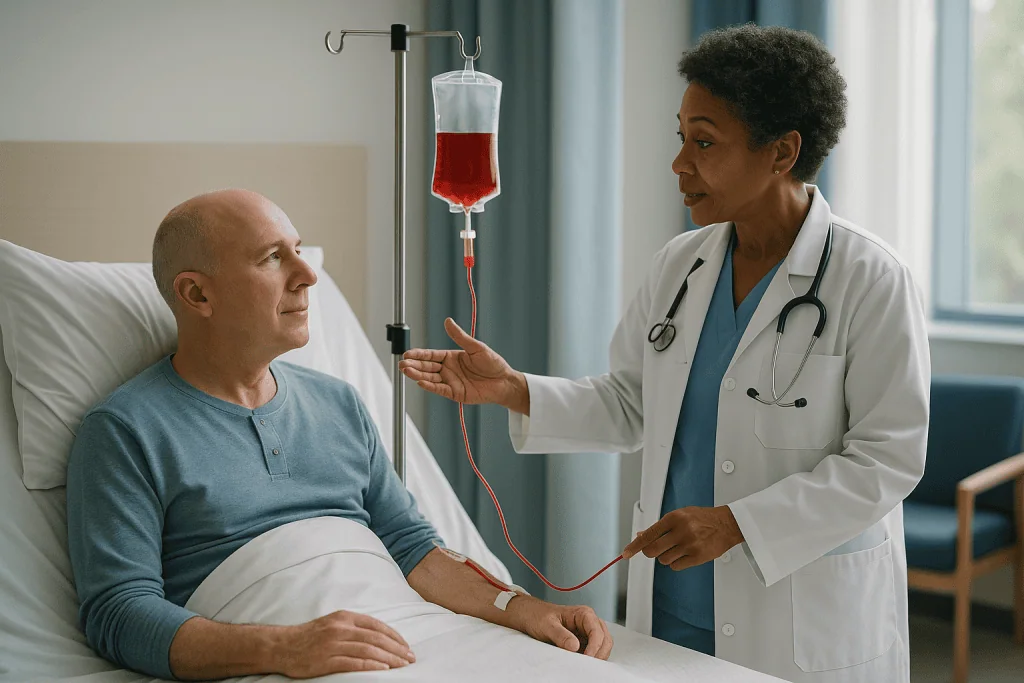
- Identity checks come first. Two clinicians confirm the patient’s name, date of birth and hospital number against the labels on each bag of cells. For donor cells, the donor identification and blood group are cross-checked too.
- Baseline observations are recorded: temperature, pulse, blood pressure, breathing rate and oxygen level. These repeat frequently throughout the infusion.
- Pre-medications may be given. Depending on the protocol and the product, an antihistamine, an anti-sickness medicine or a corticosteroid may be used to reduce the chance of a reaction. Whether these are used, and which, is the treating team’s call.
- If the cells were frozen, they are thawed at the bedside in a warm water bath, usually one bag at a time, and infused promptly because the preservative is hard on cells once they are warm.
- The cells run through the central line, a soft tube placed in a large vein in the chest or neck before the transplant, either by gravity or a pump. Fresh cells, collected from a donor within the previous day or two, may arrive in a larger volume and run more slowly.
- Nurses stay in or near the room, watching for flushing, chills, shortness of breath, chest tightness or a change in urine color. Most infusions pass without incident (Cleveland Clinic; Mayo Clinic).
Once the last bag is empty the line is flushed, observations continue for a period, and the day is, in the procedural sense, over. There is no dressing to change, no wound to protect. The cells are already circulating, and within hours they begin homing to the marrow spaces that conditioning treatment cleared for them (MedlinePlus).
Why the infusion looks like a transfusion, and why it is not surgery
The word “transplant” pulls the mind toward kidneys and livers: an incision, a surgeon, an organ lifted from one body and stitched into another. Blood-forming stem cells do not work that way, and the reason is elegant.
A kidney has to be placed where its plumbing connects. Stem cells find their own way. Once in the bloodstream, they respond to chemical signals from the marrow and migrate into it, a process known as homing. The marrow, in other words, is not a location the team has to reach; it is a destination the cells reach on their own (Johns Hopkins Medicine).
That is why the delivery method is a bag and a line rather than an operating room. Mechanically the infusion is closer to a red cell transfusion than to any surgical transplant. The cells are suspended in fluid, sometimes tinted pink or red by residual red cells, and run through the same kind of tubing.
There are differences worth knowing. Stem cell products are often frozen and contain a preservative called dimethyl sulfoxide, or DMSO, which protects cells during freezing but can cause a distinctive smell and, occasionally, nausea, flushing or a temporary drop in blood pressure as it is infused (Cleveland Clinic). Donor products carry a small risk of reaction from mismatched red cells or plasma, which is why blood groups are checked even when the transplant is between people of different types. And the stakes are higher: a unit of red cells can be replaced tomorrow, whereas a stem cell product may represent a donor’s single collection.
Where surgery does appear in this story is on the donor’s side, and only for one collection method. When cells are harvested directly from the pelvic bones, the donor has a procedure under anesthesia. The recipient, on Day Zero, never does.
Where the cells come from: marrow, blood or cord
“Bone marrow transplant” is the phrase most people use, but the cells hung on Day Zero may not have come from marrow at all. Three sources are in routine use, and each shapes what the infusion looks like at the bedside (NHS; Mayo Clinic).
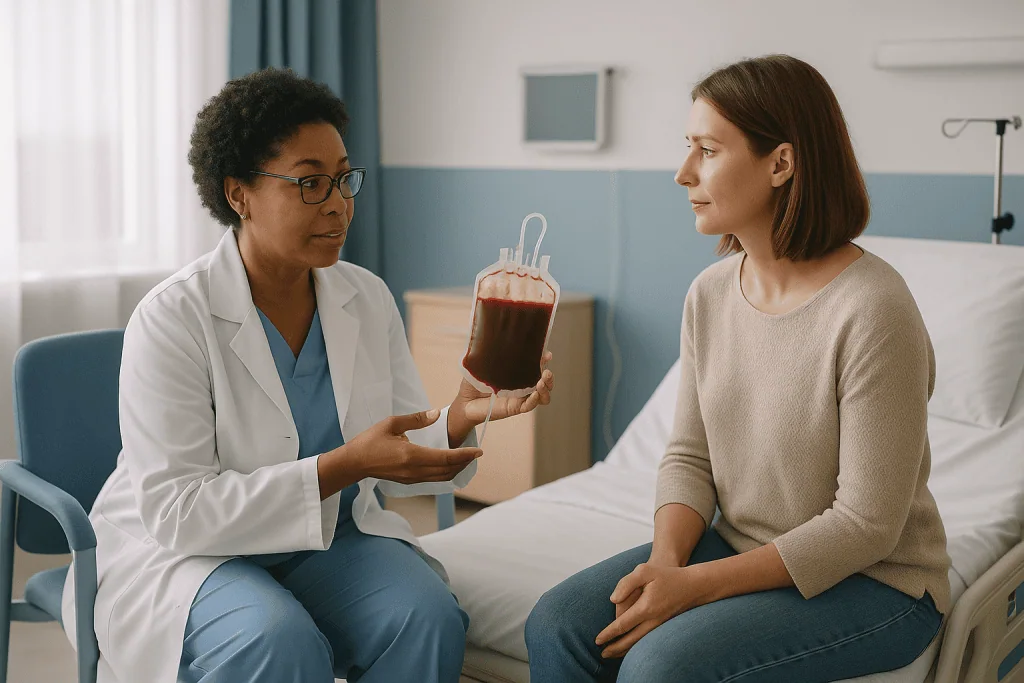
| Source | How it is collected | What the recipient sees on Day Zero |
|---|---|---|
| Bone marrow | Drawn with needles from the back of the donor’s pelvic bones under general or regional anesthesia | Larger fluid volume, often fresh rather than frozen, runs over a longer period |
| Peripheral blood stem cells | Donor receives a growth factor for several days to move stem cells into the bloodstream; cells are then filtered out through a machine (apheresis) | Smaller bags, frequently frozen; the most common source for adults today |
| Umbilical cord blood | Collected from the placenta and cord after a birth, frozen and stored in a public bank | Very small volume, always thawed at the bedside; sometimes two units are used |
The differences matter beyond appearances. Peripheral blood products usually contain more stem cells and tend to engraft somewhat faster than marrow; cord blood contains fewer cells and typically engrafts more slowly, which is one reason it is used more often in children and smaller adults (Johns Hopkins Medicine). Marrow harvests involve a procedure for the donor but no drug to mobilize cells.
Which source is chosen depends on the disease, the availability of a matched donor, the patient’s size and the center’s protocol. Patients are usually told well before Day Zero what kind of product is coming, and it is reasonable to ask why that choice was made.
How long does a bone marrow transplant procedure take, and what does "procedure" mean here?
Two questions hide inside this one, and they deserve separate answers.
The infusion itself is short. Depending on the number of bags, whether the cells are fresh or thawed, and how the patient tolerates it, the process is commonly described as taking from less than an hour to a few hours (Cleveland Clinic). A single frozen bag of peripheral blood cells may be in within thirty minutes. A large fresh marrow harvest, or several cord blood units thawed one after another, takes longer. The monitoring around it adds time on either side.
The “procedure” in the wider sense is measured in weeks. Counting from the start of conditioning chemotherapy through infusion and the early recovery period, most people are in hospital for several weeks, and some considerably longer if complications arise (NHS; Mayo Clinic). Full immune recovery is a matter of months to a year or more.
As for the word itself: in medicine, a procedure is any planned intervention performed on or for a patient, from drawing blood to open-heart surgery. It does not imply an operation. Transplant teams sometimes avoid the word for Day Zero altogether, preferring “infusion” precisely because “procedure” makes families picture a theater and a recovery room that do not exist here. If a scheduling letter says “transplant procedure,” it is worth asking whether that means the infusion day or the whole admission.
What patients often find useful is a written timeline from their own team: when conditioning starts, the planned Day Zero, and the earliest realistic point for discharge. Those dates shift, but having them on paper turns an open-ended stay into a sequence of stages, each with a purpose.
Who a stem cell transplant is usually for, and who is usually asked to wait
Transplant is not a first-line treatment for most conditions. It is offered when the disease and the person’s overall health together make the expected benefit worth the considerable risk.
The commonest reasons are blood cancers: acute leukemias, certain lymphomas and multiple myeloma. It is also used for non-cancerous conditions in which the marrow fails or produces faulty cells, including severe aplastic anemia, some inherited immune deficiencies, and hemoglobin disorders such as sickle cell disease and thalassemia (MedlinePlus; NHS). In each case the logic is the same: replace a marrow that is diseased, damaged or destroyed by treatment with one that can make healthy blood.
Being a candidate involves more than a diagnosis. Teams assess heart, lung, liver and kidney function, because conditioning chemotherapy and the weeks of low blood counts that follow place heavy demands on all of them. They look at how well the disease is controlled at the time of transplant, since cells infused into a marrow full of active disease have a harder task. They consider age and general fitness, though many centers now use a functional assessment rather than a fixed age cut-off. And they ask about practical support: whether someone can be with the patient after discharge, and whether the home environment is safe for a person with a fragile immune system (Mayo Clinic).
People are usually asked to wait when the disease is not yet in the state the protocol requires, when an active infection needs to clear, when an organ test needs repeating, or when a suitable donor has not been found. Waiting can feel like a setback. Clinically it is often the opposite: Day Zero is postponed so that Day Zero has the best chance of working. The decision, and its timing, rests with the treating team.
The days before: why Day Zero cannot happen without conditioning
If the infusion is the quiet part, conditioning is the loud one. In the week or so before Day Zero, patients receive high-dose chemotherapy, sometimes with radiation to the whole body, given over several days (NHS). This is usually the most physically demanding stretch of the entire admission, and understanding its purpose helps people endure it.
Conditioning does three jobs at once. It attacks any remaining disease. It clears space in the marrow so that new cells have room to settle. And, in a donor transplant, it suppresses the patient’s own immune system enough that it does not reject the incoming cells (Mayo Clinic). The intensity varies: some regimens are designed to wipe out the marrow completely, while reduced-intensity regimens, often used for older or less fit patients, rely more on the donor immune cells to do the work against the disease.
Side effects follow from the mechanism. Rapidly dividing cells take the brunt, which means the lining of the mouth and gut, hair follicles and the marrow itself. Nausea, mouth soreness, diarrhea and profound tiredness are common in the days around Day Zero and typically peak after it, as the last of the patient’s own blood cells die off and before the new ones arrive (Cleveland Clinic).
There is also a rest day or two between the final dose of conditioning and the infusion, giving the chemotherapy time to clear from the body so it does not damage the incoming cells. That pause can feel strange: the treatment has stopped, the cells have not yet arrived, and the counts are falling. It is expected, and it is the reason the calendar runs Day minus one before Day Zero.
What you may feel, smell and taste during the infusion
Ask anyone who has been through a frozen stem cell infusion what they remember, and a surprising number will mention sweetcorn. Or garlic. Or, less charitably, an old refrigerator.
The culprit is DMSO, the preservative that protects cells during freezing. As it enters the bloodstream and is exhaled through the lungs, it produces an odor that the patient tastes at the back of the throat and that everyone in the room can smell. Visitors sometimes notice it in the corridor. It can linger on the breath and skin for a day or two, and it is entirely harmless in that respect, though many centers keep hard candy or citrus slices at the bedside because they blunt the taste (Cleveland Clinic).
DMSO can also cause more than an odd smell. Nausea, flushing, a tickly cough, headache and a temporary drop in blood pressure or slowing of the heart rate are recognized effects, which is why frozen products are infused at a controlled rate and why pre-medications may be used. Fresh products carry no DMSO and generally cause fewer of these symptoms.
Other sensations are worth knowing about in advance. Chills, sometimes with a low-grade fever, can occur as the immune system reacts to the fluid and the cells. A tight chest or shortness of breath is uncommon but taken seriously, and the nurses will slow or pause the infusion. Urine may turn pink or red for a day, because the product contains some red cells that break down; this is expected and the team will say so, but it startles people who were not warned (Mayo Clinic).
Pain, notably, is not part of the picture. The cells arrive through a line that is already in place. Most people describe the infusion as uneventful, and a few sleep through it.
Autologous versus allogeneic: how transplant day differs
Two words sort every transplant into one of two kinds, and they change both the day and the months that follow.
An autologous transplant uses the patient’s own stem cells, collected weeks or months earlier when the disease was under control, frozen, and returned after high-dose chemotherapy. Here the transplant is really a rescue: the chemotherapy is the treatment, and the cells are given back so that the marrow can recover from a dose it could not otherwise survive. There is no donor to match and no risk of the new cells attacking the body. Recovery of counts is often somewhat faster, and long-term immune suppression is not needed (Johns Hopkins Medicine; MedlinePlus).
An allogeneic transplant uses cells from another person: a matched sibling, an unrelated volunteer donor, a half-matched family member or a cord blood unit. The incoming cells bring a new immune system with them. That is a double-edged gift. The donor immune cells can recognize and attack residual disease, an effect that is part of why allogeneic transplant is chosen for many leukemias. The same cells can also attack the recipient’s healthy tissues, causing graft-versus-host disease, in which skin, gut and liver are the usual targets (NHS).
On Day Zero itself, the differences are subtle but real. Autologous cells are always frozen, so the DMSO smell is a given. Allogeneic cells may be fresh, arriving by courier from a collection center that morning, or frozen. Blood group differences between donor and recipient mean extra checks and, sometimes, extra processing of the product. And in an allogeneic transplant, medicines to suppress the immune system will already have been started, so the patient is not only receiving cells but also beginning a long relationship with a regimen the team will adjust for months.
What the bone marrow transplant recovery timeline usually looks like in the following weeks
Day Zero starts a clock, and the first weeks on that clock follow a recognizable shape, even though the pace varies from person to person.
Days plus one to roughly plus ten are usually the low point. The patient’s own blood counts, already falling from conditioning, reach their nadir. Neutrophils, the white cells that fight bacteria, may be effectively absent, a state called neutropenia. Platelets and red cells are supported with transfusions. Mouth sores, gut upset and exhaustion are typically at their worst, and fevers are common and treated promptly with antibiotics while the cause is investigated (Cleveland Clinic).
Engraftment, the first sustained rise in neutrophil counts, most often appears somewhere between about two and four weeks after infusion, with peripheral blood products generally on the earlier side and cord blood on the later side (MedlinePlus; NHS). It is not a single moment but a trend confirmed over consecutive days of blood tests. Around this time energy may begin to return, and mouth and gut symptoms often ease as the lining regrows. Some people notice a low fever, rash or aching bones as the new cells take hold, sometimes called engraftment syndrome, which the team monitors.
Discharge usually follows engraftment once the person can eat and drink, manage medicines and has no uncontrolled fever, but it is not the end of intensive care. Clinic visits are frequent in the first few months, often several times a week at first. The immune system, particularly the part that fights viruses and fungi, takes far longer to rebuild than the neutrophil count suggests: months for autologous transplants, commonly a year or more after allogeneic transplants, and longer if graft-versus-host disease needs treatment (NHS; Mayo Clinic). Childhood vaccinations are typically repeated once the team judges the immune system ready.
Risks the team watches for on and after transplant day
Honest explainers describe risk in proportion, and transplant carries real risk. The infusion itself is the safest part; the weeks around it are where complications cluster (Mayo Clinic; MedlinePlus).
During the infusion, the concerns are reactions: to DMSO, to red cell or plasma incompatibility in donor products, or to fluid volume in someone whose heart or kidneys are under strain. These are watched for minute by minute and are usually managed by slowing the drip and giving supportive medicines.
In the days after, infection dominates. With no functioning neutrophils and a damaged gut lining, bacteria that live harmlessly in the bowel can enter the blood. Central lines are another entry point. This is why transplant units restrict visitors, why food is prepared carefully, and why any fever is treated as an emergency until proven otherwise.
Bleeding risk rises as platelets fall and is countered with transfusions. Some conditioning regimens can injure the liver’s small blood vessels, a condition called veno-occlusive disease or sinusoidal obstruction syndrome, which the team screens for with weight, abdominal girth and liver tests.
Allogeneic transplants add two large categories. Graft failure, in which the donor cells do not engraft or are rejected, is uncommon but serious. Graft-versus-host disease is more frequent: an acute form in the first months, typically affecting skin, gut and liver, and a chronic form that can appear later and involve many organs. Immunosuppressant medicines reduce but do not eliminate the risk, and they in turn raise infection risk (NHS).
Longer term, teams monitor for organ effects of conditioning, hormonal changes, fertility impact, cataracts and second cancers. None of this is a reason to refuse transplant when it is recommended; it is the reason the recommendation is made carefully, and the reason follow-up lasts years.
What people often get wrong about bone marrow transplant procedure day
Some myths about Day Zero are harmless. Others cause real distress, or lead people to underestimate the weeks that follow. A few worth correcting:
“It’s an operation.” For the recipient, it is not. There is no anesthesia, no incision and no surgical recovery. The only person who may have a procedure under anesthesia is a donor giving marrow from the pelvis, and that is a separate event, often at a different hospital (NHS).
“The cells are injected into the bone.” They are given into a vein and find the marrow themselves. Direct injection into bone is not how this works.
“Day Zero is the dangerous day.” The infusion is closely monitored and reactions are usually manageable. The higher-risk period is the following one to three weeks, when counts are at their lowest and infection is most likely (Cleveland Clinic).
“Once the counts come back, it’s over.” Neutrophil recovery is a milestone, not a finish line. Immune reconstitution takes months to years, and in donor transplants the risk of graft-versus-host disease continues well after discharge (Mayo Clinic).
“A bone marrow transplant always uses bone marrow.” Most adult transplants today use stem cells collected from the bloodstream. The older name has stuck; the source has changed.
“The donor has to be a relative.” Matched siblings are the classic donors, but unrelated volunteer donors, half-matched relatives and cord blood units are all in routine use.
“If I feel fine on Day Zero, something went wrong.” Feeling fine is the norm. The drama, such as it is, happened during conditioning and will return briefly during the nadir. A quiet infusion is a good infusion.
Questions to ask your care team before Day Zero
Transplant teams expect questions, and asking them early makes the admission easier to navigate. Writing answers down, or having a companion do so, helps on days when concentration is short. Consider asking:
- What kind of transplant is planned, autologous or allogeneic, and why is that the right choice for my situation?
- Where will the cells come from, and will they be fresh or frozen on the day?
- What conditioning regimen is planned, over how many days, and what side effects should I expect at their worst?
- Which pre-medications, if any, will be given before the infusion, and what will you be watching for while it runs?
- Roughly how long is the infusion expected to take for my product, and can family be in the room?
- When do you expect engraftment, and what will tell you it has happened?
- What is the earliest realistic discharge, and what needs to be true for me to go home?
- After discharge, how often will I be seen, and who do I contact out of hours?
- What symptoms should prompt me to call immediately rather than wait for the next appointment?
- For donor transplants, which immune-suppressing medicines will I take, how will they be adjusted, and for how long?
- What are the plans for fertility preservation, if relevant, and for re-vaccination later?
- Is there a clinical trial or an alternative approach that was considered, and why was this path recommended?
None of these questions has a universal answer. The point of asking is to hear the reasoning specific to you, from the people who will be at the bedside on Day Zero and at the clinic on Day plus one hundred.
When to call your doctor
During the inpatient stay, the nursing team is monitoring continuously, so the main task is to speak up about anything new rather than assume it is expected. After discharge, the responsibility shifts, and the threshold for calling should be low. Transplant units give patients a direct number for exactly this purpose; use it rather than waiting for a routine appointment or going through a general helpline (NHS; Cleveland Clinic).
Contact the transplant team urgently, day or night, for any of the following:
- A temperature at or above the threshold your team specified, or chills and shaking even without a measured fever.
- Shortness of breath, chest pain, or a new persistent cough.
- Bleeding that does not stop, blood in urine or stool, black stools, or widespread bruising or pinpoint red spots on the skin.
- A new rash, especially on the palms, soles, ears or trunk, or yellowing of the skin or eyes, which can signal graft-versus-host disease or liver trouble after a donor transplant.
- Severe or worsening diarrhea, vomiting that prevents you keeping down fluids or medicines, or abdominal pain and swelling.
- Redness, pain, swelling or discharge around the central line, or a line that will not flush.
- Confusion, severe headache, new weakness, or a seizure.
- Painful blisters or sores, particularly on the lips, mouth or around the eyes.
- Signs of dehydration: dizziness on standing, passing very little urine, or a racing heart.
Fever deserves special emphasis. In a person with few or no neutrophils, a fever can be the only sign of a bloodstream infection that progresses within hours. Guidelines treat it as a medical emergency requiring prompt assessment and antibiotics, not a watch-and-wait symptom (Mayo Clinic).
If you cannot reach the transplant team and symptoms are severe, call emergency services and tell them you have had a stem cell transplant. Every judgment about what to do next belongs to the clinicians who know your case.
Frequently asked questions
How long does a bone marrow transplant procedure take?
The infusion itself is commonly described as taking from under an hour to a few hours, depending on how many bags of cells there are and whether they are fresh or thawed. The wider process is much longer: conditioning chemotherapy runs over several days beforehand, and most people stay in hospital for several weeks afterward while blood counts recover. Your team can give a timeline specific to your product and protocol.
What does "procedure" mean in bone marrow transplant?
In medicine, a procedure is any planned intervention performed on or for a patient, and it does not imply an operation. For the transplant recipient, the procedure on Day Zero is an intravenous infusion of stem cells, not surgery. Some teams avoid the word and say “infusion” to prevent confusion. If a letter mentions a transplant procedure, ask whether it refers to the infusion day or the whole admission.
What happens during stem cell infusion, minute by minute?
Staff check your identity against the cell bags, record baseline observations, and may give pre-medications. Frozen cells are thawed at the bedside one bag at a time and run through your central line, either by gravity or pump. Nurses monitor temperature, pulse, blood pressure and breathing throughout and watch for flushing, chills or breathlessness. When the last bag finishes, the line is flushed and observations continue for a while.
Is stem cell transplant day zero painful?
The infusion is not usually painful. The cells arrive through a central line that was placed earlier, so there is no needle on the day. Some people feel nausea, flushing, a tickly cough, chills or an odd taste from the DMSO preservative in frozen products. The more uncomfortable phase is typically before and after Day Zero, when conditioning chemotherapy causes mouth soreness, gut upset and fatigue.
Why does the room smell like garlic or sweetcorn during the infusion?
The smell comes from dimethyl sulfoxide, or DMSO, a preservative added to stem cells before freezing so they survive storage. As it enters the bloodstream it is breathed out through the lungs, so the patient tastes it and others in the room smell it. It can linger on breath and skin for a day or two and is not a sign of a problem. Fresh, unfrozen products contain no DMSO.
Why is transplant day called Day Zero?
Teams count time from the infusion because engraftment, infection risk and later complications follow a predictable pattern measured from that moment. Conditioning days carry minus numbers, the infusion is Day Zero, and everything afterward is Day plus one, plus seven and so on. Milestones such as a Day plus one hundred assessment are anchored to it. The numbering is a clinical tool, not a measure of how dramatic the day is.
What does the bone marrow transplant recovery timeline look like after Day Zero?
Blood counts usually reach their lowest point in the first week or so after infusion, when infection risk is highest. Neutrophil recovery, called engraftment, most often appears around two to four weeks after infusion. Discharge typically follows once counts, eating and medicine-taking are stable. Immune recovery continues for months after an autologous transplant and often a year or more after a donor transplant.
Can family be in the room on transplant day?
Often yes, within the unit’s visitor rules, which exist to protect patients with very low immunity. Many units allow one or two close family members to be present during the infusion, and some encourage it because the day carries emotional weight even though it is medically quiet. Policies vary, and visitors who are unwell are always asked to stay away. Ask your team in advance.
Does the donor have surgery on the same day?
Only if cells are collected directly from bone marrow, which involves a procedure under anesthesia for the donor, usually a day or two before the infusion and often at a different hospital. Most donors today give peripheral blood stem cells through a filtering process called apheresis after several days of a growth factor, which involves no anesthesia. The recipient never has surgery on Day Zero.
Is Day Zero the riskiest part of a transplant?
No. The infusion is closely monitored and reactions are usually manageable by slowing the drip and giving supportive medicines. The higher-risk period is the following one to three weeks, when blood counts are at their lowest and infection or bleeding can develop quickly. After donor transplants, graft-versus-host disease adds risk over the following months. Any fever after transplant should be reported to the team immediately.
References
This article is for general information only and is not a substitute for professional medical advice. Please consult a qualified doctor about your individual situation.

More from the Blog

Acute vs Chronic Graft-Versus-Host Disease: How Timing and Organs Involved Shape Treatment
Acute and chronic graft-versus-host disease are distinguished mainly by their clinical features, not just by timing. Acute GVHD usually appears within the first weeks…

Who May Be a Candidate for Proton Therapy: Tumors Near Critical Organs and Younger Patients
People most often considered for proton therapy have a tumor sitting close to organs that tolerate radiation poorly, such as the brainstem, spinal cord,…

Chemotherapy Port vs PICC Line: How Each Is Placed, Maintained and Removed
A chemo port is a small reservoir implanted under the skin of the chest and connected to a large vein; a PICC line is…

Autologous vs Allogeneic Stem Cell Transplant: Own Cells or Donor Cells, and Who Gets Which
An autologous stem cell transplant returns a person's own previously collected blood-forming cells after high-dose treatment, while an allogeneic transplant uses cells from a…

Life After Thyroid Cancer Surgery: Hormone Replacement, Energy and Daily Routine
After a total thyroidectomy for thyroid cancer, the body can no longer make thyroid hormone, so most people take a daily synthetic version of…

Low Blood Counts During Lymphoma Treatment: Precautions and the Symptoms That Need a Call
Lymphoma chemotherapy and some immunotherapies temporarily lower white cells, platelets and red cells, and the infection risk usually peaks about one to two weeks…