

What Happens Years After Meniscus Surgery? Cartilage Wear and Realistic Expectations

Key Takeaways
- Fibrocartilage removed during partial meniscectomy does not regenerate, so the knee carries the same load through a permanently smaller cushion.
- Only the outer third of the meniscus has a meaningful blood supply, which is why repair works for some tears and fails for others regardless of surgical skill.
- In the FIDELITY trial, partial meniscectomy for degenerative tears produced no meaningful symptom advantage over sham surgery at 12 months.
- The METEOR trial found physical therapy alone matched surgery on function at one year for tears with mild arthritis, though about 30 percent of therapy patients later chose an operation.
- Lateral meniscus loss and bow-legged alignment concentrate cartilage stress more than medial loss in a straight leg, so the same operation can age two knees very differently.
- Roughly a third of people over 50 have a meniscal tear on MRI, and most have no symptoms, so a scan finding alone is not a reason for surgery.
Years after meniscus surgery, the knee's future depends mainly on how much meniscus tissue was removed and how healthy the cartilage was beforehand. Partial meniscectomy relieves catching and locking for many people but raises long-term cartilage stress and osteoarthritis risk; repair preserves tissue but heals less predictably. Most people remain active, and the pace of wear is shaped by body weight, muscle strength, activity choices and ongoing follow-up with the treating team.
The knee had been quiet for eleven years. Then, one autumn, a flight of stairs at work started to announce itself: a dull ache on the inside of the joint by the third floor, a stiffness on cold mornings that took a few minutes to loosen. She remembered the arthroscopy at 34, the two small scars, the surgeon saying a torn piece had been trimmed away. She had not thought about it since. Now she typed “meniscus surgery long term” into her phone and found forum threads full of contradictions.
Her question is one of the most common that orthopedic teams hear, and one of the least honestly answered online. Some pages promise the operation prevents arthritis. Others warn that it guarantees it. Neither is true.
The real answer lives in mechanics, in tissue biology and in a handful of well-run trials. It also depends heavily on a detail many patients never think to ask: exactly what was done inside the knee that day.
What does meniscus surgery long term actually mean for your knee?
Start with the anatomy, because the long-term story is written there. Each knee has two menisci: crescent-shaped pads of tough, rubbery fibrocartilage that sit between the rounded end of the thighbone and the flatter top of the shinbone. One lies on the inner (medial) side, one on the outer (lateral) side. They deepen the shallow socket, spread the load across a wider area, and absorb shock with every step. MedlinePlus describes them as the knee’s built-in cushions, and that description is more literal than it sounds.
Meniscus surgery is almost always done by arthroscopy, a keyhole technique in which a pencil-thin camera and instruments enter through small incisions. Inside, the surgeon does one of two very different things. A partial meniscectomy trims away the torn, unstable fragment and smooths the remaining edge. A meniscus repair stitches the torn edges back together so the body can heal them.
“Long term” in this context means the years and decades that follow, once the incisions have faded and the physical therapy exercises are a memory. By then, the knee is functioning under new rules. If tissue was removed, the joint carries the same weight through less cushion. If tissue was repaired and healed, the cushion is largely intact but may have a weaker seam. Either way, the joint you have at fifty is shaped by the decision made at thirty.
This is why a single verdict on meniscus surgery long term is impossible. The honest version is conditional: it depends on which operation, on how much meniscus remains, on the condition of the smooth articular cartilage coating the bone ends at the time, and on how the knee is used afterward. Each of those variables gets its own section below.
Meniscectomy vs meniscus repair: the detail that matters most years later
Patients often say “I had my meniscus done.” Orthopedic teams need to know which procedure, and so should you, because the two diverge sharply over time.

Partial meniscectomy is the more common operation. It is quick, recovery is short, and the relief from mechanical symptoms such as catching or locking is usually immediate, because the loose flap that was jamming the joint is gone. Its cost is paid slowly. The removed tissue does not grow back; fibrocartilage lacks the blood supply and cell activity needed to regenerate a wedge of meniscus. The Cleveland Clinic notes plainly that once meniscus tissue is removed, it is gone for good.
Repair takes the opposite trade. It asks more of the patient in the first months, with protected weight bearing and limits on deep bending while sutures hold the tissue still. In exchange, a healed repair restores the cushion nearly to its original footprint. The catch is biology: only the outer third of the meniscus, sometimes called the red zone, has a meaningful blood supply. Tears there can heal. Tears in the inner two thirds, the white zone, largely cannot, which is why most degenerative tears in middle-aged knees are trimmed rather than stitched.
A third path deserves mention: no surgery at all. For many degenerative tears, structured physical therapy produces outcomes comparable to arthroscopy, a finding discussed later in the trial evidence.
If you do not know which procedure you had, the operative note will say. Terms like “debridement,” “partial medial meniscectomy” or “resection” mean tissue was removed. “All-inside repair,” “inside-out repair” or “sutures” mean it was stitched. Knowing this tells you which long-term chapter applies to you.
Why does removing meniscus tissue lead to cartilage wear?
Picture standing on a soft mattress versus standing on a mattress with a chunk cut out of it. Your weight has not changed, but the pressure under your foot has, because the same load now passes through less material. That is the core mechanism of cartilage wear after meniscectomy, and it is not controversial.
The menisci enlarge the contact area between the femur and tibia. Remove part of a meniscus and the contact patch shrinks, so pressure per square millimeter on the underlying articular cartilage rises. Articular cartilage, the glassy white coating on bone ends, is remarkable at tolerating steady loads for decades, but it has almost no blood supply and very limited capacity to heal once its surface begins to fray. Mayo Clinic describes a torn or missing meniscus as a recognized risk factor for later osteoarthritis, the gradual thinning and roughening of that cartilage.
Several factors amplify or blunt the effect:
- Amount removed. A small rim trim behaves very differently from a near-total meniscectomy. More tissue lost means a smaller contact area and faster wear.
- Which side. The lateral compartment tolerates meniscus loss poorly, because both bone surfaces there are convex and rely heavily on the meniscus to fit together.
- Leg alignment. A bow-legged (varus) knee already loads its inner compartment more; losing medial meniscus there compounds the problem.
- Starting cartilage. If the surface was already softened before surgery, wear tends to progress faster.
There is a further wrinkle. When a meniscus loses its ring-like integrity, it can be pushed outward from between the bones, a phenomenon called extrusion. An extruded meniscus, even if largely present, no longer distributes load properly. This helps explain why some knees with modest tissue loss still wear quickly: the remaining tissue is there, but no longer in the right place to do its job.
Who is usually offered meniscus surgery, and who is asked to wait?
The clearest candidates are people whose knee is mechanically stuck. A displaced bucket-handle tear, in which a large strip flips into the center of the joint and blocks full straightening, is treated promptly at any age, because a locked knee damages cartilage with every attempted step. Younger patients with a fresh, traumatic tear in the vascular outer zone are typically offered repair, since their tissue has the best chance of healing and they have the most years of joint use ahead.
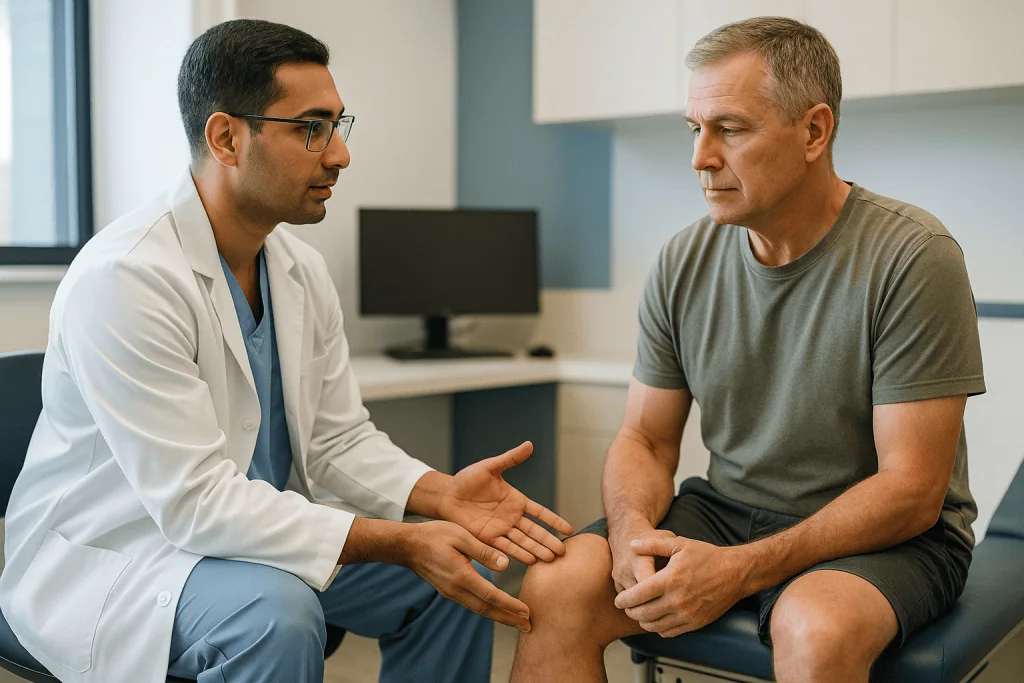
People with an unstable flap that catches and gives way, whose cartilage is otherwise healthy, may also be offered partial meniscectomy after a trial of non-surgical care, especially if the flap can be identified on MRI as the cause.
Who is usually asked to wait? Adults over roughly 40 with a degenerative tear and no locking. Degenerative tears are frays that develop gradually as the meniscus stiffens with age, rather than from a single injury. Two randomized trials shape guidance here. The FIDELITY trial, published on PubMed, randomized 146 patients with a degenerative medial tear and no osteoarthritis to partial meniscectomy or sham surgery; at 12 months the groups reported no meaningful difference in symptoms. The METEOR trial randomized 351 patients with a tear plus mild-to-moderate arthritis to surgery-plus-physical-therapy or physical therapy alone and found similar functional improvement at 6 and 12 months, though about 30 percent of the therapy group later chose surgery.
People with established, moderate-to-advanced osteoarthritis are generally not offered arthroscopic meniscus surgery at all, because the tear is one small part of a wider joint problem and trimming it rarely changes the trajectory. For them, the conversation shifts to arthritis management. In every group, the recommendation sits with the treating team, who can weigh the images against the story the knee is telling.
What happens if a meniscus tear is not treated?
“Untreated” is a slippery word here. Almost every meniscus tear is treated in some way; the question is whether it is treated with surgery or with time, load management and exercise. The consequences of leaving surgery out depend almost entirely on the type of tear.
For the large group of degenerative tears found on MRI in middle-aged and older adults, the natural history is often uneventful. A landmark population study published in the New England Journal of Medicine and indexed on PubMed found meniscal tears on MRI in roughly a third of people over 50, and most of those with a tear had no knee symptoms in the preceding month. A tear, in other words, is frequently a finding rather than a problem. Many such knees settle with strengthening and modified activity, and the tear itself becomes irrelevant.
For a large, displaced tear that locks the knee, waiting carries real risk. Mayo Clinic lists knee instability, an inability to move the knee normally and persistent pain among the consequences of an untreated significant tear, along with an increased risk of osteoarthritis over time. A flap trapped between the bone surfaces acts like grit in a hinge, scoring cartilage that cannot repair itself.
Between those extremes sits a middle ground: tears that ache intermittently, swell after long walks, and neither lock nor settle. These are the knees where shared decision-making earns its name. Non-surgical care is a reasonable first step, and the trial evidence supports it, but a knee that keeps swelling despite months of good rehabilitation is signaling that something mechanical may still be catching.
The honest summary: an untreated meniscus tear is not automatically a ticking clock, but a locked or repeatedly swelling knee should not be ignored. The distinction is clinical, and a physical examination plus imaging usually makes it.
What do the first weeks and months after meniscus surgery usually look like?
The long-term picture is set partly in the short term, so it helps to know the typical arc. Timelines below are general ranges drawn from Cleveland Clinic and Mayo Clinic patient guidance; your own team’s plan, based on what they found and did inside the knee, overrides any general figure.
After a partial meniscectomy, most people are walking the same day, often with crutches for comfort rather than necessity. Swelling and stiffness dominate the first one to two weeks. Cleveland Clinic describes a typical return to everyday activities within roughly four to six weeks, with sport-specific work later. The knee feels better quickly because the offending flap is gone, which is exactly why some people push too hard, too soon, on a joint whose cushion has just been reduced.
After a repair, the early weeks are slower by design. Many protocols use a brace and limit deep knee bending so the sutured tissue is not sheared while it knits. Cleveland Clinic gives a broad recovery window of around three to six months before the repaired meniscus is trusted with full load and pivoting. Physical therapy in this period is not optional filler; it restores quadriceps strength lost to swelling and disuse, and a weak quadriceps leaves the meniscus and cartilage doing more of the shock absorption themselves.
Beyond six months, the two paths converge on the same advice. Build strength in the thigh and hip, return to impact activity gradually, and treat recurrent swelling as information rather than an inconvenience. A knee that puffs up for a day after a run is telling you the load exceeded what its current tissues can handle.
Some people feel completely normal at three months and never think about the knee again for years. Others notice a faint awareness on stairs indefinitely. Both are within the ordinary range, and neither predicts the joint’s future on its own.
Meniscus surgery long term: how the options compare over the years
Laid side by side, the three main paths for a symptomatic meniscus tear trade short-term certainty against long-term cushion in different proportions. The table summarizes the pattern described across MedlinePlus, Mayo Clinic and Cleveland Clinic patient resources and the trial evidence cited in this article. It is a general map, not a forecast for any individual knee.
| Factor | Partial meniscectomy | Meniscus repair | Non-surgical care |
|---|---|---|---|
| What happens to the tissue | Torn fragment removed permanently | Torn edges stitched; heals if blood supply allows | Tear remains; may become asymptomatic |
| Early recovery | Weeks (Cleveland Clinic: roughly 4–6 weeks to daily activity) | Months (Cleveland Clinic: roughly 3–6 months) | Ongoing; improvement over weeks to months with therapy |
| Relief of locking or catching | Usually immediate | Usually, once healed | Not reliable for a displaced flap |
| Main long-term concern | Higher cartilage stress, osteoarthritis risk rises with amount removed | Failure of healing and need for further surgery | Persistent symptoms; some later choose surgery |
| Best-suited tears (typical) | Unstable flaps, inner-zone tears, degenerative tears with mechanical symptoms | Outer-zone tears, younger patients, traumatic tears, often with ligament reconstruction | Degenerative tears without locking, especially with existing arthritis |
Two features of the table deserve emphasis. First, the long-term concern column runs in opposite directions: meniscectomy’s risk is gradual and mechanical, repair’s is earlier and about healing. Second, non-surgical care is not a passive option. In the METEOR trial, physical therapy alone matched surgery on function at a year for most participants, though roughly 30 percent eventually crossed over to an operation. Waiting is an active strategy with its own data behind it.
The right column for you is chosen in a consultation, not from a table. What the table can do is make that consultation sharper, by telling you which trade-off you are being asked to accept.
Is running after meniscectomy safe in the long run?
There is no rule in mainstream guidance that forbids running after a partial meniscectomy, and many people return to it. There is also no evidence that running is harmless for every such knee. The honest position is that running is a load, and whether a particular knee tolerates that load depends on how much meniscus remains, which compartment it came from, how the leg is aligned, how much the person weighs and how the surrounding muscles are working.
Consider the mechanics from the earlier section. Running roughly multiplies the force through the knee compared with walking, and a knee missing part of its lateral meniscus, or carrying extra body weight on a bowed medial compartment, concentrates that force on less cartilage. A knee with a small medial rim trim, strong quadriceps and neutral alignment is in a far more forgiving situation.
Most orthopedic and physical therapy teams approach the question stepwise rather than with a yes or no:
- Full range of motion and no resting swelling before any impact work begins.
- Single-leg strength close to the uninjured side, since the quadriceps and hip muscles absorb shock before it reaches the joint.
- A graded return, alternating walking and jogging, on forgiving surfaces first.
- Swelling that persists into the next day treated as a signal to reduce volume, not to push through.
Over the years, some runners with meniscectomized knees continue without trouble, while others find the joint tolerates cycling, swimming or rowing far better than pavement. Neither outcome is a failure. Mayo Clinic frames long-term activity after a meniscus tear around protecting the joint: keeping supporting muscles strong, choosing lower-impact options when the knee complains, and maintaining a healthy weight.
If running matters to you, say so explicitly when the treatment decision is being made. It may influence whether repair is attempted, how aggressively tissue is trimmed, and how rehabilitation is structured. Afterward, the knee’s own response, swelling, warmth, and next-day soreness, remains the most reliable coach you will have.
Are meniscus repairs successful over the long term?
“Successful” needs defining before it can be answered. For a repair, success usually means the tear heals, the knee is free of mechanical symptoms, and no further surgery on that meniscus is needed. Failure typically means the repair does not heal or re-tears, and a second arthroscopy, often ending in partial meniscectomy, follows.
Healing depends on biology more than on stitches. Tears in the vascular outer third heal reasonably well; tears extending into the inner zone heal poorly or not at all. Tear pattern matters too: a clean vertical longitudinal tear holds sutures far better than a complex, frayed degenerative tear. Age influences tissue quality. And, somewhat counterintuitively, repairs performed at the same time as anterior cruciate ligament reconstruction tend to heal better, because drilling bone during the ligament surgery releases marrow cells and blood into the joint, bathing the repair in a healing environment.
Where does that leave the numbers? Published cohort studies and systematic reviews report a range of failure rates that vary widely with tear location, patient age and follow-up length, and this article will not quote a single percentage as though it applied to everyone. What the literature consistently shows is a pattern rather than a figure: repair carries a higher chance of needing another operation in the first few years than meniscectomy does, while meniscectomy carries a higher long-term risk of cartilage wear. Repair, in effect, borrows short-term risk to buy long-term cushion.
Long-term comparative data directly pitting repair against meniscectomy for the same tear types over decades remain limited, and much of what exists comes from observational studies vulnerable to selection bias: surgeons tend to repair the tears most likely to heal. That does not undermine the logic of preserving tissue; it simply means the size of the long-term benefit is less precisely known than online summaries suggest.
A failed repair is not a catastrophe. It usually leads to the same operation that would otherwise have been done first, with the tissue-preserving attempt having cost time rather than options.
Is there an age limit for meniscus surgery?
No mainstream guideline sets an upper or lower age cutoff for meniscus surgery. Age enters the decision indirectly, through what it usually says about the tear and about the cartilage around it.
In children and adolescents, meniscus tears are almost always traumatic, the tissue is richly vascular, and repair is strongly favored because a young knee has decades of load ahead. Surgeons go to considerable lengths to preserve meniscus in this group, and even tears in zones that would be trimmed in an adult are sometimes repaired.
In young and middle adulthood, the calculus shifts with the tear type. Traumatic tears in active people still lean toward repair when the pattern allows. Degenerative tears begin appearing from around 40, and here the trial evidence becomes decisive. The FIDELITY and METEOR trials, both indexed on PubMed, enrolled adults mostly in their forties to sixties and found that partial meniscectomy added little over sham surgery or structured physical therapy for degenerative tears without locking. That evidence, more than any birthday, is why older patients are often asked to try non-surgical care first.
In later life, the question is rarely “is the patient too old for arthroscopy” and more often “is this knee too arthritic for arthroscopy to help.” An active 68-year-old with well-preserved cartilage and a locked knee from a displaced fragment is a reasonable candidate for surgery. A 55-year-old with advanced cartilage loss and a degenerative fray is usually not, because the fray is a symptom of the arthritis rather than its cause.
Anesthetic fitness, other health conditions and the ability to complete rehabilitation matter at any age, and they are assessed individually. If a clinician tells you that you are too old for meniscus surgery, it is worth asking whether they mean your age or the state of your joint. The answer changes what alternatives make sense.
What do the studies really show about arthritis risk years after meniscectomy?
Here is where honesty requires slowing down, because the popular version of this evidence is often overstated in both directions.
The consistent finding across long-term cohort studies is that knees that have undergone meniscectomy show osteoarthritis on X-ray more often, and earlier, than matched knees that have not. The association strengthens as the amount of tissue removed increases, and it is more pronounced after lateral than medial meniscectomy. Mayo Clinic and Cleveland Clinic both list meniscus loss among the established risk factors for knee osteoarthritis. On that much, the evidence is clear.
What the cohort studies cannot cleanly show is how much of that arthritis the operation caused. A knee that tears its meniscus, particularly a degenerative tear in mid-life, is frequently a knee whose cartilage was already softening. The tear may be an early sign of a joint on its way to arthritis, and the meniscectomy a marker of that process rather than the engine of it. Separating the two would require randomizing people to surgery or not and following them for decades, and the trials that have randomized, FIDELITY and METEOR, followed participants for one to two years, long enough to show that surgery did not improve symptoms over alternatives, but not long enough to measure cartilage change.
So the fair statement is layered. Removing meniscus tissue increases load on cartilage: mechanically certain. Meniscectomized knees develop arthritis at higher rates: observationally consistent. The proportion attributable to the surgery itself versus the underlying joint: genuinely uncertain, and probably varying with tear type.
For someone years out from a meniscectomy, this has a practical meaning. The operation likely contributed some additional wear, more if a large portion was removed. It did not seal the knee’s fate. The variables still in play, body weight, strength, activity pattern, alignment and how flares are managed, are exactly the ones a person can influence, and the next section addresses them.
How can you protect the knee in the years after meniscus surgery?
None of what follows reverses cartilage wear. All of it is aimed at slowing the process and keeping the knee functioning well for longer, and each recommendation reflects mainstream guidance from Mayo Clinic, Cleveland Clinic and MedlinePlus rather than a promise about any individual outcome.
Body weight is the lever with the largest mechanical effect. Every step transmits several times body weight through the knee, so modest weight change alters the load on a reduced meniscus more than any brace or insole can. This is a statement about physics, not about anyone’s worth, and it applies equally to people at any size who have extra load to shift.
Muscle is the second lever. The quadriceps at the front of the thigh and the gluteal muscles at the hip decelerate the leg and absorb impact before it reaches the joint surfaces. A knee that has lost meniscus tissue but gained strong, well-coordinated muscles is often more comfortable than a knee with intact menisci and weak support. Strength work two to three times a week, progressed gradually, is the single habit most physical therapists would defend for the long haul.
Activity choice matters without needing to be restrictive. Cycling, swimming, rowing and elliptical work load the knee in smooth, predictable arcs. Deep loaded squats, repeated pivoting under load and running on hard surfaces concentrate stress. Mixing them, rather than abandoning one, is a sustainable pattern.
Flares deserve attention rather than stoicism. Swelling that recurs after specific activities is the joint reporting its limits; adjusting volume early usually costs less than pushing until the knee forces a rest.
Supplements such as glucosamine and chondroitin are widely marketed for cartilage. The evidence for meaningful benefit is inconsistent, and no supplement has been shown to regrow meniscus or reverse arthritis. Anyone considering them should discuss it with their clinician, who can weigh interactions with other medicines.
What people often get wrong about life after meniscus surgery
Misconceptions about this operation are stubborn, partly because the knee often feels excellent in the first year and partly because online advice tends to flatten nuance into slogans. Six deserve correcting.
“The meniscus grows back.” It does not. Fibrocartilage has too little blood supply to regenerate a removed wedge. The body may lay down some scar tissue at the edge, but it does not restore the cushion’s original shape or function.
“Cleaning out the knee prevents arthritis.” The opposite is closer to the evidence. Removing tissue increases cartilage load; it does not protect the joint. The purpose of meniscectomy is to relieve mechanical symptoms, not to slow degeneration.
“A tear on MRI means I need surgery.” Tears are common incidental findings in adults over 50, and most cause no symptoms. Treatment decisions rest on how the knee behaves, not on the scan alone.
“Repair is always better than removal.” Repair is better when the tear can heal. Stitching a tear in the avascular inner zone often fails, adding months of protected recovery before ending in the meniscectomy that could have been done first.
“Pain years later means the tear came back.” Sometimes it does. More often, especially after meniscectomy, later pain reflects gradual cartilage change in the compartment that lost its cushion. The distinction matters because the treatments differ.
“If it doesn’t hurt, nothing is wearing.” Cartilage has no nerve endings. Early wear is silent, which is why keeping weight and strength in good order matters even during years when the knee feels perfect.
One more, gentler correction: people sometimes blame themselves for choosing surgery decades ago. The decision was made with the knee they had and the evidence available then. The useful question now is not whether it was right, but what the joint needs going forward.
Questions to ask your care team about the long term
Whether you are deciding about surgery or living years beyond it, the quality of the answers you get tracks the quality of the questions you bring. These are the ones orthopedic teams consistently say they wish more patients asked, grouped by stage.
Before surgery:
- Is this tear likely to be repaired or removed, and what would make you change plan once you see it?
- How much of the meniscus might be trimmed, and in which compartment?
- What does my cartilage look like now, and how does that affect what you expect years from now?
- What would happen if I completed a structured physical therapy program first and reassessed?
- How would my activity goals, including running or pivoting sports, change your recommendation?
After surgery, at follow-up:
- Can you tell me exactly what was done, and can I have a copy of the operative note and any photographs?
- What proportion of the meniscus remains, roughly, and does that change the activities you would advise?
- What signs over the coming years should prompt me to come back for reassessment rather than wait?
Years later, if symptoms return:
- Does this sound like the meniscus, or like cartilage change in the compartment?
- Which imaging, if any, would change what you recommend?
- What are the non-surgical options for managing an arthritic compartment, and what does the evidence say about each?
Two framing questions apply at every stage. First: “What would you expect this knee to be like in ten years with each option?” Honest clinicians will answer with ranges and uncertainty rather than confidence, and that honesty is a good sign. Second: “What are the things within my control that affect that picture?” The answer will almost always involve weight, strength and load, and it will give you something to work with between appointments.
Write the answers down. Memory fades fastest for the details that matter most a decade later.
When to call your doctor
Most of what a knee does in the years after meniscus surgery is slow and undramatic, and slow change is best raised at a routine appointment. A few situations should not wait for one. Seek prompt medical assessment, and in the case of the first two, urgent care, if any of the following occur:
- A hot, red, rapidly swelling knee, especially with fever or chills. In the weeks after surgery this can indicate joint infection, which needs treatment quickly; years later it can still signal infection or an inflammatory process.
- Calf pain, calf swelling, or new shortness of breath after surgery. These can be signs of a blood clot in the leg or lung and warrant immediate evaluation.
- A knee that locks and will not fully straighten. A displaced fragment or re-tear can jam the joint, and a locked knee should be assessed rather than forced.
- Sudden inability to bear weight, or a knee that gives way without warning.
- Wound redness, drainage or opening in the early recovery period.
- Numbness, persistent pins and needles, or a cold, pale foot on the operated side.
Less urgent but still worth an appointment: swelling that recurs after ordinary activity for more than a few weeks, night pain that disturbs sleep, a grinding sensation with pain that is new, or a steady decline in how far you can walk comfortably. These patterns often point to cartilage change rather than a new tear, and earlier assessment widens the options for managing it.
What this article cannot do is tell you which category your symptom falls into. Meniscus and cartilage problems overlap in how they feel, and the examination, sometimes with imaging, is what separates them. Every decision about further tests, activity limits or treatment sits with the team that knows your knee, and bringing them a clear timeline of what changed and when is the most useful thing you can carry into that conversation.
Frequently asked questions
What are the meniscectomy long term effects most people actually experience?
Most people report good function for years, with the main long-term effect being gradual cartilage change in the compartment that lost tissue. That can show as stiffness on stairs, swelling after long activity, or aching in cold weather, often a decade or more later. The amount removed, the compartment involved, leg alignment, body weight and muscle strength all influence how quickly, or whether, these changes become noticeable.
Is there an age limit for meniscus surgery?
No guideline sets an age cutoff. What changes with age is the type of tear and the state of the surrounding cartilage. Young patients with traumatic tears are usually offered repair. Adults over about 40 with degenerative tears are typically asked to try physical therapy first, because randomized trials found little benefit from meniscectomy in that group. An older knee with preserved cartilage and a locked joint can still be a candidate.
What happens if an untreated meniscus tear is left alone for years?
It depends on the tear. Degenerative tears without locking often settle and cause no lasting harm; many are found incidentally in people with no symptoms. Large displaced tears that lock the knee can damage cartilage over time and are usually addressed promptly. Mayo Clinic lists instability, restricted movement and increased osteoarthritis risk among the consequences of leaving a significant tear unaddressed.
Is running after meniscectomy realistic in the long run?
Many people return to running and continue for years, but tolerance varies with how much meniscus was removed, which side, leg alignment, body weight and strength. Most teams recommend restoring full motion and near-symmetrical single-leg strength first, then building distance gradually and treating next-day swelling as a signal to reduce volume. Some knees end up preferring cycling or swimming, which is a reasonable adaptation, not a failure.
What is a realistic meniscus repair success rate?
Published failure rates vary widely with tear location, pattern, patient age and follow-up length, so no single percentage applies to everyone. Repairs in the vascular outer third heal best; those extending into the inner zone often do not. Repairs done alongside ACL reconstruction tend to heal better. The consistent pattern is that repair carries more early reoperation risk than meniscectomy while preserving tissue for the long term.
Does meniscus surgery cause arthritis?
Removing meniscus tissue increases stress on cartilage, and knees that have had meniscectomy show osteoarthritis more often and earlier in long-term studies. How much of that the operation causes, versus the underlying joint that tore in the first place, is genuinely uncertain, because degenerative tears often occur in knees already beginning to wear. The effect is larger when more tissue is removed and after lateral meniscectomy.
Can a removed meniscus grow back?
No. Meniscus fibrocartilage has very limited blood supply and cannot regenerate a removed segment. Some scar tissue may form at the cut edge, but it does not restore the original shape or load-spreading function. This permanence is the central reason surgeons trim conservatively and attempt repair when the tear pattern and location make healing plausible.
Why does my knee hurt years after meniscus surgery if it felt fine for so long?
Late pain after meniscectomy most often reflects gradual cartilage change in the compartment that lost cushion, rather than a new tear, although re-tears do occur. Cartilage has no nerve endings, so early wear is silent and symptoms appear only once the surface is thin enough to irritate surrounding tissue. Examination and sometimes imaging distinguish the two, and the management differs, so it is worth an appointment.
Should I have a degenerative meniscus tear trimmed to protect my knee?
Current evidence does not support meniscectomy as a way to protect the knee. Two randomized trials, FIDELITY and METEOR, found that trimming degenerative tears produced no meaningful advantage over sham surgery or structured physical therapy at one year. Surgery is generally considered when mechanical symptoms such as locking persist despite good rehabilitation, and that judgment rests with the treating team.
What can I do to slow cartilage wear after a meniscectomy?
The levers with the strongest mechanical basis are body weight, which multiplies with every step through a reduced cushion, and quadriceps and hip strength, which absorb impact before it reaches the joint. Mixing low-impact activities with higher-impact ones, responding early to swelling, and keeping up regular strength work over the years are the habits mainstream guidance consistently supports. No supplement has been shown to regrow meniscus or reverse wear.
This article is for general information only and is not a substitute for professional medical advice. Please consult a qualified doctor about your individual situation.

More from the Blog

Soft Tissue Injury Healing Stages: Why Sprains, Strains and Bruises Heal at Different Rates
Soft tissue injury healing time depends on what was damaged and how well it is supplied with blood. Bruises usually fade within about two…

Does a Sprain or Strain Need an MRI? When Imaging Adds to a Soft Tissue Injury Exam
Most sprains and strains do not need an MRI. Clinicians usually diagnose them by asking how the injury happened and examining the joint or…

Does Bursitis Come Back? Why Flares Recur and What Long-Term Results Usually Look Like
Yes, bursitis can come back. Most flares settle within a few weeks with rest, ice and reduced pressure on the area, but recurrence is…

Does a Torn ACL Always Need Surgery? Who Copes Without Reconstruction and Who Does Not
Not always. Many people with a torn ACL, particularly those who do not play pivoting sports, regain a stable, working knee through structured rehabilitation…

Is Swelling After Ankle Arthroscopy Normal? What Helps and When to Call Your Team
Some swelling after ankle arthroscopy is expected and usually peaks in the first few days before easing over several weeks, because the joint is…

Preparing for Meniscus Surgery: The MRI Review, Fasting Rules and Medicine Checklist
Preparing for meniscus surgery usually involves three strands: an MRI review with your surgeon that clarifies whether the tear is likely to be trimmed…