

What Results Does Endoscopic Sinus Surgery (ESS) Usually Bring, and Can Sinus Disease Return?

Key Takeaways
- Chronic rhinosinusitis, the usual reason for endoscopic sinus surgery, is defined by symptoms lasting 12 weeks or longer despite treatment, so surgery is rarely a first step.
- The operation widens blocked sinus drainage pathways through the nostrils without skin incisions, typically taking about one to three hours depending on how many sinuses are involved.
- Nasal obstruction and thick drainage are the symptoms most reliably improved; smell recovers more slowly and may remain partial in long-standing disease.
- Sinus disease can return because surgery changes anatomy, not the inflammation that caused it, and nasal polyps regrow more often than simple infection recurs.
- Early clinic cleaning visits and daily saline rinses in the first weeks are the main defense against scar bands that can narrow the new openings.
- Clear watery fluid from one nostril, eye swelling or vision change, and steady bright-red bleeding after surgery are red flags that need a same-day call.
Endoscopic sinus surgery usually widens blocked sinus drainage pathways so that mucus can clear and medicines can reach inflamed lining. Most people report less congestion, pressure and infection frequency within weeks to months, with smell often improving more slowly. The underlying inflammation is not removed, so sinus disease, especially nasal polyps, can return; ongoing medical care after surgery is expected.
The folder on the kitchen table holds the CT report, a consent form and a list of questions written in two different pens. The surgeon said the words “endoscopic sinus surgery” calmly, almost routinely, and that is exactly what unsettles people: if it is so routine, why has nothing else worked, and will this finally be the end of it?
That second question is the honest one. Anyone reading about endoscopic sinus surgery results wants two things at once: a realistic picture of what improves, and a straight answer on whether the whole cycle of congestion, pressure and antibiotics can start again.
Both answers exist, and neither requires marketing language. The operation does one specific job very well. It does not switch off the inflammation that caused the problem. Understanding that distinction is the single most useful thing a patient can carry into the consultation room.
What endoscopic sinus surgery results usually look like in the first months
Chronic rhinosinusitis, the condition this operation most often treats, means inflamed sinus lining with symptoms lasting 12 weeks or longer despite treatment, according to Mayo Clinic. By the time surgery is on the table, most people have lived with blocked breathing, facial pressure, thick drainage and a dulled sense of smell for far longer than that.
The pattern of improvement is reasonably predictable, even if the degree varies. Nasal airflow and the sense of pressure tend to change first, often within the first few weeks once swelling and crusting settle. Drainage usually thins and becomes less constant over the same period. Johns Hopkins Medicine and Cleveland Clinic both describe the aim in the same terms: open the natural drainage pathways so the sinuses can ventilate and mucus can clear.
Smell is the slow mover. Olfactory nerve endings sit high in the nasal cavity, and inflammation or polyps there take longer to calm. Some people notice a sudden return of coffee or rain-on-pavement; others see gradual, partial recovery; a minority see little change. Guideline-level sources consistently list loss of smell as both a symptom that may improve and a risk that may persist, which is a fair summary of the evidence.
Headache deserves a separate word. Facial pain and pressure that genuinely come from blocked sinuses often ease. Headaches with a different cause, such as migraine or tension-type headache, do not, and a careful surgeon will say so beforehand. Expect, in short, clearer breathing and fewer infections as the main result, not a different head.
How endoscopic sinus surgery actually works
The sinuses are air-filled pockets in the bones of the face, each draining into the nose through a narrow opening. A nasal endoscope is a thin, rigid or flexible tube with a light and camera that lets the surgeon see those openings directly through the nostril. No skin incision is needed, which is why Cleveland Clinic and Johns Hopkins describe the procedure as minimally invasive.

Under general anesthesia in most cases, the surgeon uses the endoscope and fine instruments to remove thin bone partitions, swollen lining and polyps that block drainage. Polyps are soft, non-cancerous growths of inflamed tissue. A microdebrider, a powered instrument that shaves tissue while suctioning it away, is often used. Some surgeons add image guidance, a navigation system that matches the instrument’s position to the CT scan in real time, especially for revision cases or when anatomy is distorted.
The mechanism of benefit is physical and mechanical. Widened openings let trapped mucus drain, let air reach lining that had been sealed off, and give rinses and steroid sprays a route into cavities they could never reach before. Mayo Clinic frames surgery as a way to make medical treatment more effective rather than a replacement for it.
What the surgery does not do matters as much. It does not change the immune signalling in the sinus lining, which is why the condition is managed long term rather than resolved in one afternoon. The term “functional” in functional endoscopic sinus surgery, often shortened to FESS, refers to restoring function of the drainage pathways, not to any promise about how the lining will behave afterwards.
What is a nasal endoscopy, and how do doctors check for sinus infection?
Nasal endoscopy is the same camera examination used in surgery, performed awake in the clinic after a numbing and decongesting spray. It takes a few minutes and lets the clinician see swelling, pus, polyps and the state of the drainage openings. Mayo Clinic lists it as a core step in diagnosing chronic sinusitis, alongside imaging and a detailed history.
A CT scan of the sinuses is the imaging standard. It shows the bony anatomy, how much lining is thickened and whether a sinus is completely filled. Importantly, a CT is usually requested after medical treatment has been tried, not at the first visit, because a scan taken during a cold will look alarming and tell the surgeon little. Plain X-rays are rarely helpful, and MRI is reserved for specific concerns such as suspected spread beyond the sinus.
For acute sinus infection, the picture is simpler. The NHS notes that most sinus infections follow a cold and settle on their own within two to three weeks, and the diagnosis is clinical: the pattern of symptoms, their duration and what a doctor sees on examination. Cultures of nasal discharge are taken selectively, typically when infections keep returning, when a patient’s immune system is weakened, or when the usual treatments fail.
Allergy testing and, in some cases, blood tests looking at immune function are added when the history suggests a driver beyond simple blockage. None of these is a formality. The combination of endoscopy findings, CT appearance and the symptom story is what tells the team whether surgery is likely to help, and that is the stage where the words “endoscopic sinus surgery results” start to have a personal meaning.
Who is usually offered ESS, and who is usually asked to wait
Surgery is rarely the first step. Mayo Clinic and the NHS describe a sequence: saline rinses, intranasal corticosteroid sprays that reduce lining inflammation, treatment of allergies, and antibiotics when a bacterial infection is suspected. Only when a full course of appropriate medical treatment has failed, and endoscopy or CT confirms ongoing disease, does surgery enter the conversation.

Typical candidates include people with chronic rhinosinusitis that persists despite that treatment, those with nasal polyps blocking the airway, patients with recurrent acute infections tied to a fixed anatomical blockage, and anyone with a fungal ball or a mucocele, which is a mucus-filled cyst expanding inside a sinus. Cleveland Clinic also lists complications of infection that threaten the eye or brain as reasons for urgent surgery.
Those usually asked to wait fall into a few groups. Someone with sinus-like symptoms but a clear CT after treatment is unlikely to benefit; the surgeon will look for another cause. A patient with poorly controlled asthma, bleeding risk from medicines or illness, or an active infection on the day may be rescheduled until things are stable. Children are assessed differently, with adenoid surgery and prolonged medical therapy tried first in most pathways.
Alternatives are part of a fair consultation. Longer or different medical regimens, allergy immunotherapy, and, for selected cases of polyps, newer biologic injections that target specific inflammatory pathways are all options the team may raise. Balloon sinus dilation, which stretches an opening with an inflatable catheter rather than removing tissue, suits some limited patterns of disease but not polyps. Which path fits depends on findings, not preference, and that decision sits with the treating team.
How long is endoscopic sinus surgery, and what happens on the day?
The operating time depends on how many sinuses are involved and whether polyps or previous surgery complicate the anatomy. Cleveland Clinic and Johns Hopkins describe the procedure as commonly taking between about one and three hours, with limited single-sinus work at the shorter end and extensive bilateral disease or revision surgery at the longer end. The day itself is longer, because anesthesia preparation and recovery room time wrap around the operation.
Most people arrive fasting, meet the anesthetist, and go home the same day. An overnight stay is more likely when the surgery is extensive, when other health conditions need monitoring, or when bleeding was heavier than usual. General anesthesia is the norm; local anesthesia with sedation is used in some limited procedures.
Packing is the detail patients worry about most. Older techniques used firm gauze that had to be pulled out days later; today many surgeons use dissolvable materials or no packing at all, and will say which applies before the day. A splint may be placed if the septum, the central wall of cartilage and bone, was straightened at the same time, which is a common add-on when it contributes to blockage.
Waking up, people describe a blocked, stuffy feeling rather than sharp pain, along with a trickle of blood-tinged fluid for a day or two. Someone must drive the patient home, and a quiet 24 hours follows. The question “how long is endoscopic sinus surgery” has a short answer, then; the more useful question is how long the recovery and the aftercare run, and that is covered next.
Sinus surgery recovery time: what the first days and weeks look like
Recovery is less about pain and more about patience with crusting. The operated cavities shed blood clot and healing tissue for several weeks, and the single most useful thing a patient does is rinse. Cleveland Clinic describes most people returning to desk-based work within about a week and feeling substantially better within one to two weeks, with full healing of the lining taking longer.
| Timeframe | What is typical | What usually helps |
|---|---|---|
| Days 1–3 | Blocked nose, blood-tinged drainage, fatigue, mild facial ache | Rest, head elevated, no nose blowing, prescribed rinses as directed |
| Days 4–14 | Crusting, thick discharge, breathing starts to open | Frequent saline rinses, first clinic visit for cleaning |
| Weeks 2–6 | Steadily clearer airflow, smell may begin to return | Resume moderate activity, continue sprays and rinses |
| Months 2–3 | Lining healed, results become clearer | Follow-up endoscopy, long-term plan agreed |
The clinic visits in the first weeks are not optional extras. The surgeon uses the endoscope to clear crusts and early scar bands, a process called debridement, which keeps the newly opened pathways from sealing shut. Skipping these visits is one of the commonest reasons results disappoint.
Strenuous exercise, heavy lifting and bending are typically limited for around two weeks to reduce bleeding risk, and flying is usually discussed individually. Timeframes here are typical ranges drawn from Cleveland Clinic guidance, not promises; the team’s instructions override any general table.
Which symptoms tend to improve most, and which may not
Not every symptom responds equally, and knowing this beforehand protects against disappointment. Nasal obstruction is the most reliably improved complaint, because surgery directly removes what is blocking the airway. Thick discharge and post-nasal drip usually lessen as drainage normalizes. Frequency of acute infections tends to fall, partly because trapped mucus no longer sits in a closed pocket and partly because sprays and rinses now reach the lining.
Facial pressure improves when it is genuinely sinus-related. Here the CT and endoscopy matter: if the scan shows little disease, pressure is less likely to be sinus-driven and surgery is less likely to change it. Mayo Clinic’s own description of diagnosis stresses matching symptoms to objective findings for this reason.
Smell sits in the uncertain middle. Johns Hopkins lists reduced or lost smell among symptoms of chronic sinusitis, and surgery that removes polyps from the upper nose can restore airflow to the olfactory area. Recovery is often partial and may take months, and in long-standing disease the sense may not return fully. Taste usually follows smell.
Fatigue, poor sleep and reduced concentration are frequently reported by people with chronic sinus disease and frequently improve as breathing and sleep improve, though these are the least studied outcomes. Cough can be a mixed picture, since it may come from drip, asthma or reflux. Asthma itself is worth a mention: airway inflammation above and below the voice box often travel together, and many people with both notice easier chest control after sinus treatment, though surgery is never offered for asthma alone.
Can sinusitis come back after surgery? The honest answer
Yes, it can, and a surgeon who says otherwise is overselling. Endoscopic sinus surgery changes anatomy; it does not change biology. Mayo Clinic is explicit that chronic sinusitis can recur and that ongoing treatment, including sprays and rinses, is commonly needed after surgery. The lining that produced inflammation before the operation is the same lining that heals afterwards.
Recurrence looks different depending on the original driver. In someone whose problem was a narrow drainage pathway plus repeated infections, widening that pathway often addresses the mechanical cause and infections become uncommon. In someone with diffuse inflammatory disease, particularly with polyps, allergy or aspirin sensitivity, the operation clears the field but the underlying tendency remains and symptoms can rebuild over months or years.
Scarring is the other route back. Healing tissue can form adhesions, bands that bridge the newly opened spaces and narrow them again. This is precisely why early clinic cleaning visits exist, and why rinsing matters during the first weeks.
Revision surgery, meaning a second operation, is needed for a minority of patients over the following years. Cleveland Clinic lists the possibility of further surgery among the realistic expectations, and the likelihood is higher with polyps, with asthma and with aspirin-exacerbated respiratory disease. The useful way to think about it: the first operation resets the starting point, and medical treatment afterwards is what keeps the gains. Anyone searching “can sinusitis come back after surgery” deserves that framing rather than a yes-or-no.
Why nasal polyps return more often than infection
Polyps are the clearest example of surgery treating a result rather than a cause. They arise from chronic inflammation, most often of the type involving eosinophils, white blood cells associated with allergic and asthmatic processes. Remove a polyp and the inflamed lining that produced it is still there, still receiving the same immune signals. Mayo Clinic describes polyps as commonly returning after surgery unless inflammation is controlled with ongoing treatment.
Three features raise the odds. Asthma, especially adult-onset asthma, is one. Aspirin-exacerbated respiratory disease, a condition in which aspirin and similar anti-inflammatory medicines trigger nasal and chest symptoms, is another and is associated with aggressive, recurring polyps. Allergic fungal sinusitis, where an immune reaction to inhaled fungi drives thick mucus and polyps, is a third.
Management after surgery therefore leans heavily on steroid sprays or rinses that reach the whole cavity now that it is open. For some people with severe disease, biologic medicines, injected antibodies that block specific inflammatory messengers, are considered by the specialist team. Their place in the pathway, who qualifies, and how they are combined with surgery are decisions for the prescribing clinician, and none of this article should be read as a recommendation.
The surgical side also adapts. Wider openings, particularly of the frontal and sphenoid sinuses, make later clinic cleaning and topical treatment easier. The realistic expectation with polyps is control over years with periodic adjustment, not a single decisive event, and that expectation shapes how endoscopic sinus surgery results should be judged in this group.
Complications of sinus surgery: what the evidence says about risk
The sinuses sit beside the eyes and beneath the brain, which is why complications, though uncommon, are taken seriously. Cleveland Clinic, Mayo Clinic and Johns Hopkins list a consistent set.
Bleeding is the most frequent issue. Minor oozing for a few days is expected; heavier bleeding that needs packing or a return to theater is uncommon but recognized. Infection of the healing cavities can occur and is usually managed with medicines chosen by the team. Scarring and adhesions, discussed above, can narrow the openings again.
Rarer and more serious risks involve the thin bone separating sinus from orbit and skull base. Injury to the eye area can cause bruising, double vision from muscle damage, or, very rarely, loss of vision. A cerebrospinal fluid leak, where the fluid surrounding the brain escapes through a breach in the skull base, is rare and usually repaired during the same operation if recognized. Persistent change or loss of smell, numbness of the upper teeth or lip, and a dry or crusted nose that lingers are also described. Anesthetic risks apply as with any general anesthetic.
Image guidance and careful preoperative CT review exist to reduce these events, and revision surgery carries somewhat higher risk because scar tissue blurs the landmarks. Patients should expect their surgeon to walk through this list in plain words and to ask about personal risk factors such as blood-thinning medicines or previous operations. Rates vary with disease extent and surgical technique, so any specific percentage quoted should come from a named guideline or systematic review rather than a general web page, and this article does not offer one.
Why medicines do not stop after surgery
Patients often picture surgery as a door closing on sprays, rinses and prescriptions. The evidence points the other way: surgery opens the door for those treatments to finally work. Mayo Clinic describes post-operative care that typically includes saline irrigation and intranasal corticosteroids, and most specialists continue them for months or indefinitely depending on the type of disease.
Saline rinses do physical work. They flush crusts and thick mucus from cavities that are now wide enough to be rinsed, and in the first weeks they are the main defense against adhesions. Steroid sprays and steroid-containing rinses act on the lining itself, damping the inflammatory signalling that drives swelling and polyp growth. The mechanism is the same as before surgery; the difference is reach.
Antibiotics follow a different logic. They treat bacterial infection when it occurs and are not a maintenance strategy for inflammatory disease. CDC guidance on sinus infection stresses that most episodes are viral and resolve without antibiotics, and the same principle applies after surgery: an infection flare is assessed and treated on its merits.
Allergy management continues if allergy was part of the picture, and any biologic treatment is reviewed on its own schedule by the specialist team. What a patient should not do is adjust, pause or stop anything on the basis of feeling better; the timing of changes belongs with the prescribing clinician. Thought of this way, the operation is less a finish line than the point where the treatment plan becomes workable.
What people often get wrong about endoscopic sinus surgery results
“It fixes sinus problems permanently.” It restores drainage and ventilation, which is permanent in the anatomical sense, but inflammation can recur and polyps can regrow. The result is better control, maintained with ongoing care, not an end to the condition.
“There will be black eyes and bruising.” That image belongs to older external approaches. Endoscopic surgery works through the nostrils, and visible bruising is unusual unless the eye area is involved in a complication.
“Packing is always removed in a painful visit.” Many surgeons now use dissolvable material or none at all. Ask what will be used.
“It cures headaches.” The word itself is best avoided. Sinus-related pressure often eases; migraine and tension-type headache do not respond to sinus surgery, and a careful evaluation before the operation aims to tell these apart.
“If I feel better, I can stop the sprays and rinses.” Feeling better is often the direct effect of those treatments now reaching the lining. Changes to any medicine are the prescribing clinician’s call.
“A second operation means the first failed.” Revision surgery is a recognized part of managing inflammatory sinus disease, particularly with polyps, and does not imply poor initial work.
“Antibiotics should be taken at the first sign of congestion afterward.” The NHS and CDC both note that most sinus infections are viral and clear on their own; a flare after surgery is assessed before anything is prescribed.
Each of these corrections points to the same principle: judge endoscopic sinus surgery results by sustained breathing, drainage and infection control over months, with the care plan in place, rather than by a single moment of relief or a single setback.
Questions to ask your care team before agreeing to surgery
A good consultation is a two-way conversation, and the questions below are the ones experienced patients wish they had asked. Take the list, and the answers, home.
- Which sinuses will be opened, and why those? Ask to see the CT alongside the explanation.
- What is the main driver of my disease: a blocked pathway, polyps, allergy, aspirin sensitivity or something else? How does that change what you expect surgery to achieve for me?
- Which of my symptoms do you expect to improve, and which may not change?
- What medical treatment have we completed, and is there anything else worth trying first?
- Will image guidance be used? Will the septum or turbinates, the shelves of tissue inside the nose, be treated at the same time?
- What packing or splints will I have, and when and how are they removed?
- How many clinic visits for cleaning should I expect in the first two months?
- What sprays, rinses or other treatments will I use afterward, and for how long?
- What are the specific risks in my case, given my anatomy, previous surgery and medicines?
- How likely is it that my disease returns or that I need revision surgery, based on your experience with my type of disease?
- Which signs after surgery should make me call the same day?
Patients sometimes hesitate to ask about the likelihood of recurrence, as if it questions the surgeon’s judgement. It does the opposite. A surgeon who answers it plainly, with reference to the type of disease and the role of ongoing treatment, is giving the most reliable predictor of how satisfied a patient will feel a year later: a shared, accurate expectation.
When to call your doctor after endoscopic sinus surgery
Most recovery days are dull: blocked, crusty, slightly tired. A short list of signs is different, and the team wants to hear about them promptly rather than at the next scheduled visit.
Call the surgical team the same day, or go to emergency care if they cannot be reached, for any of the following:
- Bleeding that is steady, bright red and does not slow with head elevation and rest over a short period, or any bleeding that soaks through dressings repeatedly.
- Clear, watery fluid dripping from one side of the nose, especially when leaning forward, with a salty or metallic taste; this can signal a cerebrospinal fluid leak.
- Severe headache, a stiff neck, high fever, confusion or unusual drowsiness.
- Swelling around an eye, double vision, reduced vision, or pain when moving the eye.
- Fever with worsening facial pain or discharge that becomes foul and thick after initially improving.
- Shortness of breath, chest pain, or calf pain and swelling, which can indicate a blood clot after any operation.
- Any reaction to a medicine such as rash, swelling of the lips or difficulty breathing.
These red flags are drawn from the complication lists published by Cleveland Clinic, Mayo Clinic and Johns Hopkins. Beyond the surgical period, the same rules that apply to any sinus infection hold: the NHS advises seeing a doctor when symptoms are severe, when they persist beyond the usual course, or when they keep returning, and seeking urgent help for swelling or pain around the eyes, visual change or a very high fever.
Everything else, from a question about rinsing technique to a worry about smell, can wait for the next clinic contact, but the care team would always rather hear a concern early. The decision about what any sign means, and what to do next, rests with them.
Frequently asked questions
How long is endoscopic sinus surgery?
Most endoscopic sinus operations take about one to three hours, according to Cleveland Clinic and Johns Hopkins descriptions of the procedure. Limited work on one or two sinuses sits at the shorter end; extensive polyp removal, revision surgery or added septal straightening takes longer. The full day is longer still because anesthesia preparation and recovery room time are added, and most people go home the same day.
What is the sinus surgery recovery time before I feel normal?
Many people return to desk work within about a week and feel noticeably better within one to two weeks, based on Cleveland Clinic guidance, but the lining takes several weeks to heal and crusting continues through that period. Strenuous activity is usually limited for around two weeks. Results become clearer at two to three months once swelling has fully settled, and the care team’s instructions override any general timeline.
Can sinusitis come back after surgery?
Yes. Surgery opens drainage pathways but does not remove the underlying inflammation, so Mayo Clinic notes that chronic sinusitis can recur and ongoing treatment with rinses and sprays is commonly needed. Recurrence is more likely with nasal polyps, asthma and aspirin sensitivity, and less likely when the original problem was a fixed anatomical blockage causing repeated infections. A minority of people need revision surgery over the following years.
What are the potential complications associated with sinus surgery?
Common issues are minor bleeding, crusting, temporary blockage and scar bands that can narrow the openings. Less common are infection and heavier bleeding needing treatment. Rare but serious complications involve the eye, including bruising, double vision or vision loss, and the skull base, where a cerebrospinal fluid leak can occur. Persistent smell change and numbness of the upper teeth are also described by Mayo Clinic and Cleveland Clinic.
What is a nasal endoscopy and does it hurt?
A nasal endoscopy is a clinic examination in which a thin tube with a light and camera is passed through the nostril to view the sinus openings, polyps, swelling and discharge. A numbing and decongesting spray is applied first, and most people describe pressure rather than pain over a few minutes. Mayo Clinic lists it as a key diagnostic step before and after sinus surgery.
How do doctors check for sinus infection before recommending surgery?
They combine the symptom history, especially duration beyond 12 weeks, with nasal endoscopy and a CT scan of the sinuses taken after medical treatment has been tried. Cultures of discharge are used selectively when infections keep returning or when standard treatment fails. Allergy testing may be added. Surgery is considered when objective findings on endoscopy or CT match persistent symptoms despite appropriate treatment.
Will my sense of smell come back after endoscopic sinus surgery?
It often improves, particularly when polyps blocking the upper nose are removed, but recovery is frequently gradual and may be partial. Johns Hopkins lists reduced smell as both a symptom of chronic sinusitis and a possible lasting effect. Long-standing loss and severe inflammatory disease lower the odds of full return. The care team can give a personal estimate based on endoscopy and CT findings.
Do I still need nasal sprays and rinses after surgery?
In most cases, yes. Mayo Clinic describes saline irrigation and intranasal corticosteroids as typical post-operative care, because the open cavities finally allow these treatments to reach the inflamed lining. Rinses also clear crusts and help prevent scar bands in the first weeks. How long each treatment continues, and any change to it, is decided by the prescribing clinician rather than by how a person feels on a given day.
Does endoscopic sinus surgery help headaches?
It can ease facial pressure and pain that genuinely come from blocked, inflamed sinuses confirmed on endoscopy or CT. It does not treat migraine or tension-type headache, which are often mistaken for sinus headache. Surgeons look for a match between symptoms and objective findings before suggesting surgery for pain, and a normal scan after treatment usually points toward another cause that needs separate assessment.
What is the difference between FESS and balloon sinus dilation?
FESS, functional endoscopic sinus surgery, removes thin bone, swollen lining and polyps to widen drainage pathways and is the standard operation for chronic rhinosinusitis with or without polyps. Balloon dilation stretches a sinus opening with an inflatable catheter without removing tissue and suits a narrower range of disease, typically without polyps. Which approach fits depends on the endoscopy and CT findings, and the choice rests with the treating team.
References
This article is for general information only and is not a substitute for professional medical advice. Please consult a qualified doctor about your individual situation.

More from the Blog

How Long Does FESS Recovery Take? Crusting, Congestion and When Breathing Improves
Recovery from functional endoscopic sinus surgery (FESS) usually unfolds in stages rather than on one day. Most people feel congested and tired for the…
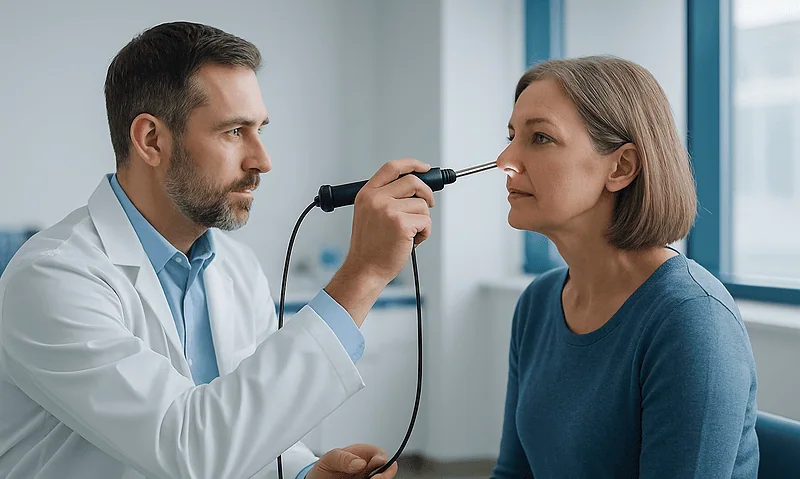
What Does a Nasal Endoscopy Show in Sinusitis, and How Does It Shape Your Treatment?
A nasal endoscopy in sinusitis lets an ear, nose and throat clinician look directly inside the nose with a thin, lighted camera, checking for…

When Is an Intratympanic Steroid Injection Considered for Sudden Hearing Loss?
An intratympanic steroid injection is usually considered for sudden sensorineural hearing loss in two situations: as initial treatment when oral corticosteroids are unsuitable, unwanted…

Is FESS the Next Step? When Chronic Sinusitis Stops Responding to Medical Treatment
FESS (functional endoscopic sinus surgery) is usually considered only after chronic sinusitis, meaning symptoms lasting 12 weeks or more, has failed a full course…

SMR or Septoplasty: What Is the Difference, and When Do Surgeons Choose Submucous Resection?
SMR (submucous resection) and septoplasty are both operations that straighten the wall between the nostrils. SMR, the older technique, removes most of the deviated…

Sinusitis Warning Signs: High Fever, Facial Swelling and Vision Changes That Need Urgent Care
Most sinusitis improves on its own within about 7 to 10 days and can be managed at home. Seek urgent care the same day…