

What Spinal Stenosis Surgery Relieves and What It May Not: Leg Pain vs Back Pain

Key Takeaways
- Decompression surgery is designed to free pinched nerves, which is why walking-related leg pain, heaviness and tingling are the symptoms it relieves most reliably.
- Low back pain from worn discs and facet joints is not removed by decompression, and the Mayo Clinic notes the operation does not treat the underlying arthritis.
- In the SPORT trial, people who had decompression reported greater gains in pain and function at two years than those managed nonsurgically, with the largest gains in leg-related measures.
- A Cochrane review found no clear benefit from adding fusion to decompression in people without spinal instability, while fusion lengthened surgery and increased blood loss.
- Long-standing numbness and weakness recover slowly and sometimes only partly, so the realistic goal is to stop further loss rather than to erase old damage.
- The NHS describes a typical hospital stay of 1–4 days after lumbar decompression, with a return to light activity and driving usually within 2–6 weeks.
Spinal stenosis surgery, usually a decompression that widens the narrowed canal, is most reliable at easing leg symptoms caused by pinched nerves: the aching, heaviness, tingling and limited walking distance known as neurogenic claudication. Chronic low back pain from worn discs and joints improves less predictably, and long-standing numbness or weakness may only partly recover. Results vary, so expectations should be set with the surgical team.
A retired schoolteacher told her surgeon she could shop again, walk the whole length of the grocery store, and stand through a grandson’s baseball game. Then she paused. Her back still ached in the morning, and she wondered whether the operation had worked. It had, for the problem it was designed to fix. It had simply never been aimed at the other one.
That gap sits at the heart of most conversations about spinal stenosis surgery results. People arrive with two complaints tangled together: legs that give out after a block, and a back that grumbles every day. Surgery treats the first far more dependably than the second, and the difference comes down to anatomy rather than luck.
Understanding which symptom lives where, and why a surgeon can reach one but not easily the other, is the single most useful thing to know before deciding whether an operation is worth it.
Why leg pain and back pain behave so differently after spinal stenosis surgery
Spinal stenosis is a narrowing of the spaces inside the spine that hold the spinal cord and the nerves branching off it. In the lower back, where it is most common, that narrowing squeezes nerve roots on their way to the legs. According to MedlinePlus, the squeeze typically comes from a mix of thickened ligaments, bulging discs and enlarged facet joints, the small joints linking one vertebra to the next.
Leg symptoms are a direct product of that pressure. Standing and walking straighten the spine slightly, which tightens the canal further; sitting or leaning on a shopping cart opens it up. This is why so many people describe a walking distance that shrinks month by month and a strange relief when they bend forward. Relieve the pressure and the nerve can conduct normally again.
Back pain has a different address. Much of it arises from the very structures that caused the narrowing: degenerating discs, arthritic facet joints, tired muscles that have been guarding a stiff spine for years. A decompression removes bone and ligament to make room for nerves. It does not rebuild a worn disc or resurface an arthritic joint. Some back pain settles because inflammation calms and posture improves, but the Mayo Clinic notes that stenosis surgery is aimed at relieving pressure on nerves, not at treating the arthritis itself.
So the honest framing is this: the operation is a plumbing job for a pinched pipe. It can be very good at that. The building around the pipe, the aging spine, is still the same building afterward. Holding both facts at once is what separates a satisfied patient from a disappointed one, even when the surgery technically went perfectly.
How decompression surgery works: what actually happens in the operating room
The core operation for lumbar stenosis is a decompression, and the classic version is a laminectomy: removal of the lamina, the bony roof over the back of the spinal canal. As the NHS explains, the surgeon may also trim the thickened ligament beneath it and shave back overgrown facet joint bone that is pressing on nerve roots. A narrower variant, laminotomy, removes only a window of bone rather than the whole roof.
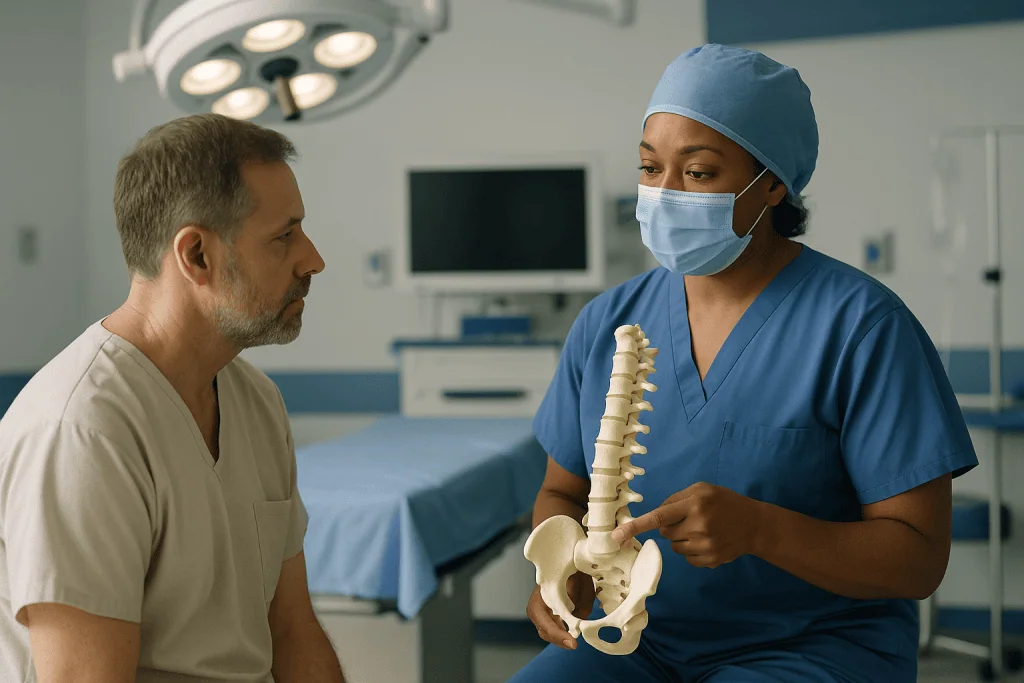
Picture the canal as a hallway with a sagging ceiling and closets bulging into the corridor. The surgeon raises the ceiling and cuts back the closets so people, or here nerves, can pass without brushing the walls. Nothing is put back; the space itself is the treatment.
Under general anesthesia, an incision is made over the affected levels, muscles are moved aside, and bone is removed with fine instruments while the nerve sac is protected. Many surgeons use an operating microscope or tubular retractors to work through a smaller opening. The Mayo Clinic describes these minimally invasive approaches as options in selected cases, with the same goal of making room rather than a different mechanism.
Sometimes a decompression alone would leave the spine unstable, particularly when one vertebra has already slipped forward on another, a condition called spondylolisthesis. In that situation the surgeon may add a fusion, joining two or more vertebrae so they heal into a single unit. Fusion is a stabilizing step, not a pain-erasing one, and the distinction matters later in this article.
The whole procedure usually takes one to a few hours depending on how many levels are involved. Most people are walking, with help, within a day, because getting the legs moving early is part of protecting against blood clots and stiffness.
Does spinal stenosis surgery relieve back pain?
Sometimes, partly, and less predictably than it relieves leg pain. That is the fairest one-line answer, and it is the one most surgeons give when asked directly.
There are a few reasons back pain can genuinely improve. Nerve root irritation itself can refer pain into the low back and buttocks, and once the root is freed that component fades. People who have spent years hunched forward to open their canal often stand straighter afterward, unloading strained muscles. Inflammation around the surgical site settles over weeks. For someone whose back pain was mostly a side effect of the stenosis, the change can feel dramatic.
Then there is the back pain that comes from the degenerative process. Discs that have lost height and water content, facet joints with worn cartilage, ligaments that have stiffened. Decompression does not repair any of these. The Mayo Clinic is explicit that surgery does not treat the underlying arthritis, and the same wear that narrowed the canal continues to age at its own pace.
Fusion is often assumed to fix this, on the logic that a joint that cannot move cannot hurt. The evidence is more cautious. A Cochrane systematic review of surgical options for lumbar stenosis, indexed on PubMed, found no convincing advantage for adding fusion to decompression in people without instability, and noted longer operations and more blood loss when fusion was added. Guidelines generally reserve fusion for structural instability rather than for back pain on its own.
What this means in practice: if leg symptoms dominate and back pain is a background hum, the outlook is favorable. If back pain is the main complaint and the legs are secondary, the treating team may steer toward nonsurgical care first, because the operation is not built for that target.
What the evidence says about spinal stenosis surgery results
The best-known study is the Spine Patient Outcomes Research Trial, usually shortened to SPORT, published in the New England Journal of Medicine and indexed on PubMed. It followed adults with lumbar stenosis, without vertebral slippage, who were either randomized or chose between decompression and nonsurgical care. At two years, those who had surgery reported greater improvements in pain, physical function and disability scores than those managed without it. The gains were largest for leg-related measures and for the ability to walk.

That sounds decisive, and in one sense it is: for people with substantial leg symptoms who had already tried other measures, surgery produced meaningful relief that nonsurgical care did not match. Two cautions apply. Many participants switched groups, which complicates the comparison, and the nonsurgical group also improved somewhat over time, a reminder that stenosis symptoms fluctuate rather than march steadily downhill.
A separate Cochrane review comparing surgery with nonsurgical treatment, also on PubMed, was more reserved. Its authors rated the overall evidence as low quality and could not say with confidence that surgery beats structured conservative care for every patient. They did report that side effects occurred in roughly 10 to 24 percent of surgical patients across the included trials, while none were reported in the conservative arms. That is not an argument against surgery; it is a description of the trade.
Read together, the studies point in a consistent direction. Decompression is a well-established option that reliably improves nerve-related leg symptoms in appropriately selected people. It carries real risks, its benefit for back pain is modest and variable, and the evidence base is thinner than patients often assume. Anyone quoting a single number for how likely surgery is to work is simplifying something the research itself leaves nuanced.
Who is usually offered surgery, and who is usually asked to wait
Surgeons tend to look for a particular fit between the story a patient tells, the findings on examination and what the imaging shows. When all three agree, surgery becomes a reasonable conversation. When they disagree, waiting is often the wiser path.
The people most often offered decompression share several features:
- Leg symptoms that limit walking, standing or daily life, and that have persisted for months despite a genuine trial of nonsurgical care.
- Imaging, usually an MRI, that shows narrowing at the level that matches those symptoms.
- Progressive weakness, numbness or unsteadiness that suggests nerves are being damaged rather than merely irritated.
- General health that makes a general anesthetic and early mobilization reasonably safe.
People commonly asked to wait, or to continue nonsurgical care, include those whose main complaint is back pain with little leg involvement, since the operation is not designed for that target. Others have imaging that looks narrow but symptoms that are mild or intermittent; the Mayo Clinic points out that some people with visible stenosis have no symptoms at all, and imaging alone does not justify an operation.
Medical factors matter too. Uncontrolled diabetes, active smoking, significant heart or lung disease, or medicines that affect bleeding may prompt a delay while these are optimized with the primary care team. Age by itself is not a barrier; stenosis is most common in people over 50, according to the Mayo Clinic, and many patients are in their seventies and eighties.
Timing is rarely an emergency. Outside the red-flag situations described later, there is usually room to try other measures, gather questions and decide without pressure. The choice belongs to the patient and the treating team together, and a good team will say plainly when surgery is unlikely to help.
Laminectomy vs fusion for stenosis: what each operation adds
Patients often hear the two terms in the same breath and assume fusion is simply the bigger, better version. It is not a bigger version of the same thing; it does a different job. Decompression makes room for nerves. Fusion locks vertebrae together so they cannot move. The table below sets the two side by side.
| Feature | Decompression alone (laminectomy or laminotomy) | Decompression with fusion |
|---|---|---|
| Main goal | Relieve nerve pressure | Relieve nerve pressure and stabilize a slipped or unstable segment |
| Typical reason chosen | Stenosis without instability | Stenosis with spondylolisthesis or other instability, or when wide bone removal would destabilize the spine |
| Hardware | Usually none | Screws and rods, often with bone graft |
| Effect on leg symptoms | Primary benefit | Similar primary benefit |
| Effect on back pain | Variable, often modest | Variable; no clear added benefit without instability (Cochrane review) |
| Operation length and blood loss | Shorter, less | Longer, more (Cochrane review) |
| Recovery | Generally quicker | Generally longer, with activity limits while bone heals |
The Cochrane review of surgical options, indexed on PubMed, is the reference point here: for people without instability, adding fusion did not clearly improve outcomes but did lengthen surgery and increase blood loss. That finding is why many guidelines describe fusion as a tool for a specific structural problem rather than a default upgrade.
There are legitimate reasons a surgeon recommends fusion: a vertebra that has already slipped, a spine that would be left wobbly after wide decompression, or a second operation at a previously treated level. When it is proposed, the most useful question is not whether fusion is good or bad but which specific instability it is meant to correct.
Numbness, weakness and balance: what recovers slowly, and what may not
Pain is the symptom that changes fastest after decompression. Numbness and weakness are slower, and here expectations need the most careful setting.
A nerve that has been compressed for months or years is not just squeezed; it may be partly starved of blood flow and its insulating covering may be damaged. Once the pressure is off, nerve fibers regrow at a slow pace, and recovery of sensation can continue for many months. MedlinePlus and the Mayo Clinic both describe numbness and weakness as symptoms that surgery aims to stop from worsening, and that may improve, rather than symptoms that reliably vanish.
In everyday terms: the pins-and-needles that came on with walking usually settle well, because that was an irritated nerve protesting. A patch of skin on the shin that has felt like cardboard for three years may stay that way, or improve only a little, because the fibers serving it have been damaged for too long. Foot drop, where the front of the foot cannot be lifted, follows the same logic; earlier decompression generally offers a better chance of recovery than a late one, which is one reason progressive weakness moves surgery up the priority list.
Balance deserves its own mention. Stenosis can dull position sense from the legs, and older adults may have been walking with a wide, cautious gait for years. Freeing the nerves helps, but so does retraining, which is why physical therapy after surgery often focuses on balance and strength as much as on the back itself.
None of this means surgery is futile for long-standing symptoms. It means the honest goal for numbness and weakness is prevention of further loss and a chance at partial recovery, with the surgical team best placed to estimate that chance for one individual’s examination and imaging.
Spinal stenosis surgery recovery time: the first days and weeks
Recovery from decompression is usually quicker than people fear, though slower than the leg relief itself, which can be noticeable almost immediately.
The NHS describes a typical hospital stay of 1–4 days after lumbar decompression. Nurses and physical therapists get patients up and walking on the first day, both to protect against blood clots and because walking is the very activity the surgery was meant to restore. Pain around the incision is expected and is managed with medicines chosen by the anesthesia and surgical team; the details of what and how much belong entirely to that team.
The first two weeks at home center on short, frequent walks, wound care and avoiding bending, twisting and heavy lifting. Many people notice that the leg heaviness that used to arrive after a block is simply absent, while the back feels bruised and stiff. Both are normal at this stage.
Between roughly 2 and 6 weeks, according to the NHS, most people can gradually return to driving once they can sit comfortably and perform an emergency stop, and to light work and everyday tasks. Physical therapy typically begins in this window, building core strength and posture. Desk-based work often resumes around 4–6 weeks, physically demanding jobs later, and the NHS notes that fuller recovery, including a return to more strenuous activity, may take several months.
If a fusion was added, the timeline stretches. Bone needs months to knit, and surgeons often restrict bending and lifting for longer, sometimes with a brace. Follow-up imaging checks that the fusion is healing.
Every one of these ranges is a typical span from published guidance, not a schedule any individual should be measured against. Age, general health, the number of levels treated and how long symptoms were present all shift the pace, and the surgical team sets the specific milestones.
Leg pain after stenosis surgery: what is normal and what is not
Most people expect leg pain to be gone the moment they wake up, and for many it largely is. But leg symptoms that flicker in the early weeks are common enough to deserve an explanation before they cause panic.
A nerve that has been compressed for a long time is inflamed, and handling it during surgery irritates it further. In the first days and weeks it may fire off tingling, burning or brief electric jolts, sometimes in a slightly different spot than before. Surgeons often describe this as the nerve waking up. It generally settles as swelling subsides, and it does not mean the operation failed.
Some patterns, though, warrant a call rather than patience. Leg pain that was gone and then returns sharply after a fall or a lift. Pain that is steadily worsening rather than fluctuating. New weakness, such as a foot that starts to catch on the floor, or numbness spreading to areas that were fine before. Any of these could point to a blood collection pressing on the nerve, a recurrent disc fragment or, less often, a problem with a fusion, and the surgical team will want to assess early rather than late.
Persistent leg pain months out, with no new event, calls for a different conversation. Possibilities include scar tissue around the nerve, narrowing at an adjacent level that was not treated, or nerve damage that predated the operation. MedlinePlus notes that stenosis can recur or progress at other levels over time. This is not a reason to avoid surgery; it is a reason to keep follow-up appointments and to describe symptoms specifically, because the pattern tells the team where to look.
A practical habit helps: note the walking distance, the sitting tolerance and the location of any pain every couple of weeks. Written trends are far more useful to a surgeon than a general sense that things are better or worse.
Nonsurgical options, and where medicines fit
Surgery is rarely the first step, and for many people it never becomes necessary. The Mayo Clinic and MedlinePlus describe a range of nonsurgical approaches that aim to keep walking distance up and pain manageable while the spine ages at its own pace.
Physical therapy is the foundation. It works on the mechanics that stenosis punishes: hip flexibility, core endurance, and posture that keeps the canal as open as possible. A stationary bicycle, which puts the spine in gentle flexion, is often tolerated far better than walking and builds fitness without provoking symptoms. Weight management reduces load on the lower spine.
Medicines are used for comfort rather than to change the narrowing. Anti-inflammatory drugs reduce swelling around irritated nerve roots and are often used in short courses. Medicines developed for nerve pain, including some anticonvulsants, work by calming overactive nerve signaling and may take weeks to show their effect. Whether any of these suit a given person, and for how long, is a decision for the prescribing clinician, who weighs kidney function, heart risk, other medicines and fall risk in older adults.
Epidural steroid injections place an anti-inflammatory medicine near the compressed nerves. The Mayo Clinic notes they can ease pain for some people, that the benefit is often temporary, and that repeated injections carry their own risks, so their number is limited.
Newer or less-studied procedures are sometimes marketed as alternatives. Where a device or technique has not been evaluated in mainstream guidelines or systematic reviews, the honest position is that its effectiveness is not established, and it should be discussed with the treating team on that basis.
Nonsurgical care does not reverse stenosis. What it can do is buy time, maintain function and clarify whether symptoms are stable or progressing, which is itself valuable information for the surgery decision.
Risks and trade-offs in plain language
Every surgical conversation should include the downside, described neutrally. The NHS lists the main complications of lumbar decompression, and none of them are exotic; they are the ordinary risks of spine surgery, most of them uncommon and most of them manageable when recognized early.
- Infection at the wound or, less often, deeper around the spine.
- Bleeding, including a blood collection that presses on nerves and may need urgent drainage.
- A tear in the dura, the membrane holding spinal fluid, which can cause headaches and sometimes needs repair.
- Nerve injury causing new weakness, numbness or, rarely, bladder or bowel problems.
- Blood clots in the legs that can travel to the lungs.
- Recurrence of stenosis at the same or an adjacent level over the following years.
- With fusion: failure of the bone to knit, hardware problems and added stress on neighboring levels.
The Cochrane review comparing surgery with nonsurgical care put a range on the overall picture, reporting side effects in roughly 10 to 24 percent of surgical patients across the trials it included. Most of these were minor and temporary, but the figure is a useful reminder that surgery is a real intervention with a real cost in risk.
The trade-off, then, is fairly stated. On one side: a well-established procedure that reliably improves nerve-related leg symptoms and walking, with less certain effects on back pain. On the other: anesthetic and surgical risks, a recovery of weeks to months, and a spine that continues to age afterward. Individual health shifts the balance. A person with diabetes and heart disease faces different odds from a healthy seventy-year-old, and the surgical and anesthesia teams are the ones who can weigh those specifics.
What people often get wrong about spinal stenosis surgery
Some misunderstandings show up in almost every clinic. Correcting them early prevents disappointment later.
The MRI decides. It does not. Scans of people over 60 frequently show narrowing that causes no symptoms at all, and the Mayo Clinic cautions that imaging findings must match the clinical picture. A dramatic-looking scan in someone who walks two miles comfortably is not a reason to operate.
Surgery fixes the whole back. Decompression frees nerves. It does not restore discs, resurface joints or turn a 70-year-old spine into a 40-year-old one. Back pain from wear and tear may persist, and that is the operation working as designed, not failing.
Fusion is the stronger version. Fusion is a stabilizing step for specific structural problems. The Cochrane review of surgical options found no clear added benefit for people without instability, and it lengthens both the operation and the recovery.
Waiting is dangerous. Outside the red-flag situations, stenosis is usually a slow, fluctuating condition. Most people have time to try other measures and decide calmly. The exception is progressive weakness or bladder and bowel changes, which do change the urgency.
Numbness will disappear. Long-standing numbness reflects nerve damage that recovers slowly and sometimes incompletely. The realistic aim is to stop it worsening and hope for partial return.
Once it is fixed, it stays fixed. Stenosis can recur at the same level or develop at a neighboring one. MedlinePlus describes it as a degenerative process, and follow-up over the years is part of the picture.
A younger person should never need it. Stenosis is most common after 50, but people born with a narrow canal, or with prior injury, can develop symptoms earlier. The decision rests on symptoms and findings, not birthdays.
Questions to ask your care team before spinal stenosis surgery
A surgical consultation moves quickly, and the best questions are the ones that pin down what the operation is expected to change for one specific person. Bringing a written list, and someone to take notes, is worth more than any amount of online reading.
- Which of my symptoms is this operation designed to relieve, and which is it unlikely to change?
- How closely do my scan findings match the symptoms I describe, and at which levels?
- Are you proposing decompression alone or decompression with fusion, and if fusion, what specific instability is it correcting?
- How many levels will be treated, and how does that affect recovery?
- What is the realistic outlook for my numbness or weakness, given how long I have had it?
- What happens if I choose to wait six months, and what would make you want to operate sooner?
- Which nonsurgical options have I not yet tried in a structured way?
- What are the specific risks for someone with my medical history, and how will they be reduced?
- What will the first two weeks at home look like, and what help will I need?
- When can I expect to drive, return to work and resume the activities that matter most to me?
- What signs after surgery should prompt me to call, and whom do I call?
- How will we follow up over the coming years, given that stenosis can progress elsewhere?
Two questions tend to be especially clarifying. The first is which symptom the surgeon considers the primary target; if the answer is leg symptoms and the patient’s main worry is back pain, that mismatch needs resolving before anything is scheduled. The second is what the surgeon would do if the operation relieved the legs but left the back unchanged, because that is a common and legitimate outcome, and knowing the plan for it in advance takes the sting out of it if it happens.
A team that welcomes these questions is doing its job well. Every decision that follows, including whether to proceed at all, sits with the patient and that team.
When to call your doctor
Most recovery worries turn out to be ordinary healing, but some signs should never wait for the next scheduled appointment. Whether surgery has happened or is still being considered, seek care the same day, or emergency care if severe, for any of the following.
- New difficulty controlling the bladder or bowels, or numbness in the groin and inner thighs. This pattern can signal severe compression of the nerve bundle at the base of the spine, and both MedlinePlus and the NHS describe it as an emergency.
- Weakness that is new or rapidly worsening, such as a foot that drags, a knee that buckles or trouble rising from a chair.
- Fever, chills, or a wound that becomes increasingly red, swollen, warm, or leaks fluid or pus.
- Severe headache that is worse when upright and eases lying flat, which can indicate a spinal fluid leak.
- Calf pain, swelling or warmth in one leg, or sudden breathlessness or chest pain, which may point to a blood clot.
- Leg or back pain that escalates sharply rather than fluctuating, especially after a fall or heavy lift.
- Numbness spreading to areas that were not affected before.
Outside these red flags, a phone call is still the right move for anything that feels wrong: pain not controlled by the plan the team provided, dizziness or confusion, or a walking distance that is shrinking again after early improvement. Surgical teams would far rather hear about a false alarm than learn of a real problem late.
For people who have not had surgery, the same emergency signs apply. Stenosis usually progresses slowly, but bladder or bowel changes and rapid weakness change the timeline entirely and need urgent assessment, not a wait-and-see approach.
Frequently asked questions
Does spinal stenosis surgery relieve back pain as well as leg pain?
Leg pain responds far more reliably than back pain. Decompression frees compressed nerve roots, which is what causes the leg symptoms. Back pain from degenerated discs and arthritic facet joints is not addressed by removing bone and ligament, so it may persist. Some back pain does ease as nerve irritation and posture improve, but the surgical team should be asked directly how much change to expect.
What is the typical spinal stenosis surgery recovery time?
The NHS describes a hospital stay of 1–4 days after lumbar decompression, with walking encouraged from the first day. Light activities and driving usually resume within 2–6 weeks, desk work around 4–6 weeks, and more strenuous activity over several months. Fusion extends these ranges because bone must heal. These are typical spans, not promises, and the surgical team sets individual milestones.
Why do I still have leg pain after stenosis surgery?
Early tingling or burning is common because the irritated nerve is settling and often fades over weeks. Pain that returns sharply, steadily worsens, or comes with new weakness needs prompt review, since it could indicate a blood collection, recurrent compression or another treatable issue. Persistent pain months later may reflect scar tissue, narrowing at another level or pre-existing nerve damage.
Laminectomy vs fusion for stenosis: which one do I need?
That depends on whether the spine is stable. Laminectomy relieves nerve pressure and is usually enough when there is no instability. Fusion is added when a vertebra has slipped or wide bone removal would leave the segment unstable. A Cochrane review found no clear benefit from fusion in people without instability, so the useful question is which specific structural problem a proposed fusion would correct.
Will my numbness go away after spinal stenosis surgery?
It may improve, but often slowly and sometimes only partly. Nerves compressed for months or years sustain damage that regrows gradually, and the Mayo Clinic describes numbness and weakness as symptoms surgery aims to keep from worsening rather than reliably reverse. Tingling that appeared only with walking usually settles well; long-standing dense numbness is less predictable. The team can estimate based on examination and duration.
Is spinal stenosis surgery worth it if my main problem is back pain?
Usually the treating team will look hard at this before recommending surgery. Decompression targets nerve compression, not degenerative back pain, so someone with mostly back pain and minimal leg symptoms is less likely to feel the operation was worthwhile. Structured nonsurgical care is often the first suggestion. The decision rests with the patient and the team after the expected benefit is spelled out honestly.
How successful is spinal stenosis surgery according to research?
The SPORT trial found that people who had decompression reported greater improvements in pain, function and disability at two years than those treated nonsurgically, especially for leg symptoms and walking. A Cochrane review rated the overall evidence as low quality and noted side effects in roughly 10 to 24 percent of surgical patients across trials. Research supports the operation for selected people without guaranteeing any individual result.
Can spinal stenosis come back after surgery?
Yes, it can. Stenosis is a degenerative process, and narrowing may recur at the treated level or develop at a neighboring one over the following years, as MedlinePlus notes. Fusion can also add stress to adjacent segments. This is why follow-up continues after recovery and why returning symptoms, especially shrinking walking distance, should be reported rather than assumed to be normal aging.
Who should not have spinal stenosis surgery?
People whose symptoms are mild, whose scan findings do not match their symptoms, or whose main complaint is back pain rather than leg symptoms are often advised to continue nonsurgical care. Uncontrolled medical conditions such as diabetes, heart or lung disease, or bleeding risks may prompt a delay while they are optimized. Age alone is not a barrier; the decision depends on symptoms, findings and overall health.
What are the warning signs after spinal stenosis surgery that need urgent care?
New bladder or bowel control problems, numbness in the groin, or rapidly worsening leg weakness are emergencies. Fever, a wound that is increasingly red or leaking, a severe headache worse when upright, calf pain or swelling, chest pain or breathlessness also need same-day attention. Surgical teams prefer an early call about a possible problem to a late discovery of a real one.
References
This article is for general information only and is not a substitute for professional medical advice. Please consult a qualified doctor about your individual situation.

More from the Blog

Nucleoplasty Recovery: Why Back Pain Can Rise Briefly and When Bending and Lifting Resume
Nucleoplasty recovery usually involves going home the same day, a brief rise in back pain over the first days as the needle path and…

Lifting, Bending and Sitting After Herniated Disc Surgery: Habits That Protect the Repair
After herniated disc surgery, most surgical teams ask patients to avoid lifting anything heavier than a light grocery bag, roughly 5 to 10 pounds,…

When Spinal Fusion Does Not Fuse: Pseudarthrosis Explained and What Revision Involves
A failed spinal fusion, called pseudarthrosis or nonunion, means the bone graft placed between vertebrae did not grow into one solid piece within the…

Who Is a Candidate for Artificial Disc Replacement? Single-Level Disease and Healthy Facets
The typical artificial disc replacement candidate has neck or low back pain traced to a single worn disc, with facet joints and surrounding bone…

Schroth Method for Adults With Scoliosis: How Goals Differ From Treating a Growing Teen
The Schroth method for adults uses the same three-dimensional posture, breathing and strengthening principles taught to teenagers, but the goal shifts. In a growing…

Preparing for ACDF Surgery: Medicines to List, Tests to Complete and Soft Foods to Stock
Preparing for ACDF surgery usually means three tasks: giving your surgical team a complete list of every prescription, over-the-counter medicine and supplement you take;…