

What to Ask Before Aesthetic Scalp Surgery: Photos, Hairline Goals and What the Plan Covers

Key Takeaways
- Hairline lowering moves existing scalp forward by removing a strip of forehead skin, so scalp laxity, not a tape measure, sets how far the line can travel.
- Numbness or tingling behind the incision is an expected effect of cutting across the supraorbital and supratrochlear nerve branches, and it may not fully resolve.
- The CDC defines surgical site infections as arising within about 30 days of an operation, which is the window to watch the wound for spreading redness, drainage or fever.
- Pattern hair loss is progressive, so a hairline lowered while recession is active can leave a scar with no hair behind it; stability across old photos is a genuine prerequisite.
- Hairs near the incision commonly shed a few weeks after surgery and regrow over months, mirroring the shedding-then-regrowth cycle MedlinePlus describes after hair transplantation.
- NHS guidance recommends a cooling-off period of around two weeks between consultation and cosmetic surgery, and a written plan should cover follow-up, complications and revision.
Before hairline lowering surgery, also called forehead reduction, ask how far your hairline can realistically move given your scalp laxity, where the incision will sit and how the scar is expected to mature, what anesthesia is planned, what the written plan covers for follow-up and revision, and how future hair loss could change the result. Bring dated photos, describe your goal as a shape rather than a measurement, and disclose every medicine and health condition.
She has done it a hundred times without thinking: fringe swept forward, a quick check in the elevator mirror, then a hand that hovers near the forehead all day. Tonight is different. A headband pulls everything back, the bathroom light is unforgiving, and her phone is open to a consultation booking form. The questions before hairline lowering surgery are already stacking up, and most of them are not about the operation at all. They are about whether the version of her in the photo is a reasonable thing to ask for.
That instinct is the right one. An aesthetic scalp operation is judged on millimeters and on decades: the position of a line today, and what the scalp around it does as the years pass. The consultation is where those two timescales meet.
What follows is not a sales script and not a checklist to hand over silently. It is the set of questions a careful patient asks, why each one matters, and what mainstream medical evidence can and cannot tell you about the answers.
What is hairline lowering surgery, and what actually happens in the operating room?
Hairline lowering, often called forehead reduction, is an operation that moves the front edge of hair-bearing scalp downward by removing a strip of forehead skin and advancing the scalp to close the gap. It is a soft-tissue procedure; the bone is not reshaped, and the eyebrows are not lifted as part of the standard operation.
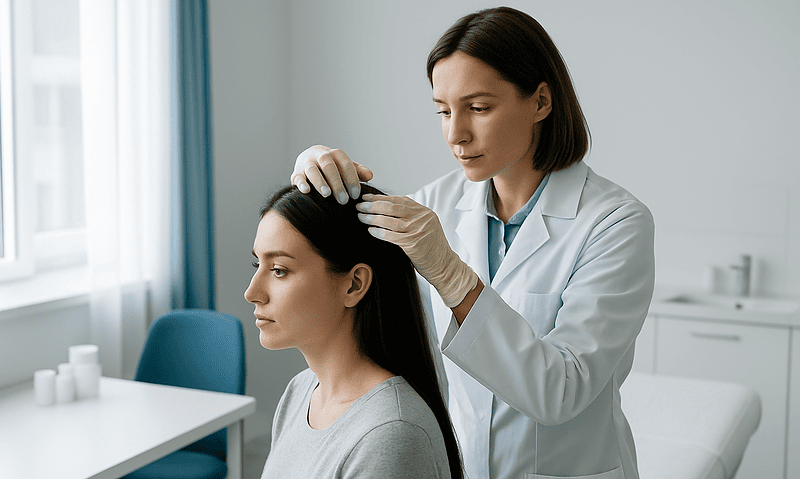
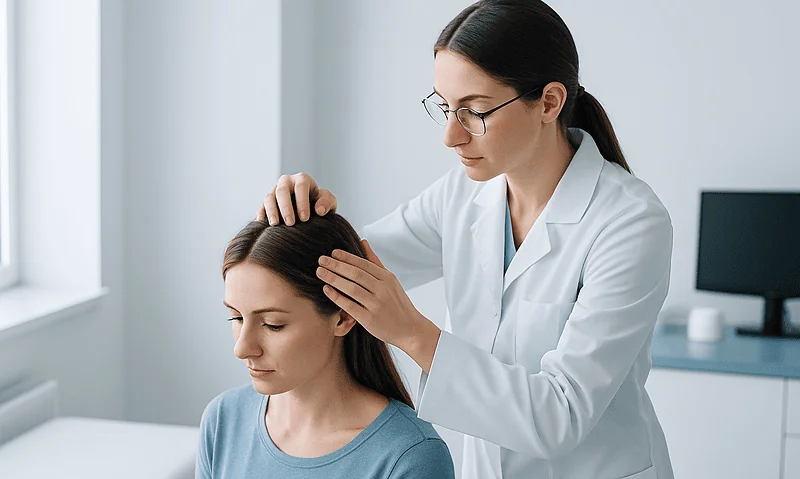
The incision is pretrichial, meaning it runs along or just inside the existing hairline. Beneath the skin lies the galea, a tough fibrous sheet that gives the scalp its stiffness. The surgeon releases the scalp from the layer under the galea so it can glide forward, then judges how much forehead skin can be removed without pulling the closure too tight. That judgment depends on scalp laxity, the natural give in your scalp when someone gently pinches and slides it, which is why a good consultation involves hands on your head, not only a look at a photo.
Many surgeons use a trichophytic closure, a technique in which one wound edge is bevelled so hair follicles sit under the healing line and grow through it, softening the scar. When laxity is limited, a two-stage approach may be discussed: a tissue expander, a silicone balloon placed under the scalp and gradually filled over a series of visits to generate extra skin, followed by the lowering operation.
Anesthesia varies. Local anesthetic with sedation and general anesthesia are both used; the choice belongs to the anesthesia team after they review your health. MedlinePlus describes the general categories of anesthesia and their typical risks, which is a sensible starting point for questions about your own case. Ask which approach is planned and why, who will be monitoring you, and where the procedure will take place. None of those answers should be vague.
Who is hairline lowering usually for, and who is usually asked to wait?
The classic candidate has a hairline that has always sat high, is not moving, and is backed by dense hair at the frontal edge. In practical terms, that usually means a person, often a woman, whose forehead height is a lifelong feature rather than a recent change, and whose scalp has enough laxity for the tissue to advance. Good frontal density matters because the scar depends on hairs growing through and around it.
People are commonly asked to wait, or steered toward a different approach, when the hairline is still changing. Androgenetic alopecia, the inherited pattern hair loss described by Mayo Clinic as the most common cause of thinning in both sexes, tends to progress. Lowering a hairline that is receding can leave a scar stranded on bare forehead as the hair behind it continues to thin. Young adults whose hairline has not settled fall into the same cautious category, and surgeons often want evidence of stability across old photographs before committing.
Medical factors also prompt a pause. Uncontrolled blood pressure or diabetes, bleeding disorders, use of medicines that affect clotting, current smoking, and a history of keloid or hypertrophic scarring (thick raised scars that outgrow the original wound) all change the risk picture. The treating team, not a website, weighs these.
Then there is the question of why. NHS guidance on cosmetic procedures encourages people to reflect on their motivations, to avoid deciding during a period of emotional upheaval, and to be honest if worry about appearance is taking over daily life. A surgeon who asks about your mood and expectations is doing the job properly, not doubting you. If the conversation feels rushed or the surgeon never asks what you hope will change beyond the mirror, that is information too.
Hairline lowering vs hair transplant: which questions separate them?
The two procedures are often confused because both change where hair appears to begin. They work in opposite ways. Lowering moves existing scalp forward in one movement. A hair transplant, as MedlinePlus explains, takes small grafts of hair-bearing skin from a donor area and places them where hair is wanted, so density builds gradually as the transplanted follicles cycle.
| Question to ask | Hairline lowering | Hair transplant to the hairline |
|---|---|---|
| What physically changes? | A strip of forehead skin is removed; the scalp advances | Individual follicular units are placed into the forehead skin |
| How soon does the line look different? | Immediately, then refined as swelling settles | Grafts shed and regrow; MedlinePlus notes new growth appears over months |
| Where is the scar? | One continuous line along the hairline | Small dot scars or a linear donor scar at the back of the scalp |
| What does it depend on most? | Scalp laxity and frontal hair density | Donor hair supply and stable hair loss |
| What if hair loss progresses? | Scar may become visible | Transplanted hair usually persists; native hair behind it may thin |
Neither is universally better. A person with a stable, dense, high hairline and a mobile scalp may be offered lowering because it produces a fuller edge quickly. Someone with early recession, limited laxity, or a preference for no long incision may be steered toward grafting. Some plans combine them: lowering first, grafting later to soften the line or cover the scar.
The question worth asking directly is: “Why this procedure for me, and what would make you choose the other?” A thoughtful answer will reference your laxity, your density, and your family pattern of hair loss. A vague one is a reason to seek a second opinion.
Why your photos matter more than you think, and what to ask about them
Photographs do two jobs in this decision, and only one of them is aesthetic. The first is documentation of stability. A hairline that looks identical at eighteen and at thirty-two tells a very different story from one that has crept upward. Dig out older pictures with the hair pulled back, ideally in similar lighting, and bring them. Surgeons read those images the way a cardiologist reads an old ECG: not for beauty, but for change over time.
The second job is communication. Phone photos are useful, but they distort. A front camera held close makes the forehead loom; a downward angle shrinks it. Ask the team whether they take standardized clinical photographs, meaning fixed distance, neutral expression, consistent lighting and several angles, and whether you can see your own set with the proposed line drawn on. Many surgeons will mark your forehead with a skin pencil during the consultation and photograph it. Ask for that. It converts a conversation into something you can look at calmly at home.
Consent for images deserves its own question. Who stores the photographs, how long are they kept, and can they be used in teaching or marketing? You are entitled to say no to any use beyond your own record, and NHS guidance on cosmetic procedures is clear that consent should be informed and unhurried.
When you are shown other patients’ results, ask for people with your hair color, texture and skin tone, and ask to see the scar close up at several time points rather than only a flattering final image. Digital simulations, if offered, are illustrations of intent. They are not predictions and should never be treated as a promise of outcome.
Hairline goals: how to describe the shape you want without quoting a number
Most people arrive with a measurement in mind. “Two centimeters lower” feels concrete, but it is the least useful thing you can say, because the scalp decides how far it will move, not the tape measure. Shape is where your input genuinely matters.
Learn a little vocabulary before the appointment. The frontal hairline can be flat, gently rounded, or shaped with a central widow’s peak, the small downward point some people have at the midline. The temporal points are the hair-bearing corners near the temples; they influence whether a face reads as oval or square. A natural hairline is rarely a crisp line; it has an irregular, feathered zone where finer hairs sit ahead of the dense edge. Surgeons sometimes plan a slightly wavy incision to imitate this, because a ruler-straight scar reads as artificial even when it heals well.
Useful phrasing sounds like: “I want the corners softer,” or “I would like the center a little lower than the sides,” or “I want it to still look like my hairline, only lower.” Then ask the surgeon to describe, in the same plain terms, what they can and cannot do with your tissue.
Two further questions protect you from surprises. First, how will the new line look when you raise your eyebrows? The frontalis, the forehead muscle that lifts the brows, folds the skin above it, and a hairline that is too close to the brows can look crowded in expression. Second, what would the surgeon refuse to do, and why? A clinician who can name a position that is too low for your face is showing judgment, and that judgment is what you are really choosing.
What the plan covers: reading the written proposal like a contract
A surgical plan is a document, not a mood. Before you agree to anything, you should be able to read, in writing, what the operation includes and what it does not. NHS guidance on cosmetic surgery recommends a cooling-off period, commonly around two weeks, between the consultation and the procedure, so that no one is deciding on the day.
Read for these elements. The named procedure, including whether tissue expansion is proposed as a first stage. The planned anesthesia and who provides it. The facility, and whether it is registered or accredited for surgery under that type of anesthesia. The follow-up schedule: when dressings are checked, when sutures come out, and how many visits are built in across the first year. Wound care instructions, with a phone number that answers out of hours.
Then look for what happens when things go sideways. If a hematoma (a collection of blood under the skin) needs draining, if an infection needs treatment, or if part of the scar widens, does the plan state who manages it and where? Ask how the team approaches revision if the scar is more visible than expected, and whether later grafting into the scar is something they perform or refer on. Ask what documentation you will receive afterward, including an operation note you can give to another clinician.
Notice what is absent. A plan that lists everything about the day of surgery and nothing about month six is incomplete. Scars and sensation evolve for many months, and the team should expect to see you then. Costs are not something this article addresses, but every other line of the plan should be legible to you before you sign.
Forehead reduction surgery risks: how risky is it really?
The honest answer is that hairline lowering is a moderate-scale soft-tissue operation with a specific set of risks, and that the evidence base is thinner than for common procedures. Most published descriptions come from surgical case series rather than controlled trials, so any percentage you see quoted online should be treated as one center’s experience, not a general truth. The allowed guideline-level sources do not publish complication rates for this operation, and this article will not invent one.
Mechanisms, however, are well understood. Bleeding and hematoma can occur because the scalp is richly supplied with blood vessels. Infection is possible with any incision; the CDC describes surgical site infections as those arising within about 30 days of an operation, which is a useful window to stay watchful. Wound edges under tension may widen the scar or, rarely, break down.
Sensation deserves special attention. The supraorbital and supratrochlear nerves travel up from the brow region toward the top of the head, carrying feeling from the forehead and front of the scalp. An incision across their path commonly causes numbness or tingling behind the scar. Sensation often improves as nerve fibers regrow, but some people are left with a permanently altered patch, and no surgeon can promise otherwise.
Hair itself can react. Shock loss, medically telogen effluvium, is a temporary shedding of hairs near the incision triggered by the stress of surgery; regrowth usually follows over months, though the timeline varies. Asymmetry, a line that sits slightly differently on each side, is another recognized outcome. Add the general risks of anesthesia listed by MedlinePlus, and the risk that later recession exposes the scar, and you have the full conversation to bring to your consultation.
The hairline lowering scar: where it sits, how it heals and what to ask
Everything about this operation is, in the end, a negotiation with one scar. Its position is fixed by design: it lies at the new junction between forehead skin and hair-bearing scalp. What varies is how it heals and how well hair disguises it.
Ask the surgeon to describe their closure technique in plain words. With a trichophytic closure, follicles are deliberately left beneath the wound edge so hairs emerge through the scar line over the following months. Ask how they handle tension, because a scalp advanced too far pulls the closure taut, and tension is the enemy of a fine scar. Ask, too, whether they plan a gently irregular line rather than a straight one, and why.
Healing happens in stages. Fresh scars are typically pink or red and slightly raised as new blood vessels supply the repair; over many months the color fades and the surface flattens. MedlinePlus advice on caring for a closed surgical wound stresses keeping the area clean, following the team’s washing and dressing instructions, and protecting healing skin from the sun, which can darken a maturing scar. Ask when you may wash your hair, when you may color it, and when heat styling is reasonable.
Your skin tone and history matter. People who form thick or dark scars elsewhere should raise this early, because it changes both the risk discussion and the aftercare plan. Finally, ask the uncomfortable question: “If my hair recedes later, what does this scar look like?” A candid answer, including the option of grafting hair into the scar, is a sign you are in careful hands. A brush-off is not.
How painful is forehead reduction surgery, and what will I feel afterward?
Pain is the question people most want answered and the one least well captured by numbers, because the scalp behaves unusually. Many people describe the early days less as sharp pain and more as tightness, a band-like pressure across the forehead, and a headache-type ache that responds to ordinary rest.
During the operation itself you should feel nothing. Whether that is achieved with local anesthetic plus sedation or with general anesthesia is a decision the anesthesia team makes with you after reviewing your history; MedlinePlus explains what each type involves and how you will be monitored. Ask who will be present throughout, and how they will keep you comfortable and warm.
Afterward, the picture is shaped by the nerves discussed earlier. Because the forehead and front scalp are often numb behind the incision, that region may feel oddly wooden rather than sore. As sensation returns, tingling, itching and brief electric twinges are common and usually reassuring rather than alarming. Tenderness around the brows and temples, and swelling that drifts down toward the eyelids in the first days, are also expected.
Your team will set the pain plan, including which medicines are appropriate for you, and this article will not suggest any. What you can do is ask for the plan in writing, ask what level of discomfort is normal on each of the first few days, and ask what would be a reason to call. Sudden severe pain on one side, a rapidly swelling area, or pain that escalates rather than eases are not part of normal recovery and are covered in the red-flag section below. Sleeping with the head elevated is commonly advised to limit swelling; confirm this with your own team.
Forehead reduction recovery time: what the following days and weeks usually look like
No two scalps heal on the same calendar, and guideline-level sources do not publish a recovery timetable specific to hairline lowering. The most defensible approach is to borrow the broad framework that MedlinePlus and NHS use for scalp surgery generally, then ask your own team where you are likely to differ.
The first two days are about pressure and rest. A dressing or head wrap is common, swelling peaks, and bruising may appear around the eyes because fluid tracks downward. Most people are up and walking the same day but are asked to avoid bending, lifting and anything that raises blood pressure in the head.
The first week is the suture week. Stitches or staples along the hairline are removed when the wound edges have knitted; MedlinePlus notes that timing depends on the wound site and type and is set by the surgical team rather than by a fixed rule. For hair transplantation, MedlinePlus describes people returning to work within about 2 to 5 days; hairline lowering involves a longer incision, so treat that figure as a floor, not a prediction, and ask your surgeon for a range that fits you.
Weeks two through six bring a pink, slightly firm scar, gradual return of exercise as permitted, and often the start of shock shedding near the incision. MedlinePlus explains that transplanted hairs shed 2 to 3 weeks after grafting before regrowing over months; native hairs stressed by surgery follow a similar cycle, so a temporary thinning along the line is expected, not evidence of failure.
Months follow. Numbness recedes at its own pace, the scar flattens and fades, and hair regrows through the closure. Plan on follow-up visits well into the first year, and treat that timeline as a pattern, not a promise.
Questions before hairline lowering surgery about your medical history and medicines
The least glamorous part of the consultation is the part most likely to change the outcome. Arrive with a written list of every prescription, over-the-counter product and supplement you take, with the reason for each. Surgeons and anesthetists are not judging; they are looking for anything that affects bleeding, healing or your safety under anesthesia.
Several categories need a conversation. Anticoagulants and antiplatelet medicines, which reduce the blood’s ability to clot, raise the risk of bleeding and hematoma in a richly vascular scalp. Some herbal or dietary supplements can have similar effects. Never stop or adjust any of these on your own; the prescribing clinician and the surgical team decide together whether and how to manage them around the operation.
Hair loss medicines are often already in the picture. Topical minoxidil is thought to prolong the growth phase of follicles and improve blood flow to the scalp; oral finasteride reduces conversion of testosterone to the hormone that drives pattern loss. Mayo Clinic notes that it can take at least six months of use to judge whether such treatments are slowing loss or supporting regrowth. Tell the surgeon whether you use them, because they influence expectations about stability. Continuing, pausing or starting them is a decision for the prescriber, not for this article.
Beyond medicines, disclose smoking or nicotine use, which narrows small blood vessels and impairs wound healing; diabetes and blood pressure control; any bleeding tendency; previous scalp or facial surgery; a history of poor or thick scarring; pregnancy or plans for it; and any history of anxiety about appearance. Each answer refines the plan. Withholding one because it feels irrelevant is the single most common way a good candidate becomes a complicated case.
What people often get wrong about hairline lowering
The myths around this operation are persistent, partly because it is uncommon and partly because social media rewards the cleanest possible version of any result. A few corrections, grounded in how the procedure actually works.
“It is a hair transplant by another name.” It is not. Lowering moves your existing scalp; grafting adds follicles. The scars, timelines and ideal candidates differ, which is why the earlier comparison table exists.
“The scar disappears.” Scars fade and hair can grow through them, but no incision vanishes. Hairstyle, hair density and skin tone determine how visible the line is, and future recession can expose it.
“It fixes a receding hairline.” Pattern hair loss, as Mayo Clinic describes it, is progressive. Lowering a hairline that is retreating tends to leave a scar without hair behind it. Stability first, surgery second.
“I can choose the exact number of centimeters.” Scalp laxity chooses. The surgeon estimates a range by examining your scalp, and the final figure is decided on the table, not in the brochure.
“It also lifts the brows.” A standard hairline lowering does not reposition the eyebrows. A brow lift is a separate procedure with different incisions and risks; if both are being discussed, ask for each to be explained on its own.
“Recovery is a weekend.” The early days are manageable for many people, but sutures, swelling, shock shedding and numbness stretch across weeks and months. Plan for the whole arc.
“Numbness means something went wrong.” Altered sensation behind the incision is an expected consequence of cutting across forehead nerve branches. It is a known trade-off to be discussed beforehand, not a complication discovered afterward.
Questions before hairline lowering surgery: the list to bring to your care team
Write these down, and write the answers down too. A consultation that goes well is one where you leave with fewer assumptions than you arrived with.
- Given my scalp laxity and hair density, what range of movement do you consider realistic for me, and what would you refuse to attempt?
- Will you draw the proposed line on my forehead and photograph it so I can review it at home?
- Which anesthesia do you propose, who provides it, and where will the operation take place?
- How do you close the incision, and how do you plan the line so it does not read as straight?
- What is your approach if my hairline recedes in later years? Do you offer grafting into the scar?
- What sensation changes should I expect behind the incision, and how do you counsel people whose numbness persists?
- What is the follow-up schedule across the first year, and who do I call after hours?
- How do you manage a hematoma, an infection or a widened scar if one occurs, and is that written into my plan?
- Do you recommend tissue expansion for me, and if so, what does the first stage involve?
- Which of my medicines and supplements need discussion with my prescriber before surgery?
- May I see photographs of people with my hair color, texture and skin tone, including close-ups of the scar at several stages?
- How long is the cooling-off period between this conversation and a booked date?
Notice what the list does not include: anything that asks the surgeon to promise a result. Good clinicians will decline to guarantee an outcome and will say so plainly. The most useful thing you can hear is a clear description of what would lead them to advise against operating on you at all.
When to call your doctor: red-flag signs after hairline lowering
Recovery has a rhythm, and most of what you notice will be ordinary: tightness, mild swelling, bruising that drifts toward the eyes, itching as nerves wake up. The signs below are different. They warrant a same-day call to your surgical team, and for the most severe, emergency care.
Call your team promptly if you notice a rapidly enlarging, tense or painful swelling under the scalp or forehead, which can indicate a hematoma; bleeding that soaks through a dressing and does not settle with gentle pressure; spreading redness, increasing warmth, thick or foul-smelling drainage, or wound edges that pull apart, all features the CDC and MedlinePlus list as signs of a possible surgical site infection; fever or chills; pain that escalates after the first day or two rather than easing; or any area of skin along the incision that turns dusky, gray or dark, which can signal a blood supply problem.
Seek emergency care without waiting for a callback if you have sudden severe headache with vomiting or confusion, difficulty breathing, chest pain, swelling of the face or tongue, a rash spreading quickly, or fainting. These are rare after scalp surgery but belong to no one’s normal recovery. Warmth, swelling or pain in a calf, or breathlessness, should also be treated as urgent, since reduced mobility after any operation can raise the risk of a blood clot.
One further reason to call is quieter: if something simply feels wrong to you and you cannot name it. Surgical teams would far rather hear from you about a worry that turns out to be nothing than discover a problem at the next scheduled visit. Every decision about how to respond, including whether you need to be seen, rests with the treating team, and this article is not a substitute for that call.
Frequently asked questions
How risky is a forehead reduction surgery?
It carries the recognized risks of a moderate soft-tissue scalp operation: bleeding and hematoma, infection, a scar that widens or stays visible, numbness behind the incision, temporary hair shedding near the line, asymmetry and the general risks of anesthesia. Reliable complication percentages do not exist in guideline-level sources, because most data come from individual surgical series. Your own risk depends on health, medicines, smoking status and scalp characteristics, all of which the treating team should review with you before any decision.
What not to say to a plastic surgeon?
There is nothing you cannot say, but some things work against you. Asking for another person’s hairline, demanding a guarantee, quoting an exact number of centimeters, or saying “do whatever you think” all shift responsibility away from the shared plan. Hiding smoking, supplements, blood thinners or a history of appearance-related anxiety is the most harmful omission, because it changes safety. Describe the shape you want in plain words and answer medical questions fully.
How painful is forehead reduction surgery?
You should feel nothing during the operation itself, whether under local anesthetic with sedation or general anesthesia. Afterward, most people describe tightness across the forehead, a headache-like ache and tenderness near the brows rather than sharp pain, partly because the skin behind the incision is often numb. Tingling and itching appear as nerves recover. Your surgical team sets the pain plan; escalating or one-sided severe pain is not normal and should prompt a call.
Do they cover your privates during surgery?
Yes. Standard operating room practice exposes only the area being operated on, in this case the forehead and front scalp. The rest of the body remains covered with a gown, sterile drapes and warming blankets, and you can ask the team beforehand exactly how you will be positioned and covered. If being under anesthesia raises worries about dignity, say so at the consultation; anesthesia and nursing staff hear this often and can explain their routines.
Hairline lowering vs hair transplant: which is right for me?
It depends on scalp laxity, frontal hair density and whether your hairline is stable. Lowering suits a lifelong high hairline with dense hair and a mobile scalp, producing an immediate change with one continuous scar. Grafting suits limited laxity, early recession or a preference to avoid a long incision, with density building over months as MedlinePlus describes. Some plans combine the two. Ask your surgeon why they favor one for you and what would change their mind.
How long is forehead reduction recovery time?
No guideline source publishes a timetable specific to hairline lowering, so treat ranges as patterns rather than promises. Swelling and bruising peak in the first days, sutures are removed when the team judges the wound ready, and MedlinePlus cites a return to work within about 2 to 5 days after hair transplantation, which is a floor rather than a forecast for the longer lowering incision. Shedding near the scar, numbness and scar fading evolve over months.
Will the hairline lowering scar be visible?
It will exist, and visibility depends on closure technique, tension, your skin’s scarring tendency, hair density and future hair loss. A trichophytic closure lets hairs grow through the line, and an irregular rather than ruler-straight design mimics a natural edge. Scars are pink and slightly raised early, then fade over many months with sun protection and proper wound care. If recession later exposes the line, grafting hair into the scar may be an option to discuss.
Can hairline lowering fix a receding hairline?
Generally, no. Pattern hair loss is progressive, as Mayo Clinic describes, and lowering a retreating hairline risks a scar stranded on bare forehead as hair behind it thins. Surgeons usually want evidence of stability across years of photographs before operating, and may discuss medicines that slow loss, whose effect Mayo Clinic notes can take at least six months to judge. For active recession, hair transplantation or waiting is more often advised. The treating team decides.
What photos should I bring to a hairline lowering consultation?
Bring the oldest clear pictures you can find with hair pulled back, plus recent ones in similar lighting, so the surgeon can judge whether the hairline has moved. Include front, three-quarter and side views. Avoid close-range selfies, which distort forehead height. Ask the team to take standardized clinical photographs, to draw the proposed line on your skin and photograph it, and to explain how your images are stored and whether consent is needed for any other use.
Which forehead reduction surgery risks affect sensation and hair?
The incision crosses branches of the supraorbital and supratrochlear nerves, so numbness or tingling behind the scar is common; sensation often improves as fibers regrow but can be permanent in patches. Hairs near the wound may shed temporarily through shock loss, medically telogen effluvium, then regrow over months. Tension on the closure can widen the scar. Ask your surgeon how they counsel people about each of these before you decide.
References
- MedlinePlus: Hair transplant
- NHS: Hair transplant (cosmetic procedures)
- NHS: Cosmetic procedures
- MedlinePlus: Anesthesia
This article is for general information only and is not a substitute for professional medical advice. Please consult a qualified doctor about your individual situation.

More from the Blog

Preparing for Scalp Micropigmentation: Skin Type Review, Tanning, Alcohol and What to Pause
Scalp micropigmentation preparation usually starts with a skin type review covering tone, scarring tendency and any active scalp condition, followed by a few weeks…

How an Afro Hair Transplant Is Performed: Curved Punches, Curl-Aware Extraction and Placement
An afro hair transplant uses the same follicular unit extraction or strip principles as any hair transplant, adapted to hair that curves beneath the…
Crown Hair Transplant: Why the Vertex Is the Hardest Zone to Restore
A crown hair transplant is considered the most technically demanding restoration because hair at the vertex grows in a spiral whorl that requires a…
What Donor Assessment Before Hair Transplant Repair Reveals: Remaining Capacity and the Plan
Donor area assessment before hair transplant repair is a structured examination of the scalp, beard and sometimes body hair that remains available after earlier…

3,000-Graft Hair Transplants: What That Session Actually Covers
A 3,000-graft session is a large hair transplant, delivering roughly 6,000 to 7,500 individual hairs, since each graft contains one to four. It can…

FUE vs FUT: Scars, Yield and Recovery: the Neutral Comparison
FUE removes follicles one at a time, leaving tiny dot scars and a quicker donor-area recovery; FUT removes a thin strip of scalp, leaving…