

What to Ask Before All On 4: Bridge Material, Bite Design and the Long-Term Maintenance Plan

Key Takeaways
- "Teeth in a day" describes the provisional bridge; the bone-healing phase before the final bridge typically takes several months according to Mayo Clinic and Cleveland Clinic descriptions of implant treatment.
- Implants lack the periodontal ligament that cushions natural teeth and signals bite force, so bite design, cantilever length and a night guard for grinding carry more weight than the shade of the teeth.
- Acrylic hybrid bridges are lighter and easier to repair but wear and stain; monolithic zirconia resists wear and staining but is heavier and harder to repair, so the right material depends on your bite and opposing jaw.
- The NHS places dental check-up intervals between three months and two years by individual risk, and implant bridge wearers are commonly scheduled toward the shorter end, often with periodic removal of the bridge for cleaning.
- Peri-implantitis, bone loss around an implant driven by plaque, often progresses with little pain because of reduced sensation, which is why scheduled monitoring of gums and bone levels matters more than how the mouth feels.
- The 3-3-3 brushing rule is a folk mnemonic, not a guideline; the NHS advises brushing twice daily with fluoride toothpaste and avoiding brushing immediately after acidic food, and none of it replaces cleaning beneath a fixed bridge.
Before a full-arch fixed bridge on four implants, ask what the bridge will be made of (acrylic on a metal frame, zirconia or metal-ceramic), how the bite will be designed and checked, how the provisional and final stages differ, what the cleaning routine involves, how often the bridge is removed for professional maintenance, and what repair or replacement is expected over the years. Put every answer in writing.
The consultation usually ends the same way. A screen shows a smooth white arch of teeth, the clinician says something reassuring about getting back to normal, and the person in the chair realizes they have spent forty minutes nodding and asked almost nothing. Then the questions arrive in the car park. What is that bridge actually made of? Who checks how I bite on it? What happens in year six?
That gap is why this article exists. The all on 4 questions to ask are not the glamorous ones about shade or how fast the teeth appear. They are about materials, about load, and about the upkeep plan that nobody frames on the wall. A full-arch bridge is an engineering object living in a wet, moving, bacteria-rich environment, and it behaves accordingly.
What follows is a plain-language guide to those questions, grounded in what mainstream dental evidence actually shows, so you can walk into your next appointment with a list rather than a vague sense of trust.
What "All-on-4" actually means, and what the name leaves out
Start with the words. “All-on-4” is a shorthand, and a trademarked one in some markets, for a full-arch fixed bridge supported by four dental implants: titanium or zirconia posts placed in the jawbone that act as artificial tooth roots. Many clinicians use the term generically for any fixed bridge on four to six implants, so the first job is to ask what, precisely, is being proposed for your mouth.
The classic design uses two upright implants at the front of the jaw and two angled implants further back. Tilting the rear implants lets the surgeon anchor them in denser front bone while still spreading support along the arch, and it often avoids the sinus in the upper jaw or the main nerve in the lower jaw. The bridge screws onto abutments, small connectors that sit on top of each implant, so it stays fixed in the mouth and comes out only in the clinic.
The sequence is typically two-stage even when it is marketed as one visit. On surgery day, remaining teeth are removed, implants are placed, and a provisional (temporary) acrylic bridge is often fitted the same day or within a short window. Then comes the quiet part: the Mayo Clinic describes dental implant treatment as a process that can take many months, because the bone must heal and fuse to the implant surface, a process called osseointegration, before the definitive bridge is made.
So the honest picture is: a surgical phase, a healing phase of several months during which you wear a lighter provisional bridge, a laboratory phase to design and build the final bridge, and then a maintenance phase that lasts as long as the implants do. Each of those phases carries its own set of questions, and they are easier to ask once you can see the whole timeline rather than the single day the advertising shows.
All on 4 questions to ask about the implants themselves
Before you discuss what sits on top, ask about what goes in. Four is a design choice, not a law of nature, and the right number depends on bone volume, bone density, jaw shape and the bite you will place on it. Some arches are planned on five or six implants for extra support; some upper jaws with very soft bone are treated differently from lower jaws. Ask why this number, for this jaw.

Useful questions in this group include:
- How was my bone assessed? A three-dimensional cone-beam CT scan (a low-dose dental CT) is the standard way to measure bone height and width and to map the sinus and nerve positions.
- Will any implants be angled, and what does that mean for how the bridge attaches?
- Is the bridge to be loaded immediately, or will I wait before teeth are attached? Immediate loading depends on how firmly each implant seats at surgery, measured as insertion torque, and the decision may change on the day.
- What is the plan if one implant does not integrate? With only four supports, the loss of one changes the whole design, and you should hear the contingency plan before surgery, not after.
- Do I need bone grafting, sinus work, or bone reshaping first?
Also ask about the surgeon’s role versus the restorative dentist’s role. Full-arch work often involves two clinicians plus a dental technician, and knowing who is responsible for which decision avoids confusion later. The Cleveland Clinic notes that implants are typically placed by a surgical specialist such as an oral surgeon or periodontist, with the teeth built by a restorative dentist or prosthodontist; in some practices one person does both.
Finally, ask how they handle smoking and medical conditions. Mayo Clinic lists smoking as a factor that can contribute to implant failure and slow healing, and uncontrolled diabetes, certain bone medicines and prior jaw radiotherapy are all discussed case by case. These are planning conversations, not judgments.
Who is usually an all on 4 candidate, and who is asked to wait
The typical candidate has lost most or all teeth in one or both jaws, or has teeth that cannot reasonably be saved because of advanced gum disease, decay or fracture. Many are current denture wearers who struggle with loose lower dentures, since the lower jaw offers little suction and shrinks over time without tooth roots. Others want to avoid a removable denture altogether.
Candidacy rests on three things: enough bone to seat four implants securely, general health that allows minor oral surgery and reliable healing, and the ability to clean and attend maintenance for years. The Mayo Clinic frames implant suitability around adequate bone, healthy gum tissue, good general health and no conditions that impair bone healing. Where bone is thin, tilted implants or grafting can sometimes extend candidacy, but that is a clinical judgment made on your scan.
People who are commonly asked to wait, or to prepare first, include those with:
- Active, untreated gum disease, because the bacteria that destroy bone around teeth can do the same around implants (NIH’s National Institute of Dental and Craniofacial Research describes gum disease as infection and inflammation that destroys the bone supporting teeth).
- Poorly controlled diabetes, which is associated with slower wound healing and higher infection risk.
- Heavy smoking, which Mayo Clinic links with lower implant success.
- Recent or ongoing treatment with certain bone-modifying medicines or head and neck radiotherapy, where the jaw’s healing capacity needs a specialist assessment.
- Growing jaws, which is why implants are generally deferred in adolescents.
“Wait” rarely means “never.” It usually means a period of gum treatment, medical optimization or smoking cessation support, followed by a reassessment. If you are told to wait, ask what specifically needs to change and how it will be measured. If you are told you are an ideal candidate within minutes and without a scan, that is itself a reason to ask more questions.
Bridge material: acrylic, zirconia or metal-ceramic, and why it matters
The bridge you see in photographs could be one of several quite different objects. Each has trade-offs in wear, repairability, weight and feel, and the right choice depends on your bite, your opposing teeth and your appetite for future maintenance.
| Bridge type | What it is | Commonly discussed strengths | Commonly discussed limitations |
|---|---|---|---|
| Acrylic hybrid on a metal frame | Denture-grade acrylic teeth and pink gum material bonded to a milled titanium or cobalt-chromium bar | Lighter; teeth can be replaced individually; relatively straightforward chairside repair; often used for provisional bridges | Acrylic wears and can stain; teeth may debond or chip; periodic refurbishment expected |
| Monolithic zirconia | Bridge milled from a single block of zirconium dioxide ceramic, sometimes with a titanium substructure | Very hard and wear-resistant; low porosity resists staining and plaque; no acrylic to degrade | Heavier; chips are harder to repair and may need remaking; hardness can wear opposing natural teeth |
| Metal-ceramic (porcelain-fused-to-metal) | Porcelain layered onto a metal framework | Natural translucency; long clinical history in crowns and bridges | Porcelain can chip under heavy load; repairs are technically demanding |
No table should decide this for you. The questions to ask are: What material are you proposing for my final bridge, and why that one for me? What is the material of the provisional? If a tooth chips in year three, is it repaired in the mouth, sent to a laboratory, or is the whole arch remade? How does my opposing jaw affect the choice, since a hard ceramic arch biting against natural teeth behaves differently from one biting against a denture?
One more question people rarely ask: how much of the pink material is covering lost gum and bone, and what does that mean for cleaning underneath? A bridge with a large pink flange sits closer to the gums and can trap more food. The design that looks best in a photograph is not always the design that is easiest to live with, and you are entitled to see both options discussed.
Bite design: the part of the plan nobody shows you on the screen
Occlusion is the clinical term for how the upper and lower teeth meet. On natural teeth, each root has a ligament that acts as a tiny shock absorber and sends feedback to the brain about how hard you are biting. Implants have no ligament; they are fused directly to bone. That means less sensory feedback and less cushioning, so forces that a natural tooth would warn you about can reach a bridge, its screws and its ceramic without the same alarm.
Bite design therefore matters at least as much as material. Ask how the bite will be planned and verified. Specific points worth raising:
- How long is the cantilever? The cantilever is the section of bridge that extends behind the last implant. A longer cantilever gives more chewing surface but acts like a lever, multiplying stress on the rearmost implant and the screws. Ask how many teeth will sit behind the last implant and why.
- How will the bite be balanced? A well-designed full-arch bridge distributes contact evenly so that no single area takes the brunt of chewing.
- What is in the opposing jaw? Natural teeth, a denture or another implant bridge each change the force picture.
- Do I grind or clench? Bruxism, the medical name for grinding or clenching, often during sleep, is a major concern for implant bridges because it applies heavy, repeated force. The NHS and Mayo Clinic both describe bruxism as common and often related to stress or sleep, and a protective night guard is one of the routine measures discussed.
- Who adjusts the bite after fitting, and how often is it rechecked?
A thoughtful team will often test the bite in the provisional bridge for weeks or months before committing to the final design, because that trial period reveals wear patterns and comfort issues that no model can predict. If you are told the bite is “automatically correct” from a digital scan, ask how it will be confirmed in the mouth. Screens are planning tools; mouths move.
What the first days and weeks usually look like
Surgery day is long. Extractions, implant placement and often the fitting of a provisional bridge may happen in a single extended session under local anesthetic with sedation or, in some settings, general anesthetic. You go home with a mouth that is numb, swollen and holding a new set of teeth that are not yet meant for work.
Over the following days, swelling and bruising typically peak then settle; Mayo Clinic lists swelling, bruising, pain at the implant site and minor bleeding as expected after implant surgery. Your team will give instructions on cold packs, rest, oral rinses and pain management; the specifics of any medicine belong to the prescribing clinician, and this article does not replace them.
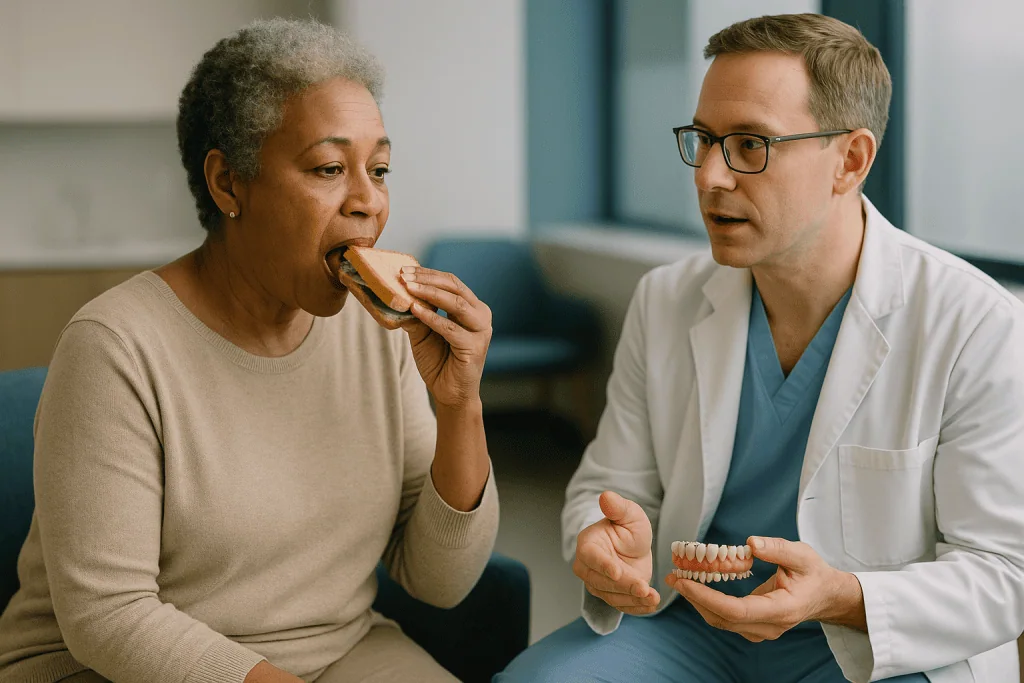
Diet is the part most people underestimate. The provisional bridge is deliberately lighter and usually acrylic, and the implants beneath it are not yet fused to bone. Chewing forces during this window can disturb healing, so teams generally ask for a soft diet for a period that they define for you. Think foods you could cut with the side of a fork: soups, eggs, fish, soft pasta, well-cooked vegetables, yogurt. Crusty bread, nuts, hard fruit and tough meat wait.
Healing itself is slow and silent. Both Mayo Clinic and Cleveland Clinic describe osseointegration as taking several months, with the exact interval depending on the jaw, the bone quality and your health. During that time you attend reviews so the team can check the gums, confirm the bridge screws are secure and adjust the bite as swelling resolves and your muscles adapt.
Then the definitive bridge is designed. This usually involves impressions or digital scans, a trial fitting, and a conversation about shape, shade and the lessons learned from the provisional. Ask how many visits that stage involves, and whether the provisional will be kept as a spare in case the final bridge ever needs laboratory repair. A backup arch is a quietly valuable thing to own.
Is eating with all on 4 implants hard?
The honest answer is: at first, yes, in specific ways, and later, usually far less so than with a loose denture, though not identically to natural teeth. Three things change the eating experience.
First, the healing diet already described. For the months before the final bridge, chewing is intentionally limited, and many people describe this phase as the hardest part of the whole process emotionally, because the teeth look ready while the instructions say otherwise.
Second, sensation. Without a periodontal ligament, you lose some of the fine feedback that tells you how hard you are biting and exactly where food is sitting. Many people adapt within weeks as the brain recalibrates using the muscles and jaw joints, but temperature and texture can feel slightly different, and biting into something unexpectedly hard is more likely to be noticed by the bridge than by you.
Third, the roof of the mouth. A fixed bridge, unlike a full upper denture, does not cover the palate, so taste and heat perception are generally less affected than with a plate. For former denture wearers this is often the most welcome change.
Practical questions to ask your team about eating:
- What foods do you want me to avoid permanently, if any, with the material you are proposing?
- How should I approach very hard items such as ice, hard sweets, bones and nut shells?
- Will the bridge design let me bite through food at the front, or should I cut food and chew at the sides?
- What signs would tell me I am overloading the bridge?
A clear expectation beats a cheerful promise. Reasonable long-term goals are comfortable chewing of an ordinary varied diet and the end of denture adhesives and embarrassment, not an identical replica of the teeth you had at twenty. People who go in with that frame tend to describe the result as a relief rather than a disappointment.
All on 4 questions to ask about the long-term maintenance plan
Here is the section that should decide your choice of team. Implants do not decay, but everything around them can fail: the gum and bone that hold them, the screws that fix the bridge, the acrylic or ceramic that does the chewing. Maintenance is not an optional extra; it is the second half of the treatment.
Ask for the maintenance plan in writing, and make sure it answers these questions:
- How often will I be seen? The NHS notes that the interval between dental check-ups can range from three months to two years depending on individual risk, and implant patients are commonly placed at the shorter end. Ask where you sit and why.
- Will the bridge be unscrewed for cleaning, and how often? Many teams remove a fixed bridge periodically to clean the underside, inspect the implants and check the screws, then replace the small screws or seals. Ask what interval they use and what it involves.
- What is the expected service life of the components? Acrylic teeth wear and are refurbished; screws fatigue and are replaced; the whole bridge may eventually be remade. You should hear realistic cycles for the material you are choosing, not a promise of permanence.
- Who does my routine cleaning, and are they trained around implants? Hygienists use specific instruments to avoid scratching implant surfaces.
- What imaging will be taken over time to watch bone levels?
- Is a night guard part of my plan, and who makes and checks it?
- What happens if I move or the practice changes? Can I take my records, scans and bridge design files with me?
Then there is the home side. A fixed bridge is cleaned differently from teeth or a denture: you cannot take it out, and you cannot floss between implant teeth in the usual way. Teams typically teach a combination of a soft brush, interdental brushes or floss threaders to clean beneath the bridge, and often a water flosser. Ask for a demonstration with your actual bridge, and ask again at the first review, because the technique that worked on a model often needs adjusting in a real mouth.
Peri-implantitis: the quiet risk that maintenance is designed to catch
Gum disease around natural teeth is called periodontitis. The equivalent around implants is peri-implantitis: inflammation of the soft tissue plus loss of the bone that holds the implant. It is driven by the same thing, a film of bacteria called plaque that is allowed to mature at the gumline, and it is the main biological way a long-term implant fails.
NIH’s National Institute of Dental and Craniofacial Research explains that gum disease begins as reversible gingivitis, with red, swollen gums that bleed easily, and can progress to a stage where the supporting bone is destroyed. Around implants, the early stage is called peri-implant mucositis and is likewise considered reversible with cleaning. Once bone is lost, the situation is harder to treat and the bone does not reliably grow back.
Why are implant bridges vulnerable? Three reasons. The underside of a full-arch bridge is hard to reach at home. Implants lack the fibrous collar that helps natural teeth resist bacteria. And the absence of ligament feedback means that inflammation can progress with less pain than people expect, which is why regular professional inspection matters more than how the gums feel.
Risk factors overlap with those for natural gum disease: a history of periodontitis, smoking, diabetes, poor plaque control, and designs that are difficult to clean. That last point links straight back to bridge material and shape. A bulky pink flange pressed against the gum may look seamless but can create a shelf where plaque lives.
Questions to ask: How will you monitor my gums and bone around the implants? Do you measure pocket depths and take periodic X-rays to compare bone levels? What are the early signs you want me to report? If early inflammation is found, what does treatment usually involve and how is it staged?
The answer you want to hear is a schedule, a method and a threshold for acting, not reassurance. Peri-implantitis is largely a preventable, maintenance-sensitive problem, which is exactly why the maintenance plan deserves as much scrutiny as the surgery.
Risks and alternatives, in plain clinical language
Every consent conversation should cover the risks of a full-arch implant bridge and the alternatives to it, without drama in either direction. The Mayo Clinic lists infection at the implant site, injury to surrounding structures such as other teeth or blood vessels, nerve damage causing pain, numbness or tingling in the lip, chin or tongue, and sinus problems when upper implants intrude into the sinus space. Cleveland Clinic adds implant failure to integrate, which means the bone does not fuse and the implant has to be removed.
Specific to full-arch work on four supports, ask about:
- Loss of a single implant during healing and what it does to the plan.
- Speech changes while adapting to a bridge that sits where your palate or lower gum used to be; most people adapt, but ask how the bridge contour will be managed if they persist.
- Mechanical complications: loosened or fractured screws, chipped teeth, debonded acrylic, fractured frameworks.
- Facial changes from removing teeth and reshaping bone, which the bridge’s pink material is designed to compensate for.
- Difficulty cleaning, with the downstream risk of peri-implantitis.
Alternatives also deserve a fair hearing. A conventional complete denture requires no surgery and remains a legitimate choice for many people. An implant-retained overdenture, a removable denture that clips onto two to four implants, offers much of the stability gain with easier cleaning and a lower surgical burden, and the NHS lists implants as one option among several for replacing missing teeth. Saving some natural teeth with periodontal treatment, root canals or crowns is sometimes possible and is worth asking about explicitly, since a full-arch plan involves removing everything in that jaw. Some people are also candidates for a fixed bridge on more than four implants, or for segmented bridges that can be repaired one section at a time.
None of these options is universally better. What matters is that each was considered for your mouth, your health and your tolerance for maintenance, and that the final decision was made with your treating team rather than presented to you as the only road.
How much do 4 teeth on 2 implants cost, and why that question is the wrong one
People search this phrase because they are trying to make the arithmetic work, and because advertising often quotes a single figure for a whole arch. This article does not publish prices, and no responsible explainer should, because the number depends on your jaw, your material, your region, whether grafting is needed, how many visits are involved, and what maintenance is bundled in. What we can do is show you what a complete written plan should contain, so you compare like with like.
First, a point of clarification. “Four teeth on two implants” describes a small implant bridge, two implants supporting a short span of crowns, usually to replace a few missing teeth in one area. It is a different treatment from a full-arch bridge on four implants, which replaces every tooth in a jaw. If you have been quoted for one and are thinking about the other, ask the team to walk you through why.
For any implant plan, ask for an itemized written proposal that specifies:
- Diagnostic imaging and planning, including the 3D scan.
- Extractions, any grafting or sinus procedures, and the surgical phase.
- The provisional bridge and the number of planned reviews during healing.
- The definitive bridge, named by material, with the laboratory stage described.
- A night guard if indicated.
- The maintenance schedule for a defined period, with what each visit includes.
- What is and is not covered if a component fails, and over what time frame.
- Sedation or anesthesia arrangements.
Then ask the two questions that the headline figure never answers: what is the expected cost structure of maintenance in years two to ten, and what would a repair or remake of the bridge involve? A plan that looks modest at the start but excludes refurbishment can look very different over a decade. The point is not to find the lowest number; it is to understand what the number buys, and to make sure the team you choose has thought beyond surgery day.
What people often get wrong about all on 4 problems and promises
Several beliefs recur in consultations and online forums, and most of them are only partly true.
“Teeth in a day means I am done in a day.” The teeth you leave with are usually provisional. The healing and the definitive bridge follow over several months, as both Mayo Clinic and Cleveland Clinic describe. One day of surgery, many months of treatment.
“Implants are permanent, so no more dentist.” The implant may last decades, but the bridge is a wearing part and the gums need surveillance. The NHS places check-up intervals at anywhere from three months to two years by risk, and implant patients rarely belong at the longest end.
“Zirconia is simply the better material.” It is harder and more stain-resistant, which is why it is popular, but it is heavier, less forgiving to repair and can wear opposing natural teeth. Acrylic hybrids trade durability for repairability. Which trade is right depends on your bite and opposing jaw.
“Four implants is always enough.” Four is a well-studied minimum for many jaws, but bone quality, arch length and bruxism may lead a team to plan more. Ask the reasoning rather than assuming the brand number.
“The 3-3-3 rule for dental care will keep implants clean.” The 3-3-3 rule is a folk mnemonic, brush three times a day, within three minutes of eating, for three minutes, not a clinical guideline. The NHS recommends brushing twice daily with fluoride toothpaste for about two minutes and advises against brushing straight after acidic foods or drinks, because softened enamel is more vulnerable. More relevant for a bridge is how you clean beneath it, which no brushing slogan addresses.
“If it does not hurt, it is fine.” Implants have reduced sensory feedback, so bone loss and screw loosening can progress quietly. Scheduled checks exist precisely because comfort is an unreliable alarm.
“A bridge means I can bite anything.” You can eat a varied diet, but the bridge is finite. Hard objects and heavy clenching are the leading causes of chips and fractures, which is why bite design and a night guard appear in so many plans.
Questions to ask your care team, in the order that matters
Bring this list. Write the answers down, or ask for them in writing. A good team will welcome it; a consultation that discourages questions is telling you something.
About planning
- What imaging have you used, and can I see where each implant will sit relative to my sinus and nerve?
- Why four implants for my jaw, and what is the plan if one fails to integrate?
- Have you considered saving any of my teeth, an overdenture, or a bridge on more implants, and why did you rule them out?
About the bridge
- What material is the provisional, and what material is the final bridge? Why that one for me?
- How is a chip or fracture handled in that material, and will I have a spare bridge?
- How much pink material will there be, and how does that affect cleaning?
About the bite
- How long is the cantilever, and how will you balance the bite?
- Do you think I grind or clench, and will a night guard be part of my plan?
- How long will I wear the provisional before the bite is finalized?
About maintenance
- How often will I be seen, and will the bridge be removed for cleaning? At what interval?
- What home-cleaning tools do you recommend, and will you show me on my own bridge?
- How will you monitor bone levels and gum health over time?
- What is the realistic refurbishment or replacement cycle for this bridge?
- What is included in the written plan for years two to ten, and what is not?
About the team
- Who places the implants, who makes the teeth, and who looks after me long term?
- Can I take my records and digital design files if I move?
- Who do I contact after hours if something goes wrong in the first weeks?
You do not need to understand every answer on the spot. You need the answers to exist, to be consistent between team members, and to be written down. If two clinicians in the same practice give you different numbers for the same question, ask them to reconcile it before you commit.
Can I call a dentist to ask questions before committing?
Yes, and you should. Most practices expect an initial inquiry call and are used to questions from people who have not yet booked. Reception staff can usually tell you who places implants, whether planning scans are done on site, how the consultation is structured and what it includes, and whether a written plan is standard. Clinical questions about your specific mouth will need an examination, but the process questions are fair game by phone.
A few ways to make those calls productive:
- Ask whether the consultation includes 3D imaging and a written, itemized proposal, or whether that comes later.
- Ask who you would be seeing, and whether the surgical and restorative clinicians are the same person or a team.
- Ask how maintenance is organized and whether the practice has implant-trained hygienists.
- Ask what their policy is if you want a second opinion elsewhere, and whether your scans can be shared.
Second opinions are normal in full-arch dentistry. This is irreversible treatment, removing every tooth in a jaw, and two experienced teams may propose genuinely different designs for the same scan. Comparing those proposals side by side, using the questions in the previous section, tells you a great deal about each team’s priorities. One may emphasize speed, another cleanability, another the bite. None is automatically wrong, but you are the one who lives with the design.
Also ask your general dentist, if you have one, to look over any plan. They know your history, your gum health and your habits, and they may be the person doing your long-term hygiene visits. A full-arch plan that does not account for who will maintain it locally is incomplete.
If you are already a patient and have questions after surgery, call. Teams would far rather hear about a loose screw, a sore spot or a dietary question early than discover a fractured bridge at a review. The point of the maintenance plan is that the relationship continues; use it.
When to call your doctor or dental team
Most recovery and most long-term life with a fixed implant bridge is uneventful, but some signs need prompt attention rather than waiting for the next scheduled visit. Treat the following as reasons to call the same day:
- Bleeding that does not slow with firm pressure over a gauze pad, or that restarts heavily after the first day.
- Swelling that keeps increasing after the first few days, spreads toward the eye or down the neck, or makes it hard to swallow or breathe. Difficulty breathing or swallowing is an emergency; use local emergency services.
- Fever, feeling generally unwell, or a foul taste and discharge from the surgical area, which can indicate infection.
- Numbness or tingling of the lip, chin or tongue that persists well beyond the expected wearing-off of local anesthetic; Mayo Clinic lists nerve injury as a known implant risk and early assessment matters.
- A bridge that feels loose, rocks, clicks, or has a visibly loose or missing screw. A loose bridge can overload the remaining connections quickly.
- A chipped or fractured tooth or framework, or a sharp edge cutting the tongue or cheek.
- Pain, swelling or bleeding around one implant in the months or years after treatment, or gums that bleed whenever you clean under the bridge, which can be early peri-implant inflammation.
- Upper-jaw symptoms such as new nasal discharge on one side, sinus pressure or air passing between mouth and nose, which can signal sinus involvement.
- A sudden change in how your bite meets, which can mean a screw has loosened or a component has shifted.
If you have a medical condition such as diabetes or a heart condition, or you take medicines that affect bleeding or bone, tell both your dental team and your physician about the surgery so they can coordinate. Any decision to adjust a medicine around treatment belongs to the clinicians who prescribe it.
Finally, if you simply feel that something is not right and cannot name it, call anyway. Implants give less sensory feedback than natural teeth, which means a vague sense of change is sometimes the earliest signal you get. Your care team is the right judge of whether it matters, and that judgment is exactly what the long-term plan is for.
Frequently asked questions
What are the most important all on 4 questions to ask at the consultation?
Ask what material the provisional and final bridges will be made of and why, how the bite will be designed and verified in your mouth, how many teeth will sit behind the last implant, what happens if one implant fails to integrate, how often the bridge will be removed for cleaning, how bone levels will be monitored, and what refurbishment or replacement is expected over ten years. Request every answer in a written, itemized plan.
Is it hard to eat with all on four implants?
Eating is deliberately restricted to soft foods while the implants heal under the provisional bridge, which many people find the hardest phase. After the final bridge, most people chew a varied diet comfortably, though sensation differs because implants have no ligament to signal bite force. Very hard items such as ice, hard sweets and bones are usually discouraged permanently to protect the bridge. Your team will define the specific diet and timeline for you.
Who is a good all on 4 candidate?
Typical candidates have lost or are losing most teeth in a jaw, have enough bone to seat four implants securely, are in reasonable general health and can commit to long-term cleaning and maintenance. People with untreated gum disease, poorly controlled diabetes, heavy smoking habits or certain bone or radiotherapy histories are often asked to address those first and be reassessed. Candidacy is decided on a 3D scan and medical review, not on a quick look.
What does all on 4 maintenance actually involve?
Maintenance combines daily home cleaning beneath the fixed bridge using a soft brush, interdental brushes or floss threaders and often a water flosser, plus professional visits at an interval your team sets. The NHS describes check-up intervals from three months to two years by risk; implant patients are usually seen more often. Many teams periodically unscrew the bridge to clean underneath, inspect implants, replace screws and take X-rays to compare bone levels.
What is the 3-3-3 rule for dental care, and does it apply to implants?
The 3-3-3 rule is an informal mnemonic: brush three times a day, within three minutes of eating, for three minutes. It is not a clinical guideline. The NHS recommends brushing twice daily with fluoride toothpaste for about two minutes and advises against brushing immediately after acidic foods or drinks. For a fixed implant bridge, the more important skill is cleaning beneath the bridge, which no brushing slogan covers.
How much do 4 teeth with 2 implants cost?
This article does not publish prices, because the figure depends on your jaw, materials, region, any grafting and the maintenance included. Note that four teeth on two implants is a small implant bridge, a different treatment from a full-arch bridge on four implants. Whatever the plan, ask for an itemized written proposal that covers imaging, surgery, provisional and final bridges, a night guard if needed, the maintenance schedule and what is covered if a component fails.
Can I call a dentist to ask questions before booking?
Yes. Practices expect inquiry calls and can usually explain who places the implants, whether 3D imaging and a written plan are part of the consultation, how maintenance is organized and whether scans can be shared for a second opinion. Questions about your specific mouth need an examination, but process questions are fair by phone. Second opinions are normal for irreversible full-arch treatment, and your general dentist is worth consulting as well.
What are the most common all on 4 problems over the long term?
The main biological problem is peri-implantitis, plaque-driven inflammation and bone loss around implants, which NIH describes as following the same pattern as gum disease around natural teeth. The main mechanical problems are loosened or fractured screws, chipped or debonded teeth, worn acrylic and, less commonly, framework fracture. Mayo Clinic also lists infection, nerve injury and sinus involvement as surgical risks. Regular maintenance exists to catch these early.
Is zirconia better than acrylic for an all on 4 bridge?
Neither is universally better. Zirconia is very hard, wear-resistant and resists staining, but it is heavier, chips are difficult to repair and it can wear opposing natural teeth. Acrylic hybrids on a metal frame are lighter and repairable chairside, but acrylic wears, stains and needs periodic refurbishment. The choice depends on your bite forces, whether you grind, what is in the opposing jaw and how you weigh durability against repairability.
How long does the whole all on 4 process take from surgery to final teeth?
Surgery and the provisional bridge often happen on one day, but Mayo Clinic describes dental implant treatment as a process that can take many months, because the bone must fuse to the implants before the definitive bridge is made. Cleveland Clinic likewise describes healing in terms of several months. Your own timeline depends on bone quality, health and whether grafting is needed, and only your treating team can estimate it for you.
References
This article is for general information only and is not a substitute for professional medical advice. Please consult a qualified doctor about your individual situation.

More from the Blog

How Long Do Inlays and Onlays Last? Wear, Bonding Strength and When Replacement Is Discussed
Inlays and onlays usually last many years, and patient-facing sources place comparable restorations in roughly the five-to-fifteen-year range that Cleveland Clinic gives for crowns,…
3-on-6 Dental Implants: How This Full-Arch Alternative Differs From All-on-4
3-on-6 dental implants replace a full arch of teeth using six upright implants that support three separate ceramic bridges, while All-on-4 uses four implants,…

Who Needs Maxillofacial Prosthetics? Obturators and Facial Prostheses After Surgery Explained
Maxillofacial prosthetics treat openings and missing structures in the mouth, jaws and face left by cancer surgery, injury, infection or birth differences. An obturator…
Dental Bone Graft Warning Signs: Exposed Membrane, Persistent Swelling and When to Call
Dental bone graft failure signs include swelling or pain that worsens after the third day instead of easing, a membrane or grayish graft material…
What Happens in Dental Implant Surgery: Flap or Flapless, Drilling and Seating the Post
In dental implant surgery, the area is numbed, the jawbone is reached by lifting a small gum flap or through a small opening (flapless),…
Why Some Teeth Need a Root Canal or Core Build-Up Before a Dental Crown
A dental crown needs a solid tooth underneath to grip. When decay or an old filling has hollowed out much of the tooth, dentists…