

What to Do During a Febrile Seizure: Side Position, Timing and When to Call Emergency Services

Key Takeaways
- Roughly 2 to 5 percent of children have at least one febrile seizure, almost always between six months and five years of age, with a peak around 12 to 18 months.
- Most febrile seizures stop within five minutes; the NHS advises calling emergency services once a seizure passes the five-minute mark on a real clock.
- A simple febrile seizure lasts under 15 minutes, involves both sides of the body, and does not recur within 24 hours; anything outside those limits is classified as complex and usually prompts closer evaluation.
- The side-lying recovery position works by letting saliva or vomit drain outward, which is why nothing should ever be placed in a convulsing child's mouth.
- Fever-reducing medicines make a sick child more comfortable but have not been shown to prevent febrile seizures, so they should be used for comfort under your clinician's guidance rather than for prevention.
- About one in three children who have a febrile seizure will have another, yet the vast majority never develop epilepsy and show no lasting effect on learning or development.
During a febrile seizure, stay calm, note the time it starts, and move your child onto their side on a soft, flat surface away from hard objects. Do not restrain them or put anything in their mouth. Call emergency services if the seizure lasts longer than five minutes, if breathing looks difficult, if it is a first seizure, or if your child does not recover normally afterward.
It usually happens on an ordinary evening. A toddler with a runny nose and warm cheeks is dozing on the sofa, and then the arms stiffen, the eyes roll, and the whole small body begins to jerk. Most parents describe the same thing afterward: the clock seemed to stop, and they could not remember a single piece of advice they had ever read.
That is exactly why knowing what to do during a febrile seizure before it happens matters so much. The steps are few and physical: turn the child on their side, keep the space clear, watch the clock, and recognize the handful of signs that mean you should call for emergency help rather than wait it out.
Febrile seizures are frightening to watch and, for the great majority of children, brief and harmless. This explainer walks through what actually happens, what the evidence says about timing, and how to make the decisions that feel impossible in the moment.
What to do during a febrile seizure: the first sixty seconds
The first minute decides very little medically, but it decides almost everything about how safe your child is while the seizure runs its course. A febrile seizure is a convulsion triggered by a fever in a young child who does not have an infection of the brain itself. Nothing you do will shorten it, and that is oddly reassuring: your job is protection, not rescue.
Glance at a clock, phone, or watch and fix the start time in your mind. Then lower your child onto a flat surface if they are on your lap or a chair. The floor is fine. A bed is fine if there is no risk of rolling off. Slide away anything hard or sharp within reach: a coffee table corner, a toy, a hot drink.
Turn them onto their side. Loosen anything tight around the neck. If they are holding food in their mouth, do not try to fish it out; the side position lets saliva or vomit drain outward rather than back toward the airway.
Then watch. Notice whether the jerking involves both sides of the body or one, whether the eyes are open, and how the breathing sounds. Breathing often looks irregular or noisy during a seizure because the chest muscles are contracting too; the lips may look dusky for a moment. Guidance from the NHS and Mayo Clinic is consistent that this typically resolves once the seizure stops.
If another adult is present, ask them to start a phone video. It feels strange, but a short recording is one of the most useful things you can hand a clinician later, because it captures details that adrenaline erases from memory.
How febrile seizure first aid works: the recovery position for seizures, step by step
The recovery position is simply a way of lying someone on their side so that gravity keeps the airway open and drains fluid away from the throat. In an unconscious adult it is a formal sequence; in a jerking two-year-old, it is a gentler, improvised version of the same idea.
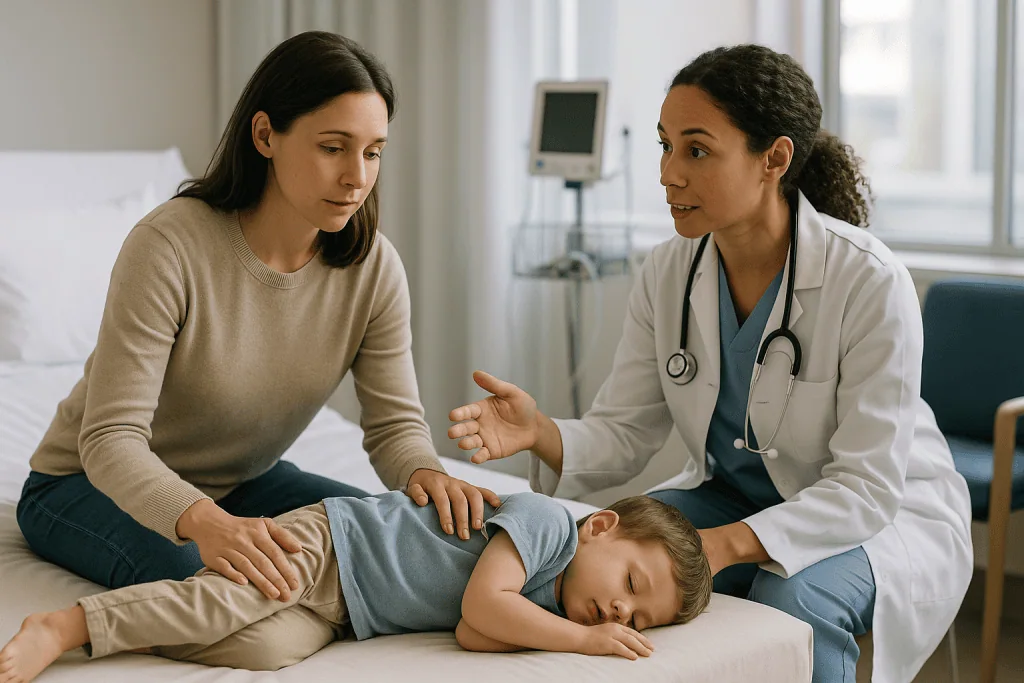
While the seizure is active, you may not be able to hold a perfect position, and you should not force one. Roll the child so that the shoulder and hip face sideways, with the lower arm out in front and the upper knee bent slightly forward to stop them rolling onto their face. Tilt the head so the chin points a little downward and outward. That angle lets saliva run out of the mouth.
What you leave out matters as much as what you do:
- Do not hold the limbs still. Restraint can bruise or dislocate a joint and does nothing to stop the seizure.
- Do not put fingers, a spoon, or a cloth between the teeth. Children do not swallow their tongues; the object is what causes injury or choking.
- Do not give medicine, water, or food by mouth until they are fully awake and can swallow normally.
- Do not put them in a cool bath. Rapid cooling of a convulsing child risks a fall, aspiration, and shivering that raises core temperature.
Once the movements stop, the child will usually be limp and unresponsive for a while. Now the recovery position becomes easier to maintain properly. Keep them on their side, stay beside them, and speak quietly. The NHS advises this side-lying position as the default for any child who has just had a seizure and is not yet fully alert, and MedlinePlus gives the same core steps.
How long do febrile seizures last, and why timing the seizure matters
Most febrile seizures are over quickly. According to the NHS, the majority last less than five minutes, and Mayo Clinic notes that many stop within one to two minutes. Parents almost always overestimate the duration, which is why an actual clock is so valuable.
Duration is the single most important piece of information you can give to a clinician, because it separates the two recognized categories. A simple febrile seizure lasts less than 15 minutes, involves the whole body, and does not happen again within the same 24 hours. A complex febrile seizure lasts 15 minutes or longer, affects one side of the body or one limb, or recurs within a day. That definition comes from the National Institute of Neurological Disorders and Stroke (NINDS) and is used in guidelines internationally.
Time is also the trigger for action. The NHS advises calling emergency services once a seizure passes five minutes, even if the child seems otherwise stable. Five minutes is not a danger line in itself; it is the point at which a seizure is statistically less likely to stop on its own soon and at which emergency clinicians may consider a rescue medicine.
Practical ways to time it:
- Start a stopwatch or note the exact minute on a phone.
- If you cannot find a device, count seconds aloud or watch a wall clock; do not guess afterward.
- Write the start and stop times down as soon as the seizure ends, before you do anything else.
A seizure that continues beyond 30 minutes is called febrile status epilepticus and is a medical emergency in its own right, though NINDS describes it as uncommon among febrile seizures overall. Timing accurately from the first jerk is how anyone knows which situation they are in.
What actually happens in the brain during a febrile seizure
A seizure is a burst of abnormal, synchronized electrical activity spreading through the brain. In a febrile seizure, that burst is set off by the combination of a rising temperature and a nervous system that is still under construction.

Young children’s brains fire more easily than adult brains. The chemical brakes that normally hold electrical activity in check, inhibitory neurotransmitters, are not yet fully mature, while excitatory pathways are already busy. Fever nudges that balance. Heat changes how nerve cells handle ions like sodium and potassium, and fever-driven immune signaling molecules, called cytokines, can make neurons more excitable. Put those together in a child between six months and five years old, and a threshold can be crossed that an older child would never reach.
Two features matter for parents. First, it is usually the speed of the temperature rise, not only its height, that seems to trigger the event. Mayo Clinic notes that a febrile seizure often happens early in an illness, sometimes before anyone has realized the child is feverish; the seizure can be the first sign. Second, the infection is almost always an ordinary one: a viral cold, an ear infection, roseola, influenza. Mayo Clinic also lists the fever that can follow some routine childhood vaccinations as an occasional trigger, with the seizure caused by the fever rather than the vaccine itself.
The abnormal activity spreads across both hemispheres in a typical simple seizure, which is why the whole body stiffens and then jerks rhythmically. When it burns out, neurons need time to reset, which produces the deep sleepiness afterward. There is no evidence from mainstream sources that a simple febrile seizure damages brain cells or affects intelligence, a point NINDS states directly.
Febrile convulsion in toddlers: who is most affected, and which situations need emergency care
Febrile seizures are a phenomenon of early childhood almost exclusively. MedlinePlus and NINDS report that roughly 2 to 5 percent of children experience at least one, with the age window running from about six months to five years. Mayo Clinic identifies 12 to 18 months as the peak, which is why the phrase febrile convulsion in toddlers is what so many parents end up searching.
Children are more likely to have one if a parent or sibling did; a family tendency is well documented. A child who has already had a febrile seizure is more likely to have another, particularly if the first came before 15 months of age or at a relatively low temperature.
The more useful question for a frightened caregiver is not who gets them but who needs an ambulance versus who can be assessed later. The NHS frames it clearly. Emergency services should be called when:
- the seizure lasts longer than five minutes;
- the child has difficulty breathing or looks blue or gray around the lips after the jerking stops;
- it is the child’s first seizure;
- the child was injured during the seizure or seizures follow one another without full recovery in between;
- you suspect a serious infection, for example a stiff neck, a rash that does not fade under pressure, or a bulging soft spot on a baby’s head.
A child who has had a previous simple febrile seizure, whose new seizure stopped within a few minutes, and who is waking up normally may not need emergency transport, but the NHS still advises seeing a doctor the same day so the cause of the fever can be checked. The decision on where and how urgently to be seen always sits with the clinician you speak to, not with a general article.
Simple versus complex febrile seizures: a side-by-side summary
Clinicians sort febrile seizures into two groups because the groups carry different implications for testing and follow-up. The labels are not about how alarming the seizure looked; a short, whole-body seizure can be terrifying and still be classified as simple. The definitions below follow NINDS.
| Feature | Simple febrile seizure | Complex febrile seizure |
|---|---|---|
| Duration | Under 15 minutes | 15 minutes or longer |
| Body involvement | Both sides, whole body | One side, one limb, or starts on one side |
| Recurrence in 24 hours | None | Happens more than once in the same illness day |
| Share of febrile seizures | The large majority | A minority |
| Usual evaluation | Examination to find the fever source; brain tests usually not needed | Often more detailed assessment, sometimes imaging or an electroencephalogram |
| Longer-term outlook | Very low added epilepsy risk | Somewhat higher risk, though most children still never develop epilepsy |
Two clarifications help parents read this table honestly. First, the categories describe the seizure, not the child; a child can have a complex seizure once and simple ones afterward. Second, complex features are a reason for closer evaluation, not a verdict. NINDS notes that even among children with complex febrile seizures, most do not go on to have epilepsy.
An electroencephalogram, or EEG, is a painless recording of the brain’s electrical rhythms through small sensors on the scalp. Guidance from Mayo Clinic and NINDS is that it is not routinely needed after a simple febrile seizure, because the result rarely changes what happens next. Whether your child needs one, or blood tests, or imaging, is a judgment for the team who examines them.
When to call emergency services: what to do during a febrile seizure that will not stop
Most caregivers are torn between two fears: overreacting and wasting emergency resources, or underreacting and missing something serious. Guidelines resolve that tension with clear thresholds so you do not have to make the judgment alone.
Call emergency services immediately, without waiting for the seizure to end, if any of these apply:
- The seizure has passed five minutes on your clock.
- Breathing is labored, or the child’s color does not improve within moments of the jerking stopping.
- This is the first seizure your child has ever had.
- The child hit their head or was otherwise injured.
- A second seizure begins before the child has fully woken from the first.
- You suspect meningitis: neck stiffness, dislike of bright light, a purple or red rash that stays visible when a glass is pressed against it, or a tense, bulging fontanelle in a baby.
Meningitis is an infection of the membranes around the brain and spinal cord; it is a rare cause of a seizure with fever, but the reason clinicians examine every first febrile seizure carefully.
Once you are on the phone, stay with the child. Dispatchers are trained to guide you, and the call itself does not require you to leave the room. Report the start time, what the movements looked like, whether both sides were involved, and any medicines already given today.
If a prescribed rescue medicine has been provided for your child after a previous prolonged seizure, use it exactly as the prescribing clinician instructed and tell the dispatcher you have done so. These medicines belong to the benzodiazepine class, which works by strengthening the brain’s own inhibitory signaling to end the seizure; how and when to give one is a decision made in advance by the treating team, not in the moment by a parent reading online.
After the seizure stops: the next hour
The convulsion ending is not the end of the episode. What follows is the postictal period, the recovery phase during which the brain resets after a seizure. It can look almost as unsettling as the jerking, mostly because the child is so unlike themselves.
Expect deep sleepiness, floppiness, confusion, or irritability. Some children cry inconsolably for a few minutes; others sleep heavily. Breathing settles into a slower, sometimes snoring rhythm. Mayo Clinic describes drowsiness that can last up to an hour after a febrile seizure. Keep the child on their side, do not offer anything by mouth, and resist the urge to shake them awake. Gentle speech and a hand on the back are enough.
Use this time to record what you saw. Note the start and stop times, which parts of the body moved, whether the eyes deviated to one side, whether there was vomiting or wetting, and what the temperature was if you managed to take it. These details help a clinician classify the seizure and decide what, if anything, needs investigating.
Signs that the recovery is going normally:
- The child responds to their name or to touch within a few minutes, even if grumpily.
- Color returns to the lips and face.
- Breathing becomes quiet and regular.
- Within about an hour they recognize you, take fluids, and behave more or less as a sick child usually does.
If the child does not become gradually more alert, cannot be roused at all after the jerking stops, or has a second seizure, that is a reason to call emergency services if you have not already. Once the child is awake and swallowing safely, treating the underlying fever for comfort and offering fluids is reasonable, using whatever plan your child’s clinician has given you.
What the following days and weeks usually look like
The febrile seizure itself is over in minutes; the illness that caused it plays out over days. Most children are back to their usual selves within a day or two of the seizure, as the infection runs its course. The NHS advises that every child who has a first febrile seizure be seen by a doctor, either through emergency services on the day or a same-day appointment, so the source of the fever can be identified and the seizure documented.
At that visit, expect a physical examination with particular attention to the ears, throat, chest, and skin, and to signs of meningitis. In a child who is fully recovered and whose seizure was simple, blood tests and brain scans are usually unnecessary, according to Mayo Clinic. A urine test may be considered if no obvious source of infection is found, because urinary tract infections can be silent in toddlers.
Over the following weeks, the main tasks are watchfulness and information. The fever may recur during the same illness, and NINDS notes that a second seizure within the same illness happens in a minority of children. Knowing the first-aid steps already makes any repeat far less overwhelming.
Follow-up with a specialist is not routine. Referral to a pediatric neurologist, a doctor specializing in children’s brain and nerve conditions, is generally reserved for complex seizures, seizures without a clear fever, developmental concerns, or a strong family history of epilepsy. Whether your child falls into one of those groups is a judgment for the examining clinician.
Emotionally, the weeks afterward can be harder for parents than for children. Sleep disruption, hovering at every sniffle, and reluctance to leave the child with anyone else are common reactions. Sharing the first-aid steps with grandparents and childcare staff is a practical way to turn that anxiety into something protective.
Do fever medicines prevent febrile seizures?
This is the question almost every parent asks, and the answer runs against intuition. Mayo Clinic and NINDS are aligned: giving fever-reducing medicine does not reliably prevent febrile seizures, and the evidence does not support using it for that purpose.
The reasoning comes back to mechanism. Fever reducers such as acetaminophen or ibuprofen work by lowering the body’s temperature set point through effects on prostaglandins, the signaling chemicals that drive fever. They lower the number on the thermometer, but the seizure appears to be triggered by the brain’s response to a rapid temperature change and to inflammatory signaling, not simply by a high reading. Many febrile seizures happen before anyone knows the child is feverish, leaving no window in which a medicine could have acted.
None of this means fever medicine is useless. It can make a miserable child more comfortable, help them drink, and help them rest, all of which matter during any infection. The point is narrower: giving it around the clock in the hope of preventing a seizure has not been shown to work, and it can create a false sense of security or lead to giving medicine to a child who does not need it. How much to give, how often, and whether to give it at all are decisions for your child’s clinician, who knows your child’s age, weight, and medical history.
Daily anti-seizure medicines to prevent recurrence are not recommended for simple febrile seizures, because the side effects outweigh the benefit for a condition that is almost always benign. For a small number of children who have had prolonged seizures, a clinician may prescribe a rescue medicine to keep at home, with specific instructions. That plan is individual, and it belongs to the prescribing team.
Will it happen again, and does a febrile seizure lead to epilepsy?
Two worries dominate the weeks after a first febrile seizure, and the evidence on both is more reassuring than most parents expect.
On recurrence, the NHS reports that about one in three children who have a febrile seizure will have another during a later fever. The risk is higher in children whose first seizure came before their first birthday, in those with a family history, and in those whose seizure occurred at a relatively low temperature or very early in an illness. Recurrences are typically of the same type as the first and, like the first, are overwhelmingly short and self-limiting. Most children stop having them by school age, as the brain matures and the excitability threshold rises.
Epilepsy is a condition of repeated seizures that occur without fever or another obvious trigger. It is a different thing from febrile seizures, and having febrile seizures is not the same as having epilepsy. NINDS states plainly that the vast majority of children with febrile seizures do not develop epilepsy. The added risk is small after a simple seizure and somewhat larger after complex seizures, prolonged seizures, or in children with existing neurodevelopmental differences or a family history of epilepsy. Even in those higher-risk groups, most children never develop the condition.
What mainstream sources also agree on is what febrile seizures do not do. NINDS reports no evidence that simple febrile seizures cause brain damage, lower intelligence, or shorten life. Learning, behavior, and school performance in children who have had them are, on average, no different from those who have not.
Those are population figures. Whether your child’s individual pattern warrants further investigation is a question for the clinician who examines them, and it is a fair one to ask directly.
What people often get wrong about febrile seizures
Folk wisdom around convulsions is old and stubborn. Several of the most common beliefs are not just wrong but actively harmful during a seizure.
Myth: put something in the mouth so they do not swallow their tongue. The tongue cannot be swallowed. Objects between the teeth break teeth, cut gums, and can be inhaled. Keep the mouth empty and the child on their side.
Myth: hold the child down to stop the shaking. Restraint does not shorten a seizure and can injure joints and soft tissue. Protect the space around them instead.
Myth: a cold bath or ice will end it. Rapid cooling can cause shivering, which raises temperature, and a wet, convulsing child is a drowning and fall risk. The NHS advises against it.
Myth: the higher the fever, the worse the seizure. It is more often the speed of the rise that matters, and febrile seizures happen at modest temperatures too. A seizure at a lower temperature is not a sign of something worse in itself.
Myth: it means epilepsy. As NINDS notes, most children with febrile seizures never develop epilepsy, and febrile seizures are not classified as epilepsy.
Myth: fever medicine on schedule will prevent the next one. The evidence from Mayo Clinic and NINDS does not support this; treat fever for comfort, not prevention.
Myth: if they have had one before, nothing needs checking. Every seizure with fever deserves a same-day clinical look to identify the infection behind it, especially in a child who is not yet fully recovered, has a rash, or seems unusually sleepy.
One misconception cuts the other way: that a short seizure means the child is fine and no one needs to be told. Documenting each episode helps the treating team see the pattern.
Questions to ask your care team
Emergency departments and clinics are busy places, and the questions that matter most tend to surface on the drive home. Writing a short list in advance means you leave with answers rather than regrets. These are the ones clinicians most often wish parents had asked.
- Was this a simple or a complex febrile seizure, and what made you classify it that way?
- What infection do you think caused the fever, and how will we treat that infection?
- Does my child need any tests now, such as urine, blood, imaging, or an EEG, and if not, what would change that decision later?
- What is my child’s individual likelihood of another febrile seizure, given their age, family history, and this episode?
- Should we have a written seizure plan for home and for childcare, and what exactly should it say about when to call emergency services?
- Is a rescue medicine appropriate for our child, and if so, who will teach us to use it and when should it be given?
- How should we manage fever during future illnesses, and what is our target: comfort, or something else?
- Are there signs specific to my child that should prompt an earlier visit?
- Is a referral to a pediatric neurologist needed, and what would be the reason?
- Are there any implications for upcoming vaccinations, and how should we prepare for fever after them?
- Whom do we contact if a seizure happens again outside office hours?
Ask the team to write down the key points, or ask permission to record the conversation on your phone. A febrile seizure is a stressful event, and retention after stress is poor. Bring your seizure notes and any video with you; they turn a vague description into concrete data the clinician can use.
The answers to these questions will differ from child to child. That variation is not inconsistency; it is the treating team tailoring general evidence to the specific child in front of them.
When to call your doctor: red-flag signs after a febrile seizure
Emergency services are for the seizure itself and for the situations described earlier. This section covers the hours and days afterward, when the acute drama has passed but a child is still ill and a caregiver is still watching closely.
Arrange same-day medical review after any first febrile seizure, even if the seizure was brief and the child has fully recovered. The NHS advises this because the purpose is to find and treat the source of the fever, not to treat the seizure.
Contact your child’s doctor promptly, or call emergency services if the situation is deteriorating, when you notice any of the following:
- Drowsiness that does not lift, or a child who is difficult to wake more than an hour after the seizure.
- Repeated vomiting, refusal to drink, or fewer wet diapers than usual.
- Neck stiffness, discomfort in bright light, or a headache the child cannot be distracted from.
- A rash of small red or purple spots that does not fade when a clear glass is pressed against it.
- A bulging or tense soft spot on a baby’s head, or a high-pitched, unusual cry.
- Fast, labored breathing, grunting, or the skin pulling in between the ribs with each breath.
- A second seizure during the same illness, or a seizure without any fever at all.
- Weakness or clumsiness on one side of the body that persists after recovery.
- A fever that lasts more than a few days, or a child who seems to be getting worse rather than better.
Trust the parental sense that something is off. Clinicians take that instinct seriously, and mainstream guidance consistently lists it as a legitimate reason to seek review.
Every threshold above is a prompt to speak with a clinician, not a diagnosis. The doctor or nurse who examines your child will weigh these signs alongside the child’s history and decide what, if anything, needs to happen next. Their judgment, not a general article, is the final word.
Frequently asked questions
What is the most important part of febrile seizure first aid?
Protecting the airway and the child’s surroundings while you time the seizure. Lay them on a flat surface, turn them onto their side, move hard objects away, and do not restrain them or put anything in their mouth. Note the start time so you can tell whether five minutes has passed, which is the threshold at which the NHS advises calling emergency services.
How long do febrile seizures last on average?
Most last less than five minutes, and many end within one to two minutes, according to the NHS and Mayo Clinic. Parents usually overestimate duration, which is why looking at a clock matters. A seizure lasting 15 minutes or more is classified as complex, and one continuing beyond 30 minutes is called febrile status epilepticus, which is uncommon but treated as an emergency.
Should I use the recovery position for seizures while my child is still jerking?
Yes, as far as you gently can. Roll the child onto their side so fluid drains from the mouth, without forcing the limbs into a fixed pose. Once the movements stop, settle them more fully into the side-lying position and stay with them until they are awake and swallowing normally. Never hold the child down or place anything between their teeth.
Is a febrile convulsion in toddlers dangerous?
For most toddlers, no. NINDS reports no evidence that simple febrile seizures cause brain damage or affect intelligence, and the vast majority of children never develop epilepsy. The main risks are injury during the seizure from falls or nearby objects, and, rarely, a serious underlying infection such as meningitis, which is why every first seizure should be checked by a doctor the same day.
Do I need to call emergency services for every febrile seizure?
Call for a first seizure, any seizure lasting over five minutes, breathing difficulty, injury, a second seizure before full recovery, or signs of meningitis such as a stiff neck or a non-fading rash. A child with a known history of brief febrile seizures who recovers normally may not need an ambulance, but the NHS still advises same-day medical review to find the cause of the fever.
Can I give fever medicine during a febrile seizure?
No. Nothing should go into the mouth of a child who is seizing or not fully awake, because it can be inhaled. Once the child is alert and swallowing normally, fever medicine may be given for comfort if your child’s clinician has advised it. Evidence from Mayo Clinic and NINDS shows these medicines do not prevent febrile seizures, so they should not be used for that purpose.
Will my child have another febrile seizure?
About one in three children who have one febrile seizure will have another, according to the NHS. The likelihood is higher if the first came before 12 to 15 months of age, if there is a family history, or if the seizure happened at a relatively low temperature. Recurrences are usually similar to the first and most children outgrow them by school age.
Does a febrile seizure mean my child has epilepsy?
No. Epilepsy involves repeated seizures without fever or another clear trigger, whereas febrile seizures are fever-related events in a developing brain. NINDS states that the vast majority of children with febrile seizures never develop epilepsy. The risk is slightly raised after complex or prolonged seizures or with a family history, but even then most children are unaffected.
Should I film the seizure?
If another adult can do it while you protect the child, yes. A short video captures which parts of the body moved, whether one side was involved, and how long it lasted, all details that help clinicians classify the seizure. Never film instead of providing first aid. Bring the video and your written notes on start and stop times to the medical review.
What tests will my child need after a febrile seizure?
Often none beyond a physical examination to find the source of the fever. Mayo Clinic notes that blood tests, brain imaging, and EEG are not routinely needed after a simple febrile seizure in a child who has recovered fully. Tests are more likely after complex seizures, if the child remains drowsy, if meningitis is suspected, or if no infection source is found. The examining clinician decides.
References
- NHS: Febrile seizures
- MedlinePlus: Febrile seizures
- NIH National Institute of Neurological Disorders and Stroke: Febrile Seizures
- Cleveland Clinic: Febrile Seizures
This article is for general information only and is not a substitute for professional medical advice. Please consult a qualified doctor about your individual situation.

More from the Blog
Building Early Intervention Therapy Into Daily Routines: Tummy Time, Bath Time and Feeding
Early intervention activities fit best inside the routines a baby already has. Tummy time, bathing, diaper changes and meals each repeat several times a…
How Does Chickenpox Progress Stage by Stage? First Spots to Crusted Blisters and Isolation End
Chickenpox rash usually moves through four visible stages over about 4 to 7 days: flat pink spots, small raised bumps, clear fluid-filled blisters, and…
Whooping Cough in Babies: Breathing Pauses, Color Changes and Other Reasons for Urgent Care
Whooping cough infant warning signs that need urgent care include any pause in breathing, lips or face turning blue, gray or dusky, coughing fits…

Inside a Pediatric Dialysis Session: Access Checks, Monitoring and Comfort for Your Child
In a pediatric dialysis session, a nurse first checks the child's access site, records weight, blood pressure and pulse, then connects the child to…

Seeing a Doctor With Suspected Chickenpox: Call Ahead, Exposure History and What Is Examined
Before a chickenpox doctor visit, phone the office first so staff can keep a contagious patient away from pregnant people, newborns and others at…

Pediatric Surgery as an International Family: Planning the Stay, Companion and Follow-Up
Planning pediatric surgery abroad means coordinating three things with the treating team: a complete handover of medical records before travel, a companion arrangement so…