

When a Tummy Tuck Needs Revision: Dog Ears, Scar Position and Residual Laxity Explained

Key Takeaways
- Dog ears form when the upper and lower wound edges are unequal in length and the surplus bunches into a cone at each scar end; small ones may flatten as the scar matures.
- Tummy tuck scars drift upward because the tightened abdominal skin retracts toward the ribs during healing, so a scar can only be moved lower if enough spare skin remains.
- Residual looseness can come from skin, fat or a stretched muscle repair, and each requires a different correction, which is why hands-on examination matters more than photographs.
- Mayo Clinic notes the final result of a tummy tuck takes months to appear and the NHS describes scars maturing for up to about two years, so surgeons usually delay revision decisions.
- A revision ranges from a brief local-anesthetic excision to a full repeat abdominoplasty, and pain and recovery track the scope of the operation, not the word revision.
- Mayo Clinic states tummy tuck results are long-lasting when weight stays stable, and laxity returning years later usually reflects ageing or weight change rather than surgical failure.
A tummy tuck revision is a second, usually smaller operation that corrects problems left after the first abdominoplasty, most often dog ears at the scar ends, a scar that sits too high or unevenly, or residual skin laxity. Surgeons generally wait until swelling has settled and the scar has matured before deciding. Whether revision is appropriate, and which technique fits, is a decision for the treating surgical team.
The mirror in the changing room was the one that did it. A year after her abdominoplasty, she had stopped noticing the flat middle she had wanted for so long and started fixing on the two puckered points at the ends of the scar, the way the line rode up above her underwear on the left, and a soft fold that reappeared every time she sat down. Her surgeon had done nothing wrong, she kept telling herself. And yet.
That mix of gratitude and quiet disappointment is where most conversations about tummy tuck revision begin. It is rarely a story of disaster. More often it is a story of tissue that healed a little differently than planned, of weight that shifted, or of a first operation that was appropriately conservative.
This explainer walks through the three complaints that bring people back to a consulting room most often: dog ears, scar position, and residual laxity. It also covers what a second operation actually involves, who is asked to wait, and the honest limits of what any surgeon can promise.
Why do some people need a tummy tuck revision at all?
An abdominoplasty, the medical name for a tummy tuck, removes excess skin and fat from the lower abdomen and usually tightens the stretched connective tissue over the abdominal muscles. Mayo Clinic describes it as a reshaping procedure, not a weight-loss operation, and that distinction matters for understanding why revisions happen.
Skin is a living material. It swells, shrinks, contracts and stretches over many months, and no surgeon can fully predict how one person’s tissue will settle. A closure that looked perfectly flat on the operating table can develop small cones of skin at either end once swelling recedes. A scar planned to sit low can migrate upward as the tightened skin pulls it toward the ribs. Fat that was left in place to protect blood supply can, once the swelling is gone, look like a bulge that was never there.
Then there are the changes that have nothing to do with surgical technique. Mayo Clinic notes that significant weight fluctuation and pregnancy after a tummy tuck can diminish the result. Ageing continues to loosen collagen. A person who was a reasonable candidate at forty may have different skin at fifty.
A tummy tuck revision, then, is not a verdict on the first surgeon. It is a recognition that body contouring is a two-way conversation between a plan and a body, and the body sometimes gets the last word. Understanding which of these forces produced a particular problem is the single most useful thing a patient and surgeon can do before anyone talks about a second incision.
What are tummy tuck dog ears, and why do they form?
A dog ear is a small, cone-shaped pucker of skin at the end of a scar; the name comes from its resemblance to the folded tip of a dog’s ear. On a tummy tuck they appear at the outer ends of the horizontal incision, near the hips, and they are among the most common reasons people ask about revision.

The geometry explains them. When a surgeon removes an ellipse of skin and closes the long wound, the upper edge and the lower edge are rarely exactly the same length. Where they meet at each end, the surplus has to go somewhere, and it bunches into a peak. The wider the ellipse relative to its length, the more pronounced the effect. Swelling hides dog ears in the early weeks, which is why they often seem to “appear” months later rather than immediately.
Body shape plays a part too. Someone with fullness over the hips and flanks has more tissue for the incision to run into, so the scar end sits on a curve rather than a flat surface. Surgeons sometimes extend the incision further around the side to chase the cone flat, but a longer scar is its own trade-off, and many choose the shorter scar and accept a small risk of dog ears.
Not every dog ear needs surgery. Small ones can flatten as the scar matures, a process the NHS says can take up to two years. Those that persist are typically corrected under local anesthetic by excising the cone and extending the scar slightly, or by using liposuction (suction removal of fat through a thin tube) to reduce the volume beneath. Whether to wait, and which approach fits, sits with the surgical team.
Why does the tummy tuck scar sit too high, too low, or unevenly?
Ask a group of people who had a tummy tuck what bothers them, and scar position comes up again and again. The intended line is low, roughly where a swimsuit bottom would cover it. The line that heals is sometimes several finger-widths higher, tilted to one side, or shaped like a shallow W instead of a gentle curve.
The main culprit is tension. To close the wound, the surgeon pulls the upper abdominal skin downward toward the incision. That skin has a mind of its own during healing: it gradually retracts back toward the ribs, dragging the scar with it. The more skin removed and the tighter the closure, the greater the upward pull. A conservative surgeon may deliberately place the incision very low, expecting some drift; an aggressive removal can leave the scar riding high with no easy way to bring it down.
Asymmetry usually reflects asymmetry that was already there. Almost everyone has one hip slightly higher than the other and a subtle curve to the spine. Mark a level line on a body that is not level, and it heals level to the body, not the floor.
Scar quality is a separate issue from scar position. A hypertrophic scar is one that is raised and red but stays within the original wound; a keloid grows beyond it. MedlinePlus notes that scars fade over time but never disappear completely, and that people with darker skin are more prone to keloids. Repositioning a scar means excising the old one and closing lower, which is only possible if enough skin remains to allow it. That reserve, not the patient’s wish, is what decides whether the scar can move.
What causes loose skin after tummy tuck surgery?
Residual laxity, meaning looseness that remains or returns, is the complaint that most needs careful diagnosis, because three different structures can produce it and each calls for a different fix.
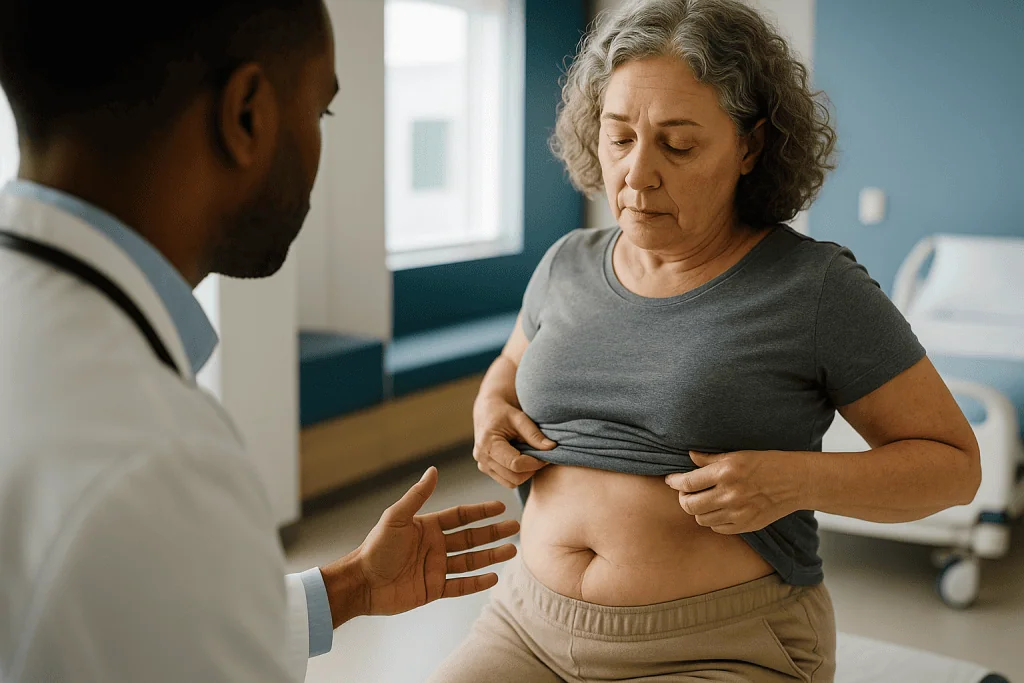
The first is skin itself. Skin that has been stretched by pregnancy or major weight loss loses elastic fibers that do not regenerate. A tummy tuck removes the worst of it, but the skin left behind is still the same low-elasticity skin. Over months it can relax, especially above the belly button where the first operation may have removed little. Some surgeons describe this as the skin “finding its own level.”
The second is fat. If a surgeon leaves a layer of fat to protect the skin’s blood supply, a wise precaution, it can read as fullness once swelling subsides. This is not laxity in the true sense, but patients experience it the same way.
The third is the muscle layer. Diastasis recti is the separation of the two vertical abdominal muscles along the midline, common after pregnancy. Most tummy tucks include plication, a row of stitches that pulls the connective tissue between the muscles back together. If the repair stretches, or if it was not done, the middle can bulge forward with standing or after meals, which looks like loose skin from the outside.
Telling these apart is a hands-on job. Pinching, asking the patient to tense the abdomen, and examining lying and standing usually sort skin from fat from muscle. Mayo Clinic is clear that tummy tuck results can be long-lasting when weight remains stable; when it does not, new laxity is common and is not a failure of the operation.
How does a tummy tuck revision actually work?
The word revision covers everything from a fifteen-minute office procedure to a full repeat abdominoplasty, and the two have almost nothing in common apart from the name. What happens depends entirely on the problem being fixed.
For a dog ear, the surgeon injects local anesthetic, cuts out the small cone of skin, and closes the wound in a slightly longer line. There may be a few stitches or absorbable sutures under the skin, and most people walk out the same day.
For a scar that is too high or uneven, the approach is excision and repositioning. The old scar is removed as a thin strip, the skin above is freed a little, and the wound is closed lower. This only works when there is enough skin to spare; otherwise the scar simply drifts up again.
For residual laxity, the operation begins to look like the original. The surgeon reopens part or all of the old incision, lifts the skin flap, and removes a further strip. If the muscle repair has loosened, the plication may be redone. If the belly button has been pulled out of shape, it can be reshaped or repositioned. Liposuction of the flanks or upper abdomen is sometimes added to blend the contour, though blood supply to the skin flap limits how much is safe in the same session.
Drains, thin tubes that carry away fluid, may be placed for a few days, as Mayo Clinic describes for primary surgery. General anesthesia is typical for anything beyond a small excision. The surgical team decides the scope; the useful thing for a patient is to know which of these three tiers is being proposed and why.
Who is usually a candidate for revision, and who is asked to wait?
Surgeons tend to be more cautious about a second abdominal operation than the first, and for good reason. Scar tissue alters the way skin gets its blood, and a flap that has been lifted once does not tolerate being lifted again as forgivingly.
People who are generally considered for revision share a few features. Their weight has been stable for a sustained period. They are not planning pregnancy. They do not smoke, or have stopped, because Mayo Clinic notes that smoking impairs healing and raises the risk of wound complications. Their concern is specific and visible to the surgeon on examination, not only in photographs taken at an unflattering angle.
Several groups are routinely asked to wait or advised against surgery. Anyone still within the early healing window, when swelling is masking the true shape. Anyone whose weight is changing, since a revision performed on a moving target will not hold. Anyone with an active wound problem or a recent seroma, a pocket of clear fluid under the skin. People with uncontrolled diabetes or other conditions that slow healing. And, gently but firmly, people whose expectation is a flawless result, because a second scar carries the same biology as the first.
The NHS advises that anyone considering cosmetic surgery should check the surgeon’s registration and specialty and take time to think it over. That applies with even more force to a revision, where the realistic goal is improvement rather than perfection. A candid surgeon will sometimes say that the honest best option is no further surgery. Hearing that is not a dismissal; it is part of care.
How long should a revision after tummy tuck surgery wait?
Timing is, in this writer’s view, the most consequential decision in the whole revision story, more than the choice of technique. Operate too early and you correct a shape that was about to change on its own, or you cut through tissue whose blood supply has not recovered.
Swelling after a tummy tuck resolves gradually. Mayo Clinic says the final result may not be apparent for several months, and both Mayo Clinic and the NHS describe a recovery in which strenuous activity is avoided for around six weeks. A scar keeps remodeling far longer. MedlinePlus and the NHS both note that scars soften and fade over many months, with the NHS putting the upper end at about two years. A raised, red, tight line at six months is often a flat, pale, supple line at eighteen.
For those reasons surgeons usually decline to book a revision in the first months, and many prefer to see a scar that has fully matured before excising it. The exception is a true complication, such as a wound that has opened or an infection, which is treated when it happens rather than scheduled.
Waiting has a second benefit that is easy to overlook. It gives the patient time to separate the problems that genuinely bother them day to day from those that were a shock in the early weeks and have since faded from attention. Dog ears in particular may shrink as the scar contracts. A surgeon who suggests coming back in several months is not stalling; the interval is part of the diagnosis.
Which revision approach fits which problem?
The table below summarizes how the three common complaints, plus two related ones, are usually understood and addressed. It is a map of typical practice, not a recommendation; the treating team decides what fits an individual.
| Complaint | Usual cause | Typical revision approach | Usual setting |
|---|---|---|---|
| Dog ears at scar ends | Mismatch in wound-edge length; hip fullness | Excise the skin cone and extend the scar slightly; sometimes liposuction of the flank | Local anesthetic, office or minor-procedure room |
| Scar too high or tilted | Upward retraction of tightened skin; pre-existing pelvic asymmetry | Excise the old scar and re-close lower, if spare skin allows | Local with sedation or general anesthetic |
| Residual skin laxity | Low-elasticity skin relaxing; weight change; conservative first removal | Reopen incision, remove further skin, possibly re-tighten muscle layer | General anesthetic |
| Midline bulge on standing | Stretched or absent muscle plication (diastasis recti) | Redo the plication through the existing scar | General anesthetic |
| Belly button shape or position | Tension during healing; scar contracture around the umbilicus | Reshape or reposition the umbilical opening | Local or general depending on extent |
Two patterns stand out. First, the amount of anesthesia tracks the amount of tissue being lifted, and so does recovery. A dog ear correction is a different order of event from a repeat abdominoplasty. Second, almost every row depends on how much skin remains. Skin is the currency of body contouring, and a first operation that spent most of it leaves the second surgeon with few options.
A third, quieter point: some problems in the table are combinations. A high scar often travels with laxity above the belly button, because both come from skin that has relaxed upward. Addressing one without the other can leave a person disappointed twice.
How painful is a tummy tuck revision, and what do the first weeks look like?
Pain after a revision depends almost entirely on which tier of operation is done, so the honest answer is a range rather than a number.
A dog ear excision or small scar revision under local anesthetic is closer to having a mole removed than to the original surgery. Soreness at the site for a few days, a dressing, and a return to most activities quickly is the usual pattern. Pain relief, if needed, is decided by the prescribing clinician.
A repeat abdominoplasty with muscle work is a different experience. Many people who have had both say the muscle repair is what hurts, because every cough, laugh and roll out of bed engages it. Mayo Clinic describes primary tummy tuck recovery as involving several days of drains, walking soon after surgery to reduce clot risk, and avoiding bending, lifting and strenuous activity for around six weeks. The NHS gives a similar picture: a hospital stay of a night or more, walking hunched at first, and several weeks before normal exercise. A full revision generally follows that same arc.
The first week is about walking gently, emptying drains if present, and watching the wound. The second and third weeks bring easing of tightness and the removal of drains and any external stitches. By weeks four to six most people are cleared for lighter exercise, though swelling above the scar can persist for months.
Two practical points deserve emphasis. Walking early is not optional; the NHS lists immobility after surgery as a risk factor for deep vein thrombosis, a clot in a leg vein. And a compression garment, if the surgeon prescribes one, is meant to be worn as instructed, not as comfort allows.
Can a tummy tuck be done twice?
Yes, a tummy tuck can be repeated, and repeat abdominoplasty is an established operation. Whether it should be repeated in a given person is a narrower question, and it turns on three things: skin, blood supply, and reason.
Skin first. A second operation removes more of it. If the first surgeon was conservative, there may be a generous reserve; if the first operation was aggressive, pulling the remaining skin down may be impossible without dragging the scar high or pulling the belly button out of position. Surgeons sometimes address a shortage by using a vertical incision as well as the horizontal one, a pattern often called a fleur-de-lis, which removes skin in two directions at the cost of a second, visible scar.
Blood supply second. The abdominal skin flap normally receives blood from several directions. The first tummy tuck cuts off some of those routes, and the flap survives on what remains. Lifting the same flap again means relying on vessels that have already been disturbed, which is why surgeons are wary of combining a repeat lift with extensive liposuction, and why smoking status weighs so heavily in the decision.
Reason third. A repeat operation performed because weight has changed substantially since the first is a reasonable proposition once weight has been stable. One performed while weight is still moving simply resets the clock on the same problem.
Nothing about a second tummy tuck guarantees the second scar will behave better than the first. Skin type, tension and healing tendencies persist. That is not a reason to refuse surgery; it is a reason to go in with the goal of improvement rather than erasure.
What happens 10 years after a tummy tuck?
People searching this question are usually asking two things at once: will the result last, and will the scar fade. The evidence gives a fairly clear answer to both, with one large caveat.
On durability, Mayo Clinic states that tummy tuck results are usually long-lasting as long as weight remains stable. The skin and fat that were removed do not grow back. The muscle repair, once healed, is a permanent rearrangement of connective tissue. Ten years on, a person who has held a steady weight and not been pregnant generally still has a flatter abdomen than they would have had without surgery.
The caveat is that the rest of the body keeps ageing. Skin everywhere loses collagen and elasticity with time; the abdomen is not exempt. Fat distribution shifts, especially around menopause. Someone comparing their shape at ten years to their shape at ten weeks is comparing a fifty-year-old body to a forty-year-old one, and the difference is not the surgery’s doing.
On scars, MedlinePlus notes that scars fade over time but do not disappear. A decade-old tummy tuck scar is typically a pale, flat line, often paler than the surrounding skin. In some people it stays wider or more visible, particularly if it healed under tension or if the person tends toward hypertrophic or keloid scarring.
Late revision at the ten-year mark is not unusual and is not a sign that the first operation failed. It most often addresses laxity that has crept back with age or weight change, and it follows the same logic as any revision: diagnose which structure has changed, and treat that.
What are the risks and alternatives to revision surgery?
Every operation carries risk, and a second abdominal operation carries the same list as the first plus a few of its own. Mayo Clinic and the NHS list the main complications of abdominoplasty: infection, bleeding into the tissues (a hematoma), fluid collection (a seroma), poor wound healing or wound breakdown, changes in skin sensation that can be lasting, and skin necrosis, meaning loss of part of the skin flap from inadequate blood supply. The NHS also flags deep vein thrombosis and the general risks of anesthesia.
The revision-specific additions are subtle but real. Scar tissue makes surgical planes less predictable. Previously disturbed blood supply raises the chance of delayed healing. And there is the risk that matters most to patients: the problem may be improved but not eliminated, or a new asymmetry may replace the old one.
Alternatives deserve honest treatment. For scars that are raised or red rather than misplaced, MedlinePlus and the NHS describe non-surgical options such as silicone sheets or gels, steroid injections given by a clinician, and, for some keloids, other clinic-based treatments. These can improve scar texture and color; they cannot move a scar or remove a fold. Weight stabilization, and where appropriate weight loss, can reduce fullness that mimics laxity. Physical therapy directed at the deep abdominal muscles can help function when diastasis is mild, though it does not close a wide separation.
Devices marketed to tighten skin without surgery are widely advertised. The mainstream evidence for meaningful tightening of substantially loose abdominal skin is limited, and no allowed source supports them as a substitute for excision. A patient deserves to hear that plainly.
What people often get wrong about tummy tuck revision
A handful of beliefs come up so consistently that they are worth correcting one by one.
“Needing a revision means my surgeon made a mistake.” Sometimes technique is the cause. Far more often the explanation is biology: skin retraction, swelling that hid a dog ear, weight that shifted. A surgeon who deliberately left the scar short to avoid extending around the hips, accepting a small risk of dog ears, made a reasonable choice, not an error.
“I can tell at three months whether I need a revision.” Mayo Clinic notes the final result takes months to appear, and the NHS describes scar maturation stretching toward two years. Judging at three months is judging a photograph mid-development.
“A revision is a quick touch-up.” A dog ear fix is. A repeat abdominoplasty with muscle repair is a major operation with the same recovery as the original.
“The second scar will be better because the surgeon has more experience with my body.” Scar quality depends mostly on skin type and tension, not on how many times a line has been cut. The second scar heals by the same rules as the first.
“Creams can bring the scar down.” Topical treatments can soften and lighten a scar. Nothing applied to the skin changes where a scar sits.
“Revision fixes loose skin for good.” It removes the skin that exists today. It does not stop skin from continuing to age or from stretching with future weight gain.
“Any surgeon can do this.” The NHS advises checking a surgeon’s registration and that they are trained in the specific procedure. Revision is technically harder than primary surgery, which makes that advice more pointed, not less.
Questions to ask your care team
A good consultation for a possible revision is less about being sold a solution and more about arriving at a shared understanding of what caused the problem. These questions help get there.
- Which structure is responsible for what I am seeing: skin, fat, or the muscle layer? How did you determine that?
- Is what bothers me likely to change further on its own if I wait, and how long would you want to wait before deciding?
- Which tier of operation are you proposing: a small excision under local anesthetic, a scar repositioning, or a repeat abdominoplasty?
- Is there enough spare skin to bring the scar lower, or would that risk it drifting up again?
- Will you redo the muscle repair, and how did you assess whether it has loosened?
- What is the realistic improvement, and what is likely to remain? What would make you say no further surgery is the better option?
- How will my previous surgery affect blood supply to the skin, and does that change what you are willing to do in one session?
- What is your plan for preventing blood clots, and how soon will I be walking?
- What non-surgical options exist for the scar itself, and what does the evidence say they can and cannot do?
- Who do I contact after hours if something worries me, and what signs should prompt that call?
Bring notes and, if it helps, photographs taken in consistent light. Ask to see how the surgeon marks the planned incision while you are standing, since a level line on a standing body is what you will live with. And notice how the answers feel. A surgeon willing to say “I would not operate on that” is giving you information, not turning you away.
When to call your doctor
Most recovery after a revision is uneventful, and the aesthetic questions in this article are matters for a scheduled follow-up, not an urgent call. A few signs are different. They can indicate infection, bleeding, a fluid collection, a wound that is failing, or a blood clot, and they warrant contacting the surgical team the same day or seeking emergency care.
Contact the team promptly if you notice:
- Spreading redness, increasing warmth, or worsening pain around the incision after the first few days, or pus draining from the wound. MedlinePlus lists these as signs of a surgical wound infection.
- A fever, or feeling shivery and unwell.
- A rapidly enlarging, tense, painful swelling on one side of the abdomen, which can signal bleeding under the skin.
- A soft, sloshing collection of fluid that is growing, or fluid leaking from the wound after drains are out.
- Any area of skin along the incision or flap turning dark, dusky, purple or black, or the wound edges pulling apart.
Seek emergency care immediately for:
- Pain, swelling, warmth or redness in one calf or thigh, which the NHS lists as features of deep vein thrombosis.
- Sudden shortness of breath, chest pain, coughing up blood, or a racing heartbeat, which can indicate a clot that has traveled to the lungs.
- Heavy bleeding that does not stop with firm pressure.
- Fainting, confusion, or feeling very faint on standing.
If you are unsure whether something is serious, that uncertainty is itself a reason to call. Surgical teams would far rather hear about a false alarm than learn about a real one late.
Frequently asked questions
How common are tummy tuck revisions?
There is no single reliable figure, because revision is defined differently across studies and many minor touch-ups are never recorded. What the mainstream sources do say is that dog ears, scar irregularities and some persistent looseness are recognized outcomes of abdominoplasty rather than rare events. Ask your surgeon how often they perform minor and major revisions on their own patients, and what kinds of problems those usually address.
How painful is a tummy tuck revision?
It depends on the scope. A dog ear excision or small scar revision under local anesthetic usually causes a few days of soreness, similar to a minor skin procedure. A repeat abdominoplasty with muscle tightening feels much like the original operation, with the muscle repair typically the sorest part and strenuous activity avoided for around six weeks according to Mayo Clinic. Pain management is decided by the prescribing clinician.
Can a tummy tuck be done twice?
Yes, a tummy tuck can be repeated, and repeat abdominoplasty is an established operation. Whether it is advisable depends on how much spare skin remains, how the first surgery affected blood supply to the abdominal skin, and whether weight is stable. Surgeons are generally more cautious the second time, and the decision about scope and safety rests with the treating surgical team.
What happens 10 years after a tummy tuck?
Mayo Clinic says results are usually long-lasting if weight stays stable, because removed skin and fat do not return. Over a decade, however, skin everywhere loses elasticity, fat distribution shifts, and pregnancy or weight change can undo tightening. The scar typically fades to a pale, flat line but does not disappear, as MedlinePlus notes. Late revision for age-related laxity is not unusual.
Can tummy tuck dog ears go away on their own?
Small dog ears sometimes flatten as swelling resolves and the scar contracts, a process the NHS says can continue for up to about two years. Larger cones, or those with a good deal of fat beneath them, usually persist. Because of this, surgeons often prefer to reassess once healing is well advanced before offering a minor excision under local anesthetic.
Why is my tummy tuck scar too high?
A tummy tuck scar rides high mainly because the tightened upper abdominal skin gradually retracts back toward the ribs during healing, pulling the incision line upward with it. The tighter the closure, the greater the drift. Whether the scar can be lowered depends on how much spare skin remains to allow a new, lower closure; if there is little, repositioning may not be possible.
How long after a tummy tuck can you have a revision?
Most surgeons wait until swelling has fully settled and the scar has matured, since Mayo Clinic notes the final result takes months to appear and the NHS describes scar maturation lasting up to about two years. Genuine complications such as infection or wound breakdown are treated when they occur rather than scheduled. Your surgical team will set the timing based on your healing.
Does loose skin after tummy tuck surgery mean the operation failed?
Not usually. Skin that has been stretched by pregnancy or weight change has lost elastic fibers that do not regenerate, so the skin left behind can relax over time even after a well-performed operation. Weight gain, pregnancy and ageing add to this. Looseness can also come from fat left to protect blood supply or from a stretched muscle repair, each of which is addressed differently.
Will a revision leave a worse scar than the first tummy tuck?
Not necessarily, but it will not automatically be better either. Scar quality depends chiefly on skin type, tension across the wound and individual healing tendency, all of which are the same the second time. A scar revision may produce a slightly longer line, particularly when dog ears are corrected. Non-surgical scar care such as silicone products can help texture and color but cannot change position.
Can anything other than surgery fix a tummy tuck scar or dog ears?
For raised, red or thickened scars, MedlinePlus and the NHS describe non-surgical options including silicone sheets or gels and clinician-administered steroid injections, which can improve texture and color. None of these can move a scar or flatten a true dog ear, which is excess skin. Skin-tightening devices are widely marketed, but mainstream evidence does not support them as a substitute for excision of substantially loose skin.
References
This article is for general information only and is not a substitute for professional medical advice. Please consult a qualified doctor about your individual situation.

More from the Blog
How Hi Def Liposuction Is Performed: Mapping Muscle Lines Before Fat Is Sculpted
Hi def liposuction is performed by first marking the patient standing up, with muscles flexed, to map where the abdominal, chest and flank muscle…

Can Body Contouring Be Done in One Operation? How Surgeons Sequence Multiple Stages Safely
Body contouring after major weight loss can sometimes be completed in a single operation, but surgeons often split it into two or more stages…

Do You Need a Reverse Tummy Tuck? Upper Abdominal Laxity and Who Actually Qualifies
A reverse tummy tuck is usually considered only for people whose loose skin sits mainly above the navel, in the upper abdomen, while the…

How Fat Transfer Works Step by Step: Harvesting, Purifying and Injecting Your Own Fat
Fat transfer, also called fat grafting, is done in three stages during one procedure. A surgeon removes fat from an area such as the…
Is Body Aesthetics Surgery Right for You? Weight Stability, Skin Quality and Overall Health
A body aesthetics surgery candidate is usually an adult whose weight has held steady for months, who does not smoke, whose long-term conditions are…

Does Hi Def Liposuction Build Muscle? Separating Fact From Marketing on Sculpted Abs
No. Hi def liposuction does not build muscle. It removes fat from the thin layer under the skin and sculpts what remains so that…