

When Bruxism Needs Treatment: Worn Enamel, Morning Jaw Pain and Headaches

Key Takeaways
- Enamel worn away by grinding does not regenerate, so progressive flattening or chipping between check-ups is the strongest reason to treat even in the absence of pain.
- Jaw pain and headaches that are worst on waking and ease through the day point to sleep bruxism, because the masseter and temporalis muscles have been working overnight.
- A night guard shields teeth from each other and may relieve muscle soreness, but it does not stop the grinding motion itself, which continues against the appliance.
- Sleep bruxism often coexists with obstructive sleep apnea, so loud snoring or daytime sleepiness alongside grinding usually warrants a sleep assessment before a splint is fitted.
- Grinding that begins or worsens after starting an SSRI antidepressant or a stimulant medicine should be reported to the prescriber rather than managed by changing the medicine yourself.
- Childhood bruxism commonly resolves on its own by adolescence, so most children are monitored rather than fitted with appliances.
Bruxism needs treatment when grinding or clenching is causing measurable harm or persistent symptoms: enamel that is visibly flattening or chipping, jaw muscles that ache or feel stiff most mornings, recurring temple headaches, teeth that have become sensitive or loose, or a bed partner kept awake by the noise. Occasional, symptom-free grinding is usually monitored by a dentist rather than treated; the decision rests with the treating team.
The dental hygienist pauses mid-cleaning, tilts the mirror and says, almost casually, that the biting edges of the lower front teeth look flat. Not chipped, not decayed, just worn smooth, like river stones. The patient in the chair has no idea she grinds. Her husband, it turns out, has known for years.
Scenes like this are how most people first meet the word bruxism, and the question that follows is always the same: is this a problem, or just a quirk? Answering when does bruxism need treatment matters more than it sounds, because the condition sits on a sliding scale. At one end is a harmless habit that waxes and wanes with a stressful month. At the other is enamel that has thinned past the point of repair, a jaw joint that clicks and locks, and a headache that greets every morning.
The difference between the two ends is not how loudly you grind. It is what the grinding is doing to teeth, muscles and sleep, and whether anything is driving it that deserves attention in its own right.
What bruxism is, and why not every grinder needs treatment
Bruxism is the medical term for repeatedly grinding, gnashing or clenching the teeth when you are not chewing. Dentists divide it into two forms. Awake bruxism is mostly clenching, a silent, sustained squeeze of the jaw that people do while concentrating, driving or scrolling. Sleep bruxism is classified by the Mayo Clinic as a sleep-related movement disorder, and it tends to involve the rhythmic, side-to-side grinding that makes the noise bed partners complain about.
The two forms often overlap in the same person, but they behave differently. Awake clenching is a habit layered onto emotion and attention, which means it can sometimes be unlearned. Sleep grinding happens during brief arousals from sleep that you are not aware of, so willpower has little to do with it.
Here is the part the top search results tend to skip: a great many people grind without ever developing a problem. Teeth are built to take force. Enamel, the outer shell of a tooth, is the hardest substance in the body, and the jaw muscles, joints and the ligament cushioning each tooth root all share the load. The National Library of Medicine notes that mild bruxism may not need treatment at all. Children grind too, and the Mayo Clinic observes that childhood bruxism often goes away on its own by the teenage years.
So the question is never simply whether you grind. It is whether the grinding is frequent and forceful enough to outpace the body’s tolerance, and whether something treatable is sitting behind it. That is the lens for everything that follows.
When does bruxism need treatment? The three signals in the title
Three findings turn a background habit into something worth acting on, and they map neatly onto what a dentist looks for and what a patient feels.

The first is worn enamel. Grinding slowly planes the chewing surfaces flat and can chip or crack edges. The critical fact, confirmed across Cleveland Clinic and MedlinePlus patient resources, is that enamel does not grow back. Once the yellower dentin underneath is exposed, teeth become sensitive to cold, sweet and heat, and the tooth loses its protective cap for good. A dentist who sees the wear advancing between check-ups has strong grounds to intervene, even if you feel fine.
The second is morning jaw pain. The masseter, the thick muscle you feel bulge at the angle of the jaw when you clench, and the temporalis, the fan-shaped muscle over the temple, are the engines of grinding. Hours of overnight work leave them stiff, tender and sometimes fatigued, so chewing breakfast feels like effort. Pain that is routinely worst on waking and eases through the day points to sleep bruxism, according to the Mayo Clinic.
The third is headache. The Mayo Clinic describes it as a dull ache that begins in the temples, which is exactly where the temporalis sits. Many people treat these as ordinary tension headaches for years before anyone connects them to the jaw.
Any one of these alone can justify a conversation with a dentist. Two or three together, especially when a partner confirms nightly noise, usually tip the balance toward treatment rather than observation. The dentist makes that call after examining teeth, muscles and joints, not from a symptom list alone.
What actually happens in your jaw during a night of grinding
Picture the jaw as a lever. The hinge is the temporomandibular joint (TMJ), the pair of joints just in front of each ear where the lower jaw meets the skull. The muscles pull, the teeth meet, and force transfers through tooth to bone.
During chewing, that contact is brief and buffered by food. During sleep bruxism, the teeth meet directly, often with the jaw shifted sideways so that only a few teeth bear the whole load. Episodes come in bursts tied to micro-arousals, short shifts toward lighter sleep that the sleeper never remembers. Heart rate and breathing rise briefly, the jaw muscles fire, and the teeth slide against one another. Then the body settles and the cycle may repeat many times a night.
Three structures absorb the consequences. Enamel wears, because two hard surfaces rubbing under load always abrade. The muscles fatigue and develop tender knots, which is why the jaw feels tired and the temples ache on waking. The joint itself can become inflamed, and the small cartilage disc that normally glides with the jaw may slip out of position, producing clicking, grating or a jaw that briefly locks. The Mayo Clinic lists TMJ disorders, headaches and damaged teeth or dental work among the complications of severe bruxism.
Awake clenching is quieter but not gentler. Sustained isometric squeezing, the kind you do without moving, starves the muscle of blood flow and builds soreness in the same way holding a heavy bag at arm’s length does. It also loads the teeth continuously rather than in bursts.
Understanding this mechanism explains why treatment has two aims: redistribute or reduce the force, and calm whatever is triggering the arousals or the clenching in the first place.
How a dentist decides whether your grinding needs attention
Most bruxism is diagnosed in a dental chair, not a sleep laboratory. The NHS advises seeing a dentist if you suspect grinding, and the examination is more thorough than it looks.
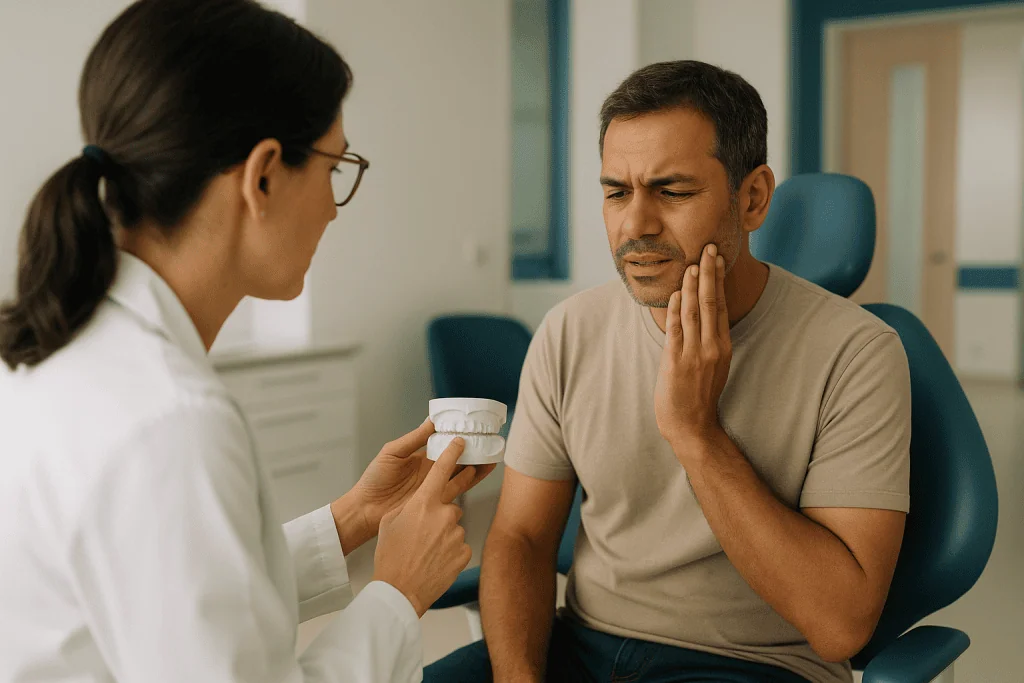
The dentist checks the chewing surfaces for flattening, shiny polished facets and chips, then compares what they see with your previous records and photographs. Wear that has progressed since the last visit matters more than wear that has sat unchanged for a decade. They look at the gum line for small notches, at fillings and crowns for fractures, and at the inside of the cheeks and the edges of the tongue for ridges where soft tissue has been pressed against the teeth.
Next come the muscles and joints. Gentle pressure on the masseter and temporalis reveals tenderness. The dentist watches the jaw open and close, measuring how wide it opens and whether it deviates to one side, and listens for clicks or grating at the joint. Teeth may be tested for mobility and for sensitivity to cold.
The history matters just as much. Expect questions about morning symptoms, headaches, snoring, daytime sleepiness, caffeine and alcohol intake, tobacco, current medicines and recent stress. If snoring or witnessed pauses in breathing come up, the Mayo Clinic notes that referral to a sleep specialist may follow, since sleep bruxism frequently travels with other sleep disorders such as obstructive sleep apnea.
Formal sleep studies that record jaw muscle activity exist, but they are reserved for complex cases. For most people, the combination of visible wear, tender muscles and a consistent story is enough for the dentist to grade the bruxism as mild, moderate or severe and to recommend either monitoring or treatment. That grading, not the patient’s worry level, drives the plan.
Who treatment is usually for, and who is usually asked to wait
Dentists tend to recommend active treatment for people in a few recognizable situations. The first is progressive wear: enamel that is measurably thinner than at the previous visit, exposed dentin, or a pattern of chipped edges and fractured fillings. The second is persistent pain, whether in the jaw muscles, the joint or the temples, that recurs most mornings. The third is damage to existing dental work, since crowns, veneers and implants are expensive to lose and are often the first casualties of heavy grinding. People about to receive extensive restorative work also commonly receive a protective appliance, because new restorations can fail under the same forces that wore the originals.
A fourth group is defined less by teeth than by sleep. Loud grinding accompanied by snoring, gasping or unrefreshing sleep prompts evaluation for sleep apnea, where treating the breathing problem is the priority and often the route to quieter nights.
Watchful waiting is usually proposed when grinding is occasional, the teeth show only minimal or stable wear, there is no pain, and no partner reports noise. Children are the clearest example. The Mayo Clinic notes that bruxism in children is common and frequently resolves by adolescence, so most pediatric cases are monitored rather than fitted with appliances.
Adults whose grinding tracks a specific stressful period, a new job or exam season, may also be advised to try stress-reduction measures and recheck in a few months before committing to an appliance.
Waiting is not the same as ignoring. It means scheduled rechecks, often with photographs or models of the teeth so that change can be measured rather than guessed. If wear advances or symptoms appear, the plan shifts. The treating dentist decides which path fits, and that decision can change over time.
What are the treatment options for clenching teeth?
There is no single treatment that stops bruxism in everyone. The Mayo Clinic frames the goal as preventing damage and relieving pain, and the available options fall into four groups that are often combined.
Protective appliances come first. Night guards and occlusal splints, custom-made plastic covers worn over the upper or lower teeth, do not stop the grinding itself. They place a sacrificial layer between the teeth so the appliance wears instead of the enamel, and they can spread force across the arch so no single tooth takes the brunt. For many people this alone is enough to protect the teeth and ease morning soreness.
Behavioral approaches target the awake form and the stress that feeds both forms. These include habit awareness training, relaxation techniques, improving sleep routines, and cutting back on caffeine, alcohol and tobacco, all of which the Mayo Clinic and NHS list as contributors. Biofeedback, which uses a sensor to alert you when jaw muscles tense, is sometimes used.
Treating underlying drivers is the third group. Sleep apnea, certain antidepressant medicines in the selective serotonin reuptake inhibitor (SSRI) class, and some stimulant medicines are associated with bruxism. Where a medicine is suspected, the prescribing clinician reviews whether an adjustment is appropriate; patients should never change a prescription on their own.
Medicines directed at bruxism itself form the smallest group, and the Mayo Clinic notes that evidence for them is limited. Short courses of muscle relaxants may be used before bed in some cases. Botulinum toxin injections into the jaw muscles, which temporarily weaken the muscle’s ability to contract, are considered for severe bruxism that has not responded to other measures; the effect is temporary and the injections would need repeating. Any of these sits with the treating clinician, who weighs benefit against side effects for the individual.
The different types of mouthguards and splints, compared
The phrase mouthguard covers several very different devices, and choosing the wrong one is a common reason people give up on treatment. A sports mouthguard is designed to cushion a blow from outside; a night guard is designed to withstand hours of pressure from inside. They are not interchangeable.
| Type | What it is | Usually suited to | Limitations |
|---|---|---|---|
| Over-the-counter boil-and-bite | Soft thermoplastic softened in hot water and molded at home | Short-term trial while waiting for a dental assessment | Bulky, imprecise fit; soft material may encourage chewing; wears quickly |
| Custom soft guard | Flexible appliance made from an impression of your teeth | Light grinding, people who cannot tolerate hard plastic | Some clinicians report soft surfaces invite more clenching; durability modest |
| Custom hard occlusal splint | Rigid acrylic plate covering one arch, adjusted so teeth meet evenly | Moderate to heavy grinding, protection of dental work, jaw muscle pain | Needs an adjustment period and periodic checks; must be dentist-fitted |
| Dual-laminate guard | Soft inner lining with hard outer shell | People who want comfort with better wear resistance | Thicker than a plain hard splint |
| Mandibular advancement device | Two-piece appliance holding the lower jaw forward | Bruxism coexisting with snoring or mild sleep apnea | Prescribed for the breathing disorder; requires sleep assessment first |
Two points matter more than the material. First, fit. A guard that rocks or sits high on one side can concentrate force on a few teeth, which is the opposite of the goal. Second, follow-up. A splint shows the dentist exactly where you grind, in the form of scuffs and grooves, and the pattern guides adjustments and tells both of you whether the grinding is settling or intensifying. The NHS notes that a dentist can make a mouth guard fitted to your teeth; the custom route is slower but is what most clinicians recommend once bruxism is confirmed.
How to stop clenching teeth during the day
Awake bruxism is the form you can actually influence, because it happens while you are conscious, even if you are not paying attention. Most people are startled to discover how often their teeth are touching. At rest, the jaw should hang slightly open with the lips together and the teeth apart. Clenchers hold the teeth in contact for much of the day.
The first step is noticing. Dentists often suggest pairing a check-in with cues you already encounter: every time you stop at a red light, open a new email or walk through a doorway, ask where your teeth are. If they are touching, let the jaw drop. Some people place a small sticker on a monitor or steering wheel as a reminder. This is the core of habit reversal, and it works by making an automatic behavior visible long enough to interrupt it.
The second is a resting position you can return to. One commonly taught version places the tip of the tongue lightly behind the upper front teeth, which naturally parts the back teeth. Others simply exhale and let the jaw hang.
The third is dealing with the fuel. Concentration, frustration and caffeine all tighten the jaw. The Mayo Clinic lists stress management, including exercise, meditation and talking with a counselor, among recommended approaches. People who chew gum or pens habitually are usually advised to stop, because constant chewing keeps the muscles primed.
Biofeedback devices that buzz or sound when jaw muscles tense can accelerate awareness, though the evidence for lasting benefit is limited and a clinician should guide their use. What does not work is forcing relaxation through gritted teeth; a jaw cannot be relaxed and clenched at once. Progress is measured in longer gaps between episodes, not in never clenching again.
Is teeth grinding linked to anxiety? What the evidence shows
Yes, but the link is more nuanced than the common assumption that anxious people grind and calm people do not.
Stress and anxiety are the most consistently reported associations with bruxism in patient-facing guidance from the NHS, Mayo Clinic and Cleveland Clinic. Awake clenching, in particular, tracks emotional state closely: deadlines, conflict and worry tighten the jaw in real time. Many people can point to the week their grinding started and name what was happening in their lives.
For sleep bruxism, the relationship is real but indirect. Grinding during sleep is tied to arousals in the brain’s sleep cycle, and anxiety fragments sleep, producing more of those arousals. Anxious people also tend to drink more caffeine, use more alcohol as a wind-down and sleep less regularly, each of which independently increases grinding. Untangling cause from company is difficult, and the honest summary is that anxiety raises the likelihood and intensity of bruxism without being its sole cause.
The Mayo Clinic also lists personality traits such as competitiveness and hyperactivity, and the SSRI class of antidepressants, among risk factors. That last point creates a loop: treating anxiety with certain medicines can, in some people, bring on or worsen grinding. It is a reason to tell both your dentist and your prescriber about new jaw symptoms, and never a reason to stop a medicine without that conversation.
Plenty of relaxed people grind, and plenty of anxious people never do. Genetics appear to play a part, since bruxism runs in families. So the practical conclusion is this: addressing stress is a reasonable part of any bruxism plan and may be the most important part for daytime clenching, but it should not be the only strategy when teeth are already wearing. Protecting the enamel while the stress work proceeds covers both fronts.
Sleep apnea, medicines and other hidden drivers of grinding
A night guard protects teeth, but if something upstream is producing the grinding, protecting teeth is only half the job. Several drivers deserve a specific look.
Obstructive sleep apnea is the one most often missed. In this condition the airway narrows or collapses repeatedly during sleep, breathing pauses, and the brain triggers a brief arousal to reopen the throat. Those arousals are the same events during which grinding episodes occur, and the Mayo Clinic notes that people with sleep bruxism are more likely to have other sleep disorders, including snoring and apnea. Clues include loud snoring, witnessed breathing pauses, waking with a dry mouth or headache, and daytime sleepiness despite a full night in bed. When apnea is confirmed and treated, grinding often eases, and some dentists will not fit a splint until a sleep assessment has ruled apnea in or out, because a splint on the upper teeth can, in some people, affect the airway.
Medicines come next. Bruxism is a recognized side effect of SSRI antidepressants and is also reported with some stimulant medicines used for attention disorders. The timing is often the giveaway: grinding that begins or worsens within weeks of a new prescription. The prescribing clinician decides whether any change is warranted; the patient’s role is to report it.
Substances play a part too. The Mayo Clinic lists caffeine, alcohol, tobacco and recreational drugs as factors that raise bruxism risk. Alcohol in the evening is a frequent culprit because it fragments the second half of the night’s sleep.
Less common associations include gastroesophageal reflux, certain neurological conditions and, in children, a possible link with enlarged tonsils or adenoids that disturb breathing. None of these is a reason to self-diagnose; each is a reason the history your dentist takes is as important as the wear they see.
What the first weeks with a night guard usually look like
Receiving a custom splint is rarely the end of the story. Expect a short adjustment period, and expect the appliance to be modified at least once.
The first nights feel strange to most people. The mouth produces extra saliva in response to a foreign object, the lips may not close comfortably, and some wake to find they have removed the guard in their sleep without remembering. Dentists usually suggest wearing it for a short period while awake in the evening first, so the mouth learns the sensation before sleep. Clear speech returns quickly once it comes out in the morning.
Teeth may feel slightly odd on waking for a few minutes, as if they do not quite meet the way they did. This is common and settles as the ligaments around each tooth readjust; if the sensation persists through the morning or teeth feel sore, the splint needs adjusting and the dentist should hear about it.
A follow-up visit is standard. The dentist examines the splint for wear marks, which show the exact pattern of grinding, and checks that the bite against the appliance is even. High spots are ground down. Over subsequent months, scuffs on the guard become a record of whether grinding is settling.
Jaw muscle soreness often improves within the first weeks once the teeth stop locking together, though how quickly varies widely between people, and dentists generally avoid promising a timeline. Headaches that stem from the temporalis may follow the same curve. Enamel that has already worn will not change, which is why the splint is paired with monitoring of the teeth themselves.
Care is simple: rinse and brush the guard with cool water, store it dry in its case, and bring it to every dental visit. Guards do wear out; a hole or crack means it is time for a replacement, which the dentist will advise on.
Repairing teeth already worn by grinding
A splint stops future damage. It does nothing for a tooth that is already flattened, chipped or sensitive, and the question of whether to repair existing wear comes up at almost every bruxism consultation.
The answer depends on depth. Enamel that is flattened but intact is usually left alone and watched, because any restoration replaces natural tooth structure with artificial material that will itself wear under the same forces. Smooth, shiny facets without exposed dentin rarely need more than a protective guard.
Once the yellower dentin is exposed, the calculation changes. Dentin is softer than enamel and wears far faster, and it contains tiny tubules that transmit cold and sweet sensations to the nerve, which is why worn teeth become sensitive. Options at this stage range from desensitizing treatments and small bonded fillings to cover exposed patches, through to crowns on heavily worn back teeth. Where many teeth have shortened, some patients need a more extensive rebuild of the bite, which is complex work carried out in stages.
Two principles govern good practice here. First, protect before you repair: a new crown placed into a jaw that still grinds unprotected is at high risk of fracturing, and the Mayo Clinic lists damaged dental work among bruxism complications for exactly this reason. Most dentists fit or re-fit a splint alongside any restorative plan. Second, the bite must be checked carefully after any repair, because restorations that sit even slightly high can become a focal point for clenching.
Cosmetic concerns are legitimate, especially when front teeth have shortened and the smile looks older than the face, but they are weighed against the lifetime maintenance that restorations in a grinding mouth will need. The dentist lays out the trade-offs; the pace and extent of repair is a shared decision, not an emergency.
What people often get wrong about bruxism
The myths around teeth grinding are stubborn, partly because the condition is invisible to the person who has it. A few deserve correcting.
A night guard stops grinding. It does not. The appliance protects teeth from each other and may ease muscle soreness, but the grinding motion continues against the plastic, which is why the guard develops wear marks. Thinking of it as a shield rather than a brake sets realistic expectations.
If I do not hear myself, I am not grinding. Clenching makes no sound at all, and much sleep grinding is quiet. Many people are diagnosed from tooth wear alone, having never heard a thing. Equally, a partner’s report of noise is useful but not definitive, since some noisy grinders show little damage.
Grinding is always caused by stress. Stress is a major contributor, but sleep apnea, medicines, caffeine, alcohol and genetics all play roles, and some of the heaviest grinders describe themselves as perfectly calm. Treating stress alone can leave a breathing disorder untreated.
A sports mouthguard will do. Sports guards cushion impact and are too soft and bulky for nightly grinding; the material can even encourage chewing. Over-the-counter night guards are a step up but still lack the precise fit that spreads force evenly.
Children who grind need treatment. Usually not. The Mayo Clinic notes childhood bruxism commonly resolves by adolescence, and most pediatric cases are monitored, with attention to any snoring or breathing concerns.
Worn teeth can be fixed back to normal. Restorations can rebuild shape, but enamel does not regenerate, and artificial materials in a grinding mouth need lifelong maintenance. The best outcome is always preventing the next millimeter of wear rather than replacing the last one. That is the strongest argument for taking early signs seriously without alarm.
Questions to ask your care team about bruxism treatment
A good consultation leaves you understanding both the damage and the plan. These questions help steer the conversation, and none of them has a single right answer, which is the point.
- How severe is the wear on my teeth, and has it changed since my last visit? Ask whether photographs or models can be taken now so future change is measurable.
- Do you think this is mainly awake clenching, sleep grinding or both? The answer shapes which treatments make sense.
- Are there signs that my jaw joints are affected, and should anything be done about that now?
- Could my sleep be part of this? Ask directly whether snoring, daytime tiredness or a partner’s observations warrant a sleep assessment before an appliance is made.
- Could any of my current medicines be contributing? If so, who should I speak with about that, and what should I avoid doing on my own?
- Which type of splint are you recommending for me, and why that one rather than the alternatives?
- What should the first weeks with the appliance feel like, and what would tell me it needs adjusting?
- How often will you want to check the guard and my teeth?
- Do any of my teeth or existing fillings need repair now, or can they be watched? What happens if we wait?
- What can I do during the day that would make a real difference?
Bring your partner’s observations if you have them, a list of medicines and supplements, and an honest account of caffeine, alcohol and tobacco use. The dentist cannot see the nights; your history fills that gap. If a question is answered with a promise rather than a range, ask what the evidence actually shows. Credible clinicians are comfortable with uncertainty and will tell you where the limits of knowledge lie.
When to call your doctor or dentist about grinding
Most bruxism is handled at routine dental visits, but some situations should prompt a call sooner rather than waiting for the next check-up.
Contact your dentist promptly if a tooth has chipped, cracked or become loose; if a filling, crown or other dental work has fractured or fallen out; if a tooth has become sharply sensitive to hot, cold or biting; or if jaw pain is now constant rather than confined to the morning. Jaw joint symptoms that change character also warrant a call: a jaw that locks open or closed, grating rather than clicking, or an inability to open the mouth fully.
Speak with your primary care clinician if headaches are increasing in frequency or severity, if you are waking unrefreshed and sleepy during the day, or if a partner reports that you snore loudly or stop breathing during sleep. These point toward a sleep disorder that needs its own evaluation. Also make contact if grinding began or clearly worsened after starting a new medicine; the prescriber needs that information and will decide whether anything should change. Do not stop or alter a prescription yourself.
Seek urgent care for red-flag signs that are not typical of bruxism and need to be ruled out: a sudden severe headache unlike any you have had before, a headache with fever, stiff neck, confusion, weakness or vision change, jaw or facial pain accompanied by chest pressure, shortness of breath or sweating, or facial swelling with fever that suggests a dental infection. These are not grinding symptoms and should be assessed the same day.
For everything else, the rule is simple. New wear, new pain or a change in an existing pattern is a reason to be seen, not a reason to wait and see. The treating team decides what comes next.
Frequently asked questions
What are the treatment options for clenching teeth?
Treatment usually combines a custom-fitted splint to protect the teeth, behavioral measures such as habit awareness and stress reduction, and treatment of any underlying driver such as sleep apnea or a contributing medicine. For severe cases that have not responded, clinicians may consider short-term muscle relaxants or botulinum toxin injections, though the Mayo Clinic notes evidence for medicines is limited. The treating team chooses the combination.
What are the different types of mouthguards for grinding?
The main types are over-the-counter boil-and-bite guards, custom soft guards, custom hard acrylic occlusal splints, dual-laminate guards with a soft lining and hard shell, and mandibular advancement devices used when grinding coexists with sleep apnea. Hard custom splints are most often recommended for moderate to heavy grinding because they fit precisely, spread force evenly and show the dentist the grinding pattern through wear marks.
How can I stop unconsciously clenching my teeth?
Start by noticing: link a quick check of where your teeth are to everyday cues such as stopping at a red light or opening an email, and let the jaw hang if the teeth are touching. Resting the tongue tip behind the upper front teeth keeps the back teeth apart. Reducing caffeine, avoiding gum chewing and addressing stress all help. Progress means longer gaps between episodes, not never clenching.
Is teeth grinding linked to anxiety?
Yes. Stress and anxiety are the most consistently reported associations with bruxism, especially daytime clenching, which tracks emotional state closely. For sleep grinding the link is indirect: anxiety fragments sleep and increases the arousals during which grinding occurs. Some antidepressants used for anxiety can also cause grinding. Anxiety is a major contributor, not the only cause, and protecting the teeth should proceed alongside stress management.
When does bruxism need treatment rather than just monitoring?
Treatment is usually recommended when wear is progressing, dentin is exposed, teeth are sensitive or loose, dental work is fracturing, or jaw pain and temple headaches recur most mornings. Monitoring is reasonable when grinding is occasional, wear is minimal and stable, and there is no pain. Children are usually monitored because the habit often resolves by adolescence. The dentist grades severity and decides.
Can grinding cause morning headaches?
It can. The temporalis muscle, which helps close the jaw, sits over the temple, and hours of overnight clenching leave it fatigued and tender. The Mayo Clinic describes the result as a dull headache beginning in the temples. These are often mistaken for ordinary tension headaches. A dentist can check whether the muscle is tender and whether tooth wear supports the diagnosis.
Does a night guard stop teeth grinding?
No. A night guard is a shield, not a brake. The grinding motion continues against the plastic, which is why guards develop scuffs and grooves over time. What the appliance does is protect enamel and dental work from direct tooth-to-tooth contact and spread force across the arch, which often eases jaw muscle soreness. Reducing the grinding itself depends on addressing stress, sleep and other drivers.
Can worn enamel from grinding grow back?
No. Enamel has no living cells and cannot regenerate once lost. Flattened but intact enamel is usually monitored with a protective guard. Where the softer dentin beneath is exposed, dentists may use desensitizing treatments, bonded fillings or crowns to cover and rebuild the tooth. Any restoration in a grinding mouth needs lifelong maintenance, so prevention of further wear remains the priority.
Is bruxism connected to sleep apnea?
Often. Both involve brief arousals from sleep, and the Mayo Clinic notes that people with sleep bruxism are more likely to have other sleep disorders, including snoring and obstructive sleep apnea. Loud snoring, witnessed breathing pauses, waking with a dry mouth and daytime sleepiness alongside grinding should prompt a sleep assessment. Treating apnea often eases grinding, and some dentists require that assessment before fitting a splint.
Can medicines cause teeth grinding?
Some can. Bruxism is a recognized side effect of the SSRI class of antidepressants and has been reported with certain stimulant medicines. The clue is usually timing: grinding that begins or worsens within weeks of a new prescription. Tell both your dentist and the prescribing clinician. The prescriber decides whether any change is appropriate; never stop or adjust a medicine on your own.
References
- NHS: Teeth grinding (bruxism)
- Cleveland Clinic: Teeth grinding (bruxism)
- MedlinePlus Medical Encyclopedia: Bruxism
This article is for general information only and is not a substitute for professional medical advice. Please consult a qualified doctor about your individual situation.

More from the Blog

What MRI and CT Reveal About TMJ: The Disc, Arthritis and Joint Damage
MRI is the preferred way to see the soft tissues of the temporomandibular joint, especially whether the cartilage disc sits on top of the…

What Porcelain Veneers Can Change and What Still Depends on Your Gums: Realistic Results
Porcelain veneers are thin ceramic shells bonded to the front of teeth. They can reliably change color, small chips, minor spacing and the shape…
How a Dentist Bonds Dental Crystals (Tooth Gems) Without Drilling the Enamel
A dentist bonds a tooth gem the same way tooth-colored fillings are bonded: the enamel is cleaned, briefly etched with a mild acid gel…

Can Gum Disease Kill You? The Links to Heart and Whole-Body Health
Gum disease itself rarely kills, but advanced periodontitis is associated with higher rates of heart attack, stroke, and poorly controlled diabetes, and in rare…

After Halitosis Treatment: Hydration, Tongue Cleaning and the Daily Routine Dentists Recommend
After halitosis treatment, dentists usually recommend a simple halitosis daily routine: brush twice a day for two minutes with fluoride toothpaste, clean between the…

Tongue Scraping: What It Actually Does (and Doesn’t) for Your Mouth
Tongue scraping removes the bacteria-rich coating on the tongue's surface and, in small clinical studies, modestly reduces the sulfur compounds behind bad breath for…