

When Can You Walk, Drive, Work and Exercise After Gastric Sleeve Surgery? A Recovery Timeline

Key Takeaways
- A sleeve gastrectomy removes about 80 percent of the stomach, including most of the tissue that produces the hunger hormone ghrelin, which is why appetite often quiets after surgery.
- Patients are typically walked within hours of a laparoscopic sleeve and discharged after one to two nights, because early movement is the main defense against blood clots.
- Driving is cleared not by a date but by two tests: being off sedating painkillers and being able to brake hard and twist without pain, which most people meet within the first couple of weeks.
- Heavy lifting and strenuous exercise usually wait about six weeks because the deeper abdominal wall heals more slowly than the skin incisions and straining early raises hernia risk.
- The staged diet from liquids to pureed to soft to regular food over roughly two months protects a swollen, stapled stomach; advancing early is a common cause of vomiting and readmission.
- Weight loss is fastest in the first months and continues into the second year, with some regain after that being common rather than exceptional, which is why long-term follow-up is built into every program.
Gastric sleeve recovery time varies, but most people walk within hours of surgery, leave the hospital after one to two nights, and resume driving once they are off sedating painkillers and can brake sharply without pain. Desk work often restarts within a few weeks; heavy lifting and strenuous exercise usually wait about six weeks. Your surgical team sets the exact timeline based on your healing.
The night before her operation, one patient told me she wasn’t nervous about the surgery itself. She was nervous about the calendar. Who would drive the kids on Thursday? Could she sit through a two-hour meeting the following week? When could she get back to the pool, the one place her joints didn’t ache? Nobody had given her a straight answer, and the internet offered a dozen contradictory ones.
That gap is what this article tries to close. Gastric sleeve recovery time is not one number; it is a series of small clearances, each tied to a specific piece of healing. Walking comes first, then driving, then work, then the gym. Each has its own logic, and once you understand the logic, the timeline stops feeling arbitrary.
What follows is drawn from mainstream clinical sources and written for the person staring at that calendar. Where the evidence gives a range, you’ll get the range. Where it doesn’t, you’ll be told so.
What actually happens during gastric sleeve surgery, and why gastric sleeve recovery time is shorter than people expect
A gastric sleeve, formally a sleeve gastrectomy, is an operation that removes roughly 80 percent of the stomach and leaves a narrow tube about the shape of a banana (Mayo Clinic). The part that remains still connects to the esophagus above and the small intestine below, so food follows its normal route. Nothing is rerouted, and nothing is implanted.
Almost all sleeves are done laparoscopically. That means the surgeon works through a handful of small incisions using a camera and long instruments rather than one long cut across the abdomen (MedlinePlus). The stomach is divided along a stapling device, the larger portion is removed through one of the small ports, and the staple line is checked for leaks before the incisions are closed.
Two things make this operation change appetite and intake. The first is mechanical: the new stomach holds a few ounces rather than a quart, so meals end sooner. The second is hormonal. The portion removed produces most of the body’s ghrelin, a hormone that signals hunger, and levels typically fall after surgery (Cleveland Clinic). Many patients describe not so much fullness as a quieter interest in food.
The recovery implications flow from the technique. Small incisions mean less muscle disruption, so people stand and walk within hours and usually go home after one to two nights (MedlinePlus). The internal work, however, is substantial. A long staple line has to seal, swelling inside the new stomach has to settle, and the body has to adjust to very little food for a period. That is why the outside of you looks recovered long before the inside has finished the job, and why the waiting periods for lifting and eating solid food last longer than the incisions would suggest.
Who is usually offered a sleeve, and who is usually asked to wait
Bariatric surgery is generally considered for adults with a body mass index of 40 or higher, or 35 or higher with a weight-related condition such as type 2 diabetes, high blood pressure or sleep apnea, when structured attempts at weight loss through diet, activity and medical support have not achieved lasting results (NIDDK). BMI is a ratio of weight to height used as a screening measure; it is imperfect, and teams weigh it alongside health history, not in isolation.

Candidacy is about more than a number. Most programs ask for a psychological assessment, nutritional counseling and, often, evidence that a person can attend follow-up over the long term (NHS). The sleeve in particular is sometimes chosen when a person has conditions that make the more complex bypass less attractive, or when a surgeon wants a procedure that preserves the normal path of digestion.
Some people are asked to wait rather than refused. Common reasons include uncontrolled reflux, since a sleeve can worsen heartburn in a subset of patients (Mayo Clinic); active smoking, because nicotine slows healing and raises the chance of staple-line problems; untreated psychiatric illness or active substance use; and pregnancy or plans to conceive in the near term, given that rapid weight loss is not advised during pregnancy. Certain conditions such as severe heart or lung disease may need optimization first so that anesthesia is safer.
Timing matters in the other direction too. Delaying surgery indefinitely while a person’s diabetes or joint disease progresses is its own risk, and a good team talks through that trade-off openly. None of these thresholds is a verdict on a person’s worth or effort. They are questions about whether the operation, on this day, gives this body the best chance of healing well. The final call rests with the multidisciplinary team, and it is entirely reasonable to ask them to explain their reasoning.
The first 48 hours: what the hospital stay looks like
Most people wake in a recovery area with a sore, tight abdomen, a dry mouth and a very strong desire to lie still. The nursing staff will have other ideas. Within a few hours of a laparoscopic sleeve, patients are typically helped to sit up, dangle their legs and take a short walk along the corridor (MedlinePlus). It feels early. It is early on purpose.
The first day is mostly about three checks. Can you take small sips of clear liquid without vomiting? Is your pain controlled enough to move? Are your vital signs steady? Some programs perform a swallow study or contrast X-ray to confirm the staple line is intact; others rely on clinical judgment. Either way, a nurse will be watching your heart rate and temperature closely, because a persistently fast pulse is one of the earliest signals of a problem.
Expect an IV drip for fluids, since you cannot yet drink enough to stay hydrated, along with compression stockings or calf pumps that squeeze the legs to keep blood moving. Many teams also give a blood-thinning injection in the hospital to reduce clot risk; whether it continues at home is decided by the surgeon based on individual risk, and that decision belongs to them.
Discharge usually comes after one to two nights (MedlinePlus; Mayo Clinic), once you are drinking small volumes steadily, walking independently, passing urine and managing pain with oral medicine. You will leave with written instructions on fluids, wound care and warning signs, plus a follow-up appointment. Some people feel almost disappointed by how undramatic the departure is. That is a good sign. The drama, if any, is meant to be caught while you are still inside the building.
When can you walk after gastric sleeve surgery?
Right away, and often sooner than you would choose. Walking within the first few hours after surgery is standard in bariatric programs (MedlinePlus), and it is arguably the single most useful thing a patient does in the first week.
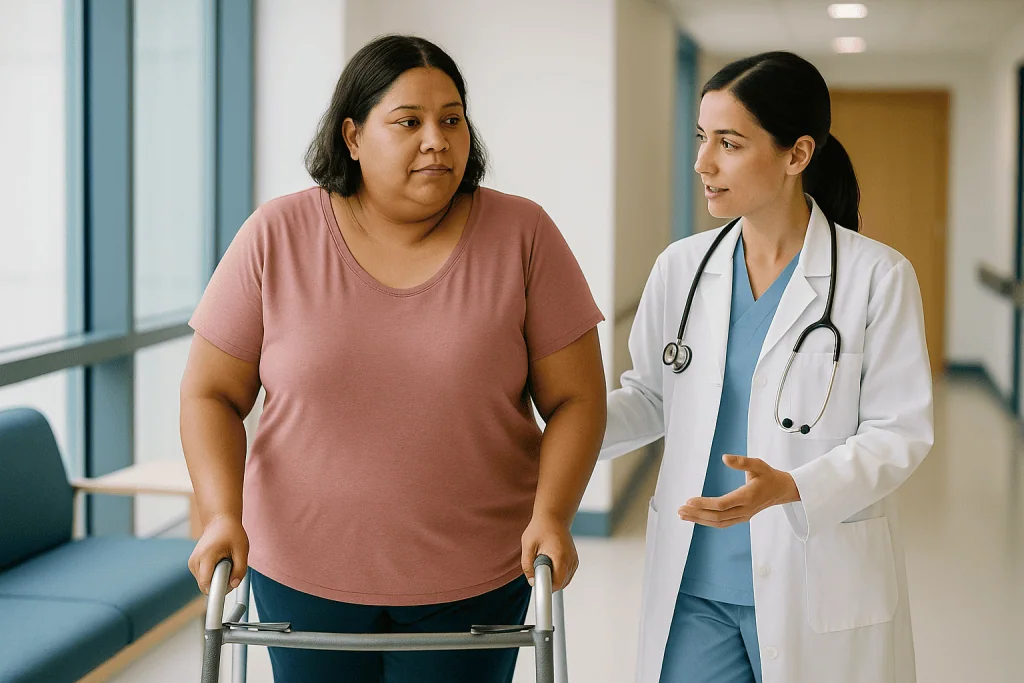
The reasoning is about blood clots. Surgery, immobility and higher body weight each raise the risk of a deep vein thrombosis, a clot in the leg veins that can travel to the lungs and cause a pulmonary embolism. Contracting the calf muscles as you walk squeezes blood back toward the heart, which is why nurses will nudge you up before you feel ready. Walking also helps the bowel wake up after anesthesia and eases the trapped gas that gives many patients a peculiar ache in the shoulder for a day or two.
What “walking” means in week one is modest: a lap of the ward, then a lap of the house, then to the end of the street. Several short walks spread across the day are more useful than one long push, and fatigue is the limit, not pain. Most people find they can walk comfortably for fifteen to twenty minutes at a time by the end of the first week, though sources describe this as typical rather than guaranteed, and your energy will lag behind your legs because you are eating very little.
Two cautions apply. Dizziness on standing is common in the first days because fluid intake is low, so rise slowly and sit if you feel lightheaded. And walking is not the same as hurrying: brisk pace, hills and stairs taken two at a time can wait until the incisions have knitted. If a leg becomes swollen, warm or painful, or if you become short of breath, stop and call your team, because those are clot symptoms rather than exertion.
How long after gastric sleeve can I drive?
The honest answer is: when you can pass two tests, not when a calendar says so. The first test is pharmacological. If you are still taking opioid or other sedating painkillers, you should not be behind the wheel, because reaction time and judgment are impaired and, in many jurisdictions, driving under their influence is illegal (NHS). The second test is physical. You must be able to twist to check a blind spot and slam on the brake in an emergency without hesitation or pain.
For most people after a laparoscopic sleeve, both conditions are met within the first couple of weeks, and surgical programs commonly clear driving around then. Some patients are ready sooner, some later. Anyone whose recovery included complications, or who had an open rather than keyhole procedure, will typically wait longer.
A few practical points. Try the movements in a parked car first: seat belt over tender incisions, full turn of the torso, a hard press on the brake pedal. If any of that makes you wince, you are not ready. Start with short daytime trips on familiar roads rather than a highway commute. Keep a bottle of water in the car, because dehydration in the early weeks can cause the kind of lightheadedness you do not want at an intersection.
Insurance is the other consideration. Some insurers ask that a doctor confirm fitness to drive after abdominal surgery, and a claim can be complicated if you were driving against medical advice. Asking your surgeon to note the clearance in your discharge paperwork costs nothing and settles the question. The decision remains theirs, and it is one of the few recovery milestones where being a little cautious carries no downside at all.
Return to work after gastric sleeve: desk jobs versus physical jobs
Work is where the timeline splits most sharply. The NHS describes most people needing a few weeks off after weight loss surgery before returning to work and normal activity (NHS), but the shape of that leave depends almost entirely on what your job asks of your body.
Someone in a seated role who can control their pace often feels able to return within two to three weeks, sometimes on reduced hours or from home at first. The obstacles at that stage are rarely the incisions. They are fatigue from a very low-calorie liquid diet, the need to sip fluids constantly, and frequent small meals that do not fit a rigid meeting schedule. A discreet bottle and a manager who knows you may need short breaks solve most of it.
Physical jobs are a different matter. Lifting, pushing, prolonged standing and repetitive bending load the abdominal wall while the incisions and the deeper fascia are still healing. Programs generally ask patients to avoid heavy lifting and strenuous activity for about six weeks (NHS), which for a warehouse worker, nurse or tradesperson usually means either that long off or a temporary light-duty arrangement.
| Type of work | Typical return window | What usually limits it |
|---|---|---|
| Seated or remote | Around two to three weeks | Fatigue, hydration, meal timing |
| On your feet, light lifting | Around three to four weeks | Stamina, wound comfort |
| Heavy lifting or manual labor | Around six weeks, or light duty sooner | Abdominal wall healing, hernia risk |
These windows are ranges described by clinical sources, not promises. Ask your surgeon for a written fitness-to-work note that states any restrictions, and ask early, since employers handle phased returns better with notice. If your workplace involves driving or operating machinery, the same sedating-medicine rule applies as for your own car.
Exercise after gastric sleeve: walking, cardio, weights and swimming
Think of exercise after a sleeve in three layers, each unlocked by a different piece of healing.
The first layer is walking, and it starts on day one, as covered above. Over the first few weeks, that walking can lengthen and quicken. Gentle stationary cycling with no resistance and light stretching usually join it once you are moving comfortably, often in the second or third week, though this is a common program pattern rather than a fixed rule.
The second layer is anything that raises your heart rate hard or engages the core: jogging, elliptical machines, cycling with resistance, yoga that involves twisting or planking. Most programs hold these until the surgeon has checked the incisions at a follow-up visit, typically around four to six weeks (NHS). The concern is not your stamina but the abdominal wall, since straining before the deeper layers have healed raises the chance of an incisional hernia, a weak spot where tissue pushes through the muscle.
The third layer is resistance training and contact sport. Lifting weights, deadlifts in particular, and sports where you might take a blow to the abdomen generally wait until around six weeks and are reintroduced gradually (NHS). When you do restart, begin lighter than your pride would like and build weekly.
Swimming deserves its own note because so many patients ask about it. The water itself is not the problem; open or scabbed incisions are. Pools and hot tubs harbor bacteria, and a wound that is not fully sealed is an entry point. Most surgeons ask patients to wait until every incision is closed and dry with no scab, which commonly falls in the two-to-four-week range, and to get an explicit go-ahead.
One caution matters more than any timeline: fuel. In the early months you are eating very little, and hard training on a liquid or pureed diet can cause dizziness, muscle loss and fainting. Build activity alongside protein intake, not ahead of it.
Gastric sleeve recovery week by week: a summary table
Recovery after a sleeve is easier to picture as overlapping phases than as a single countdown. The table below gathers the milestones discussed in this article into one view. Every window is a typical range drawn from the cited clinical sources, and your team may move any of them earlier or later based on how you are healing.
| Period | Activity | Eating | What is healing |
|---|---|---|---|
| Days 0 to 2 | Short walks within hours; hospital discharge after one to two nights (MedlinePlus) | Sips of clear liquids | Staple line sealing; anesthesia clearing |
| Days 3 to 7 | Several short home walks daily; showering; no lifting | Clear then full liquids, protein-focused | Internal swelling; incision surfaces closing |
| Weeks 2 to 3 | Driving once off sedating medicine and braking is pain-free; light desk work often possible | Pureed foods introduced (Mayo Clinic) | Skin incisions sealed; energy still low |
| Weeks 4 to 6 | Return to most work; moderate cardio after surgeon review; swimming once wounds are fully dry | Soft foods; small portions | Deeper abdominal layers strengthening |
| Week 6 onward | Heavy lifting and strenuous exercise reintroduced gradually (NHS) | Regular textures, small portions, protein first | New stomach adapting; ongoing weight change |
Two features of this table deserve emphasis. First, the eating timeline lags the activity timeline. You may feel fit enough to run before you are eating solid food, and that mismatch catches people out. The dietary stages exist to protect a staple line under pressure from swelling, not because you lack willpower, and rushing them is one of the more common reasons for early vomiting and readmission.
Second, the milestones are gates, not deadlines. Being cleared for weights at six weeks does not mean you should lift heavy at six weeks. Fatigue, hydration and protein intake in the early months are the true limiters, and they often improve on a slower curve than the wounds do. A recovery that looks unremarkable week to week is exactly what a surgical team hopes to see.
How painful is recovery from gastric sleeve surgery, honestly?
Less than most people fear, and different from what they imagine. The abdominal incisions themselves are small and, for the majority, ache rather than throb. What surprises patients is the gas pain. Surgeons inflate the abdomen with carbon dioxide to create working space, and residual gas irritates the diaphragm, which shares a nerve pathway with the shoulder. The result is a sharp ache at the shoulder tip that has nothing to do with the shoulder and usually eases within a couple of days as you walk and the gas is absorbed (Cleveland Clinic).
The other distinctive discomfort is a tight, cramping sensation behind the breastbone when you sip. The newly narrowed stomach is swollen, and even small volumes stretch it. This is not incision pain and it does not respond to painkillers; it responds to slowing down. Tiny sips, spaced out, are the treatment.
Pain relief in the hospital typically combines a local anesthetic at the incision sites with scheduled non-opioid medicine and, if needed, short-term opioids. Most programs aim to send patients home on non-opioid medicine alone or with a very brief supply. Many bariatric teams ask patients to avoid a class of anti-inflammatory painkillers known as NSAIDs after a sleeve, because they can irritate the stomach lining and raise ulcer risk; whether that applies to you, and for how long, is a decision for your prescribing clinician.
Day two is often the worst, day three or four the turning point, and by the end of the first week many people describe soreness rather than pain. Pain that worsens after initially improving, pain that spreads across the whole abdomen, or pain accompanied by fever or a racing heart is not a normal part of this curve and should be reported the same day. The expected trajectory is steady improvement; anything else deserves a phone call.
Eating again: the diet stages and what the 30/30 rule means
The eating timeline after a sleeve is a staircase, not a ramp. Clinical sources describe a progression from clear liquids in the first days, to thicker liquids and protein drinks, to pureed foods, to soft foods, and finally to regular textures over roughly the first two months (Mayo Clinic). Each step protects a staple line that is still sealing and a stomach that is still swollen, and skipping a step is a common route to vomiting, pain and, occasionally, a trip back to the hospital.
Three habits matter more than any specific food. Protein comes first at every meal, because the body is losing weight quickly and will take muscle as well as fat if protein is short. Portions are small and eaten slowly, since the new stomach signals fullness abruptly and one bite too many can mean discomfort or regurgitation. And fluids are sipped throughout the day rather than gulped with meals.
That last habit is where the so-called 30/30 rule comes from. There is no single official definition, and it is not a guideline in the formal sense; it is shorthand that many programs use for two related pieces of advice. The first: stop drinking about 30 minutes before a meal and wait about 30 minutes after before drinking again, so that liquid does not fill the small stomach in place of food or wash food through too quickly. The second, in some versions: take around 30 minutes to eat a meal, chewing each mouthful thoroughly. Your program may use slightly different intervals. The principle behind both is the same, which is to separate eating from drinking and to slow everything down.
Micronutrients round out the picture. With less stomach, absorption of certain vitamins and minerals changes, and lifelong supplementation with periodic blood tests is standard after bariatric surgery (NIDDK). Which supplements, and in what form, is a conversation for your dietitian and surgeon rather than a shopping list from an article.
How long will you keep losing weight after a gastric sleeve?
Weight loss after a sleeve is front-loaded. The steepest change comes in the first months, when intake is smallest and the body is drawing heavily on stored fat, and it slows progressively as portions expand and metabolism adjusts. Clinical sources describe weight loss continuing into the second year, with the Mayo Clinic noting that it is possible to lose roughly 60 percent or more of excess weight within two years (Mayo Clinic). “Excess weight” means the difference between a person’s current weight and a reference weight for their height, so the figure is not a percentage of total body weight.
Two features of that trajectory deserve honesty. The first is variability. Averages hide a wide spread, and factors such as starting weight, activity, sleep, medications, other health conditions and how closely a person follows the dietary plan all shift the individual curve. No clinician can promise where you will land, and any source that does is overstepping the evidence.
The second is regain. Some weight regain after the second year is common rather than exceptional (NIDDK), and it is not a moral failing. The remaining stomach can stretch modestly over time, hunger hormones partially recover, and life intervenes. Programs that keep patients in follow-up, with dietitian contact and, where appropriate, medical therapy, tend to see this managed better than those that lose touch after the first year, which is one reason long-term attendance is emphasized at the outset.
Plateaus are part of the pattern too. A few weeks of no change on the scale during month three or four is frequent enough that dietitians expect it. Measuring waist, noticing clothing fit and tracking strength often tell a more accurate story than the number on a given morning. Weight is one outcome. Blood pressure, blood sugar, joint pain and sleep quality are others, and they often move before the scale does.
What people often get wrong about gastric sleeve recovery
“I’ll be flat on my back for weeks.” The opposite is closer to the truth. Walking begins within hours and is the main tool for preventing clots (MedlinePlus). Excessive bed rest is a risk, not a comfort.
“Once the incisions look healed, I’m healed.” Skin closes in a week or two. The deeper abdominal wall and the staple line inside take longer, which is why heavy lifting and strenuous exercise typically wait about six weeks even when you feel fine (NHS).
“If I feel good, I can move to the next diet stage early.” The staged diet protects a swollen, stapled stomach, not a fragile ego. Advancing texture ahead of schedule is a common cause of vomiting and pain in the first weeks.
“There’s a list of foods I can never eat again.” There is no universal forbidden list. Most people eventually eat a wide variety of regular foods in small portions. What changes durably is how you eat: slowly, protein first, liquids separated from meals. Some individuals find specific foods, often bread, rice, tough meat or very sweet items, sit poorly, but that is discovered personally rather than decreed.
“I can’t take any painkillers after a sleeve.” Pain relief is expected and planned. What many programs restrict is one specific class, NSAIDs, because of stomach irritation. Your team will tell you what is appropriate for you.
“Weight loss will be steady and permanent.” It is fast early, slower later, punctuated by plateaus, and some regain after two years is common (NIDDK). Follow-up exists precisely because this is expected.
“Alcohol is fine once I’m eating normally.” After a sleeve, alcohol is absorbed faster and its effects hit harder, and it delivers calories without protein. Many programs advise avoiding it for a period and treating it cautiously afterward. Ask yours.
“Reflux will go away.” Some people find heartburn improves; a subset find it worsens, because the narrow sleeve raises pressure in the stomach (Mayo Clinic). Persistent reflux after surgery should be reported, not endured.
Questions to ask your care team before and after surgery
The most useful questions are the ones that convert general ranges into your specific plan. Take this list to your pre-operative visit and again to your first follow-up.
- Which milestones will you personally sign off, and which can I judge for myself? Driving, work and exercise clearances are often handled differently.
- How long do you expect me to stay in the hospital, and what would extend that?
- Will I go home on a blood-thinning injection, and if so, who teaches me to give it and for how long is it planned?
- Which painkillers should I use, which should I avoid, and is the NSAID restriction lifelong or temporary in my case?
- What exactly should I look for at the incisions, and what does a normal versus a worrying wound look like?
- What is the dietary staging plan, week by week, and who do I call if I cannot keep fluids down?
- When can I swim, and does that depend on the wounds or the calendar?
- My job involves lifting or standing all day. What written restrictions can you give my employer, and for how long?
- What is your threshold for heart rate, temperature or pain that means I should call, and what number do I call after hours?
- How will my other medicines change? Some medications, especially for diabetes and blood pressure, may need adjustment as weight falls, and that must be managed by the prescriber rather than by me.
- Which vitamin and mineral supplements will I need, when do blood tests start, and how often will they continue?
- How long does your program follow patients, and what happens if I move or change insurers?
- I have reflux now. How do you expect the sleeve to affect it, and what is the plan if it worsens?
- If I am considering pregnancy, how long do you advise waiting after surgery?
Write the answers down or bring someone who will. The early days after surgery are foggy, and the questions you did not ask are the ones that turn into anxious late-night searches. A good team will welcome the list; it means you intend to be an active participant in your own recovery.
When to call your doctor: red-flag signs after gastric sleeve surgery
Most recoveries are uneventful, and this section exists so you can tell the difference between uncomfortable and unsafe. The single most important principle is trajectory: recovery should improve steadily, and anything that gets worse after getting better is a reason to call, not to wait.
Seek emergency care immediately if you develop chest pain, sudden shortness of breath, coughing up blood, fainting, or a leg that becomes swollen, warm and painful. These can signal a blood clot in the leg or lung, which is a recognized risk after bariatric surgery (MedlinePlus). Do the same for severe abdominal pain that spreads or does not ease, especially with a rapid heart rate or fever, because those can indicate a staple-line leak or internal bleeding, both of which are uncommon but time-critical.
Call your surgical team the same day for a fever, a heart rate that stays fast at rest, repeated vomiting or an inability to keep down fluids for more than a few hours, since dehydration develops quickly when the stomach is small. Report redness spreading from an incision, pus, a foul smell, or a wound edge that opens. Black or tarry stools or vomit that looks like coffee grounds suggest bleeding into the gut. Yellowing of the skin or eyes, severe or worsening heartburn, or pain when swallowing that does not settle also warrant a call.
Contact the team within a day or two for symptoms that are less urgent but still matter: persistent dizziness on standing, very dark urine or passing little urine, new tingling or numbness in the hands or feet, hair loss that alarms you, or low mood that is not lifting. Low mood after major surgery and rapid weight change is common and treatable, and it deserves the same attention as a wound.
Keep the after-hours number from your discharge paperwork somewhere you can find it in the dark. Calling about something that turns out to be nothing is never a mistake. Your team would far rather hear from you early than meet you late.
Frequently asked questions
How long is gastric sleeve recovery time overall?
Most people are walking within hours, home after one to two nights, driving within a couple of weeks, back at desk work within a few weeks and cleared for heavy lifting and strenuous exercise at around six weeks. Eating progresses more slowly, reaching regular textures over roughly two months. These are typical ranges from clinical sources, and your surgical team adjusts them to how you heal.
How long after gastric sleeve can I drive?
You can drive once you are no longer taking sedating painkillers and can perform an emergency stop and check a blind spot without pain or hesitation. For many people after a laparoscopic sleeve that falls within the first two weeks, but it is a functional test rather than a fixed date. Ask your surgeon to confirm clearance in writing, since some insurers require it after abdominal surgery.
When can I return to work after gastric sleeve surgery?
It depends on the job. Seated work is often manageable within two to three weeks, limited mainly by fatigue and the need to sip fluids and eat small meals. Roles involving heavy lifting or prolonged standing usually wait about six weeks or need temporary light duty. The NHS describes most people needing a few weeks off. Request a written note stating any restrictions for your employer.
What kind of exercise after gastric sleeve is safe in the first month?
Walking is safe and encouraged from day one, lengthening and quickening over the first weeks. Gentle stationary cycling without resistance and light stretching commonly join it in the second or third week. Anything that strains the core, raises the heart rate hard or involves weights generally waits until a surgeon has reviewed the incisions, typically around four to six weeks. Pair activity with adequate protein to avoid dizziness and muscle loss.
How painful is recovery from a gastric sleeve?
For most people it is soreness rather than severe pain. The small incisions ache, and trapped surgical gas causes a sharp shoulder-tip pain for a day or two that eases with walking. Sipping can cause a tight cramping behind the breastbone from the swollen new stomach. Day two is often the worst and improvement follows steadily. Pain that worsens after improving, or comes with fever or a racing heart, should be reported the same day.
What is the 30/30 rule after gastric sleeve?
It is informal shorthand used by many programs, not a formal guideline, and definitions vary. Most versions mean stopping fluids about 30 minutes before a meal and waiting about 30 minutes after before drinking again, so liquid does not fill the small stomach or wash food through too fast. Some add taking around 30 minutes to eat a meal. The principle is separating eating from drinking and slowing down.
How long will you lose weight after a gastric sleeve?
Weight loss is steepest in the first several months and typically continues, more slowly, into the second year. The Mayo Clinic notes it is possible to lose roughly 60 percent or more of excess weight within two years, though individual results vary widely. Plateaus are common, and some regain after the second year is frequent rather than unusual, which is why ongoing follow-up with a dietitian and surgical team is standard.
What can I never do again after gastric sleeve?
There is no universal list of forbidden foods or activities. Most people eventually eat a wide range of regular foods in small portions and return to full exercise. What changes permanently is how you eat: slowly, protein first, with liquids separated from meals, plus lifelong vitamin and mineral supplementation with periodic blood tests. Many programs also restrict a class of anti-inflammatory painkillers and advise caution with alcohol, which is absorbed faster after surgery.
When can I swim after gastric sleeve surgery?
Once every incision is fully closed and dry with no scab, and your surgeon has given explicit clearance. Pools and hot tubs harbor bacteria, and an unsealed wound is an entry point for infection. For most people that falls somewhere in the two-to-four-week range, but it depends on the wounds rather than the calendar. When you return, start with gentle swimming rather than hard laps.
What does gastric sleeve recovery week by week look like for eating?
Days one to seven are usually clear then thicker liquids with a focus on protein drinks. Around weeks two to three, pureed foods are introduced. Weeks four to six bring soft foods in small portions. From roughly week six to eight onward, regular textures return, still in small amounts with protein eaten first. Each stage protects a swollen, stapled stomach, and your dietitian sets the exact progression.
References
- MedlinePlus Medical Encyclopedia: Vertical sleeve gastrectomy
- NHS: Weight loss surgery – Afterwards
- NIH NIDDK: Bariatric Surgery
- Cleveland Clinic: Gastric Sleeve Surgery
This article is for general information only and is not a substitute for professional medical advice. Please consult a qualified doctor about your individual situation.

More from the Blog

Robotic vs Laparoscopic Bariatric Surgery: How Surgeons Decide Which Approach Fits You
Robotic and laparoscopic bariatric surgery are both minimally invasive; the difference is how the surgeon controls the instruments, not what is done to the…
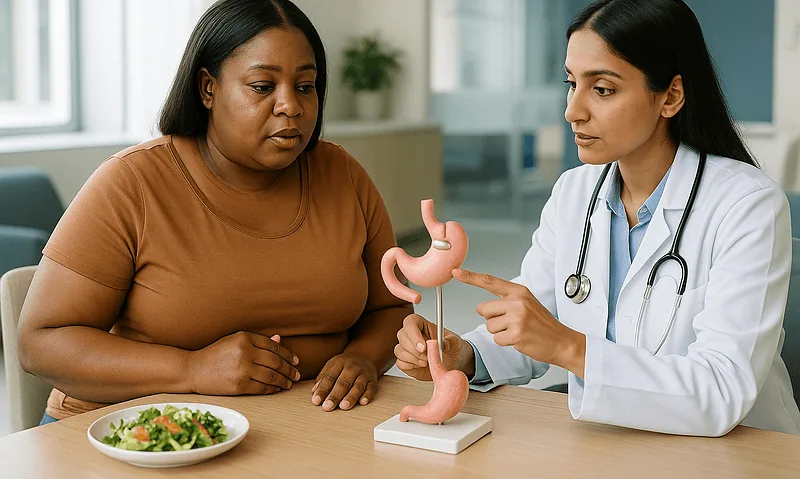
Gastric Band vs Gastric Sleeve: Reversible Device or Lasting Reshaping, Compared Honestly
An adjustable gastric band is a removable silicone ring fitted around the upper stomach and tightened through a port under the skin; a gastric…
Robotic Bariatric Surgery: What the Robotic Arms Change Inside the Operating Room
Robotic bariatric surgery uses a surgeon-controlled console and wristed instruments to perform standard weight-loss operations, such as sleeve gastrectomy or gastric bypass, through small…

Gastric Balloon vs Gastric Sleeve: Temporary Device or Surgery, and How Doctors Compare Them
A gastric balloon is a temporary, saline-filled device placed in the stomach through the mouth and usually removed after about six months, while a…
Preparing for an Obesity Clinic Appointment: Weight History, Medicines and Questions to Bring
To prepare for an obesity clinic appointment, bring a written weight history (your weight at key life stages, past attempts, what helped and what…

Gastric Sleeve Results Over the Years: What Realistic Long-Term Expectations Look Like
Gastric sleeve results long term typically show the largest weight loss in the first one to two years, with a partial regain for many…