

When Do Laser Liposuction Results Show? Swelling, Skin Retraction and Final Contour Timing
Key Takeaways
- The Mayo Clinic describes liposuction swelling as subsiding within a few weeks and the leaner final appearance emerging within several months, while the NHS allows up to six months for the area to settle.
- The treated area commonly looks larger, not smaller, in the first week because injected tumescent fluid and inflammatory swelling occupy the space the fat left.
- Firm, lumpy patches felt from around week three onward are usually healing scar tissue in the cannula tunnels and typically soften over months, not missed fat.
- Laser heat may modestly help skin with good elasticity retract, but the Mayo Clinic is explicit that liposuction cannot fix loose skin or cellulite, and no technique changes that rule.
- Liposuction is not a weight-loss method; the volume removed is capped for safety because large fluid shifts can strain the heart and kidneys, and the scale often barely moves.
- Removed fat cells do not come back, but remaining fat cells enlarge with weight gain and distribution can shift, so the long-term result tracks weight stability.
Laser liposuction results usually appear in stages rather than all at once. Swelling and bruising are most noticeable in the first one to two weeks, the treated area typically looks less bulky after a few weeks, and the leaner final contour becomes clear over several months, often up to six, as fluid clears and the skin settles. Timing varies with the area treated, the volume removed and individual healing.
Ten days after the procedure, she is standing sideways in the bathroom mirror with the compression garment peeled down to her hips, and the thought is impossible to ignore: it looks the same. Possibly bigger. The surgeon said to be patient, the discharge sheet said to be patient, and yet the tape measure in the drawer is calling.
That moment, somewhere between the first week and the first month, is where most of the doubt about a laser liposuction results timeline lives. The body is doing exactly what it should, but what it should do is swell, bruise, leak a little fluid and stiffen before it softens into shape. None of that reads as progress from the outside.
This explainer walks through what is happening under the skin at each stage, which changes are expected, which ones deserve a phone call, and why the honest answer to “when will I see it?” is a range measured in months rather than days.
Laser liposuction results timeline: the short version
If you remember one shape for the whole process, make it a curve that dips before it climbs. The treated area usually looks worse than it did before surgery for the first several days, then roughly the same, then gradually smaller, with the final contour emerging over months.
Mainstream patient guidance is fairly consistent on the broad timing. The Mayo Clinic describes swelling that typically subsides within a few weeks, after which the treated area should look less bulky, with a leaner appearance expected within several months. The NHS tells patients that it can take up to six months for the area to fully settle. Neither source promises a date, and neither should any clinician, because the speed depends on how much fat was removed, where it was removed from, how the skin behaves and how the individual body handles fluid.
Laser-assisted liposuction adds one variable that traditional suction does not: heat. The laser fiber warms the fat and the underside of the skin before the fat is removed. That heat is the reason some people describe firmer, tighter-feeling tissue in the early weeks, and it is also the reason the early swelling can feel more solid than expected. Heated tissue produces an inflammatory response that takes time to resolve.
So the realistic sequence is this: a week or two of obvious swelling and bruising, a month or so of a vaguely smaller but still puffy area, then a long tail of refinement in which the skin tightens where it can and the last of the fluid drains away. The sections that follow break down each stage, including the one where nothing seems to be happening at all.
How laser liposuction actually works
Liposuction, in any form, is the surgical removal of fat deposits through small incisions using a thin hollow tube called a cannula. The cannula is passed back and forth beneath the skin to loosen fat, which is then drawn out with suction. Laser-assisted liposuction is one of several variations the Mayo Clinic lists alongside tumescent, ultrasound-assisted and power-assisted techniques.
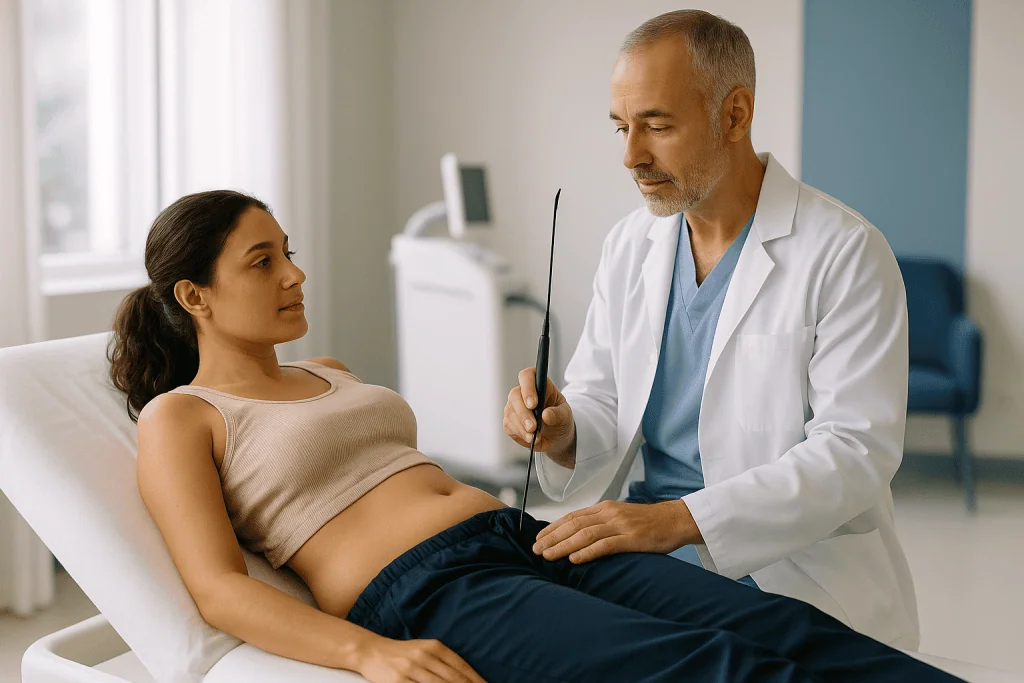
In the laser version, the surgeon first introduces a laser fiber through the same kind of small incision. The fiber delivers light energy that converts to heat in the fat layer, breaking down fat cells so they are easier to remove. The surgeon then uses a cannula to suction out the liquefied fat. In many cases the procedure is combined with the tumescent technique, in which a large volume of dilute salt water containing a local anesthetic and a blood-vessel-constricting medicine is injected into the area first. That fluid numbs the tissue, reduces bleeding and makes the fat easier to move.
Three things about this process explain most of the timeline questions that follow. First, a lot of fluid goes in, and not all of it comes out on the day; what remains leaks or is absorbed over days. Second, the cannula passages create tiny tunnels through the fat, and the body fills those tunnels with inflammatory fluid, then scar tissue, before it remodels. Third, the heat from the laser injures the fat layer and the deep surface of the skin in a controlled way, and healing from a thermal injury takes longer than healing from a mechanical one.
The procedure can be done under local anesthesia with sedation or under general anesthesia depending on the extent, and the Mayo Clinic notes that recovery usually involves a few days away from work and several weeks before full normal activity.
Why you look bigger before you look smaller
This is the part the before-and-after photos never show. In the first week, the treated area is often wider, firmer and heavier than it was on the morning of surgery, and that is a normal consequence of three overlapping processes.
The first is the tumescent fluid. Because so much of it is injected, some remains in the tissue after suctioning stops. It seeps out of the incision sites for a day or two, which is why dressings are often pink-stained, and the rest is absorbed by the lymphatic system, the network of vessels that returns excess tissue fluid to the bloodstream.
The second is inflammation. Every tunnel made by the cannula and every patch of fat heated by the laser triggers an injury response: blood vessels become leaky, immune cells arrive, and fluid floods the area. This is swelling in the ordinary medical sense, and it peaks over the first several days before beginning to recede. Bruising follows the same arc, as blood that leaked from small vessels is broken down and cleared.
The third is the garment. Compression, which the NHS and the Mayo Clinic both describe as typical for several weeks, pushes fluid out of the treated zone, but it also shifts it. Many people notice puffiness just below the garment line, in the pubic area after abdominal treatment or at the knees after thigh treatment. Gravity contributes too; swelling tends to pool at the lowest point when you are upright.
None of this means fat is returning. The number of fat cells in the treated area has gone down, and that change is permanent. What you are seeing is water and inflammation sitting in the space the fat used to occupy, and it will leave on its own schedule.
What the first two weeks usually look like
Ask people which days were the hardest and most point to the second through fourth. The local anesthetic in the tumescent fluid wears off, the swelling climbs toward its peak, and the treated area feels bruised, tight and heavy. Sitting up from lying down after abdominal treatment, or climbing stairs after thigh treatment, is often the moment that ache announces itself.

Fluid drainage from the incisions is common in the first day or two, and dressings may need changing. By the end of the first week, drainage usually stops and the bruising begins shifting from purple toward yellow-green as the body breaks it down. The Mayo Clinic notes that people may need to wait a few days before returning to work and a few weeks before resuming normal activities, and that pain, swelling and bruising are expected for some weeks.
Numbness is another early feature. The small sensory nerves running through the fat are disturbed by the cannula and the laser heat, and the skin over the treated area can feel wooden or tingly. This usually improves over weeks to months, though the Mayo Clinic lists persistent numbness as a possible complication.
What you will not see in the first two weeks is a clean contour. The area may already be slightly smaller than before surgery once the peak swelling passes, but the surface is often lumpy, the skin may look loose or wrinkled where the fat beneath it was removed, and the garment leaves creases that take hours to fade.
Walking is encouraged early, within the limits your surgical team sets. Gentle movement keeps blood flowing in the legs, which matters for clot prevention, and it helps the lymphatic system move fluid out of the treated area. Strenuous exercise, by contrast, is usually off the table for several weeks.
Weeks three to six: the phase where nothing seems to happen
Search engines are full of people typing “six weeks after liposuction no results,” and the frustration is understandable. The acute swelling is gone, the bruises have faded, the pain is manageable, and the area still looks roughly like a softer version of what it was before. This is the plateau, and it is the most misunderstood stretch of the whole laser liposuction results timeline.
Underneath, the body has moved from the inflammatory phase into repair. The tunnels left by the cannula are being filled with early scar tissue, a process called fibrosis, and that tissue is firm. Many people can feel hard, ropey or knotty patches under the skin at this stage, sometimes described as feeling like cottage cheese or a bag of marbles. These are not fat deposits that were missed; they are healing tissue that will soften as it remodels over the coming months.
Residual swelling is also harder to perceive now. Instead of obvious puffiness, it is diffuse fluid held in the tissue, giving the area a padded, slightly thick quality. The NHS guidance that an area can take up to six months to settle is referring largely to this slow drainage and remodeling, not to the dramatic early swelling.
Skin is adjusting too. Where the fat beneath it has gone, skin that was stretched over a fuller contour now has to shrink to a smaller one. In the laser technique, heat applied to the undersurface of the skin is intended to encourage collagen, the structural protein that gives skin its firmness, to contract and rebuild. That is a slow biological process, and in the first six weeks it is barely visible.
The practical advice for this stage is unglamorous: keep wearing the garment as instructed, keep moving, avoid the tape measure, and take a photograph in the same light and position every two weeks. The camera notices what the mirror misses.
How long does swelling after laser liposuction last, month by month?
Swelling after laser liposuction follows a predictable shape, even though the exact dates vary. Thinking about it in three layers helps.
The first layer is acute swelling: the obvious, tense puffiness of the first one to two weeks. The Mayo Clinic describes this as typically subsiding within a few weeks, after which the treated area should look less bulky. For most people this is the swelling that visibly comes down, often faster at the top of the treated area than the bottom.
The second layer is residual tissue fluid. This is the diffuse thickness that lingers from roughly the end of the first month onward and clears gradually, which is why guidance from the NHS allows up to six months for the area to settle fully. Lower body areas, particularly the thighs, knees and calves, are known for holding swelling longer than the abdomen, flanks or arms, because fluid has to travel upward against gravity to leave.
The third layer is the swelling that comes and goes. It is common in the first months to notice the area look flatter in the morning and fuller by evening, or puffier after a long flight, a salty meal, a hot bath or a day on your feet. This daily fluctuation is normal and does not mean the result is slipping.
Laser-assisted procedures can produce firmer, more persistent swelling than suction alone because of the thermal injury, and some surgical teams counsel patients to expect the plateau to feel longer. That is an observation from clinical practice rather than a precisely measured difference, and the mainstream patient guidance cited here does not assign separate timelines to each technique.
What the evidence does support is this: the leaner appearance the Mayo Clinic describes as emerging within several months is the result of swelling finishing its slow retreat, not of further fat loss.
Does laser lipo tighten skin? What skin tightening after laser lipo really means
Skin tightening is the claim most often attached to laser-assisted liposuction, and it deserves careful handling. The idea is plausible: heat delivered to the underside of the skin causes existing collagen fibers to contract and prompts the skin to produce new collagen over the following months. In principle, that should help skin retract to the smaller contour.
In practice, the effect is modest, variable and not consistently demonstrated in high-quality comparative research. Mainstream patient guidance is notably cautious. The Mayo Clinic states plainly that liposuction does not improve cellulite dimpling or other skin surface irregularities, and that after fat removal the skin molds itself to the new contours. It goes on to say that people with good skin tone and elasticity are likely to end up with smooth-looking skin, while those whose skin is thin and has poor elasticity may find the treated areas look loose. The laser does not change that fundamental rule.
What this means for timing is that skin retraction is the slowest part of the whole process. Collagen remodeling continues for months after a thermal injury, so any firming that does occur tends to be noticed in the second half of the recovery, when swelling has already cleared. If the skin was already lax before the procedure, from pregnancy, significant weight loss or age, the laser is unlikely to overcome it, and a surgeon may discuss skin-removal procedures as the more realistic path.
A fair summary for anyone weighing the laser version specifically: the evidence supports a small potential advantage in skin response for some people, not a reliable tightening effect for everyone. Decisions about which technique suits a given area and skin type belong with the treating surgeon after an in-person examination.
Laser liposuction results timeline at a glance
The table below pulls the stages together. The timeframes are typical ranges drawn from the Mayo Clinic and NHS patient guidance; individual recovery sits somewhere on each range, and the treating team may give different instructions for a particular area or volume.
| Stage | What you may notice | What is happening underneath | Typical timing (Mayo Clinic, NHS) |
|---|---|---|---|
| Days 1 to 3 | Fluid leaking from incisions, tense swelling, early bruising, heavy ache as anesthetic wears off | Tumescent fluid draining, inflammation rising, small vessels sealing | First few days; usually off work |
| Days 4 to 14 | Peak swelling then slow decline, bruises changing color, numbness, garment creases | Inflammatory fluid at its highest, then lymphatic clearance begins | Swelling subsides over a few weeks |
| Weeks 3 to 6 | Area looks slightly smaller but padded; firm or lumpy patches; little visible change | Early scar tissue forming in cannula tunnels; diffuse fluid; skin starting to adjust | Normal activities resume over a few weeks; strenuous exercise usually still limited |
| Months 2 to 3 | Clearer contour, softening lumps, evening puffiness that fades overnight | Scar tissue remodeling; residual fluid draining; collagen response under way | Leaner appearance emerging within several months |
| Months 3 to 6 | Final shape becoming apparent; skin firming where elasticity allows; sensation returning | Remodeling and skin retraction completing; late swelling gone | Up to six months to fully settle |
Two notes on reading it. Lower-body areas tend to sit at the later end of each range because fluid drains more slowly against gravity. And the final row is a ceiling, not a target: some people are essentially settled by the third month, while others, particularly after larger-volume procedures or when multiple areas are treated at once, are still refining at the sixth.
Who laser liposuction is usually for, and who is usually asked to wait
Liposuction of any kind is a contouring procedure, not a weight-loss procedure. The NHS states that it is not a treatment for obesity, and the Mayo Clinic describes typical candidates as people with a stable body weight who want to remove specific fat deposits that have not responded to diet and exercise. That framing matters for the timeline, because someone close to their long-term weight will generally see a cleaner result than someone whose weight is still moving.
Beyond weight stability, surgeons look at skin quality and general health. Good skin elasticity makes a smooth outcome more likely, which is why the Mayo Clinic flags thin, inelastic skin as a reason the result may look loose. General health matters because liposuction is surgery, with the risks surgery carries; the Mayo Clinic lists conditions that affect bleeding, heart function or immune response as reasons a person may not be suitable.
People commonly asked to wait, or to consider a different approach, include those who are actively losing weight and have not yet reached a plateau, those who are pregnant or recently postpartum, those with significant loose skin for whom removal of skin rather than fat is the real need, those with uncontrolled medical conditions, and smokers, since smoking impairs wound healing and raises the risk of complications. Someone who expects liposuction to treat cellulite will also usually be redirected, because it does not.
Laser-assisted liposuction is typically discussed for smaller or more fibrous areas, where the heat may help break down dense fat, and where a surgeon judges that some skin response could be useful. Whether it is the right technique for a specific person and area is a clinical judgment made at consultation, after examination, and it may differ from what a person has read online.
How many pounds can laser lipo remove?
Fewer than most people expect, and the number on the scale is the wrong way to measure it anyway.
There is a safety ceiling on how much fat can be removed in a single session, because removing large volumes shifts fluid, blood and electrolytes in ways that stress the heart and kidneys. The Mayo Clinic lists kidney and heart problems among the risks of liposuction for exactly this reason, noting that the shifts in fluid levels during large-volume procedures can be dangerous. The exact limit for a given person depends on their size, their health and the type of anesthesia, and the treating surgeon sets it.
Within that ceiling, the fat removed from a typical contouring procedure weighs very little. Fat is light for its volume, and the areas usually treated, such as the lower abdomen, flanks, inner thighs or upper arms, hold a few handfuls rather than many pounds. It is common for the scale to move by a small amount or not at all, particularly in the first weeks when retained fluid and inflammation are adding weight in the same place the fat was taken from.
The more honest measure is shape. A modest volume removed from a stubborn pocket can change how clothes fit far more than the same weight lost evenly across the whole body, because it is targeted. That is the entire point of contouring, and it is also why the Mayo Clinic is explicit that liposuction is not a weight-loss method or an alternative to one.
Anyone whose goal is a meaningfully lower body weight should expect a surgeon to steer the conversation toward nutrition, activity and, where appropriate, medically supervised weight management first, with liposuction considered afterward for areas that remain.
What people often get wrong about liposuction results
Most disappointment traces back to a handful of durable myths. Here are the ones worth dismantling.
“If I can’t see it at six weeks, it didn’t work.” Six weeks is mid-recovery. The Mayo Clinic places the leaner appearance at several months and the NHS allows up to six months to settle. Judging the result at six weeks is like judging a cake halfway through baking.
“Laser lipo is non-surgical.” It is surgery. Incisions are made, a cannula is inserted, fat is suctioned out, and the Mayo Clinic lists the same risks for it as for other liposuction techniques, including infection, fluid collections, contour irregularities and, rarely, serious internal injury. The laser is an addition to the procedure, not a replacement for it.
“The hard lumps mean fat was left behind.” Firm, uneven patches in the first months are healing scar tissue in the cannula tunnels, and they usually soften. Genuine contour irregularities can occur, and the Mayo Clinic lists them as a risk, but they are assessed once swelling has fully cleared, not before.
“The fat can come back.” The fat cells that were removed are gone. What can happen, as the Mayo Clinic explains, is that the remaining fat cells, in the treated area and elsewhere, grow larger if weight goes up, and fat distribution may change. The result holds as long as weight stays reasonably stable.
“The laser will tighten loose skin.” It may help modestly in skin that still has elasticity. It will not rescue skin that has already lost it, and no mainstream guidance claims otherwise.
“Compression is optional once the swelling is down.” The garment supports the skin as it retracts and keeps fluid moving during the plateau. Stopping it early because the area looks better is one of the more common ways people prolong the puffy phase.
What happens 10 years after liposuction? How long final results after liposuction last
The honest answer is that a decade on, the treated area reflects two things: what was removed, and what the body has done since.
The removal part is durable. Adult fat cells do not regenerate in meaningful numbers, so an area that had its fat-cell population reduced keeps that reduction. The Mayo Clinic describes liposuction results as generally long lasting provided weight stays stable. This is the reason people who maintain their weight often report that a treated area still looks proportionally smaller years later, even as the rest of the body ages.
The body’s part is where the variation comes in. If weight rises, the fat cells that remain, including those in the treated zone, enlarge, and the Mayo Clinic notes that fat distribution may change, with new fullness sometimes appearing in areas that were not treated. Pregnancy, menopause and the normal redistribution of fat with age all shift where the body stores it. And skin, regardless of what was done to it, loses collagen and elasticity with time, so an area that looked smooth at six months may look softer or looser a decade later for reasons unrelated to the surgery.
Scars from the small incisions typically fade to faint marks. Numbness that persisted in the early months has usually resolved, although the Mayo Clinic acknowledges that altered sensation can occasionally be permanent. Contour irregularities, if they were present once swelling cleared, do not spontaneously correct themselves later; they are addressed, if at all, by further treatment.
So the realistic long-term picture is this: the fat that left does not return, the shape holds in proportion to weight stability, and the skin ages as skin does. Maintaining results is less about the procedure than about the ordinary, unglamorous work of a stable weight and regular activity in the years that follow.
Questions to ask your care team
A good consultation leaves you with a timeline that is specific to your body, not to the internet’s. These questions help get there.
- Which technique are you planning for my area, and why laser-assisted rather than another approach?
- What volume do you expect to remove, and what does that mean for how long my swelling is likely to last?
- Based on my skin, how much retraction is realistic, and would a skin-removal procedure give a better result?
- What should the treated area look and feel like at two weeks, six weeks and three months, so I know what counts as on track?
- How long will I wear the compression garment, and how will I know when to stop?
- Which activities are off limits, and for how long?
- What signs would make you want to see me sooner than the scheduled follow-up?
- When will you assess the final contour, and what would be done if an irregularity remained?
- What is your approach if swelling or firmness lasts longer than expected?
- How will my current medicines and supplements be managed around the procedure?
Write the answers down. The weeks after surgery are a poor time to rely on memory, and having the team’s own expectations in front of you makes the plateau phase far easier to sit through. If an answer sounds like a guarantee rather than a range, ask the question again; the honest version of every timeline in this article is a range, and a surgeon who frames it that way is telling you the truth.
When to call your doctor
Most of what happens after laser liposuction is uncomfortable rather than dangerous, but a small number of signs need prompt attention, and the treating team will want to hear about them the same day.
Call your surgical team urgently if you notice any of the following:
- A fever, chills, or feeling generally unwell in the days after surgery.
- Spreading redness, warmth, increasing pain, or a bad-smelling discharge around an incision, which can signal infection.
- A soft, sloshing, or rapidly enlarging swelling in the treated area, which may indicate a fluid collection called a seroma that the Mayo Clinic lists as a known risk and that sometimes needs draining.
- Pain that gets worse after the first few days rather than better, or pain that is severe and not controlled by what you were prescribed.
- Skin over the treated area that turns dark, dusky, or blistered, which can mean the blood supply is compromised.
- Heavy bleeding or persistent drainage that soaks dressings beyond the first couple of days.
Seek emergency care immediately, without waiting for a call back, for pain, swelling or warmth in one calf; sudden shortness of breath; chest pain; coughing up blood; confusion; or fainting. These can be signs of a blood clot in the leg or lung, which the NHS guidance on deep vein thrombosis describes as a medical emergency, or of a fat embolism, which the Mayo Clinic lists among the rare but serious complications of liposuction.
For everything less urgent, including lumps that are not softening, numbness that is not improving after a few months, or a contour that still looks uneven once swelling has cleared, raise it at follow-up. Those are questions for the team that did the procedure, and the decision about whether and how to act on them sits with them.
Frequently asked questions
How quickly does laser lipo work?
The fat is removed during the procedure itself, so the physical change is immediate, but you cannot see it for weeks because swelling fills the space. The Mayo Clinic describes swelling subsiding over a few weeks, after which the area looks less bulky, with the leaner contour appearing within several months. Visible change usually begins between the second and sixth week and continues refining for months after that.
What are the worst days after liposuction?
For most people, roughly days two through four are the most uncomfortable. The local anesthetic from the tumescent fluid has worn off, swelling is approaching its peak, bruising is at its most colorful, and the treated area feels tight and heavy. The Mayo Clinic notes that pain, swelling and bruising are expected for some weeks, but the sharpest discomfort usually eases after the first week.
How long does swelling after laser liposuction last?
Obvious swelling typically settles within a few weeks according to the Mayo Clinic, but a subtler, diffuse puffiness can persist for months, and the NHS allows up to six months for the area to fully settle. Laser-assisted procedures involve heat, which can make early swelling feel firmer and last a little longer. Lower-body areas such as the thighs and knees usually hold swelling longer than the abdomen or arms.
What does skin tightening after laser lipo actually involve?
The laser heats the underside of the skin with the aim of contracting existing collagen and encouraging new collagen over the following months. The effect is modest and depends heavily on how elastic the skin was to begin with. The Mayo Clinic states that liposuction does not improve loose skin or cellulite, and that thin, inelastic skin may look loose afterward regardless of technique. Any firming is usually noticed late in recovery.
When do final results after liposuction become visible?
Most mainstream guidance points to several months. The Mayo Clinic describes a leaner appearance within several months once swelling has cleared, and the NHS tells patients it can take up to six months for the treated area to settle. Larger volumes, multiple areas and lower-body treatment tend to sit at the later end of that range. Surgeons generally wait until swelling is fully resolved before judging the final contour.
Why do I have no results six weeks after liposuction?
Six weeks is the middle of recovery, not the end. At that point the acute swelling has gone but diffuse fluid remains, scar tissue is forming in the cannula tunnels, and the skin is only beginning to retract, so the area can look padded and unchanged. The NHS allows up to six months to settle. Consistent photographs every couple of weeks usually reveal progress the mirror does not.
What happens 10 years after liposuction?
The fat cells removed do not return, so the treated area keeps its reduced fat-cell count, and the Mayo Clinic describes results as generally long lasting if weight stays stable. What changes is the rest of the body: weight gain enlarges the remaining fat cells, fat distribution can shift with age, pregnancy or menopause, and skin loses elasticity over time. The long-term look depends mostly on weight stability and normal aging.
How many pounds can laser lipo remove?
Only a modest amount, because safety limits the volume that can be removed in one session; the Mayo Clinic notes that large fluid shifts during liposuction can cause kidney and heart problems. Fat is light for its volume, so even a visible contour change may barely move the scale, especially early on when retained fluid adds weight. Liposuction is a shaping procedure, not a weight-loss method, and the treating surgeon sets the safe limit.
Are hard lumps after laser liposuction normal?
Firm, ropey or knotty patches in the weeks after surgery are common and usually represent healing scar tissue forming in the tunnels left by the cannula, combined with residual swelling. They typically soften over months as the tissue remodels. Lumps that are growing, soft and sloshing, painful, or accompanied by redness or fever should be reported promptly, since they can signal a fluid collection or infection.
When can I exercise again after laser liposuction?
Gentle walking is usually encouraged within days because it supports circulation and helps clear fluid, while strenuous exercise is generally held back for several weeks; the Mayo Clinic describes a few weeks before resuming normal activities, with pain and swelling guiding the pace. The exact timing depends on the area and volume treated, and the surgical team’s instructions take priority over any general rule.
References
This article is for general information only and is not a substitute for professional medical advice. Please consult a qualified doctor about your individual situation.
Add us as a Preferred Source to see more of our trusted health content across Google Search, AI Overviews and Discover.

Planning This Treatment in Turkey
Our full guide for international patients: techniques, hospital stay, recovery and cost.
More from the Blog

Can You Have Arm Liposuction Before Reaching Your Goal Weight? How Surgeons Time It
Arm liposuction can sometimes be done before you reach your goal weight, but most surgeons prefer a weight that has been stable for several…

Lifting Your Toddler After a Mommy Makeover: A Realistic Return-to-Childcare Plan
Most people are asked to avoid lifting a toddler for several weeks after a mommy makeover, because a tummy tuck tightens the abdominal wall…

Brazilian Tummy Tuck Recovery: Compression, Early Walking and Protecting the Repaired Muscles
Brazilian tummy tuck is a marketing name for abdominoplasty, often combined with liposuction, so recovery follows the same pattern as any tummy tuck. Most…

When Do CoolSculpting Results Appear? Why Fat Freezing Takes Weeks to Show a Change
CoolSculpting is a brand name for cryolipolysis, a procedure that cools fat cells until they are damaged and gradually cleared by the body. Because…

When Labial Discomfort Becomes a Surgical Question: Non-Surgical Steps Before Labiaplasty
Labiaplasty for discomfort is surgery that reduces or reshapes the inner vulval lips, usually considered only after simpler measures have been tried. Most labial…

How Is a Cosmetic Gynecology Plan Chosen? Labiaplasty, Vaginoplasty or Perineoplasty
A cosmetic gynecology plan is chosen by matching one clearly described concern to the anatomy behind it. Labiaplasty reshapes the outer folds (labia), vaginoplasty…