

When Does a Sports Injury Need Supervised Rehabilitation Rather Than Rest Alone?

Key Takeaways
- The NHS suggests seeing a clinician if a sprain or strain has not improved after about two weeks, which is a practical cut-off for moving from rest alone to assessment.
- Joint instability, a knee or ankle that gives way, is one of the clearest signs that rest will not be enough, because ligament and proprioceptive deficits do not resolve with time alone.
- Mayo Clinic describes recovery after ACL reconstruction as generally taking around nine months, with return to sport often eight to twelve months or more, nearly all of it spent in active rehabilitation.
- The NHS advises no contact sport for at least three weeks after a concussion, and only when symptom-free and cleared by a clinician, following a staged return.
- Painful, overloaded tendons usually improve with progressive loading over weeks to months; prolonged complete rest tends to leave them weaker and more painful on return.
- Pain typically resolves before strength and balance recover, which is why most re-injuries happen in the first weeks back rather than during the injury itself.
A sports injury usually needs supervised rehabilitation rather than rest alone when pain, swelling or weakness has not clearly improved after about two weeks of sensible self-care, when you cannot bear weight or use the limb normally, when a joint feels unstable or gives way, after any concussion, or when you plan to return to a demanding sport. Your treating team decides the pathway.
The ankle rolled on a Tuesday evening five-a-side pitch. By Thursday the bruise had turned the colour of a plum, and the question that followed is one physiotherapists hear constantly: should I just rest it, or do I actually need rehab? Most people guess. They either wrap the ankle and sit on the sofa for a month, or they hobble back the next weekend because it “felt fine walking to the car.”
Knowing when do you need sports rehabilitation, and when rest alone will carry you through, is less about toughness and more about tissue. Ligaments, tendons, muscles and the brain heal on different clocks and respond to rest in different ways. A muscle strain might genuinely need little more than patience. A knee that gives way needs something else entirely.
This explainer walks through the evidence behind that decision, what supervised rehab actually involves, and the warning signs that mean the choice is no longer yours to make alone.
Why rest alone is sometimes right, and sometimes a trap
Rest has a job to do. In the first 48–72 hours after a sprain or strain, the injured tissue is leaking fluid and inflammatory cells into the surrounding space; that swelling is part of healing, not a mistake. Protecting the area, elevating it and avoiding anything that provokes sharp pain gives the body room to lay down the first fragile repair tissue. The NHS describes this early self-care approach for sprains and strains, and it notes that most people start to feel better within about two weeks.
The trouble starts when rest outlives its usefulness. Muscle begins to lose strength within days of disuse. Joints that are held still stiffen. Perhaps most importantly, the body’s sense of where a joint is in space, called proprioception, fades quickly when an injured ankle or knee is not asked to balance or react. That is why a sprained ankle that “healed” on the sofa so often rolls again within the same season.
Think of early rest as scaffolding on a building. Useful while the structure is unstable, obstructive once it is time to move in. The question is not whether to rest, but when to stop resting and how to replace rest with graded movement.
Supervised rehabilitation exists to manage that transition. A physiotherapist or sports medicine clinician judges how much load the tissue can tolerate this week, then nudges it slightly further next week. Doing that alone is possible for minor injuries. For others, the margin between helpful load and harmful load is narrow enough that guessing is risky.
When do you need sports rehabilitation rather than rest alone?
There is no single lab test for this, but mainstream guidance from the NHS, Mayo Clinic and MedlinePlus converges on a handful of signals that push an injury out of the rest-alone category.
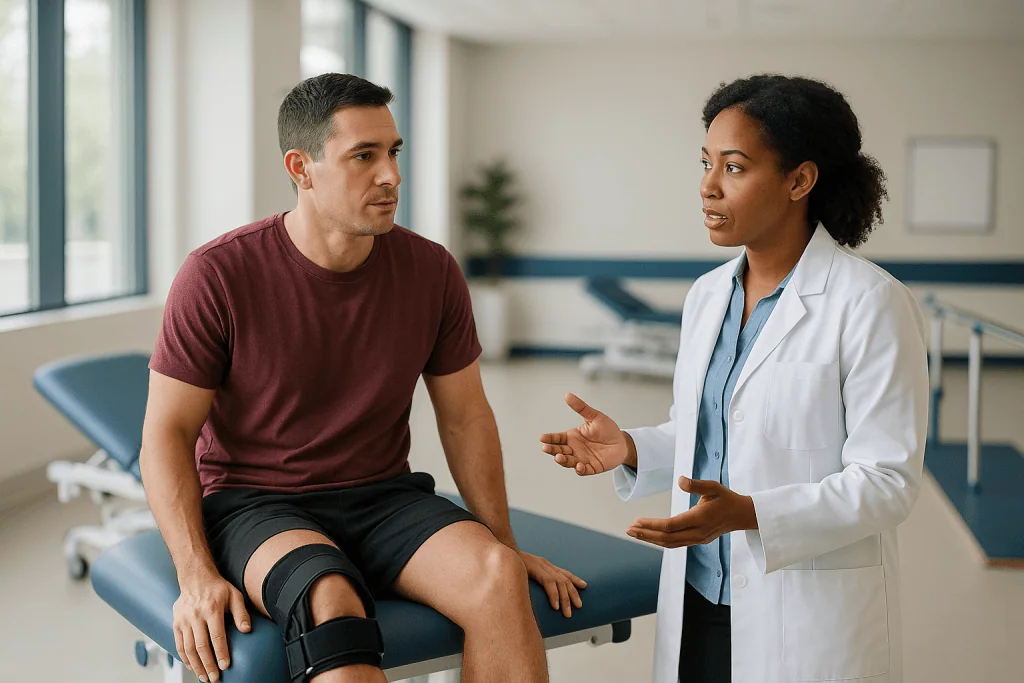
- Function has not returned. If you still cannot walk normally, grip, lift the arm overhead or fully straighten a joint after roughly two weeks of self-care, the NHS advises seeing a clinician rather than waiting longer.
- The joint feels unstable. A knee or ankle that buckles, or a shoulder that feels like it will slip out, points to ligament or labral involvement that rest does not fix.
- Pain is not trending downward. Pain that plateaus or worsens suggests the diagnosis may be wrong, or that the tissue is being loaded badly.
- The injury involved the head. Concussion follows its own rules, and “rest and see” without assessment is not appropriate.
- You want to return to demanding sport. Walking to work and sprinting on a pivoting knee are different tests. Rest can achieve the first; it rarely achieves the second.
- It has happened before. Recurrent injury is one of the strongest indicators that something about strength, control or movement pattern was never addressed.
Notice what is not on the list: the size of the bruise, the amount of swelling on day one, or how dramatic the moment of injury looked. These are poor predictors. A spectacular fall can produce a trivial injury, and a quiet “twinge” during a sprint can be a significant hamstring tear.
If two or more of these signals apply, the realistic answer to when do you need sports rehabilitation is: now, or at least a clinical assessment now. The assessment may well conclude that home exercises are enough. That is still a supervised plan, just a light-touch one.
What happens in sports rehab, and what do they actually do?
People picture rows of resistance bands and a lot of stretching. Some of that is real, but the first and most valuable thing that happens in supervised rehabilitation is an assessment. A clinician watches you move, tests joint range, compares strength side to side, checks ligament stability with specific hands-on tests and asks pointed questions about how the injury happened. For a knee, that might include tests for the anterior cruciate ligament (ACL), the band of tissue that stops the shin bone sliding forward. For an ankle, it includes checking whether pain over particular bones warrants an X-ray.
From there the work is structured around load. Early sessions focus on restoring motion without provoking swelling: gentle range-of-motion exercise, controlled weight-bearing, and often manual techniques to ease a stiff joint. Isometric exercises, where a muscle contracts without the joint moving, are common at this stage because they build tolerance with minimal strain.
Middle sessions shift to strength and control. This is where the exercises start to look like training: single-leg squats, step-downs, resisted band work, and balance tasks on unstable surfaces to rebuild proprioception. The clinician’s skill lies in dosage. Too little and nothing changes; too much and the tissue flares.
Later sessions become sport-specific. A footballer practices cutting and decelerating. A swimmer rebuilds overhead endurance. A runner progresses from walk-run intervals toward continuous effort. Objective measures, such as hop tests or strength ratios compared with the uninjured side, help the team decide when the athlete is ready rather than relying on how the person feels on a good day.
Education runs through all of it. Understanding why your knee swells after stairs, or why your shoulder aches after one particular stroke, is what turns a six-week programme into a lasting change.
The stages of sports rehabilitation: four phases or five?
Search engines are full of people asking about “the 5 stages of rehabilitation in sport” or “the four phases of injury rehabilitation.” Both exist, and neither is wrong. Different textbooks and professional bodies slice the same continuum into slightly different pieces. What matters is that the phases are sequential, overlapping and governed by tissue healing rather than by the calendar.
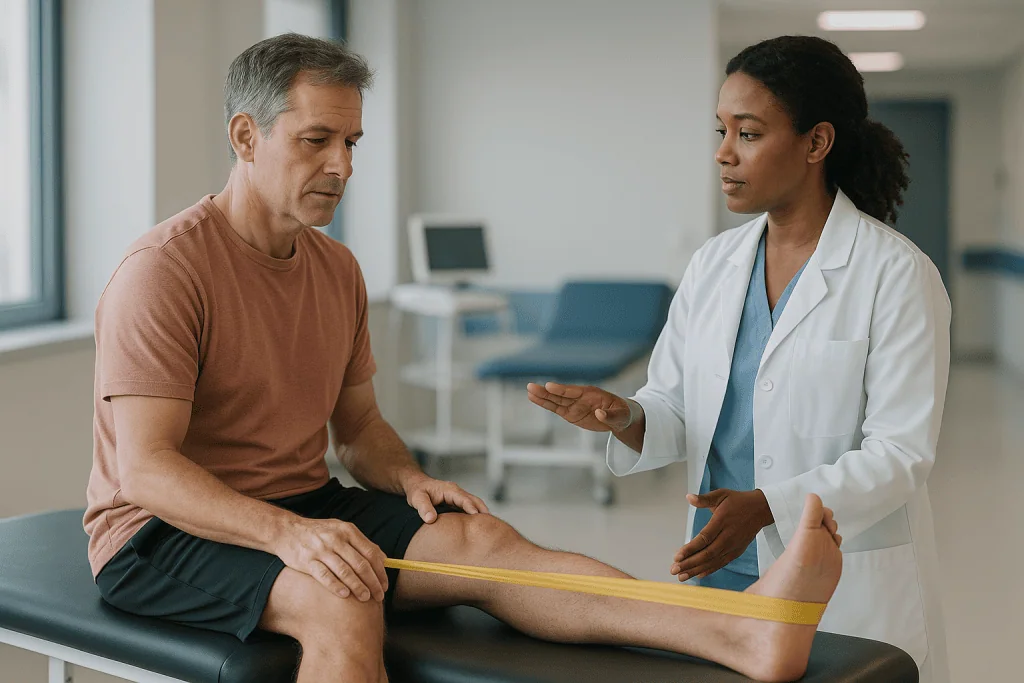
A common four-phase model runs: protection and early healing; restoring range of motion; restoring strength and neuromuscular control; and return to sport. The five-stage version simply splits the final part into “functional or sport-specific training” and “return to play with prevention,” because for many athletes the gap between running in a straight line and tolerating a full contact match is wide enough to deserve its own phase.
| Phase | Main goal | Typical signal to progress |
|---|---|---|
| 1. Protect and heal | Control swelling and pain, protect repair tissue | Swelling stable, able to begin pain-free movement |
| 2. Restore motion | Regain full, comfortable joint range | Range close to the uninjured side |
| 3. Restore strength and control | Rebuild muscle, balance and joint sense | Strength and single-leg balance approaching symmetry |
| 4. Sport-specific training | Practice the movements the sport demands | Cutting, jumping or throwing without pain or giving way |
| 5. Return to play and prevention | Graded return, address the original risk factors | Full participation tolerated, prevention plan in place |
The phases are not a ladder you climb once. A flare of swelling after a hard session may send you back half a step. That is normal and expected; a good rehabilitation plan builds in that flexibility rather than treating setbacks as failure.
Who supervised rehab is usually for, and who is usually asked to wait
Not every injury earns a referral on day one, and that is appropriate. Clinicians generally steer people toward one of three pathways.
Rest and self-care first. Mild muscle strains and first-degree sprains, where the ligament is stretched but not torn, usually respond to protection, gentle movement and time. The NHS suggests seeing a clinician if a sprain or strain has not improved after two weeks, which effectively gives a built-in review point. People in this group are often asked to wait before formal rehabilitation, not because their injury does not matter but because it is likely to settle on its own.
Early assessment, then decide. Moderate injuries sit here: an ankle that swells quickly and makes walking painful, a hamstring that produced a sudden sharp pull, a shoulder that aches with any overhead reach. An early clinical assessment rules out fracture or complete tear and sets a plan. That plan may be a short course of supervised sessions with home exercise in between.
Supervised rehabilitation from the outset. This group includes anyone with joint instability, any suspected ligament rupture, injuries managed with surgery, recurrent injuries, concussion, and people whose job or sport demands a high level of function. Rest alone is not considered a complete treatment here.
Age, general health and the sport itself shift the lines. An older adult with a shoulder injury may need supervision sooner because stiffness sets in faster. A child or teenager with a growth plate (the soft area at the end of a growing bone) deserves assessment of what looks like a simple sprain, because growth plates injure more easily than mature bone, and the pathway then centers on protection and gradual return.
The decision always rests with the treating team, who can see the injury in front of them rather than a description of it.
Rest or physio for an injury? The ankle sprain example
Ankle sprains are the most useful case study because they are common, usually mild, and frequently mismanaged in both directions.
In a typical lateral sprain, the ligaments on the outer ankle are overstretched when the foot rolls inward. The NHS advises the familiar early approach: protect, rest, ice, compress and elevate for the first few days, then begin gentle movement as pain allows. For many people, that is enough. Swelling fades, walking normalizes, and running resumes gradually over several weeks.
Two things change the picture. The first is weight-bearing. If you cannot take a few steps on the ankle shortly after the injury, or there is tenderness directly over the bony knobs on either side, clinicians generally want an X-ray to exclude a fracture. The second is instability. An ankle that feels loose, or that has rolled more than once, usually has a proprioceptive deficit that rest will not repair.
Supervised rehabilitation for an ankle looks modest from the outside: single-leg balance, controlled heel raises, resistance band work in all directions, then hopping and change-of-direction drills. The mechanism is not mysterious. Balance training retrains the reflexes that fire the peroneal muscles on the outer shin a fraction of a second before the ankle would roll. Rest cannot teach a reflex.
So the honest answer to “rest or physio for an ankle sprain” is both, in sequence. A few days of protection, then movement, and a clinical review if you are not walking normally within a fortnight or if the joint ever gives way. People who skip the second half tend to meet the same ankle again.
Knee ligament injuries: why rest alone is rarely the end of the story
The knee is where the rest-versus-rehab debate stops being theoretical. The anterior cruciate ligament, or ACL, runs through the centre of the joint and controls rotation. When it tears, people often describe a pop, rapid swelling within hours, and a sense that the knee will not be trusted. Mayo Clinic describes exactly this presentation, along with the loss of range and the giving-way episodes that follow.
Rest will settle the swelling. It will not restore the ligament, and it will not restore stability. Whether an ACL injury is managed with surgical reconstruction or with structured non-surgical rehabilitation depends on age, activity goals, associated damage to cartilage or meniscus, and how unstable the knee is in daily life. That decision belongs to the orthopaedic and physiotherapy team together with the patient.
Either route runs through supervised rehabilitation. Mayo Clinic notes that recovery after ACL reconstruction generally takes around nine months, and that it may be eight to twelve months or more before athletes return to their sport. Those months are not spent waiting. Early work restores extension and quadriceps activation, which switches off quickly after knee injury. Middle phases rebuild strength symmetry. Late phases test the knee with hop and agility tasks before anyone considers pivoting sport.
Medial collateral ligament sprains, on the inner knee, often heal well without surgery but still benefit from progressive strengthening to protect the joint. Meniscus tears vary widely; some settle with rehabilitation alone, some require surgery.
The common thread is that the knee is a load-bearing, rotating joint with very little tolerance for muscle weakness. A knee that was rested back to “no pain” but never regained quadriceps strength is a knee waiting to be injured again.
Concussion: the one injury where rest means something different
Concussion is a mild traumatic brain injury caused by a blow or jolt to the head or body that makes the brain move inside the skull. It sits oddly in a rehabilitation article because the tissue being protected is not a ligament, and because the rest-versus-activity balance has shifted in recent years.
Old advice was to lie in a dark room until symptoms vanished. Current guidance from the CDC and the NHS is more nuanced: a short period of relative rest in the first day or two, then a gradual return to normal daily activity as symptoms allow, with physical and cognitive exertion stepped up in stages rather than all at once. Prolonged total rest is no longer thought to help and may slow recovery.
What makes concussion a “supervised” injury is the return-to-sport part. The NHS advises not returning to contact sport for at least three weeks after a concussion, and only once symptoms have cleared and a clinician has agreed. Most people feel better within about two weeks, but a minority have symptoms that linger, and the NHS recommends seeing a GP if symptoms persist beyond two weeks.
Supervised return-to-play for concussion is a staged protocol: light aerobic exercise, then sport-specific movement, then non-contact training, then full contact practice, then competition, with at least a day at each step and a return to the previous step if symptoms recur. Nobody should move through this alone, and no coach or parent should be the one signing off.
Why so cautious? A second head injury while the brain is still recovering carries a higher risk of a more serious or prolonged problem. The downside of waiting a week too long is boredom. The downside of returning a week too early is not symmetrical.
Tendon injuries and the problem of rest making things worse
Tendons are the cords that attach muscle to bone, and they respond to rest in a way that surprises people. Tendinopathy, the term for a painful, overloaded tendon such as the Achilles at the heel, the patellar tendon below the kneecap or the rotator cuff tendons in the shoulder, is a condition of failed adaptation. The tendon has been asked to do more than it could remodel to handle, and it has become painful and structurally disorganized.
Complete rest calms the pain. It also deconditions the tendon further, so the first return to training is often more painful than before. Mainstream guidance, including the NHS page on tendonitis, favors a short period of reduced load followed by a gradual, progressive return to activity rather than weeks of total avoidance. The tendon needs load to remodel; it simply needs the right amount, delivered consistently.
This is where supervised rehabilitation earns its keep. A clinician typically prescribes progressive loading exercises, often beginning with isometric holds, moving to slow heavy resistance work, and eventually to faster, more explosive movements that mimic the sport. The programme is adjusted week by week against a simple rule: some discomfort during and after exercise is acceptable if it settles within a day, while pain that is worse the next morning means the dose was too high.
Timelines here are honest rather than encouraging. Tendons remodel slowly, and improvement is usually measured over weeks to months rather than days. People who understand this stick with the programme; people who expect a two-week fix often abandon it just as it begins to work.
Sudden sharp pain in a tendon with a snap or a feeling of being kicked, particularly in the Achilles, is a different injury altogether and needs urgent assessment for a rupture.
Sports injury recovery time: what the following days and weeks usually look like
Recovery time is the question everybody asks and the one clinicians answer most carefully, because tissue type, injury severity and the demands of the sport all pull the estimate in different directions. The ranges below are typical patterns described in mainstream sources, not promises.
| Injury type | Typical early course | Typical pattern for return to sport | Source |
|---|---|---|---|
| Mild sprain or strain | Noticeable improvement within about 2 weeks | Strenuous activity such as running may need to wait up to 8 weeks | NHS |
| Concussion | Most people feel better within about 2 weeks | No contact sport for at least 3 weeks, and only when symptom-free with clinical agreement | NHS |
| ACL reconstruction | Early focus on range and quadriceps activation | Recovery generally around 9 months; return to sport often 8–12 months or more | Mayo Clinic |
| Tendinopathy | Pain settles with reduced load over days to weeks | Progressive loading over weeks to months | NHS |
In practice, the first week after most soft-tissue injuries is about controlling swelling and protecting the tissue. Weeks two to four usually bring a return of comfortable movement and the start of strength work. Weeks four to eight are where the gap between rest-alone and supervised rehabilitation becomes visible: this is when balance, strength and sport-specific control are either rebuilt or left to chance.
Three things reliably stretch a timeline. Returning to full activity before strength has recovered. Ignoring a flare of swelling. And treating the end of pain as the end of the injury. Pain usually resolves before strength and control do, which is exactly why so many re-injuries happen in the first weeks back.
What is the hardest sports injury to recover from?
Ask a room of physiotherapists and the answers will cluster, but they will not be unanimous, because “hardest” depends on whether you mean longest, most uncertain or most likely to recur.
Longest: ACL rupture, especially when it comes with meniscus or cartilage damage. Mayo Clinic’s timeline of around nine months, often longer for return to pivoting sport, makes it one of the longest rehabilitation journeys in common sport. Achilles tendon rupture runs it close, because the tendon must be protected for weeks before loading can begin in earnest.
Most uncertain: concussion. Most people recover within a couple of weeks, but a minority have symptoms that persist, and there is no scan or blood test that reliably predicts who. That uncertainty is harder for many athletes than a known long road.
Most likely to recur: hamstring strains in sprinting sports and shoulder dislocations in young contact athletes. Both have a reputation for returning, and in both cases the recurrence is strongly linked to returning before strength and control have been fully restored.
What unites all of these is that rest alone is clearly insufficient. Each involves either a structure that does not regain function without targeted loading, or a system (the brain, the shoulder’s stabilizing muscles) that needs retraining rather than time.
There is a quieter candidate too: the chronic, low-grade overuse injury that was never properly diagnosed. Persistent groin pain, long-standing shin pain, a shoulder that has ached for a year. These are hard not because the tissue is dramatic but because nobody has yet sat down and worked out what is actually happening. Assessment, not more rest, is the step people skip.
What people often get wrong about rest and rehabilitation
“No pain means healed.” Pain is the first thing to go and the least reliable marker of readiness. Strength, balance and the ability to tolerate sport-specific load lag behind by weeks. Testing those, not just asking how it feels, is the point of a supervised return.
“Ice and anti-inflammatories fix it.” Ice can ease pain and may help limit early swelling. Non-steroidal anti-inflammatory drugs (NSAIDs), the class that includes several common over-the-counter pain relievers, work by dampening the chemical signals that drive inflammation and pain. They can make the first days more comfortable. Neither treats the underlying weakness or instability, and whether to use any medicine, and for how long, is a decision for you and your prescribing clinician.
“Rehab is only for serious injuries or professional athletes.” A recreational runner with a recurrent calf strain benefits from the same principles as an elite one. The sessions may be fewer and the home programme larger, but the logic is identical.
“If it needed surgery, the surgery is the treatment.” For ligament reconstruction or tendon repair, the operation restores the structure. Rehabilitation restores the function. Skipping the second half leaves the job unfinished.
“Stretching is the main thing.” Flexibility matters for some injuries, but the evidence for stretching alone as a treatment is weak. Progressive strengthening and neuromuscular control carry most of the benefit in modern rehabilitation.
“Lasers, gadgets or supplements speed healing.” Various devices and products are marketed as accelerating recovery. For most, the evidence is limited or inconsistent, and none replaces graded loading. Anything described as a shortcut deserves a careful question about what the studies actually show.
“Total rest after concussion is safest.” Current guidance favors a brief rest, then a gradual return to normal activity, with sport reintroduced in supervised stages.
Questions to ask your care team
A rehabilitation plan works better when you understand it. These questions tend to produce useful answers and are worth bringing to a first appointment.
- What exactly is injured, and how confident are you in that diagnosis? Would imaging change the plan?
- Is this an injury that usually settles with self-care, or does it need supervised rehabilitation from the start?
- What should I expect to feel during and after exercises? How do I tell a normal response from a setback?
- What are the specific markers you will use to decide I am ready for the next phase, and for a return to my sport?
- How much of this can I do at home, and how often do you need to see me to adjust the programme?
- If surgery is one option, what does the non-surgical pathway look like, and how do the two compare for someone with my goals?
- What are the risks of returning too early, and what are the risks of waiting too long?
- What caused this, and what should change in my training, equipment or technique to reduce the chance of it happening again?
- Are there activities I can safely continue for fitness while the injured area recovers?
- Who should I contact, and how quickly, if something changes between appointments?
The answers you receive will vary with the injury, and that is the point. A clinician who gives you specific criteria rather than a date is giving you a better plan. If you are told simply to “rest it and come back in a month,” it is reasonable to ask what you should be doing during that month and what would make you come back sooner.
Write the answers down. Rehabilitation is a weeks-long project, and the reasoning behind each phase is easy to lose by the time you reach it.
When to call your doctor
Most sports injuries are not emergencies, but some signs mean rest-and-see is the wrong strategy and prompt assessment is needed. Seek urgent care, or call emergency services, if any of the following apply.
- A limb or joint looks deformed, or a bone is visibly out of place.
- You cannot put any weight on the leg, or take a few steps, after the injury.
- Numbness, tingling, coldness or a pale or blue color in the hand or foot below the injury.
- A loud pop or snap followed by a joint that gives way, or a sudden feeling of being kicked in the back of the calf.
- Severe pain that is not eased by rest and simple measures.
- After a head knock: vomiting, worsening headache, confusion, unusual drowsiness or difficulty waking, a seizure, weakness in the arms or legs, slurred speech, clear fluid from the nose or ears, or any loss of consciousness.
- Calf pain, swelling and warmth developing days after an injury, especially after a period of immobilization or long travel, which can indicate a blood clot.
- Signs of infection around a wound or surgical site: spreading redness, heat, pus, or fever.
Arrange a routine appointment, rather than waiting it out, if pain, swelling or stiffness has not clearly improved after about two weeks, if a joint repeatedly gives way, if concussion symptoms persist beyond two weeks, or if the same injury keeps recurring. The NHS sets this two-week review point for sprains and strains and for concussion symptoms, and it is a sensible marker for most soft-tissue injuries.
None of these lists replaces a clinician’s judgement. If something feels wrong to you, that alone is a good enough reason to be seen. The decision about how your injury is managed, and when you return to sport, sits with the team treating you.
Frequently asked questions
What are the 5 stages of rehabilitation in sport?
The five stages commonly described are protection and early healing, restoring range of motion, rebuilding strength and neuromuscular control, sport-specific functional training, and a graded return to play with prevention work. Some frameworks combine the last two into a single phase, giving four stages. Progress depends on how the tissue responds, not on fixed dates, and clinicians often move people back half a step after a flare.
What are the four phases of injury rehabilitation?
The four-phase model groups rehabilitation into protection and healing, restoring motion, restoring strength and control, and return to sport. It covers the same ground as the five-stage version but folds sport-specific drills into the final phase. Whichever model your team uses, the signals to advance are the same: swelling under control, range close to the other side, strength approaching symmetry, and sport movements tolerated without pain or giving way.
What do they do in a sports rehab session?
A session usually starts with a reassessment of pain, swelling and movement, then moves through exercises matched to your current phase: gentle range-of-motion work early on, progressive strengthening and balance training in the middle, and sport-specific drills such as cutting, jumping or throwing later. Hands-on techniques may be used for stiff joints. Much of the value lies in adjusting the load each week and teaching you a home programme.
What is the hardest sports injury to recover from?
It depends on how you define hard. ACL rupture and Achilles tendon rupture are among the longest, with Mayo Clinic describing ACL recovery as generally around nine months. Concussion is the most unpredictable, because a minority of people have symptoms that persist. Hamstring strains and shoulder dislocations are notable for recurring when athletes return before strength and control have recovered. None of these is managed well by rest alone.
How do I know if I should rest or get physio for an injury?
Rest and self-care are reasonable first steps for mild sprains and strains that are clearly improving day by day. Arrange an assessment if you cannot bear weight or use the limb normally, if a joint feels unstable, if pain is not trending downward, if the injury involved your head, or if there has been no clear improvement after about two weeks. Recurrent injury is also a reason to be seen.
What are the stages of sports rehabilitation for an ankle sprain?
An ankle sprain typically moves from a few days of protection and swelling control, to restoring movement and comfortable walking, to strength work with resistance bands and heel raises, then balance and proprioception training on one leg, and finally hopping and change-of-direction drills before returning to sport. The NHS notes most sprains feel better within about two weeks, while running may need to wait up to eight weeks.
How long is sports injury recovery time for a mild strain?
The NHS describes most sprains and strains as starting to feel better within about two weeks, with more strenuous activities such as running possibly needing to wait up to eight weeks. These are typical ranges rather than guarantees, and the time to full sport depends on the muscle involved, how severe the tear was, and whether strength has been rebuilt. A clinician can give a more specific estimate after examining you.
Does rest alone heal a torn ACL?
Rest settles the swelling and pain but does not restore the ligament or the knee’s stability. ACL injuries are managed either with surgical reconstruction or with structured non-surgical rehabilitation, and both pathways involve months of supervised strengthening and control work. The choice between them depends on age, activity goals and associated damage, and it is made by the orthopaedic and physiotherapy team together with the patient.
Should you rest completely after a concussion?
Current guidance favors a short period of relative rest in the first day or two, followed by a gradual return to normal daily activity as symptoms allow. Prolonged total rest is no longer recommended. The NHS advises avoiding contact sport for at least three weeks and returning only when symptom-free and cleared by a clinician, following staged steps that increase exertion gradually. Persistent symptoms beyond two weeks should be reviewed by a doctor.
Can I keep training while doing sports rehabilitation?
Often yes, with modifications. Many people can maintain fitness through activities that do not load the injured area, such as cycling or swimming during a lower-limb injury, or lower-body work during a shoulder problem. Your rehabilitation team can advise which activities are safe at each phase. Continuing to train through sharp pain, swelling or instability, however, usually prolongs recovery and raises the chance of re-injury.
References
This article is for general information only and is not a substitute for professional medical advice. Please consult a qualified doctor about your individual situation.

More from the Blog

What Is Physiotherapy? What Physiotherapists Actually Do, Session by Session
Physiotherapy (called physical therapy in the United States) is a regulated health profession that restores movement, strength, and everyday function after injury, surgery, or…
Gait Training and Gait Analysis: Relearning to Walk, Properly
Gait training is supervised, task-specific physical therapy that rebuilds a safe, efficient walking pattern after injury, surgery, stroke, or a neurological condition. Gait analysis…
What to Bring to Your First Therapeutic Exercise Session: Reports, Restrictions and Shoes
For a first therapeutic exercise session, bring any imaging or surgical reports, a written list of your current medicines and health conditions, and any…

Bobath Neurodevelopmental Treatment Between Sessions: The Daily Home Program and Positioning
A Bobath home program is the between-session part of neurodevelopmental treatment: positioning, handling and short bouts of task practice that a therapist designs for…
Dry Needling: What It Is, What It Helps, What the Evidence Says
Dry needling is a technique in which a trained clinician inserts thin, solid filament needles into tight, tender bands of muscle called trigger points,…
What a Rehabilitation Robot Actually Does: Guided Repetition for Legs, Arms and Balance
A rehabilitation robot is a motorized, sensor-equipped device that supports a person's leg, arm or trunk while they practice walking, reaching or balancing. It…