

When Does Trying Become Infertility? How Long to Wait Before an Evaluation and Who Goes Sooner

Key Takeaways
- The WHO and CDC define infertility as not conceiving after 12 months of regular unprotected sex, which the NHS describes as intercourse every two to three days throughout the cycle.
- About 84 in 100 couples conceive within a year and roughly 92 in 100 within two years, according to NHS data, so the year-one threshold is where evaluation begins, not where hope ends.
- Women 35 and older are advised by the CDC to seek evaluation after six months, and the Mayo Clinic notes testing may start right away for those over 40.
- A male factor is identified in roughly one third of infertile couples, so a semen analysis belongs at the very start of any workup, and an abnormal result is usually repeated about three months later.
- A published ovarian reserve model estimates about 12 percent of a woman's peak egg supply remains at 30 and 3 percent at 40, but egg quality, not count, drives the decline in fertility and cannot be measured by AMH.
- In about a quarter of couples no cause is found after a full workup, and the leading identified causes are ovulation disorders in women, most often PCOS, and sperm quality problems in men.
Most guidelines define infertility as not conceiving after 12 months of regular, unprotected sex, and that is the usual point to request an evaluation. Women 35 or older are generally advised to seek assessment after six months of trying, and people over 40, or anyone with irregular periods, a known reproductive condition, repeated miscarriage, or a suspected sperm problem, are often evaluated right away rather than waiting.
The ovulation test strips live in the second drawer now, next to the thermometer and a notebook with nine months of cycle dates. Nine months is long enough to have stopped telling friends you are trying, and short enough that the question keeps circling: is this normal, or is this the moment to ask for help? Knowing when to see a fertility specialist turns out to be one of the few parts of this process with a reasonably clear answer.
The answer is not the same for everyone. A 29-year-old with clockwork periods and a 41-year-old who has had two miscarriages are given very different advice, and for good reasons that have to do with probability rather than pessimism.
This article walks through what the guidelines actually say, why the thresholds sit where they do, who is asked to come in early, what a first evaluation involves for both partners, and which signs should prompt a call today rather than in three months.
When to see a fertility specialist: the 12-month rule, explained
The word infertility sounds like a verdict. In clinical use it is a threshold. The World Health Organization defines it as failing to achieve a pregnancy after 12 months or more of regular, unprotected sexual intercourse, and the CDC uses the same 12-month window for people under 35. Nothing about that definition says a pregnancy cannot happen; it marks the point at which the odds of an underlying factor become high enough that testing is worth doing.
Two details in that sentence matter more than they look. Regular, in the NHS description, means having sex every two to three days throughout the cycle, not only on predicted ovulation days. A couple who has been together a year but has managed intercourse on a handful of well-timed occasions has not really completed a year of trying in the way the definition intends. Unprotected means no barrier or hormonal contraception during that period, and it is worth being honest with yourself about the months immediately after stopping a long-acting method, when cycles may still be settling.
Thresholds also differ slightly by country. US guidance, including the CDC, sets the earlier-evaluation age at 35. The NHS advises seeing a GP after a year, or sooner if the woman is 36 or older or if either partner has a known fertility problem. The one-year difference is a matter of where each system draws its line on the same age curve, not a disagreement about biology.
What the rule is not: a waiting room you are required to sit in. If something in your history already points toward a problem, the 12 months is a guideline for people with no other clues, and you may have clues.
How long does it normally take to get pregnant?
Waiting a year feels arbitrary until you see the curve it comes from. According to the NHS, roughly 84 in every 100 couples having regular unprotected sex will conceive within one year. Of those who do not, about half will conceive in the second year, taking the cumulative figure to around 92 in 100 by 24 months. Read one way, that says most people who are still trying at month 12 will eventually get pregnant without help. Read another way, it says the group left after a year contains most of the couples who have a treatable problem, which is exactly why that is where evaluation begins.
Month-to-month, the odds are lower than most people expect. Even for a couple with no fertility issues, a given cycle carries a real chance of no pregnancy, so three or four unsuccessful months in a row are within ordinary variation, not a signal.
How common is difficulty conceiving? The WHO estimates that about one in six people worldwide experience infertility at some point in their lives, a figure that is remarkably similar across high- and low-income countries. The NHS puts it at around one in seven couples in the UK, and CDC data suggest that about one in five married women aged 15 to 49 with no prior births are unable to get pregnant after a year of trying. Whichever figure you use, the person in the next office or the next pew who quietly went through this is not rare.
Age changes the shape of the curve rather than the principle. Both natural conception rates and the likelihood that a given cycle produces a chromosomally normal egg decline through the 30s and more steeply after about 37, according to the Mayo Clinic. That decline is the reason the evaluation threshold moves earlier with age.
Trying to conceive after 35: who is asked to come sooner, and who is usually asked to wait
The 12-month rule has exceptions built into it, and they follow a simple logic: the more likely a problem is, and the more time-sensitive the situation, the less waiting makes sense.

Age is the first modifier. The CDC advises women 35 and older to seek evaluation after six months of trying, and the Mayo Clinic notes that for women over 40, a clinician may recommend starting testing or treatment right away. This is not about fertility ending at a birthday; it reflects the fact that a six-month delay costs more at 38 than at 28, because the underlying decline is steeper.
History is the second modifier. The Mayo Clinic and NHS both list reasons to seek help before a year is up, regardless of age. These include irregular or absent periods, very painful periods, a known diagnosis of endometriosis (tissue similar to the womb lining growing outside the womb), polycystic ovary syndrome (a hormonal condition that often disrupts ovulation), a history of pelvic inflammatory disease, two or more miscarriages, previous cancer treatment in either partner, or a known sperm problem, testicular surgery or injury in the male partner.
| Situation | Typical guidance on timing | Source |
|---|---|---|
| Under 35, no known issues | Evaluate after 12 months of regular unprotected sex | CDC, WHO |
| 35 to 39, no known issues | Evaluate after 6 months (UK: from age 36) | CDC, NHS |
| 40 or older | Discuss evaluation now; testing may begin right away | Mayo Clinic |
| Irregular or absent periods, known PCOS or endometriosis | Do not wait the full year | Mayo Clinic, NHS |
| Two or more miscarriages | Seek evaluation now | Mayo Clinic |
| Known or suspected sperm problem | Seek evaluation now | Mayo Clinic |
Who is usually asked to wait? A person under 35 with regular cycles, no relevant history, and fewer than 12 months of well-timed trying. For that group, waiting is not neglect; it is the evidence-based choice, because the majority will conceive without intervention.
Fertility specialist vs OB-GYN: when to see a fertility specialist first
People often picture the first step as a specialist appointment, but in most health systems the door opens somewhere more ordinary. In the UK, the NHS pathway starts with a GP, who takes the history, orders initial blood tests and a semen analysis, and refers on if needed. In the US, an OB-GYN or a primary care clinician frequently performs the same first round.
A fertility specialist is usually a reproductive endocrinologist, an obstetrician-gynecologist who has completed additional training in the hormones and anatomy of reproduction. Their clinics coordinate the more involved parts of the workup, such as imaging of the fallopian tubes, and deliver treatments like ovulation induction and IVF. Male-factor problems may be handled alongside a urologist, and some urologists specialize further in male reproductive health.
So who should go straight to the specialist? The reasoning follows the earlier-evaluation list. If you are over 40, have had two or more miscarriages, have a known condition such as endometriosis or PCOS, or already have an abnormal semen analysis, starting with the specialist can save a cycle of repeated appointments. If you are under 35 with no history and have just crossed the 12-month line, beginning with your OB-GYN or GP is reasonable and often what your insurance or health system expects.
There is no wrong door, only faster and slower ones. What matters is that someone takes a full history from both partners, orders the baseline tests, and gives you a plan with a date attached. If your first appointment ends with advice to keep trying and no tests, and you are 35 or older or have any of the history above, it is fair to ask why, or to request a referral.
What actually happens at a first fertility evaluation
The first visit is mostly conversation. Expect questions for both partners about how long you have been trying, how often you have sex, cycle length and regularity, previous pregnancies with any partner, contraception history, surgeries, sexually transmitted infections, medications, smoking, alcohol, and family history of early menopause or genetic conditions. Bring cycle records if you have them; a year of dates in a notebook is more useful than it looks.
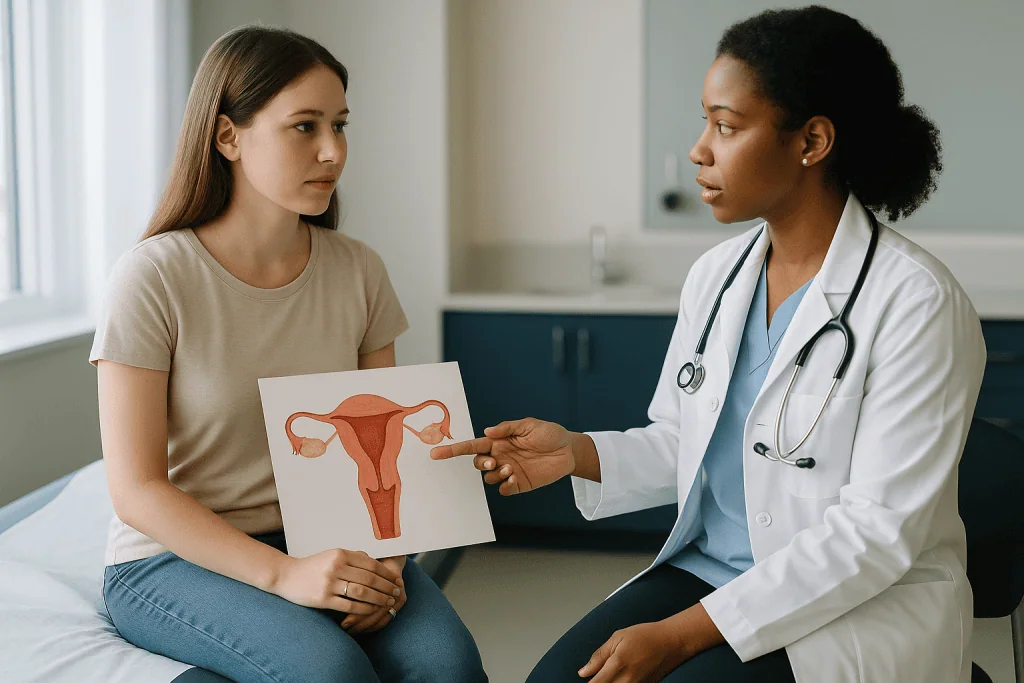
Testing then follows three questions, as the NHS diagnosis pathway lays out: is ovulation happening, are sperm present and functional, and is the path between them open?
Ovulation is usually checked with a blood test for progesterone, a hormone that rises after an egg is released, timed to the second half of the cycle. Other blood tests may include thyroid function and prolactin, since both can disrupt ovulation, and sometimes anti-Müllerian hormone, or AMH, a marker that reflects roughly how many eggs remain in the ovaries but says nothing about their quality.
Sperm are assessed with a semen analysis, covered in the next section. The pathway between egg and sperm is checked with imaging. A pelvic ultrasound looks at the womb and ovaries. A hysterosalpingogram, or HSG, is an X-ray taken while a dye is passed through the womb to see whether the fallopian tubes are open. Where endometriosis or scarring is suspected, a laparoscopy, keyhole surgery under general anesthesia to look directly at the pelvic organs, may be offered.
The clinician may also screen for infections such as chlamydia, which the NHS notes can damage the tubes without ever causing symptoms. None of this happens in a single afternoon; several tests are tied to specific days of the cycle, so the workup is spread out rather than rushed.
Infertility testing for men: why the semen analysis comes first
If one message from this article travels furthest, let it be this: the male partner is tested at the beginning, not after everything else has come back normal. According to the Mayo Clinic, a problem on the male side is identified in roughly one third of infertility cases, either alone or alongside a female factor. A semen analysis is inexpensive in effort, noninvasive, and quick to arrange, which makes leaving it until later hard to justify.
The test itself is straightforward. A sample is produced into a sterile container, usually at the clinic or delivered within a short window, after a brief period of abstinence that the laboratory will specify. The lab reports the volume of fluid, the concentration of sperm, the proportion that are moving and how well (motility), and the proportion with normal shape (morphology). It may also note white blood cells, which can hint at infection.
One result is rarely the final word. Sperm counts vary from week to week with illness, fever, heat exposure and stress, so the NHS notes that an abnormal first result is generally repeated, typically about three months later, to see whether the picture is consistent.
If the repeat test is still abnormal, the man is usually examined, with attention to the testicles and to any varicocele, an enlargement of veins in the scrotum that can raise local temperature. Blood tests for testosterone and the pituitary hormones that drive sperm production may follow, and occasionally genetic tests or a scrotal ultrasound. The point of all this is not to assign blame but to find something addressable: some causes of low sperm quality respond to treating an underlying condition or stopping a contributing medication, decisions that belong to the treating clinician.
Men often report that being tested felt like the first moment the process included them. It should be the first moment, chronologically too.
Signs of infertility in women: what is a reason to book, and what is not
Search engines are full of lists promising sure signs that something is wrong. In reality, most infertility has no symptoms at all, which is precisely why the 12-month rule exists. Still, certain features of your history do shift the odds enough that guidelines say not to wait, and it helps to separate those from the ordinary anxieties of trying.
Reasons the Mayo Clinic and NHS treat as grounds for earlier evaluation include cycles that are consistently shorter than about 21 days or longer than about 35, periods that have stopped for several months, periods so painful they disrupt normal life, a prior diagnosis of endometriosis, PCOS, thyroid disease, or pelvic inflammatory disease, and prior chemotherapy or pelvic radiation. Two or more miscarriages belong on this list as well, because recurrent loss has its own set of investigations.
What does not, on its own, indicate a problem: a handful of negative ovulation tests, cycles that vary by a few days, mild cramping, a single early miscarriage, or the fact that a friend conceived faster than you. These are common and mostly uninformative.
None of this is a checklist to diagnose yourself with. Irregular cycles have many explanations, from recent contraceptive use to weight change, travel and stress, and painful periods do not automatically mean endometriosis. What the list does is tell you when a clinician should be involved sooner, so that a real cause is found early or ruled out and you can go back to trying with less uncertainty.
One more point that gets lost: regular, predictable periods do not guarantee that an egg is being released each month, and they say nothing about whether the tubes are open. That is why the evaluation checks ovulation and anatomy directly rather than relying on the calendar.
What is the number one cause of infertility? The honest answer
People want a single culprit, and the evidence declines to provide one. The Mayo Clinic summarizes the distribution this way: in about one third of infertile couples the problem is identified in the male partner, in about one third in the female partner, and in the remaining third both partners contribute or no cause is found. The NHS puts the unexplained fraction at roughly a quarter of couples, meaning that after a full workup, everything looks normal and the couple still has not conceived.
Within female-factor infertility, ovulation disorders are the most common category. The egg is not released, or is released so irregularly that timing becomes a lottery. The NHS identifies polycystic ovary syndrome as the leading cause of ovulation problems, followed by thyroid disorders, premature ovarian insufficiency (ovaries stopping normal function before 40), and disruptions from significant weight change, intense exercise or high stress hormone levels.
Blocked or damaged fallopian tubes come next, frequently the legacy of pelvic inflammatory disease, endometriosis or previous surgery. Womb conditions such as fibroids or polyps can also interfere with implantation.
On the male side, the most common finding is a problem with the sperm themselves: too few, too many that do not move well, or too many with abnormal shape. Behind those numbers sit varicoceles, hormonal imbalances, prior infections, some medications, and lifestyle contributors like smoking.
So the truthful answer to the top-searched question is that the leading cause depends on which partner you are asking about, and for a quarter of couples there is no identified cause at all. That last group is not a failure of medicine so much as a reminder that current tests measure only part of a complex process. Unexplained infertility is still treatable in the sense that conventional options can be offered; it simply means the reason they are needed remains unclear.
At what age are 90 percent of your eggs gone? What that figure does and does not mean
The startling statistic circulating online, that most of a woman’s eggs are gone by 30, comes from a specific piece of research and deserves to be read in context. A mathematical model of ovarian reserve published in PLoS ONE in 2010 estimated that, on average, about 12 percent of a woman’s maximum egg supply remains by age 30 and roughly 3 percent by age 40. Turned around, that gives the headline figures: about 88 percent gone by 30 and 97 percent by 40.
Here is what the model does not say. The starting point is enormous, in the order of a million or more immature eggs present before birth, and the vast majority of those were never going to be ovulated under any circumstances. Losing them is not a malfunction; it is how the ovary works, from before birth onward. A woman at 30 still has, on average, many thousands of eggs, far more than she could release in the years remaining before menopause.
The number that matters for conceiving is not how many eggs remain but how many of the ones released each month are chromosomally normal, and that proportion falls with age in a way no drawer of test strips can measure. The Mayo Clinic describes fertility declining gradually through the 30s and more sharply after about 37, driven mainly by egg quality rather than quantity.
This is also why an AMH blood test, which reflects the size of the remaining pool, is a poor predictor of natural fertility for an individual. A low AMH at 30 does not mean you cannot conceive this year; a high AMH at 42 does not restore egg quality. Specialists use AMH mainly to predict how the ovaries may respond to stimulation medicines, not to hand out a verdict.
The 90 percent figure is real, then, but it is a fact about biology, not a countdown. It is one reason evaluation moves earlier after 35; it is not a reason to panic at 30.
What the following weeks usually look like after a first fertility visit
Once the first appointment ends, the process tends to unfold across at least one full menstrual cycle, because several tests are pinned to particular days. Hormone tests that assess the ovaries are typically drawn in the first few days of a period. The progesterone check that confirms ovulation is drawn roughly a week after ovulation is expected. Tubal imaging is usually scheduled after a period has finished and before ovulation. Meanwhile the male partner produces his sample, and if the result is abnormal, the repeat is spaced out as the NHS describes.
A review visit then pulls the results together. Broadly, the conversation heads in one of a few directions.
If ovulation is irregular or absent, the clinician may discuss ovulation induction. The medicines used for this belong to classes that work by altering the hormonal signals between the brain and the ovaries so that a follicle matures and releases an egg. Cycles are monitored with ultrasound and blood tests, and whether to use them, which one, and for how many cycles are decisions for the prescribing clinician based on your diagnosis.
If the tubes are blocked, or sperm parameters are significantly reduced, the discussion may move toward intrauterine insemination, where prepared sperm are placed directly into the womb around ovulation, or toward IVF, in which eggs are collected, fertilized in the laboratory, and an embryo is transferred into the womb. Surgery may be discussed for endometriosis, fibroids, polyps or a varicocele.
If everything is normal, the option most often raised first is continuing to try for a defined further period, with a plan to escalate if a pregnancy does not occur. That can feel deflating, but it reflects the NHS data that a meaningful share of couples still unassisted at 12 months conceive in the second year.
Whatever the direction, ask for the plan in writing, with the next decision point named.
What disqualifies you from IVF?
This question ranks high in searches and usually comes from fear rather than curiosity. The honest answer is that there is no universal disqualification list; eligibility is decided case by case by the treating team, and the factors weighed are medical rather than moral.
Several considerations come up consistently. The first is whether IVF is the right tool for the problem at all. Blocked tubes, significant male-factor infertility, and unexplained infertility that has not responded to simpler approaches are classic indications; irregular ovulation on its own is often addressed with less intensive options first.
The second is ovarian response. IVF depends on stimulating the ovaries to produce multiple eggs, and when reserve is very low, as can happen in the mid-40s or with premature ovarian insufficiency, a clinic may advise that a person’s own eggs are unlikely to yield embryos and discuss donor eggs instead. This is a probability judgment, communicated as such, not a ban.
The third is the safety of a pregnancy. Some medical conditions make carrying a pregnancy risky enough that a team may recommend treating or stabilizing them first, or may discuss alternatives. Untreated infections, certain womb abnormalities, and uncontrolled chronic disease fall here. Some programs also apply body mass index ranges because of anesthetic and pregnancy considerations; these vary between health systems and are worth asking about directly, without assuming what the answer will be.
Publicly funded systems add non-medical criteria. The NHS, for example, applies age and eligibility rules that differ by region, and self-funded care follows different rules again. None of this article can tell you where you fall; it can only tell you what to expect the conversation to cover.
If a team advises against IVF, ask what specifically drove that judgment, whether it could change, and what the alternatives are. You are entitled to the reasoning, and to a second opinion.
What people often get wrong about when to see a fertility specialist
Some misunderstandings cost couples months. Here are the ones that come up most, with what the evidence actually shows.
It is usually the woman. The Mayo Clinic’s one-third, one-third, one-third breakdown puts male and female factors on equal footing. Any workup that does not include a semen analysis at the start is incomplete.
Just relax and it will happen. Stress is unpleasant and worth addressing for its own sake, but there is no good evidence that ordinary life stress causes infertility, and telling someone with blocked tubes to relax delays a diagnosis. Relaxing is not a treatment plan.
You have to wait a full year no matter what. The year applies to people under 35 with no relevant history. The CDC’s six-month threshold at 35 and the Mayo Clinic’s immediate-evaluation advice over 40 exist precisely because waiting has a cost that rises with age.
Regular periods prove you are ovulating. Bleeding can occur in cycles without egg release, and regular cycles say nothing about tubal patency or sperm. Ovulation is confirmed with a timed blood test, not a calendar.
Seeing a specialist means IVF. Most first visits end with tests and a plan, not a procedure. Many people leave with a reassuring workup or a simpler intervention such as ovulation induction. A specialist’s job is diagnosis first.
A low AMH means you cannot conceive. AMH reflects egg quantity, not quality or the chance of natural pregnancy in a given month. It is most useful for planning stimulation, as the section above explains.
Home ovulation kits replace testing. A positive test detects a hormone surge, not a released egg. In PCOS, the kits can read positive repeatedly without ovulation occurring.
One year of trying with one partner tells you about your fertility with anyone. Infertility is a diagnosis of a couple. A change in partner resets the evaluation, not the biology.
Questions to ask your care team
A first fertility appointment can move quickly, and the questions you meant to ask have a way of surfacing in the parking lot. Writing them down beforehand keeps the visit yours. The following are ones clinicians commonly hear and welcome.
- Based on our ages and history, do you recommend testing now or continuing to try for a defined period, and what is the reasoning?
- Which tests will each of us have, in what order, and how are they timed to the cycle?
- Will the semen analysis be done at the start, and if it is abnormal, when would you repeat it?
- What will each test tell us, and what would each possible result change about the plan?
- If everything comes back normal, what happens next, and at what point would we escalate?
- Which of the possible treatments fits our likely diagnosis, and which would you not recommend for us, and why?
- What are the risks of the tests and treatments you are considering, including multiple pregnancy and side effects of any medicine?
- Are there lifestyle factors, medications or health conditions in either of us that you would want addressed first?
- Do we need a referral to a urologist, an endocrinologist or a genetic counselor?
- How will we receive results, and who is our point of contact between visits?
- If we are considering a break from trying, is there a time frame after which you would want to see us again?
Ask for answers in language you both understand, and for the plan and its decision points to be written down. A good team will not be offended by a request for a second opinion, and the question of what would make them change course is often the most revealing one you can ask.
Every decision that follows, from whether to test to whether to treat, sits with you and the clinicians who know your full picture. This article can frame the questions; it cannot answer them for you.
When to call your doctor
Most of this article is about months and cycles. A few situations are about hours, and they should not wait for a scheduled fertility appointment or the end of the 12-month clock.
Seek urgent care the same day for sudden, severe pelvic or lower abdominal pain, especially if it comes with fainting, shoulder-tip pain, or a positive pregnancy test, since these can signal an ectopic pregnancy, a pregnancy growing outside the womb. Do the same for heavy vaginal bleeding that soaks through pads hourly, fever with pelvic pain or unusual discharge, or, for men, sudden testicular pain or swelling, which can indicate torsion or infection.
Contact your clinician within days, not months, if periods have stopped for three months or more without pregnancy, if there is bleeding between periods or after sex, if there is a new lump or persistent ache in a testicle, or if either partner has been diagnosed with a sexually transmitted infection while trying to conceive.
If you are already taking a fertility medicine, call the prescribing team promptly for rapid abdominal swelling, severe bloating, vomiting, shortness of breath, or sharply reduced urination. These can be signs of ovarian hyperstimulation, and the team will want to assess you rather than have you wait for the next scheduled visit. Never adjust or stop a prescribed medicine on your own; call and ask.
Mental health belongs on this list too. Trying to conceive without success is associated with anxiety and depression, and persistent low mood, loss of interest in daily life, or thoughts of self-harm deserve a conversation with a clinician as much as any physical symptom. Fertility teams expect this and can point you to support.
For everything else, the earlier sections give the timelines. Under 35 with no history, ask for evaluation at 12 months; 35 or older, at six; over 40 or with a known issue, now.
Frequently asked questions
What are the warning signs of infertility?
Most infertility has no symptoms, which is why guidelines rely on time spent trying rather than signs. Features that do justify earlier evaluation, according to the Mayo Clinic and NHS, include irregular or absent periods, very painful periods, a known diagnosis of endometriosis or PCOS, past pelvic infection, two or more miscarriages, previous cancer treatment, or a known testicular or sperm problem in the male partner. These are reasons to book, not a self-diagnosis.
At what age are 90 percent of your eggs gone?
A mathematical model of ovarian reserve published in PLoS ONE estimated that about 12 percent of a woman’s peak egg supply remains at age 30 and about 3 percent at 40, so roughly 88 percent is gone by 30. That reflects normal biology: most eggs present before birth are never ovulated. Fertility depends far more on egg quality, which the Mayo Clinic describes as declining more sharply after about 37, than on the raw number remaining.
What disqualifies you from IVF?
There is no universal disqualification list; eligibility is judged case by case by the treating team. Factors commonly weighed include whether IVF suits the diagnosis, how the ovaries are likely to respond, and whether pregnancy would be safe given any medical conditions. Some programs apply body mass index or age ranges, and publicly funded systems such as the NHS add their own criteria. If a team advises against IVF, ask for the specific reasoning and the alternatives.
What is the number one cause of infertility?
No single cause dominates. The Mayo Clinic reports roughly one third of cases involve a male factor, one third a female factor, and one third both or no identified cause; the NHS estimates about a quarter of couples remain unexplained after testing. Among women, ovulation disorders are most common, with polycystic ovary syndrome the leading reason. Among men, the most frequent finding is reduced sperm count, movement or shape.
Fertility specialist vs OB-GYN: which should I see first?
For someone under 35 with regular cycles and no relevant history who has just reached 12 months of trying, starting with an OB-GYN or GP is reasonable; they can order baseline blood tests and a semen analysis, as the NHS pathway describes. Going directly to a reproductive endocrinologist makes more sense if you are over 40, have had two or more miscarriages, have a known condition such as endometriosis, or already have an abnormal semen result.
How long should I try before seeing a fertility doctor if I am under 35?
Twelve months of regular unprotected sex is the threshold used by the WHO and CDC for people under 35 with no known fertility problems. NHS data show about 84 in 100 couples conceive within that first year, so waiting is the evidence-based choice for this group. If you have irregular periods, a known reproductive condition, repeated miscarriage or a suspected sperm issue, you do not need to wait the full year.
When should I see a fertility doctor if I am trying to conceive after 35?
The CDC advises women 35 and older to seek evaluation after six months of trying rather than 12, and the NHS uses 36 as its threshold for earlier GP review. The Mayo Clinic notes that for women over 40, a clinician may recommend beginning testing or treatment right away. The shorter window reflects a steeper decline in egg quality with age, which makes delay more costly.
What does infertility testing for men involve?
The first step is a semen analysis, which measures the volume of fluid, the concentration of sperm, how many are moving and how well, and how many have normal shape. Because results vary from week to week, the NHS notes an abnormal result is typically repeated about three months later. If it stays abnormal, a physical examination, hormone blood tests, and sometimes an ultrasound or genetic testing follow, often with a urologist involved.
Can I see a fertility specialist before I start trying to conceive?
Yes. A pre-conception visit is common for people with a known condition such as PCOS, endometriosis or a prior cancer diagnosis, for those over 40, for anyone with a family history of early menopause, and for same-sex couples or single people who will need donor sperm or eggs. Such a visit reviews history, may include baseline tests, and helps set a realistic timeline with the care team before the clock starts.
Does having regular periods mean I am fertile?
Not necessarily. Regular bleeding usually suggests ovulation but does not prove it; cycles can occur without an egg being released, and the calendar says nothing about whether the fallopian tubes are open or the sperm are healthy. That is why a fertility evaluation confirms ovulation with a timed progesterone blood test and checks the tubes and sperm directly, rather than relying on cycle regularity alone.
References
- NHS: Infertility: Overview
- NHS: Infertility: Diagnosis
- CDC: Infertility: Frequently Asked Questions
- WHO: Infertility fact sheet
This article is for general information only and is not a substitute for professional medical advice. Please consult a qualified doctor about your individual situation.

More from the Blog

Who Is ICSI Recommended For? Male-Factor Infertility, Prior Fertilization Failure and More
ICSI is usually recommended when sperm are unlikely to fertilize an egg on their own: severe male-factor infertility such as very low sperm count,…

GIFT (Gamete Intrafallopian Transfer) Step by Step: Eggs, Sperm and the Laparoscopic Placement
GIFT, or gamete intrafallopian transfer, is an assisted reproduction technique in which eggs are collected after ovarian stimulation, mixed with prepared sperm, and placed…

GIFT vs IVF: Why Fertilization Location Matters and How Fertility Teams Choose Between Them
GIFT (gamete intrafallopian transfer) places eggs and sperm together into a fallopian tube so fertilization happens inside the body, while IVF fertilizes eggs in…

Ovulation Pain (Mittelschmerz): Why It Happens and When It Is Something Else
Ovulation pain, also called mittelschmerz, is a one-sided lower abdominal ache or twinge that occurs around the middle of the menstrual cycle when a…

Tracking Ovulation: Basal Temperature, Cervical Mucus and the Fertility Window Explained
Cervical mucus changes with estrogen: scant and sticky after a period, then wetter, and finally clear, stretchy and slippery in the days before ovulation,…

Cramping or Spotting After Insemination: What Is Expected and When to Contact Your Clinic
Mild cramping after IUI is common and usually expected. The thin catheter passing through the cervix, the fluid placed in the uterus, and the…