

When Hormone Therapy Joins Prostate Cancer Treatment: With Radiation, Before Surgery or Alone

Key Takeaways
- Hormone therapy for prostate cancer removes or blocks testosterone, the hormone most prostate tumors depend on, and works throughout the body rather than only in the gland.
- Paired with radiation for intermediate- and high-risk localized cancer, hormone therapy has improved disease control in randomized trials, with courses running from several months to up to three years depending on risk.
- Routine hormone therapy before prostatectomy improves pathology reports but has not been shown to reduce recurrence, so guidelines reserve it for clinical trials.
- GnRH agonists cause a brief testosterone flare in the first one to two weeks and reach very low testosterone within about a month; antagonists skip the flare and act within days.
- Bone thinning, muscle loss, hot flashes and metabolic changes are predictable effects of lowered testosterone and estrogen, and most can be reduced with exercise, monitoring and specific treatments.
- A falling PSA on hormone therapy shows the cancer has lost its fuel, not that it has disappeared, which is why radiation still follows a neoadjuvant course and monitoring continues.
Hormone therapy for prostate cancer is used in three main situations: alongside radiation for intermediate- and high-risk disease, where it shrinks the gland and makes the cancer more sensitive to treatment; on its own when cancer has spread, returned after local treatment, or when surgery and radiation are not suitable; and rarely before surgery, because trials have not shown a clear benefit. The treating team decides the timing and length.
The folder on the kitchen table is already thick: a biopsy report, a bone scan appointment, a leaflet about radiation. Then, near the end of the consultation, the oncologist adds one more line. “We would also like to put you on hormone therapy for a while.” For many men, that sentence lands harder than the rest. It sounds vague, it sounds permanent, and it sounds like something borrowed from a different kind of medicine altogether.
Knowing when hormone therapy is used, and why, takes much of the sting out. In prostate cancer the phrase has a precise meaning. It describes a group of treatments that starve the tumor of testosterone, the hormone it depends on to grow. Sometimes that is a supporting act for radiation. Sometimes it is the main event. Occasionally it is suggested before surgery, and that is the scenario the evidence supports least.
This explainer walks through each of those situations, what happens in the body, how long courses typically run, and the questions worth bringing to the next appointment.
Why is hormone therapy used for prostate cancer at all?
Prostate cells, healthy or cancerous, carry receptors for androgens. Androgens are the male sex hormones, chiefly testosterone, made mostly in the testicles with a small contribution from the adrenal glands. When testosterone docks onto those receptors, it switches on the machinery of cell growth. A prostate tumor inherits that dependence. Cut the supply, and most prostate cancers slow, shrink or stop dividing for a time.
That is the whole logic of hormone therapy, which clinicians usually call androgen deprivation therapy, or ADT. It does not poison cancer cells directly the way chemotherapy does. It removes the fuel. The National Cancer Institute (NCI) describes it as treatment that lowers androgen levels or blocks androgens from acting on cancer cells.
Two consequences follow from that mechanism, and they shape every decision about when hormone therapy is used. First, it works throughout the body, not just in the prostate. Cancer cells that have escaped to lymph nodes or bone are reached just as readily as cells in the gland itself. That is why it becomes the backbone of treatment once cancer has spread. Second, it rarely wipes out every cell. Over months or years, some cancers adapt and learn to grow with very little testosterone, a state called castration-resistant prostate cancer. Hormone therapy therefore controls disease rather than eliminating it, and the team plans around that reality.
The question is never simply whether a tumor responds to testosterone deprivation; most do. The question is whether, for this man and this cancer, the gains justify a treatment with real side effects. That is why the same medicine can be a few months of support for one patient and a lifelong partner for another.
How does androgen deprivation therapy actually work in the body?
Testosterone production runs on a chain of command. The hypothalamus in the brain releases a signal called gonadotropin-releasing hormone (GnRH, sometimes written LHRH). The pituitary gland responds by releasing luteinizing hormone. That hormone tells the testicles to make testosterone. Hormone therapy interrupts the chain at one or more links.

GnRH agonists are the most common starting point. Agonist means they mimic the natural signal. Paradoxically, by stimulating the pituitary constantly instead of in pulses, they exhaust it. The pituitary stops responding and testosterone falls to very low levels, a drop the NCI says usually takes a few weeks. Before that fall there is a brief surge, called a flare, which the team manages with a short course of a second drug.
GnRH antagonists block the same receptor outright, so there is no flare and testosterone falls within days rather than weeks. Both approaches achieve what surgeons once achieved by removing the testicles, an operation called orchiectomy that is still offered to some men because it is quick, permanent and avoids repeated injections.
Antiandrogens work at the other end of the chain. Instead of lowering testosterone, they sit in the androgen receptor and stop whatever testosterone remains from switching it on. Newer agents, often grouped as androgen receptor pathway inhibitors, either block the receptor far more powerfully or shut down testosterone production in the adrenal glands and in the tumor itself. These are added to standard ADT in specific situations, mainly advanced disease.
None of these medicines knows where the cancer is. They change the hormonal weather of the entire body, which explains both their reach and their side effects.
When is hormone therapy used with radiation?
This is the most common pairing, and the one with the strongest evidence. For men whose cancer is still confined to the prostate region but judged intermediate or high risk, adding hormone therapy to external beam radiation has been shown in randomized trials to improve control of the disease compared with radiation alone, according to the NCI and the NHS.
Three mechanisms explain why the combination beats either part on its own. Hormone therapy shrinks the prostate before treatment, so the radiation target is smaller and nearby bladder and bowel receive less dose. Low testosterone appears to make cancer cells less able to repair the DNA damage radiation causes. And because ADT works body-wide, it treats microscopic deposits that may already have left the gland and that no beam can target.
The length of the course tracks the level of risk. The NHS notes hormone therapy is often started several months before radiotherapy begins and may be continued for up to three years afterward in higher-risk disease; Mayo Clinic describes a similar spread, from a few months to several years. In practice, intermediate-risk cancers tend to receive the shorter courses and high-risk cancers the longer ones, though guideline bodies continue to refine the exact boundaries and the treating oncologist tailors the duration.
The pairing also applies to brachytherapy, in which radioactive seeds or temporary sources are placed inside the gland. Here shrinking the prostate first can make seed placement technically feasible for men with larger glands.
Men sometimes ask whether they can skip the hormones and simply have more radiation. The trials that established the combination did not find that trade-off worked for higher-risk disease, which is why most guidelines treat the two as a package in that setting.
Hormone therapy before radiotherapy: what the months of preparation are for
The waiting period between the first injection and the first radiation session often puzzles patients. Treatment has started, yet nothing visible is happening. In fact a great deal is.
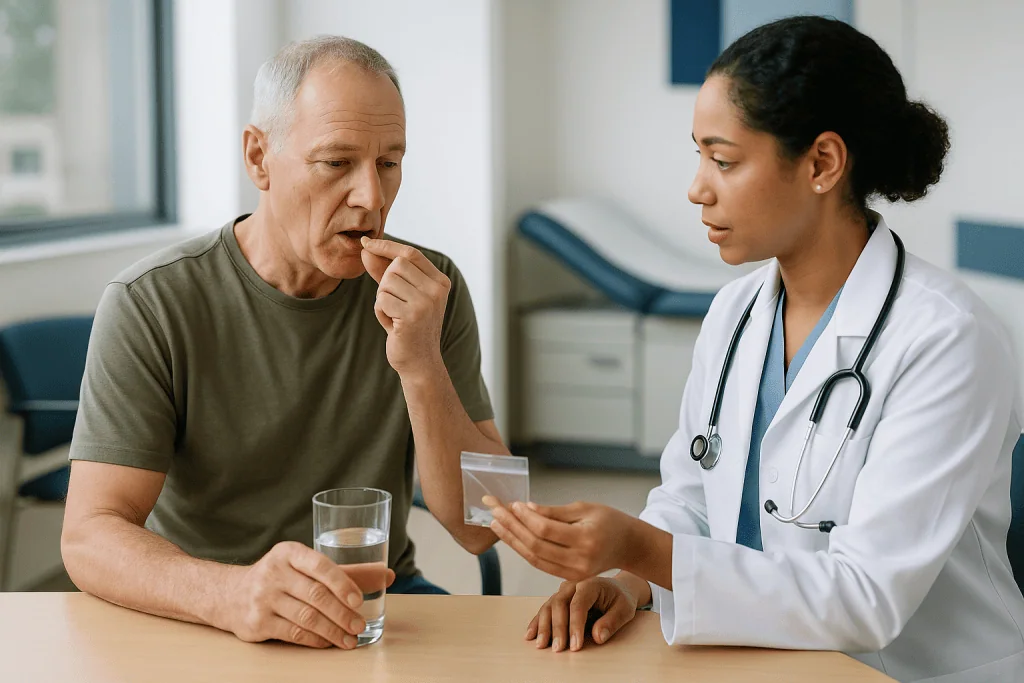
In the first weeks, testosterone falls and the prostate begins to lose volume. Radiation planners use this time deliberately. A CT or MRI taken after the gland has shrunk gives a smaller, more stable target. Radiation oncologists call this neoadjuvant hormone therapy; neoadjuvant simply means treatment given before the main therapy to make it work better.
The prostate-specific antigen, or PSA, a protein made by prostate cells and measured in a blood test, typically drops sharply during these months. Patients often read the falling number as proof the cancer is beaten. It is better understood as proof the cancer has lost its fuel. The radiation is still needed to deal with cells that would otherwise regrow when testosterone returns.
Men also use this window to prepare. Side effects such as hot flashes and fatigue usually begin here, so this is when the team learns how an individual tolerates the therapy and adjusts support. It is a sensible time to begin resistance exercise, which helps counter the muscle loss that ADT causes, and to arrange a baseline bone density scan if the planned course is long.
Once radiation begins, hormone therapy usually continues alongside it and, depending on risk, for a defined period afterward. The adjuvant phase, meaning treatment given after the main therapy, is where most of the long-course benefit in high-risk disease appears to come from. Stopping early because the PSA looks good is a decision for the oncologist, not a conclusion to draw from the number alone.
Why hormone therapy is rarely given before prostate surgery
If shrinking the gland helps radiation, it seems logical that it should help a surgeon too. Researchers tested exactly that idea in a series of trials in which men received several months of ADT before radical prostatectomy, the operation that removes the whole prostate.
The results were mixed in an instructive way. Pathologists did find smaller tumors and fewer positive surgical margins, meaning cancer cells at the cut edge of the removed tissue. But when patients were followed for years, those improved pathology reports did not translate into fewer recurrences. The NCI notes that hormone therapy given before prostatectomy has not been shown to improve outcomes, and major guidelines in the United States and United Kingdom do not recommend it as routine practice.
Surgeons also report a practical drawback. Hormone-treated tissue becomes fibrous and the planes between prostate and surrounding structures harder to define, which can make the nerve-sparing part of the operation more delicate.
There are exceptions, and they are the reason the title of this article includes surgery at all. Clinical trials are testing newer, more potent androgen receptor pathway inhibitors before surgery in high-risk men, on the theory that stronger suppression might succeed where older ADT did not. A man may be offered this inside a research study. Occasionally a team also uses hormone therapy to bridge a delay before a planned operation.
Outside those situations, a man being prepared for surgery who is told he does not need hormones first is not being short-changed. He is being treated according to the evidence. Hormone therapy may still be recommended after surgery if the pathology report or a rising PSA suggests cancer remains, which is a different and better-supported decision.
When is hormone therapy used alone?
Hormone therapy stands on its own in several circumstances, and they differ considerably in what the treatment is expected to achieve.
The clearest is metastatic prostate cancer, where imaging shows deposits in bone, lymph nodes or elsewhere. Local treatments cannot reach disease in many places at once; ADT can. Here hormone therapy is the foundation of care and is usually continued long term, with the team adding other agents, such as an androgen receptor pathway inhibitor or chemotherapy, depending on how much disease is present and how fit the patient is. The NCI and NHS both describe this layered approach for cancer that has spread.
A second situation is biochemical recurrence: the PSA begins rising months or years after surgery or radiation, signaling that cancer has returned even though scans may show nothing. Whether to start hormone therapy immediately or wait until disease becomes visible is a genuine judgment call that weighs how fast the PSA is doubling against the side effects of years of treatment.
Third, some men with localized cancer are not candidates for surgery or radiation because of age, other illnesses or personal choice. For them, ADT alone can keep the cancer in check for a period. Guidelines are cautious here, because trials have generally shown that for men fit enough to have local treatment, hormone therapy by itself is not an equivalent substitute.
Finally, hormone therapy relieves symptoms. A man with painful bone metastases or a tumor obstructing urine flow may start ADT primarily to feel better, and the response can arrive within weeks.
In every one of these settings the duration is open-ended rather than fixed, which changes how side effects are weighed.
Who is usually offered hormone therapy, and who is asked to wait
Risk grouping drives the decision. Clinicians combine three measurements: the PSA level, the Gleason score or grade group (a pathologist’s rating of how abnormal the biopsy cells look), and the clinical stage (how far the tumor extends). The result sorts cancers into low, intermediate and high risk, and the recommendation about hormones follows from that sorting.
Men usually offered it include those with high-risk localized or locally advanced disease receiving radiation, those with cancer in lymph nodes or distant sites, those whose PSA is rising rapidly after local treatment, and those with symptoms that ADT can relieve. Men with intermediate-risk cancer having radiation are often offered a shorter course, though guideline bodies increasingly distinguish between favorable and unfavorable intermediate risk and may spare the former.
Men usually asked to wait, or told they do not need it at all, include most of those with low-risk cancer. For them, active surveillance, meaning regular PSA tests, repeat imaging and biopsies with treatment only if the cancer changes, is the standard recommendation of the NHS and most guideline groups. Adding hormone therapy to low-risk disease exposes a man to side effects without a demonstrated benefit. Men having surgery for localized cancer are also generally not given hormones beforehand, for the reasons covered above.
A third group sits in between: older men or those with significant heart disease, diabetes or osteoporosis. For them the metabolic and cardiovascular side effects of ADT weigh more heavily, and the team may choose a shorter course, a GnRH antagonist, or a watchful approach. The conversation is individual, and an answer of “not yet” is a clinical judgment, not a dismissal.
Three scenarios compared: with radiation, before surgery, alone
Seen side by side, the three situations in the title have different goals, different durations and different weights of evidence behind them. The table summarizes what mainstream guidance currently says.
| Scenario | Main goal | Typical duration | What the evidence shows |
|---|---|---|---|
| With radiation, intermediate risk | Shrink gland, sensitize cells, treat hidden spread | Shorter course, several months (NHS, Mayo Clinic) | Improves disease control versus radiation alone in trials; benefit less certain in favorable intermediate risk |
| With radiation, high risk | Same, plus prolonged suppression after radiation | Longer course, up to 2–3 years (NHS) | Longer courses outperform shorter ones in high-risk trials |
| Before surgery (neoadjuvant) | Shrink tumor, reduce positive margins | A few months in trials | Better pathology but no shown improvement in recurrence; not routine (NCI) |
| Alone, metastatic disease | Control cancer throughout the body | Long term, often lifelong | Standard backbone of treatment; additional agents usually layered on |
| Alone, rising PSA after local treatment | Delay progression | Variable; may be intermittent | Timing of start is individualized; earlier is not always better |
| Alone, unfit for local treatment | Keep disease in check, relieve symptoms | Open-ended | Not equivalent to surgery or radiation for fit men |
Two patterns stand out. The strongest evidence belongs to the combination with radiation in higher-risk disease, where randomized trials have repeatedly shown better control. The weakest belongs to routine use before surgery. Between them sits a large territory of judgment, where the team balances how aggressive the cancer appears against how long a man can reasonably live with low testosterone.
The durations shown are ranges drawn from published guidance, not promises. A man’s own course may be shorter or longer depending on his risk group, his response and his tolerance.
How long does hormone therapy last, and what the first weeks feel like
The first appointment is usually an injection or an implant placed under the skin, long-acting so that it continues working for weeks or months before the next one. Some men instead take a GnRH antagonist, which is available as injection or, more recently, as a tablet. Orchiectomy remains an option for men who prefer a single procedure.
With an agonist, the first one to two weeks bring the flare described earlier. Testosterone briefly rises before it falls, which is why the team prescribes a short course of an antiandrogen around the first injection. Men with bone metastases are watched more closely during this window, because a surge can temporarily worsen pain. Antagonists skip this phase entirely.
By roughly the third or fourth week testosterone has usually reached the very low target range, according to the NCI. Hot flashes commonly begin around this time, often as a sudden wave of heat in the face and chest lasting a few minutes. Fatigue tends to build more gradually over the first months. Sexual desire typically falls within weeks.
PSA is checked periodically to confirm the cancer is responding, and testosterone is sometimes checked to confirm the medicine is doing its job. A PSA that fails to fall, or that rises while testosterone stays low, is an early signal that the team may need to change approach.
How long treatment continues depends entirely on the scenario. Courses paired with radiation have a planned end, often several months to three years. Courses for metastatic disease usually do not. For men in the latter group, side effects are managed as a long-term project rather than endured until a finish line, and that difference shapes the conversation from the start.
Hormone therapy side effects in men: what lowering testosterone changes
Testosterone does far more than drive sexual function, so removing it changes many systems at once. The NCI and Mayo Clinic list the following as common effects of ADT.
- Hot flashes, often the earliest and most disruptive complaint.
- Loss of libido and erectile difficulty, which usually persist for as long as treatment continues.
- Fatigue and reduced stamina.
- Loss of muscle mass and strength, with a shift toward body fat, particularly around the abdomen.
- Breast tenderness or enlarged male breast tissue (gynecomastia), more common with antiandrogen monotherapy.
- Thinning of bone, raising fracture risk the longer therapy lasts.
- Changes in cholesterol, blood sugar and blood pressure, which is why the American Heart Association and others flag ADT as relevant to cardiovascular risk.
- Mood changes, difficulty concentrating and, for some men, depression.
- Shrinkage of the testicles and penis, and reduced body hair.
Not every man experiences every effect, and intensity varies widely. What matters is that most of them are predictable and several are preventable or treatable. Resistance exercise several times a week is the best-supported counter to muscle loss and fatigue. A baseline bone density scan, adequate calcium and vitamin D from diet, and bone-protecting medicines when indicated address fracture risk. Hot flashes have several evidence-based treatment options the oncologist can discuss. Routine checks of weight, blood pressure, lipids and glucose let the primary care clinician manage metabolic shifts early.
Men often hesitate to raise sexual or emotional changes. Doing so early gives the team more options. Side effects that are tolerable for a six-month course alongside radiation can be a different proposition over five years of treatment for metastatic disease, and that distinction legitimately influences which approach is chosen.
What are the effects of estrogen on the male body, and does this therapy involve estrogen?
Search engines fill with this question for a reason. Modern ADT does not give men estrogen, but it does change estrogen, and some of the side effects are easiest to understand through that lens.
Men make estrogen by converting a fraction of their testosterone with an enzyme called aromatase. Estrogen in men helps maintain bone density, supports healthy blood vessels and plays a role in sexual function and mood. When ADT drives testosterone down, estrogen falls too, because there is little left to convert. Much of the bone loss and some of the hot flashes seen on hormone therapy are thought to reflect estrogen deficiency rather than testosterone deficiency alone; the parallel with menopause is biologically real, which is why the two groups share symptoms.
Historically, prostate cancer was treated with oral estrogens, which suppress testosterone through the same brain-pituitary chain. The approach was largely abandoned in many countries because oral estrogen raised the risk of blood clots and cardiovascular events. Researchers have revisited the idea using estrogen patches, which bypass the liver and appear to avoid much of that clotting risk while protecting bone. The NHS notes this is being studied in trials; it is not standard practice, and no one should seek it outside a research setting.
Antiandrogens used alone, which block the receptor without lowering testosterone, leave testosterone free to convert to estrogen, so these men may have relatively higher estrogen levels and more breast tenderness or enlarged male breast tissue (gynecomastia). Teams sometimes offer preventive measures when planning this approach.
Hormone therapy for prostate cancer, then, is about removing male hormones, not adding female ones. The estrogen story sits in the background, explaining several side effects and pointing to research still under way.
Continuous or intermittent: does hormone therapy ever pause?
For men on long-term ADT, particularly those treated for a rising PSA without visible spread, oncologists sometimes propose intermittent therapy. Treatment runs until the PSA falls to a low plateau, then stops. The PSA is monitored, and treatment resumes once it climbs back past an agreed threshold. The cycle repeats.
The appeal is obvious. During off-treatment periods testosterone may recover, and with it energy, sexual function and muscle. Hot flashes often fade. The NCI describes intermittent ADT as an approach that can reduce side effects while maintaining control in appropriately selected men.
The evidence has limits that the team will weigh. Large trials comparing intermittent with continuous treatment in men with rising PSA after radiation found the two approaches broadly comparable for disease control, with better quality of life during breaks. In men with widespread metastatic disease, results were less reassuring and continuous therapy remains the usual recommendation. Testosterone recovery during breaks is also slower and less complete in older men and in those who have been on treatment for years, so the hoped-for holiday does not always arrive.
Intermittent therapy requires discipline: regular PSA testing, clear restart triggers and a patient comfortable with a number that is deliberately allowed to rise. It is not a way to stop treatment, and a man should never pause injections on his own because he feels well. The decision belongs to the oncologist, who will consider how the cancer has behaved so far.
For courses given alongside radiation, intermittent treatment does not apply; those have a planned duration and are completed as scheduled unless side effects force a change.
What people often get wrong about hormone therapy for prostate cancer
It is the same as HRT. Hormone replacement therapy for menopause adds hormones a body has stopped making. Prostate cancer hormone therapy does the opposite, removing hormones a tumor depends on. The names overlap; the treatments are mirror images.
It is chemotherapy. Hormone therapy does not attack dividing cells directly and does not cause hair loss, nausea or low blood counts the way chemotherapy does. The two are sometimes combined in metastatic disease, which may be where the confusion comes from.
A falling PSA means the cancer is gone. PSA falls because hormone-starved cells make less of it, not necessarily because they have died. That is why radiation still follows a successful neoadjuvant course, and why PSA is monitored indefinitely.
It is only for men who are dying. The majority of hormone therapy courses in high-income countries are given alongside radiation to men whose cancer has not spread, with a planned finish date.
Starting earlier is always better. For men with a slowly rising PSA and no visible disease, starting ADT immediately rather than at progression has not consistently been shown to help, while it guarantees years of side effects sooner. Timing is a judgment.
Diet or supplements can replace it. No food, supplement or herbal preparation has been shown in controlled trials to lower testosterone enough to treat prostate cancer. The NIH Office of Dietary Supplements maintains fact sheets on individual supplements; none supports that claim.
Side effects mean the drug is not working. Hot flashes and fatigue are signs that testosterone has fallen, which is the intended effect. Whether the cancer is responding is a separate question answered by PSA and imaging.
Questions to ask your care team before starting
Bringing a written list to the appointment changes the quality of the conversation. These questions cover the decisions that matter most.
- Which risk group is my cancer in, and what specifically makes hormone therapy part of the plan for me?
- Is this course paired with radiation, a treatment on its own, or something being considered before surgery? If before surgery, is it within a clinical trial?
- How long is the course planned to last, and what would make you shorten or extend it?
- Will I receive an agonist, an antagonist, an antiandrogen or a combination, and why that choice for my situation?
- What is the plan for the flare period if I am starting an agonist?
- Should I have a bone density scan before we begin, and how will my bone health be protected during treatment?
- I have heart disease or diabetes: how does that change the choice of medicine or the monitoring?
- Which side effects should I expect in the first month, and which have treatments available if they become troublesome?
- How often will my PSA and testosterone be checked, and what result would prompt a change of plan?
- Is intermittent therapy an option for me later, and what would the restart trigger be?
- What exercise and dietary steps have evidence behind them for men on this treatment?
- Who do I contact between appointments, and what symptoms should prompt a same-day call?
It helps to ask the team to write down the planned duration and the goal of treatment in one sentence. Men who can say “six months alongside radiation to improve control of a high-risk tumor” or “ongoing treatment to keep metastatic disease in check” tend to cope better with side effects, because they know what the effects are buying.
When to call your doctor during hormone therapy
Most side effects of hormone therapy are uncomfortable rather than dangerous, and routine appointments are the place to discuss them. A small number of symptoms need a same-day call to the oncology team or emergency care, because they can signal a complication of treatment or a change in the cancer itself.
- Chest pain, pressure or breathlessness, or pain and swelling in one calf. Hormone therapy is associated with cardiovascular risk and clots can occur; these symptoms are treated as emergencies.
- New weakness, numbness or tingling in the legs, difficulty walking, or loss of bladder or bowel control. In men with bone metastases these can indicate pressure on the spinal cord, which needs urgent assessment.
- Sudden inability to pass urine, or severe pain while trying.
- Rapidly worsening bone pain, especially in the first two weeks of an agonist, when a testosterone flare is possible.
- Fever, chills or spreading redness and swelling at an injection or implant site.
- A fall with new pain, since bone thinning raises fracture risk.
- Severe low mood, hopelessness or thoughts of self-harm. Mood changes on ADT are recognized and treatable, and the team wants to know.
- Confusion, severe headache or unusual drowsiness.
Symptoms that warrant a call at the next working day rather than an emergency visit include hot flashes that disturb sleep most nights, persistent breast tenderness, a noticeable drop in energy that limits daily activity, or new difficulty with memory and concentration. None of these should be endured in silence; each has management options.
Men should never stop or delay a planned injection, implant or tablet because of side effects without speaking to the prescribing team first. Pausing treatment is sometimes appropriate, but it is a clinical decision made with knowledge of how the cancer has behaved. The oncologist, the urologist and the primary care clinician together remain the decision-makers throughout.
Frequently asked questions
Why is hormone therapy used for prostate cancer?
Because most prostate cancer cells need testosterone to grow, and removing it slows or shrinks the tumor wherever it sits in the body. That body-wide reach makes hormone therapy the foundation of treatment once cancer has spread, and a valuable partner to radiation for higher-risk cancers still confined to the prostate region. It controls disease rather than eliminating every cell, so the team plans monitoring alongside it.
When is hormone therapy used with radiation and for how long?
Hormone therapy joins radiation when a localized cancer is judged intermediate or high risk. It shrinks the gland, makes cells more sensitive to radiation and treats microscopic spread. The NHS describes courses starting several months before radiotherapy and continuing for up to three years in higher-risk disease; intermediate-risk cancers usually receive the shorter courses. The oncologist sets the exact duration for each patient.
Is hormone therapy given before prostate surgery?
Rarely, and not as routine care. Trials of androgen deprivation before prostatectomy produced smaller tumors and fewer positive margins but no reduction in recurrence over the following years, so the NCI and major guidelines do not recommend it outside clinical trials. Newer, more potent agents are being tested in this setting, and a man may be offered them within a study.
When is hormone therapy used alone, without surgery or radiation?
On its own, hormone therapy is used for cancer that has spread to bone or lymph nodes, for a PSA that rises after local treatment, for men who cannot or choose not to have surgery or radiation, and to relieve symptoms such as bone pain. In metastatic disease it is usually combined with additional agents and continued long term rather than for a fixed period.
What is androgen deprivation therapy for prostate cancer?
Androgen deprivation therapy, or ADT, is the medical name for hormone therapy that lowers androgens, the male hormones including testosterone, or blocks their action on cancer cells. It is delivered with GnRH agonists or antagonists, antiandrogens, newer androgen receptor pathway inhibitors, or surgical removal of the testicles. All approaches aim at the same result: starving the cancer of the hormone it uses to grow.
How long does hormone therapy last?
It depends on why it is given. Courses paired with radiation have a planned end, typically several months for intermediate-risk disease and up to two or three years for high-risk disease according to NHS and Mayo Clinic guidance. Treatment for metastatic cancer is usually open-ended. Some men with a rising PSA are offered intermittent therapy with planned breaks, a decision made and monitored by the oncologist.
What are the most common hormone therapy side effects in men?
Hot flashes, loss of libido and erectile difficulty, fatigue, loss of muscle with gain in body fat, bone thinning, breast tenderness, mood changes and shifts in cholesterol and blood sugar are the effects listed most often by the NCI and Mayo Clinic. Their intensity varies widely. Resistance exercise, bone density monitoring and specific treatments for hot flashes reduce many of them, so they are worth reporting early.
What are the effects of estrogen on the male body during this treatment?
Men make estrogen by converting part of their testosterone, so when hormone therapy lowers testosterone, estrogen falls too. Estrogen helps maintain bone and blood vessel health in men, which is why bone loss and hot flashes on treatment resemble menopause. Modern therapy does not add estrogen; patch-based estrogen as a way to suppress testosterone is being studied in trials and is not standard care.
Is prostate cancer hormone therapy the same as HRT for menopause?
No. Hormone replacement therapy for menopause adds back hormones the body has stopped producing. Prostate cancer hormone therapy does the reverse, removing or blocking testosterone that a tumor depends on. The two share a name and several symptoms, including hot flashes and bone thinning, but they are opposite in purpose, and menopause medicines have no role in treating prostate cancer.
Does a falling PSA on hormone therapy mean the cancer is gone?
Not on its own. PSA drops because testosterone-starved prostate cells make less of it, whether or not those cells have died. That is why radiation still follows a neoadjuvant hormone course, and why PSA and sometimes testosterone are monitored throughout treatment. A PSA that rises while testosterone remains low is an early signal that the team may need to adjust the plan.
References
This article is for general information only and is not a substitute for professional medical advice. Please consult a qualified doctor about your individual situation.

More from the Blog

How Myelogenous Leukemia Treatment Differs for Chronic and Acute Forms
Chronic myelogenous leukemia (CML) and acute myeloid leukemia (AML) are treated very differently because they behave differently. CML usually grows slowly and is driven…

How Long Targeted Therapy Continues: Cycles, Scans and What Decides When It Stops
Targeted therapy has no single length. Courses given after surgery to lower recurrence risk usually have a set end point, commonly around a year…
Compression Garments and Cancer Rehabilitation: Managing a Swollen Arm or Leg Day to Day
Compression garments after cancer treatment are fitted elastic sleeves, gauntlets, stockings or adjustable wraps that apply graded pressure to a limb with lymphedema, helping…
Colon Cancer Surgery Step by Step: Removing the Segment, Rejoining the Bowel, Recovery
Colon cancer surgery, usually called a colectomy or bowel resection, removes the section of colon containing the tumor together with a margin of healthy…
Preparing for Pancreatic Cancer Treatment: Nutrition, Medication Review and Fitness
Preparing for pancreatic cancer treatment usually means three things done together: eating enough protein and calories to stop weight loss, having a clinician review…
Recovering After Breast Cancer Surgery: Arm Movement, Drains and Returning to Work
After breast cancer surgery, most people are encouraged to begin gentle arm and shoulder movement within a day or two, progressing to fuller stretches…