

When Is Radiation Chosen Over Surgery for Vulvar Cancer, and When Are Both Used?
Key Takeaways
- About nine in ten vulvar cancers are squamous cell carcinomas, and the surgery-versus-radiation choice discussed in guidelines applies mainly to this type.
- Surgery is preferred when a tumor can be removed with a clear margin without damaging the urethra, anus or clitoris, because the pathology report it produces guides everything that follows.
- Radiation, usually with weekly platinum-based chemotherapy as a sensitizer, takes the lead when a tumor has reached those midline structures, when groin nodes are fixed, or when an operation is medically unsafe.
- Postoperative radiation is typically added when margins are close or involved, when two or more groin nodes contain cancer, or when cancer breaks through a node's capsule.
- A Cochrane review found only one small, early-stopped trial comparing groin radiation with groin surgery, with more groin recurrences after radiation, so surgery remains the standard way to stage operable groins.
- Radiation sessions are painless, but the vulvar skin reaction peaks in the final week, continues for about a week after the course ends and then usually settles over the following few weeks.
Surgery is usually the first treatment for vulvar cancer that can be removed with a clear margin of healthy tissue while preserving bladder, bowel and sexual function. Radiation is chosen instead when a tumor sits too close to the urethra, anus or clitoris to remove safely, is very large or fixed, or when an operation is not medically safe. Both are combined when surgery leaves close margins or finds cancer in groin lymph nodes.
She had two folders on her lap, one from the surgeon and one from the radiation oncologist, and the same question written on the front of each: which one first? The biopsy had come back the week before, the words “squamous cell carcinoma of the vulva” still felt like a foreign language, and now two specialists were each explaining a plan that sounded reasonable. Nobody had said either plan was wrong. That was the hard part.
The radiation vs surgery vulvar cancer decision is one of the most personal in gynecologic oncology, because the organ involved is small, sits between the bladder and the bowel, and matters for continence, sensation and intimacy. A few millimeters of tumor location can change the recommendation entirely.
This explainer walks through how each treatment works, who tends to be offered which, why the two are so often used together, and what the weeks afterward realistically look like. The final decision always belongs to you and your treating team; the aim here is to make that conversation easier to follow.
What are the treatment options for vulvar cancer?
Most vulvar cancers, roughly nine in ten according to the National Cancer Institute, are squamous cell carcinomas, meaning they begin in the flat skin-like cells that cover the vulva. Rarer types include melanoma, adenocarcinoma of the Bartholin glands and basal cell carcinoma, and each follows a somewhat different playbook. What follows applies mainly to squamous cell disease, which is where the radiation-or-surgery question comes up most often.
Three tools do most of the work. Surgery removes the tumor together with a rim of healthy tissue; depending on size and location it ranges from a wide local excision (cutting out the tumor plus a margin) to a partial or radical vulvectomy (removing a larger portion or all of the vulva). Radiation therapy uses focused high-energy X-rays to damage the DNA of cancer cells so they can no longer divide. Chemotherapy, in vulvar cancer, is used mostly in small weekly amounts alongside radiation to make the radiation work harder, rather than as a stand-alone treatment; the medicines involved are usually platinum-based, and the choice sits with the oncology team.
A fourth tool matters for a minority. When the cancer has spread beyond the pelvis or has returned after earlier treatment, systemic therapy, including immune checkpoint inhibitors (medicines that release the brakes on the body’s own immune cells), may be discussed, often within a clinical trial. Groin lymph node assessment, covered in its own section below, is technically part of surgery but deserves separate attention because it drives so much of the decision-making.
Stage sets the frame. A tumor that has barely broken through the surface layer is handled very differently from one that has reached the urethra or produced enlarged groin nodes, and imaging with CT, MRI or PET is often used to sort that out before anyone commits to a plan.
Radiation vs surgery for vulvar cancer: what each one actually does
Picture the tumor as a weed in a flowerbed. Surgery digs it out with a scoop of surrounding soil; the pathologist then examines that soil under a microscope to confirm the roots did not extend past the edge of the scoop. That edge is the “margin,” and whether it is clear, close or involved by cancer is the single most important piece of information the operation produces. A clear margin usually means no further local treatment; a close or involved one changes the conversation.
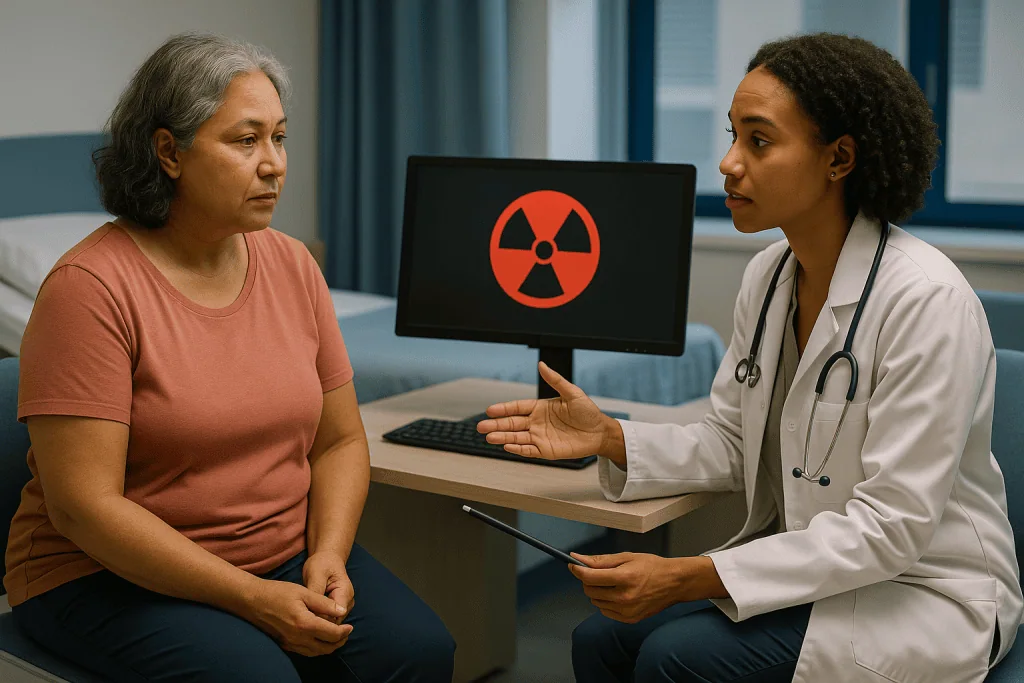
Radiation works on a different principle. Rather than removing tissue, it delivers energy that breaks the DNA strands inside cells. Cancer cells divide quickly and repair DNA poorly, so they are more likely to die from the damage; healthy cells repair themselves between sessions. That is why a course is split into many small daily doses, or fractions, spread over several weeks, rather than given all at once. Modern planning techniques such as intensity-modulated radiation therapy (IMRT) shape the beams to hug the target and spare bladder, rectum and bone marrow as far as anatomy allows.
The consequence for the patient is that surgery front-loads its effects: a wound, a recovery period, then a report. Radiation is the reverse: painless sessions at first, with side effects building over the course and peaking near the end, and no pathology report to confirm what was destroyed. Follow-up imaging and examination stand in for the microscope.
Neither approach is inherently stronger. Each is better at certain jobs, and much of the art of vulvar cancer care lies in matching the tool to the tumor’s size, depth and neighbors.
Who is usually offered surgery first, and who is asked to hold off
Surgery is the default for early disease for a plain reason: it removes the cancer in a single step and produces a pathology report that tells everyone exactly what they are dealing with. People most often offered an operation first have a tumor that is confined to the vulva, small enough to remove with a healthy margin, positioned away from the urethral opening and anus, and no fixed or ulcerated groin nodes. They also need to be fit enough for general or regional anesthesia. The Mayo Clinic and NHS treatment guides both describe surgery as the main treatment for vulvar cancer that has not spread widely.
Some people are asked to pause before an operation, and the reasons vary. A tumor that has grown into the urethra, anus or vagina might only be removable with a procedure that sacrifices continence and requires a permanent stoma (an opening on the abdomen for urine or stool); in that situation, most teams will discuss shrinking the tumor with chemoradiation first. Bulky groin nodes that are stuck to surrounding tissue often cannot be cleared safely by dissection alone. Serious heart, lung or kidney disease may make anesthesia riskier than the cancer itself in the short term.
A third group is asked to wait for a more ordinary reason: staging is not finished. Imaging of the groins and pelvis, a cystoscopy or proctoscopy to check the bladder and rectum, and sometimes an examination under anesthesia may all be needed before the team can promise a clear margin.
Finally, people with the very earliest disease, where the tumor has invaded less than one millimeter into the tissue, are typically offered local excision alone and asked to skip groin surgery entirely, because the chance of node spread at that depth is very low in guideline series.
When is radiation chosen over surgery for vulvar cancer?
Radiation takes the lead in a handful of situations, and almost all of them come back to one idea: the price of surgery would be too high, or the surgery would not get everything.
The first is anatomy. The urethra, clitoris and anal sphincter sit within a few centimeters of one another. A tumor that has reached or wrapped around these structures cannot be excised with a safe margin without removing part of them, and the trade-off, incontinence or loss of sensation, may be one that neither the patient nor the team is willing to make. The National Cancer Institute’s treatment summary lists radiation, usually with chemotherapy, as an option for locally advanced disease that would otherwise require this kind of exenterative surgery.
The second is medical fitness. An older adult with advanced heart failure, severe lung disease or a recent stroke may be a poor candidate for a long operation. Radiation, delivered as an outpatient over several weeks, avoids anesthesia and a surgical wound, though it carries its own demands.
The third is the groin. When nodes are enlarged and fixed, dissecting them may be impossible or may leave disease behind; radiation to the groin and pelvis is then used as the primary approach, sometimes after removing whatever nodes can be safely taken.
The fourth is recurrence in a field that has already been operated on more than once, where further surgery may not heal. And the fifth is preference. A person who understands both options and declines an operation that would alter her body permanently is entitled to that choice, and radiation is a legitimate alternative rather than a consolation. What radiation alone rarely does is replace surgery for small, well-placed tumors, where an excision remains simpler and more certain.
When are both surgery and radiation used together?
Combining the two is common, and it happens in two directions.
The more frequent pattern is surgery first, radiation second, known as adjuvant radiation. The pathology report triggers it. Guideline summaries from the National Cancer Institute describe several findings that prompt a discussion of postoperative radiation: a margin the pathologist reports as involved or close, where re-excision is not feasible; cancer found in two or more groin lymph nodes; a single node with cancer breaking through its capsule into surrounding fat; or a node that is large. In these cases the surgeon has removed what could be seen, and radiation is added to treat microscopic cells that may remain in the vulvar bed, groins or pelvic nodes. It typically begins once the wound has healed enough to tolerate treatment, usually a matter of weeks, because irradiating an open wound delays healing further.
The reverse order, radiation or chemoradiation first and surgery second, is used for tumors that start out too large or too close to critical structures. The goal is to shrink the cancer so that a smaller, function-preserving excision becomes possible, or to confirm with a biopsy that nothing viable remains. Whether an operation follows depends on the response, judged by examination, imaging and sometimes biopsy several weeks after radiation ends.
There is a third, quieter combination: sentinel node surgery for staging the groin, followed by radiation instead of a full node dissection if the sentinel node is positive. Trials in this area are ongoing, and practice varies, so the team’s reasoning is worth asking about directly.
Each pairing adds side effects from both modalities, particularly wound complications and lymphedema (chronic swelling from disrupted lymph drainage), which is why teams try hard to justify every component rather than defaulting to everything.
Chemoradiation for vulvar cancer: why chemotherapy is added
The word “chemoradiation” alarms people because it sounds like two full treatments stacked on top of each other. In vulvar cancer it means something more specific. Chemotherapy is given in small amounts, usually once a week during the radiation course, as a radiosensitizer: a medicine that makes cancer cells less able to repair the DNA damage radiation causes. The chemotherapy is the helper; the radiation is doing the main work.
The drugs most often used are platinum-based, the same class relied on for cervical cancer, and much of the rationale is borrowed from the cervical cancer literature, where adding weekly platinum to radiation improved outcomes in large randomized trials. For vulvar cancer, which is far rarer, the evidence is drawn from smaller prospective studies and retrospective series summarized in the National Cancer Institute’s treatment overview, so the certainty is lower even though the approach is widely adopted. Honest teams will say so.
Who is offered it? Mostly people with locally advanced disease: tumors involving the urethra, anus or vagina, or bulky groin nodes, where the aim is either to treat definitively without surgery or to shrink the tumor before a smaller operation. It is also used in some postoperative settings when nodes are heavily involved.
The added cost is side effects. Weekly platinum can cause nausea, lowered blood counts, ringing in the ears and kidney strain, and it intensifies the skin, bowel and bladder effects of pelvic radiation. Blood tests before each dose are routine, and the oncology team may hold or adjust treatment based on them; those decisions rest entirely with the prescribing clinician. Whether the extra benefit outweighs the extra burden in a particular case depends on age, kidney function, hearing and general health, and that is a conversation worth having in full.
Radiation therapy for vulvar cancer: what a course looks like week by week
The first visit is not treatment at all. It is a planning session, sometimes called simulation, during which a CT scan is taken in the exact position that will be used every day. For vulvar radiation that position is often lying on the back with the knees apart, sometimes on a custom cushion. A few permanent freckle-sized tattoos or skin marks are placed so the therapists can line up precisely each session. The team then spends days designing beams that cover the vulva, groins and often the pelvic lymph nodes while sparing as much bladder, rectum and bowel as possible.
Treatment itself is undramatic. Sessions run on weekdays, each lasting roughly ten to twenty minutes in the room, most of which is positioning; the beam is on for a fraction of that and cannot be felt. The NHS describes external radiotherapy as being given in small daily doses over several weeks, and courses for vulvar cancer commonly fall in that range, with the exact number of sessions set by the radiation oncologist.
The pattern of side effects is predictable. Weeks one and two usually pass with little more than tiredness. From around week three the skin of the vulva and groin folds begins to redden and feel sore, bowel movements may become looser and more urgent, and urination may sting. By the final week the skin reaction can be at its most uncomfortable, and many people take time off work. Weekly review appointments with the radiation team are standard, and this is when creams, sitz baths, pain relief and dietary changes are discussed.
The course ends, but the effects do not switch off. Skin and bowel reactions typically continue to build for a week or so afterward before settling over the following few weeks, which surprises people who expected relief on the last day.
Radiation vs surgery vulvar cancer: side-by-side comparison
Laid out together, the two approaches look less like rivals and more like specialists with different strengths. The table below summarizes the typical picture for squamous cell vulvar cancer; individual plans vary, and the treating team’s assessment always overrides a general guide.
| Aspect | Surgery | Radiation (with or without chemotherapy) |
|---|---|---|
| Main goal | Remove tumor with a clear margin; stage the groin nodes | Destroy cancer cells in place while preserving anatomy |
| Usually preferred for | Early, well-placed tumors; fit patients | Tumors near urethra, anus or clitoris; fixed groin nodes; medically unfit patients |
| Typical course | One operation, hospital stay of days | Weekday outpatient sessions over several weeks |
| Information it provides | Pathology report: margins, depth, node status | Response judged by exam, imaging and sometimes biopsy |
| Main short-term effects | Wound pain, wound breakdown, infection, drains | Skin soreness in folds, diarrhea, bladder irritation, fatigue |
| Main long-term effects | Lymphedema after node dissection; altered sensation; scarring | Vaginal narrowing and dryness; skin changes; bowel or bladder changes; possible early menopause |
| Often combined when | Margins close or involved; nodes positive | Tumor shrinks enough for a smaller excision |
Two cells in this table deserve emphasis. The “information it provides” row explains why surgeons are reluctant to abandon operating on operable tumors: a microscope report is worth a great deal when planning what comes next. The “long-term effects” row explains why radiation oncologists are reluctant to irradiate small tumors that a scalpel could remove: pelvic radiation changes tissue permanently, and those changes accumulate if the field ever needs treating again.
Neither column is the “easy” option. The choice is about which set of trade-offs fits the tumor and the person.
The groin question: sentinel node biopsy, node dissection or groin radiation
The vulva drains lymph fluid to the inguinofemoral nodes, a cluster in the crease of each groin, and whether cancer has reached them is the strongest predictor of how the disease behaves. Managing the groin is therefore a decision in its own right, separate from what is done to the vulva.
Three approaches exist. The first is inguinofemoral lymphadenectomy, a full dissection that removes the node-bearing fat of one or both groins. It is thorough but carries a meaningful risk of wound breakdown, infection and long-term lymphedema of the leg. The second is sentinel lymph node biopsy: a radioactive tracer and sometimes blue dye are injected around the tumor, the first node or nodes to take up the tracer are located and removed, and only if they contain cancer is further treatment offered. Guideline groups generally reserve it for single tumors smaller than about four centimeters with groins that feel and look normal on imaging, because the technique is less reliable outside those conditions.
The third is radiation to the groins instead of surgery. This is where the evidence is weakest and the most contested. A Cochrane systematic review comparing primary groin irradiation with primary groin surgery for early vulvar cancer found only one small randomized trial, which was stopped early because more groin recurrences occurred in the radiation arm; the reviewers rated the evidence low quality and noted that the radiation technique used may have underdosed the deeper nodes. Surgery remains the standard way to stage the groin in people fit for it, with radiation added afterward if nodes are positive, and used alone mainly when dissection is unsafe.
For most people, then, the question is not surgery versus radiation for the groin but how much surgery, and whether a sentinel procedure can spare them the full dissection.
Vulvectomy recovery time: what the days and weeks after surgery usually look like
The first thing many people notice on waking is not pain at the surgical site but hardware: a urinary catheter, often one or two thin drains from the groins if nodes were removed, and compression stockings. Getting out of bed and walking, even a few steps, is encouraged on the first day to lower the risk of blood clots, and the catheter usually comes out within the first few days once swelling settles. The NHS notes that people commonly stay in hospital for several days after vulvar surgery, longer if drains need to remain.
Wound care dominates the first two to three weeks. The vulvar skin is thin, sits in a warm and moist area, and is under tension when sitting, so wounds here heal more slowly than most and partial breakdown of the groin incisions is a well-recognized complication rather than a sign anything was done wrong. Rinsing with water after using the toilet, patting dry, wearing loose cotton and using a doughnut cushion are the practical staples. Pain is usually managed with regular oral medicines in the early days, chosen by the surgical team.
By four to six weeks most incisions have closed and light activity, including gentle walking and desk work, is usually manageable, though the Mayo Clinic and NHS guides both stress that recovery time varies with the extent of surgery. Radical vulvectomy with bilateral node dissection takes noticeably longer to recover from than a wide local excision, and older adults or those with diabetes may heal more slowly.
Some effects unfold over months. Leg swelling from disrupted lymph drainage can appear weeks after the operation and may need referral to a lymphedema therapist. Numbness at the inner thigh from nerve division is common. Sexual sensation and body image are affected in ways that are hard to predict in advance, and asking early about pelvic floor physiotherapy and psychosexual support tends to help more than waiting.
Is radiation for vulvar cancer painful? Side effects and how they are managed
The treatment itself is not. Lying on the table feels like having an X-ray; there is no heat, no sensation of the beam, and people often describe the strangest part as the quiet. The discomfort comes later, from the tissue reaction, and the honest answer is that vulvar radiation produces one of the more uncomfortable skin reactions in radiation oncology because the target is a skin fold that is warm, moist and rubbed by movement.
Skin changes begin as redness around the third week, progress to dry peeling and, in many people, to moist desquamation, where the top layer of skin lifts and the area weeps. The labia, groin creases and perianal skin are most affected. Teams manage this with barrier creams, sitz baths, non-adherent dressings, loose clothing and, when needed, prescription pain relief; the specifics belong to the treating team. The National Cancer Institute and NHS both describe skin reactions as usually improving within a few weeks after the course ends.
Because the pelvis is in the field, the bowel and bladder react too. Loose or urgent stools, cramping and a burning sensation when passing urine are common and typically ease after treatment finishes. Fatigue builds gradually and can linger for weeks. If the ovaries are within the radiation field in someone who has not reached menopause, radiation can stop them working, bringing on menopausal symptoms; this should be discussed before treatment begins.
Longer-term, the vagina can narrow and lose elasticity, making examinations and intercourse uncomfortable. Radiation teams commonly advise the use of vaginal dilators and moisturizers after healing to keep the tissue supple; this is one of the most effective and most under-discussed parts of aftercare. Pain, in short, is real but temporary for most, and the team expects it, plans for it, and wants to hear about it at each weekly review.
What people often get wrong about vulvar cancer treatment
The first misconception is that radiation is the “weaker” option, offered when surgery is off the table. In reality it is chosen for tumors that surgery cannot handle well, which are often the more advanced ones. Being recommended radiation says something about where the tumor sits, not about giving up.
The second is that surgery always means removing the whole vulva. Radical vulvectomy was once standard, but modern practice favors wide local excision or partial vulvectomy for most early tumors, with a margin of healthy tissue rather than removal of everything. The extent of surgery is driven by the tumor, not by tradition.
The third is that chemoradiation means a full course of chemotherapy with hair loss and months of infusions. As explained above, the chemotherapy component is usually a small weekly amount intended to sensitize the cancer to radiation, and hair loss is not typical with the platinum agents used this way. Side effects are real but different.
The fourth is that a sexual life ends with treatment. Both surgery and radiation change the vulva and vagina, and adjustment takes time, but many people resume intimacy with the help of dilators, lubricants, pelvic floor physiotherapy and frank conversation with a partner and the care team. The topic is far more often avoided by clinicians than raised by patients, so raising it yourself is fair.
The fifth concerns blame. Roughly half of vulvar squamous cancers are linked to human papillomavirus, the same common virus that causes cervical cancer; the rest arise from long-standing skin conditions such as lichen sclerosus, particularly in older women. Neither cause is a matter of fault, and neither changes the fact that the disease is treatable at most stages when found.
Finally, some assume rare means untreatable. Vulvar cancer is uncommon, which is why care is best delivered by a gynecologic oncology team that sees it regularly, but rarity does not equal a poor outlook.
Questions to ask your care team
Bringing written questions to a consultation is not a sign of distrust; oncology teams generally welcome it, because a patient who understands the plan copes with it better. The following are the questions that most often turn out to matter for the radiation-versus-surgery decision. Not all will apply, and the answers will be specific to your pathology and imaging.
- What stage is my cancer, and what does the depth of invasion and tumor size mean for the plan?
- Is my tumor removable with a clear margin without affecting the urethra, anus or clitoris? If not, what would surgery involve?
- Am I a candidate for a sentinel lymph node biopsy rather than a full groin dissection, and why or why not?
- If you recommend radiation, is it instead of surgery or in addition to it, and what findings would change that?
- If chemotherapy is added, what is its role, and how will it change the side effects I should expect?
- How many weeks will treatment take, and what do the weekly reviews involve?
- Which side effects are likely to be temporary, and which may be permanent?
- Are my ovaries in the radiation field, and what does that mean for menopause or fertility?
- What should I do to protect against lymphedema, and who do I contact if my leg swells?
- Who can I speak to about sexual function, body image and emotional support, and when?
- Is there a clinical trial relevant to my situation?
- What is the follow-up schedule, and what symptoms should prompt me to call between appointments?
One further suggestion: ask whether your case has been reviewed at a multidisciplinary tumor board, where surgeons, radiation oncologists, medical oncologists, radiologists and pathologists discuss the plan together. For a decision with this many moving parts, knowing that several specialists agreed on the recommendation is reassuring, and if they disagreed, it is useful to hear why.
When to call your doctor
Both treatments come with a list of expected discomforts and a shorter list of signs that should not wait for the next scheduled appointment. Knowing the difference saves worry in one direction and delay in the other.
After surgery, contact the team the same day for a temperature above the threshold they gave you, spreading redness, warmth or foul-smelling discharge from a wound, a wound that opens or bleeds more than a light ooze, or pain that is escalating rather than easing. Call urgently, or seek emergency care, for swelling, warmth or pain in one calf, sudden breathlessness or chest pain, which can signal a blood clot; for being unable to pass urine; or for heavy bleeding that soaks a pad within an hour. New swelling of a leg or the lower abdomen in the weeks or months afterward should be reported promptly so lymphedema can be assessed early.
During radiation, most skin, bowel and bladder symptoms are anticipated and handled at weekly review, but call sooner for skin that is bleeding, deeply cracked or shows pus; diarrhea that is watery many times a day or accompanied by dizziness or dark urine; inability to keep fluids down; blood in the urine or stool; fever; or pain that the recommended relief is not controlling. If chemotherapy is part of the plan, fever or chills are treated as an emergency because the medicine can lower the white cells that fight infection.
At any stage of follow-up, a new lump in the groin, a sore on the vulva that does not heal, new pain, itching or bleeding, or unexplained weight loss are all reasons to bring the next appointment forward. Most such symptoms will have a benign explanation, and the team would far rather examine an anxious patient than miss an early recurrence. The number for the oncology nurse line belongs on your refrigerator, not buried in a folder.
Frequently asked questions
How long does it take to recover from vulvectomy surgery?
Most people spend several days in hospital and need several weeks before returning to normal activity, with the NHS and Mayo Clinic both noting that the time depends on how much tissue was removed. A wide local excision heals faster than a radical vulvectomy with groin node dissection. Wound care dominates the first two to three weeks, incisions have usually closed by four to six weeks, and effects such as leg swelling or numbness may develop or persist over months.
Can you live with vulvar cancer?
Yes. Vulvar cancer is treatable at most stages, and many people live long lives after treatment, particularly when it is found while confined to the vulva. Outcomes depend heavily on whether groin lymph nodes are involved, which is why node assessment is so central to planning. Because the disease is rare, guideline bodies recommend care from a gynecologic oncology team, and regular follow-up examinations for several years are standard to catch any recurrence early.
What are the treatment options for vulvar cancer?
The main options are surgery, radiation therapy and chemotherapy, used alone or in combination depending on stage. Surgery ranges from wide local excision to partial or radical vulvectomy, often with sentinel node biopsy or groin node dissection. Radiation may be given instead of surgery for tumors near the urethra or anus, or after surgery when margins or nodes are involved. Chemotherapy is usually given weekly alongside radiation to make it more effective, and systemic therapies including immunotherapy are discussed for advanced disease.
Is radiation for vulvar cancer painful?
The sessions themselves are painless, but the skin reaction that develops over the course can be very sore. Redness begins around the third week, and by the final week the vulvar and groin skin may peel and weep, with burning on urination and loose stools also common. Radiation teams manage this with creams, sitz baths, dressings and pain relief, and the National Cancer Institute and NHS note that skin reactions usually improve within a few weeks after treatment finishes.
What is the typical vulvectomy recovery time compared with radiation recovery?
Surgery front-loads recovery: a hospital stay of days, wound care for two to three weeks and gradual return to activity over four to six weeks or longer for radical procedures. Radiation spreads it out: several weeks of outpatient sessions with side effects that build toward the end, peak about a week after the last session and then settle over the following few weeks. When both are combined, the total time from diagnosis to recovery is correspondingly longer.
What does chemoradiation for vulvar cancer involve?
Chemoradiation combines daily weekday radiation over several weeks with a small weekly dose of chemotherapy, usually a platinum-based medicine, given to make cancer cells less able to repair radiation damage. It is used mainly for locally advanced tumors that involve the urethra, anus or vagina, either as definitive treatment or to shrink the tumor before smaller surgery. The chemotherapy adds nausea, lowered blood counts and intensified skin and bowel effects, and blood tests before each dose are routine.
Can radiation therapy for vulvar cancer replace groin lymph node surgery?
Usually not for people fit for surgery. A Cochrane systematic review found only one small randomized trial comparing groin radiation with groin surgery, and it was stopped early because groin recurrences were more frequent in the radiation arm, with the reviewers rating the evidence low quality. Surgery, increasingly by sentinel node biopsy, remains the standard for staging the groin; radiation is added if nodes are positive and used alone chiefly when dissection is unsafe.
Does pelvic radiation for vulvar cancer cause menopause?
It can, if the ovaries lie within or near the radiation field in someone who has not yet reached menopause, because radiation damages the ovarian follicles that produce estrogen. Symptoms such as hot flashes and vaginal dryness may follow within weeks to months. Whether the ovaries are in the field depends on which lymph node regions are being treated, so this should be discussed before planning, along with fertility and hormone considerations, with the radiation oncology team.
Will I need a stoma if I have surgery for vulvar cancer?
Most people do not. A stoma, an opening on the abdomen to divert urine or stool, is only needed when the tumor has grown into the urethra, bladder or anal sphincter and removing it means sacrificing those structures. For exactly this reason, teams usually recommend chemoradiation first for such tumors, aiming to shrink them enough that function-preserving surgery, or no surgery at all, becomes possible. Ask directly whether your tumor’s position makes a stoma a realistic possibility.
Can vulvar cancer come back after radiation or surgery?
It can, which is why follow-up examinations continue for years after treatment. Recurrence most often appears on the vulva itself, where it can frequently be treated again with surgery or radiation, or in the groin, which is harder to treat and is the reason node status carries so much weight in the initial plan. Any new lump, non-healing sore, bleeding or pain between appointments should be reported promptly rather than watched.
References
This article is for general information only and is not a substitute for professional medical advice. Please consult a qualified doctor about your individual situation.

More from the Blog
Infection Risk After a Stem Cell Transplant: Protective Isolation, Masks and When to Call
Infection risk after a stem cell transplant is highest in the first few weeks, when conditioning treatment has wiped out white blood cells and…
Who May Benefit From Cancer Rehabilitation: Fatigue, Weakness and Limb Swelling
Cancer rehabilitation is usually considered for anyone whose cancer or its treatment has left them with persistent fatigue, muscle weakness, limb swelling (lymphedema), stiffness,…

How Engraftment After a Stem Cell Transplant Shows Up in Your Blood Counts Week by Week
Engraftment after a stem cell transplant is the point when transplanted stem cells settle in the marrow and begin producing new blood cells. Counts…
What Is Normal Healing After Vulvar Cancer Surgery and What Needs a Prompt Call
After vulvar cancer surgery, mild swelling, bruising, thin pinkish drainage, numbness and soreness that eases week by week are usually part of normal healing.…

Lymphedema After Breast Cancer Treatment: How It Is Monitored and Managed Long Term
Lymphedema after breast cancer treatment is persistent swelling of the arm, hand, breast or chest wall caused by damage to lymph nodes and vessels…

Targeted Therapy for Chronic Myeloid Leukemia: How Daily Treatment and Monitoring Work
Targeted therapy for chronic myeloid leukemia uses daily oral tyrosine kinase inhibitors (TKIs) that block BCR-ABL1, the abnormal enzyme driving the disease. Treatment is…