

When Is Radiotherapy Used for Skin Cancer Instead of Surgery? How the Choice Is Made
Key Takeaways
- Surgery lets a pathologist confirm the tumor's edges are clear, a piece of information radiotherapy cannot provide, which is one reason excision or Mohs remains the usual first option.
- Radiotherapy is most often chosen for tumors on the nose, eyelid, ear, or lip, and for people whose age or health makes an operation riskier or reconstruction more disfiguring.
- Radiation-treated skin often looks best about a year after treatment and may slowly thin or pale over the following decades, while surgical scars usually improve with time, which is why age enters the decision.
- Skin that has been irradiated generally cannot be treated with radiation again, so teams may hold radiotherapy in reserve for people likely to need many treatments over a long life.
- Superficial skin radiotherapy reaches only a few millimeters deep, so whole-body side effects like nausea are not expected; the reaction is confined to the treated patch.
- Radiotherapy is also given after surgery for squamous cell carcinoma when the pathologist finds close margins, nerve invasion, or lymph node involvement.
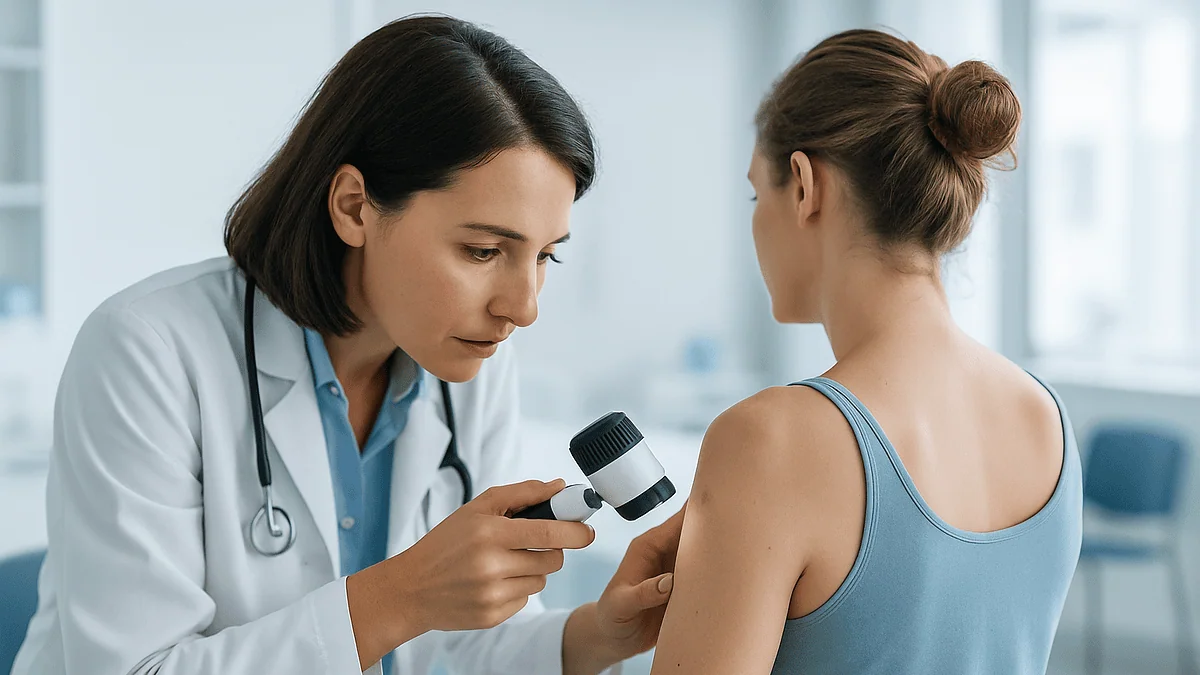
Radiotherapy is usually chosen instead of surgery for skin cancer when an operation would be difficult, risky, or cosmetically costly: for example, in people who are older or frail, when a tumor sits on the nose, eyelid, ear, or lip, or when the cancer is large or has grown into nerves. Surgery remains the standard first option for most basal and squamous cell cancers; the treating team weighs the tumor, the person, and their priorities.
The biopsy result came back on a Tuesday, and by Wednesday Ruth had two appointments on her calendar. One was with a surgeon, who talked about margins and a flap from her cheek to rebuild the side of her nose. The other was with a radiation oncologist, who talked about a mask, a course of short daily visits, and how the skin would look a year from now. Both were kind. Both were confident. Neither told her which to pick, because that was not entirely theirs to decide.
That fork in the road is where a lot of people find themselves after a skin cancer diagnosis, and the question of skin cancer radiotherapy vs surgery is rarely answered by a single fact. It is answered by a cluster of them: where the tumor is, how deep it goes, how old the person is, what else is going on in their body, and what they can live with afterward.
This explainer walks through how that decision is actually made, what each option involves, and what the evidence does and does not show.
What actually happens during radiotherapy for skin cancer
Radiotherapy uses high-energy X-rays or electron beams to damage the DNA inside cancer cells so they can no longer divide. Healthy skin cells in the beam are also injured, but they repair themselves more reliably than cancer cells do, which is why treatment is split into repeated small sessions rather than one large blast.
The first visit is a planning appointment. The team maps the tumor, often with a fine drawn margin of skin around it, and may make a custom mask or lead shield to protect the eye, teeth, or nearby healthy tissue. For a skin tumor, the beam only needs to reach a few millimeters deep, so a superficial X-ray or electron beam is chosen that deposits most of its energy near the surface and fades quickly beneath it.
Each treatment session is short. You lie still, the machine hums for a minute or two, and you feel nothing. There is no cutting, no anesthetic, and you go home the same day. The NHS describes radiotherapy for non-melanoma skin cancer as a course spread over a number of sessions rather than a single visit, and the length of that course depends on the size and site of the tumor and the person’s overall health.
The effect is not immediate. Because the treatment works by preventing cells from dividing, the tumor shrinks over the following weeks, and the treated skin goes through a predictable cycle of redness, soreness, and healing. That delay is one of the practical differences from surgery, where the cancer is physically gone the moment the operation ends.
Skin cancer radiotherapy vs surgery: what each one is good at
Surgery has one enormous advantage: a pathologist can look at the removed tissue under a microscope and confirm whether the edges are clear. That is a piece of information radiotherapy simply cannot give you. With radiation, the team relies on follow-up examinations to judge whether the tumor has responded, and any residual disease may take months to show itself.
Surgery is also fast and, for most small tumors on the trunk, arms, or legs, straightforward. A local anesthetic, an excision with a small margin of normal skin, a few stitches, and a scar that fades over a year. Mayo Clinic lists surgical excision and Mohs surgery as the most common approaches to basal cell carcinoma, with radiation held in reserve for situations where surgery is not a good option.
Radiotherapy has its own strengths. There is no wound to heal, no risk of bleeding or anesthetic complications, and no tissue is physically removed, which matters enormously on a nostril rim, an eyelid, or the edge of a lip, where even a small excision can distort the shape or function of the feature. It can also treat a wide field, which helps when a tumor’s edges are indistinct or when it has tracked along a nerve.
The NIH National Cancer Institute describes both approaches as standard treatments for basal and squamous cell skin cancers, and the practical question is less about which is better in the abstract and more about which fits this tumor, on this person, at this stage of life.
Who is radiotherapy usually for, and who is usually steered toward surgery
Ask a radiation oncologist to sketch the typical person they treat for skin cancer and a picture emerges quickly. They are often in their seventies or beyond. They may take blood thinners, have heart or lung disease that makes an operation riskier, or have a tumor in a spot where reconstruction would need a graft or a flap. Some simply cannot face another procedure after several previous excisions.
Tumor features also push toward radiation. A squamous cell carcinoma that has grown into a nerve, a basal cell carcinoma with edges the surgeon cannot define, or a large tumor that would leave a defect out of proportion to the person’s wishes: each of these is a scenario where the NIH lists radiation as an accepted option, either alone or after surgery.
Who is usually steered toward surgery instead? Younger people, for reasons explored later in this article. People with a condition called basal cell nevus syndrome (an inherited tendency to develop many basal cell cancers), in whom radiation can trigger new tumors. People with certain connective tissue diseases, such as scleroderma or lupus, whose skin tolerates radiation poorly. And anyone whose tumor has already come back after a previous course of radiotherapy, since the same skin cannot safely be treated twice.
Then there is the practical filter. A course of radiotherapy means repeated trips to a treatment center, sometimes daily for weeks. For someone who lives far away, cannot drive, or has a caregiver’s schedule to consider, a single surgical appointment may be the kinder path even if radiation looks attractive on paper. The team is expected to raise these questions; if they do not, you are entitled to.
Why the location on the face changes the answer
Picture two identical basal cell carcinomas, each the size of a pencil eraser. One sits on the upper back. The other sits on the free edge of the nostril. The first is a fifteen-minute excision with a scar nobody will ever notice. The second is a genuine dilemma.
The face is full of structures that do not tolerate loss of tissue well. The nasal ala (the curved wing of the nostril), the eyelid margin, the vermilion border of the lip, and the helix of the ear all have thin skin over cartilage or muscle, with little spare tissue nearby to borrow. Removing even a small tumor with an adequate margin can leave a notch, a pulled eyelid that no longer closes properly, or a nostril that collapses on breathing in. Reconstructing these areas often requires a flap or graft and sometimes more than one operation.
Radiotherapy leaves the architecture in place. The tumor is treated where it sits, and the skin, once it has recovered, usually keeps its shape. Mayo Clinic notes that radiation may be used when surgery is not possible or when a tumor sits in an area where surgery would be difficult, and these facial subunits are exactly what clinicians have in mind.
There is a trade-off. Irradiated skin on the face can become paler, thinner, or slightly shiny over the years, with fine visible blood vessels, and radiation near the eye needs careful shielding to protect the lens. The team weighs a scar that is present immediately but often improves with time against skin changes that are absent at first but may slowly emerge. Neither is trivial, and the person’s own preference about which they would rather live with is a legitimate part of the medical decision.
Mohs surgery vs radiation: what are the downsides of Mohs surgery?
Mohs surgery is a specialized technique in which the surgeon removes the tumor in thin layers, examines each one under a microscope while you wait, and stops only when the edges are clear. Mayo Clinic describes its main appeal as removing as little healthy tissue as possible while checking every edge, which is why it is often chosen for tumors on the face and for cancers that have returned after earlier treatment.
People searching for the downsides usually have a specific worry in mind, so it is worth being concrete. The day is long: the procedure typically takes several hours because each layer must be processed and read before the next is taken. Repeated injections of local anesthetic are needed as the session goes on. Once the tumor is out, the resulting defect may be larger than expected, and closing it can require a flap, a skin graft, or referral to a reconstructive surgeon on the same or a later day.
Common surgical risks apply: bleeding, infection, a scar that heals thicker or wider than hoped, and temporary or occasionally lasting numbness if a small sensory nerve is cut. Mohs also requires a surgeon trained in the technique and a laboratory on site, which is not available everywhere.
What Mohs does not do is remove the need for follow-up. Skin that has grown one cancer is at risk of growing another, and both Mohs and radiation patients are advised to keep regular skin checks. The honest way to frame Mohs surgery vs radiation is not as a contest with a winner but as two tools with different costs: Mohs trades a longer day and a wound for certainty about margins; radiation trades that certainty for a gentler procedure and preserved anatomy.
Radiotherapy for basal cell carcinoma and squamous cell carcinoma: does the cancer type matter?
Non-melanoma skin cancer is an umbrella term for basal cell carcinoma and squamous cell carcinoma, the two most common skin cancers, both of which arise from cells in the outer skin layer. They behave differently, and that difference shapes how radiotherapy is used.
Basal cell carcinoma is slow and rarely spreads to other parts of the body, but it can burrow locally, especially around the nose and eyes. For radiotherapy for basal cell carcinoma, the aim is almost always local control with the best possible cosmetic result, and both the NHS and Mayo Clinic list radiation as a recognized option when surgery is unsuitable.
Squamous cell carcinoma is more variable. Most are low risk, but some grow quickly, invade nerves, or spread to lymph nodes. In those higher-risk cases, radiotherapy plays a second role: it may be given after surgery to treat the surgical bed or the nearby lymph node region if the pathologist finds features that raise the chance of the cancer coming back. The NIH lists radiation therapy among the treatments for squamous cell carcinoma both as a primary approach and after surgery.
Melanoma is a different story altogether. It arises from pigment cells, is treated primarily with surgery, and radiotherapy is used far more selectively, usually for specific situations such as disease that has spread or cannot be removed. If your diagnosis is melanoma, most of the surgery-versus-radiation discussion in this article does not apply in the same way, and your team will frame the choices differently.
Rarer skin cancers, such as Merkel cell carcinoma, have their own pathways in which radiotherapy often features prominently. The type on your pathology report is the first thing your team looks at.
When radiotherapy is added after surgery rather than instead of it
Not every choice is either-or. In a meaningful share of cases, especially with squamous cell carcinoma, radiotherapy is used after an operation. Clinicians call this adjuvant radiotherapy, meaning treatment given in addition to the main treatment to reduce the chance the cancer returns.
The trigger is usually something the pathologist sees. The tumor may extend to or very close to the cut edge of the specimen, meaning some cells might remain. It may have grown along a nerve, a pattern called perineural invasion that lets cancer travel beyond the visible tumor. It may be unusually thick or poorly differentiated, or it may have already reached a lymph node. In any of these situations, the NIH notes that radiation may be given after surgery to treat any cancer cells that remain.
The sequence matters. Surgery removes the bulk of the tumor and provides that microscopic look at the edges; radiotherapy then sweeps a wider field that a scalpel cannot reach without disfigurement. Starting radiation usually waits until the wound has healed enough to tolerate it, which is one reason the two teams need to talk to each other before the first operation, not after.
There is also the reverse situation. Occasionally a tumor is too large to remove cleanly, and radiotherapy is used first to shrink it, with surgery considered afterward if enough tumor remains. This is less common for skin cancers than for some other tumor types, but it illustrates the point: surgery and radiation are colleagues, not rivals. A multidisciplinary team, meaning surgeons, radiation oncologists, pathologists, and dermatologists meeting together, is the setting where these sequences are planned, and asking whether your case has been through such a meeting is a fair question.
How many radiotherapy sessions for skin cancer? Understanding fractionation
People searching for how many radiotherapy sessions skin cancer needs are often surprised to learn there is no single number. The total dose is divided into portions called fractions, and the team can deliver it as a few larger fractions or many smaller ones. That choice is a medical judgment, not a fixed protocol, and specific figures are for your radiation oncologist to set, not for an article to quote.
What can be said in general terms is this. Shorter courses with fewer, larger fractions are convenient and are often chosen for older or frail people, or for those who travel a long way, because they mean fewer visits. Longer courses with more, smaller fractions are gentler on healthy skin and tend to give a better long-term cosmetic result, so they are often preferred for the face or for people expected to live many decades after treatment. The NHS describes radiotherapy for non-melanoma skin cancer as being given over several sessions, with the schedule tailored to the individual.
Each session itself is brief, typically a matter of minutes on the treatment couch, and most of the appointment is positioning and checks. Many people continue working or caring for family throughout a course, timing visits around their day.
The pattern of side effects follows the schedule. Skin reactions build gradually and often peak in the week or two after the final session rather than during treatment itself, a point worth knowing so the timing does not alarm you. If a course is interrupted, for illness or any other reason, the team recalculates rather than simply picking up where it left off, because the biology of the gap matters.
Skin cancer radiotherapy vs surgery at a glance
The table below is a plain summary, not a scoring sheet. Every row has exceptions, and the point of the exercise is to see which considerations weigh most heavily for you.
| Consideration | Surgery (excision or Mohs) | Radiotherapy |
|---|---|---|
| Confirmation the tumor is fully treated | Pathologist examines the edges of the removed tissue | Judged by clinical follow-up over months; no specimen to examine |
| Number of visits | Usually one procedure, plus wound checks and suture removal | A course of repeated sessions, length set by the team |
| Anesthetic and wound | Local anesthetic; a wound that needs care while it heals | No anesthetic, no wound; skin reaction develops over weeks |
| Effect on facial features | Tissue removed; may need flap or graft on nose, eyelid, ear, lip | Structure preserved; skin may thin or pale over years |
| Speed of result | Cancer removed on the day | Tumor regresses over the following weeks |
| Long-term skin changes | Scar, usually fading with time | Possible late changes; small long-term risk of a new radiation-related tumor |
| If the cancer returns | Radiotherapy or further surgery both remain options | Same area cannot usually be re-irradiated; surgery in irradiated skin heals more slowly |
| Usually less suitable for | Very frail people, tumors in cosmetically critical sites, ill-defined edges | Younger people, inherited multiple basal cell syndromes, certain connective tissue diseases |
The rows about what happens if the cancer returns deserve a second look. Because radiotherapy usually closes the door on treating the same patch of skin again with radiation, and because surgery in irradiated skin is harder, some teams prefer to keep radiation in reserve for people likely to need many treatments over a long life. That logic is one reason age recurs so often in these discussions, and it is the subject of a later section.
What the following days and weeks usually look like after each treatment
After surgical excision, the first week is about the wound. There is a dressing, sometimes a pressure bandage on the first night, and a list of things to avoid: heavy lifting, bending that raises blood pressure to the head, soaking the area. Stitches on the face commonly come out within about a week, while those on the trunk or legs may stay longer; your surgeon sets the timing. Bruising and mild swelling are expected, and a firm ridge along the scar is normal for a few months as collagen remodels. Mayo Clinic notes that scars from Mohs surgery continue to improve for a year or more.
After radiotherapy, the timeline runs in the opposite direction. The first few sessions cause little or nothing you can feel. Redness appears gradually, followed by dryness, itching, and sometimes peeling or a moist, weeping surface toward the end of the course. Symptoms usually peak in the week or two after treatment finishes, then settle over the following weeks as new skin forms. A crust may form over the treated tumor and eventually fall away. Hair in the treated area may be lost, sometimes permanently.
Skin care during and after radiotherapy is gentle: lukewarm water, fragrance-free products approved by the team, no scrubbing, no adhesive tape on the treated skin, and rigorous sun protection once the skin has healed. Your radiotherapy team will give specific written instructions, and those instructions override anything general written here.
Both routes converge on follow-up. Irradiated skin needs a few months before the team can judge the result, and surgically treated skin needs regular checks for new lesions elsewhere. Either way, expect a schedule of skin examinations stretching over years, and expect to be taught how to check your own skin between visits.
Long-term effects: why your age keeps coming up
People are sometimes puzzled, even offended, when age enters the conversation. It is not about whether someone is worth treating well. It is about how the two treatments behave over decades.
Surgical scars tend to improve with time. They fade, flatten, and soften, and a scar that looks angry at three months often looks unremarkable at two years. Radiation-treated skin tends to move the other way. It may look excellent at one year and then, slowly, become thinner, paler, or more fragile, with fine visible vessels called telangiectasias, over five, ten, or twenty years. The NIH lists such late skin changes among the considerations for radiation to the skin.
There is a second reason. Radiation itself can, rarely and usually many years later, cause a new cancer in the treated field. For a person in their eighties, that risk is small enough to be almost theoretical. For someone in their thirties, with fifty years of life ahead, it is a real entry on the ledger. This is also why radiotherapy is generally avoided in people with basal cell nevus syndrome, whose skin is unusually prone to forming new tumors after radiation exposure.
A third consideration is what happens if a cancer returns. Skin that has been irradiated heals poorly after surgery, and the same area generally cannot receive a second course of radiation. Keeping radiotherapy in reserve therefore preserves options for someone likely to need treatment again.
None of this makes radiotherapy wrong for a younger person. When a tumor sits somewhere surgery would be disfiguring, or when someone cannot safely undergo an operation, the balance can tip toward radiation at any age. The point is that the team is doing arithmetic about the future, not making assumptions about the present.
Is there a new procedure instead of Mohs surgery?
This question usually reflects two things: a wish to avoid a long surgical day, and advertising for newer forms of superficial radiation. Both deserve a straight answer.
Superficial radiation therapy is not new. Low-energy X-rays that penetrate only a few millimeters have treated skin cancer for the better part of a century, and modern superficial and electron-beam machines are refinements of that idea. What is more recent is the pairing of superficial radiation with ultrasound imaging to guide the beam, and a form of brachytherapy in which a small radiation source is placed directly against the skin. These are legitimate techniques, and some clinicians use them, but the long-term evidence comparing them directly with surgery, particularly follow-up stretching beyond a few years, remains limited. That is what the evidence actually shows, and it is why mainstream guidance from bodies such as the NHS continues to describe surgery as the usual first treatment, with radiotherapy for people who cannot or prefer not to have it.
Other non-surgical options exist for a narrow group of very superficial, low-risk basal cell carcinomas on the trunk or limbs. These include curettage and cautery (scraping the tumor away and sealing the base with heat), cryotherapy (freezing), photodynamic therapy (a light-activated cream), and certain prescription creams that stimulate the immune system or damage dividing cells. MedlinePlus and the NHS both list these as accepted approaches for suitable lesions. They are not substitutes for Mohs in high-risk or facial tumors, and none of them offers the microscopic confirmation of clear edges that surgery provides.
If someone offers you a procedure described as newer or better than Mohs, the right questions are: what is the evidence for this tumor type and location, how long has it been followed, and what does my team recommend?
What people often get wrong about radiation and surgery for skin cancer
“Radiation is the last resort.” For some tumors and some people it is a first-line choice, particularly on the nose, eyelid, ear, and lip in older adults. Guidance from the NIH lists it as a standard treatment, not a fallback.
“Radiotherapy will make me sick.” Whole-body effects like nausea and hair loss come from radiation aimed at deep organs or from chemotherapy. Superficial skin radiotherapy reaches only a few millimeters deep, and its side effects are almost entirely confined to the treated patch of skin.
“Surgery spreads the cancer.” Basal and squamous cell carcinomas do not seed themselves along the scalpel. Removing them is the standard treatment precisely because it works.
“Mohs is always better than a standard excision.” Mohs is designed for high-risk and cosmetically sensitive sites. For a small, well-defined tumor on the back, a standard excision achieves the same goal with less time and equipment, which is why Mayo Clinic describes Mohs as most useful for specific situations rather than every case.
“Once treated, I’m done.” Having one skin cancer is the strongest predictor of developing another. Follow-up skin checks matter as much as the treatment.
“The skin will look perfect right after radiation.” The reverse is often true: skin looks worst in the weeks just after a course and best a year or so later, while late thinning can emerge slowly over years.
“Better to travel far for a famous surgeon.” The technique matters more than the postcode. Ask about training, follow-up arrangements, and who will manage complications close to home.
Questions to ask your care team before choosing
A good consultation leaves room for questions, and the ones below are the sort a well-prepared person brings on paper. Not every question will apply, and the aim is a conversation, not an interrogation.
- What type of skin cancer is this exactly, and is it considered low or high risk? Why?
- Has my case been discussed by a team that includes both a surgeon and a radiation oncologist?
- If surgery is recommended, would it be a standard excision or Mohs, and how would the wound be closed? Would I need a graft or flap?
- If radiotherapy is recommended, why is it preferred for me, and what would the course involve in terms of visits?
- What would the treated area be expected to look like at three months, one year, and ten years with each option?
- What are the specific risks of each approach at this particular site on my body?
- If the cancer came back after this treatment, what options would remain?
- Are there any conditions I have, or medicines I take, that make one option safer than the other?
- Do I have a reason to avoid radiation, such as an inherited skin cancer syndrome or a connective tissue disease?
- Who do I contact if something goes wrong in the evening or on a weekend?
- How will follow-up work, how often, and for how long?
- Is there anything about my own priorities, such as appearance, time off work, or travel, that you would like to know before advising me?
That last question is often the most useful. Clinicians can only weigh what they know, and what you can live with is part of the medical evidence. Write the answers down or bring someone to listen; most people remember only a fraction of a first consultation.
When to call your doctor
Most recovery from either treatment is uneventful, but some signs should prompt a same-day call to your treating team rather than a wait for the next appointment.
After surgery, call promptly if the wound bleeds and does not stop after firm pressure for twenty minutes; if it becomes increasingly red, hot, swollen, or starts to leak pus; if you develop a fever; if the edges of the wound pull apart; or if pain is worsening rather than easing after the first two or three days. Sudden numbness, weakness, or drooping in a part of the face that was not affected before surgery also warrants a call. Mayo Clinic lists bleeding, infection, and nerve-related changes among the recognized complications to watch for.
During or after radiotherapy, contact the team if the treated skin breaks down into an open, weeping, or bleeding area that is spreading; if there are signs of infection such as spreading redness, heat, or pus; if you develop a fever; if pain is not controlled by the measures the team advised; or if radiation near the eye leaves it red, painful, gritty, or with any change in vision.
At any point after either treatment, tell your doctor about a new lump, a sore that does not heal within a few weeks, a scar or treated area that starts to thicken or change, or bleeding from a spot that was previously quiet. These are the signals your team wants to hear about early, and a call that turns out to be nothing is never a wasted call.
Every decision about what to do next, from adjusting skin care to arranging an urgent review, sits with the team that knows your case.
Frequently asked questions
Which is better for skin cancer, surgery or radiation?
Neither is better in the abstract; the right one depends on the tumor and the person. Surgery is the usual first choice because the removed tissue can be checked under a microscope. Radiation is preferred when an operation would be risky or disfiguring, particularly on the nose, eyelid, ear, or lip in older adults. Your treating team weighs these factors and should explain their reasoning.
What are the downsides of Mohs surgery?
Mohs involves a long day, often several hours, because each layer of tissue is examined before the next is removed. The final wound can be larger than expected and may need a flap or graft to close. Bleeding, infection, scarring, and numbness from small nerve injury are recognized risks. It also requires a trained surgeon and an on-site laboratory, which limits where it is available.
What is the new procedure instead of Mohs surgery?
There is no established replacement for Mohs. Newer forms of superficial radiation, including image-guided systems and surface brachytherapy, are being used by some clinicians, but long-term evidence comparing them directly with surgery is still limited. For very superficial, low-risk lesions on the trunk or limbs, options such as curettage, cryotherapy, photodynamic therapy, and prescription creams exist. Ask your team what the evidence shows for your tumor.
How many radiotherapy sessions skin cancer needs: is there a standard number?
No. The total dose is divided into fractions, and the team chooses between fewer, larger sessions and more, smaller ones based on the tumor site, its size, the person’s age and health, and how far they travel. Longer courses tend to be gentler on the skin and are often preferred for the face. The exact schedule is set by your radiation oncologist and should be explained at planning.
Is Mohs surgery vs radiation a decision I make or my doctor makes?
It is shared. Your team assesses the tumor type, location, depth, and your health to decide which options are medically reasonable, and then your priorities about appearance, time, travel, and risk help choose among them. If only one option has been offered, it is fair to ask whether the other was considered and why it was set aside.
Does radiotherapy for basal cell carcinoma hurt?
The sessions themselves are painless; you feel nothing while the machine is on. Over the course, the treated skin becomes red, dry, and sore, sometimes with peeling or a moist surface, and this usually peaks in the week or two after the final session before healing. Your team will advise on gentle skin care and on what to do if soreness becomes hard to manage.
Why is radiotherapy usually avoided in younger people with skin cancer?
Because its effects unfold over decades. Irradiated skin can slowly thin, pale, and develop visible small vessels years later, and radiation carries a small long-term risk of causing a new tumor in the treated area. The same skin also cannot easily be treated again. For someone with many decades ahead, teams often prefer surgery, though radiation can still be right when surgery would be disfiguring.
Can I have surgery if radiotherapy does not work?
Usually yes, though it is more complicated. Skin that has been irradiated heals more slowly and is more prone to wound problems, so surgeons plan carefully and may involve reconstructive colleagues. The reverse sequence, radiation after surgery, is generally simpler. This asymmetry is one reason some teams keep radiotherapy in reserve when a person is likely to need further treatments.
Will radiation make me feel sick or lose my hair?
Not in the way people fear. Superficial skin radiotherapy penetrates only a few millimeters, so nausea, fatigue from whole-body treatment, and general hair loss are not expected. Hair within the treated patch of skin, such as an eyebrow or part of the scalp, may be lost and does not always regrow. Side effects are essentially limited to the area being treated.
How long before I know whether radiotherapy has worked?
Longer than with surgery. Because radiation works by stopping cells from dividing, the tumor shrinks over the weeks after the course finishes, and the skin needs time to heal before the team can judge the result. Follow-up examinations over the following months confirm the response. Any concern about residual or returning disease is assessed by your team rather than assumed.
References
This article is for general information only and is not a substitute for professional medical advice. Please consult a qualified doctor about your individual situation.

More from the Blog
How Vulvar Cancer Treatment Is Planned by Stage and Tumor Location
Vulvar cancer treatment is planned by stage, which describes how deep the tumor has grown and whether it has reached lymph nodes or other…
Why Proton Therapy Side Effects Often Peak After the Last Session, Then Settle
Proton therapy side effects often peak in the first week or two after the final session because radiation damages the deep cell layers that…
Follow-Up Visits After Breast Cancer: What Is Checked at Each Stage of Recovery
After breast cancer treatment, follow-up usually means a clinical exam every three to six months for the first few years, then every six to…
The Whipple Procedure for Pancreatic Cancer: What Is Removed and How the Body Adapts
The Whipple procedure, or pancreaticoduodenectomy, removes the head of the pancreas, the first part of the small intestine, the gallbladder, part of the bile…

Hormone Therapy for Cancer vs HRT: Same Words, Opposite Goals
Hormone therapy for cancer and hormone replacement therapy (HRT) use similar words but pull in opposite directions. Cancer hormone therapy blocks or lowers estrogen…
How Leukemia and Lymphoma Treatment Paths Differ, and Where They Overlap
Leukemia and lymphoma are both cancers of white blood cells, but leukemia begins in the bone marrow and travels in the blood, so it…