

Which Areas Does a Post-Bariatric Body Lift Address and How Is the Operation Staged?

Key Takeaways
- A lower body lift, or belt lipectomy, treats five regions in one circumferential operation: abdomen, flanks, lower back, buttocks and outer thighs.
- Arms, chest or breasts, upper back and inner thighs are separate procedures, usually performed in later stages months apart to limit anesthesia time and clot risk.
- Skin markings are drawn while the patient stands, because gravity reveals where tissue hangs and where the permanent scar will fall.
- Weight stability, commonly discussed as roughly 12–18 months after bariatric surgery, and corrected nutrition come before any contouring, according to Mayo Clinic guidance.
- Seroma, a pocket of clear fluid under the skin, is the most common complication, while wound separation is most likely where long incisions meet at the back or sides.
- Return to normal activity is commonly around six weeks and scar fading takes a year or more, per NHS tummy tuck guidance, with all timelines set by the treating team.
A post-bariatric body lift removes and tightens skin left loose after major weight loss. The lower body lift, also called a belt lipectomy, addresses the abdomen, flanks, lower back, buttocks and outer thighs in one circumferential procedure. Arms, chest or breasts, upper back and inner thighs are usually handled in separate stages, spaced months apart, with the order and timing set by the surgical team.
The jeans finally fit. That was the plan, after all: the bypass, the protein shakes, the two years of steady, stubborn effort that took more than a hundred pounds off. And yet, in the fitting room mirror, there is a fold of skin at the waistband that no belt can tame, and another under each arm that swings when the hanger goes back on the rail. It is a strange kind of grief to feel healthier than ever and still not recognize your own outline.
That is the moment many people start typing questions about body lift surgery, how it is done, and whether the whole thing really happens in one operation. The honest answer is more interesting than the before-and-after photos suggest.
A body lift is not one procedure but a family of them, mapped onto the body in zones and usually performed in stages. What follows is a plain account of which areas each stage covers, what actually happens in the operating room, and why the schedule is often the part people least expect.
What is a post-bariatric body lift, and why is it different from a tummy tuck?
Skin is remarkably elastic, but it has limits. When a person carries a large amount of extra weight for years, the skin stretches to accommodate it, and the fibers that let it snap back, collagen and elastin, become permanently lengthened. After major weight loss, whether through bariatric surgery or other means, the fat underneath shrinks while the envelope stays the same size. The result is loose, hanging tissue, sometimes called redundant skin, that diet and exercise cannot shrink because it is not fat.
A body lift is the surgical answer to that envelope problem. The surgeon removes the excess skin and a thin layer of the fat attached to it, then re-drapes and tightens what remains. According to the Mayo Clinic’s overview of body contouring after weight loss, the goal is to improve shape and reduce physical problems caused by hanging skin, such as rashes and difficulty with hygiene, rather than to remove weight itself.
A tummy tuck, or abdominoplasty, works on the front of the abdomen only. It tightens the abdominal wall muscles and removes skin between the navel and the pubic area. That is often enough for someone with moderate laxity after pregnancy. After massive weight loss, though, the looseness rarely stops at the hips. It wraps around to the flanks, the lower back and the buttocks, and it continues down the thighs and up the arms.
That is why the post-bariatric version is described as circumferential: the incision travels all the way around the body like a belt, and the lift pulls tissue upward from the thighs and buttocks as well as downward from the chest. Think of the difference between hemming the front of a curtain and re-hanging the whole thing on a new, higher rod.
Body lift surgery: how it is done, step by step
Most people picture a single long cut and a lot of pulling. The real sequence is more methodical, and each step exists for a reason.
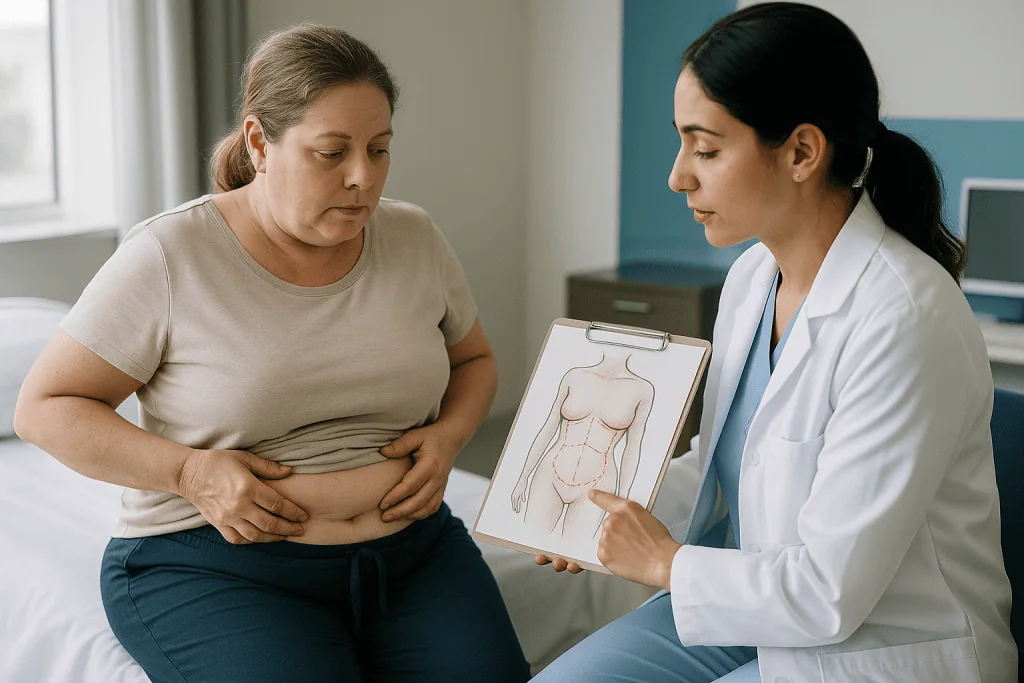
The process starts standing up, not lying down. Before anesthesia, the surgeon marks the skin with a pen while the patient stands, because gravity shows where the tissue hangs and where the final scar will fall. Those markings become the map for the entire operation.
Next comes general anesthesia, meaning the patient is fully asleep and monitored by an anesthesiologist throughout. Compression devices are placed on the calves to keep blood moving, and a urinary catheter is usually inserted because the operation lasts several hours.
The surgeon then works in sections. For a lower body lift, the patient is typically positioned on one side or face down first so the back, flanks and buttocks can be addressed, then turned onto the back for the abdomen. In each zone the incision is made along the marked line, the excess skin and attached fat are lifted away from the muscle layer, and the tissue that remains is pulled upward or downward to its new position.
Where the abdominal wall has separated, the surgeon may stitch the muscles back toward the midline, a step the Mayo Clinic describes in its tummy tuck overview. Liposuction, the removal of fat through a thin suction tube, is sometimes used to fine-tune contours in areas the incision does not reach.
Finally the wound edges are brought together in several layers of stitches, deep ones for strength and fine ones at the surface. Thin plastic drainage tubes are often left in place to collect fluid, the navel is repositioned if the abdomen was lifted, and a compression garment is applied before the patient wakes.
Which areas does a lower body lift or belt lipectomy procedure address?
The lower body lift is the workhorse of post-bariatric surgery, and its other name, belt lipectomy, tells you almost everything. Lipectomy simply means removal of fat and skin; belt describes the shape of the incision, which runs continuously around the waistline.
Five regions fall within that belt. The abdomen is the most obvious: the hanging apron of skin over the pubic area, known medically as a pannus or panniculus, is removed, and the skin above it is stretched down to meet the lower incision. The flanks, the sides of the waist people often call love handles, are tightened as the incision curves around the hips. The lower back is smoothed by lifting the skin upward toward the waistline scar.
The last two areas are lifted rather than reduced. Skin from the buttocks and the outer thighs is pulled upward and anchored at the belt line, which raises sagging buttock tissue and softens the outer thigh. Some surgeons preserve a portion of the tissue that would otherwise be discarded and tuck it under the buttock skin to add fullness, a technique often called autologous augmentation, meaning the body’s own tissue is used.
What the belt does not reach matters just as much. The inner thighs generally need their own incision because pulling from above cannot tighten the skin near the groin. The upper abdomen above the navel improves but may not become completely flat, since the lift moves tissue toward the scar rather than removing skin everywhere. Arms and chest are untouched.
Where the scar sits is a design decision. Most surgeons place it low enough to be covered by underwear or swimwear, but exactly how low depends on where the loose skin is and how much tension the closure can safely carry.
What does a body lift include beyond the waist: the upper body and thigh stages
The phrase full body lift is marketing shorthand, not a surgical term. What people mean by it is a lower body lift plus one or more additional procedures on the upper body and legs. Each of these has its own name, incision pattern and recovery profile.

Arm lift, or brachioplasty, removes the loose tissue that hangs from the underside of the upper arm. The incision usually runs from the elbow to the armpit along the inner arm, sometimes extending onto the side of the chest when laxity continues there. It is a scar people notice in short sleeves, and surgeons discuss that trade-off openly.
Breast lift, or mastopexy, reshapes deflated breast tissue and raises the nipple to a higher position. After massive weight loss the breast often loses volume as well as elevation, so some patients discuss combining the lift with an implant or with tissue moved from the side of the chest. In men, the equivalent procedure treats sagging chest skin and is often paired with liposuction.
Upper body lift addresses the rolls that form across the mid and upper back, often continuing from the chest procedure around to the spine. Not everyone needs it; it becomes relevant when back laxity is significant enough that the belt lipectomy does not reach it.
Thigh lift, or thighplasty, tightens the inner thigh. A shorter version places the scar in the groin crease; a longer version runs down the inner thigh toward the knee when skin excess is extensive. It is one of the more delicate procedures because the inner thigh skin is thin and the area is prone to fluid collection and slow healing.
Face and neck laxity, which many people are surprised to develop, is handled separately again, using standard facial procedures.
Area-by-area map: what each part of a body lift addresses
Because the terminology piles up quickly, the table below lays the pieces side by side. The stage column shows the most common sequence; individual plans vary, and the treating team sets the order for each person.
| Area | Procedure name | What is done | Typical scar location | Usual stage |
|---|---|---|---|---|
| Abdomen and pannus | Abdominoplasty component of belt lipectomy | Excess skin removed, muscles tightened if separated, navel repositioned | Low horizontal line above pubic area, around navel | First |
| Flanks and lower back | Belt lipectomy | Skin lifted upward and excess removed | Continuation of the belt line around the waist | First |
| Buttocks and outer thighs | Belt lipectomy with buttock lift | Tissue lifted and anchored; own tissue sometimes used for fullness | Belt line across upper buttocks | First |
| Upper arms | Brachioplasty | Hanging skin removed along inner arm | Inner arm from elbow toward armpit | Second |
| Breasts or chest | Mastopexy or chest contouring | Tissue reshaped and raised; volume options discussed | Around nipple, vertical, sometimes under the breast | Second |
| Mid and upper back | Upper body lift | Back rolls removed, often connected to chest procedure | Horizontal line across the back at bra level | Second |
| Inner thighs | Thighplasty | Loose inner thigh skin removed and tightened | Groin crease, sometimes extending toward knee | Third |
Two points deserve emphasis. First, the stage number is a habit, not a rule; a person whose arms trouble them most may reasonably start there after discussion. Second, every row involves a permanent scar. The Mayo Clinic is direct about this in its body contouring overview: scars are extensive and lasting, even when well placed. Anyone weighing these procedures is trading skin excess for scar lines, and a good consultation makes that exchange explicit.
How are full body lift stages planned, and why not do everything at once?
The single most common misunderstanding about body lift surgery, how it is done and how long it takes, is the assumption that everything can happen in one long day. Surgeons almost never plan it that way, and the reasons are about safety rather than convenience.
Time under anesthesia is the first constraint. A lower body lift alone runs for several hours. Adding arms, chest and thighs would push the operation into a range where blood loss, temperature drop and the risk of blood clots climb steeply. Long operations also increase the chance that a wound will break down, because tissue that has been handled for many hours does not heal as reliably.
Positioning is the second. The belt lipectomy requires turning the patient during surgery; the thigh lift needs the legs positioned apart; the arm lift needs the arms extended. Each change adds time and risk of pressure injury.
The third reason is that each procedure changes the landscape for the next. A lower body lift pulls skin upward from the thighs and downward from the abdomen. Until it has settled, the surgeon cannot judge accurately how much inner thigh or upper abdominal excess remains. Operating in sequence lets each stage be planned against the actual result of the previous one.
In practice, the lower body lift is usually first because it addresses the largest area and often the most functional problems, such as skin rashes under the pannus. Upper body procedures, meaning arms and chest, commonly follow, sometimes combined with each other in a single session. Thighs often come last because they heal more slowly and benefit from the lift already achieved from above.
The interval between stages is set by the surgical team based on healing, nutrition and the patient’s stamina. It is measured in months, not weeks, and it is one of the most individual decisions in the whole pathway.
Who is body lift surgery usually for, and who is asked to wait?
The ideal moment for a body lift is not when the weight comes off but when it stops moving. Skin removed while weight is still falling will loosen again; skin removed while weight is creeping back will be pulled tight over returning fat. The Mayo Clinic’s body contouring guidance describes the typical expectation that weight has been stable for a sustained period, commonly discussed as roughly 12–18 months after bariatric surgery, before contouring is considered. Individual teams set their own thresholds.
Beyond weight stability, surgeons look at several factors. Nutrition is central. Bariatric procedures, especially those that bypass part of the intestine, can lead to low protein, iron, vitamin B12, vitamin D and zinc, and each of those matters for wound healing. Blood tests before surgery are routine, and deficiencies are corrected first, with any supplementation directed by the treating team.
Smoking and nicotine use are among the strongest reasons to postpone. Nicotine narrows small blood vessels, and a body lift relies on skin flaps that have had part of their blood supply cut. The NHS tummy tuck guidance notes that smoking raises the risk of complications, and most surgeons require complete cessation for a period before and after surgery. Diabetes that is not well controlled, uncontrolled high blood pressure, active skin infection under the folds, and a history of blood clots are all reasons for further assessment or delay.
Psychological readiness matters too. A body lift involves large scars, a long recovery and a result that improves shape without producing a body that never carried extra weight. People who are still deciding whether they are finished with weight loss, who expect perfection, or who are under acute life stress are often asked to wait, not as a judgment but because the recovery is demanding.
Finally, the decision to proceed, and in what order, always rests with the surgical team after examination.
How is body lift surgery done safely? What the preparation weeks involve
The operation itself is only the visible part of the process. The weeks before it are where a great deal of the safety is built in.
Assessment usually begins with the bariatric team confirming that weight has plateaued and that follow-up blood work is acceptable. The plastic surgery consultation then involves a physical examination of every area of laxity, measurement of skin excess, photographs for planning and a frank conversation about scars. Many surgeons draw the proposed incision lines on the skin during this visit so the patient can see, literally, where the trade-off will sit.
Medical optimization follows. Anemia is corrected because blood loss during a circumferential procedure can be meaningful. Protein intake is reviewed, since wound healing demands more protein than day-to-day living. Blood sugar targets are tightened where relevant. Anyone taking blood thinners or medicines that affect bleeding will have those reviewed by the prescribing clinician; no one should stop or adjust a prescribed medicine on their own.
Practical preparation is easy to underestimate. Because bending, twisting and lifting are restricted afterward, people are advised to arrange help at home, prepare meals in advance, set up a sleeping area that allows the hips to stay slightly flexed, and buy loose front-opening clothes. Compression garments, which are firm elastic wraps that reduce swelling and support the healing tissue, are usually fitted before surgery.
The pre-operative anesthesia review covers airway assessment, sleep apnea screening, which is common after obesity, and clot prevention planning. The Mayo Clinic’s tummy tuck guidance describes the standard instructions: stop smoking, avoid certain over-the-counter products that increase bleeding as directed by the team, maintain a stable weight and arrange for someone to drive you home and stay with you.
None of this is glamorous. All of it reduces the odds of the complications described later in this article.
How painful is a full body lift?
This is the question people ask most quietly, and it deserves a straight answer. A lower body lift hurts, particularly in the first days, and the pain is different from what people expect.
The sharpest discomfort is not usually at the incision. Skin has relatively few pain fibers once it has been re-draped, and many people report numbness rather than pain along the scar line for months. The deeper ache comes from two sources: the muscle tightening in the abdomen, which makes every cough, laugh and transfer from bed to chair register as a pulling sensation, and the sheer extent of the surgical field, which means the whole waistline feels bruised and tight when the compression garment is on.
Pain control is planned in layers. During surgery, local anesthetic is often infiltrated into the tissue, and some teams use regional nerve blocks, which numb a section of the abdominal wall for a period afterward. In the hospital, a combination of non-opioid medicines and short courses of opioids is typical, with the specific plan set by the anesthesia and surgical teams. The Mayo Clinic’s tummy tuck overview describes this general approach without prescribing a formula, and the same principle applies here: the prescribing clinician decides what, how much and for how long.
Movement, counterintuitively, reduces pain over the first week. Early walking prevents stiffness and lowers the risk of clots, and most people find that the second and third days are the hardest, after which the trajectory turns. Arm lifts and thigh lifts are generally described as less painful than the belt procedure, though the inner thigh can be sore with walking.
Two things make pain worse: pushing activity too soon and letting constipation develop, which is common with opioid use and reduced mobility. Both are worth discussing with the team before surgery rather than after.
Body lift recovery: what do the first days and weeks usually look like?
Recovery from a body lift is a staged affair in its own right, and knowing the shape of it makes the hard days easier to tolerate.
The first night is usually spent in hospital. Drains are checked, the compression garment is adjusted, and the first assisted walk to the bathroom happens within hours of waking, because early movement lowers clot risk. Most people go home once they can walk safely, eat and manage the drains, which involves emptying small bulbs and recording the volume.
The first week is about positioning and patience. The abdomen is closed under tension, so people sleep and sit slightly bent at the hips, often in a recliner. Showering is usually allowed once drains are removed or per the team’s instructions. Swelling peaks around this time and can be alarming; the waistline can look larger than before surgery, which is normal fluid, not fat.
Between the second and sixth weeks, drains typically come out as output falls, standing straightens gradually, and walking distance increases. The NHS tummy tuck guidance describes about six weeks before most people return to normal activities and advises against strenuous exercise until then; body lift teams commonly apply a similar window, and the Mayo Clinic notes compression is usually worn for around six weeks as well. Desk work often resumes earlier than physical work, depending on healing.
Beyond six weeks, the scar enters its longest phase. It is red, raised and firm for months before flattening and fading; the NHS notes that scars can take a year or more to settle. Numbness along the incision may persist longer still, and the final contour, once residual swelling drains from the thighs and pubic area, emerges gradually over many months.
Every one of these timelines is a typical range from the cited sources, not a promise. The team’s follow-up schedule is what determines when each restriction lifts.
What are the risks of body lift surgery in plain language?
Any operation carries risk, and a circumferential procedure on tissue with a compromised blood supply carries more than most. Being clear-eyed about the list is part of consenting properly.
Seroma is the most frequent problem. A seroma is a pocket of clear fluid that collects in the space the surgeon created between skin and muscle. Drains and compression reduce it, but it still occurs, and it may need to be drawn off with a needle in clinic once or several times. Hematoma, a collection of blood rather than fluid, is less common and may require a return to the operating room.
Wound healing problems are the second major category. Where two long incisions meet, often at the back or the sides, the skin edges have the poorest blood flow and may separate, a process called dehiscence. Small areas usually heal on their own with dressings over weeks; larger ones may need surgical revision. Smoking, poor nutrition and excessive tension on the closure all make this more likely, which is why so much of the preparation targets those factors.
Infection, numbness, asymmetry between sides, persistent swelling of the pubic area or thighs and scars that widen or thicken are all recognized outcomes described in the Mayo Clinic’s overview of body contouring after weight loss. Some people need a smaller touch-up procedure later to address a dog-ear, meaning a small pucker of skin at the end of a scar.
The most serious risks are blood clots in the leg veins, deep vein thrombosis, and clots that travel to the lungs, pulmonary embolism. Long surgery, reduced mobility and a history of obesity all raise the baseline risk, which is why calf compression devices, early walking and, where the team judges it appropriate, clot-preventing medicines are standard.
Alternatives exist for those who decide against the full procedure: a panniculectomy removes only the hanging apron without tightening the rest, and some people choose no surgery and manage skin folds with barrier creams and supportive garments.
How long do body lift results last?
Skin that has been removed does not grow back, so in one sense a body lift is permanent. In every other sense, the answer depends on what happens to the body afterward.
Weight is the dominant variable. If weight stays within a stable range, the contour achieved at the end of healing generally holds, subject to ordinary aging. If a significant amount of weight is regained, the tightened skin stretches again and fat returns beneath it; if a great deal more is lost, new laxity can appear. This is why surgeons are so insistent on weight stability before operating and why the Mayo Clinic’s body contouring guidance frames maintenance of a healthy weight as central to a lasting result.
Skin quality is the second factor, and it is the one people can do least about. Skin that has been stretched for many years, or that has stretch marks, contains fibers that are already damaged. It will loosen again more readily than skin that was never overstretched. Older age, sun damage and genetics all play a role. Some degree of gradual relaxation of the lifted tissue over the following years is expected and is not a sign that something went wrong.
Pregnancy after a body lift is possible but will stretch the abdominal wall and skin again, and most surgeons advise finishing childbearing before the abdominal stage if that is an option.
What a body lift cannot do is stop time. The scars mature and fade but remain visible. Skin continues to age. Muscle tone still depends on activity. The most durable results in the surgical literature tend to be in people who reached a stable weight, kept it, and treated the operation as a finishing step rather than a fresh start. No article can promise how long any individual result will hold; that is a conversation for the treating team, who can see the tissue in question.
What people often get wrong about body lifts
Some misconceptions come up in almost every consultation, and correcting them early saves disappointment later.
It is a weight-loss operation. It is not. The tissue removed can weigh several pounds, but the purpose is contour and comfort, not weight reduction, and surgeons do not use the procedure to bring down a high body mass index. A person still carrying substantial excess fat is usually advised to wait, because removing skin over fat that later shrinks leaves new laxity.
Liposuction would do the same job. Liposuction removes fat and relies on the skin shrinking back afterward. Post-bariatric skin has lost that ability, so liposuction alone tends to make hanging skin hang more. It is useful as a refinement alongside excision, not as a substitute for it.
The scar will be hidden. It will be placed thoughtfully, and it will fade, but a belt lipectomy scar goes all the way around the body and is permanent. The Mayo Clinic’s body contouring overview says this plainly. Anyone who is told otherwise should ask more questions.
Everything can be done in one operation. As described earlier, staging exists to limit anesthesia time, blood loss and clot risk. Compressing the timeline is a safety decision, not a scheduling one.
Recovery is like a tummy tuck. The belt procedure involves turning during surgery, a longer incision and a larger raw surface underneath the skin, so recovery is generally longer and more demanding than an abdominoplasty alone.
There is a standard price. This magazine does not publish cost figures for any treatment, because they vary enormously with the number of stages, the setting, the length of stay and whether any component is judged medically necessary. The right place to ask is the treating team and the insurer, with the surgical plan in hand.
Questions to ask your care team before body lift surgery
A consultation moves quickly, and it is easy to leave without asking the things that matter most. Writing questions down beforehand changes the conversation. These are the ones worth bringing.
- Which areas do you propose to address, in which order, and why that sequence for my anatomy?
- How many stages do you anticipate, and how will you decide when I am ready for the next one?
- Where exactly will each scar run? Can you draw it on me so I can see it standing and sitting?
- What is my current nutritional status, and is anything being corrected before surgery?
- What is your plan for preventing blood clots, given my history and the length of the operation?
- How long do you expect me to stay in hospital, and what support will I need at home in the first two weeks?
- What will pain control look like, and who do I contact if it is not working?
- What complications have you seen most often with this procedure, and how are they managed?
- If a wound separates or a seroma forms, what does that mean for my recovery and for the next stage?
- How will pregnancy, further weight change or aging affect the result, and is there anything I should complete first?
- What is your policy on revisions if a small pucker or asymmetry remains?
- Which of my current medicines need review, and who will make those decisions?
Two habits make these questions more useful. First, ask for the answer in terms of typical ranges and what would change them, rather than a single figure. A surgeon who says most people go home within a certain window but that drains, pain control and mobility decide it is giving you a more honest picture than one who quotes a number. Second, ask what the surgeon would want to know if they were the patient. The reply is often the most revealing part of the visit.
When to call your doctor after a body lift
Recovery has a normal amount of discomfort, swelling and drainage, and a smaller number of signs that should never be waited out. The team will give written instructions; the list below is the general guidance that sits behind them.
Call emergency services or go to the nearest emergency department for sudden shortness of breath, chest pain, coughing up blood, fainting or a racing heartbeat. The Mayo Clinic’s deep vein thrombosis guidance lists these as warning signs of a clot that has traveled to the lungs, which is the most dangerous complication of any long operation.
Call the surgical team the same day for any of the following:
- Swelling, pain, warmth or redness in one calf or thigh, which can signal a clot in a leg vein.
- A wound that is opening, or drainage that turns cloudy, thick or foul-smelling.
- Fever, chills or a spreading area of redness around an incision.
- A rapidly enlarging, tense or painful swelling under the skin, which may be bleeding.
- Drain output that suddenly increases, becomes bright red or stops completely.
- Pain that is escalating rather than easing, or that is not controlled by the prescribed plan.
- Skin near an incision that turns dark, dusky or blistered, which can mean the blood supply is compromised.
- Persistent vomiting, inability to pass urine or new confusion.
Numbness along the scar, mild bruising, tightness when standing straight and a waistline that looks puffier than expected in the first weeks are common and usually settle. When in doubt, the rule is simple: a phone call that turns out to be unnecessary costs nothing, while a delayed one can. Follow-up appointments are not optional; they are where drains are removed, wounds are checked and the timing of the next stage is judged. Every decision about what is normal and what needs action sits with the treating team, who know the details of the operation performed.
Frequently asked questions
How painful is a full body lift compared with a tummy tuck?
A lower body lift is generally more uncomfortable than a tummy tuck alone because the incision runs all the way around the body and the raw surface under the skin is larger. The worst days are typically the second and third, with the deepest ache coming from abdominal muscle tightening rather than the incision itself. Pain plans combine local anesthetic, non-opioid medicines and short opioid courses, all decided by the prescribing team.
How long do body lift results last?
Removed skin does not return, but the contour depends on what follows. Stable weight, good skin quality and ordinary aging generally allow the result to hold for many years with gradual relaxation. Significant weight regain, further major weight loss or pregnancy will stretch the tissue again. No one can promise a duration for an individual; the Mayo Clinic frames a stable healthy weight as the key to a lasting result.
What is the lower body lift recovery time?
Most people stay in hospital for a short period, then spend the first week resting in a slightly bent position with drains in place. Light activity resumes over the following weeks, and NHS guidance for the related tummy tuck describes about six weeks before normal activities return, with compression worn for a similar period per Mayo Clinic advice. Scars keep fading for a year or longer. The treating team confirms each step.
What is the average cost of a full body lift?
This magazine does not publish price figures for any treatment. Costs vary widely with the number of stages, the length of hospital stay, the surgical setting and whether any component, such as removal of a hanging skin apron causing rashes, is considered medically necessary by an insurer. The reliable way to understand the financial side is to ask the treating team and your insurer once a written surgical plan exists.
What does a body lift include, and is the face part of it?
A lower body lift includes the abdomen, flanks, lower back, buttocks and outer thighs. A so-called full body lift adds arm lifts, breast or chest reshaping, an upper back lift and inner thigh lifts, each as its own procedure. Face and neck laxity, which often develops after major weight loss, is not part of a body lift and is treated separately with standard facial procedures if the person chooses.
Why is the belt lipectomy procedure usually done first?
The belt lipectomy addresses the largest area of loose skin and often the most functional problems, such as rashes and hygiene difficulty under the abdominal apron. It also lifts tissue upward from the thighs and buttocks, which changes how much excess remains for later stages. Operating in that order lets the surgeon plan thigh and upper body procedures against the actual result rather than an estimate.
How many full body lift stages are typical?
Most plans involve two or three stages: the lower body lift first, upper body procedures such as arms and chest second, and inner thighs third. Some people need only one stage; others combine arm and chest work into a single session. Staging limits anesthesia time, blood loss and clot risk. The number and order are set by the surgical team after examining each area of laxity.
Will I have drains, and how long do they stay in?
Thin plastic drainage tubes are commonly placed to collect fluid from the space between skin and muscle, reducing the risk of seroma. They are emptied and measured at home, and they are removed in clinic once the daily output falls below a threshold the surgeon sets. Timing varies with the extent of surgery and individual healing, so the team’s instructions, not a fixed number, determine when they come out.
Can liposuction replace a body lift after weight loss?
Generally not. Liposuction removes fat and relies on the skin tightening afterward, but skin stretched for years by excess weight has lost much of that ability. Liposuction alone often makes hanging skin appear looser. Surgeons do use it alongside skin excision to refine contours the incision cannot reach. Whether it has a role in an individual plan is a judgment for the treating surgeon after examination.
What are the warning signs of a blood clot after body lift surgery?
Swelling, pain, warmth or redness in one leg can signal a clot in a deep vein. Sudden shortness of breath, chest pain, coughing up blood, fainting or a rapid heartbeat can mean a clot has reached the lungs and requires emergency care. The Mayo Clinic lists these as deep vein thrombosis and pulmonary embolism warning signs. Early walking and calf compression during and after surgery are standard preventive measures.
References
This article is for general information only and is not a substitute for professional medical advice. Please consult a qualified doctor about your individual situation.

Planning This Treatment in Turkey
Our full guide for international patients: techniques, hospital stay, recovery and cost.
More from the Blog

How Do Bariatric Surgeons Choose Between Sleeve and Bypass for Your Health Profile?
Bariatric surgeons choose between sleeve gastrectomy and gastric bypass by weighing a person's body mass index, type 2 diabetes history, acid reflux, prior abdominal…

When a Sleeve Gastrectomy Needs Revision: Re-Sleeve, Conversion to Bypass and Why
Sleeve gastrectomy revision options include re-sleeving a stretched stomach, converting the sleeve to a Roux-en-Y gastric bypass, which is usually favored when acid reflux…

Who May Be a Candidate for a Gastric Balloon? What the Bariatric Team Evaluates First
Gastric balloon candidates are usually adults whose body mass index falls roughly between 30 and 40, who have tried structured diet and activity changes…

Is Obesity a Willpower Problem? Common Myths and What Medicine Actually Says
No. Mainstream medical evidence does not treat obesity as a willpower problem. Body weight is regulated by genes, appetite hormones, sleep, medicines, health conditions…

Sleeve Gastrectomy (Gastric Sleeve) Eligibility: What the Team Weighs Beyond BMI
Sleeve gastrectomy eligibility usually starts with body mass index, commonly a BMI of 40 or higher, or 35 and above with a weight-related condition…

Metabolic Syndrome Myths: Why It Is Not Only About Weight and Not Only About Sugar
Metabolic syndrome is a cluster of at least three linked measures: a large waist, raised blood pressure, high triglycerides, low HDL cholesterol and raised…