

Which Facial Rejuvenation Treatment Fits Which Concern? Lines, Volume Loss and Skin Texture
Key Takeaways
- Facial aging happens in distinct layers, muscle, fat and bone, and skin surface, and each mainstream treatment acts on only one of them, which is why combinations are common.
- Botulinum toxin treats lines made by expression, with Mayo Clinic describing effects that begin within days and last about three months or longer, but it does nothing for volume or sagging.
- Hyaluronic acid fillers restore lost volume for roughly six to eighteen months according to the NHS and can be dissolved with an enzyme, a safety advantage over non-reversible fillers.
- Resurfacing depth decides both result and recovery: Mayo Clinic cites one to seven days of healing for a light peel versus around two weeks for ablative laser, with pinkness that can last months.
- A facelift repositions descended tissue and, per Mayo Clinic, generally holds for about a decade, but it does not improve sun damage, fine lines or pigment.
- Cosmetic acupuncture is supported only by small, inconsistent studies, while daily sunscreen and topical retinoids remain the best-evidenced everyday measures for skin texture.
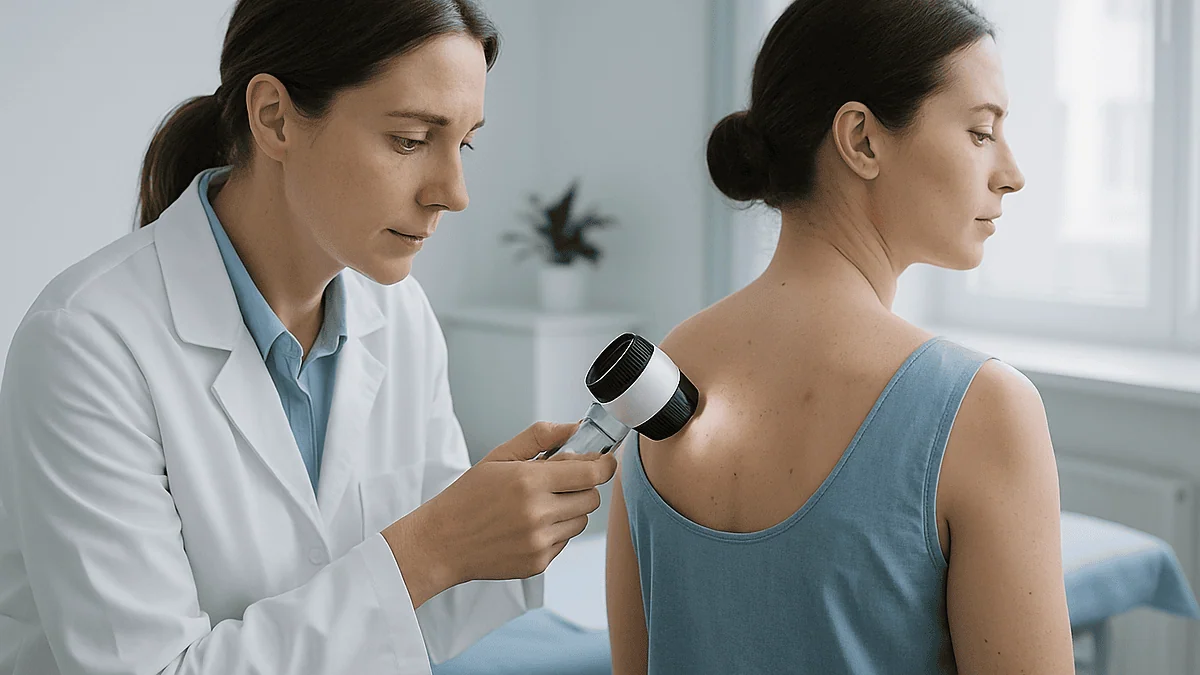
Facial rejuvenation treatment options are usually matched to the underlying change rather than to age. Lines caused by muscle movement are commonly treated with botulinum toxin, static lines and texture with resurfacing such as peels or lasers, and volume loss with fillers, fat grafting or, when tissue has descended, surgery. Many people need a combination, and a clinician decides after examining the face.
She had taken the same photograph at the same kitchen window every January for a decade, and this year she noticed something she could not name. The smile lines were familiar. What bothered her was flatter: the cheeks looked tired even when she was rested, and the skin had a faint crepe-paper quality under the eyes. A friend suggested a laser. Another swore by fillers. A third asked whether she had thought about a facelift. Each of them was describing a different problem.
That confusion is the real starting point for anyone comparing facial rejuvenation treatment options. The face does not age in one way; it ages in at least three, and the treatments that help one kind of change often do very little for another.
This explainer walks through those three changes, lines, volume loss and skin texture, and maps the mainstream treatments onto each, with what the evidence does and does not support.
Why facial rejuvenation treatment options should start with the concern, not the menu
Most people arrive at a consultation with a treatment already in mind, usually the one a friend had. That order is backward. The useful question is not “should I have a laser?” but “what, precisely, has changed in my face, and which tissue is responsible?”
Dermatologists and plastic surgeons tend to sort facial aging into three overlapping categories. The first is dynamic and static lines: creases that form where muscles fold the skin thousands of times a day, and that eventually stay etched even at rest. The second is volume loss: the slow deflation of fat pads, thinning of bone at the cheek and jaw, and the sag that follows as support disappears beneath the skin. The third is surface texture: roughness, uneven pigment, enlarged pores, fine crinkling and the dull tone that comes mostly from sun exposure, a process clinicians call photoaging, meaning skin damage driven by ultraviolet light rather than by birthdays alone.
MedlinePlus summarizes the biology plainly: with age the outer skin layer thins, the connective tissue loses elasticity, and underlying fat diminishes, so the skin both sags and wrinkles. Sun exposure accelerates every part of that. A treatment that relaxes muscle will not refill a hollow cheek. A filler will not smooth sun-damaged skin. A resurfacing laser will not lift a jowl.
Once the concern is named, the menu of facial rejuvenation treatment options shrinks to something manageable, and the conversation with a clinician becomes a matching exercise rather than a guessing game.
How facial aging actually works: three layers that change at different speeds
Think of the face as a building with a facade, insulation and a frame. Each layer ages on its own schedule, and the visible result on the surface is the sum of all three.

The facade is the epidermis and upper dermis. Here, collagen, the protein scaffolding that keeps skin firm, is produced more slowly and broken down faster, particularly where ultraviolet light has damaged the cells that make it. Elastin fibers, which let skin snap back, fragment. Pigment cells cluster unevenly, producing sun spots. The surface becomes thinner, rougher and less even in color.
The insulation is the subcutaneous fat, arranged in discrete compartments rather than one continuous sheet. Some compartments shrink, others descend, and the junctions between them show as grooves: the tear trough under the eye, the fold beside the nose, the pre-jowl notch at the jawline.
The frame is bone and the ligaments that pin soft tissue to it. The eye socket widens, the mid-face bone retreats, and the jaw loses height. Soft tissue that was once draped over a fuller frame now hangs with less support.
Muscle adds a fourth, dynamic element: repeated contraction of the brow, forehead and eye muscles creases the overlying skin, and a crease repeated enough times becomes a permanent line.
Every mainstream treatment acts on one of these layers. Botulinum toxin quiets muscle. Fillers and fat grafting restore volume. Peels, lasers, microneedling and topical retinoids remodel the surface. Surgery repositions tissue that has moved. Understanding which layer is driving a concern is the single most valuable thing a patient can bring to a consultation.
Lines and wrinkles: botulinum toxin versus resurfacing, and why they are not interchangeable
A line that appears only when you frown and a line that is still there in a passport photo look similar in the mirror but have different causes, and that distinction decides the treatment.
Dynamic lines, those produced by expression, are the classic territory of botulinum toxin, a purified protein that temporarily blocks the nerve signal telling a muscle to contract. When the muscle rests, the skin above it stops folding and existing creases soften. Mayo Clinic notes that the effect usually begins within one to three days, may take a week or more to reach full strength, and typically lasts around three months or longer before the muscle gradually regains movement. The treatment does nothing to the skin itself; it works entirely by changing the behavior of the muscle underneath. Clinicians use it most on the forehead, between the brows and at the outer corners of the eyes.
Static lines, those etched into the skin at rest, respond less well to muscle relaxation alone, because the crease has become a structural change in the dermis. These are more often treated with resurfacing methods that stimulate new collagen, with a filler placed under a deep crease, or with a combination.
A few practical points follow from the mechanism. Botulinum toxin cannot address sagging; weakening the muscles of the lower face can look odd rather than younger, which is why its use there is more limited. The result is temporary and reversible by design. In the United States it is a prescription medicine administered by trained clinicians, and whether it is appropriate for a given person, including anyone pregnant, breastfeeding, or living with a neuromuscular condition, is a decision for the treating clinician after a medical history.
Volume loss: what dermal fillers and fat grafting really do beneath the skin
Deflation is the aging change people most often misread. A hollow under the eye reads as fatigue; a flattened cheek reads as sadness; a groove beside the mouth reads as a wrinkle when it is really a shadow cast by lost support above it.
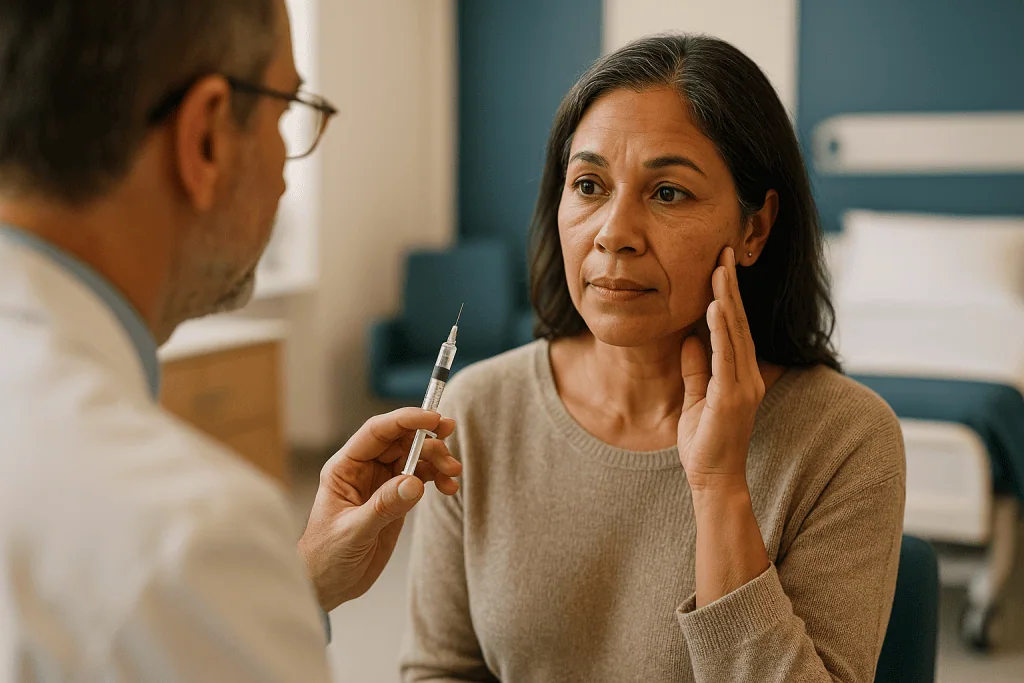
Dermal fillers are injectable gels placed under the skin to restore that support. The most widely used class is based on hyaluronic acid, a sugar molecule found naturally in skin that binds water and adds volume. The NHS explains that these products are not permanent and that effects usually last between six and eighteen months, depending on the product, the site and how quickly an individual metabolizes it. A specific advantage of hyaluronic acid fillers is that an enzyme called hyaluronidase can dissolve them if needed, which matters for safety as well as for correcting an unwanted result.
Other filler classes use materials intended to stimulate the body’s own collagen over months rather than adding volume directly. They last longer and are harder or impossible to reverse, a trade-off that belongs in the consultation.
Fat grafting takes a different route: a surgeon harvests a small amount of the person’s own fat, usually from the abdomen or thigh, purifies it and injects it into the face. Some of the transferred fat does not survive, so the final result is judged months later, and the procedure is a surgical one with its own recovery.
Fillers carry real risks. Bruising and swelling are common and temporary. Lumps, asymmetry and infection are less common. The serious complication is injection into or compression of a blood vessel, called vascular occlusion, which can damage skin or, rarely, vision. Anatomical knowledge and the ability to recognize and treat that complication immediately are the reasons regulators and professional bodies emphasize injector training.
Skin texture: how skin resurfacing treatments rebuild the surface
Texture is the concern that creams promise the most about and deliver the least on. Rough, crinkled, blotchy skin is the signature of photoaging, and improving it means removing damaged surface cells and persuading the dermis to build fresh collagen. That is what skin resurfacing treatments do, at varying depths and with varying downtime.
Chemical peels apply an acid solution that controls how deeply the outer layers are injured and shed. Mayo Clinic describes three tiers. A light peel reaches only the epidermis, heals within about one to seven days, and is repeated for cumulative benefit. A medium peel reaches the upper dermis, heals in roughly seven to fourteen days, and may be repeated after several months. A deep peel penetrates further, is performed once, and involves two to three weeks of healing with redness that can last months; it is a significant procedure with sedation and cardiac monitoring.
Laser resurfacing works by heat rather than acid. Ablative lasers remove the outer skin layer entirely and heat the layer beneath; Mayo Clinic notes the skin is raw and swollen afterward and takes around two weeks to heal, with results that can persist for years. Non-ablative lasers leave the surface intact and heat the dermis to stimulate collagen, so recovery is a matter of hours to days, but several sessions are usually needed and the improvement is gentler.
Microneedling creates columns of controlled micro-injury with fine needles to trigger collagen production. Intense pulsed light, which is not a laser, targets red and brown pigment more than texture.
Topical retinoids, vitamin A derivatives available in prescription and lower-strength forms, remain the best-studied daily treatment for fine lines and uneven tone, working slowly over months. Whether and which one suits a person is for their clinician.
Facial rejuvenation treatment options compared: which concern each one addresses
The table below is deliberately blunt about what each approach does and does not treat. A treatment shown as “indirect” may help a concern a little, usually by improving the overall impression, but is not the primary tool for it. Durations are typical ranges reported by the cited sources, not promises; individual results vary with skin type, sun habits, smoking and the skill and judgment of the treating team.
| Approach | Dynamic lines | Static lines | Volume loss | Texture and pigment | Sagging | Typical duration of effect |
|---|---|---|---|---|---|---|
| Botulinum toxin | Primary | Partial | No | No | No | About 3 months or longer (Mayo Clinic) |
| Hyaluronic acid filler | No | Primary for deep creases | Primary | No | Indirect | About 6–18 months (NHS) |
| Fat grafting | No | Partial | Primary | No | Indirect | Long-lasting once fat survives; surgical |
| Chemical peel | No | Light to medium: partial; deep: primary | No | Primary | No | Light: repeated; deep: once (Mayo Clinic) |
| Ablative laser | No | Primary | No | Primary | Minor tightening | Years (Mayo Clinic) |
| Non-ablative laser / microneedling | No | Partial | No | Primary, gradual | Minor | Series of sessions; maintenance needed |
| Facelift | No | Indirect | Indirect | No | Primary | Around a decade (Mayo Clinic) |
| Daily sunscreen and retinoid | No | Partial, slow | No | Primary, slow | No | Only while continued |
Two things stand out. No single row covers every column, which is why combination plans are common. And the bottom row, the unglamorous one, is the only entry that also slows future change, because sun protection addresses the main cause of texture damage rather than its results.
What is the most effective skin rejuvenation treatment? An honest, evidence-graded answer
People type this question into search engines every day, and the honest answer is that it has no single reply, because “effective” depends on what is being measured.
For dynamic lines, botulinum toxin has decades of controlled trial evidence and regulatory approval for specific facial areas, and its effect on expression lines is consistent and predictable. For volume loss, hyaluronic acid fillers have the strongest body of clinical data among injectables, with the added safety of reversibility. For sun-damaged texture and pigment, the deeper the resurfacing, the larger the change: ablative laser and deep peels produce the most dramatic improvement in a single treatment, at the price of the longest recovery and the greatest risk of pigment change, particularly in darker skin. For tissue that has descended, nothing non-surgical repositions it the way a facelift does.
Among daily treatments, prescription-strength retinoids have the most robust evidence for fine lines and tone, and broad-spectrum sunscreen has the clearest evidence for prevention. Everything else in the pharmacy aisle sits further down the evidence ladder: some antioxidants and peptides have small studies behind them; many marketing claims have none.
Newer energy devices, including radiofrequency and ultrasound skin-tightening, show modest tightening in studies, with results generally described as subtle rather than surgical. They are not the answer for significant sagging, however they are advertised.
So the practical version of “most effective” is: the treatment that acts on the layer responsible for your specific concern, delivered at a depth your skin type tolerates, by a clinician who examined you first. A reader with a fixed budget of downtime or risk may reasonably choose a gentler option and accept a gentler result; that is a legitimate choice, not a failure of effectiveness.
When surgery enters the conversation: facelift, eyelid surgery and brow lift
There is a point at which injectables stop making sense, and a good clinician will say so. When skin has stretched and tissue has slid downward, adding volume on top of it can make a face heavier rather than fresher. That is the territory of surgery.
A facelift, in clinical terms a rhytidectomy, repositions the deeper layer of tissue beneath the facial skin, removes excess skin, and often addresses the neck at the same time. Mayo Clinic is clear that it treats sagging and jowls; it does not treat sun damage, fine lines or uneven pigment, and it does not restore lost volume on its own, which is why surgeons frequently combine it with fat grafting or later resurfacing. Mayo Clinic also notes the results are not permanent, with the effect generally expected to last around ten years as the face keeps aging.
Eyelid surgery, called blepharoplasty, removes or repositions excess skin and fat around the eyes, addressing hooded upper lids and under-eye bags that fillers cannot correct. A brow lift raises a heavy forehead and brow that botulinum toxin can only slightly soften.
Surgery carries surgical risks: bleeding, infection, nerve injury that can be temporary or occasionally lasting, visible scarring, skin loss along incisions (a risk markedly higher in smokers), and the usual risks of anesthesia. Recovery is measured in weeks rather than days.
Whether a person is a candidate rests on their health, their expectations and the surgeon’s examination. Conditions that affect healing or bleeding, smoking, certain medicines and unrealistic goals are all reasons a surgeon may advise against or defer an operation. The decision belongs to the patient and the treating team together, after that assessment, and not to a social media feed.
Who non surgical facial rejuvenation is usually for, and who is usually asked to wait
The ideal candidate for any of these treatments is not a particular age. Clinicians look instead at three things: a concern that the treatment genuinely addresses, a body that can heal, and expectations that match what the evidence supports.
Non surgical facial rejuvenation suits people with early to moderate change: expression lines, mild hollowing, sun-related texture and pigment. Someone whose main complaint is a slack jawline is likely to be told, correctly, that injectables will disappoint them.
Several groups are usually asked to wait or are steered toward a different plan.
- People who are pregnant or breastfeeding: there is little safety data for injectables and most resurfacing agents in these periods, so clinicians generally defer.
- Anyone with an active skin infection, cold sore, acne flare or inflammatory skin disease at the treatment site, because treating inflamed skin raises the risk of spread and scarring.
- People with a history of keloid or thick scarring, who face a higher risk from procedures that injure the skin.
- Those taking certain medicines, including some oral retinoids, blood thinners or immune-suppressing drugs, where the prescribing clinician’s input is needed before any decision; no one should stop or change a prescribed medicine for a cosmetic procedure without that conversation.
- People with darker skin tones considering deep resurfacing, who have a higher risk of long-lasting pigment change and are often offered gentler or fractional approaches.
- Anyone with a neuromuscular condition considering botulinum toxin, which requires specific medical review.
- Those with a recent tan or planned sun exposure, which complicates resurfacing.
Mental health is part of candidacy too. Clinicians are trained to recognize body dysmorphic disorder, a condition in which a person is intensely preoccupied with a perceived flaw, and cosmetic treatment in that setting tends to deepen distress rather than relieve it. A thoughtful consultation sometimes ends with a referral to a different kind of help, and that is good medicine.
How long does facial rejuvenation last? Realistic ranges for each approach
The second most common question after “which one?” is “for how long?”, and the ranges differ by an order of magnitude depending on the mechanism.
Botulinum toxin is the shortest-lived by design. Mayo Clinic describes the effect as lasting about three months or longer, after which nerve signaling to the muscle recovers and movement returns. Some people notice a slightly longer interval after repeated treatment; the evidence for this is observational rather than definitive.
Hyaluronic acid fillers sit in the middle. The NHS cites six to eighteen months, with thinner products in mobile areas such as the lips at the shorter end and firmer products over bone at the longer end. The gel is gradually broken down by the body’s own enzymes.
Resurfacing lasts longer because it changes the skin’s structure rather than adding something temporary. Mayo Clinic notes that ablative laser results can persist for years and that a deep chemical peel is typically done only once. Lighter peels, non-ablative lasers and microneedling produce cumulative but shorter-lived gains that need periodic maintenance.
Surgery lasts longest. A facelift, per Mayo Clinic, can generally be expected to hold for about a decade, with the caveat that aging continues from the new baseline.
Two factors shorten every one of these timelines: sun exposure and smoking. Ultraviolet light keeps destroying collagen regardless of what has been injected or resurfaced, and nicotine narrows the small blood vessels skin relies on to repair itself. Daily broad-spectrum sunscreen is the only intervention that protects every other investment on this list.
Whatever the range, no clinician can promise where an individual will fall within it, and anyone who guarantees a duration is overstating what the evidence allows.
What the following days and weeks usually look like after each treatment
Downtime is the practical difference between options, and it is often the deciding factor for people with jobs, children or an event on the calendar.
After botulinum toxin, most people have small bumps at the injection points that settle within an hour, occasionally a bruise, and no restriction beyond the clinician’s advice to avoid rubbing the area or lying flat for a few hours. The effect emerges over days rather than immediately; Mayo Clinic gives one to three days for the first signs and about a week or more for the full result.
After fillers, swelling and some bruising are expected for several days, the treated area may feel firm or slightly lumpy at first, and the final look is judged after a couple of weeks once swelling has gone. Clinicians typically advise avoiding strenuous exercise, alcohol and heat for a short period, since each worsens swelling.
Light chemical peels and non-ablative lasers produce redness and flaking for a few days, during which sunscreen and bland moisturizer matter more than usual. Medium peels, per Mayo Clinic, involve roughly one to two weeks of swelling, crusting and peeling.
Ablative laser and deep peels are a different order of recovery: raw, weeping skin for days, dressings or ointment, strict wound care, around two weeks before the surface closes, and pinkness that can last weeks to months. Sun must be avoided for an extended period.
After a facelift, Mayo Clinic describes bruising and swelling that improve over about two to three weeks, drains or dressings in the first days, sutures removed within the first week or two, and numbness or tightness that eases over months. Driving, exercise and work return on the surgeon’s schedule.
Every one of these timelines is a typical range. A person’s own clinician will set the specific aftercare, and following it is the most reliable way to protect the result.
Is rejuvenating good for your skin? Weighing benefits against risks
Search engines are asked whether rejuvenation is “good for your skin” as if the answer were yes or no. It is neither; it is a trade-off, and an honest article should describe both sides.
Some treatments do leave the skin biologically healthier. Resurfacing removes sun-damaged cells, including some with precancerous changes, and stimulates fresh collagen. Topical retinoids thicken a thinned epidermis and normalize pigment production. Daily sunscreen measurably slows photoaging. In that narrow sense, these interventions improve skin rather than merely decorating it.
Others are purely cosmetic. Botulinum toxin and fillers do nothing for skin health; they change how the face looks for a period of time and then wear off. That is not a criticism, but it is worth being clear-eyed about.
Every treatment also carries harm that scales with its depth. Common and temporary effects include bruising, swelling, redness, flaking and tenderness. Less common but more serious effects include infection, scarring, prolonged redness, and hyperpigmentation or hypopigmentation, meaning darker or lighter patches that can persist for months and are more likely in darker skin after aggressive resurfacing. Fillers add the rare but potentially severe risk of vascular occlusion. Botulinum toxin can cause a temporarily drooping eyelid or brow if it diffuses to an unintended muscle. Surgery adds bleeding, nerve injury and anesthesia risk.
Two things tilt the balance toward benefit: a clinician who matches depth to skin type and health, and a patient who follows aftercare and sun protection. Two things tilt it toward harm: treatment chosen for the wrong concern, and treatment delivered by someone without the training to recognize and manage complications.
A fair answer, then, is that rejuvenation can be good for the skin when it is the right procedure at the right depth for the right concern. It is not good for the skin as a category.
What people often get wrong about facial rejuvenation, including acupuncture facial rejuvenation
Myths cluster around this topic, partly because so much of the public information is written by people selling something. A few corrections, each grounded in what the evidence actually shows.
“Botulinum toxin freezes the face.” Over-treatment can limit expression, but the dose and placement decide that, and modern practice aims to soften lines while preserving movement. The effect wears off either way.
“Fillers stretch the skin and make you look worse when they wear off.” There is no good evidence that the skin ends up looser than it would have been without filler. What people notice is ordinary aging that continued underneath, now visible again.
“One treatment will handle everything.” Each mainstream option acts on one layer. A face with lines, hollowing and sun damage will generally need more than one tool, or a frank conversation about which concern matters most.
“Non-surgical tightening replaces a facelift.” Radiofrequency and ultrasound devices produce modest tightening in studies. They do not reposition descended tissue. Marketing that implies otherwise is overstating the data.
“Acupuncture facial rejuvenation is a proven alternative.” Cosmetic acupuncture involves placing fine needles into the facial skin with the stated aim of improving tone and reducing lines. The studies that exist are small, mostly uncontrolled and inconsistent in how they measure results, so the evidence does not currently support it as an established treatment for lines, volume loss or texture. It appears to be low-risk when performed by a trained practitioner, with bruising the main reported effect, but anyone considering it should understand it as unproven rather than as equivalent to the treatments above.
“Expensive skincare rivals procedures.” Outside sunscreen and retinoids, most topical claims rest on weak or no clinical evidence. Price is not a proxy for data.
Questions to ask your care team before choosing any facial rejuvenation treatment
A consultation goes better when the patient comes with questions that force specifics. These are the ones clinicians generally welcome, because they lead to a safer, better-matched plan.
- Which of my concerns is caused by muscle, which by volume loss, which by skin texture, and which by sagging? Which matters most to me, and does the proposed treatment act on that one?
- What is your training and experience with this specific procedure, and who will actually perform it?
- What are the likely temporary effects, and what are the uncommon but serious complications? How would you recognize and manage a vascular occlusion, an infection or unexpected pigment change?
- Is this product reversible? If a filler, is it hyaluronic acid-based and can it be dissolved?
- Given my skin tone and history, am I at higher risk of pigment change or scarring from resurfacing, and does that change which option you recommend?
- How many sessions are usually needed, over what period, and what maintenance should I expect?
- What is the typical recovery, day by day, and when can I return to work, exercise and sun exposure?
- Are there medicines or supplements I take that affect bleeding or healing, and should I discuss them with my prescribing doctor before we proceed?
- What would you recommend instead if you think this treatment will not meet my goal? Is doing nothing a reasonable option?
- What happens if I am unhappy with the result, and who do I contact after hours if something feels wrong?
A team that answers these clearly, including the ones about risk and about doing nothing, is demonstrating the judgment that matters more than any device. A team that answers mainly with reassurance is telling you something too.
When to call your doctor after a facial rejuvenation treatment
Most reactions after these treatments are mild and expected: bruising, swelling, redness, tenderness and, after resurfacing, peeling. A few signs mean the situation has moved beyond “expected” and the treating team, or emergency services, should be contacted promptly.
Seek urgent care, the same day and immediately if symptoms are severe, for any of the following.
- After fillers: skin that turns white, blotchy, dusky or purple, develops a net-like pattern, or becomes intensely painful out of proportion to the injection; any change in vision, eye pain or a drooping eyelid; or signs of a stroke such as facial weakness, slurred speech or arm weakness. Vascular occlusion is time-critical.
- After botulinum toxin: difficulty swallowing, speaking or breathing, generalized muscle weakness, or double vision. These are rare but require immediate medical attention.
- After any resurfacing or surgery: spreading redness, warmth, increasing rather than decreasing pain, pus, a foul smell, or fever, which suggest infection; clustered blisters that may indicate a cold sore virus reactivating across treated skin; or any area of skin that looks dark, dry or is not healing.
- After surgery: sudden swelling on one side of the face, heavy bleeding through dressings, chest pain, shortness of breath, or calf pain and swelling, which can signal a blood clot.
- At any time: a widespread rash, facial swelling with difficulty breathing, or dizziness, which may indicate an allergic reaction.
Less urgently, contact the team within a day or two for persistent lumps, asymmetry that is not settling after two weeks, redness lasting well beyond the expected window, or darker or lighter patches emerging where skin was treated. Early review often allows simpler correction.
The treating team is responsible for the plan, the aftercare and the response to complications. Keep their after-hours contact details to hand, and do not let embarrassment or a wish not to bother anyone delay a call that could protect your skin or your sight.
Frequently asked questions
What is the most effective skin rejuvenation treatment?
There is no single most effective treatment, because effectiveness depends on the concern. Botulinum toxin has the strongest evidence for expression lines, hyaluronic acid fillers for volume loss, deeper resurfacing such as ablative laser or deep peels for sun-damaged texture, and a facelift for sagging. Among daily measures, prescription retinoids and sunscreen have the best data. A clinician’s examination determines which layer of the face is responsible and therefore which treatment fits.
How long does full facial rejuvenation last?
It depends on the mechanism. Botulinum toxin effects last about three months or longer according to Mayo Clinic; hyaluronic acid fillers last roughly six to eighteen months per the NHS; ablative resurfacing results can persist for years; and Mayo Clinic notes a facelift can generally be expected to hold for about a decade. Sun exposure and smoking shorten every one of these ranges, and no clinician can promise where an individual will fall.
Is rejuvenating good for your skin?
Some treatments genuinely improve skin health, including resurfacing that removes sun-damaged cells and stimulates collagen, topical retinoids and daily sunscreen. Others, such as botulinum toxin and fillers, are purely cosmetic and change appearance without altering skin biology. All carry risks that increase with depth, from bruising to scarring and pigment change. Rejuvenation is good for the skin when the right procedure is matched to the right concern, not as a general category.
What is acupuncture facial rejuvenation?
Cosmetic acupuncture involves inserting fine needles into facial skin with the aim of improving tone and softening lines. The studies supporting it are small, mostly uncontrolled and inconsistent in their outcome measures, so the evidence does not currently establish it as an effective treatment for lines, volume loss or texture. It appears low-risk in trained hands, with bruising the main reported effect, but it should be understood as unproven rather than as an alternative to established treatments.
What are the main non surgical facial rejuvenation options?
The mainstream non-surgical options are botulinum toxin for expression lines, dermal fillers for volume loss and deep creases, and a family of skin resurfacing treatments for texture and pigment, including chemical peels, ablative and non-ablative lasers, microneedling and intense pulsed light. Energy-based tightening devices using radiofrequency or ultrasound offer modest tightening. Daily sunscreen and topical retinoids underpin all of them. None of these repositions significantly sagging tissue.
Which skin resurfacing treatments have the least downtime?
Light chemical peels and non-ablative lasers have the shortest recovery, with Mayo Clinic describing healing within about one to seven days for a light peel and redness lasting hours to days after non-ablative laser. The trade-off is that results are gentler and several sessions are usually needed. Medium peels involve roughly one to two weeks of peeling, while ablative laser and deep peels require around two weeks of wound care and longer-lasting pinkness.
Can one treatment fix lines, volume loss and texture at the same time?
Generally not, because each concern arises from a different layer of the face. Lines from expression respond to muscle relaxation, volume loss to fillers or fat grafting, and texture to resurfacing. A face with all three usually needs a combination plan or a decision about which concern matters most. Clinicians often stage treatments rather than performing everything at once, which also makes it easier to judge each result and manage any side effects.
Who should wait before having facial rejuvenation treatments?
Clinicians usually defer treatment for people who are pregnant or breastfeeding, anyone with an active infection, cold sore or inflammatory skin condition at the site, and those with a recent tan or planned sun exposure. People with a history of keloid scarring, those on medicines affecting bleeding or healing, and anyone with a neuromuscular condition considering botulinum toxin need specific medical review. Unrealistic expectations or signs of body dysmorphic disorder are also reasons to pause.
Are dermal fillers reversible if I do not like the result?
Hyaluronic acid fillers can be dissolved with an enzyme called hyaluronidase, which is one reason they are the most widely used class and a key safety feature if a vessel is affected. Fillers based on other materials, including collagen-stimulating products, are longer-lasting and cannot be dissolved in the same way. Asking whether a proposed filler is reversible is one of the most useful questions a patient can bring to a consultation.
Does sunscreen really make a difference to facial rejuvenation results?
Yes. Ultraviolet light is the main driver of texture damage, collagen breakdown and uneven pigment, and it continues to act on skin regardless of what has been injected or resurfaced. Daily broad-spectrum sunscreen is the only measure that slows future change as well as protecting the result of any treatment, and it is particularly important after resurfacing, when freshly healed skin is prone to pigment change. Smoking has a similar accelerating effect.
References
This article is for general information only and is not a substitute for professional medical advice. Please consult a qualified doctor about your individual situation.

More from the Blog

What to Disclose Before a Liquid Facelift: Blood Thinners, Supplements and Cold Sore History
Before a liquid facelift, tell the injector about every blood-thinning medicine (anticoagulants and antiplatelets, including low-dose aspirin), all supplements and herbal products, any history…
How Nasal Reconstruction Rebuilds the Nose in Stages: Forehead Flaps and Cartilage Grafts
Forehead flap nasal reconstruction rebuilds a missing part of the nose using a strip of forehead skin that stays attached to its own blood…

When Is It Safe to Fly Home After Facial Aesthetic Surgery? Stay Length and Follow-Up Abroad
Most people are asked to wait at least a week before flying home after facial aesthetic surgery, and often longer for a facelift or…

Does Revision Rhinoplasty Take Longer to Heal? Swelling, Splints and a Realistic Timeline
Yes, revision rhinoplasty usually heals more slowly than a first nose operation. The early steps look similar: the external splint typically comes off after…
Can Filler Fix a Dorsal Hump? What Liquid Rhinoplasty Changes and What Only Surgery Can
Filler cannot remove a dorsal hump; it can only camouflage one. In liquid rhinoplasty, a clinician injects a hyaluronic acid gel above and below…

Zygoma Reduction Risks: Cheek Sagging, Nerve Numbness and Bone Healing Concerns Explained
Zygoma reduction, or reduction malarplasty, carries risks that include cheek soft-tissue sagging, numbness in the cheek and upper lip from irritation of the infraorbital…