

Who Is a Candidate for Robotic Hair Surgery? Why Hair Color, Curl and Contrast Matter
Key Takeaways
- Robotic systems identify follicular units by the tonal difference between hair and skin, so dark hair on light skin gives the camera the most to work with, and very light or dark-on-dark hair gives it the least.
- Curly follicles bend beneath the skin surface, which is why a punch aligned to the visible hair angle can cut the root, making tightly coiled hair a common reason robotic harvesting is limited or declined.
- Light or gray hair is often temporarily dyed a day or two before robotic harvesting purely to give the camera contrast; this does not help when the skin tone, not the hair, is the limiting factor.
- A transplant redistributes existing hair from the back and sides and does not stop the genetic process in surrounding native hair, so long-term donor budgeting matters more than any single session's graft count.
- Transplanted hairs are expected to shed within two to eight weeks, with new growth appearing around six months and thickening over twelve to eighteen months, according to NHS guidance.
- Being told you are not a robotic candidate because of curl, color or contrast is a statement about one harvesting tool, not about whether manual FUE or strip surgery could be offered by another surgeon.
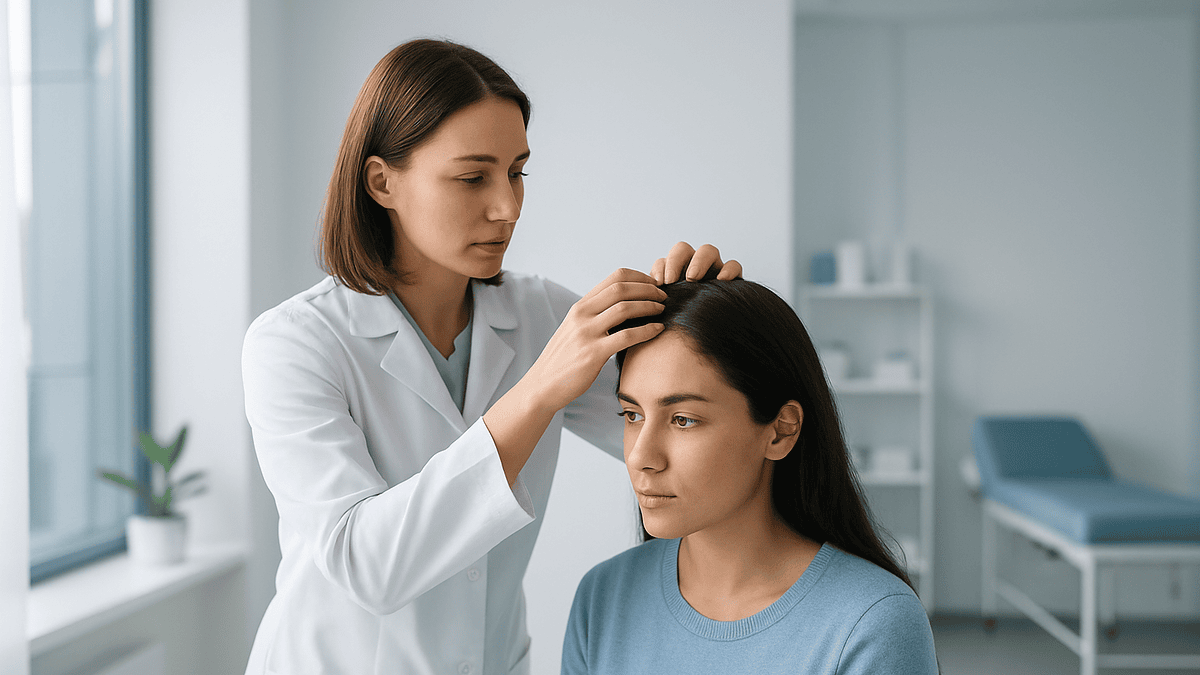
A typical robotic hair surgery candidate has stable, pattern-type hair loss, a dense donor area at the back and sides of the scalp, and hair the robot's camera can see clearly, usually straight to wavy, with color that contrasts against the skin. Tightly curled hair, very light or gray hair, active scalp disease, unstable shedding, or unrealistic expectations often lead a surgical team to suggest waiting or a different approach.
He had already done the math in the bathroom mirror. Six years of a hairline drifting backward, one photo from a wedding where the flash caught more scalp than he expected, and a browser history full of clinics promising that a robot could do what a surgeon’s hands could not. What he had not found was a straight answer to the only question that mattered to him: was he actually a robotic hair surgery candidate, or just a person who wanted to be one?
The honest answer turns out to depend less on the robot and more on him. Robotic systems do one job with great consistency, and that job is limited by what a camera can see. Hair color, the degree of curl, and the contrast between hair and skin decide whether the machine can identify and lift individual follicles cleanly. Everything else, from donor supply to the stability of the hair loss itself, is the same set of questions a surgeon would ask before any transplant.
What follows is the version of that conversation you would want a friend in medicine to have with you, without the marketing.
How does robotic hair surgery actually work?
Start with the unit of currency. Scalp hair does not grow as single strands but in small natural bundles called follicular units, each holding one to four hairs plus their oil glands and a tiny muscle (Cleveland Clinic). Every modern transplant, robotic or not, moves these bundles from a place where hair is programmed to stay, usually the back and sides, to a place where it is thinning.
Follicular unit extraction, or FUE, is the technique of harvesting those bundles one at a time with a small circular punch rather than removing a strip of skin. A robotic system performs the harvesting half of FUE. Its cameras photograph the shaved donor area many times per second, software maps each follicular unit and calculates the angle at which the hair exits the skin, and a mechanical arm positions a two-stage punch: a sharp inner needle scores the surface, then a blunter outer punch separates the graft from surrounding tissue. Technicians then lift the loosened grafts by hand.
Some systems also plan and create the recipient sites, the tiny slits where grafts will be placed, using a digital design agreed with the surgeon. In most practice, the placing of grafts into those sites remains a human task, done with forceps or implanter pens under magnification.
Two consequences follow. First, the surgeon has not been removed; they choose the plan, decide density, and remain responsible for judgment calls the algorithm cannot make. Second, because the robot depends on image recognition, its performance is tied to how distinctly each hair stands out against the skin and how predictably it travels beneath the surface. That is why the same physical features that make a photograph easy to read, contrast and straight lines, make a scalp easy for a robot to harvest.
Why hair color and skin contrast decide what the robot can see
Imagine trying to count dark threads scattered on a white tablecloth, then repeating the exercise with white threads on the same cloth. The first task is trivial. The second is guesswork. A robotic harvesting system faces exactly this problem, because its cameras identify follicular units by the difference in tone between hair shaft and surrounding skin.
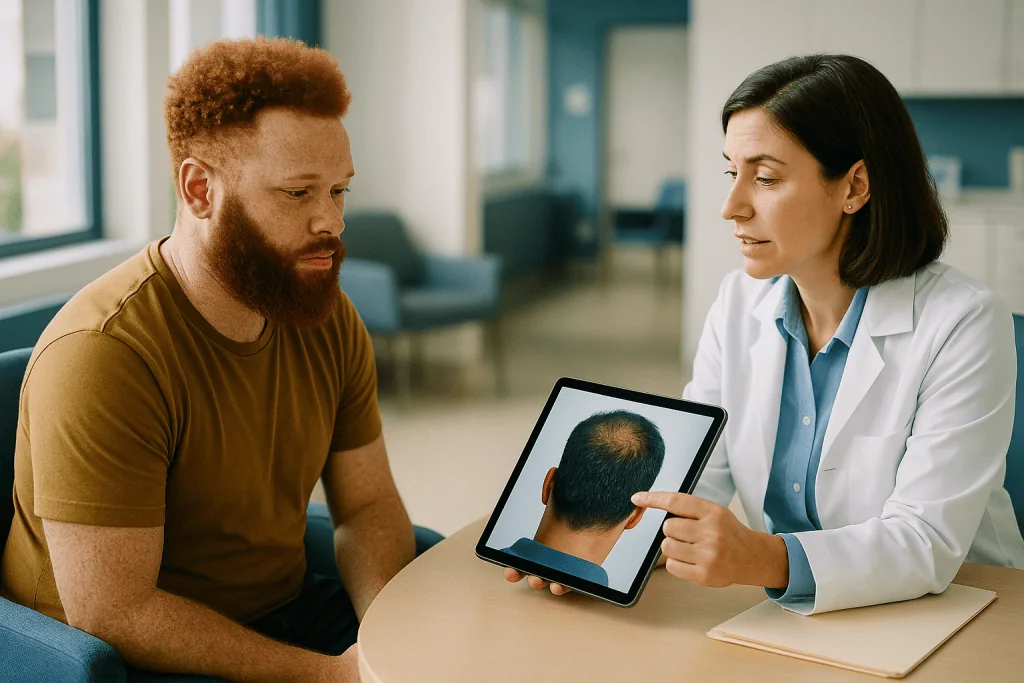
Dark hair on lighter skin gives the highest contrast, so the software can outline each bundle, count the hairs in it, and calculate the exit angle with confidence. Medium brown hair on medium skin still works in most cases. Very blonde, red, white, or gray hair on light skin, and very dark hair on very dark skin, can fall below the threshold at which the system reliably distinguishes one unit from the next or from the background.
Surgical teams have a practical workaround for the low-contrast, light-hair end of the spectrum: temporarily darkening the donor hair with a semi-permanent dye a day or two before surgery. This is a cosmetic adjustment, not a medical treatment, and it only helps when the hair is light against darker skin; it does nothing for dark hair on dark skin, where the limiting factor is the skin tone rather than the hair.
Gray hair carries a second complication. Gray or white hairs often lack pigment even within the shaft, and some people have a mixed field of pigmented and unpigmented hairs in the same donor zone. The camera may map the dark hairs beautifully and miss the light ones sitting beside them, which distorts the estimate of how many grafts the area truly holds. A surgeon assessing you for a hair transplant with gray hair will usually want to see the donor area up close, under magnification and good light, before saying whether robotic harvesting is realistic or whether manual FUE would give a more complete picture.
Curly hair transplant candidates: what the curl does under the skin
Curl is the feature that trips up robotic harvesting most often, and the reason is anatomical rather than technical. In straight hair, the visible shaft leaves the skin at a certain angle and the follicle beneath continues in roughly the same line, like a nail driven into wood. The robot measures the angle above the surface and extrapolates the path below it, then aligns its punch to that path.
In curly and tightly coiled hair, the follicle itself is curved. It may leave the surface pointing one way and bend sharply within the first few millimeters, so that the root sits well to one side of where a straight projection would place it. A punch aligned to the surface angle can shear through the curve and cut the bulb, a damaged graft that will not grow. Surgeons performing manual FUE on curly hair compensate by feel and by adjusting depth and angle in real time; current robotic systems have less ability to do that mid-punch.
Afro-textured hair adds the contrast problem discussed earlier, since dark hair against darker skin narrows the camera’s working margin. The combination of curved follicles and lower contrast is why many surgical teams tell people with tightly coiled hair that robotic harvesting is either not appropriate or would be attempted only after a small test session to see how many grafts survive intact.
None of this means curly-haired people cannot have a transplant. The curl actually works in their favor at the recipient end, because each curved hair covers more scalp than a straight one, so fewer grafts may produce a similar visual density. The candidacy question for a curly hair transplant is about the harvesting method, not about whether transplantation can be done at all, and that distinction is worth pressing on when a clinic seems to be selling the robot rather than the result.
Who is usually a robotic hair surgery candidate?
Strip away the technology and the profile of a good robotic hair surgery candidate is the profile of a good hair transplant candidate with a few visual requirements added. Surgical teams generally look for the following features together, not in isolation.
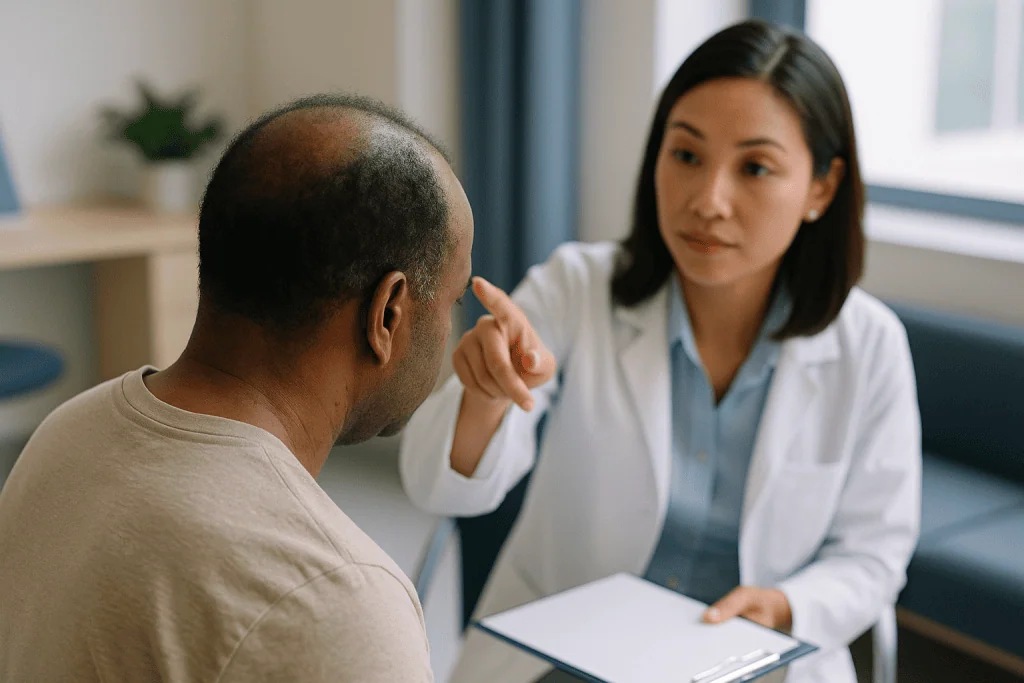
- A pattern-type diagnosis. Androgenetic alopecia, the inherited, hormone-sensitive thinning that affects an estimated half of men over 50 and a substantial share of women (MedlinePlus Genetics), leaves the back and sides largely intact. That preserved zone is the donor supply.
- Stability. Hair loss that has settled into a recognizable pattern rather than shedding rapidly across the whole scalp.
- A dense, mobile donor area. Enough follicular units per square centimeter that removing a portion will not leave visible thinning.
- Hair the camera can read. Straight to wavy texture and enough color contrast against the skin, or light hair that can be temporarily darkened.
- Willingness to shave the donor area. Robotic systems need hair trimmed to about a millimeter to map angles, so people unwilling to have the back and sides clipped short are usually steered toward manual approaches.
- Realistic goals. An understanding that a transplant redistributes existing hair and does not create new hair, so the aim is improved coverage, not the density of a teenager.
Most people who meet these criteria are also candidates for manual FUE or strip surgery. The robot is one way to harvest, chosen for consistency and reduced operator fatigue on long cases, not because it unlocks a category of patient who could not otherwise be treated. Any clinic that presents robotic candidacy as a distinct, special status is describing a tool as if it were a diagnosis.
What disqualifies you from a hair transplant, robotic or otherwise?
The people asking what disqualifies you from a hair transplant usually want a single deal-breaker. In practice, surgeons think in terms of reasons to wait and reasons to choose a different path, and only a few are absolute.
The clearest reason to decline surgery is a lack of donor supply. Diffuse unpatterned alopecia, where thinning affects the back and sides as much as the top, means the hair moved would be just as likely to fall out as the hair it replaces. Similarly, someone with very advanced loss and a narrow remaining band of hair may simply not have enough grafts to cover the area they hope to fill, and an honest surgeon will say so rather than sell a procedure that will disappoint.
Active inflammatory or scarring scalp disease is another firm reason to wait. Conditions such as lichen planopilaris or frontal fibrosing alopecia destroy follicles through inflammation, and grafts placed into active disease can be destroyed too. Alopecia areata, an autoimmune condition in which the immune system attacks follicles in patches, behaves unpredictably and can affect transplanted hair as readily as native hair (Cleveland Clinic). A dermatologist’s assessment, sometimes with a scalp biopsy, may be requested before any surgical plan.
Uncontrolled medical conditions matter as they do for any elective procedure: poorly controlled diabetes, bleeding disorders, immune suppression, and active infection raise the risk of poor healing and graft loss. A history of keloid or hypertrophic scarring is a concern because thousands of tiny punch wounds create thousands of opportunities for abnormal scars.
Finally, there is the psychological dimension. Body dysmorphic disorder, in which a person is preoccupied with a perceived flaw that others see as minor or absent, is a recognized reason for surgeons to decline cosmetic procedures, because surgery tends not to relieve the distress. A good team asks about expectations for the same reason it examines the donor area.
Robotic FUE vs manual FUE vs strip surgery: a side-by-side view
People weighing a robotic FUE hair transplant against the alternatives often assume the newest technology is automatically the best fit. The table below sets out how the three main approaches differ on the features that actually shape candidacy. It describes typical practice, not a ranking, and individual surgeons vary.
| Feature | Robotic FUE | Manual FUE | Strip (FUT) |
|---|---|---|---|
| How grafts are harvested | Image-guided robotic punch, grafts lifted by technicians | Surgeon or technician punches each unit by hand | A strip of scalp removed and divided under microscopes |
| Donor scarring | Many tiny dot scars, usually hidden by short hair | Many tiny dot scars, usually hidden by short hair | One linear scar, hidden if hair kept longer |
| Donor hair must be shaved | Yes, to roughly a millimeter | Usually, though small unshaven sessions are possible | Only the strip area |
| Straight or wavy hair | Suited | Suited | Suited |
| Tightly curled hair | Often limited or declined | Feasible with an experienced operator | Feasible |
| Light, gray or low-contrast hair | May need temporary dye; limited if dark-on-dark | Feasible | Feasible |
| Very large graft numbers | Consistent over long sessions | Operator fatigue is a factor | Efficient for high counts in one session |
Two honest notes. Published comparisons of robotic and manual FUE are mostly small case series from centers that own the equipment, so evidence that one produces better long-term growth than the other is limited; consistency in graft dimensions is the most reproducible finding. And strip surgery has not been made obsolete. For someone with straight hair who wants to keep it long over the donor area, or who needs a very high graft count, a linear scar may be a reasonable trade the treating team is right to raise.
The donor area is a budget, not a bank
Every transplant conversation eventually arrives at a number: how many grafts. The figure that matters more is the one behind it, which is how many grafts a donor area can spare over a lifetime without looking thin itself. Surgeons call this the safe donor zone, the band across the back and sides where hair is least sensitive to the hormones driving pattern loss.
Robotic harvesting adds a specific pressure on this budget. Because the system selects follicular units by image analysis, it can be programmed to favor units with more hairs per graft, which improves coverage at the recipient site but can over-harvest the densest part of the donor area if spacing is not set carefully. Surgeons counter this by defining minimum distances between punches and by capping the proportion of units removed from any square centimeter. That is a judgment call the surgeon programs in, not a decision the machine makes on its own.
Skin laxity, the looseness of the scalp, matters mostly for strip surgery, where a tight scalp limits how wide a strip can be closed without tension. For FUE of either kind, density and hair caliber matter more. Fine hair covers less scalp per graft than coarse hair, so a person with fine donor hair may need more grafts for the same visual effect, which draws down the budget faster.
The reason this belongs in a candidacy article is that pattern loss progresses. Hair moved into the hairline at 30 will still be there at 50, but the native hair behind it may have retreated, leaving an island unless grafts were held in reserve. A team that talks about your donor supply in terms of decades rather than a single session is treating candidacy the way the evidence suggests it should be treated, as a long-term plan.
Age, unstable loss and the problem of operating too early
The most common reason a surgeon asks an otherwise suitable person to wait is not hair type. It is youth. Pattern hair loss can begin in the late teens, and a person of 22 with a receding hairline often has the strongest desire for surgery and the least predictable future.
The concern is straightforward. Nobody can tell from a single visit how far a young person’s loss will progress. Placing grafts to rebuild a low, dense hairline at 22 can look natural for a decade and then increasingly unnatural as the surrounding hair thins toward a pattern the hairline no longer matches. Grafts are permanent; the hair around them is not. This is why many surgical teams prefer to see loss stabilize, often documented with photographs over a year or more, and why some encourage a period of medical treatment first to see how much native hair can be held.
Robotic harvesting does not change this calculus, though it can tempt people toward it. The machine’s consistency is sometimes marketed as making early surgery lower-risk, which confuses the technical risk of the harvest with the strategic risk of a plan that ages badly. The camera cannot see the future of the hair it is not harvesting.
Rapid diffuse shedding, whatever the age, is its own reason to pause. Telogen effluvium, a temporary shedding phase triggered by illness, surgery, childbirth, major stress or certain medicines, can mimic pattern loss for several months before recovering on its own (Mayo Clinic). Operating during that phase risks transplanting into a scalp that would have regrown anyway and complicates judging the result. A surgeon who wants to know what happened in your life over the past year is asking a clinical question, not a personal one.
Medical conditions and medicines that change the picture
Hair surgery is elective, performed under local anesthesia, and involves thousands of small wounds. That combination makes a few background conditions more relevant than they would be for a dental filling but less than for a major operation.
Blood thinners of any class raise the risk of bleeding during harvesting and placement and of grafts being displaced by oozing. Whether to adjust them is a decision for the prescribing doctor and the surgeon together, weighed against the reason the medicine was started, and no one should alter anticoagulation on the advice of a cosmetic consultation alone. Immunosuppressive treatments, including long-term steroid tablets and biologic therapies, can slow healing and blunt the graft’s ability to establish a blood supply. Diabetes matters chiefly when glucose control is poor, because high glucose impairs wound healing and infection defense.
Thyroid disease and iron deficiency deserve mention because both can cause diffuse hair thinning that is not pattern loss and may improve with treatment of the underlying cause (Mayo Clinic). Blood tests before a surgical decision are a reasonable step, and a result that explains the thinning can turn a candidate into a non-candidate in the best possible way.
The medicines used to slow pattern loss deserve their own paragraph. Topical minoxidil is thought to prolong the growth phase of follicles and widen small vessels around them; oral finasteride, used in men, blocks conversion of testosterone to the more potent dihydrotestosterone that shrinks susceptible follicles. Both take months to show an effect, with Mayo Clinic noting at least six months before judging whether minoxidil is helping, and neither is a substitute for surgery where hair is already gone. Many surgeons regard them as a way to protect the native hair around grafts, but whether to use them, and how, is a conversation for the prescribing clinician rather than a condition of candidacy.
Does the robot make more people candidates, or fewer?
One of the more widely repeated claims about robotic systems is that they expand the pool of people who can have a transplant. It is worth being precise about what the evidence actually supports, because the answer cuts both ways.
On the expanding side, robotic harvesting reduces the fatigue that limits how many grafts an individual surgeon can punch by hand in a single day with consistent quality. For a person with straight, high-contrast hair who needs a large number of grafts, that consistency is a genuine practical advantage, and it may allow FUE, with its dot scarring rather than a linear scar, for someone who might otherwise have been offered strip surgery for a high graft count.
On the narrowing side, every feature discussed in this article that the camera struggles with removes people from robotic candidacy who remain perfectly good candidates for manual harvesting. Tightly curled hair, gray or very light hair on light skin, dark hair on dark skin, and an unwillingness to shave the donor area are not barriers to a hair transplant. They are barriers to one particular harvesting tool. A clinic that only offers the robot will, quite naturally, describe those people as poor candidates, when the accurate statement is that they are poor candidates for that clinic’s equipment.
What the published literature does not show is that robotically harvested grafts grow better, survive longer, or produce results patients rate more highly than grafts harvested by an experienced surgeon. The studies that exist are largely descriptive, come from centers invested in the technology, and measure things like transection rate, the proportion of grafts cut during harvest, rather than long-term outcomes. Until independent comparisons exist, the fair summary is that the robot changes how the harvest is done and who it can be done on, not the ceiling of what a transplant can achieve.
What the days, weeks and months after robotic hair surgery usually look like
Candidacy conversations often skip the aftermath, yet the timeline is where many people’s expectations quietly go wrong. The procedure itself typically occupies most of a day, with local anesthesia and long periods of lying still while grafts are harvested and placed (MedlinePlus).
The first days bring swelling of the forehead, small crusts around each graft, and a donor area that looks like it has been stippled with red dots. The NHS notes that most people can return to work within a few days, though sports, swimming and anything that raises blood pressure to the head are usually restricted for a couple of weeks (NHS). Sleeping propped up and following the team’s washing instructions to the letter protects grafts during the window before they anchor.
Then comes the part that alarms people who were not warned: the transplanted hairs fall out. This is expected. The follicle survives while the shaft it carried is shed, typically within two to eight weeks of surgery (NHS). The follicle then rests before entering a new growth phase, and the first fine new hairs usually appear around the sixth month, with the result continuing to thicken over twelve to eighteen months (NHS). Because scalp hair grows roughly half an inch a month (Cleveland Clinic), even hair that has restarted takes time to reach a length that reads as coverage.
Some people also experience shock loss, a temporary shedding of native hair near the recipient or donor sites, provoked by the trauma of surgery. It generally recovers over the following months, but it can make the third month look worse than the day before surgery, and a candidate who has not been told this may conclude the procedure failed. Photographs at consistent intervals, taken by the team, are the fairest way to judge progress rather than daily mirror checks.
What people often get wrong about robotic hair transplant candidacy
The myths around hair surgery are durable because they are half true. Here are the ones that most often shape a poor decision.
The robot does the surgery. It does not. It harvests grafts, and in some setups creates recipient sites, according to a plan a surgeon designs. Design, density, hairline shape and graft placement remain human work, and the results vary with the humans involved.
Robotic means fewer scars. Robotic and manual FUE leave the same kind of scarring, many small dots across the donor area. These are usually hidden by hair kept a few millimeters long, but they are permanent, and someone who later shaves their head closely may see them. Strip surgery leaves one line instead. Neither is scarless.
A transplant stops hair loss. It moves resistant hair into thinning areas. The genetic process driving pattern loss continues in the surrounding native hair, which is why teams talk about long-term planning and, sometimes, medical treatment alongside surgery.
Celebrities prove what works. Search engines fill with questions about which billionaire or politician used which treatment. Public figures rarely disclose medical records, their photographs are lit and styled professionally, and speculation about one person’s hairline tells you nothing about your own follicles, donor supply or diagnosis. The evidence that should guide you comes from a scalp examination, not a red carpet.
If I am not a robotic candidate, I am not a candidate. This is the most consequential misunderstanding, and the whole point of this article. Curl, color and contrast are limits of a camera. Manual FUE and strip surgery are performed on curly, gray, and dark-on-dark hair routinely. Being told no by a robotic clinic is a reason to ask a second surgeon with different tools, not a verdict.
Alternatives if you are not a good candidate right now
Being asked to wait or steered away from surgery is disappointing, but it is rarely the end of the options. Which of these makes sense depends on the diagnosis, and every one of them is a decision for a dermatologist or the treating team rather than a self-prescription.
Medical treatment is usually the first conversation. Topical minoxidil, available for both men and women, and oral finasteride, used in men, are the treatments with the most consistent evidence for slowing pattern loss and encouraging some regrowth, with effects judged over months rather than weeks (Mayo Clinic). Neither restores a hairline that has fully receded, but both can hold ground, which is exactly what a young person with unstable loss needs while a surgical decision matures.
Low-level laser devices, platelet-rich plasma injections and a range of supplements are widely marketed. The evidence for laser devices is modest and mixed; for platelet-rich plasma it consists mainly of small trials with varied protocols; and for most supplements, unless a deficiency has been documented by blood test, there is little to support a benefit (Mayo Clinic). The honest summary is that none of these is established as an alternative to surgery, and anyone presenting them as equivalent is ahead of the evidence.
Cosmetic approaches deserve more respect than they get. Scalp micropigmentation, a form of tattooing that creates the appearance of short stubble, can disguise a widening part or a donor scar. Fibers and concealing powders, hairpieces and hair systems, or simply a shorter cut that narrows the contrast between thin and dense areas, change what others see without changing the scalp at all.
For scarring alopecias and alopecia areata, the priority is controlling the inflammation, which is dermatological rather than surgical care, and a transplant is only ever revisited once the disease has been quiet for a period the specialist is satisfied with.
Questions to ask your care team before agreeing to robotic hair surgery
A good consultation should leave you with fewer questions than you arrived with, not more. These are the ones that separate a genuine candidacy assessment from a sales appointment, and they are worth writing down beforehand.
- What is my diagnosis, and how confident are you that this is pattern hair loss rather than a condition that needs medical treatment first?
- Have you examined my donor area under magnification, and what is your estimate of how many grafts it can safely provide over my lifetime, not just today?
- Given my hair color, curl and skin tone, is robotic harvesting the best method for me, or the method this practice offers? Would you recommend manual FUE or strip surgery instead, and why?
- If my hair is light or gray, will it need to be dyed before surgery, and how does that affect your ability to count and select grafts?
- If my hair is curly, what is your expected rate of damaged grafts with this method, and would a small test session be sensible?
- Who will design my hairline and place the grafts, and how many procedures like mine has that person performed?
- How will my remaining native hair likely change over the next twenty years, and how does the plan account for that?
- What is the realistic coverage I should expect, and can I see photographs of people with similar hair type and degree of loss, at twelve months or later, taken in consistent lighting?
- What are the specific risks in my case, including infection, poor growth, shock loss, visible scarring and unnatural appearance, and how are they handled?
- What will the first weeks look like, and who do I contact if something concerns me?
Notice that none of these questions is about the robot’s specifications. The technology is the least variable part of the process. The judgment applied to your particular scalp is where outcomes are decided, and the answers you receive should reflect an examination of you rather than a description of the equipment.
When to call your doctor after hair transplant surgery
Most recoveries are uneventful, and the expected course, some swelling, crusting, itching and the unsettling shed of transplanted hairs, does not need a phone call. A short list of signs does, because they can indicate infection, bleeding or a healing problem that is easier to treat early.
Contact the surgical team the same day if you notice spreading redness or warmth around the donor or recipient area, especially if it is accompanied by increasing rather than decreasing pain after the first two or three days. Pus, a foul smell, or yellow-green discharge from any wound suggests infection. A fever, chills or feeling generally unwell in the first week should be reported promptly. Bleeding that does not stop with gentle pressure for several minutes, or that soaks through dressings, needs assessment.
Seek urgent care, by emergency services if necessary, for signs that can accompany any procedure involving anesthesia or medication: difficulty breathing, swelling of the lips or tongue, a widespread rash or hives, chest pain, fainting, or a severe headache with vision changes.
Later concerns deserve a call too, even if they are not emergencies. Small pimple-like bumps at graft sites may be folliculitis, an inflammation of the follicle, and a persistent numb or tingling patch of scalp beyond a few weeks, unusual thickened scarring, or an area of the donor zone that looks noticeably thinner than the rest are all worth documenting with the team. If at any point you are unsure whether something is normal, that uncertainty is itself a reason to ask; the people who placed the grafts are best placed to judge, and every decision about treatment, including whether anything needs to be done at all, rests with them.
Frequently asked questions
What disqualifies you from a hair transplant?
The firmest reasons are a donor area too thin to spare grafts, active scarring or autoimmune scalp disease, uncontrolled medical conditions that impair healing, a history of keloid scarring, and body dysmorphic disorder. Rapid diffuse shedding and very young age are usually reasons to wait rather than permanent exclusions. Hair color and curl do not disqualify anyone from a transplant; they may only limit whether a robotic harvesting method is appropriate for you.
Who isn't a good candidate for robotic hair surgery specifically?
People with tightly curled or coiled hair, very light or gray hair that cannot be adequately darkened for contrast, dark hair on dark skin, or an unwillingness to shave the donor area are the usual poor fits for robotic harvesting. Each of these limits what the camera can see or predict beneath the skin. Many of these same people remain candidates for manual FUE or strip surgery, so the answer depends on the method, not the person.
Can I have a robotic FUE hair transplant if I have gray hair?
Sometimes, and it depends on your skin tone and how mixed the gray is. Light hair on darker skin can often be temporarily dyed before surgery to give the camera enough contrast to map follicular units. Where gray and pigmented hairs are mixed, the system may undercount the light ones, distorting the donor estimate. A surgeon examining you under magnification will decide whether robotic or manual harvesting gives a more complete picture.
Is a curly hair transplant possible with a robot?
It is often limited or declined, because curly follicles curve beneath the skin and a punch aligned to the surface angle can cut the root. Manual FUE and strip surgery are performed on curly and afro-textured hair routinely by surgeons who adjust angle and depth by feel. Curl also helps at the recipient end, since each curved hair covers more scalp, so fewer grafts may be needed for a similar visual result.
Does the robot give better results than a surgeon doing FUE by hand?
The evidence does not show that. Published comparisons are mostly small case series from centers that use the equipment, and they measure things like graft consistency and transection rate rather than long-term growth or how patients rate their appearance years later. The robot offers consistency over long sessions on suitable hair types. Design, density and graft placement remain human tasks, and those are where results vary most.
What did Elon Musk or other famous people use to regrow their hair?
Nobody outside their care teams knows, because public figures rarely release medical records, and confident online accounts are speculation. Professional lighting, styling and camera angles also change how a hairline appears. Whatever any individual did, it tells you nothing about your own diagnosis, donor supply or hair type. The treatments with mainstream evidence for pattern loss are described by sources like Mayo Clinic, and a dermatologist can tell you which apply to you.
Am I a bad candidate for hair transplant if I am under 25?
Not necessarily bad, but often too early. Pattern loss in the early twenties is unpredictable, and a hairline built to suit a 22-year-old can look mismatched decades later as surrounding hair recedes. Many surgeons prefer to document stability over a year or more, sometimes alongside medical treatment, before operating. The delay is about protecting a finite donor supply and a result that has to age with you.
Do I have to shave my head for robotic hair surgery?
The donor area, usually the back and sides, generally needs to be clipped to about a millimeter so the cameras can measure each hair’s exit angle. The top and front can often be left longer, depending on the plan. If you are not willing to have the donor area shaved, manual FUE in small unshaven sessions or strip surgery, which removes only a narrow band, may be discussed as alternatives.
How long before I see results after a robotic hair transplant?
Longer than most people expect. Transplanted hairs typically shed within two to eight weeks, the follicles rest, and new growth usually becomes visible around six months, with the result continuing to thicken over twelve to eighteen months, according to NHS guidance. Scalp hair grows roughly half an inch a month, so even regrowing hair takes time to read as coverage. Consistent photographs from the team are a fairer gauge than the mirror.
Can a hair transplant treat alopecia areata or a scarring alopecia?
Usually not while the condition is active. Alopecia areata is an autoimmune process that can attack transplanted follicles as readily as native ones, and scarring alopecias destroy follicles through inflammation that can consume grafts. The priority is controlling the underlying disease with a dermatologist. Surgery is only revisited once the condition has been quiet for a period the specialist is satisfied with, and the decision remains theirs.
References
- MedlinePlus: Hair transplant
- NHS: Hair transplant
- MedlinePlus Genetics: Androgenetic alopecia
- Cleveland Clinic: Alopecia Areata
This article is for general information only and is not a substitute for professional medical advice. Please consult a qualified doctor about your individual situation.

More from the Blog
Eyebrow Transplant Recovery: Healing, Scabbing and the Trimming Routine
Eyebrow transplant recovery typically follows a predictable arc: redness and tiny scabs for the first 5 to 10 days, a shedding phase between roughly…
Afro Hair Transplant for Traction Alopecia: Why Stopping the Pull Comes Before Surgery
An afro hair transplant can restore a hairline thinned by traction alopecia, but only after the pulling has fully stopped and the scalp has…

Norwood 6: What Advanced Loss Means for Donor Supply and Expectations
Norwood 6 is advanced male pattern hair loss: the frontal and crown bald areas have merged into one, leaving only a horseshoe of hair…
Mature Hairline or Receding? How to Tell the Difference Honestly
A mature hairline moves back evenly, about a finger's width, or 1 to 1.5 centimeters, above the adolescent line, and then stabilizes, with the…
The Norwood Scale: How Surgeons Stage Hair Loss to Plan a Transplant
The Norwood scale is a seven-stage classification of male pattern hair loss, running from a full youthful hairline (stage 1) to a single horseshoe…
Which Sleeping Position Protects Grafts After an FUE Hair Transplant? Elevation and Pillows
After an FUE hair transplant, most care teams ask patients to sleep on their back with the head raised on pillows or a wedge…