

Who May Be a Candidate for vNOTES Scarless Surgery? What Gynecologic Surgeons Consider

Key Takeaways
- vNOTES combines the vaginal entry of a conventional vaginal hysterectomy with the camera and instruments of laparoscopy, which is what lets the surgeon see and remove the tubes and ovaries directly.
- The strongest candidates have a benign diagnosis, a uterus that is not markedly enlarged, and no history suggesting dense pelvic adhesions or deep endometriosis behind the cervix.
- Suspected gynecologic cancer generally rules out vNOTES because staging requires access to lymph nodes and the upper abdomen that this route does not provide.
- "Scarless" refers to the abdomen only; an incision at the top of the vagina is stitched into a vaginal cuff that needs weeks to heal, which is why sex is usually deferred at least 4 to 6 weeks.
- Routine razor shaving before surgery is no longer recommended by infection-prevention guidance, and vNOTES often requires no hair removal at all since there are no abdominal incisions.
- Mainstream hysterectomy guidance places full recovery at about 6 to 8 weeks after an abdominal operation and often shorter after vaginal or laparoscopic routes, but internal healing is never instant.
vNOTES surgery candidates are usually people who need a hysterectomy, fallopian tube removal, or ovarian cyst surgery for a benign (non-cancerous) condition, whose uterus is not very enlarged, who have no known dense pelvic scarring or deep endometriosis, and whose vaginal anatomy allows the instruments to pass. Suspected cancer, active pelvic infection, or a history suggesting heavy adhesions usually points toward another route. The gynecologic surgeon decides after an exam and imaging.
She had already decided on the hysterectomy. What she hadn’t decided on was the route, and the consultation ended with a phrase she had never heard before: “You might be a candidate for vNOTES.” That evening she searched the term, found a wall of promotional pages promising no visible scars, and came away with more questions than she started with. Would she qualify? Why wouldn’t everyone?
That gap between the marketing and the medicine is where this article lives. The question of who makes the list of vNOTES surgery candidates is less about a wish list and more about anatomy, history, and what the surgeon expects to find once the operation begins.
What follows is the reasoning a gynecologic surgeon typically works through, laid out plainly: who tends to be offered this approach, who is usually steered elsewhere, and what the following weeks look like for most people.
What is vNOTES surgery, and what actually happens during it?
vNOTES stands for vaginal natural orifice transluminal endoscopic surgery. In plain terms, it is keyhole surgery on the pelvic organs performed entirely through the vagina, with no cuts in the abdominal wall. The word “endoscopic” simply means the surgeon watches the operation on a screen through a thin camera rather than looking directly into an open incision.
The technique borrows from two older operations. From vaginal hysterectomy, it takes the entry point: an incision made at the top of the vagina, around the cervix. From laparoscopy (abdominal keyhole surgery), it takes the tools: a camera, long slim instruments, and gas that gently inflates the pelvis so the surgeon has room to see and work. A soft, flexible port sits in the vaginal opening and holds these instruments in place, sealing the space so the gas stays in.
Once inside, the surgeon can see the uterus, the fallopian tubes, and the ovaries from below. That view is the key difference from a conventional vaginal hysterectomy, where the surgeon works mostly by touch and can struggle to reach the tubes and ovaries. In vNOTES, the ovaries and tubes (together called the adnexa) come into direct view, so they can be examined or removed if the plan calls for it.
The organ being removed comes out through the same vaginal opening. The incision at the top of the vagina is then closed with dissolvable stitches, forming what surgeons call the vaginal cuff. The patient wakes with no abdominal wound to dress. The operation typically takes place under general anesthesia, and most centers that offer it aim for a short hospital stay, though how short depends on the individual case and local practice (Mayo Clinic).
Who are the usual vNOTES surgery candidates?
When people ask “Who is a good candidate for a vNOTES hysterectomy?” the honest answer starts with the reason for surgery. vNOTES has been developed and studied mainly for benign gynecologic conditions: fibroids that are causing symptoms, heavy bleeding that has not responded to other treatment, adenomyosis (where the uterine lining grows into the muscle wall), uterine prolapse, and removal of tubes or ovarian cysts. If the diagnosis is one of these and a hysterectomy or adnexal operation is already the agreed plan, the route becomes a live question.

Beyond the diagnosis, surgeons look for a handful of favorable features:
- A uterus that is not markedly enlarged. Very large fibroid uteruses can be difficult to bring down and remove through the vagina, even in pieces.
- Good vaginal access. Enough room to place the port and move the instruments, which depends on individual anatomy rather than on age or childbirth history alone.
- A pelvis that is expected to be free of dense scarring. Prior cesarean sections or other pelvic surgery do not automatically rule someone out, but they raise the surgeon’s index of suspicion for adhesions (internal scar tissue that glues organs together).
- No known deep endometriosis behind the uterus, which can fix the bowel to the back of the cervix precisely where the vNOTES entry is made.
- A medical profile that tolerates general anesthesia and the head-down positioning used for pelvic keyhole surgery.
Notably, having never given birth is not by itself a barrier; surgeons assess the actual anatomy at examination. Likewise, a higher body weight does not exclude someone; some surgeons consider the absence of abdominal incisions a practical advantage in that setting, though the evidence remains observational. The unifying thread is predictability: the more confident the surgeon feels about what they will find, the more comfortable they are with a route that offers less room to improvise.
vNOTES surgery candidates who are usually asked to wait or offered another route
Being told you are not a candidate can feel like a door closing. In practice it usually means the surgeon judges another route safer for your specific situation, not that surgery is off the table.
Suspected or confirmed gynecologic cancer is the clearest example. Cancer surgery often requires removing lymph nodes high in the pelvis and abdomen, inspecting the upper abdomen, and avoiding any cutting of the tumor into pieces. Those requirements sit outside what vNOTES is currently designed to deliver, and most guidance treats known malignancy as a reason to use laparoscopic, robotic, or open approaches instead.
Other situations that commonly lead surgeons to pause or redirect include:
- A very large uterus, often described in weeks-of-pregnancy equivalents, where the surgeon doubts it can be safely delivered through the vagina.
- Known or strongly suspected severe adhesions from previous surgery, pelvic infection, or a ruptured appendix, because scarred bowel near the entry point raises the risk of injury.
- Deep infiltrating endometriosis involving the space between the rectum and vagina.
- Active pelvic infection, which most surgeons prefer to treat first.
- Narrow vaginal access or a cervix positioned in a way that makes the entry incision difficult.
- Medical conditions that make general anesthesia or steep head-down positioning risky, such as certain heart or lung problems, which would affect any keyhole route.
Pregnancy is a straightforward reason to defer. So is any situation where the diagnosis is still uncertain, since the operation should never be chosen before the reason for operating is clear (NHS).
One more category deserves mention: places where the surgical team has limited experience with vNOTES. Surgeon familiarity is a legitimate part of candidacy. A person who is anatomically ideal may still, sensibly, be offered a route the team performs every week.
How does a gynecologic surgeon decide? The candidacy work-up explained
The assessment usually begins before the word vNOTES is ever spoken. It starts with the history: how many pelvic operations, what kind, whether there have been episodes of pelvic inflammatory disease, whether endometriosis has ever been diagnosed or suspected, and what symptoms are driving the decision now.
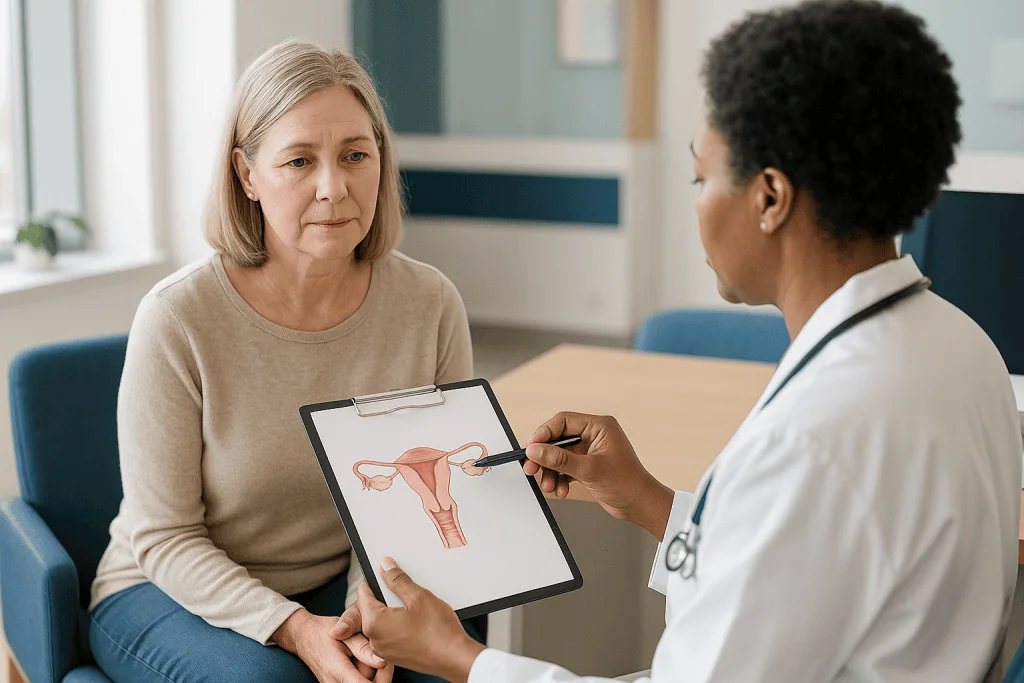
Then comes the pelvic examination. A surgeon assessing for a vaginal route is feeling for several things at once: the size and mobility of the uterus, how far it descends when gently pulled, the width and depth of the vagina, and whether there is tenderness or nodularity behind the cervix that could hint at endometriosis. A uterus that moves freely is reassuring; one that feels fixed suggests adhesions.
Imaging fills in the rest. A pelvic ultrasound measures the uterus, maps fibroids, and looks at the ovaries. If the picture is unusual, an MRI may follow. Where there is any suspicion of cancer, an endometrial biopsy or other tests come first, because the answer changes the route entirely.
The surgeon is also weighing the operation’s contingency plan. Every vNOTES procedure carries a possibility of “conversion,” meaning switching mid-operation to laparoscopy or an open incision if the view is poor or something unexpected appears. Consent discussions typically cover this explicitly, and a person’s willingness to accept that possibility is part of the decision.
The final piece is the conversation itself. What matters most to this particular person? Some prioritize avoiding abdominal scars; others prioritize the route their surgeon knows best; others have a strong preference to keep or remove the ovaries. Candidacy is not a checklist that spits out a verdict. It is a judgment that blends anatomy, history, imaging, the surgeon’s experience, and the patient’s priorities, and the treating team owns the final call (Cleveland Clinic).
Which gynecologic procedures can be done with vNOTES?
Hysterectomy is the operation most people associate with vNOTES, and it is where most of the published experience lies. But the approach is not limited to removing the uterus. Because the camera reaches the tubes and ovaries directly, several adnexal procedures are also performed this way.
Procedures commonly offered through vNOTES in centers that use it include:
- Hysterectomy, with or without removal of the fallopian tubes and ovaries, for benign conditions such as fibroids, heavy bleeding, adenomyosis, or prolapse.
- Salpingectomy, meaning removal of one or both fallopian tubes, whether for permanent contraception or to reduce future ovarian cancer risk in people already having pelvic surgery.
- Removal of ovarian cysts thought to be benign, or removal of an ovary.
- Some prolapse repairs that involve attaching the top of the vagina to strong pelvic ligaments.
- Diagnostic looks at the pelvis in selected cases.
Where vNOTES is not routinely used tells its own story. Removing fibroids while keeping the uterus (myomectomy) through this route is described in small series but is not standard. Cancer staging, as discussed earlier, sits largely outside its current scope. Complex endometriosis excision involving the bowel is generally approached laparoscopically or robotically, where the surgeon has a wider field.
The pattern is consistent: vNOTES suits operations centered on the uterus, tubes, and ovaries, in a pelvis expected to be relatively clean, where the tissue being removed can leave through the vagina. The further a case drifts from that center, the more likely a surgeon is to choose a different route or to combine approaches. Some teams, for instance, add a single small abdominal port when they want extra reach, which changes the “scarless” label but may be the safer plan (MedlinePlus).
vNOTES vs laparoscopic hysterectomy and other routes: a side-by-side table
A hysterectomy can be performed through the abdomen with a single larger incision, through several small abdominal keyholes (laparoscopic or robot-assisted), through the vagina alone, or through the vagina with keyhole tools (vNOTES). Each has a place. The table below summarizes how they differ in broad, guideline-level terms; individual experience varies widely, and the treating team weighs these trade-offs for each person.
| Route | Where the incisions are | View of tubes and ovaries | Typical situations where it is favored | Common limits |
|---|---|---|---|---|
| Abdominal (open) | One incision on the lower abdomen | Direct, wide | Very large uterus, suspected cancer, extensive scarring | Longer recovery; visible scar |
| Laparoscopic / robotic | Several small abdominal cuts | Excellent, including upper abdomen | Most benign cases; endometriosis; when ovaries need careful inspection | Small scars; requires abdominal entry |
| Vaginal (conventional) | Top of the vagina only | Limited; often by touch | Prolapse; smaller mobile uterus | Hard to reach ovaries; narrow access can be limiting |
| vNOTES | Top of the vagina only, with a port | Good for pelvis; limited for upper abdomen | Benign hysterectomy or adnexal surgery in a pelvis expected to be free of dense adhesions | Not for cancer staging; large uterus; deep endometriosis; newer evidence base |
Two honest caveats belong under the table. First, the evidence for vNOTES is younger than for the other routes. Randomized comparisons with laparoscopy exist but are few, and longer-term data on outcomes such as pelvic floor function are still accumulating. Second, mainstream guidance on hysterectomy generally favors a vaginal route when it is feasible, followed by laparoscopy, with open surgery reserved for cases that need it. vNOTES sits within that vaginal-first philosophy, but “feasible” remains the operative word, and that is a surgeon’s judgment (NHS).
Is vNOTES really scarless? What the evidence shows
The word “scarless” does a lot of work in the way this operation is described, and it deserves a careful look. It is accurate in one sense: there are no incisions on the skin of the abdomen, so there is nothing visible when the person is dressed or undressed. It is inaccurate in another: an incision is made at the top of the vagina and heals into a scar there, just as it does after a conventional vaginal hysterectomy. That internal scar is not seen, but it exists, and it is the site that needs the most care during recovery.
What does the research say about outcomes? The best available comparisons come from single-center series and a small number of randomized trials comparing vNOTES with conventional laparoscopic hysterectomy for benign disease. Broadly, these studies report that vNOTES can be completed successfully in appropriately selected patients, with hospital stays and pain scores that are similar to or shorter than laparoscopy in the early days. Those findings are encouraging but come with limits: most studies involve experienced surgeons operating on carefully chosen patients, follow-up is often measured in weeks or months rather than years, and the total number of participants is small compared with the decades of data behind laparoscopy.
Questions that remain genuinely open include the long-term effect on sexual function and pelvic support, the true rate of conversion in everyday practice outside specialist centers, and how outcomes hold up as more surgeons learn the technique. None of this means vNOTES is unproven in the sense of being ineffective. It means the honest description is “a promising, established-in-some-centers technique with a maturing evidence base,” rather than a settled standard. A surgeon who says this plainly is giving you good information, not hedging.
Do they shave your pubic hair before a hysterectomy? What surgery day involves
This is one of the most searched questions about hysterectomy, and the answer surprises people. Routine shaving of pubic hair before surgery is no longer recommended. Infection-prevention guidance from bodies such as the CDC and WHO advises against removing hair with a razor, because tiny nicks in the skin can raise the risk of wound infection. If hair removal is needed at all for access or dressings, teams use electric clippers, and for a vNOTES procedure there is often no need to remove any hair because there are no abdominal incisions. Patients are usually asked not to shave the area themselves in the days before surgery for the same reason.
The rest of surgery day follows a familiar rhythm. Most people are asked to stop eating for several hours beforehand; the exact instructions come from the anesthesia team. On arrival, checks are repeated, consent is confirmed, and an intravenous line is placed. General anesthesia is standard for vNOTES, so the person is asleep throughout.
Once asleep, a urinary catheter is placed to keep the bladder empty and out of the way. The legs are positioned in supports, and the operating table is tilted head-down so the bowel drifts away from the pelvis. After the procedure, the catheter is often removed within hours, though timing varies by center and by how the bladder was handled during surgery.
Waking up, people commonly describe cramping low in the pelvis, a feeling of pressure, and sometimes shoulder-tip discomfort from the gas used during keyhole surgery, which settles as the gas is absorbed. Some light vaginal bleeding or discharge is expected. Many units that perform vNOTES plan for discharge the same day or the next, but this is a target, not a guarantee, and the team will keep someone longer if pain, bleeding, or bladder function are not settled (Mayo Clinic).
vNOTES hysterectomy recovery time: what the first days and weeks usually look like
Recovery has no single timeline, but general hysterectomy guidance offers useful anchors. The NHS notes that full recovery after an abdominal hysterectomy takes about 6 to 8 weeks, and that recovery is often shorter after vaginal or laparoscopic routes (NHS). vNOTES falls within the vaginal family, so most surgeons discuss recovery in those terms while stressing that individual variation is wide.
The first few days are usually dominated by pelvic cramping and fatigue. Walking around the house is encouraged early, both for comfort and to reduce the risk of blood clots. Vaginal discharge is normal and may be pinkish or brownish; it should lessen over time rather than increase. Pain relief follows the plan the surgical team provides.
Across the first couple of weeks, most people find they can manage light daily activities and short walks, while heavy lifting, vigorous exercise, and anything that strains the pelvic floor are usually kept on hold. The stitches at the top of the vagina are the concern here: they take weeks to heal, and pressure or penetration too early can disrupt them.
On the specific questions people ask most:
- Sex and anything inserted into the vagina, including tampons, are typically deferred until healing is confirmed at a follow-up visit, which the NHS describes as usually at least 4 to 6 weeks (NHS).
- Driving is generally resumed when a person can sit comfortably, wear a seat belt without pain, and perform an emergency stop; the NHS frames it this way rather than as a fixed date.
- Return to work depends heavily on the job, with desk-based roles usually resuming sooner than physically demanding ones.
If the ovaries were removed before natural menopause, hot flushes and other symptoms may begin within days. That possibility is best discussed before surgery so the plan for managing it is already in place, guided by the treating team.
What fills the hole after a hysterectomy?
People imagine an empty cavity where the uterus used to be. Anatomically, that is not what happens. The uterus is a muscular organ roughly the size of a small pear in someone who has not had children and somewhat larger after pregnancies or with fibroids. When it is removed, the space it occupied is quickly taken up by the surrounding structures: loops of small intestine settle a little lower, the bladder and rectum shift slightly toward each other, and the pelvic floor muscles and ligaments continue to provide the same support they did before.
The opening at the top of the vagina, where the cervix was attached, is closed with dissolvable stitches at the end of the operation. That closure is the vaginal cuff. Once healed, the vagina ends in a smooth pouch rather than opening onto the cervix, so there is no channel leading anywhere. The vaginal length is usually preserved or changes only slightly, though experiences vary and this is a fair question to raise with the surgeon.
If the ovaries are left in place, they stay roughly where they were, supported by their own ligaments, and continue to produce hormones until natural menopause. If they are removed, the fallopian tubes typically go with them.
Two practical consequences follow. First, periods stop completely, because there is no uterine lining to shed, and pregnancy is no longer possible. Second, because the cervix is removed in a total hysterectomy, routine cervical screening is usually no longer needed for people whose surgery was for benign reasons and whose screening history was normal; anyone with a history of abnormal screening or whose cervix was left in place (a subtotal hysterectomy) should follow the advice of their care team (MedlinePlus).
vNOTES surgery risks: what can go wrong, described plainly
Every hysterectomy route carries risk, and vNOTES shares most of the general ones while adding a few that relate to its entry point. Surgeons discussing consent generally cover the following, in neutral terms rather than as predictions.
- Bleeding, during or after surgery, occasionally requiring transfusion or a return to the operating room.
- Infection, including of the vaginal cuff, the pelvis, or the urinary tract.
- Injury to nearby organs. The bladder sits directly in front of the vNOTES entry point and the rectum directly behind it, so both are at risk during the initial incision. The ureters (the tubes carrying urine from kidney to bladder) run close to the sides of the cervix and can be injured during any hysterectomy.
- Conversion to laparoscopy or open surgery if the view is inadequate, adhesions are found, or bleeding cannot be controlled from below. This is a safety decision, not a failure.
- Vaginal cuff dehiscence, meaning the stitched top of the vagina opens before it has healed, which is uncommon but recognized after any total hysterectomy and is the main reason for the weeks-long pause on sex.
- Blood clots in the legs or lungs, the risk of which is reduced by early walking and, in some cases, medicines or compression stockings arranged by the team.
- Anesthetic complications, which apply to any operation under general anesthesia.
- Effects on the ovaries even when they are kept, since their blood supply runs alongside the uterus; some people experience earlier menopause than they otherwise would have.
How these risks compare between vNOTES and laparoscopy is still being clarified. Early studies suggest complication rates in selected patients are broadly comparable, but the patient groups are small and carefully chosen. Anyone weighing this route deserves to hear both that reassurance and its limits from the surgeon who will be operating (Cleveland Clinic).
What people often get wrong about vNOTES
Some misunderstandings show up in almost every consultation about this operation. Correcting them tends to make the decision clearer.
“Scarless means nothing was cut.” An incision is made and stitched at the top of the vagina. It heals like any surgical wound and needs the same weeks of care.
“If I’m a good candidate, I should have vNOTES.” Being anatomically suitable is one factor. The experience of the team is another, and mainstream guidance treats the surgeon’s expertise with a given route as a legitimate reason to choose it.
“vNOTES is the same as a vaginal hysterectomy.” They share an entry point, but vNOTES adds a camera and keyhole tools, which is what allows the tubes and ovaries to be seen and treated directly.
“Once they start from below, they can’t switch.” Conversion to laparoscopy or an open incision is always available and is planned for in advance. Consent discussions normally cover it.
“It’s not possible if I’ve never had a baby.” Vaginal access is assessed by examination. Childbirth history informs the assessment but does not decide it.
“Recovery is instant because there are no cuts.” Internal healing takes weeks regardless of route. The NHS gives 6 to 8 weeks as a full-recovery guide for abdominal hysterectomy and describes vaginal and laparoscopic recovery as often shorter, not as immediate (NHS).
“It’s a brand-new experimental operation.” It is newer than laparoscopy and its evidence base is still growing, but it is performed in established programs and has been studied in randomized trials. “Newer with maturing evidence” is the fair description.
“My ovaries have to come out.” Whether to remove the ovaries is a separate decision from the route and is made on its own merits with the treating team.
Questions to ask your care team before deciding on vNOTES
A good consultation leaves room for questions, and the most useful ones are specific. Consider bringing a list such as this one to the appointment:
- Based on my examination and imaging, what makes me a suitable or less suitable candidate for vNOTES, and what specifically concerns you, if anything?
- How often does your team perform this procedure, and what is your usual approach when the vNOTES route turns out not to be possible mid-operation?
- Would you recommend removing my fallopian tubes, my ovaries, or both, and how does that decision affect the route?
- Will my cervix be removed, and what does that mean for future cervical screening?
- What are the alternatives for me, including a conventional vaginal, laparoscopic, or open approach, and how do their trade-offs apply to my situation?
- What is your plan if you find adhesions or endometriosis that were not expected?
- How long do you anticipate I will stay in hospital, and what would lead you to keep me longer?
- What should my recovery look like week by week, and what activities should I avoid until my follow-up?
- What symptoms after surgery would you want to hear about immediately?
- If my ovaries are removed before menopause, how will we manage symptoms, and who will follow that up?
- Is there anything about my medical history, medicines, or previous surgeries that changes the risk profile of this route?
It is reasonable to ask the surgeon to explain their answer to the first question in some detail. A surgeon who can describe exactly why your uterus size, pelvic mobility, and history make vNOTES a sensible or unwise choice is giving you the substance of the decision, not just its label. Equally, if the answer is that another route suits you better, ask what that route offers in your case. The aim is a decision you understand, made with the team that will carry it out (MedlinePlus).
When to call your doctor after vNOTES surgery
Most recoveries are uneventful, but a few signs mean the surgical team should hear from you promptly rather than at the next scheduled visit. Knowing them in advance takes the guesswork out of the first weeks.
Contact your care team the same day, or seek emergency care if symptoms are severe, for any of the following:
- Heavy vaginal bleeding, such as soaking a pad within an hour or passing large clots, or bleeding that increases rather than settles.
- Vaginal discharge that becomes foul-smelling, thick, or green or yellow, especially with fever or chills.
- A temperature that is persistently raised, or shaking chills.
- Worsening pelvic or abdominal pain that is not controlled by the pain plan you were given, or a belly that becomes swollen and tense.
- Difficulty passing urine, burning on urination, or urine leaking from the vagina, which can signal a bladder or ureter problem.
- A sudden gush of watery fluid from the vagina, or a sensation that something is bulging or protruding, which can indicate a problem with the vaginal cuff and needs urgent assessment.
- Redness, warmth, swelling, or pain in one calf, which can be a sign of a blood clot.
- Sudden shortness of breath, chest pain, or coughing up blood, which may indicate a clot in the lung and is a reason to call emergency services.
- Persistent vomiting or an inability to keep fluids down.
Bowel changes in the first days, mild cramping, and light pinkish discharge are common and usually settle. If you are unsure whether something counts as a red flag, the safest course is to call and describe it. Surgical teams would far rather hear about a symptom that turns out to be nothing than miss one that mattered (NHS).
Frequently asked questions
Who is a good candidate for a vNOTES hysterectomy?
Typically someone having a hysterectomy for a benign condition such as fibroids, heavy bleeding, adenomyosis, or prolapse, with a uterus that is not very enlarged, adequate vaginal access, and no history pointing to dense pelvic scarring or deep endometriosis. The surgeon confirms suitability through a pelvic examination and ultrasound, and also weighs their own team’s experience with the technique before recommending it.
What is vNOTES hysterectomy recovery time compared with other routes?
General hysterectomy guidance from the NHS gives about 6 to 8 weeks for full recovery after an abdominal operation and notes that vaginal and laparoscopic routes are often shorter. vNOTES belongs to the vaginal family, so surgeons usually discuss recovery in those terms. Everyone heals at a different pace, and the vaginal cuff still needs weeks before sex or anything inserted into the vagina is safe.
What fills the hole after a hysterectomy?
There is no lasting hole. Once the uterus is removed, nearby structures such as the small intestine, bladder, and rectum shift slightly to occupy the space, supported by the same pelvic floor muscles and ligaments as before. The top of the vagina is stitched closed into a smooth pouch called the vaginal cuff, so the vagina no longer opens onto a cervix and leads nowhere.
Do they shave your pubic hair before a hysterectomy?
Routine shaving is no longer recommended. Infection-prevention guidance advises against razors because small skin nicks can increase wound infection risk; if hair removal is needed for access, electric clippers are used instead. For vNOTES there are no abdominal incisions, so hair removal is often unnecessary. Patients are usually asked not to shave the area themselves in the days before surgery.
What are the main vNOTES surgery risks?
They include bleeding, infection, injury to the bladder, rectum, or ureters, blood clots, anesthetic complications, and opening of the stitched vaginal cuff before it heals. There is also a possibility of converting to laparoscopy or open surgery if the view is poor or unexpected findings appear. Early studies suggest rates broadly comparable to laparoscopy in selected patients, but the evidence base is still small and growing.
How does vNOTES compare with laparoscopic hysterectomy?
Both use a camera and slim instruments, but laparoscopy enters through small abdominal cuts while vNOTES enters through the top of the vagina. Laparoscopy offers a wider view including the upper abdomen and suits endometriosis and suspected cancer; vNOTES avoids abdominal incisions and suits benign cases in a pelvis expected to be free of dense scarring. Which is better depends on the individual and the surgeon’s experience.
Can I have vNOTES if I have never given birth?
Often yes. Never having given birth is not by itself a barrier. What matters is the actual vaginal access found at examination, meaning whether there is enough room to place the port and move instruments, and how mobile the uterus is. Some people who have never been pregnant have excellent access and others do not, so the surgeon assesses each person individually.
Can vNOTES be used if cancer is suspected?
Generally not. Cancer surgery often requires removing lymph nodes high in the pelvis and abdomen, examining the upper abdomen, and removing tissue intact, none of which vNOTES is designed to deliver. When there is any suspicion of malignancy, surgeons usually complete biopsies and other tests first and then choose a laparoscopic, robotic, or open approach appropriate to the diagnosis.
Will my ovaries be removed during a vNOTES hysterectomy?
Not necessarily. Whether to remove the ovaries is a separate decision from the surgical route, based on age, cancer risk, and personal preference. vNOTES allows the surgeon to see the ovaries directly and remove them if that is the plan, or leave them in place. If they are removed before natural menopause, menopausal symptoms can begin within days, so that plan should be discussed beforehand with the treating team.
What happens if the surgeon cannot finish the operation through the vagina?
The team converts to another route, usually laparoscopy or an open incision, to complete the operation safely. This possibility is discussed during consent and is treated as a safety decision rather than a failure. Reasons include unexpected adhesions, bleeding that cannot be controlled from below, or a view that is inadequate. Having a clear conversion plan is part of what makes vNOTES a reasonable option.
References
This article is for general information only and is not a substitute for professional medical advice. Please consult a qualified doctor about your individual situation.

More from the Blog
What Size of Ovarian Cyst Is Dangerous? Centimetres, Millimetres and What They Mean
There is no single size at which an ovarian cyst becomes dangerous. Most cysts are small, fluid-filled and disappear on their own within a…

Pelvic Ultrasound vs Hormone Tests in PCOS: Why Diagnosis Needs More Than One Finding
Neither a pelvic ultrasound nor a blood test can diagnose PCOS on its own. Clinicians use the Rotterdam approach, which requires at least two…

Endometriosis Treatment in Steps: Hormonal Medicine, Pain Care and When Surgery Is Added
Endometriosis treatment options are usually built in steps. Most people start with pain care, often anti-inflammatory medicines, and hormonal medicine that lowers estrogen's effect…

How Fast Ovarian Cysts Grow: Typical Timelines, Warning Signs and When to Treat
Most ovarian cysts are functional cysts that form during a normal menstrual cycle, reach roughly 2 to 5 centimeters, and shrink or disappear within…

What the Robot Actually Changes in a Robotic Hysterectomy: Precision, Incisions and Recovery
In a robotic hysterectomy the robot does not operate on its own. The surgeon sits at a console a few feet from the patient…

Cystectomy vs Oophorectomy: Removing the Cyst or the Ovary and How Surgeons Decide
A cystectomy removes only the cyst and leaves the ovary in place; an oophorectomy removes the whole ovary, sometimes with the fallopian tube. Surgeons…