

Why Brachytherapy for Cervical Cancer Is Usually Paired With External Beam Radiation
Key Takeaways
- Radiation intensity drops steeply with distance from its source, which is why a source placed against the cervix can treat the tumor far more intensely than a beam from outside while sparing bowel and bladder.
- External beam radiation treats the whole pelvis including lymph node chains, a job brachytherapy cannot do because its high-intensity zone extends only a centimeter or two from the applicator.
- External beam almost always comes first because several weeks of treatment shrink the tumor, letting the applicator sit closer to residual disease and pushing bladder and rectum further from the source.
- With high-dose-rate brachytherapy the source is inside the body only for minutes and is withdrawn afterward, so patients are not radioactive and need no restrictions around family.
- The NHS describes a combined external and internal radiotherapy course for cervical cancer as typically lasting around five to eight weeks, and teams aim to finish without unplanned gaps because tumors can regrow between sessions.
- Vaginal narrowing and treatment-induced menopause are the most common permanent effects, and regular dilator use after treatment is standard aftercare that many patients abandon too early.
Brachytherapy for cervical cancer is usually paired with external beam radiation because each does a job the other cannot. External beam treats the whole pelvis, including lymph nodes, from outside the body. Brachytherapy places a radiation source inside or beside the cervix, delivering a much higher intensity to the tumor itself while sparing nearby bowel and bladder. Together they form the standard radiation approach for locally advanced disease.
The consent form runs to three pages, and somewhere on page two a phrase keeps snagging: “external beam radiotherapy followed by brachytherapy boost.” Two treatments. Two schedules. Two sets of side effects to read about at midnight. A reasonable person, already tired, wonders why one kind of radiation is not enough.
That question sits at the heart of brachytherapy for cervical cancer, and the answer is more physics than mystery. Radiation behaves like heat from a campfire: fierce up close, fading fast as you step back. A machine outside the body has to send its beam through skin, bowel and bladder to reach a tumor deep in the pelvis. A tiny source placed against the cervix does not.
What follows is an honest walk through how the two methods fit together, what a treatment day actually involves, what the evidence does and does not show, and where the decisions belong, which is always with the team who knows your scans.
Why cervical cancer treatment usually uses two kinds of radiation, not one
Start with the anatomy. The cervix is the narrow lower part of the uterus, sitting at the top of the vagina. A tumor there lives within a few centimeters of the bladder in front and the rectum behind, and cervical cancer tends to spread first to lymph nodes along the pelvic side walls, small filters of the immune system that a surgeon or radiation oncologist cannot see without imaging.
External beam radiation, meaning high-energy X-rays aimed from a machine outside the body, is good at treating a wide region. It can cover the cervix, the tissues beside it and the lymph node chains in one carefully shaped field. The catch is that everything in the path receives a share. Bowel and bladder can only tolerate so much before the risk of lasting damage climbs, so the intensity that external beam alone can safely deliver to the tumor is capped by its neighbors.
The tumor, meanwhile, needs far more than that cap to be controlled. This is where brachytherapy earns its place. The word comes from the Greek for “short distance”: a radiation source is placed inside or immediately beside the tumor, so the intensity is enormous at the source and falls away steeply within a centimeter or two. The rectum and bladder, sitting just outside that zone, receive a fraction of what the cervix receives.
Guideline summaries from the National Cancer Institute describe radiation for locally advanced cervical cancer as a combination of external beam and brachytherapy, usually with chemotherapy running alongside. External beam almost always comes first, and there is a practical reason: several weeks of beam treatment shrink the tumor, which lets the brachytherapy applicator sit closer to whatever remains and puts the high-intensity zone exactly where it is needed.
How internal radiation for cervical cancer (brachytherapy) actually works
Internal radiation for cervical cancer relies on a device called an applicator, a set of hollow tubes and a small ring or ovoids, made of plastic or metal, that a radiation oncologist positions in the uterus and upper vagina. The applicator itself contains no radiation. It is a track. Once it is in place and imaging confirms its position, a machine called a remote afterloader pushes a sealed radioactive source along the track by cable, pauses it at pre-planned spots for pre-planned seconds, then withdraws it.
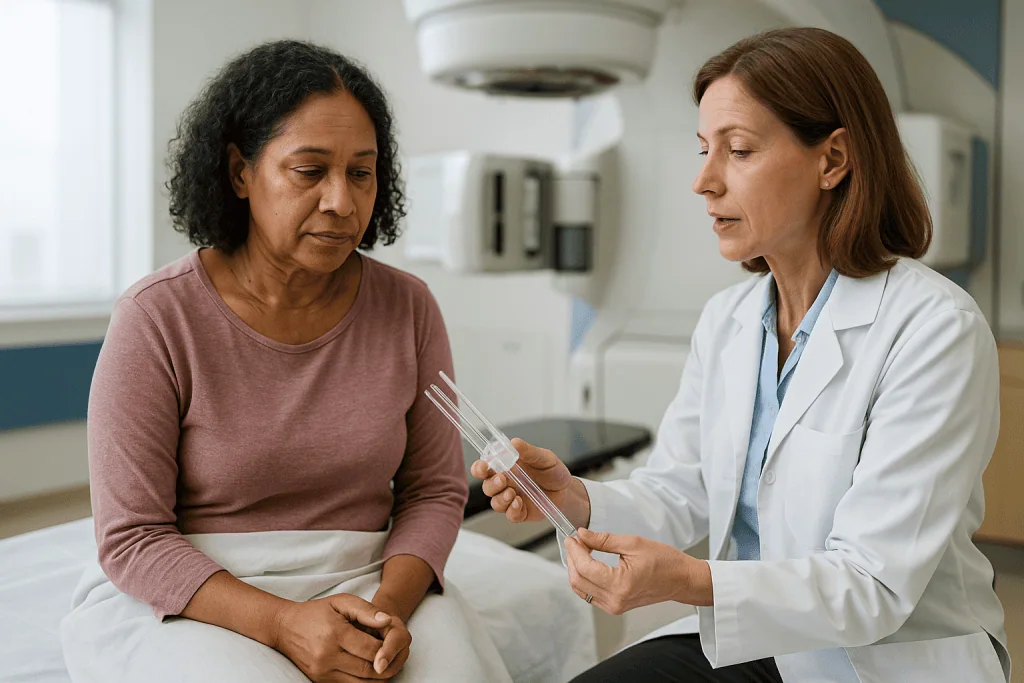
Most centers now use high-dose-rate brachytherapy, which delivers the treatment in minutes per session, according to Mayo Clinic. The older low-dose-rate method left sources in place for a day or more while the patient stayed in a shielded room; it is used far less often today. Whichever rate is used, the principle is the same: a source close to the target, with intensity dropping sharply with distance.
Planning is where the craft lies. After the applicator is placed, the team takes CT or MRI images with it in position. A radiation physicist and the oncologist then draw the tumor, the bladder, the rectum and the sigmoid colon on those images and tell the software how long the source should pause at each point. If the residual tumor is lopsided or has crept sideways into the tissue beside the cervix, thin hollow needles, called interstitial needles, may be added so the high-intensity region can be shaped to follow it.
When the source is back inside the afterloader, there is no radiation left in the body. Patients treated with high-dose-rate brachytherapy are not radioactive afterward and pose no risk to children, partners or pets, a point MedlinePlus makes plainly and one worth repeating to worried relatives.
What actually happens on a brachytherapy treatment day
The day tends to be long, and most of it is waiting rather than treatment. Here is a typical shape, drawn from descriptions published by Mayo Clinic and the NHS; details vary between departments.
Preparation usually starts with an empty stomach, because the applicator is placed under sedation, spinal anesthesia or a general anesthetic. Which one depends on the department, your health and how complex the placement is expected to be. A thin catheter is often placed in the bladder so it can be emptied and, sometimes, filled with contrast to make it visible on imaging.
Placement itself takes roughly half an hour to an hour. The oncologist examines the cervix, gently widens the cervical canal, and slides the applicator components into position. Gauze packing is placed in the vagina to hold everything steady and to push the bladder and rectum a little further from the source. Some teams stitch the applicator to the skin or use an external frame so it cannot shift.
Then come the scans and the planning. This is the stretch that surprises people: an hour or more lying still while the images are checked, the contours drawn and the plan calculated and double-checked by a second physicist. A skewed applicator caught on the scan gets repositioned before treatment, not after.
The treatment itself is quick. You lie alone in a shielded room while the afterloader runs, watched on camera and able to speak to staff through an intercom. Nothing is felt while the source is out. Afterward the applicator and packing are removed, which can be briefly uncomfortable, and most patients go home the same day once the anesthetic has worn off and they have passed urine.
Who is usually offered brachytherapy for cervical cancer, and who is asked to wait
Brachytherapy for cervical cancer is aimed mainly at people whose tumor is too large or has spread too far locally for surgery to be the sensible first choice, but has not spread to distant organs. In staging language that generally means tumors larger than a few centimeters, tumors that have grown into the tissue beside the cervix, or disease that has reached the pelvic lymph nodes. The National Cancer Institute’s treatment summary lists chemoradiation, meaning external beam radiation with concurrent chemotherapy, followed by brachytherapy, as the standard approach for this group.

People with very small, early tumors are often treated with surgery instead, and may never need radiation. Some who have surgery are found afterward to have features that raise the risk of the cancer returning in the pelvis, such as cancer cells in lymph nodes or at the edges of the removed tissue; they may be offered external beam radiation, with or without a shorter brachytherapy component directed at the top of the vagina.
Being asked to wait is different from being turned away. Common reasons a team pauses include an active pelvic infection, significant anemia that needs correcting first, because low oxygen in a tumor makes radiation less effective, heavy bleeding that needs settling, or a general medical state that makes anesthesia unsafe for now. Anatomy matters too: if a tumor has grown in a shape the standard applicator cannot cover, the team may plan interstitial needles or, rarely, an alternative such as a highly focused external beam technique.
For people whose cancer has already spread to distant sites, radiation to the pelvis may still be offered to control bleeding or pain. The goals and the schedule are different, and the treating team will explain what is realistic. None of this is a single decision point; fitness for brachytherapy is reassessed throughout the external beam phase.
How many brachytherapy sessions for cervical cancer, and how long does the whole course take?
The overall course is measured in weeks, not days. The NHS describes a combined course of external and internal radiotherapy for cervical cancer as typically lasting around five to eight weeks. The external beam phase runs first, usually one short session every weekday, with weekends off to let normal tissues recover. Each session lasts a few minutes on the machine, though the appointment itself takes longer.
Brachytherapy is added toward the end, sometimes overlapping with the final external beam sessions, sometimes following them. Most high-dose-rate schedules involve several sessions spaced days apart, and some departments deliver two treatments during a single applicator placement, one in the morning and one later the same day or the next, to reduce the number of anesthetics. How many sessions you are given, and how they are spaced, depends on your department’s protocol, the size and response of the tumor, and how well you are tolerating treatment. That number is set by your radiation oncologist and is not something a general article can predict.
One principle does apply across protocols: radiation oncologists try hard to finish the whole course within the planned window and without unplanned gaps. Cervical cancers can regrow between sessions, so a course that drifts over extra weeks may be less effective than the same treatment delivered on time. If you feel unwell, the team would far rather adjust supportive care than pause the schedule, so tell them early.
People often ask whether the sessions get easier. Physically, the applicator placement is much the same each time. What usually changes is familiarity: the second visit is rarely as frightening as the first, because the long quiet stretches and the odd sensations are no longer unknown.
External beam radiation for cervical cancer versus brachytherapy: a side-by-side view
Seeing the two methods next to each other makes the pairing feel less like duplication and more like a division of labor. The table summarizes typical features described by Mayo Clinic, the NHS and MedlinePlus; your own plan may differ in the details.
| Feature | External beam radiation | Brachytherapy |
|---|---|---|
| Where the radiation comes from | A machine outside the body | A sealed source placed inside or beside the cervix |
| Main target | Whole pelvis: cervix, surrounding tissue, lymph nodes | The cervix and residual tumor itself |
| Intensity at the tumor | Limited by nearby bowel and bladder | Very high, falling off within a centimeter or two |
| Anesthesia needed | No | Usually sedation, spinal or general anesthetic |
| Session pattern | Short daily sessions over several weeks | A few longer visits, minutes of actual treatment each |
| Typical timing | First phase of the course | Final phase, once the tumor has shrunk |
| Radioactive afterward? | No | No, with high-dose-rate treatment |
| Chemotherapy alongside | Often, once weekly during this phase | Usually not given on brachytherapy days |
Two rows deserve a second look. The intensity row explains why neither method is offered alone when the aim is to eliminate a bulky tumor: external beam cannot reach the level the tumor needs without harming its neighbors, and brachytherapy on its own would miss the lymph nodes several centimeters away. The timing row explains the sequence. A tumor that has shrunk after weeks of external beam leaves less tissue for the applicator to cover and moves the bladder and rectum a little further from the source.
Think of external beam as tidying the whole room and brachytherapy as scrubbing the one stubborn corner. Skipping either leaves the job half done.
Where chemotherapy fits alongside the radiation
Most people treated with radiation for locally advanced cervical cancer also receive chemotherapy during the external beam phase. Here the chemotherapy is not doing the heavy lifting on its own; it is acting as a sensitizer, a medicine that makes cancer cells more vulnerable to radiation damage and less able to repair it between sessions. The National Cancer Institute’s treatment summary describes this combined approach, known as chemoradiation, as standard for this stage of disease.
The medicines used for this purpose are usually platinum-based agents, a class of chemotherapy that works by damaging the DNA of dividing cells. They are typically given by intravenous drip once a week while external beam treatment is under way, timed so that radiation follows within hours. Chemotherapy is generally not given on brachytherapy days, partly because the brachytherapy visit is already long and involves an anesthetic, and partly because the intensity delivered by the source is high enough without a sensitizer.
Which agent is used, how often, and whether it is safe for you at all are decisions that depend on kidney function, hearing, blood counts and other factors your oncologist will review before each cycle. Some people are not fit for chemotherapy and receive radiation alone; that is a legitimate plan, not a lesser one, and the team will explain the reasoning.
Side effects from the sensitizing chemotherapy can blur into those of radiation: nausea, a drop in blood counts, ringing in the ears and kidney strain are the ones oncologists watch for most closely, and blood tests before each weekly dose are routine. If a cycle is delayed because of low counts, the radiation usually continues on schedule. Keeping the radiation course intact tends to take priority over squeezing in every chemotherapy dose, but that judgment call, like all others here, sits with the prescribing clinician.
What are the common side effects of brachytherapy for cervical cancer?
Brachytherapy side effects in cervical cancer split into two groups: those that appear during treatment and fade within weeks, and those that can emerge months or years later. Both groups are described in patient information from the NHS, Mayo Clinic and Cleveland Clinic; how strongly any one person is affected varies widely.
In the early weeks, the commonest complaints are tiredness, a sore or irritated vagina with some discharge or light bleeding, a bladder that feels urgent or stings when passing urine, and looser or more frequent bowel movements. Much of this reflects the external beam phase as well, since brachytherapy arrives when several weeks of pelvic radiation have already stirred up the bowel and bladder lining. Cramping in the hours after applicator removal is common and usually short-lived.
Late effects are the ones to understand before you start. Radiation to the vagina can leave it drier, less elastic and narrower, a change called vaginal stenosis, which can make intercourse and pelvic examinations uncomfortable. Departments routinely teach the use of vaginal dilators, smooth tapered devices used regularly after treatment to help keep the vagina open; the NHS lists this as standard aftercare. Radiation to the ovaries in people who have not yet reached menopause usually stops them working, bringing on menopause and ending fertility. Bowel and bladder can develop longer-term changes such as urgency, frequency or occasional bleeding from fragile blood vessels.
Rare but serious late effects include a fistula, an abnormal channel between the vagina and the bladder or rectum, and fractures of pelvic bones weakened by radiation. These are uncommon, and the elaborate planning described earlier exists largely to keep them that way. Anyone who develops new bleeding, unexplained leakage of urine or stool from the vagina, or persistent pelvic pain after treatment should report it rather than assume it is expected.
What are the disadvantages of brachytherapy?
Patients deserve the unvarnished list, because a treatment this effective still asks a great deal. The first disadvantage is that brachytherapy is invasive. An applicator has to be placed inside the body, which means an anesthetic, a bladder catheter, vaginal packing and, for some, needles through the tissue beside the cervix. Each placement carries the small risks that accompany any procedure under anesthesia, plus a modest chance of bleeding or infection.
The second is time. A treatment day can stretch across many hours, most of them spent lying still in an unfamiliar position while planning happens out of sight. That is physically tiring and emotionally draining, particularly when it is repeated across several visits at the end of an already long course.
Third, brachytherapy is technically demanding. It needs a radiation oncologist experienced in placement, physicists trained in image-based planning, and equipment that not every hospital owns. Where those resources are thin, waiting times can lengthen or people may need to travel to a different department within their own health system. This is a resource issue rather than a reason to accept a plan without brachytherapy; guideline bodies regard it as a standard component for locally advanced disease.
Fourth, the late effects listed in the previous section are real, and some, such as vaginal narrowing and treatment-induced menopause, are permanent. Fertility is lost. For people who hoped to carry a pregnancy, that loss deserves a proper conversation, and a referral to a fertility specialist before treatment starts, if time allows.
Finally, brachytherapy cannot be used if the anatomy does not permit an applicator to sit safely, if a fistula is already present, or if the tumor has spread beyond what local treatment can address. In those cases the team may adapt the plan or change the goal of treatment. Weighing these disadvantages against the alternative, which for most people means leaving the tumor undertreated, is exactly the discussion your team should be willing to have.
What is the success rate of brachytherapy for cervical cancer? An honest answer
There is no single number, and anyone who offers you one without asking about your stage is guessing. What can be said with confidence is structural. The National Cancer Institute’s treatment summary presents chemoradiation with brachytherapy as the standard approach for locally advanced cervical cancer, meaning it is the benchmark other treatments are measured against, not an optional add-on. Radiation oncology bodies internationally take the same view, and when brachytherapy is left out of a plan for someone who was suitable, that omission is generally regarded as undertreatment.
How well any individual does depends on factors that the treatment itself does not control: how large the tumor was at the start, whether lymph nodes were involved, how far along the pelvic side wall the disease had spread, whether the full course was completed on schedule, whether chemotherapy could be given alongside, and how the tumor responded on imaging during treatment. Two people with the same stage label can have quite different outlooks because of these details.
Outcome statistics published in trials and registries are averages drawn from large groups treated over many years, some with older techniques. They tell you about populations, not about you. Your radiation oncologist has your scans, your pathology and your response to the external beam phase, and is the right person to translate general evidence into a realistic personal picture. It is fair to ask directly what the treatment is aiming to achieve, how confident the team is, and what would change the plan.
The purpose of this article is not to hand you a figure but to explain why brachytherapy is included in the first place: it is the part of the plan that gets the intensity to the tumor. Everything else, from the weeks of external beam to the weekly chemotherapy, sets the stage for it.
What the following days and weeks usually look like
The evening after a brachytherapy session tends to be quiet. Cramping and a dull pelvic ache are common, a little spotting is expected, and the bladder may sting for a day or two from the catheter. Most departments advise rest, plenty of fluids and pain relief as directed by the team; nothing about the treatment requires isolation, because no radiation remains in the body once the source is withdrawn.
Between sessions, life carries on much as it did during the external beam phase. Fatigue usually deepens toward the end of the course, and bowel looseness may peak in these final weeks. The NHS notes that many radiation side effects continue to build for a week or two after the last session before they begin to settle, so feeling worse in the fortnight after finishing does not mean the treatment has failed.
Over the following month or two the acute effects generally ease. Bowel habit steadies, bladder irritation fades and energy returns gradually rather than all at once. This is also when dilator use typically begins, once the team confirms the vaginal tissues have healed enough. Early, regular use is the part of aftercare most often abandoned and most worth persisting with; it makes later examinations far more comfortable.
Follow-up appointments usually start a few weeks after treatment ends and continue at intervals for years. The first imaging scan to assess response is commonly scheduled around three months after finishing, because scans taken sooner can be misleading while inflammation is still settling. Your team will set the exact schedule.
Emotionally, the weeks after treatment can be strange. The structure of daily appointments vanishes, and with it the reassurance of being watched closely. Many people find this the hardest stretch. Cancer support services, counselors and patient groups exist for exactly this gap, and asking for a referral is a sign of good sense, not weakness.
What people often get wrong about brachytherapy
The misunderstandings are consistent enough that they are worth naming one by one.
“I’ll be radioactive afterward.” With high-dose-rate brachytherapy, the source is inside the body only for the minutes of treatment and is withdrawn into a shielded machine afterward. MedlinePlus and Mayo Clinic both state that no radiation remains and there is no restriction on hugging children or sharing a bed. Permanent radioactive seeds are used for some other cancers, not for the cervix.
“External beam alone would be gentler and just as good.” Gentler in the short term, perhaps. But external beam cannot safely deliver the intensity a bulky cervical tumor needs without harming bowel and bladder. Leaving out brachytherapy for a suitable patient is regarded by guideline bodies as undertreatment, not as a kinder alternative.
“Brachytherapy is a last resort.” The opposite is closer to the truth. It is a standard component of first-line treatment for locally advanced disease, planned from the start rather than added when other things fail.
“If the scan after external beam looks clear, I can skip the internal part.” Scans cannot see microscopic disease, and the brachytherapy phase is designed to treat what remains at the cellular level. A good response to external beam makes brachytherapy easier and more precise; it does not make it unnecessary.
“The side effects mean the treatment is too strong.” Bowel and bladder irritation reflect normal tissue reacting to radiation, not a sign of overdose. Departments monitor these reactions closely and have supportive treatments for most of them.
“Once treatment ends, the work is done.” Dilator use, follow-up scans and reporting new symptoms promptly are all part of the treatment, not an optional coda. The people who do well in the long run are usually the ones who kept the aftercare going when it felt tedious.
Questions to ask your care team before brachytherapy
A good consultation leaves you with fewer questions than you walked in with, but only if you brought them. Write these down, add your own, and do not be shy about asking for answers in plain words.
- What is the goal of my radiation plan, and how does brachytherapy contribute to it in my particular case?
- How many brachytherapy sessions are planned, over how many visits, and what happens if one has to be delayed?
- Which type of anesthesia will be used for the applicator placement, and how long should I expect to be in the department each time?
- Will imaging with MRI or CT be used to plan each session, and will the plan be adjusted if the tumor changes shape?
- Are interstitial needles likely to be needed for my anatomy, and what would that involve?
- What side effects should I expect during treatment, which ones should prompt a call, and who do I call outside office hours?
- What long-term changes to my bladder, bowel and sexual function are likely, and what support is available for them?
- Will this treatment bring on menopause, and are there options for managing symptoms or for discussing fertility before I start?
- When will I be shown how to use vaginal dilators, and for how long am I expected to continue?
- What is the follow-up schedule after treatment, and when will the first scan to assess response take place?
- Is there a clinical nurse specialist, psychologist or support group I can contact during and after treatment?
Bring someone with you if you can. Consultations move quickly, and a second pair of ears catches what anxiety filters out. Many departments are happy for you to record the conversation on your phone if you ask first. Above all, understand that asking why a step is planned is not doubting your team; it is the kind of engagement good teams welcome.
When to call your doctor during or after brachytherapy
Most reactions to pelvic radiation are expected and manageable, but a few signs mean the team needs to hear from you the same day, and some mean emergency care rather than a phone call. Every department gives patients a direct contact number for exactly this purpose; keep it where you can find it at two in the morning.
Contact your team promptly if you develop a fever, chills or shivering, particularly during the chemotherapy phase when blood counts may be low. A fever in someone receiving chemotherapy can signal a serious infection and should never be watched and waited on overnight. Call the same day for vaginal bleeding that is heavier than a light period or does not slow down, for pain when passing urine that comes with fever or an inability to pass urine at all, for diarrhea that persists despite the measures your team advised or that leaves you dizzy or unable to keep fluids down, or for vomiting that stops you eating and drinking for more than a day.
Seek emergency care immediately for heavy bleeding that soaks through pads within an hour, for sudden severe abdominal or pelvic pain, for a swollen, painful calf or sudden breathlessness and chest pain, which can signal a blood clot, or for confusion or fainting.
After treatment ends, red flags shift toward late effects. Report any leakage of urine or stool from the vagina, new or worsening pelvic or hip pain, blood in the stool or urine that persists, or bleeding after intercourse. None of these should be dismissed as “just the radiation” until your team has looked. They may well turn out to be manageable, and the sooner they are seen, the more options there are. If ever unsure whether a symptom warrants a call, make the call; your team would always rather hear from you than not.
Frequently asked questions
What are the disadvantages of brachytherapy for cervical cancer?
The main disadvantages are that it is invasive, time-consuming and technically demanding. Each session needs an anesthetic, a bladder catheter and an applicator placed in the uterus and vagina, followed by hours of imaging and planning. Late effects can include vaginal narrowing, menopause, loss of fertility and, rarely, a fistula. Access can also be limited where specialist equipment and expertise are scarce.
What is the success rate of brachytherapy for cervical cancer?
There is no single figure, because outcomes depend on tumor size, lymph node involvement, whether chemotherapy is given alongside and whether the full course is completed on time. The National Cancer Institute presents chemoradiation with brachytherapy as the standard approach for locally advanced disease. Your radiation oncologist, who has your scans and pathology, is the right person to discuss a realistic personal outlook.
What are the common brachytherapy side effects in cervical cancer?
Early effects include tiredness, vaginal soreness or discharge, light bleeding, bladder stinging or urgency, and looser bowel movements, most of which settle within weeks of finishing. Longer-term effects can include vaginal dryness and narrowing, bowel and bladder changes, and menopause if the ovaries were in the treatment area. Rare serious effects include fistula formation and pelvic bone fractures.
How many brachytherapy sessions for cervical cancer are usually needed?
Most high-dose-rate schedules involve several sessions spread over one to two weeks toward the end of the radiation course, but the exact number varies between departments and is set by your radiation oncologist based on tumor response and your tolerance. Some centers deliver two treatments during a single applicator placement to reduce the number of anesthetics.
Is internal radiation for cervical cancer painful?
The applicator is placed under sedation, spinal or general anesthesia, so placement itself is not felt. Lying still with the applicator in position for several hours can be uncomfortable, and cramping or a dull ache is common after removal. The treatment delivery, when the radioactive source moves through the applicator, produces no sensation at all.
Why is external beam radiation for cervical cancer given before brachytherapy rather than after?
External beam comes first because several weeks of treatment shrink the tumor and treat the lymph nodes and surrounding tissue. A smaller tumor lets the brachytherapy applicator sit closer to what remains, and moves the bladder and rectum a little further from the high-intensity zone, which improves both coverage of the cancer and protection of healthy organs.
Will I be radioactive after brachytherapy for cervical cancer?
No. With high-dose-rate brachytherapy the sealed source is inside the body only for the minutes of treatment and is withdrawn into a shielded machine afterward. MedlinePlus and Mayo Clinic confirm that no radiation remains, so there are no restrictions on contact with children, partners or pets. Permanent radioactive seeds are used for some other cancers, not the cervix.
Can brachytherapy be skipped if my scan looks clear after external beam radiation?
Generally not for a patient who was suitable for it. Scans cannot detect microscopic disease, and the brachytherapy phase is designed to treat residual cancer at the cellular level with an intensity external beam cannot safely match. A good response to external beam makes brachytherapy easier and more precise rather than unnecessary. Any change to the plan is your treating team’s decision.
What is the life expectancy for people with end-stage cervical cancer?
It varies too widely for a single answer. Outlook for advanced cervical cancer depends on where the cancer has spread, how quickly it is growing, overall health and how it responds to treatment. Radiation, including brachytherapy, may still be used to control bleeding or pain. An oncologist who knows the individual case is the only person who can give a meaningful estimate.
How long after brachytherapy can I return to normal activities?
Most people go home the same day and rest for a day or two after each session. Fatigue and bowel or bladder irritation often peak in the fortnight after the whole course ends, then ease over the following month or two according to the NHS. Return to work, exercise and sexual activity should be discussed with your team, who will also advise on when to begin dilator use.
References
This article is for general information only and is not a substitute for professional medical advice. Please consult a qualified doctor about your individual situation.

More from the Blog
When Targeted Therapy Stops Working: Resistance, Repeat Biopsies and the Next Options
When targeted therapy stops working, it usually means the cancer has found a way around the drug, a process called acquired resistance. The care…
Why Cystoscopy Surveillance Continues for Years After Bladder Cancer Treatment
Cystoscopy surveillance after bladder cancer continues for years because the disease has one of the highest recurrence rates of any solid tumor, and new…

Radiation Precautions After Radioiodine Treatment: Distance, Sleeping Alone and Hygiene
Radiation precautions after radioactive iodine usually mean keeping extra distance from other people, sleeping alone, and taking care with urine, saliva and sweat for…

How Acute Lymphocytic Leukemia Treatment Runs in Phases, From Induction to Maintenance
Acute lymphoblastic leukemia is treated in sequential phases rather than one course. Induction, usually about four weeks, aims to clear leukemia cells from the…

What Sarcoma Follow-Up Involves: Scheduled Imaging, Wound Review and Function Checks
Sarcoma follow-up combines scheduled imaging, wound checks and function assessments. Guideline consensus suggests chest imaging by CT or X-ray, plus MRI or ultrasound of…

Flying Home After Radioiodine Treatment: Airport Detectors, Timing and What to Carry
Flying after radioactive iodine treatment is usually possible once your treating team confirms your radiation level has fallen enough for close contact with other…