

Why Chemotherapy Often Surrounds Stomach Cancer Surgery: Perioperative Treatment Explained
Key Takeaways
- In the MAGIC trial, 36 percent of people who had chemotherapy before and after stomach cancer surgery were alive at five years compared with 23 percent who had surgery alone.
- The FLOT4 trial found a median overall survival of about 50 months with a taxane-containing perioperative regimen versus about 35 months with the older three-drug combination.
- Perioperative chemotherapy is aimed at cancer that has grown into the muscle layer of the stomach or reached nearby lymph nodes without spreading to distant organs; very early tumors and cancer that has already spread follow different pathways.
- In the FLOT4 protocol, preoperative chemotherapy lasted about eight weeks and surgery was planned roughly four to six weeks after the final cycle to allow recovery.
- Only about half of FLOT4 participants completed the full postoperative course, and the trial's survival benefit already accounts for those who did not finish, so stopping early does not erase the preoperative effect.
- A CT scan after chemotherapy cannot distinguish scar tissue from living cancer, so the true response is measured by the pathologist on the removed specimen, which is one reason surgery still follows even when a tumor appears to have shrunk.
Chemotherapy is often given both before and after stomach cancer surgery because gastric tumors are frequently found at a locally advanced stage, when cancer cells may already have spread microscopically beyond what a surgeon can remove. Randomized trials have shown that this perioperative approach improves survival compared with surgery alone for eligible patients. Timing, regimen and suitability are decided individually by the treating team.
The scan results are back, the surgeon has explained the operation, and then comes the sentence many people do not expect: “We’d like to start with chemotherapy.” For someone who has just learned they have stomach cancer, that can sound like a detour, or even a demotion. Why wait, when the tumor is sitting right there?
Yet chemotherapy before stomach cancer surgery, usually paired with more chemotherapy afterward, has become a standard pathway for many people whose tumor has grown into the stomach wall or reached nearby lymph nodes. The logic is not about delay. It is about treating what the surgeon cannot see.
This explainer walks through what that plan involves, which trials shaped it, who it is usually offered to, what the weeks look like, and the questions worth bringing to your next appointment. Every decision along the way remains with your treating team.
Why is chemotherapy given before stomach cancer surgery at all?
Think of the stomach as an organ surrounded by a busy transport network. Lymph vessels drain it toward clusters of nodes along the major blood vessels, and a tumor’s cells can enter that network well before anyone feels unwell. Stomach cancer is often diagnosed only after symptoms such as persistent indigestion, feeling full quickly or unintended weight loss have gone on for a while, by which point the tumor has frequently grown through several layers of the stomach wall (NHS).
A surgeon removes what can be seen and felt: the tumor, a margin of healthy tissue around it, and the surrounding lymph nodes. What no operation can remove are microscopic clusters of cells, sometimes called micrometastases, that may already have traveled elsewhere. Chemotherapy circulates through the bloodstream and reaches those cells wherever they sit.
Giving that treatment before the operation has three practical aims. First, it may shrink the primary tumor, which can make it easier to remove with clear margins, meaning no cancer cells at the cut edge under the microscope. Second, it treats any hidden spread months earlier than a plan that waits until after surgery and recovery. Third, it offers a real-world test of how the cancer responds to the drugs, information that helps the team plan what comes next.
There is also a very human reason. A major stomach operation is demanding, and many people find it difficult to complete a full course of chemotherapy while recovering from it. Front-loading part of the treatment means more people actually receive it. In the FLOT4 trial, only around half of participants managed to complete the planned postoperative portion, a figure that reflects how hard recovery can be rather than any lack of effort (PubMed, FLOT4).
How perioperative chemotherapy actually works, step by step
Perioperative simply means “around the time of surgery,” so perioperative chemotherapy is drug treatment given in two halves: one before the operation and one after. Here is the sequence most people follow, with variations decided by the team.
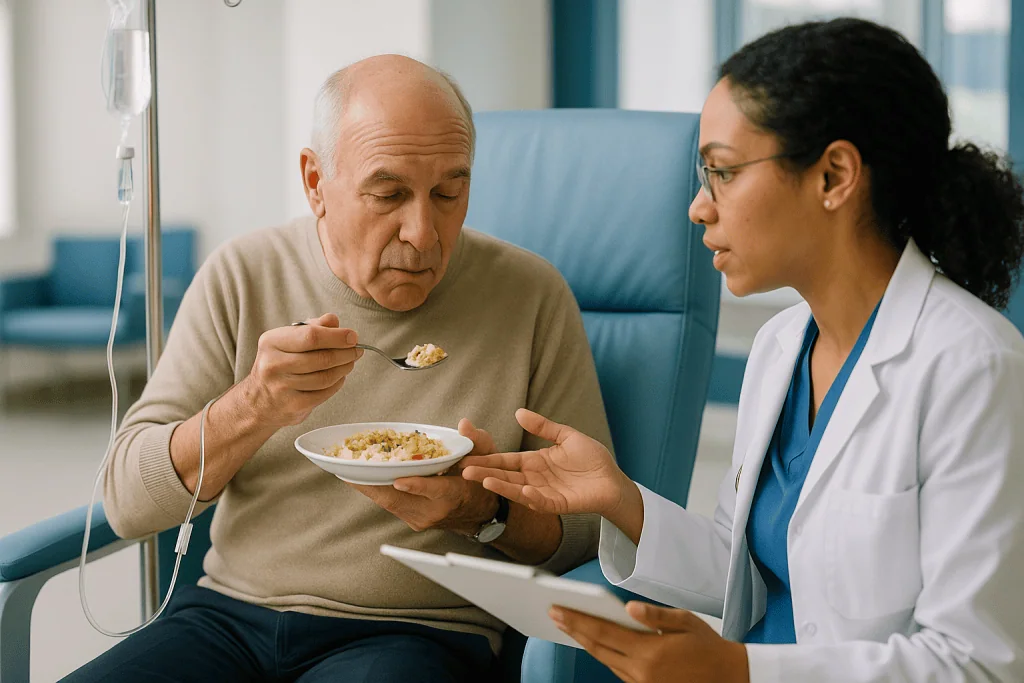
It starts with staging, the process of working out how far the cancer has spread. That typically involves an endoscopy with biopsy, a CT scan of the chest, abdomen and pelvis, and sometimes a PET scan or an endoscopic ultrasound to gauge how deeply the tumor has grown (Mayo Clinic). Many centers also perform a staging laparoscopy: a short keyhole procedure in which a camera checks the lining of the abdomen for tiny deposits that scans can miss.
Those results go to a multidisciplinary team, a meeting of surgeons, oncologists, radiologists, pathologists and specialist nurses who agree a recommendation together. If perioperative chemotherapy is proposed, you meet a medical oncologist, have baseline blood tests and heart and kidney checks, and often have a small device placed under the skin of the chest so drugs can be given repeatedly without needle sticks in the arm each time.
Chemotherapy is then given in cycles, a block of treatment followed by a rest period so healthy cells recover. Before each cycle, blood counts are checked, and treatment may be delayed or adjusted if they are low. After the preoperative course, a repeat CT scan reassesses the tumor, and the surgery date is set to allow the body to recover from the drugs.
After the operation and a period of healing, the second half begins, usually with the same drugs, provided recovery and blood results allow. Throughout, the plan is reviewed at each step; nothing is fixed simply because it was written down at the start.
What is neoadjuvant chemotherapy for gastric cancer, and how does it differ from adjuvant?
Two words come up constantly in clinic letters, and they are easy to confuse. Neoadjuvant chemotherapy is treatment given before the main procedure, in this case before the stomach operation. Adjuvant chemotherapy is treatment given afterward, with the aim of dealing with any cells left behind. Perioperative chemotherapy uses both halves. And when you hear “gastric,” it means the same thing as “stomach”; gastric cancer and stomach cancer are one condition.
The distinction matters because the two halves do slightly different jobs. Neoadjuvant treatment works on a tumor that is still in place, so its effect can be measured on scans and later under the microscope. The pathologist examines the removed tumor and grades how much of it has been replaced by scar tissue, a measure known as tumor regression. That report tells the team how sensitive the cancer was to the drugs.
Adjuvant treatment, by contrast, is given when there is nothing left to measure. Its purpose is purely to reduce the chance of recurrence by treating cells that cannot be seen. Because there is no visible target, decisions about whether to continue rest on the pathology report, the person’s recovery and blood results rather than on imaging.
Different health systems have historically leaned toward different sequences. Several large trials from East Asia, where stomach cancer is more common and often detected earlier through screening, studied surgery followed by adjuvant chemotherapy alone, and that remains a well-established pathway in those settings (NCI). Western trials such as MAGIC and FLOT4 tested the perioperative sequence and found it improved outcomes compared with surgery alone (PubMed). Neither approach is “right” in the abstract; the choice reflects the stage of the tumor, how it was found, the person’s fitness and the evidence base the team works within.
Who is usually offered chemotherapy before stomach cancer surgery, and who is asked to wait?
Perioperative chemotherapy is aimed at a specific group: people whose cancer is locally advanced but still considered removable. In practice, that usually means the tumor has grown at least into the muscle layer of the stomach wall, or nearby lymph nodes appear involved, and there is no sign of spread to distant organs (PubMed, FLOT4). The person also needs to be well enough to withstand both chemotherapy and a major operation, which the team assesses through fitness, heart and kidney function, nutrition and other medical conditions.
Several groups are commonly steered toward a different path.
- Very early tumors. When cancer is confined to the innermost lining, it may be removed through an endoscope or with surgery alone, and chemotherapy usually adds little (NCI).
- Cancer that has already spread. If scans or a staging laparoscopy show deposits in the liver, lungs or abdominal lining, removing the stomach is generally not recommended, and chemotherapy becomes the main treatment rather than a preparation for an operation (NHS).
- Urgent complications. Heavy bleeding, a blockage that prevents eating, or a perforation can mean surgery or another procedure needs to come first, with drug treatment considered afterward.
- Reduced fitness. Someone with significant heart, kidney or lung disease, or who is frail, may be offered surgery alone, a gentler drug plan, or a different balance of risks and benefits.
- Tumors at the junction with the esophagus. Here, chemotherapy combined with radiotherapy before surgery is an alternative some teams favor, depending on the exact location (NCI).
Being “asked to wait” or offered something different is not a verdict on how serious things are. It reflects the team matching the sequence to the biology and to you. If you do not understand why a particular path was proposed, asking for the reasoning is entirely reasonable.
What the evidence actually shows: the MAGIC and FLOT4 trials
Two randomized trials underpin most of what oncologists in the US and Europe do here, and it is worth knowing what they found and what they did not.
The MAGIC trial enrolled just over 500 people with stomach or lower esophageal adenocarcinoma that was judged removable. Half had surgery alone; half had chemotherapy before and after. At five years, 36 percent of the perioperative group were alive compared with 23 percent of the surgery-only group, and the tumors removed after chemotherapy were smaller and less advanced on average (PubMed, Cunningham et al.).
The FLOT4 trial then asked which perioperative combination worked better. It compared an older three-drug regimen containing a platinum drug, an anthracycline and a fluoropyrimidine with a newer combination that swapped in a taxane. Among 716 participants, median overall survival was about 50 months with the taxane-containing regimen versus about 35 months with the older combination (PubMed, Al-Batran et al.). More people in the newer arm had no cancer cells left in the removed tumor.
What these numbers mean for an individual is less certain than they look. Trial participants were, on average, fitter and younger than the general population of people with stomach cancer, and results describe groups, not the person sitting in the consulting room. The trials also predate routine testing for markers such as mismatch repair status and HER2, which now shape some decisions, and they did not include the immunotherapy drugs currently being studied alongside perioperative chemotherapy.
Still, the direction of the evidence is consistent: for people who fit the trial profile, chemotherapy around surgery has repeatedly performed better than surgery alone in high-quality randomized studies. That is the standard against which newer approaches are now being measured.
FLOT chemotherapy for stomach cancer: what is in it and how it is given
Regimens are often known by acronyms, and FLOT is the one people hear most. Each letter stands for a generic drug: fluorouracil, leucovorin, oxaliplatin and a taxane called docetaxel. Knowing what each does turns a string of letters into something understandable.
Fluorouracil is a fluoropyrimidine, a class of drugs that mimics one of the building blocks of DNA. Cancer cells take it up as they try to copy themselves, and the copying process jams. Leucovorin is not a chemotherapy drug at all; it is a form of folate that helps fluorouracil bind more tightly to its target enzyme. Oxaliplatin is a platinum compound that forms cross-links inside DNA strands, preventing them from being read or duplicated. Docetaxel belongs to the taxanes, which interfere with the internal scaffolding a cell uses to pull itself apart into two, stalling division at the last moment.
The combination is given through a vein. In the FLOT4 protocol, oxaliplatin, docetaxel and leucovorin were infused in the clinic, and fluorouracil was then run slowly over about a day through a small portable pump attached to the central line, so people went home wearing it (PubMed). Cycles were repeated with rest periods between them, and the preoperative course lasted roughly two months, followed by a gap of several weeks before surgery.
The exact drugs, the number of cycles, any adjustments for age or kidney function, and whether an alternative regimen suits you better are decisions for the prescribing oncologist. Some people are not suitable for a taxane. Some have tumors with features, such as HER2 overexpression, that may open the door to additional targeted treatment within a trial or specific pathway. None of this is fixed by the acronym. FLOT is a template, and the treating team tailors it.
Perioperative, neoadjuvant and adjuvant: a side-by-side comparison
Placed next to each other, the main sequencing options are easier to weigh. This table describes typical uses in guideline-level terms; individual plans vary.
| Approach | When drugs are given | Main aim | Typical situation | Trade-offs |
|---|---|---|---|---|
| Perioperative chemotherapy | Before and after surgery | Shrink the tumor, treat hidden spread early, then consolidate | Locally advanced but removable stomach cancer in a fit person | Longer total treatment; the second half is not completed by everyone |
| Neoadjuvant chemotherapy or chemoradiation only | Before surgery | Downstage the tumor and improve clear-margin rates | Some tumors at the junction with the esophagus; people unlikely to tolerate postoperative treatment | No postoperative consolidation; radiotherapy adds its own effects |
| Adjuvant chemotherapy only | After surgery | Reduce recurrence risk after complete removal | Cancer found to be more advanced than expected at surgery; common pathway in East Asian practice | Later start; recovery may limit tolerance |
| Surgery alone | None | Remove the tumor | Very early tumors; people who cannot safely have chemotherapy | No treatment for microscopic spread |
| Chemotherapy without surgery | Ongoing | Control the cancer and symptoms | Cancer that has spread beyond the stomach and nearby nodes | Not aimed at removal; goals are different |
A few things stand out. The perioperative row is the only one that both shrinks a visible tumor and returns after surgery, which is why it became the default for the locally advanced group in Western trials. The adjuvant-only row is not a lesser option; it is the pathway with the strongest evidence in settings where tumors are often caught earlier and where surgery includes an extensive lymph node dissection (NCI). The final row is a reminder that when scans show distant spread, the question of chemotherapy “before surgery” no longer applies, because the goals change.
Where you sit in this table depends on staging, fitness and, increasingly, on molecular features of the tumor. The table frames the conversation; it does not settle it.
How long is chemo before stomach surgery, and what does the overall timeline look like?
People planning around work, family and caring responsibilities understandably want dates. The honest answer is that timelines are ranges, and yours will be set by the team. Typical patterns from trials and guideline summaries give a useful shape.
The preoperative course is usually the shorter of the two halves in terms of disruption. In the FLOT4 protocol, the chemotherapy given before surgery lasted about eight weeks (PubMed). Each cycle involves blood tests a day or two beforehand, a clinic visit for the infusion, and often a portable pump worn for about a day afterward. Between cycles, most people are at home, with good days and harder days that tend to follow a recognizable rhythm.
Then comes a deliberate pause. Surgery is not scheduled the moment chemotherapy ends, because blood counts and energy need time to recover. In FLOT4, the operation was planned for roughly four to six weeks after the final preoperative cycle (PubMed). A restaging CT scan usually happens in this window.
The operation itself, a partial or total gastrectomy, meaning removal of part or all of the stomach along with nearby lymph nodes, is followed by a hospital stay whose length depends on the type of operation, whether keyhole or open, and how recovery goes. The NHS describes this as major surgery with a recovery period measured in weeks to months rather than days (NHS).
The postoperative half begins once eating, wound healing and blood results allow, which in trials was generally within a few months of the operation. Adding up the phases used in the FLOT4 protocol gives a total journey of well over half a year from first infusion to last, with wide individual variation (PubMed).
Ranges are not promises. Delays for low blood counts, infections or slow recovery are common and are a normal part of adjusting treatment to the person, not a sign that the plan has failed.
Chemotherapy after gastrectomy: why the second half is harder, and what if you cannot finish
The postoperative half of perioperative chemotherapy is where plans most often bend. Understanding why helps people feel less like they have failed if it happens to them.
After a gastrectomy, eating changes fundamentally. With part or all of the stomach gone, meals must be small and frequent, and many people experience dumping syndrome, a rush of food into the small intestine that can cause cramping, sweating, dizziness and diarrhea after eating (Mayo Clinic). Weight loss is common in the first months. Absorption of iron, vitamin B12 and calcium can fall, because the stomach played a role in absorbing them (Cleveland Clinic). Starting chemotherapy, which itself affects appetite, taste and the gut lining, on top of that adjustment is genuinely hard.
The trial data reflect this. In FLOT4, while most participants in the taxane arm went on to have surgery, only about half completed the full planned postoperative course (PubMed). Reasons included slow recovery, complications, low blood counts and personal choice. Importantly, the survival advantage reported in the trial was for the whole group as randomized, so it already accounts for people who did not finish.
That has a practical implication. If your team recommends stopping early, reducing intensity, or switching to a gentler plan after surgery, you have not lost the benefit of what came before. The preoperative half did its work on a tumor that was still in place, and the pathology report from surgery tells the team how well it worked. Some teams weigh that report heavily when deciding how much postoperative treatment to pursue.
Whether to proceed, pause or adjust the second half is a decision for the prescribing oncologist, taken together with you and informed by how you are recovering. Asking what the pathology showed, and how that shapes the recommendation, is a good way into that conversation.
Side effects people commonly ask about, and how teams manage them
Side effects vary with the regimen and the person, so this section describes patterns rather than predictions. Your team will give you a written list specific to your drugs.
The effect that matters most for safety is a fall in white blood cells, called neutropenia, because it lowers the body’s defenses against infection. In FLOT4, roughly half of people in the taxane arm had a significant drop at some point (PubMed). Teams manage this with blood checks before each cycle, delaying or adjusting treatment when needed, and sometimes with medicines that stimulate white cell production. The single most important thing you can do is treat any fever during chemotherapy as urgent; more on that in the final section.
Digestive effects are common with fluoropyrimidines and taxanes: nausea, diarrhea, mouth soreness and changed taste. Anti-sickness medicines are given routinely, and diarrhea has a clear management plan your nurse will explain. Fatigue builds across cycles for many people and typically eases in the weeks after treatment stops.
Oxaliplatin has a distinctive effect on nerves. Many people notice tingling or an odd sensitivity in the fingers, toes or throat when touching or drinking something cold, especially in the days after an infusion (Mayo Clinic). Much of this settles, but cumulative nerve damage can persist, which is one reason teams monitor it closely and sometimes modify treatment.
Hair thinning is common with docetaxel. Nail changes, watery eyes and fluid retention can occur. Allergic reactions to the platinum or taxane are uncommon but are watched for during infusions.
Two points deserve emphasis. First, side effects during the preoperative phase do not by themselves make surgery unsafe; the planned gap before the operation exists precisely to allow recovery. Second, report everything, including symptoms that seem minor. Teams cannot adjust what they do not know about, and early adjustments are usually simpler than late rescues.
Restaging: what scans after chemotherapy can and cannot tell you
Around the end of the preoperative course, a repeat CT scan is usually arranged. People often invest this scan with enormous meaning, hoping to hear that the tumor has “gone.” It helps to know what the images can genuinely show.
CT measures size and looks for new deposits. It can suggest that the tumor has shrunk, stayed the same or grown, and it can detect new spread to the liver, lungs or elsewhere. What it cannot do is tell the difference between living cancer cells and the scar tissue that replaces them after chemotherapy. A tumor that looks unchanged may be largely dead inside; one that looks smaller may still contain active disease. Stomach tumors are also notoriously difficult to measure precisely, because the stomach wall changes shape with each breath and each meal.
The real assessment of response happens after surgery, under the microscope. The pathologist reports how much viable tumor remains and how many lymph nodes contain cancer. A complete pathologic response, meaning no living cancer cells found in the removed tissue, occurred in a minority of people in the FLOT4 taxane arm, and more often than with the older regimen (PubMed). Most people have a partial response, which still carries useful information about how the cancer behaves.
Occasionally, restaging shows the cancer has progressed during chemotherapy, with new deposits that change the picture. This is uncommon, and it is not a consequence of “waiting” for surgery; a cancer that spreads within weeks of diagnosis very likely already had, microscopically, regardless of sequence. In that situation the team revisits the plan, and removing the stomach may no longer be recommended because it would not address the spread.
The restaging scan, in short, is a checkpoint rather than a verdict. Ask your team what they are looking for and how the result will change, or not change, the next step.
What people often get wrong about chemotherapy before stomach cancer surgery
Misunderstandings cluster around the same few ideas. Correcting them early saves a lot of worry.
“Chemo first means the cancer is too advanced to operate on.” The opposite is closer to the truth. Perioperative chemotherapy is offered because the team believes surgery is possible and wants to make it as effective as it can be. When cancer has spread too far for surgery, the plan is described differently and the goals are different.
“Delaying surgery lets the cancer grow.” The chemotherapy is not a delay; it is active treatment reaching every part of the body from the first infusion. Randomized trials comparing this sequence with immediate surgery found better outcomes with chemotherapy first, not worse (PubMed, MAGIC and FLOT4).
“If the scan shows the tumor has shrunk, I can skip the operation.” Scans cannot distinguish scar from living cancer, and stomach tumors that appear to vanish on imaging frequently still contain viable cells. Surgery remains the treatment that removes the tumor and provides the pathology that guides everything after. Omitting surgery after a strong response is being studied for some cancers, but it is not standard for stomach cancer.
“If I can’t finish the postoperative half, the whole plan was pointless.” Trial results reflect everyone as randomized, including the many who did not complete the second half. The preoperative treatment had its effect while the tumor was still in place.
“Everyone gets the same drugs.” The regimen is adapted to age, kidney and heart function, other illnesses and tumor features. Two people with the same stage may receive different plans for sound reasons.
“Chemotherapy will leave me too weak for surgery.” Most people in the trials went on to have their operation, and the built-in gap before surgery exists to allow recovery (PubMed). Fitness is monitored throughout, and prehabilitation, meaning exercise and nutrition support before an operation, is increasingly part of the plan.
Nutrition, weight and fitness during perioperative treatment
If there is one thing to prioritize alongside the medical plan, it is holding on to muscle and weight. People with stomach cancer often arrive at diagnosis already having lost weight, because the tumor makes eating uncomfortable and appetite unreliable (NHS). Chemotherapy can then blunt taste and appetite further, and surgery removes part or all of the organ that stores food. Each step chips away at reserves, and those reserves are what carry a person through the operation and recovery.
Ask early to see a dietitian, ideally before the first cycle. Their advice is usually practical: smaller, more frequent meals; prioritizing protein; using nourishing drinks when solid food is difficult; adjusting textures if swallowing or fullness is a problem. If the tumor is causing a blockage that prevents adequate intake, the team may discuss a feeding tube or a stent to keep nutrition going during chemotherapy. These are supportive measures, not signs of things going badly.
Weight and muscle are tracked at each visit for a reason. Significant loss can prompt a change in the plan, a pause, or additional support, so telling the team honestly how much you are managing to eat matters more than putting on a brave face.
Fitness is the other lever. Prehabilitation, the practice of building physical condition before surgery, typically involves regular walking or other moderate activity, breathing exercises and strength work tailored to what you can manage during chemotherapy. Even modest daily movement helps maintain muscle and supports mood, and it appears to aid recovery after major surgery, though the evidence base is still maturing and programs vary.
Stopping smoking, if relevant, is one of the clearest ways to reduce surgical and breathing complications, and support is available through your team. Alcohol is generally best minimized during treatment. If you take supplements, mention every one to the oncologist, because some interact with chemotherapy or affect bleeding around surgery.
Questions to ask your care team
Appointments are short and the information dense. Bringing a written list, and a second pair of ears, helps. These questions are a starting point; add your own.
- What stage is my cancer, and what did the staging laparoscopy or scans show about spread?
- Why is chemotherapy before surgery recommended for me specifically, rather than surgery first or surgery alone?
- Which regimen are you proposing, and why this one rather than an alternative?
- Has my tumor been tested for HER2 and mismatch repair or microsatellite status, and do the results change the plan?
- Am I eligible for any clinical trials, including those combining chemotherapy with immunotherapy?
- How many cycles are planned before surgery, and how long will the gap be before the operation?
- What type of operation do you expect, partial or total, keyhole or open, and how might the response to chemotherapy change that?
- Which side effects should I expect with these drugs, and which ones mean I should call straight away?
- How will you decide whether to go ahead with the postoperative half, and what will the pathology report tell us?
- Can I see a dietitian now, and is a prehabilitation program available?
- How will treatment affect my ability to work, drive or care for others during these months?
- Who is my main point of contact between appointments, and how do I reach the team out of hours?
- Is there a specialist nurse or support service I can talk to about the emotional side of this?
- If I want a second opinion, how would that fit with the timeline?
It is fine to ask the same question twice or to request that the answer be written down. Teams expect it, and a clear understanding of the plan tends to make the months ahead easier to carry. You can also ask what would make the team change course, because knowing the decision points in advance removes some of the fear from each scan and blood test.
When to call your doctor
Chemotherapy and major surgery each come with a short list of symptoms that should never wait for the next appointment. Your team will give you a 24-hour contact number; keep it on your phone and by the bed.
During chemotherapy, the most urgent sign is fever. A temperature of 38°C (100.4°F) or higher, or any threshold your team has specified, can indicate infection at a time when white blood cells are low, a situation called neutropenic sepsis that needs same-day assessment. Do not wait to see if it settles, and do not take medicines that lower temperature before checking with the team, as they can mask the picture. Shaking, chills, confusion or feeling suddenly very unwell warrant the same urgency even without a measured fever (NHS).
Call the same day for: vomiting that stops you keeping fluids down for more than a few hours; diarrhea that is frequent or watery, or that comes with dizziness; black or tarry stools, or vomiting blood, which can signal bleeding from the tumor or gut; severe or new abdominal pain; mouth sores that stop you eating or drinking; sudden difficulty swallowing; or a painful, swollen calf, which can indicate a clot.
Seek emergency help immediately for chest pain, sudden breathlessness, coughing up blood, a seizure, one-sided weakness or facial drooping, or a severe allergic reaction with swelling of the face or throat. People with cancer have a higher risk of blood clots, and clots can travel to the lungs.
After surgery, contact the team promptly for a fever, redness or leakage around the wound, abdominal pain that is worsening rather than improving, persistent vomiting, or an inability to pass wind or stool along with a swollen abdomen (Cleveland Clinic).
When in doubt, call. Teams would far rather hear about a symptom that turns out to be nothing than learn later about one that was not.
Frequently asked questions
Why do doctors give chemotherapy before stomach cancer surgery instead of operating right away?
Because stomach cancer is often found after it has grown deep into the stomach wall or reached lymph nodes, microscopic spread may already be present that no operation can remove. Chemotherapy given first treats those hidden cells early, may shrink the tumor to make clear-margin removal easier, and shows how the cancer responds. Randomized trials found this sequence improved outcomes compared with surgery alone in eligible patients.
What is neoadjuvant chemotherapy for gastric cancer?
Neoadjuvant chemotherapy is drug treatment given before the main operation; gastric simply means stomach. It is usually the first half of a perioperative plan, with a second course after surgery. Its effect can be measured on scans and, more reliably, under the microscope when the pathologist grades how much of the removed tumor has been replaced by scar tissue. Whether it is right for you depends on stage and fitness, judged by your team.
How long is chemo before stomach surgery?
In the FLOT4 trial protocol, the preoperative course lasted about eight weeks, followed by a planned gap of roughly four to six weeks before the operation so blood counts and energy could recover. Individual schedules vary with the regimen, side effects and how the person is coping, and delays for low blood counts or infections are common. Your oncologist will give you a timeline specific to your plan.
What is FLOT chemotherapy for stomach cancer?
FLOT is an acronym for a combination of four generic drugs: fluorouracil, leucovorin, oxaliplatin and docetaxel. Fluorouracil jams DNA copying, leucovorin helps it bind its target, oxaliplatin cross-links DNA, and docetaxel stalls cell division. In the FLOT4 trial it performed better than an older regimen when given before and after surgery. Whether it, or an alternative, is suitable is decided by the prescribing oncologist based on your health and tumor features.
Is chemotherapy after gastrectomy always necessary?
Not always, and it is not always possible. Eating changes after stomach surgery, weight loss is common and recovery takes time, so in the FLOT4 trial only about half of participants completed the planned postoperative course. The trial’s benefit was measured across everyone as randomized, so stopping early does not undo the preoperative effect. Your team weighs the pathology report and your recovery before recommending whether to proceed, adjust or stop.
Does chemotherapy before surgery mean my cancer is very advanced?
No. Perioperative chemotherapy is offered precisely because the team believes the cancer can be removed and wants to improve the chances of a clear-margin operation while treating any microscopic spread. When cancer has already spread to distant organs, surgery to remove the stomach is generally not recommended and the plan is described differently, with chemotherapy as the main treatment rather than a preparation for an operation.
What happens if the cancer grows during chemotherapy?
It is uncommon, but restaging occasionally shows new deposits or growth. This usually reflects a biologically aggressive cancer that already had microscopic spread at diagnosis, not the sequence of treatment. The multidisciplinary team then reviews the plan; if spread beyond the stomach is confirmed, removing the stomach may no longer be recommended because it would not address the disease elsewhere, and a different drug approach may be discussed.
Can I skip surgery if the tumor disappears on the scan?
Standard practice is still to operate. CT scans cannot tell scar tissue from living cancer cells, and stomach tumors that seem to vanish on imaging often still contain viable disease when examined by a pathologist. Surgery removes the tumor and nearby lymph nodes and produces the pathology report that guides further treatment. Omitting surgery after a strong response is being studied in some cancers but is not an established approach for stomach cancer.
Will chemotherapy make the operation riskier?
Most participants in the MAGIC and FLOT4 trials went on to have their planned operation, and the built-in gap of several weeks between the last preoperative cycle and surgery exists to let blood counts and strength recover. Teams monitor fitness, weight and organ function throughout and can adjust or pause treatment. Prehabilitation, meaning exercise and nutrition support before surgery, is increasingly used to protect reserves during this period.
Is immunotherapy part of treatment before stomach cancer surgery?
Immunotherapy drugs that help the immune system recognize cancer are established for some people with advanced stomach cancer and are being studied in combination with perioperative chemotherapy. Results so far are evolving, and whether adding them helps, and for whom, is not yet settled. Some tumor features, such as mismatch repair deficiency, may influence eligibility for trials. Ask your team whether a clinical trial is available and appropriate for you.
References
This article is for general information only and is not a substitute for professional medical advice. Please consult a qualified doctor about your individual situation.

More from the Blog
Who May Be a Candidate for SBRT for Early-Stage Lung Cancer When Surgery Is Not Planned
SBRT for early-stage lung cancer is usually considered for people with a small non-small cell lung cancer that has not spread to lymph nodes…

Why a PSMA PET Scan Comes Before Lutetium-177 PSMA Therapy and What It Has to Show
A PSMA PET scan comes before lutetium-177 PSMA therapy because the treatment only works on cancer cells that display the PSMA protein, and the…

Eating After Pancreatic Cancer Surgery: Enzyme Replacement, Blood Sugar and Small Meals
After pancreatic cancer surgery, many people need enzyme replacement because the remaining pancreas cannot release enough digestive enzymes; the capsules are taken with food…

Infection Prevention During Lymphocytic Leukemia Treatment: Vaccines, Habits, Warning Signs
CLL infection prevention during treatment rests on four layers: non-live vaccines timed around therapy (ideally before B-cell-depleting drugs, then again once the immune system…
Bladder Removal or Bladder Preservation? How Specialists Compare the Two Approaches
For muscle-invasive bladder cancer, specialists compare radical cystectomy (removing the bladder, usually after chemotherapy) with bladder preservation, most often trimodality therapy combining tumor resection,…
Induction Chemotherapy for Acute Myeloid Leukemia: What the First Hospital Weeks Involve
AML induction chemotherapy is an intensive first treatment given in hospital, usually as a continuous course lasting about a week, followed by several weeks…