

Why Daily Physical Therapy Matters During Limb Lengthening: Joints, Muscles and Nerves

Key Takeaways
- Bone lengthens by roughly one millimeter a day in small increments, while the muscles, tendons and nerves over it are stretched rather than regrown, which is why they fall behind without daily attention.
- Contractures form fastest during the distraction phase, so the most important rehabilitation happens while the device is still on, not after it comes off.
- In tibial lengthening the calf and ankle are most at risk; in femoral lengthening the hamstrings, quadriceps and knee take the strain, and night splints hold the gains between stretching sessions.
- A physical therapist is often the first to spot early nerve irritation such as foot drop, and that report can prompt the surgeon to slow or pause lengthening before damage becomes permanent.
- Consolidation of the new bone generally takes longer than the lengthening itself, so the device usually stays on for several months in total and the bone remains fracture-prone for a period after removal.
- The larger the length gained, the higher the rate of complications and the greater the loss of joint motion, which is why large totals are usually staged across separate procedures.
Physical therapy during limb lengthening matters because the bone is pulled apart roughly a millimeter a day while muscles, tendons, joint capsules and nerves must stretch to keep up. Without daily guided stretching, strengthening and joint positioning, soft tissue tightens faster than bone grows, raising the risk of contractures, joint stiffness, subluxation and nerve irritation. Your surgical team sets the program.
The turn of a small key. That is what distraction sounds like at the kitchen table at seven in the morning: a quiet click as the frame or the internal rod separates two ends of a bone by a fraction of a millimeter. The bone will fill the gap. The calf muscle, the hamstring and the nerve running behind the knee did not get the memo, and they have to be coaxed, every single day, into following along.
That is the part most people underestimate when they first ask about physical therapy during limb lengthening. They picture the surgery as the hard bit and the months afterward as waiting. Surgeons and therapists see it the other way around. The operation takes hours. The lengthening takes months, and the soft tissues decide whether a longer bone becomes a leg that bends, straightens and walks.
This explainer walks through what happens to joints, muscles and nerves while bone grows, why therapy is daily rather than weekly, and which warning signs should never wait until the next appointment.
How does limb lengthening surgery work?
Limb lengthening relies on a biological trick called distraction osteogenesis, which simply means growing new bone by slowly pulling two cut ends apart. A surgeon makes a controlled break, called an osteotomy, through the femur (thigh bone) or tibia (shin bone). The two segments are held by a device: either an external frame fixed to the bone with pins and wires, or an internal telescoping rod placed inside the marrow canal and lengthened by a magnet or small motor from outside the skin.
Three phases follow. The latency phase is a short wait of several days while the body lays down a soft healing callus at the cut. The distraction phase begins when the device starts separating the segments, typically at a total of about one millimeter per day split into several small adjustments, a rate Johns Hopkins Medicine describes as fast enough to prevent the gap from healing shut but slow enough for new bone to form behind it. The consolidation phase begins when the target length is reached and the new, column-like bone hardens, a process that generally takes longer than the lengthening itself.
Here is the detail that explains this entire article. Bone, given a gentle daily pull, regenerates in the gap. Muscle, tendon, fascia, joint capsule and nerve do not regenerate in the same way; they are stretched. A gastrocnemius muscle that is pulled longer every day and never moved through its full range will adapt by shortening its resting length and stiffening. The bone keeps growing. The muscle quietly refuses. The joint caught between them pays the price.
Why physical therapy during limb lengthening is daily, not weekly
Physical therapy during limb lengthening is scheduled in days because the threat it counters is measured in days. Every adjustment of the device adds a tiny increment of tension to the soft tissues crossing the lengthened segment. Left alone for a week, those increments stack into a noticeable loss of joint motion that is far harder to recover than it was to prevent.
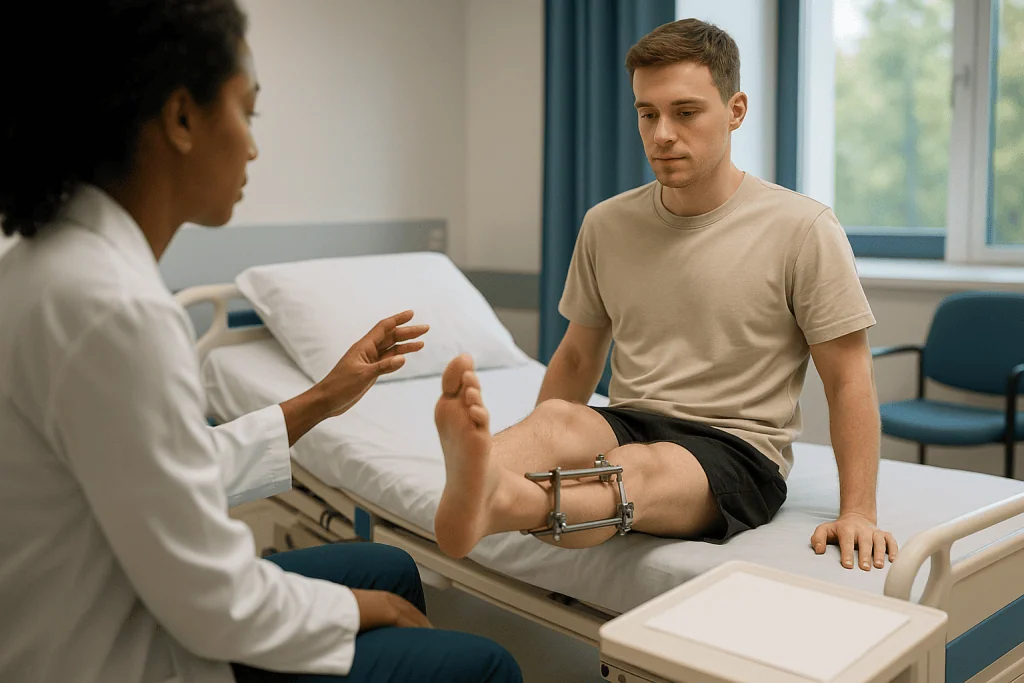
Think of it like a new pair of stiff leather boots. Worn for a few minutes each morning, they soften and shape to the foot. Left in the closet for a week and then worn for an hour, they blister. Muscle and tendon respond to the same logic of frequent, moderate loading rather than occasional heroics.
Daily work serves several jobs at once:
- Maintaining joint range so the knee can fully straighten and the ankle can pull up toward the shin.
- Keeping muscles active so they do not waste from disuse, which happens quickly in a limb that is painful and partly immobilized.
- Teaching safe weight bearing and gait with the device in place.
- Giving a trained eye a daily look at pin sites, swelling, skin and nerve function, so that problems are caught at the stage when they are easy to address.
In many programs, formal sessions with a therapist are frequent during the distraction phase, supplemented by a home program performed more than once a day. The exact schedule varies with the bone being lengthened, the device used and the patient’s age, and it is set by the surgical team rather than chosen by the patient. The NHS describes physiotherapy broadly as a partnership between therapist and patient, and nowhere is that partnership more literal than here.
What happens to muscles while the bone grows
A muscle has a preferred resting length. When a bone beneath it grows longer, the muscle is held in a stretched position, and over time its connective tissue shortens and stiffens in response. The medical term is contracture: a fixed shortening of muscle or tendon that limits how far a joint can move.
The muscles most at risk depend on which bone is lengthened. In tibial lengthening, the calf muscles are the chief concern. They cross the ankle and attach through the Achilles tendon to the heel, so as they tighten they pull the foot downward into a position called equinus, where the toes point and the heel cannot reach the floor. In femoral lengthening, the hamstrings behind the thigh and the rectus femoris at the front are the usual trouble, pulling the knee toward a bent position or limiting how far it can flex.
Guided stretching aims to keep these muscles at their new, longer working length rather than letting them settle short. Strengthening matters just as much. A lengthened muscle that is also weak behaves like a slack rope; it cannot stabilize the joint or produce a normal stride. Therapists therefore combine passive range-of-motion work with active exercise, often starting with isometric contractions, where the muscle tightens without the joint moving, and progressing to resisted movement as the bone and device allow.
Splints or braces worn at night are commonly used alongside exercise, holding the ankle at a right angle or the knee straight for the many hours when nobody is stretching. None of this is optional decoration. Severe contracture can force the surgical team to slow or pause lengthening, and in some cases a tendon-lengthening procedure is needed to restore motion.
Joints under tension: why the knee, hip and ankle need protecting
A joint is a meeting point of bones held together by ligaments and a fibrous capsule. When the muscles crossing it tighten unevenly, the joint can be pulled out of its normal alignment. Partial loss of alignment is called subluxation; complete loss is dislocation. Both are recognized complications of lengthening and both are easier to prevent than to treat.

Each joint has its own vulnerability. During femoral lengthening, the knee is squeezed between a tightening hamstring behind and a tightening quadriceps in front, and the hip can be stressed if the muscles around it are already imbalanced, as they may be in some congenital conditions. During tibial lengthening, the ankle bears the pull of the calf, and the small joints of the foot can be dragged out of position when the heel lifts. The joint above and the joint below a lengthened bone are therefore watched throughout.
Physical therapy protects joints in three practical ways. First, by keeping both sides of a joint flexible so the pulling forces stay balanced. Second, by maintaining the muscle strength that actively holds a joint centered. Third, by teaching positioning: how to sit, lie and stand so the knee is not left bent for hours and the foot is not left pointing. Some external frames are deliberately extended across a joint with hinges to hold it in a safe position while the bone lengthens; the therapist works within that design.
Loss of joint motion is one of the most consistently reported problems after lengthening, and the degree of loss tends to track with how much length is gained. That relationship is a strong argument for realistic goals as well as diligent therapy, a theme the risks section returns to.
Nerves on the stretch: tingling, numbness and what a therapist watches
Nerves are long cables of living tissue, and like any cable they have limited slack. A peripheral nerve running the length of the thigh or calf is gradually stretched along with everything else. Mild tightness or occasional tingling can accompany lengthening, but persistent numbness, burning pain or weakness in the foot are signals that a nerve is being pulled too fast or compressed within swollen tissue.
The common peroneal nerve deserves particular mention. It wraps around the outer side of the knee just below the joint, close to the skin, and supplies the muscles that lift the foot and toes. Irritation here can produce foot drop, a difficulty raising the front of the foot that makes the toes catch on the floor. In tibial lengthening it is one of the most carefully monitored structures.
A physical therapist is often the first clinician to notice early nerve trouble, because they handle the limb daily and ask about sensation and strength every session. Signs they track include changes in how the skin feels to light touch, the ability to pull the foot and toes up against gravity or resistance, and pain that radiates along the course of a nerve rather than sitting in a muscle.
Gentle nerve-gliding exercises, which move a nerve through its surrounding tissue without stretching it hard, are sometimes included. Reporting is as valuable as any exercise. When a therapist documents new numbness, the surgical team may slow the distraction rate, pause it for a few days, or in some cases release pressure on the nerve surgically. These are decisions for the treating team, made faster and better when the daily observations are detailed.
Who is usually offered limb lengthening, and who is usually asked to wait
Lengthening is most commonly performed for a measurable limb length discrepancy, which means one leg is shorter than the other by enough to affect walking, posture or the back. Causes include conditions present from birth, growth plate injuries in childhood, bone infection, trauma that shortened a bone, and some forms of short stature. Johns Hopkins Medicine notes that small discrepancies are frequently managed without surgery, with a shoe lift or by observation, and that surgery is considered when the difference is large enough to cause functional problems or is expected to become so as a child grows.
Candidacy depends on far more than the length of the bone. Surgeons typically weigh:
- Bone quality and the health of the surrounding soft tissue, skin and blood supply.
- Joint stability above and below the segment, since an unstable hip or knee can worsen under lengthening.
- Nutrition, smoking status and conditions such as diabetes that slow bone healing.
- The ability to attend and perform daily therapy for many months, including transport and support at home.
- Psychological readiness for a long, uncomfortable process with visible hardware.
People are often asked to wait, or counseled against the procedure, when any of these is unresolved: an active infection, uncontrolled chronic illness, a joint that must be stabilized first, or circumstances that make daily rehabilitation impractical. Children are sometimes asked to wait so that growth can be measured and the eventual discrepancy predicted more accurately.
Lengthening performed purely to increase height in people with no discrepancy is a separate and contested area. The biology and the therapy demands are identical, and the complication profile is not lower because the reason is cosmetic. Any decision rests with an orthopedic team after a full assessment.
What physical therapy during limb lengthening involves, phase by phase
The goals of physical therapy during limb lengthening shift as the bone moves from freshly cut to fully hardened. The table below summarizes what usually dominates each phase. Exact protocols differ by bone, device, age and surgeon, so treat this as a map rather than a prescription.
| Phase | What the bone is doing | Main therapy priorities | Typical frequency |
|---|---|---|---|
| Immediately after surgery and latency | Forming early callus at the cut | Pain and swelling control, gentle joint motion, safe transfers, learning to use crutches or a walker, pin-site care education | Daily in hospital, then as set by the team |
| Distraction | Lengthening by about 1 mm per day in small increments | Daily stretching of at-risk muscles, splinting, strengthening, protected weight bearing, monitoring joints and nerves | Often several supervised sessions per week plus a home program more than once daily |
| Consolidation | New bone hardening at the target length | Progressive weight bearing, restoring full range, building strength and endurance, normalizing gait | Supervised sessions continue; home program remains daily |
| After device removal | Bone fully load-bearing | Return to full activity, balance and sport-specific training, addressing any residual stiffness | Tapering supervision over weeks to months |
Two things stand out. The home program never disappears, because the soft tissue threat is continuous. And the weight-bearing column depends heavily on the device: many external frames allow weight through the limb from early on because the frame carries load, while some internal lengthening rods have strict limits until the new bone is strong enough to share it. Your surgeon sets those limits, and they are not negotiable from the therapy side.
Limb lengthening recovery time: what the days and weeks usually look like
Limb lengthening recovery time is long, and the honest version of the timeline is more useful than the hopeful one. The arithmetic begins with the distraction rate. At about one millimeter per day, as Johns Hopkins Medicine describes, gaining five centimeters takes roughly fifty days of active lengthening, before a single day of consolidation. Consolidation is generally slower than distraction, often taking at least as long again and frequently longer, so a person gaining a few centimeters should expect the device to be in place for several months in total. Children usually consolidate faster than adults because their bone forms more vigorously.
The first week is about surgical recovery: swelling, incision care, learning to move with the device and beginning gentle range-of-motion work. Distraction then starts, and most people describe a rhythm of discomfort that peaks around the adjustment and eases with movement. The middle of the distraction phase is often the hardest stretch psychologically. Length is accumulating, muscles feel tight, sleep is disrupted by the device, and the finish line is not yet in sight.
Consolidation brings relief from daily adjustments but not from therapy; this is when range and strength are rebuilt and walking becomes more natural. X-rays at intervals show the new bone brightening as it mineralizes. Device removal, for external frames, is a second procedure, and the bone remains vulnerable to fracture for a period afterward, so protected activity continues.
Full functional recovery, meaning strength and gait close to the person’s own baseline, commonly extends well beyond device removal. The exact duration cannot be promised in advance; it depends on length gained, age, complications and, more than almost anything else, how consistently the daily therapy was done.
Stretches after limb lengthening: which ones matter most and why they are prescribed, not chosen
The stretches after limb lengthening that matter most are the ones aimed at the muscles crossing the lengthened bone, because those are the tissues under daily tension. The list is predictable for each bone, though the technique, hold time and intensity are tailored by the therapist.
For tibial lengthening, the priority is the calf. Stretching the gastrocnemius with the knee straight and the deeper soleus with the knee bent keeps the ankle able to reach at least a right angle. For femoral lengthening, the hamstrings and the quadriceps share top billing, with the goal of a knee that fully straightens and bends well past ninety degrees. The hip flexors and the iliotibial band along the outer thigh often join the list, since both can tighten and alter hip and knee alignment.
Why not simply follow a video? Three reasons. First, the device changes what is safe: a stretch that is harmless for an intact leg may load a pin site or a healing cut in a harmful direction. Second, the dose has to track the distraction rate; a therapist adjusts intensity based on what the bone did that day. Third, pain during stretching in a lengthened limb carries diagnostic meaning. Muscle tightness feels different from nerve pain, and nerve pain during a stretch is information the surgical team needs the same day.
Good stretching in this setting is firm, sustained and repeated several times a day, never ballistic or forced to the point of sharp pain. Splints hold the gains between sessions. Many patients find that an evening stretching routine before a night splint goes on is the single habit that most protects their ankle or knee. That observation is clinical experience rather than a trial result, and it is still worth acting on.
Walking after leg lengthening: can you ever walk normally again?
Walking after leg lengthening is a question with a reassuring general answer and an honest set of conditions. Many people who complete lengthening for a true discrepancy walk with a more symmetrical gait than before, because the discrepancy itself was distorting their stride. Reaching that point, however, runs through months of altered walking, and the quality of the final gait depends on the joints and muscles the therapy protected.
During distraction, walking is usually permitted with support, and the amount of weight allowed through the limb is dictated by the device. The pattern is deliberately abnormal: a walker or crutches, a shoe lift on the other side to level the pelvis as the leg grows, and a stiff, careful stride. This is not failure; it is protection.
Gait retraining becomes a central task during consolidation and after device removal. Therapists work on three common faults. A knee that does not fully straighten at heel strike produces a crouched, tiring walk. An ankle that cannot reach a right angle forces the person onto their toes or makes them swing the leg outward. Weak hip muscles let the pelvis drop on the opposite side with each step. Each of these traces directly back to a contracture or weakness that daily therapy during lengthening was designed to prevent.
Residual differences are possible, especially after large lengthenings or after complications such as joint stiffness or nerve injury. Running and higher-impact sport are generally reintroduced later than walking, once the regenerated bone is fully consolidated and strength has returned. Whether and when that happens is a judgment for the surgical and therapy team, based on imaging and function rather than the calendar.
How risky is leg lengthening surgery? The main leg lengthening surgery risks explained
Leg lengthening surgery risks are real, varied and strongly influenced by two factors: how much length is attempted and how closely the rehabilitation is followed. Orthopedic sources consistently describe lengthening as a procedure with a high rate of minor complications and a meaningful rate of serious ones, which is why it is reserved for people whose discrepancy or deformity justifies it.
The common problems cluster into groups:
- Pin-site infection around the wires of an external frame, usually superficial and managed with cleaning and, when needed, antibiotics chosen by the team.
- Muscle contracture and joint stiffness, discussed above, which can delay or halt lengthening.
- Joint subluxation or dislocation when muscle forces across a joint become unbalanced.
- Nerve irritation or injury, including foot drop, from stretch or compression.
- Problems with the new bone: forming too slowly (delayed union or nonunion), forming too quickly and bridging the gap before the target is reached (premature consolidation), or fracturing after the device is removed.
- Bending or angulation of the new bone under uneven muscle pull.
- Blood clots in the deep veins of the leg, a risk after any lower-limb surgery with reduced mobility; the NHS and Mayo Clinic describe calf pain, swelling and warmth as typical signs.
- Compartment syndrome, a rare emergency in which pressure builds inside a muscle compartment and cuts off blood flow.
Physical therapy cannot touch every item on that list, but it directly lowers the odds of the soft-tissue group, which is the largest, and it provides the daily surveillance that catches nerve, clot and pressure problems early. The question people most want answered, whether very large gains such as six inches are possible, belongs here: the bigger the lengthening, the higher the complication rate, which is why large totals are usually staged across separate procedures and why surgeons push back on ambitious targets.
What people often get wrong about rehabilitation during lengthening
Several myths circulate in online forums and in the quieter corners of waiting rooms. Correcting them is part of the job of any honest explainer.
The first is that therapy is something that starts after the device comes off. The opposite is true. The window in which soft tissue is most at risk is the distraction phase, when the bone is actively growing beneath it. Waiting until the frame is removed to address stiffness means trying to recover motion that has already been lost for months.
The second is that more pain means more progress. In most rehabilitation, moderate discomfort during stretching is expected. In a lengthening limb, sharp or radiating pain is a potential nerve signal and should slow the session, not intensify it. Forcing a stretch past that point can injure the very structures therapy is meant to protect.
The third is that the device does the work and the patient waits. The device moves bone. It does nothing for the calf, the hamstring, the hip abductors or the peroneal nerve. The portion of the outcome that depends on the patient is the daily program, and surgeons routinely say that commitment to therapy is among the strongest predictors of a good result.
The fourth is that faster lengthening finishes sooner. Distraction rates are set to match the biology of bone and soft tissue. Going faster risks poor bone formation and nerve injury; the team adjusts the rate up or down for reasons, and a patient who adjusts their own device is taking a serious gamble.
The fifth is that a healthy, athletic person can skip steps. Fitness helps with strength and endurance, but muscle tightens under lengthening regardless of how fit the person was beforehand. If anything, large, well-developed muscles can be harder to keep flexible.
Questions to ask your care team before and during lengthening
A good consultation is a conversation, and the most useful questions are the ones that reveal how the team plans for the soft tissues, not just the bone. Consider bringing a list like this:
- Which bone will be lengthened, how many centimeters are planned, and why that amount rather than more or less?
- Which device do you recommend for me, and how does it change the weight I can put through the leg during each phase?
- How often will I see a physical therapist during distraction, and what will the home program look like on an ordinary day?
- Which muscles and joints are most at risk in my case, and will I need night splints or braces?
- What signs of nerve irritation should I report, and to whom, and how quickly will the team respond?
- How will pin sites be cared for, and who do I contact if one becomes red or painful?
- What is the plan if a contracture develops or if lengthening has to be paused?
- What is a realistic range for how long the device will stay in place, and what would extend it?
- What are the restrictions after the device is removed, and for how long is the new bone at risk of fracture?
- If this is a child, how will growth be monitored afterward, and could a second lengthening be needed later?
During the lengthening itself, the most valuable question is often the simplest: is this what you expected to see today? Asking it of the therapist at each session turns daily observation into a shared record and keeps small changes from slipping past.
Write the answers down. Over several months, memory blurs and the written plan becomes the reference point for everyone involved, including family members who help with the home program.
When to call your doctor
Daily therapy gives you a built-in check-in, but some signs should not wait for the next scheduled session. Contact the surgical team the same day if you notice any of the following:
- New or worsening numbness, tingling, burning pain or weakness in the foot or toes, particularly difficulty lifting the front of the foot.
- A sudden loss of joint motion, a foot that will no longer reach a right angle, or a knee that will no longer straighten.
- Redness, warmth, increasing pain, pus or spreading swelling around a pin site, or a pin that feels loose.
- A fever without an obvious cause.
- A sudden change in the alignment of the limb, a snap or a sharp new pain in the bone, which may signal a fracture or a problem with the device.
Seek emergency care immediately if you develop severe pain out of proportion to what you expect, pain made much worse by gently stretching the muscles of the segment, a feeling of intense tightness or pressure, or pale, cool skin with numbness. The NHS and MedlinePlus describe these as features of acute compartment syndrome, which needs urgent surgical treatment to protect muscle and nerve. Emergency care is also needed for signs of a blood clot: a swollen, painful, warm calf or thigh, and especially sudden breathlessness, chest pain or coughing blood, which the NHS and Mayo Clinic list as signs that a clot may have traveled to the lungs.
Finally, call if you simply cannot do the program: pain, equipment problems or circumstances at home are getting in the way. Missed days are a clinical issue, not a personal failing, and the team can usually adjust the plan. Every decision about slowing, pausing or changing treatment rests with the people who operated and who know your case.
Frequently asked questions
How does a limb lengthening surgery work?
A surgeon cuts the bone and attaches a device, either an external frame or an internal telescoping rod, that pulls the two ends apart by about a millimeter a day in small increments. New bone forms in the widening gap, a process called distraction osteogenesis. Once the target length is reached, the new bone hardens over months while physical therapy keeps the muscles, joints and nerves moving with it.
Can you gain 6 inches from limb lengthening?
Not usually in a single procedure. Each lengthening of one bone is typically limited to a few centimeters, because complication rates and joint stiffness rise steeply with larger gains. Totals approaching six inches generally require staged surgeries on more than one bone, spread over years, with a full rehabilitation cycle each time. Surgeons set the target based on anatomy and risk, not on the number requested.
Can you ever walk normally after leg lengthening surgery?
Many people do, especially when lengthening corrected a true discrepancy that was already distorting their stride. Normal walking depends on the knee straightening fully, the ankle reaching a right angle and the hip muscles being strong, all of which daily therapy during lengthening is designed to protect. Residual differences are possible after large gains or complications, and the timeline varies from person to person.
How risky is leg lengthening surgery?
It carries a high rate of minor problems such as pin-site infection and a meaningful rate of serious ones, including contractures, joint subluxation, nerve injury, bone that forms too slowly or too quickly, fracture after device removal, blood clots and, rarely, compartment syndrome. Risk rises with the amount of length attempted. Consistent daily therapy lowers the odds of the soft-tissue complications, which are the largest group.
What is the typical limb lengthening recovery time?
Lengthening about one millimeter a day means roughly ten days per centimeter of active distraction, followed by a consolidation phase that is usually at least as long and often longer. The device therefore commonly stays on for several months in total, and strength and gait keep improving well after removal. Children generally consolidate faster than adults. No specific duration can be promised in advance.
Which stretches after limb lengthening are most important?
The muscles crossing the lengthened bone. For the tibia that means the calf, stretched with the knee both straight and bent to keep the ankle at a right angle. For the femur it means the hamstrings, quadriceps and often the hip flexors and iliotibial band. Technique, intensity and timing must come from your therapist, because the device and the healing bone change what is safe.
Is walking after leg lengthening allowed while the device is on?
Usually yes, with support and within limits set by the surgeon. External frames often carry enough load to permit early weight bearing, while some internal lengthening rods have stricter limits until the new bone can share the load. A walker or crutches and a temporary shoe lift on the other side are common. Gait becomes more natural during consolidation and after device removal.
Why does my therapist keep asking about tingling in my foot?
Because nerves are stretched along with everything else, and persistent tingling, numbness, burning pain or weakness can be the earliest sign that a nerve is being pulled too fast or compressed. The common peroneal nerve near the outer knee is especially vulnerable in tibial lengthening and controls lifting the foot. Reporting these changes quickly lets the surgical team adjust the lengthening rate before injury becomes lasting.
Do children need the same daily therapy as adults during lengthening?
Yes. Children form new bone faster, but their muscles tighten under lengthening just as adults’ do, and contractures can affect a growing joint for years. Pediatric programs focus on making stretching and splinting part of a daily routine, involving parents or caregivers, and keeping the child active and comfortable. Any medicine for pain is managed entirely by the treating team.
What happens if I miss several days of therapy during distraction?
Soft tissue may tighten noticeably, because the bone kept lengthening while the muscles were not moved through their range. Tell your team rather than trying to catch up with forceful stretching, which can injure tissue or irritate a nerve. They may examine joint motion, adjust the lengthening rate or add splinting. Missed days are treated as a clinical issue to solve, not a failing.
References
- NHS: Physiotherapy
- NHS: Compartment syndrome
- MedlinePlus Medical Encyclopedia: Compartment syndrome
- NHS: Deep vein thrombosis (DVT)
This article is for general information only and is not a substitute for professional medical advice. Please consult a qualified doctor about your individual situation.

More from the Blog

Preparing for Knee Replacement: The Tests and Medication Checks Your Team Orders First
To prepare for knee replacement surgery, most teams first order a pre-assessment visit with blood tests (blood count, kidney function, blood sugar, clotting and…

Is the Ponseti Cast Slipping? Toe Checks, Swelling and Problems That Need a Same-Day Call
A Ponseti cast may be slipping if your baby's toes, which were visible at the cast edge, begin disappearing inside it, if the cast…

Who Is a Good Candidate for Ankle Replacement? Arthritis Type, Alignment and Activity
A good ankle replacement candidate is usually an adult with end-stage ankle arthritis (osteoarthritis, post-traumatic or inflammatory) whose pain persists despite non-surgical care, whose…

Knee Replacement Abroad: The Verification Checklist Before You Book
Knee replacement abroad can be done safely, but only after independent verification: confirm the surgeon's annual case volume and credentials, the implant's track record…

Clubfoot Cast Warning Signs: Swollen Toes, Color Changes and When to Call the Clinic
Most clubfoot casts cause no trouble, but a few signs need a same-day call to the orthopedic team: toes that swell, turn pale, blue…

Foot Surgery Preparation Checklist: Imaging, Anesthesia Assessment and Setting Up Your Home
Foot surgery preparation usually covers three areas: imaging such as X-rays or an MRI so the surgeon can plan the operation, a pre-anesthesia assessment…