

Why Does Mohs Surgery Take a Whole Day? Skin Cancer Removed Layer by Layer While You Wait
Key Takeaways
- Mohs surgery removes skin cancer in thin layers, and each layer is examined under a microscope on site before any more tissue is taken.
- Mayo Clinic describes the laboratory work for a single stage as taking up to about an hour, and the full visit as typically four hours or more.
- The number of stages depends on how far a tumor extends beneath the surface and is not a measure of how dangerous the cancer is.
- Mohs is most often used for basal cell and squamous cell carcinomas on the face, ears, hands and other sites where sparing skin matters.
- Basal cell carcinoma grows slowly and very rarely spreads, so a wait of some weeks before surgery is a common and clinically accepted pattern.
- If a dressing soaks through with bright red blood, apply firm continuous pressure for 20 minutes; bleeding that persists after that is a reason to call.
Mohs surgery takes most of a day because the skin cancer is removed in thin layers, and each layer is frozen, sliced, stained and examined under a microscope while the patient waits. Each round of removal plus laboratory work typically takes about an hour, so a tumor that needs two or three rounds, followed by wound repair, fills several hours. The waiting is the quality check.
The instruction sheet says to bring a book, a snack and a phone charger. For a procedure done under local anesthetic, on a spot no bigger than a pencil eraser, that sounds odd. Yet the person who arrives at eight in the morning with a small basal cell carcinoma on the side of the nose may still be sitting there after lunch, bandage in place, waiting for a nurse to say the next layer is ready.
Understanding why Mohs surgery takes all day changes how that waiting feels. The hours are not a sign that something has gone wrong, and they are not idle time for the team. Between each visit to the procedure room, a tiny piece of skin is being frozen, cut into slices thinner than a human hair, stained and read under a microscope, edge by edge.
This explainer walks through what happens in those hours, who the technique is usually chosen for, what the following weeks commonly look like, and which questions are worth asking before you sit down with your book.
Why Mohs surgery takes all day: the short version
Mohs micrographic surgery is a way of removing skin cancer in stages, checking the edges of each stage under a microscope before deciding whether to remove more. The surgeon takes a thin layer of tissue, and then stops. Nothing further is cut until the laboratory has confirmed whether cancer cells remain at any edge.
That pause is the whole point. In standard excision, a surgeon removes the visible tumor plus a safety margin in one go, closes the wound, and sends the tissue to a pathology laboratory. The result comes back days later. With Mohs, the laboratory work happens on site, during the same visit, and the patient waits in a chair rather than going home and hoping.
Each cycle of removal, processing and reading is called a stage. Mayo Clinic describes the full procedure as typically taking about four hours or more, and notes that the laboratory step for a single stage can take up to an hour. A tumor cleared after one stage makes for a shorter morning. A tumor with roots spreading further than they looked on the surface may need three or four stages, and then the wound still has to be repaired.
Three things stretch the day, then: the number of stages a particular tumor turns out to need, the time each stage spends in the lab, and the repair at the end. None of these can be known precisely in advance, which is why clinics ask people to clear the entire day rather than promise a finishing time.
Put simply, the hours buy certainty. You leave knowing the tissue examined that day showed clear edges, instead of waiting a week for a phone call.
What actually happens during Mohs surgery, step by step
The day usually begins much like any minor skin procedure. The site is cleaned, the surgeon marks the visible tumor, and a local anesthetic (medicine injected to numb one area while you stay awake) is given. Most people describe a sting that fades within a minute or two.
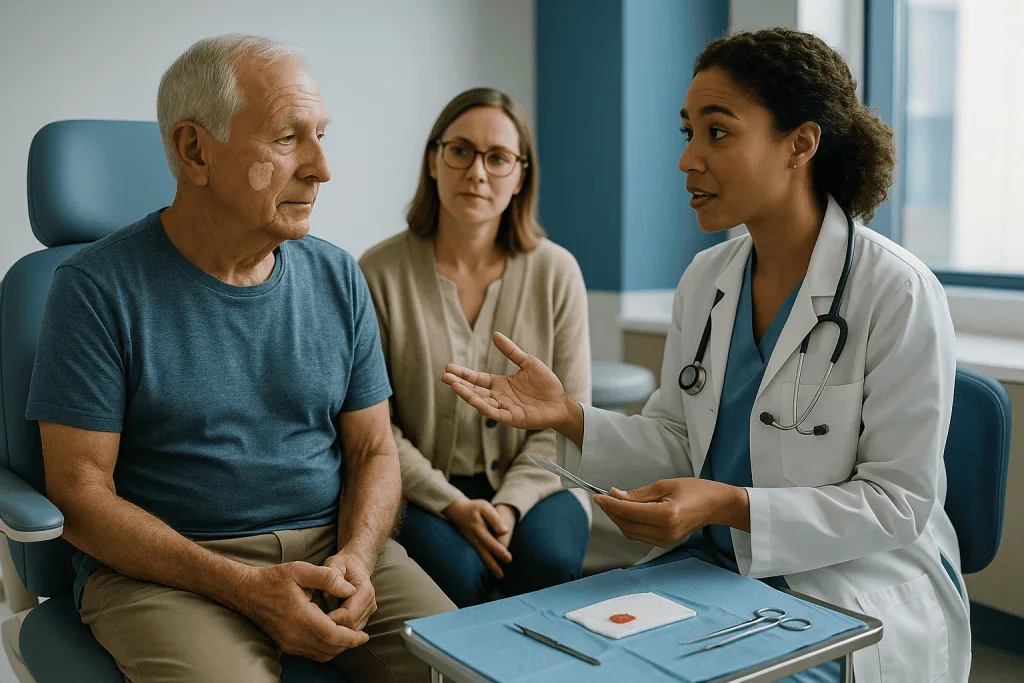
Next comes the first stage. The surgeon removes the visible cancer along with a very thin rim of surrounding skin, angled like a shallow saucer rather than a deep cone. A temporary dressing goes on, and you move to a waiting area.
Behind the scenes, the removed tissue is divided, inked with colored dyes to mark its orientation, and drawn on a map that matches your wound. A technician freezes it, slices it horizontally so the entire underside and outer rim sit on one slide, and stains it. The surgeon, who is trained to read these slides, examines every edge.
If any area of the slide shows cancer cells, the map tells the surgeon exactly where on your wound that area corresponds to. Only that spot is re-anesthetized if needed and another thin layer is removed. This is the second stage, and it is processed the same way.
The cycle repeats until a slide shows no cancer at the edges. At that point the surgeon turns to repair: closing the wound with stitches, using a flap of nearby skin, applying a graft, or letting it heal on its own, depending on size and location.
Cleveland Clinic and Mayo Clinic both describe this sequence in detail, and both make the same point: the technique removes as little healthy tissue as possible because every millimeter taken is checked before more is taken.
How long does Mohs surgery take, stage by stage?
Nobody can promise an exact finish time, but the structure of the day is predictable enough to sketch out. The figures below are typical ranges drawn from Mayo Clinic and Cleveland Clinic patient information, not guarantees for any individual.
| Part of the day | What is happening | Typical time (cited range) |
|---|---|---|
| Check-in and preparation | Consent, marking, numbing | Roughly 15–30 minutes |
| Tissue removal, each stage | Thin layer taken in the procedure room | Often 10–20 minutes |
| Laboratory processing and reading, each stage | Freezing, slicing, staining, microscope review | Up to about an hour per stage (Mayo Clinic) |
| Wound repair | Stitches, flap, graft or decision to heal naturally | Often 30–60 minutes, longer for complex sites |
| Whole visit | All stages plus repair | About four hours or more (Mayo Clinic) |
Two variables dominate. The first is the number of stages, which depends on how far the tumor extends beneath the surface. Clinics commonly see a mix of one-stage and multi-stage cases on the same morning, and the people sitting next to each other in the waiting area may have very different days.
The second variable is the repair. A small wound on the back may close with a few stitches. A wound on the nose, eyelid or lip can require a flap, where neighboring skin is loosened and moved across, and that takes careful planning.
Scheduling also plays a role. A surgeon may be caring for several patients at once, staggering their stages so the laboratory runs continuously. Your layer may be in a queue behind someone else’s for a short while.
When people search for how long Mohs surgery takes, the honest answer is a range measured in hours, with the number of stages the single biggest driver.
Why the lab work, not the cutting, fills the hours
Ask a Mohs technician what they are doing during your wait and the answer involves a cryostat, a machine that holds tissue at well below freezing and shaves it into slices a few micrometers thick. A micrometer is a thousandth of a millimeter. Getting a complete, unbroken slice of frozen skin at that thickness, flat on a glass slide, is skilled work that cannot be hurried.
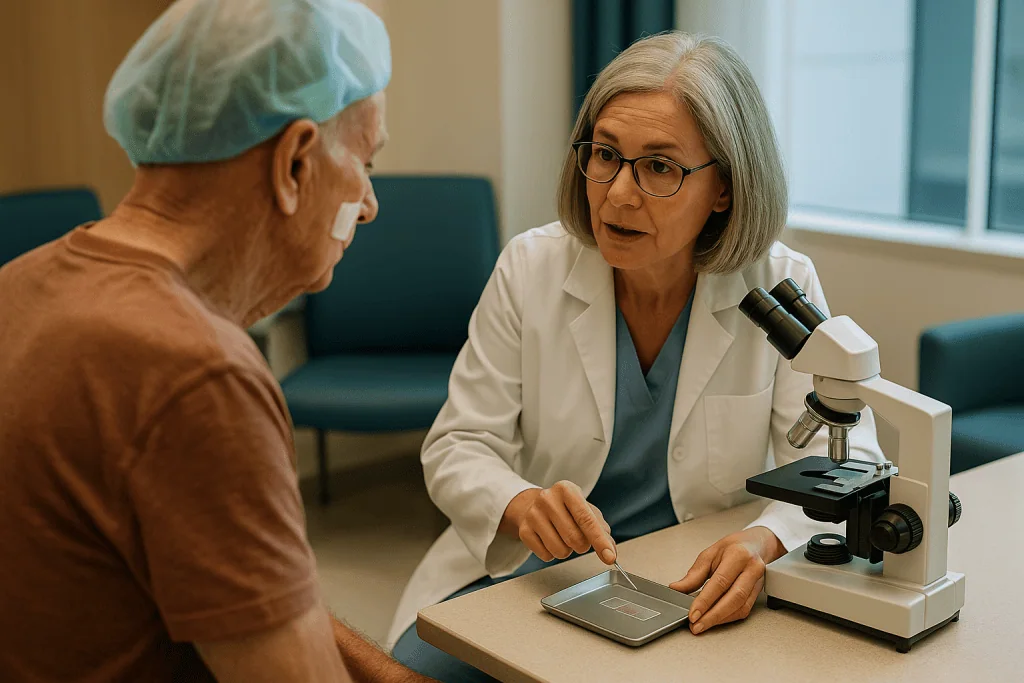
Standard pathology uses a different method. Tissue is placed in preservative, embedded in wax over many hours, and sliced vertically at intervals, like cutting a loaf of bread. Only the surfaces of those slices are seen, so cancer hiding between slices can be missed. The trade-off is that wax sections are easier to read and can be stored indefinitely.
Mohs sections are cut horizontally, so the entire bottom and the full circumference of the removed piece appear on a single slide. Mayo Clinic describes the technique as allowing the surgeon to examine the complete margin, which is the reason the frozen-section route is chosen despite being slower on the day.
Staining adds further minutes. Dyes must soak into the tissue so that cell nuclei show up dark and the surrounding structures take a contrasting color. The slide is then dried, covered and carried to the surgeon.
Reading is the final step. The surgeon scans the whole edge, matching any suspicious patch to the inked colors and the hand-drawn map. A tumor with an irregular, fingerlike pattern, common in some basal cell carcinomas, takes longer to assess than a compact nodule.
Multiply those steps by the number of stages, and the arithmetic of a long day becomes clear. The surgery itself is brief. The microscope is what you are waiting for.
What skin cancers require Mohs surgery, and who is usually asked to wait
Mohs is not the default for every skin cancer. It is chosen when the balance between removing all the cancer and saving healthy tissue is particularly delicate. MedlinePlus and Mayo Clinic describe it as most often used for basal cell carcinoma and squamous cell carcinoma, the two common non-melanoma skin cancers, and in selected cases for some melanomas and rarer tumors.
Features that commonly tip a team toward Mohs include:
- A tumor on the face, scalp, ears, hands, feet or genitals, where every millimeter of skin matters for function and appearance.
- A cancer that has come back after earlier treatment.
- Edges that are hard to define by eye, or a growth pattern that spreads under the surface.
- Large tumors, fast-growing tumors, or tumors in someone whose immune system is suppressed.
Who is asked to wait? Essentially everyone having the procedure, because the waiting is built into the method. The technique is almost always done under local anesthetic as an outpatient, so you remain awake, able to read, eat a light snack if permitted, and walk around between stages. People who cannot tolerate lying still, or who need general anesthesia for medical reasons, are sometimes offered a different route.
A separate kind of waiting happens before the day itself. Non-melanoma skin cancers typically grow slowly, and a team may schedule Mohs weeks after diagnosis so that the surgeon with the right training is available. That interval is a clinical judgment about the specific tumor, not a sign of neglect.
Deciding whether Mohs or another method suits a particular cancer sits with the dermatologist or surgical team who have seen the biopsy result. The features above explain the reasoning; they are not a checklist to apply to yourself.
How quickly should basal cell carcinoma be removed?
This is one of the most common questions after a biopsy result arrives, and the anxiety behind it is understandable. The word carcinoma lands hard. Yet basal cell carcinoma behaves very differently from the cancers most people picture.
The NHS describes basal cell carcinoma as the most common type of skin cancer and notes that it very rarely spreads to other parts of the body. It grows locally, often over months or years, and the main risk from delay is that it enlarges, destroys nearby tissue and becomes harder to remove neatly. That is a real reason to treat it, but it is a reason measured in weeks and months rather than hours.
Squamous cell carcinoma carries a somewhat higher chance of spreading, particularly in larger or deeper tumors, on the lip or ear, or in people with weakened immunity. Teams tend to schedule these with more urgency. Melanoma is treated differently again and is usually prioritized.
What does this mean for someone waiting for a Mohs appointment? A gap of a few weeks between diagnosis and surgery is a normal pattern for a typical basal cell carcinoma, and the evidence does not show that this interval worsens the outlook for the usual slow-growing tumor. A tumor that is visibly growing week by week, bleeding repeatedly or becoming painful is a different situation and worth reporting so the team can reassess timing.
Because the appropriate urgency depends on tumor type, size, location and your overall health, the people best placed to answer the question are the clinicians who read your biopsy. Ask them directly whether your wait is within the range they consider safe, and what changes would make them bring the date forward.
Can a regular dermatologist do Mohs surgery?
Any dermatologist can diagnose and treat skin cancer, and many perform standard excisions in their own offices. Mohs is different because one person acts as both surgeon and pathologist, reading the frozen slides and mapping the results back to the wound. That dual role is the reason additional training exists.
Mayo Clinic explains that Mohs surgeons are typically dermatologists who have completed further fellowship training in the technique, including laboratory interpretation. The procedure also depends on an on-site laboratory with a technician able to produce horizontal frozen sections to a high standard. A general dermatology office may not have that equipment or staff.
So the practical answer is that a dermatologist without Mohs training would usually refer you to a colleague who has it, in the same way a family physician refers to a specialist. The referral is not a judgment on anyone’s skill; it reflects the specific infrastructure the method requires.
What this means for your day is that you may meet several people. The Mohs surgeon performs the removal and reads slides. A nurse or medical assistant manages dressings, anesthetic top-ups and your comfort. A histotechnician runs the laboratory. In some cases, particularly for large facial wounds, a plastic or reconstructive surgeon handles the repair, occasionally on a following day.
Questions about who will be doing what are fair to ask in advance, and a team will usually be glad to explain. Avoid judging any clinic by promotional claims about speed or results; the relevant facts are whether the surgeon has Mohs training and whether the laboratory is on site. Everything else, including whether Mohs is the right method for your tumor at all, remains a decision for the treating team.
What the wound repair stage involves
When the final slide comes back clear, the shape of your day changes. The wound, which may be slightly larger than you expected because each stage widened it a little, now needs a plan. Mayo Clinic and Cleveland Clinic describe four common approaches, and the surgeon chooses based on size, depth, location and how the surrounding skin moves.
The simplest is direct closure. Edges are brought together and stitched, often in two layers, with dissolving stitches beneath and removable ones on the surface. Small wounds on the cheek, forehead or trunk are frequently handled this way.
A flap uses skin next to the wound. The surgeon loosens a neighboring section, slides or rotates it across the defect, and stitches it in place. The donor area is then closed too. Flaps keep color and texture matched, which matters on the nose and around the eyes, but they take longer and produce a longer line of stitches than the original wound.
A graft takes skin from elsewhere, often behind the ear or from the collarbone region, and lays it over the wound. Grafts suit areas where there is little loose skin nearby. They heal with a slightly different color at first.
Healing by secondary intention means leaving the wound open under a dressing to fill in on its own. On concave areas like the inner corner of the eye or the temple, this can produce a result comparable to stitches, with less surgery.
Occasionally the repair is scheduled for another day, particularly if a different specialist will do it or if swelling needs to settle. If that applies to you, the team will send you home with a dressing and clear instructions, and the wait continues at home rather than in the waiting room.
Mohs surgery aftercare: the first 48 hours
You will leave with a pressure dressing, a written sheet and, ideally, someone to drive you if the site is near an eye or the surgery was long. The first two days are about three things: keeping the dressing in place, keeping the wound still, and recognizing the difference between expected oozing and bleeding that needs attention.
Mayo Clinic’s patient guidance advises leaving the initial dressing undisturbed for the period the team specifies, commonly 24 to 48 hours, and keeping the area dry during that time. Many teams then show you how to clean the wound gently and apply a fresh dressing with a thin layer of petroleum-based ointment, which keeps the surface moist and helps healing.
Rest matters more than people expect. Bending, lifting, running and anything that raises blood pressure can start bleeding under the dressing. Sleeping with the head raised on an extra pillow reduces swelling for facial sites. Alcohol thins the blood and is usually best avoided for a couple of days.
Some bruising and swelling are normal, especially around the eyes, where gravity pulls fluid downward. Discomfort is typically mild and managed with whatever your clinician recommends; do not take extra over-the-counter medicines without asking, because some increase bleeding.
A small amount of pink staining on the dressing is expected. If bright red blood soaks through, the standard first response described by Mayo Clinic is firm, continuous pressure with a clean cloth for a full 20 minutes without lifting to check. Bleeding that continues after that is a reason to call the clinic or seek urgent care.
The aftercare sheet you are given overrides any general advice here, because the team knows exactly what repair they performed and how it needs to be protected.
Mohs surgery recovery timeline: the following weeks
Recovery is a slow fade rather than a switch. The sequence below reflects what Cleveland Clinic and Mayo Clinic describe as typical, with the usual caution that location, repair type and your general health shift every date.
In the first week, the wound is sealed but fragile. Swelling peaks around day two or three and then declines. Facial stitches are commonly removed after about a week, while those on the trunk or limbs, where skin is under more tension, often stay closer to two weeks. If you had dissolving stitches only, there may be nothing to remove.
During weeks two to four, the scar is typically pink, slightly raised and firm. This is normal collagen laying down and not a sign of a problem. Gentle activity returns, though contact sports and heavy exertion usually wait until the team confirms the repair is solid.
From month one onward, the scar begins remodeling. Cleveland Clinic notes that scars continue to improve for many months, and most surgeons advise judging the final appearance only after a year or so. Sun protection over the scar during this period reduces darkening.
Numbness, tingling or a tight feeling around the site can persist for months as small nerves regrow; most of it settles, though some permanent change in sensation is possible after deeper surgery.
The other half of the timeline is surveillance. Someone who has had one skin cancer has a higher chance of developing another, so regular full-skin checks, often every six to twelve months initially, are part of the plan. Your team sets that interval. Think of the recovery timeline as two tracks running together: the wound healing over weeks, and the longer habit of watching your skin.
Risks and alternatives in plain language
Every surgical procedure carries risks, and Mohs is no exception. MedlinePlus, Mayo Clinic and Cleveland Clinic list the common ones, which are shared with any skin surgery: bleeding, infection, pain, scarring and, less often, numbness or weakness if a nerve runs through the area. Facial sites add specific concerns, such as changes to eyelid position or nostril shape after repair. Rarely, cancer returns at the site despite clear margins on the day, which is one reason follow-up checks continue.
The specific advantage of Mohs is that it examines the full edge of the removed tissue, which the evidence links to lower recurrence for high-risk tumors compared with standard excision. The trade-offs are a longer day, the need for a trained surgeon and laboratory, and the possibility of a larger wound than the visible lesion suggested.
Alternatives exist, and for many tumors they are entirely reasonable. Standard excision, with the margin checked afterward in a conventional laboratory, is widely used for low-risk cancers on the trunk and limbs. Curettage and electrodesiccation, where the tumor is scraped and the base heat-treated, suits some small superficial lesions. Radiation therapy is an option for people who cannot have surgery or for certain locations. Prescription creams and photodynamic therapy, which uses a light-activated medicine, are used for some very superficial basal cell carcinomas and precancerous patches; they are not used for deeper or high-risk tumors.
None of these is universally better. Each has situations where it fits and situations where it does not, and the choice weighs tumor type, size, depth, site, previous treatment and your health. A good conversation with the treating team covers why Mohs is being suggested for your lesion and what the alternatives would look like in your case.
What people often get wrong about Mohs surgery
A long waiting day breeds myths, and a few come up repeatedly.
The first is that a long day means a bad cancer. It can simply mean a tumor with irregular roots, or a busy laboratory, or a complex repair. Many slow-growing basal cell carcinomas need several stages precisely because they spread sideways in thin strands that are invisible on the surface. Stage count is not a severity scale.
The second is that the surgeon is cutting continuously. In reality, the time in the chair is short. The hours pass while the tissue is in the cryostat and under the microscope, and you are not being operated on during them.
The third is that you will leave with a wound the size of the original spot. Each stage adds a narrow rim, and the repair may extend the line further to let the skin close smoothly. People are sometimes surprised by the length of the stitch line on the first dressing change. This is expected and planned.
The fourth is that Mohs is always the right choice for skin cancer. It is a tool for particular situations. For a small, well-defined tumor on the back, a standard excision may be equally appropriate with a shorter visit.
The fifth is that a clear slide means you are done with skin cancer forever. The evidence is that people who have had one non-melanoma skin cancer are more likely to develop others, often in different places, which is why surveillance continues.
Finally, some assume it must be done under general anesthesia because it takes so long. Nearly all Mohs is performed under local anesthetic, with top-ups as needed between stages, which is exactly what makes a day of waiting feasible.
How to prepare for a day of Mohs surgery
Preparation is mostly practical, and the clinic’s pre-procedure letter is the authority. A few themes are near universal.
Tell the team about every medicine and supplement you take, especially anything that affects clotting. Do not stop a prescribed blood thinner on your own; many teams prefer to continue it and manage bleeding on the day, and stopping some medicines carries its own risk. The decision is the prescriber’s, and it should be made before the appointment, not in the waiting room.
Eat a normal breakfast unless told otherwise, since local anesthetic does not require fasting, and low blood sugar makes a long morning harder. Bring a light snack and water. Caffeine is usually fine in moderation, though some teams suggest limiting it to reduce bleeding.
Dress in a loose shirt that buttons at the front so nothing has to be pulled over a facial dressing. Leave makeup, jewelry and fragrance off the area. Bring reading glasses if you use them; waiting rooms are well lit but a book is more comforting than a phone screen for several hours.
Arrange a companion or transport home if the surgery is near an eye, if you expect to feel tired, or if the team advises it. Clear the afternoon and ideally the next day of commitments, since repair timing is not predictable and you may be asked to rest.
Write down questions in advance, because the moments before anesthetic are not when clear thinking is easiest. If anxiety about procedures is a known issue for you, raise it beforehand; teams have approaches ranging from a calmer room to a brief relaxation technique, and knowing the plan reduces stress on the day.
Questions to ask your care team
A short list, carried in on paper, turns a daunting appointment into a conversation. These are questions that tend to produce useful answers rather than reassurance alone.
- Why is Mohs being recommended for my specific tumor, and what would the alternative be?
- Based on the biopsy, roughly how many stages do you expect, understanding it cannot be known for certain?
- Who will repair the wound, and is there any chance the repair will be on a different day?
- What should I do about my regular medicines, including blood thinners, before and after?
- How large might the final wound be compared with the visible spot?
- What kind of scar is realistic for this location, and what can I do to help it heal?
- When can I shower, exercise, drive and return to work?
- What level of pain is expected, and what would be unusual?
- Which signs mean I should call, and which number do I call outside office hours?
- How often will my skin be checked afterward, and for how long?
Ask for the answers in writing where possible, or take notes. If a term is unfamiliar, ask for a plain-language version; a good team will not mind. Bringing a companion to listen is useful, since two people remember more than one.
One question is worth asking yourself rather than the team: what matters most to you about this surgery? For some people it is minimizing the scar; for others it is finishing in one visit, or avoiding a second operation. Saying this out loud helps the team tailor the plan, and it is the single most useful thing a patient can add to the discussion.
When to call your doctor
Most recoveries are uneventful, and a day of Mohs is usually followed by a quiet, slightly uncomfortable week. Knowing the handful of signs that warrant a call lets you relax about everything else.
Contact the clinic the same day, or seek urgent care if the clinic is closed, for:
- Bleeding that soaks through the dressing and does not stop after 20 minutes of firm, uninterrupted pressure.
- Pain that is increasing rather than easing after the first day or two, or pain that is not controlled by what you were advised to use.
- Spreading redness around the wound, warmth, swelling that is getting worse, yellow or green discharge, or a bad smell, which can indicate infection.
- A fever or chills in the days after surgery.
- The wound edges coming apart, a flap or graft turning dark or very pale, or stitches pulling loose.
- New numbness, weakness or drooping on the face that was not present when you left, particularly around the eye or mouth.
- Any allergic reaction such as a rash spreading from the dressing, or difficulty breathing, which is an emergency.
In the longer term, report any new lump, crusting, bleeding or change at the scar site, or a new or changing spot anywhere on your skin, at your next check rather than waiting for a scheduled one. Recurrence after Mohs is uncommon, but it is not zero, and early review is simple.
Do not adjust any prescribed medicine, including blood thinners or antibiotics, on your own in response to a symptom. Call, describe what you see, and let the team decide. They would far rather hear from you about something minor than miss something that mattered.
Frequently asked questions
Why does Mohs surgery take all day?
Because each layer removed is frozen, sliced, stained and read under a microscope while you wait, and that laboratory step can take up to about an hour per stage. A tumor needing two or three stages, plus the wound repair at the end, fills most of a day. The surgery itself is brief; the microscope is what sets the pace.
How long does Mohs surgery take if only one stage is needed?
A single-stage case can be finished in two to three hours, including preparation, one round of removal, the laboratory reading and a straightforward repair. Mayo Clinic gives four hours or more as the typical overall range, and clinics still ask you to clear the whole day because the stage count is only known once the slides are read.
What skin cancers require Mohs surgery?
Mohs is most often used for basal cell and squamous cell carcinomas, particularly on the face, scalp, ears, hands, feet and genitals, for cancers that have returned after treatment, and for tumors with poorly defined edges. Selected melanomas and some rarer skin tumors are also treated this way. Whether it suits your specific lesion is a decision for the treating team.
How quickly should basal cell carcinoma be removed?
Basal cell carcinoma usually grows slowly and, according to the NHS, very rarely spreads elsewhere, so treatment is typically scheduled over weeks rather than days. The aim is to remove it before it enlarges and damages nearby tissue. A tumor that is visibly growing, bleeding or painful should be reported so the team can reconsider timing.
Can a regular dermatologist do Mohs surgery?
Usually a dermatologist refers you to a colleague with specific Mohs fellowship training, because the technique requires one person to act as both surgeon and pathologist, supported by an on-site frozen-section laboratory. A general dermatology office often lacks that setup. The referral reflects the method’s requirements rather than anyone’s ability.
How do you care for the wound after Mohs surgery?
Keep the initial pressure dressing in place and dry for the period your team specifies, commonly 24 to 48 hours, then clean gently and apply a fresh dressing with a thin layer of ointment as instructed. Avoid bending, lifting and strenuous activity for the first few days, sleep with the head raised for facial sites, and follow your written aftercare sheet over any general advice.
What does the Mohs surgery recovery timeline look like week by week?
Swelling peaks around day two or three and then eases. Facial stitches commonly come out after about a week and trunk or limb stitches closer to two. The scar is typically pink and firm for several weeks, then softens and fades over many months. Numbness around the site can persist for months as nerves regrow.
Is Mohs surgery painful?
The main discomfort is the sting of the local anesthetic, which fades within a minute or two. During the procedure the area is numb, and top-ups are given between stages if needed. Afterward, most people describe mild soreness for a few days. Pain that worsens rather than eases after the first couple of days is worth reporting.
Will I be awake during Mohs surgery?
Yes. Nearly all Mohs procedures are done under local anesthetic as an outpatient, which is what makes a day of waiting between stages practical. You can read, eat a light snack if permitted and walk around while slides are processed. General anesthesia is reserved for unusual situations and is decided by the team.
Does a clear result on the day mean the cancer will not come back?
It means the edges of the tissue examined that day showed no cancer, which is strongly reassuring. Recurrence at the site is uncommon but not impossible, and people who have had one non-melanoma skin cancer are more likely to develop new ones elsewhere. Regular skin checks, at the interval your team sets, remain part of the plan.
References
This article is for general information only and is not a substitute for professional medical advice. Please consult a qualified doctor about your individual situation.
Add us as a Preferred Source to see more of our trusted health content across Google Search, AI Overviews and Discover.

More from the Blog

Immunotherapy With an Autoimmune Condition or Transplant History: What the Team Weighs
People with an autoimmune condition or a transplant history can sometimes receive cancer immunotherapy, but it is a case-by-case decision. The treating team weighs…

How Long Immunotherapy Takes to Show a Response and Why Early Scans Can Mislead
Immunotherapy for cancer usually takes longer to show a measurable response than chemotherapy. Most people have their first scan roughly 8 to 12 weeks…
How Head Cancer Treatment Is Planned for Mouth, Throat, Sinus and Salivary Gland Tumors
Head and neck cancer treatment planning starts with a biopsy to confirm the cancer type, imaging and examination to assign a stage, and a…

Can Skin Cancer Be Fatal? Which Types Are Dangerous and How Early Detection Changes the Outlook
Yes, skin cancer can be fatal, but the risk depends heavily on the type and the stage at diagnosis. Melanoma causes most skin cancer…

Why a Sarcoma Biopsy Is Planned So Carefully and What the Pathology Review Adds
A sarcoma biopsy is planned carefully because the needle path can seed tumor cells, so the route is chosen to be removed with the…

What International Patients Ask Before Leukemia or Lymphoma Treatment Abroad
Before leukemia or lymphoma treatment abroad, patients usually want to know which exact subtype they have, how urgently treatment must start, how long the…