Quick answer
Astigmatism is a common refractive error caused by an irregularly curved cornea or lens, which makes vision blurred or distorted at all distances. At Acibadem in Turkey, astigmatism is evaluated with detailed eye examinations and managed with options such as glasses, contact lenses, or, when suitable, laser vision correction or lens-based procedures.
What is astigmatism?
Astigmatism is a common vision condition in which the front surface of the eye, or the lens inside the eye, has an uneven curve. In an eye with regular vision, the cornea (the clear front window of the eye) is shaped almost like a perfect dome, so light entering the eye focuses at a single sharp point on the retina (the light-sensing layer at the back of the eye). In an eye with astigmatism, the cornea or lens is shaped more like the side of a football than a basketball, so light focuses at more than one point. The result is vision that appears blurred or distorted at all distances, both near and far.
If you have wondered what is astigmatism and whether it is a disease, it may help to know that it is not an illness in the usual sense. It is a refractive error, meaning a problem with how the eye bends and focuses light, in the same broad category as nearsightedness (difficulty seeing distant objects) and farsightedness (difficulty seeing close objects). Many people have some degree of astigmatism, often mild enough that they never notice it. It affects people of all ages, including young children, and it frequently occurs together with nearsightedness or farsightedness.
Astigmatism can be present from birth, can develop during childhood or adulthood, and can change over time. In most people it is a stable, manageable condition rather than a threat to eye health. Less commonly, astigmatism is linked to an underlying eye condition such as keratoconus (a progressive thinning and bulging of the cornea), which is why an accurate eye examination matters.
Symptoms of astigmatism
Astigmatism symptoms vary widely depending on how strong the refractive error is. People with very mild astigmatism may have no symptoms at all, or only vague eye discomfort after long visual tasks. People with moderate or higher degrees usually notice more obvious changes in their vision.
Common astigmatism symptoms include:
- Blurred or distorted vision at both near and far distances
- Eyestrain or a feeling of tired, aching eyes, especially after reading or screen use
- Headaches, often after prolonged visual concentration
- Squinting to try to see more clearly
- Difficulty seeing at night, including glare, halos, or streaks around lights while driving
- Trouble distinguishing similar letters or shapes, sometimes noticed first in schoolchildren
How symptoms appear can differ by type and degree. In mild astigmatism, blurring may be subtle, and the main complaints are often eyestrain and headache rather than obviously poor vision. In stronger astigmatism, blurring and distortion are usually noticeable at all distances. Doctors also distinguish between regular astigmatism, where the curve of the cornea is uneven in a predictable, symmetric way and is usually well corrected with glasses, and irregular astigmatism, where the surface is uneven in an unpredictable pattern. Irregular astigmatism is less common, is often related to conditions such as keratoconus, corneal scarring, or previous eye injury or surgery, and may not be fully corrected with standard glasses.
Children with astigmatism deserve special attention because they may not realize their vision is abnormal. Signs can include sitting very close to screens, tilting the head, rubbing the eyes frequently, or struggling with schoolwork. Uncorrected significant astigmatism in early childhood can, in some cases, contribute to amblyopia (often called lazy eye), a condition in which the brain does not develop full vision in one or both eyes. Early detection helps prevent this.
Causes and risk factors
Astigmatism causes come down to the shape of the eye’s focusing surfaces. In most cases, the cornea has slightly different curves in different directions, so light is bent unevenly. Less often, the lens inside the eye has an irregular shape; this is sometimes called lenticular astigmatism. In many people, no single event explains why the eye developed this shape: it is simply how the eye grew.
Recognized causes and risk factors include:
- Genetics and family history. Astigmatism often runs in families. Many people are born with it or develop it during childhood as the eye grows.
- Other refractive errors. Astigmatism frequently occurs alongside nearsightedness or farsightedness.
- Keratoconus and related corneal conditions. Keratoconus causes the cornea to thin and bulge into a cone shape, producing progressive and often irregular astigmatism.
- Eye injury or scarring. Trauma or infection that scars the cornea can change its shape.
- Previous eye surgery. Some eye operations, including certain cataract or corneal procedures, can alter the corneal curve.
- Eyelid pressure. In some cases, long-standing pressure from eyelid conditions such as a large stye or eyelid growths may temporarily change corneal shape.
Contrary to a common belief, astigmatism is not caused by reading in dim light, sitting too close to a television, or squinting. These habits do not change the shape of the cornea, although they may reflect an existing vision problem.
Diagnosis
Astigmatism diagnosis is straightforward and painless. It is made during a comprehensive eye examination performed by an eye doctor, either an ophthalmologist (a medical doctor specializing in eye disease and surgery) or an optometrist (a clinician trained in vision testing and eye care). At Acibadem, this evaluation is carried out within the ophthalmology department.
Tests commonly used to confirm astigmatism include:
- Visual acuity test. You read letters on a chart at a set distance to measure how sharply you see.
- Refraction. The doctor uses a device called a phoropter, placing different lenses in front of your eyes while you look at a chart, to find the exact lens prescription that gives you the clearest vision. An automated instrument called an autorefractor may provide a starting measurement.
- Keratometry. An instrument measures the curvature of the central cornea, showing how uneven the curve is and in which direction.
- Corneal topography. This is a detailed computerized map of the entire corneal surface. It is especially useful for detecting irregular astigmatism and screening for keratoconus, and it is routinely performed before any laser vision correction.
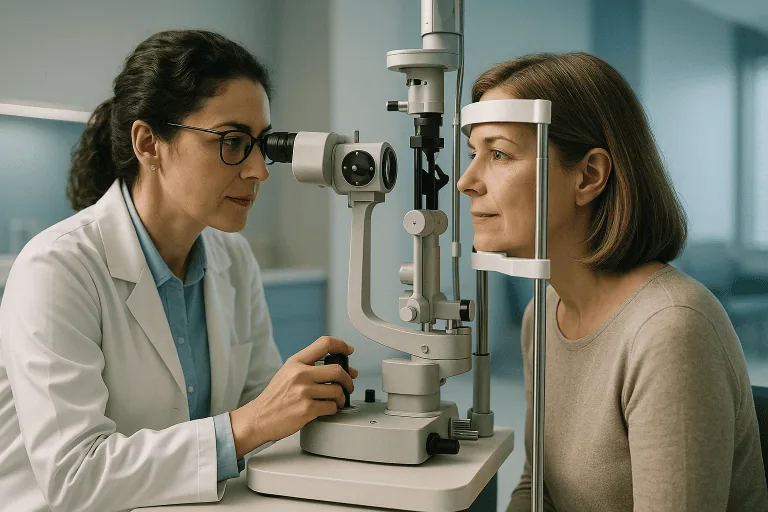
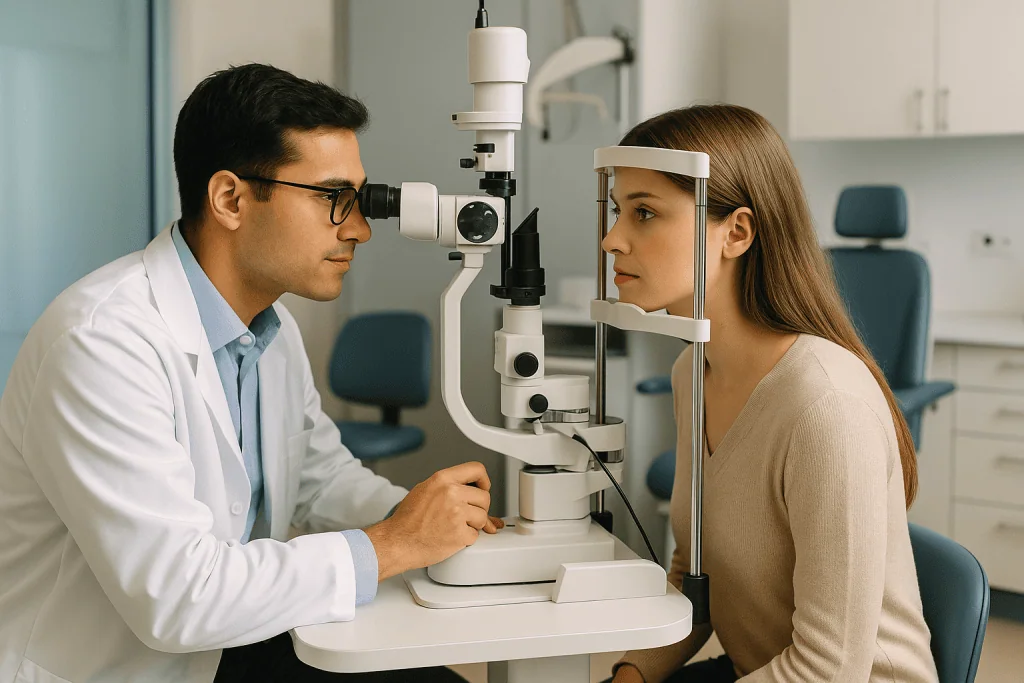
- Slit-lamp examination. The doctor examines the eye under a special microscope to check the health of the cornea, lens, and other structures, and to rule out scarring or other causes of irregular astigmatism.
Astigmatism is measured in units called diopters, and the prescription also records the axis, which is the direction of the uneven curve. Your doctor will use these measurements to decide whether correction is needed and which options are suitable. In children, drops that temporarily relax the eye’s focusing muscles may be used to obtain a more accurate measurement.
Treatment options for astigmatism
Astigmatism treatment aims to help light focus properly on the retina so that vision becomes clearer. The right choice depends on the degree of astigmatism, whether it is regular or irregular, your age, your lifestyle, and the overall health of your eyes. Detailed information about the condition and its management is also available on the astigmatism treatment page.
Observation for mild cases
Very mild astigmatism that causes no symptoms often needs no treatment at all. In these cases, your doctor may simply recommend routine eye examinations to monitor whether the astigmatism changes over time. There is no medication that corrects astigmatism, because the problem lies in the physical shape of the eye rather than in a disease process that drugs can treat.
Eyeglasses
Glasses are the simplest and most common treatment. Lenses with a cylindrical component compensate for the uneven curve of the cornea, bringing light to a single focus point. Glasses can correct astigmatism together with nearsightedness or farsightedness in the same lens. For most people, especially children, glasses are the first-line option.
Contact lenses
Soft contact lenses designed for astigmatism, called toric lenses, are shaped to counteract the uneven corneal curve and are designed to stay in the correct orientation on the eye. Rigid gas-permeable lenses can also correct astigmatism and are often preferred for irregular astigmatism, because they create a smooth new optical surface over the uneven cornea. Specialty lenses, such as scleral lenses (larger rigid lenses that vault over the cornea), may be used in more complex cases. Contact lens wear requires good hygiene to reduce the risk of eye infection, and your doctor can advise whether lenses are appropriate for you.
Orthokeratology
Orthokeratology involves wearing specially designed rigid lenses overnight to temporarily reshape the cornea, allowing clearer vision during the day without glasses or lenses. The effect is not permanent; the cornea gradually returns to its original shape if lens wear stops. This option suits only some patients and requires careful fitting and follow-up.
Refractive surgery
For suitable adults whose prescription has been stable, laser refractive surgery can permanently reshape the cornea to correct astigmatism. Common techniques include LASIK (in which a thin flap is created in the cornea and laser reshaping is performed underneath), PRK (in which the surface layer of the cornea is removed and the surface is reshaped directly), and other laser-based procedures. Each technique has its own advantages, recovery profile, and eligibility criteria. Not everyone is a candidate; corneal thickness, corneal shape, eye health, and conditions such as keratoconus all affect suitability. Like all surgery, refractive procedures carry risks, including dry eye, glare, under- or over-correction, and, rarely, more serious complications. A thorough preoperative evaluation, including corneal topography, is essential.
Options during cataract surgery and for irregular astigmatism
Adults who develop cataracts (clouding of the eye’s natural lens) and who also have astigmatism may be offered a toric intraocular lens, an artificial lens implant designed to correct astigmatism at the time of cataract surgery. For irregular astigmatism caused by keratoconus, treatments may include specialty contact lenses, a procedure called corneal cross-linking (which strengthens the cornea to slow progression), or, in advanced cases, corneal transplantation. Your ophthalmologist will explain which pathway fits your specific situation.
Living with astigmatism and outlook
For the large majority of people, the outlook with astigmatism is very good. It is a manageable condition, and most people achieve clear, comfortable vision with glasses, contact lenses, or, when appropriate, surgery. Astigmatism itself does not typically damage the eye or lead to blindness, although it can significantly affect daily comfort and safety, particularly night driving, if left uncorrected.
A few practical points can make living with astigmatism easier:
- Keep up with regular eye exams. Astigmatism can change gradually, so prescriptions may need updating. Children in particular should be checked at recommended intervals, since uncorrected astigmatism can affect visual development and school performance.
- Wear your correction as advised. Using an outdated or incorrect prescription can cause avoidable eyestrain and headaches.
- Manage screen time comfortably. Taking regular short breaks from screens and ensuring good lighting will not cure astigmatism, but it can reduce eyestrain.
- Follow contact lens hygiene carefully. Proper cleaning and replacement schedules lower the risk of infection.
- Report new changes. If your vision worsens quickly, becomes newly distorted, or your prescription changes frequently, tell your eye doctor, since this can occasionally signal a condition such as keratoconus that benefits from early treatment.
No treatment can be guaranteed to give perfect vision in every case, and outcomes vary from person to person. However, with modern correction options and routine follow-up, most people with astigmatism live without meaningful limitation from the condition.
Frequently asked questions
What is astigmatism in simple terms?
Astigmatism means the front of your eye is not perfectly round, so light does not focus at a single sharp point inside the eye. Instead of a dome-shaped surface, the cornea or lens is slightly oval, like the side of a football. This makes vision blurry or distorted at all distances. It is a very common focusing problem, not a disease, and it is usually easy to correct with glasses or contact lenses.
Can astigmatism heal or go away on its own?
In most cases, astigmatism does not go away on its own, because it reflects the physical shape of the eye. Mild astigmatism in young children sometimes lessens as the eye grows, but adults should not expect it to resolve without correction. Glasses and contact lenses manage the condition rather than cure it, while refractive surgery can permanently reshape the cornea in suitable candidates. Eye exercises and dietary changes have not been shown to correct astigmatism.
How serious is astigmatism?
For most people, astigmatism is not serious. It does not usually harm the eye, and it responds well to standard correction. That said, significant uncorrected astigmatism in young children can affect visual development, and rapidly changing or irregular astigmatism can occasionally be a sign of an underlying corneal condition such as keratoconus. This is why a proper eye examination, rather than self-assessment, is the right way to understand your individual situation.
What are the first symptoms of astigmatism?
Early astigmatism symptoms are often subtle. Many people first notice eyestrain, tired eyes, or headaches after reading or screen work, before they notice obvious blur. Others report squinting, difficulty seeing fine detail, or glare and halos around lights at night. In children, the first signs may be behavioral, such as sitting close to screens or struggling to read the board at school. Because these symptoms overlap with other eye conditions, an eye exam is needed to confirm the cause.
How is astigmatism diagnosed?
Astigmatism diagnosis is made during a routine comprehensive eye exam. The doctor measures how sharply you see, performs a refraction to find your exact prescription, and may measure the curve of your cornea with keratometry or corneal topography. These tests are painless and typically take under an hour. If irregular astigmatism or a corneal condition is suspected, more detailed corneal mapping may be performed.
What is the best treatment for astigmatism?
There is no single best astigmatism treatment for everyone. Glasses are the simplest and most common option and work well for most people. Toric contact lenses suit those who prefer not to wear glasses, and laser refractive surgery may be an option for adults with stable prescriptions and healthy corneas. Irregular astigmatism often requires specialty lenses or other corneal treatments. Your eye doctor will recommend the option that fits your prescription, eye health, age, and daily needs.
What is recovery like after astigmatism surgery?
Recovery depends on the procedure. After LASIK, many people notice clearer vision within a day or two, with mild dryness or light sensitivity for a period afterward. After PRK, the surface of the eye needs several days to heal, and vision typically sharpens more gradually over weeks. Your surgeon will prescribe eye drops and schedule follow-up visits to monitor healing. Individual recovery varies, and final visual results can take weeks to months to stabilize, so realistic expectations and adherence to aftercare instructions are important.
When to see a doctor
You should arrange a routine eye examination if you notice persistent blurred or distorted vision, frequent headaches or eyestrain, increasing difficulty with night driving, or if a child shows signs of vision problems such as squinting, head tilting, or trouble at school. Regular exams are also advisable even without symptoms, since mild astigmatism and other eye conditions can go unnoticed.
Seek prompt or urgent medical attention if you experience any of the following red-flag warning signs, which are not typical of simple astigmatism and may indicate a more serious eye problem:
- Sudden loss of vision or a rapid, marked worsening of vision in one or both eyes
- Sudden onset of flashes of light, new floaters, or a shadow or curtain across your field of vision, which can signal a retinal problem
- Severe eye pain, especially with redness, nausea, or halos around lights
- Eye injury or a chemical splash to the eye
- Double vision that appears suddenly
- Signs of eye infection in a contact lens wearer, such as pain, redness, discharge, or light sensitivity
- Rapidly changing prescriptions or increasing distortion, particularly in teenagers and young adults, which may warrant screening for keratoconus
If any of these urgent symptoms occur, do not wait for a routine appointment, prompt evaluation by an eye specialist can protect your sight. For ongoing, non-urgent concerns about astigmatism, an ophthalmologist or optometrist can assess your vision and discuss which correction options are right for you.
Medically reviewed by the Acıbadem International Medical Board September 2, 2026
See our medical review board →
Update history
- PublishedJune 14, 2026
- Medical review approvedSeptember 2, 2026
- Last content updateSeptember 2, 2026