Gastrointestinal Stromal Tumor
Gastrointestinal Stromal Tumor is a rare digestive tract cancer. Learn symptoms, causes, diagnosis, treatment options and when to see a doctor.
Quick answer
Gastrointestinal stromal tumor is a rare tumor that develops in the digestive tract, most often from specialized cells in the stomach or small intestine, and is treated according to its size, location, and spread. At Acibadem in Turkey, evaluation typically includes endoscopy, imaging, and biopsy when appropriate, with treatment that may involve surgery, targeted medicines, and follow-up care by a…
What is gastrointestinal stromal tumor?
A gastrointestinal stromal tumor, often shortened to GIST, is a rare type of tumor that starts in the wall of the digestive tract. The digestive tract is the long tube that carries food through your body, from the esophagus (the food pipe) down through the stomach and intestines. Unlike the more common cancers of the stomach or colon, which begin in the lining of these organs, a gastrointestinal stromal tumor develops from special cells found in the muscle layer of the digestive tract wall. These cells, called interstitial cells of Cajal, act like a pacemaker for the gut, helping to coordinate the muscle movements that push food along.
Most gastrointestinal stromal tumors form in the stomach or the small intestine, although they can appear anywhere along the digestive tract and, less often, in nearby tissue in the abdomen. Some GISTs grow slowly and behave in an almost harmless way, while others grow faster and can spread to other parts of the body, most often the liver or the lining of the abdomen. Because their behavior varies so widely, doctors describe GISTs on a spectrum of risk rather than simply calling every one of them “cancer.”
Gastrointestinal stromal tumors are uncommon. They are most often diagnosed in adults in middle age or later, typically after age 50, and they affect men and women at roughly similar rates. GISTs in children and young adults exist but are rare and often behave differently from the adult form.
Symptoms of gastrointestinal stromal tumor
Gastrointestinal stromal tumor symptoms depend a great deal on the size of the tumor and where it sits in the digestive tract. Small GISTs often cause no symptoms at all. In fact, many small tumors are discovered by chance during an endoscopy (an examination of the digestive tract with a thin, flexible camera), imaging scans, or surgery performed for another reason.
When a gastrointestinal stromal tumor does cause symptoms, they may include:
- Bleeding into the digestive tractthis may show up as vomiting blood, passing black or tarry stools, or passing visibly bloody stools
- Anemiaa low red blood cell count caused by slow, hidden bleeding, which can lead to tiredness, weakness, pale skin, or shortness of breath
- Abdominal pain or discomfort, which may be vague at first
- A feeling of fullness after eating only a small amount
- Nausea or vomiting
- A lump or swelling in the abdomen that you or your doctor can feel
- Difficulty swallowing, if the tumor is in or near the esophagus
- Unintended weight loss or loss of appetite
Symptoms often differ by stage. Early or small tumors frequently cause nothing more than mild, easy-to-ignore complaints, or no symptoms at all. Larger tumors are more likely to cause pain, a noticeable mass, or a sense of pressure. Bleeding is one of the most common reasons a GIST comes to medical attention, and it can range from slow, unnoticed blood loss that causes anemia over time to sudden, heavy bleeding that requires emergency care. Rarely, a large tumor can rupture (break open) or block the intestine, both of which cause sudden, severe abdominal pain and are medical emergencies.
It is important to remember that all of these symptoms can also be caused by far more common and less serious conditions, such as ulcers or gastritis (irritation of the stomach lining). Only medical testing can determine the actual cause.
Causes and risk factors
Gastrointestinal stromal tumor causes come down, in most cases, to genetic changes (mutations) that occur inside the tumor cells during a person’s lifetime. These are not usually inherited from parents and are not passed on to children. In the majority of GISTs, the mutation affects a gene called KIT, and in a smaller group it affects a related gene called PDGFRA. Both genes carry the instructions for proteins that act like switches telling cells when to grow. When the gene is mutated, the switch becomes stuck in the “on” position, and the cells grow and divide when they should not. A smaller number of GISTs have changes in other genes, such as those involved in a cellular energy system called SDH; these tumors are more common in younger patients.
Known risk factors for gastrointestinal stromal tumor include:
- Agemost GISTs are diagnosed in people over 50
- Rare inherited conditionsa very small number of families carry inherited KIT or PDGFRA mutations, and conditions such as neurofibromatosis type 1 (a genetic disorder that causes tumors to grow along nerves) and certain SDH-related syndromes increase the risk
Unlike many other cancers, gastrointestinal stromal tumor has no clearly established links to smoking, diet, alcohol, infections, or other lifestyle and environmental factors. In most cases, there is nothing a person did or failed to do that caused the tumor, and there is no proven way to prevent it.
Diagnosis
Gastrointestinal stromal tumor diagnosis usually involves a combination of imaging, endoscopy, and laboratory analysis of tissue. Because GISTs grow within the wall of the digestive tract rather than on its inner surface, they can be harder to spot and sample than more common digestive cancers.
Tests your doctor may use include:
- Endoscopya thin, flexible tube with a camera is passed through the mouth to look at the esophagus, stomach, and the first part of the small intestine. A GIST often appears as a smooth bulge under the normal lining.
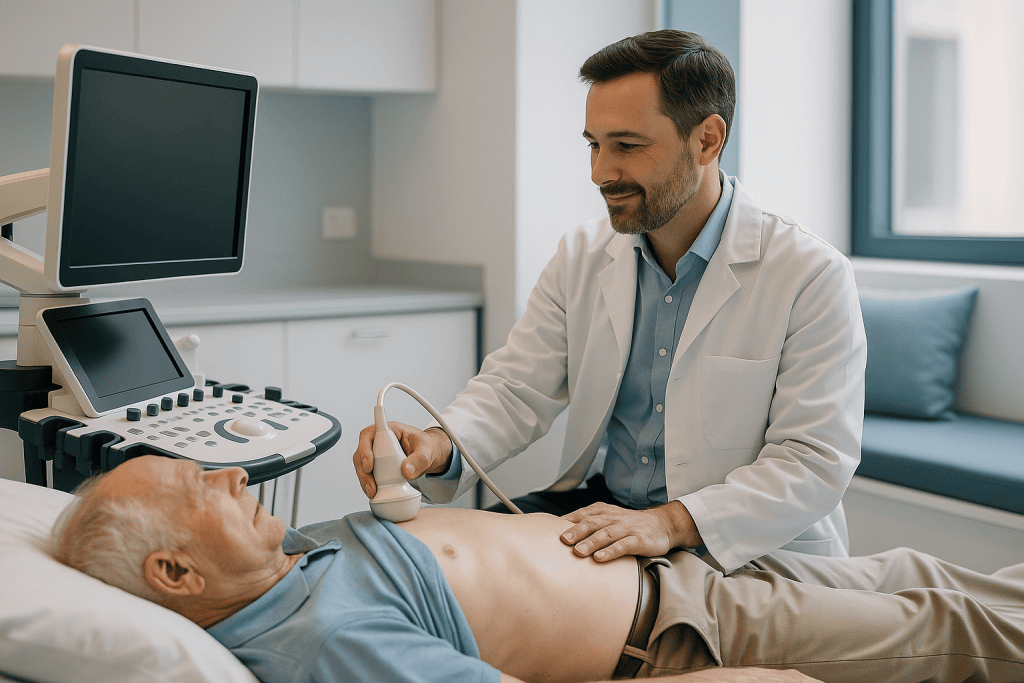
- Endoscopic ultrasound (EUS)an endoscope fitted with a small ultrasound probe that produces detailed pictures of the layers of the digestive tract wall. This is especially useful because GISTs arise within the wall itself. It also allows the doctor to guide a fine needle into the tumor to collect cells or tissue (a biopsy).
- CT scan (computed tomography)a detailed X-ray-based scan of the abdomen and pelvis, used to measure the tumor, see how it relates to nearby organs, and check whether it has spread, particularly to the liver.
- MRI (magnetic resonance imaging)a scan using magnetic fields, sometimes used for tumors in certain locations such as the rectum, or to look more closely at the liver.
- PET scan (positron emission tomography)a scan that highlights metabolically active tissue; in selected cases it helps assess spread or measure how well treatment is working.
- Biopsy and pathologythe definitive step. A pathologist (a doctor who examines tissue under a microscope) studies the cells and performs special stains. Most GISTs test positive for a protein marker called CD117 (also known as KIT), which helps confirm the diagnosis.
- Mutation testinglaboratory analysis of the tumor’s DNA to identify which gene is mutated (KIT, PDGFRA, or another). This matters because the specific mutation can influence which medications are likely to work.
Once a GIST is confirmed, doctors estimate its risk of coming back or spreading. This assessment is usually based on three factors: the size of the tumor, where it is located, and how quickly its cells are dividing, measured by something called the mitotic rate (the number of dividing cells seen under the microscope). Whether the tumor has ruptured also affects risk. This risk assessment guides decisions about treatment after surgery.
Treatment options
Gastrointestinal stromal tumor treatment is tailored to the size, location, and risk level of the tumor, whether it has spread, and the patient’s overall health. Care is typically coordinated by a team that includes surgeons, medical oncologists (doctors who treat cancer with medication), gastroenterologists, pathologists, and radiologists. In many hospitals, including within the Acibadem group, this coordination is led through a Medical Oncology Department working alongside surgical teams.
Active surveillance (watchful waiting)
For some very small GISTs, particularly tiny tumors in the stomach found by chance and showing no worrisome features, doctors may recommend monitoring with periodic endoscopy or imaging rather than immediate treatment. This approach is considered case by case, and any growth or change usually prompts a move to active treatment.
Surgery
Surgery is the main treatment for a localized gastrointestinal stromal tumor, meaning one that has not spread. The goal is to remove the tumor completely with a rim of healthy tissue while avoiding rupture, because a burst tumor can spread cells inside the abdomen. Unlike surgery for many other digestive cancers, removal of nearby lymph nodes is usually not needed, because GISTs rarely spread through the lymph system. Depending on the tumor’s size and position, surgery may be done through small keyhole incisions (laparoscopy) or through open surgery. For some tumors, surgeons can remove just a portion of the stomach or intestine rather than the whole organ.
Targeted drug therapy
GISTs generally do not respond well to conventional chemotherapy or radiation. Instead, the standard medication approach is targeted therapydrugs designed to block the overactive KIT or PDGFRA proteins that drive the tumor’s growth. These medications are called tyrosine kinase inhibitors, and they are taken as pills. They may be used in several situations:
- After surgery (adjuvant therapy)for tumors judged to have a higher risk of returning, a period of targeted therapy after surgery can lower the chance of recurrence. The duration is decided by the oncology team based on risk assessment.
- Before surgery (neoadjuvant therapy)for large tumors or those in difficult locations, medication may be given first to shrink the tumor and make surgery safer or less extensive.
- For advanced or spread (metastatic) diseasetargeted therapy is the main treatment when the tumor has spread or cannot be removed. Many patients respond for extended periods. If a tumor stops responding to the first drug, other targeted drugs may be tried in sequence.
The results of mutation testing help guide drug choice, because certain mutations respond better to certain medications, and a few respond poorly to the standard first-line drug. Side effects vary but can include fluid retention, tiredness, nausea, muscle cramps, skin changes, and diarrhea; most can be managed with dose adjustments and supportive care.
Other procedures
In selected situations, for example, a limited number of tumors that have spread to the liver, doctors may consider additional local procedures alongside medication, or surgery to remove remaining disease that has responded well to drugs. These decisions are individualized and made by the multidisciplinary team.
Living with gastrointestinal stromal tumor / outlook
The outlook for people with a gastrointestinal stromal tumor varies widely and depends mainly on the tumor’s size, location, mitotic rate, whether it was removed completely, and whether it had spread at diagnosis. Many small, low-risk GISTs are effectively dealt with by surgery alone, and many people go on to live normal lives afterward. Higher-risk tumors carry a greater chance of returning, which is why targeted therapy after surgery and long-term follow-up are often recommended.
The introduction of targeted drugs has substantially improved outcomes for advanced GIST compared with the era before these medications existed. Even when a GIST cannot be cured, it can often be controlled for a long time as a chronic condition, with treatment adjusted over the years. No doctor can promise a specific outcome for an individual patient, and honest conversations with your care team about your personal risk profile are the best source of realistic expectations.
Living with a GIST or its aftermath usually involves:
- Regular follow-upscheduled CT scans or other imaging for several years after treatment, since recurrences are most often detected on scans before they cause symptoms
- Taking medication consistentlyfor those on targeted therapy, taking the pills as prescribed matters greatly, and side effects should be reported rather than endured silently or managed by stopping the drug on your own
- Adjusting after surgerydepending on how much of the stomach or intestine was removed, some people need to eat smaller, more frequent meals or take supplements; a dietitian can help
- Emotional supportliving with a rare tumor can feel isolating, and counseling or patient support communities for GIST can be genuinely helpful
Frequently asked questions
What is a gastrointestinal stromal tumor in simple terms?
It is a rare tumor that grows in the muscle layer of the wall of the digestive tract, most often in the stomach or small intestine. It starts from pacemaker-like cells that help the gut move food along, and it behaves differently from common stomach or colon cancers. Some GISTs grow slowly and cause little trouble, while others grow faster and can spread, which is why each one is assessed individually.
Is a gastrointestinal stromal tumor cancer?
GISTs sit on a spectrum. All of them have some potential to behave in a cancerous way, but the actual risk ranges from very low to high depending on the tumor’s size, location, and how quickly its cells are dividing. Doctors therefore talk about low-risk and high-risk GISTs rather than simply labeling every one as benign or malignant. Your pathology report and your doctor’s risk assessment will tell you where your tumor falls.
Can a gastrointestinal stromal tumor be cured?
In many cases, yes, particularly when the tumor is localized and can be removed completely with surgery. Low-risk tumors that are fully removed often never come back. Higher-risk tumors have a greater chance of recurring, which is why targeted medication after surgery is often recommended. When a GIST has already spread, a complete cure is less likely, but modern targeted drugs can frequently control the disease for extended periods. No outcome can be guaranteed for any individual.
How serious is a gastrointestinal stromal tumor?
Seriousness varies enormously. A tiny, slow-growing GIST found by chance may need nothing more than monitoring, while a large or fast-growing tumor, or one that has spread, requires active treatment and long-term follow-up. Complications such as heavy bleeding, rupture, or intestinal blockage can be dangerous and need urgent care. The risk assessment your medical team performs after diagnosis gives the most accurate picture of how serious your particular tumor is.
What are the first symptoms of a gastrointestinal stromal tumor?
Often there are none, many GISTs are found incidentally during tests for something else. When early symptoms do occur, the most common are signs of bleeding into the digestive tract, such as black stools, or the tiredness and weakness of anemia from slow blood loss. Vague abdominal discomfort, feeling full quickly, and nausea are also possible. Because these complaints overlap with many everyday conditions, testing is the only way to know the cause.
What is recovery like after surgery for a GIST?
Recovery depends on the type of operation. After keyhole (laparoscopic) removal of a smaller tumor, many people leave the hospital within days and return to normal activities within a few weeks. Larger open operations, or those removing part of the stomach or intestine, take longer to recover from and may require dietary adjustments, such as eating smaller, more frequent meals. Your surgical team will give you a personalized recovery plan and follow-up schedule.
Do I have to take medication for life after a GIST diagnosis?
Not necessarily. After complete removal of a low-risk tumor, medication may not be needed at all. For higher-risk tumors, targeted therapy is typically given for a defined period after surgery, decided by your oncologist. For advanced or metastatic GIST, treatment is usually ongoing for as long as it keeps the disease under control, with the drug or dose adjusted over time. Decisions about stopping or changing medication should always be made together with your care team.
When to see a doctor
Make an appointment with a doctor if you notice persistent abdominal pain, ongoing nausea or feeling full quickly, unexplained tiredness or weakness, unintended weight loss, or a lump in your abdomen. These symptoms have many possible causes, most of them unrelated to tumors, but they deserve proper evaluation rather than watchful worry at home.
Seek urgent or emergency medical care if you experience any of the following red-flag warning signs:
- Vomiting blood, or vomit that looks like coffee grounds
- Black, tarry stools or visible blood in the stool
- Sudden, severe abdominal pain, especially with a rigid or very tender abdomen
- Dizziness, fainting, rapid heartbeat, or cold and clammy skin, which can signal serious internal bleeding
- Inability to pass stool or gas together with vomiting and abdominal swelling, which may indicate a blocked intestine
If you have already been diagnosed with a gastrointestinal stromal tumor, contact your care team promptly about any new or worsening symptoms, significant medication side effects, or signs of bleeding. Early reporting often allows problems to be managed before they become serious.
Medically reviewed by the Acıbadem International Medical Board September 3, 2026
See our medical review board →
Update history
- PublishedJune 8, 2026
- Medical review approvedSeptember 3, 2026
- Last content updateSeptember 2, 2026